
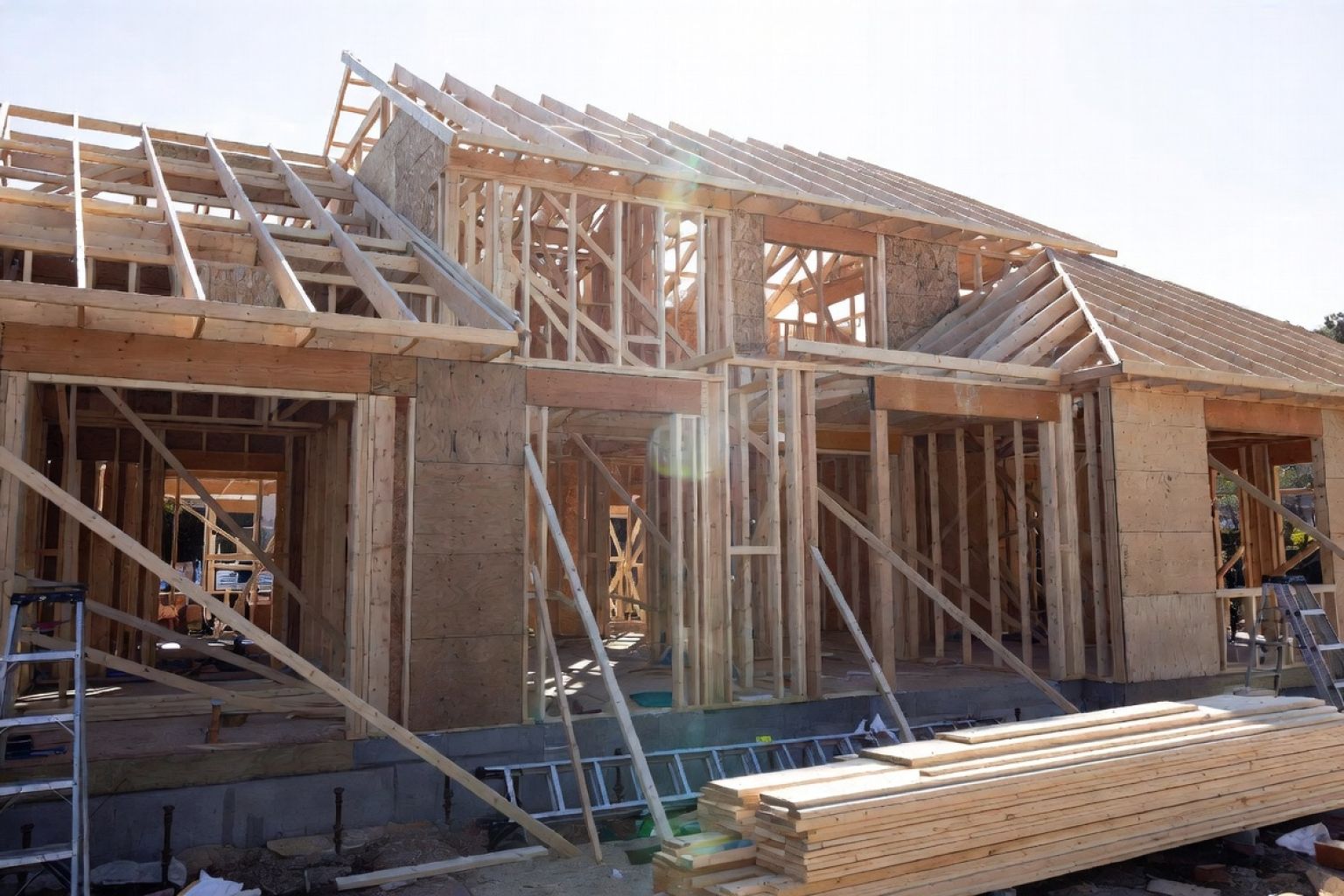
House framing decides whether the build starts clean or starts crooked.
Everything after it depends on the frame. Floors want level. Walls want plumb. Windows and doors want square. Roof loads need a straight path down. Finishes expose the mistakes later.
Get the frame right and the job moves better. Get it wrong and the costs keep showing up.
What House Framing Includes
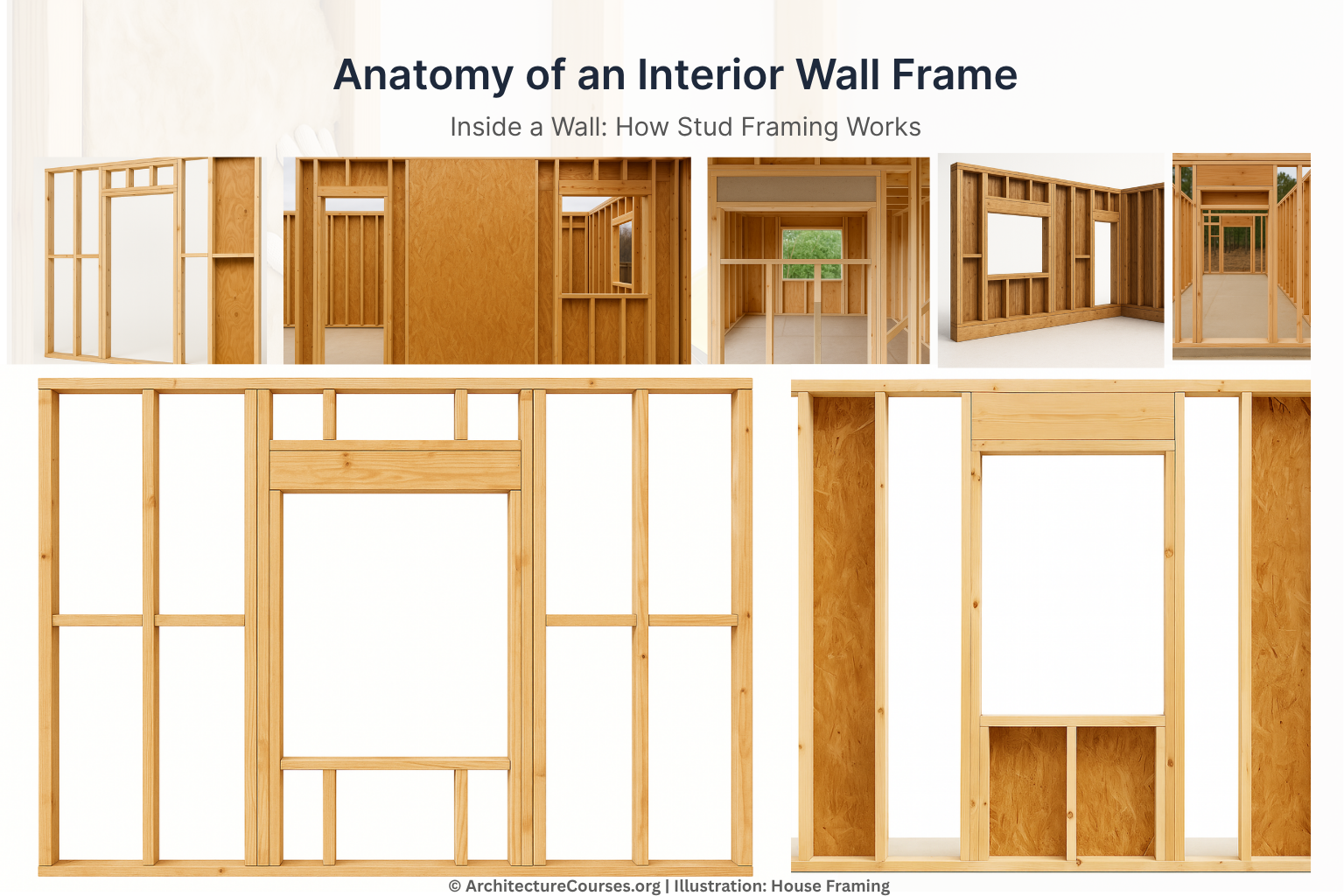
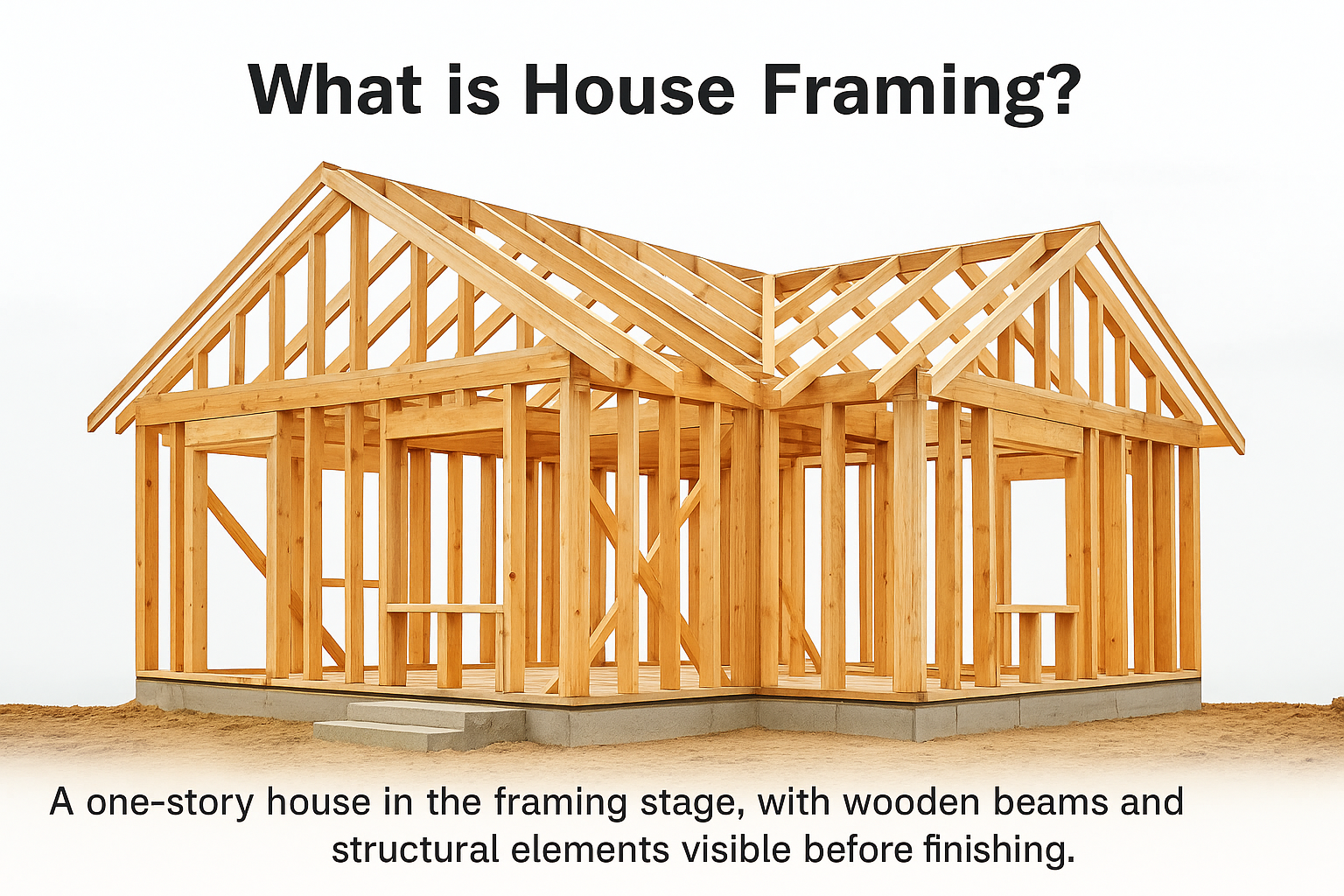
House framing is the structural framework of the home. It is not just walls. It includes the floor system, wall system, roof system, key openings, load transfer, bracing, and the connections that tie everything back to the foundation.
In practice, framing a house means doing five things well:
- laying out the structure so walls, openings, spans, and bearing points land where they should
- building the floor system so it stays level, stiff, and properly supported
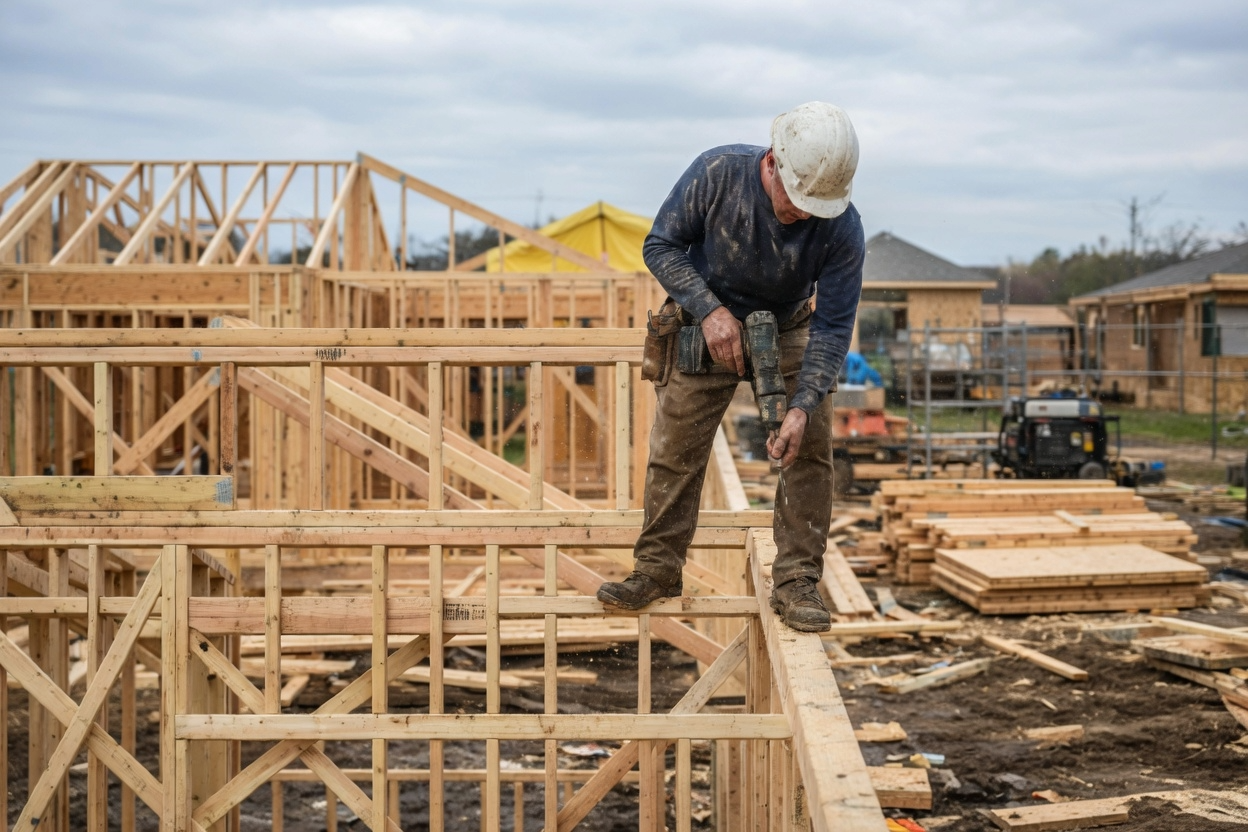
- framing walls that are straight, plumb, braced, and ready to carry loads
- framing rough openings that carry loads without sagging or drifting later
- building a roof structure that can take dead load, live load, wind, and weather without pushing the walls apart
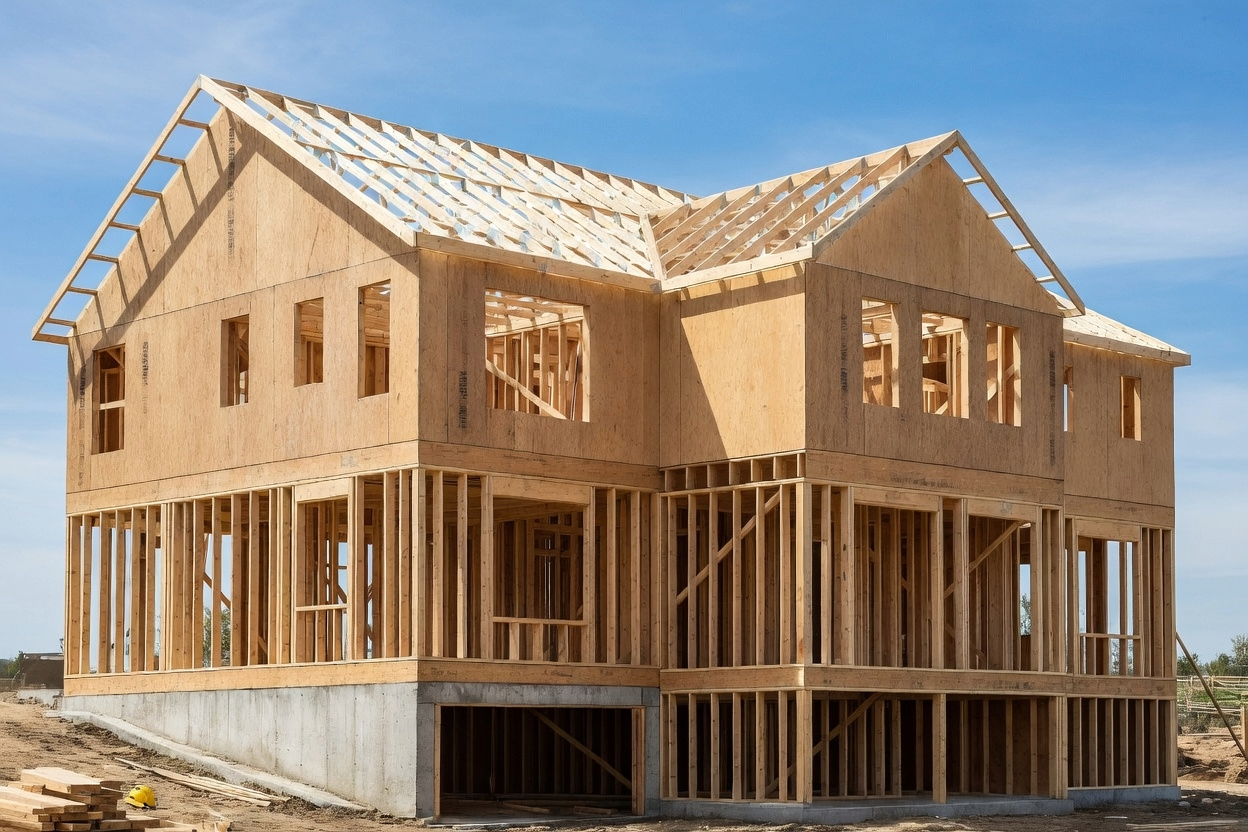
The broader system comparison sits in Construction Framing Types.
Framing Methods at a Glance
Most houses are not framed the same way. The method affects speed, labor, insulation strategy, roof options, and cost pressure. Some systems are forgiving on site. Some are not.
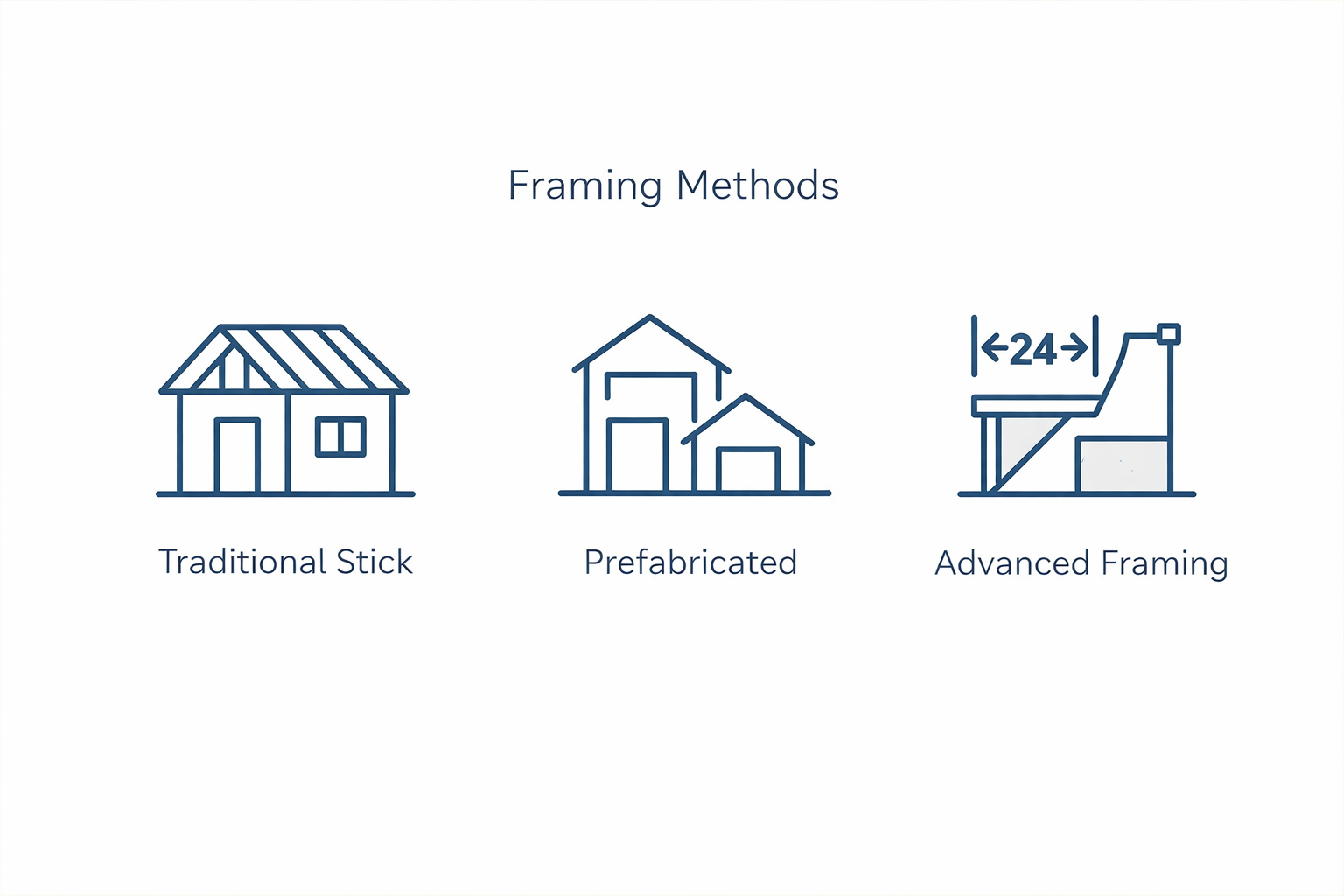
| Method | Where It Fits Best | What It Does Well | What Can Backfire |
|---|---|---|---|
| Platform framing | Most houses, additions, and standard residential builds | Simple sequencing, familiar labor, strong code fit | Bad layout carries floor to floor if the first platform is off |
| Prefabricated panels or trusses | Jobs where speed matters and the design is already settled | Fast erection, cleaner factory tolerances, less site cutting | Late design changes get painful fast |
| Advanced framing | Builds where energy performance matters and the crew understands the system | Less lumber, less thermal bridging, better insulation depth | Sloppy execution turns “efficient” into awkward |
| Timber or post-and-beam systems | Custom work, open spans, exposed structure | Big spaces, strong visual character, fewer interior bearing walls | More engineering, more planning, more money |
| Light-gauge steel or hybrid systems | Fire, pests, long spans, or special performance needs | Dimensional stability, durability, selective structural strength | Thermal bridging and specialized labor can erase the upside |
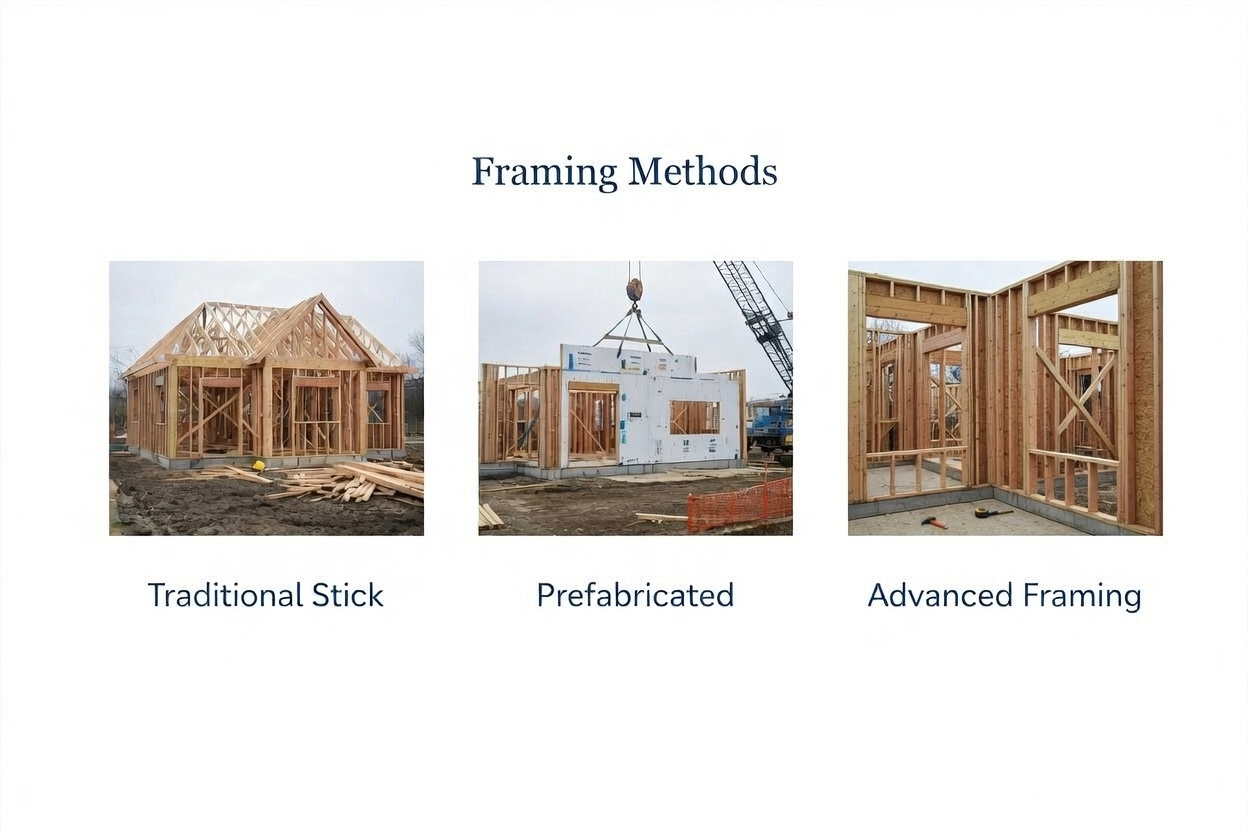
For most houses, platform wood framing is still the baseline because it works, crews know it, and the sequence is manageable. That does not make it the answer for every build. A clean timber system, a hybrid beam-and-wall approach, or a prefabricated shell can make more sense when the design pushes wide spans, steep roof forms, a short schedule, or a more exposed structural expression.
House shape changes that framing logic too. Single-Story vs Two-Story Framing and Two-Story House Framing cover that side of it.
Where the Frame Earns Its Keep: Floors, Walls, and Roof
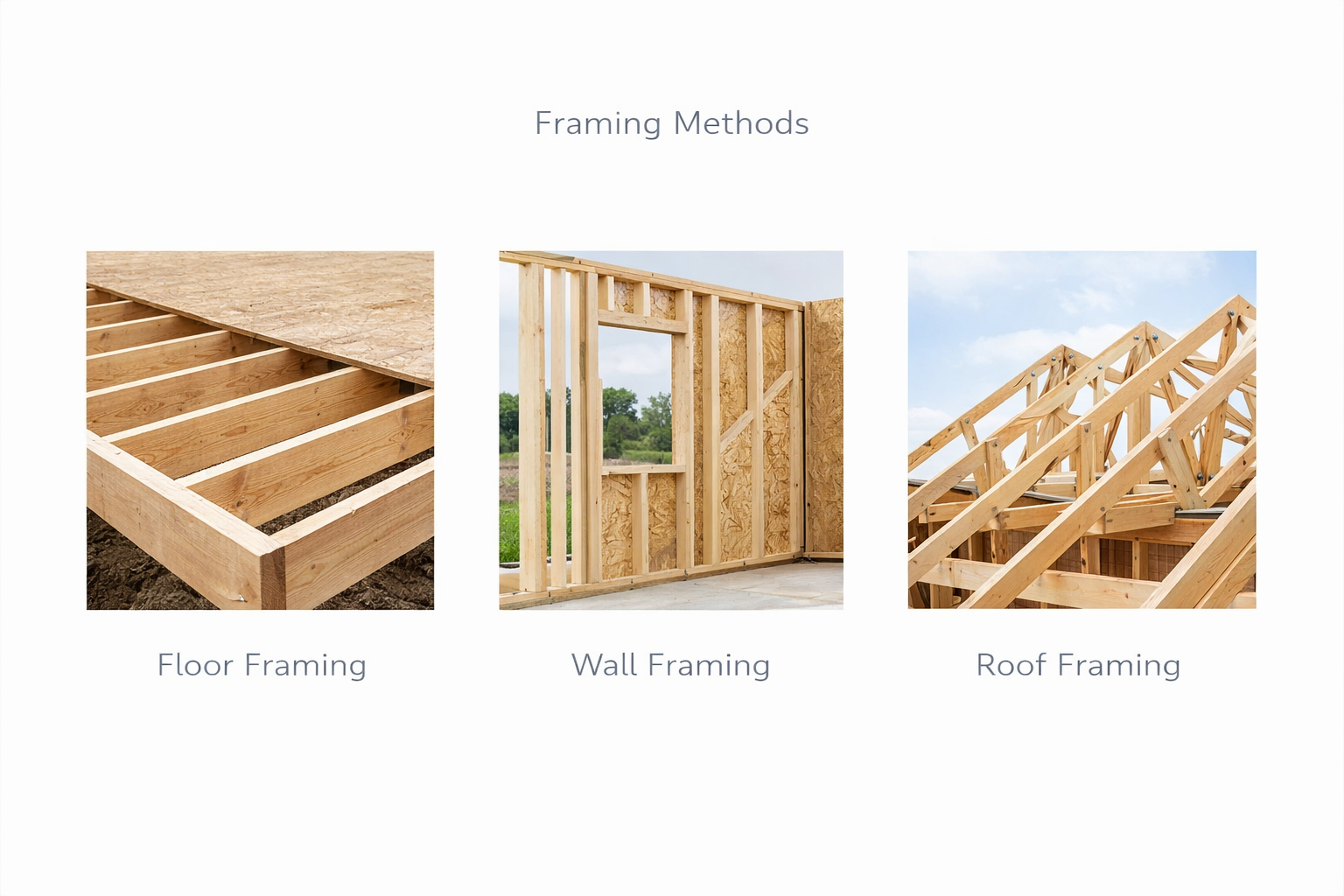
Illustration by ArchitectureCourses.org. Floor, wall, and roof framing shown as three core parts of a wood-framed house.
Stop treating house framing like one big abstract subject and it gets easier fast. Most of the job lives in three systems.
Floor Framing
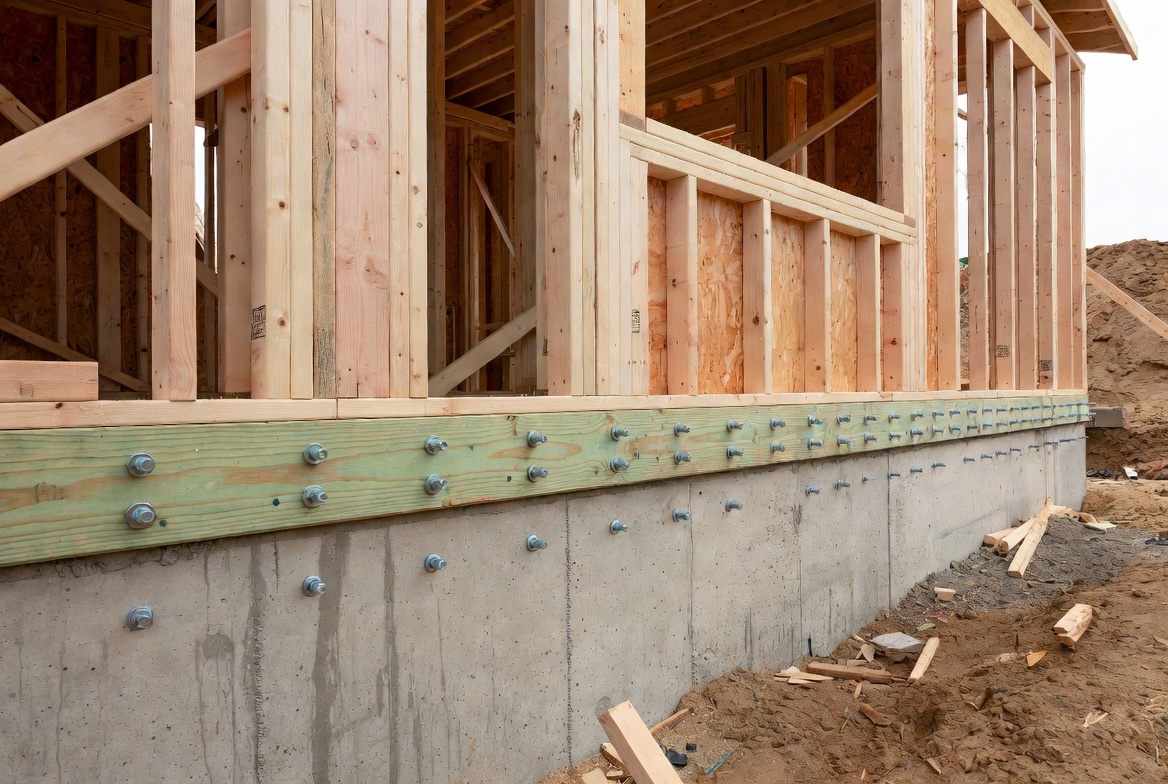
Illustration by ArchitectureCourses.org. Floor framing begins at the foundation and sets the base for the walls above.
The floor system sets the base for everything above it. If the floor frame is weak, out of level, or over-spanned, the rest of the house starts compensating for it. That shows up as bounce, squeaks, cracked finishes, and doors that stop behaving.
The core parts are sill plates, beams, joists, blocking or bridging, subfloor, and the connections back to the foundation. Depending on the plan, that may mean dimensional lumber, I-joists, LVLs, girder beams, or steel where the spans start getting ambitious.
Floor framing is also where cheap decisions create long memories. Thin subfloor, weak adhesive practice, stretched spans, weak bearing details, and sloppy layout at the rim do not stay hidden for long.
Wall Framing

Illustration by ArchitectureCourses.org. A clean wall section showing framing, insulation, cladding, and the foundation connection.
Wall framing does more than hold drywall. It carries vertical loads, resists racking, sets rough openings, and creates the geometry that everything else will depend on.
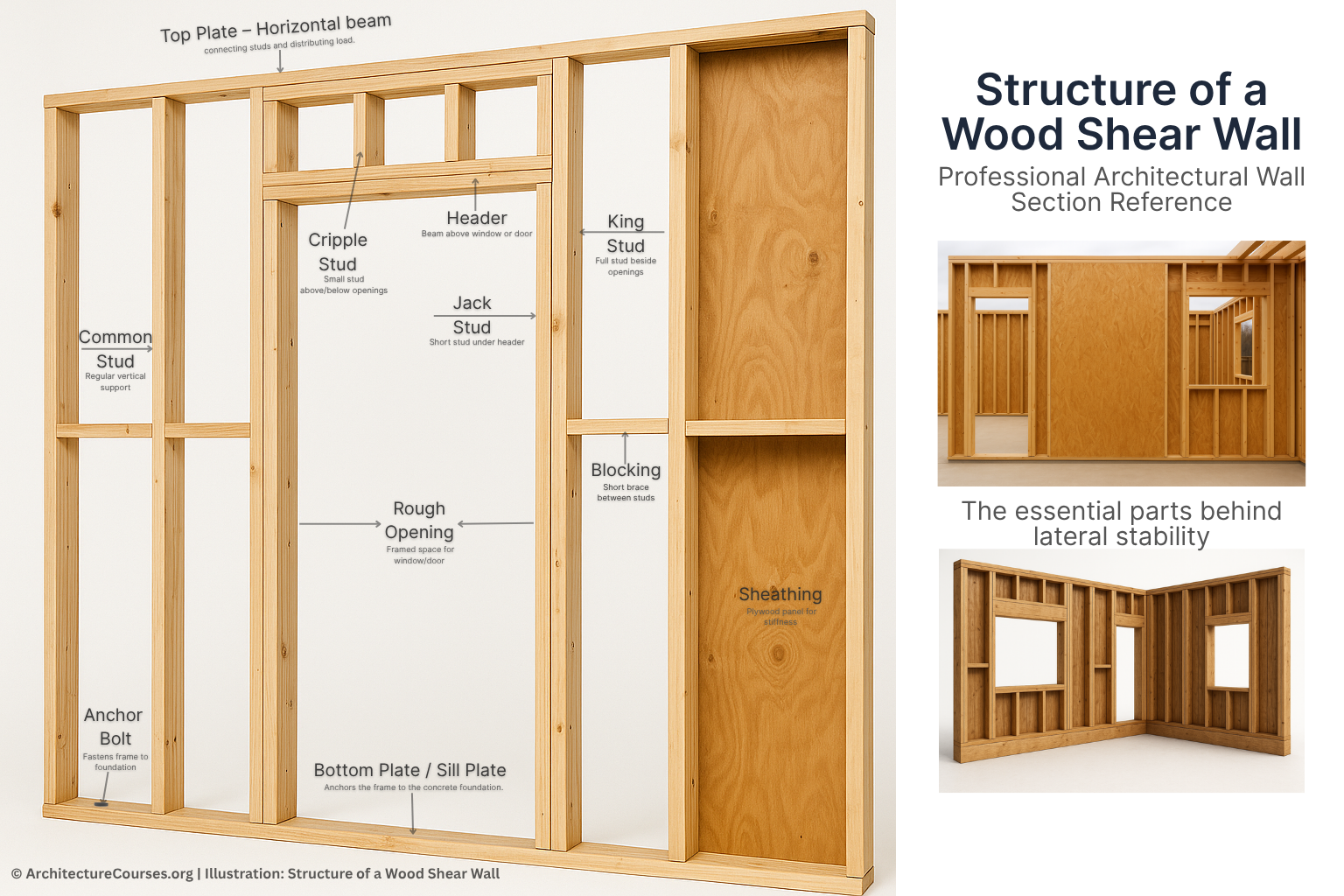
That means stud layout, top and bottom plates, sheathing, headers, jack studs, king studs, corners, bracing, blocking, and fastening patterns all matter. A wall can stand up and still be badly framed.
Stud spacing belongs in that conversation too. Sixteen inches on center is still the common default because it is straightforward, stiff, and works cleanly with most residential layouts. Twenty-four inches on center can make sense in advanced framing, but only when the wall design, loads, sheathing, and code path all support it.
Fire blocking is another detail people miss until inspection or renovation work exposes it. Open wall cavities can let fire travel farther than most readers expect, especially in older assemblies or vertically continuous framing conditions.
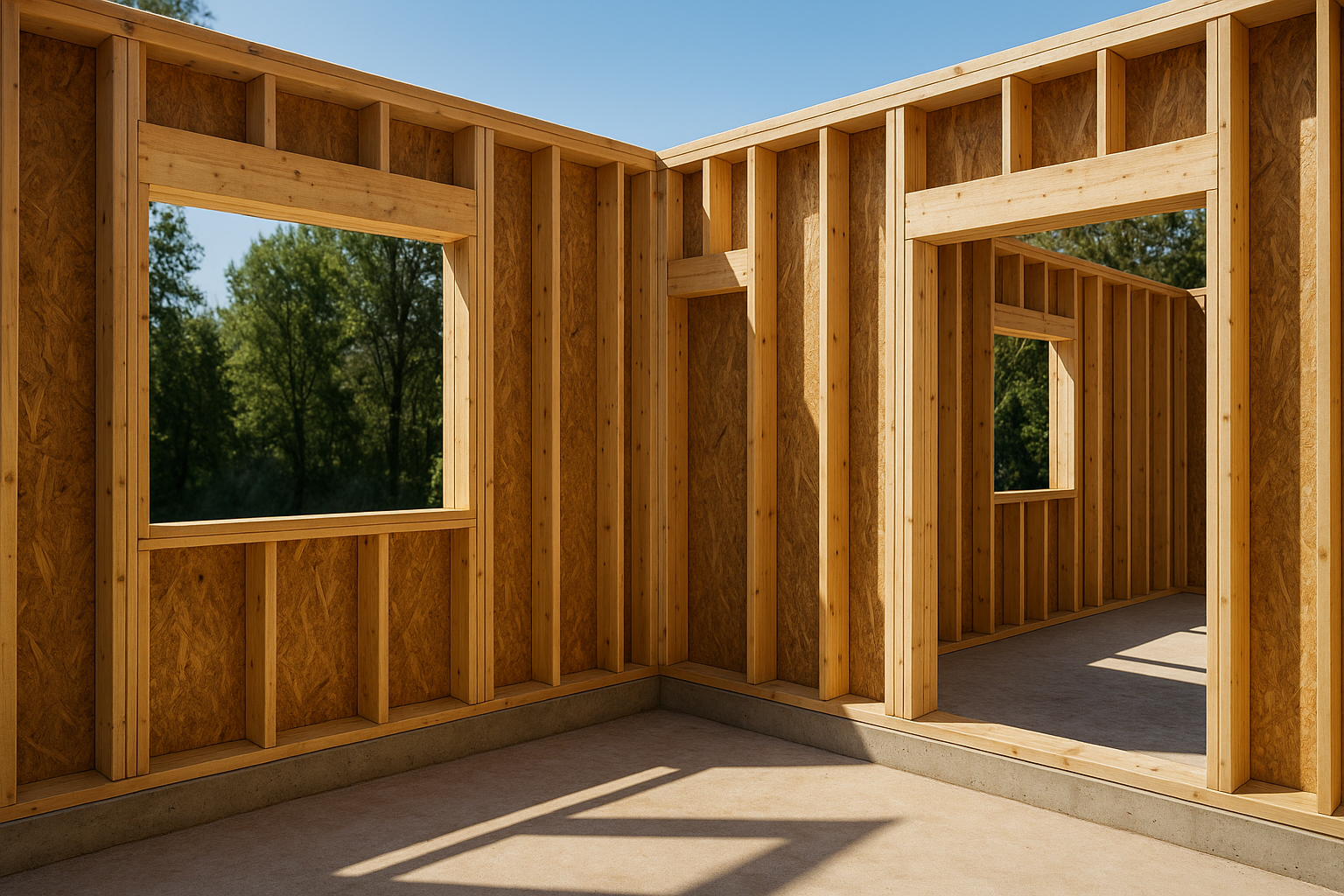
If you need the wall-build side in more detail, start with How to Frame a Wall and Wall Framing Basics. If the problem is openings, go straight to Window Rough Openings, Window Header Framing, Jack Stud Framing, and King and Jack Stud Framing.
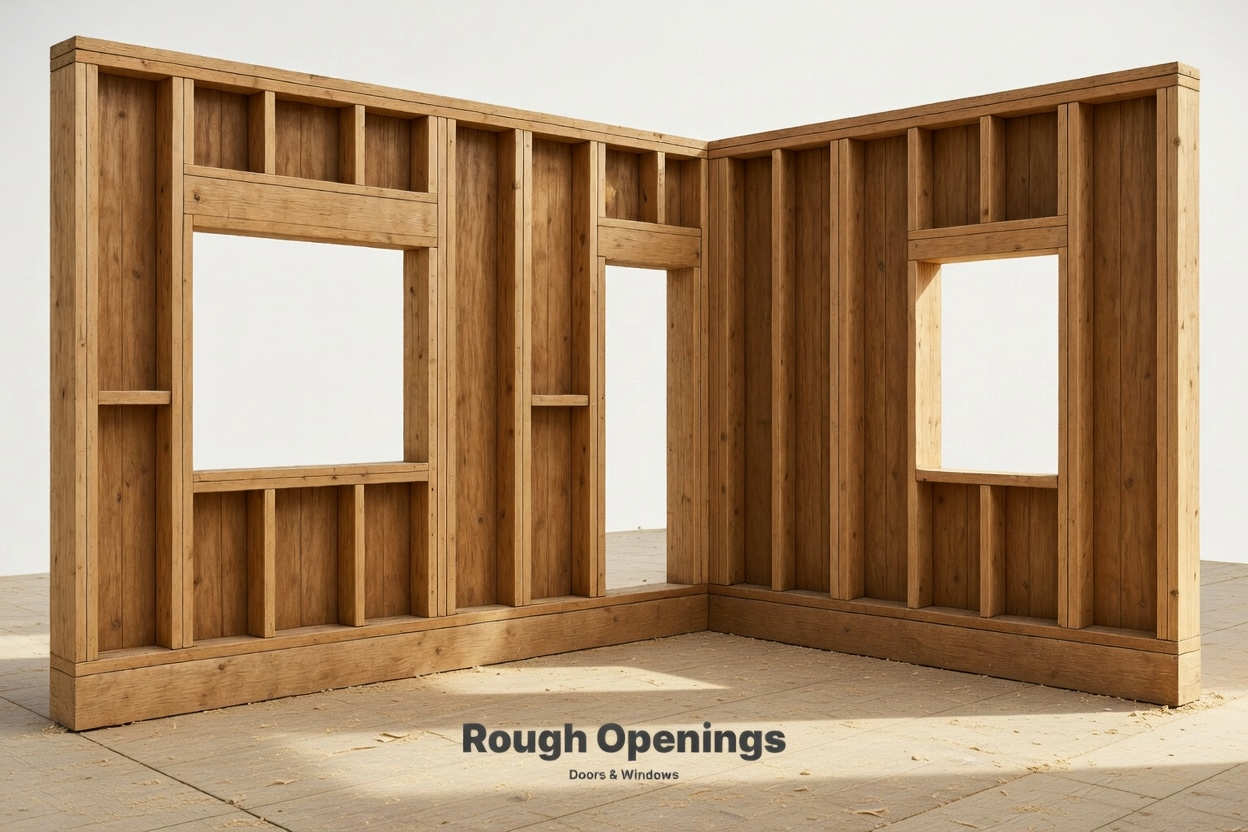
Illustration by ArchitectureCourses.org. Wood-framed wall corner showing rough openings for a door and windows.
Sheathing belongs in this conversation too, especially once the question shifts from studs to rigidity, fastening, and enclosure prep. House Sheathing 101 covers that side of it.
Roof Framing
Roof framing is where loads get less forgiving. Dead load, wind uplift, snow, geometry, overhangs, bracing, and the relationship between rafters or trusses and the wall line all start to matter at once.
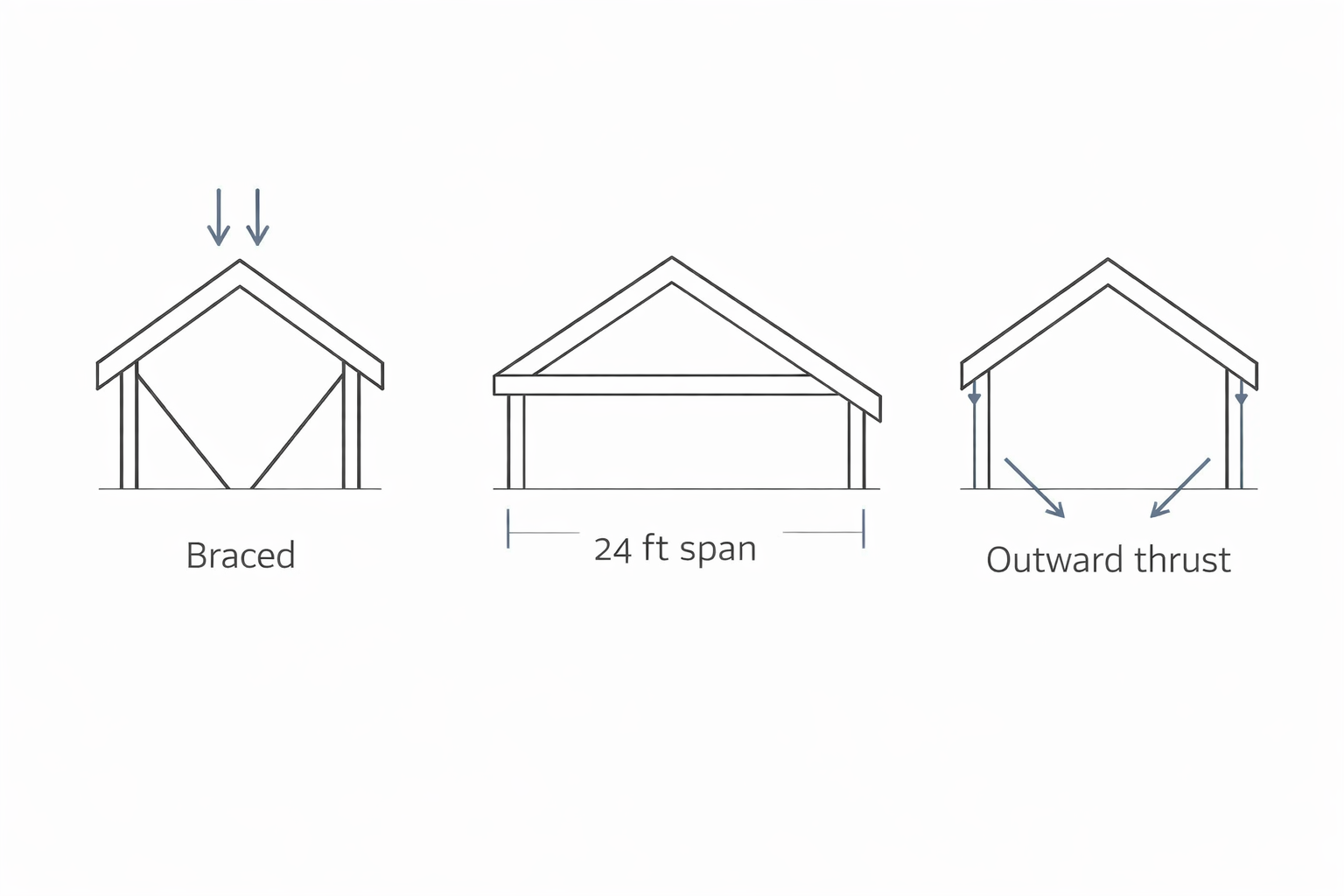
Some houses want a simple truss package and should not pretend otherwise. Others need stick framing because the roof form is doing more work: attic rooms, vaulted ceilings, dormers, complex intersections, longer spans, or a custom ridge-beam condition.
Gable roof framing and hip roof framing do not behave the same way. Gables are simpler and cheaper to frame. Hips can perform better in some wind conditions, but they add complexity, cuts, and labor. Dormers, skylight openings, and vaulted ceilings also change the roof-framing conversation because they interrupt standard layout and often require more careful support details.
Once the roof starts driving the build, Introduction to Roof Structures, Roof to Wall Connections, and Truss Bracing and Roof Support Systems are the better follow-ups.
Basic Framing Terms That Matter on Site
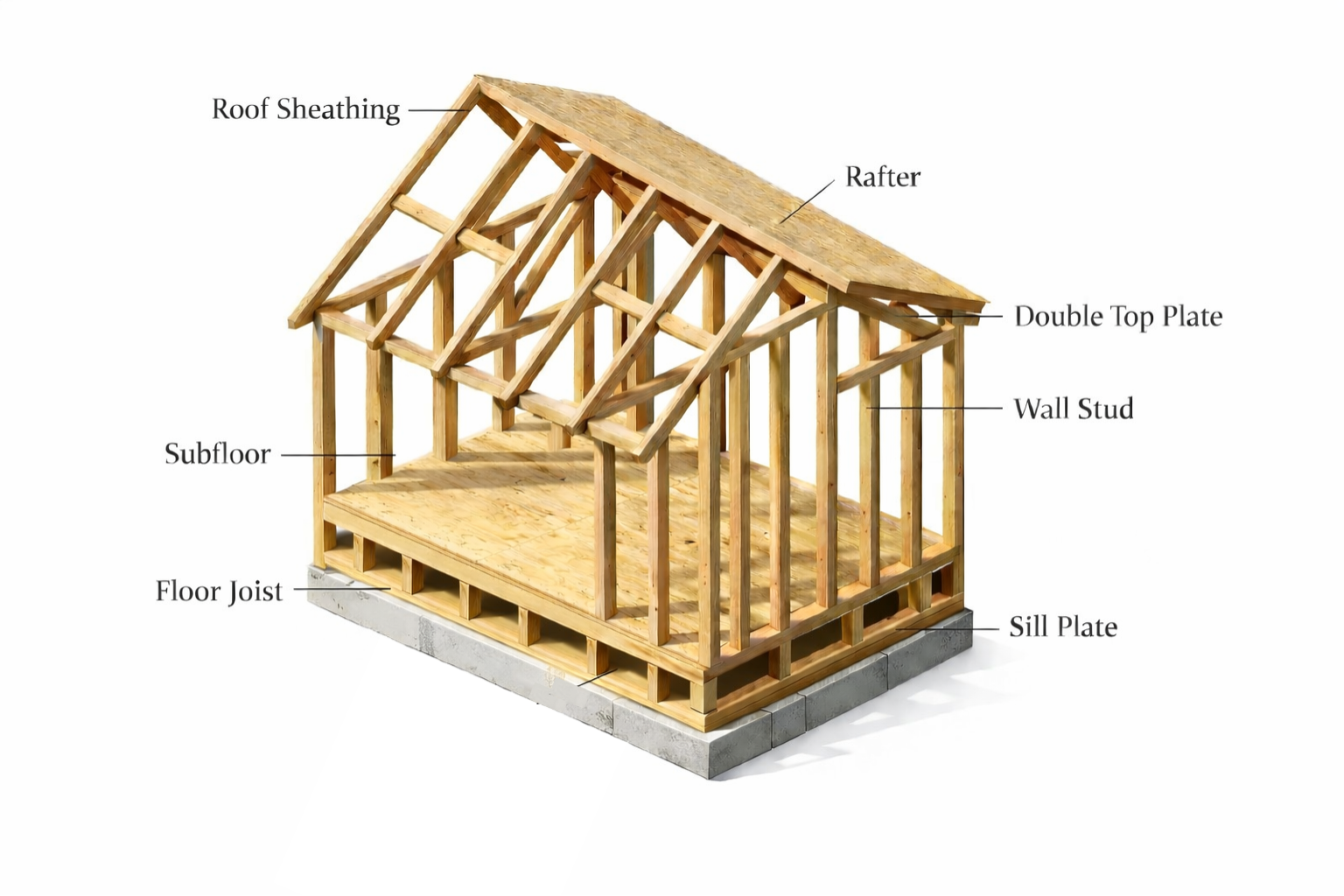
A broad framing guide still needs the field terms readers keep running into.
| Term | What It Does |
|---|---|
| Sill Plate | The first wood member anchored to the foundation. It ties the frame to the concrete below. |
| Joist | A horizontal framing member that carries floor or ceiling loads across a span. |
| Subfloor | The structural layer over the joists that stiffens the floor system and supports the finished floor. |
| Stud | A vertical wall member that carries loads and sets the basic wall layout. |
| Header | The structural member over a door or window opening that transfers load around the opening. |
| Jack Stud | The shorter stud that supports the header at each side of an opening. |
| Sheathing | The panel layer that stiffens walls or roofs and prepares them for exterior finishes. |
| Rafter or Truss | The main roof-framing member, either site-built one piece at a time or factory-built as a system. |
If the real issue is openings, the deeper reads are Window Header Framing, Jack Stud Framing, and King and Jack Stud Framing.
How a House Gets Framed in the Field
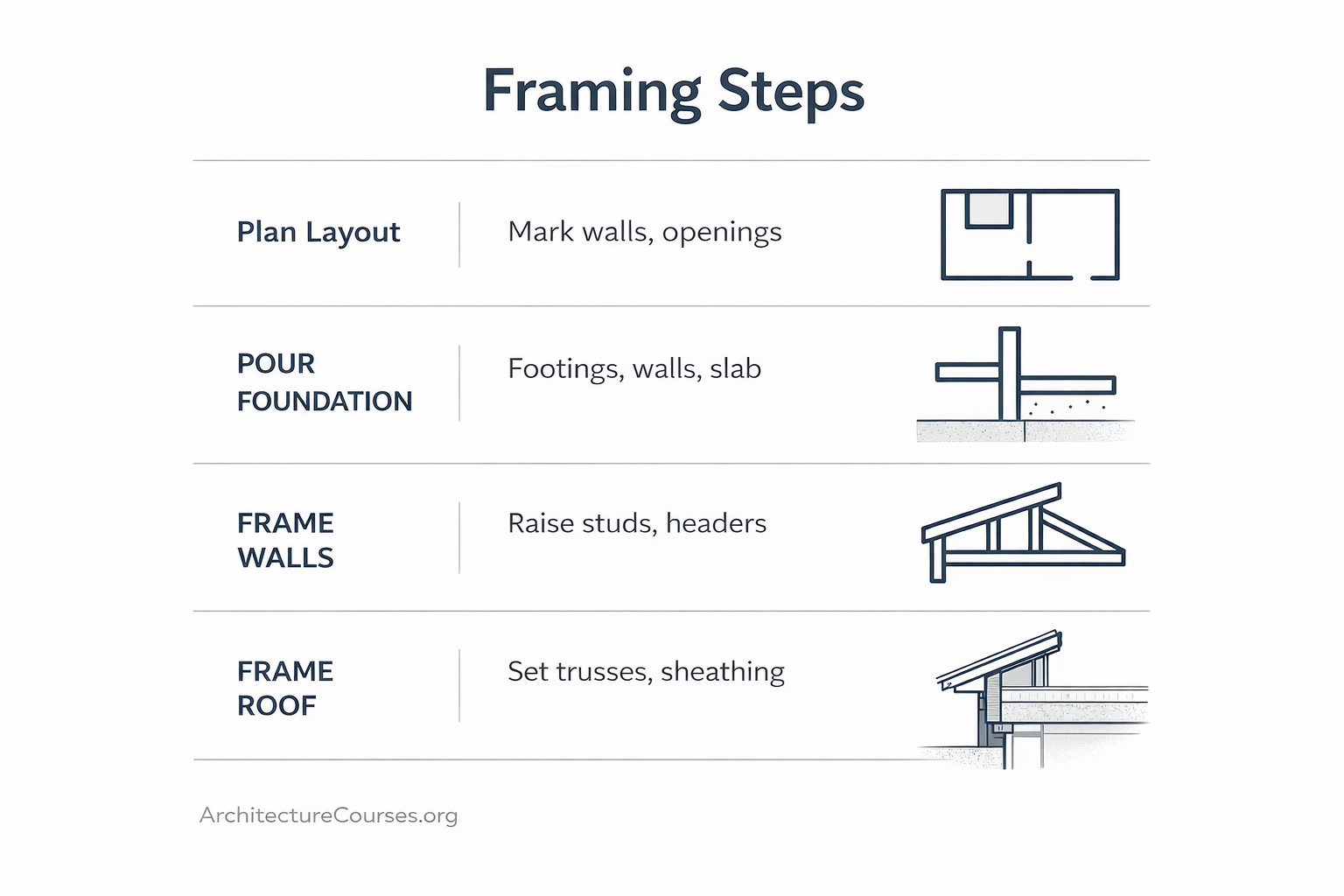
The field sequence is not mysterious. It only gets messy when one stage is rushed and the next crew inherits it.
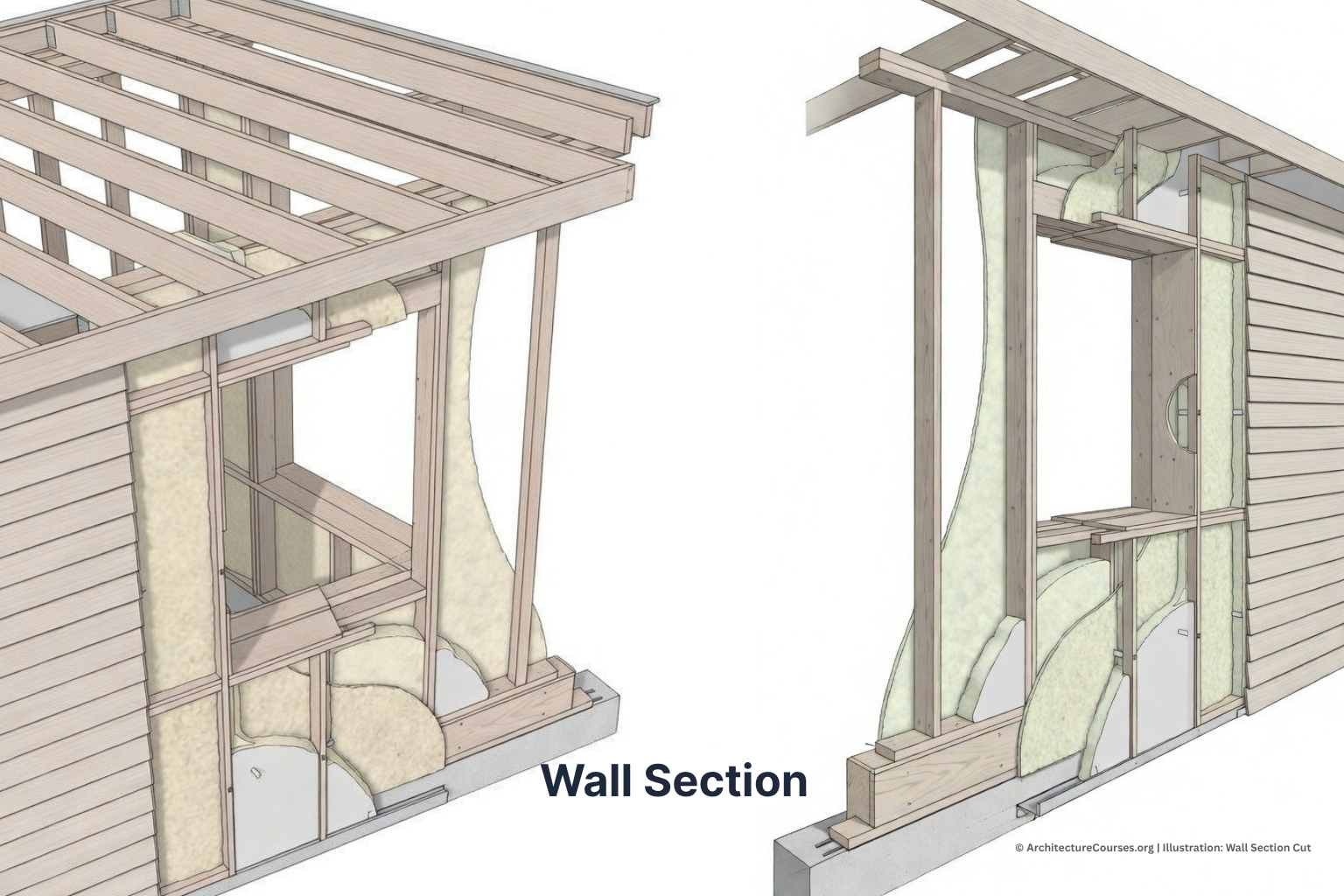
Illustration by ArchitectureCourses.org. Exterior wall section showing framing, insulation, cladding, and the foundation connection.
- Check the foundation before framing starts. Not just level. Square too. If the diagonals are off, the frame will spend the whole job trying to recover from it.
- Install sill plates and anchor the base cleanly. Pressure-treated lumber, proper bearing, proper fastening, proper sill sealing. This is not the place for improvisation.
- Frame the floor system. Beams, joists, blocking where needed, then subfloor installed tightly enough that the house does not start its life squeaking.
- Frame and stand the walls. Layout first, openings right, temporary bracing in place, walls checked for plumb before the shell gets locked in.
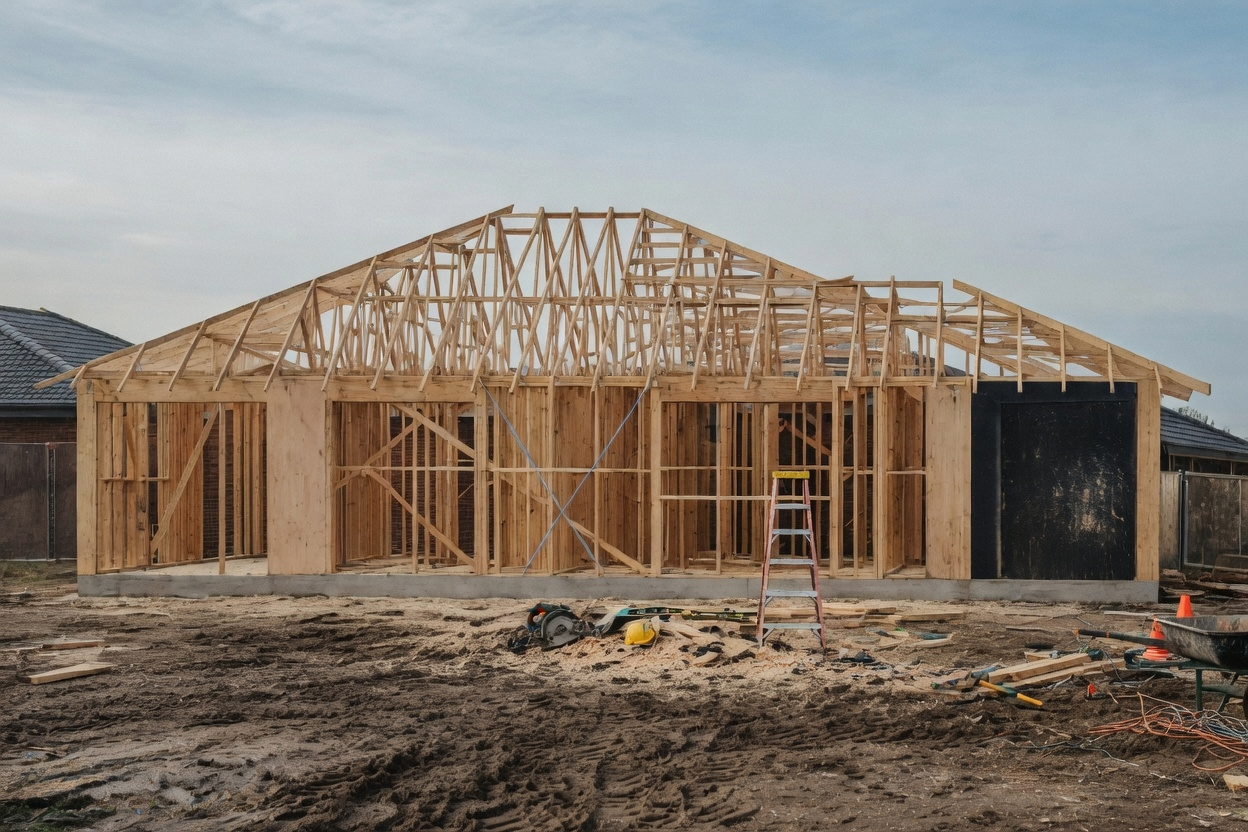
- Set the roof structure and brace it correctly. Trusses or rafters go on, but the job is not done when they are standing. Bracing, sheathing, and connections are what stabilize the system.
That sequence fits the majority of straightforward residential builds. Once the plan starts asking for long spans, custom roof lines, heavy structural glazing, or mixed-material structure, the framing package usually needs more engineering discipline before lumber starts flying.
What Drives House Framing Cost
House framing cost is not just lumber plus labor. It moves with the shape of the house, the roof, the spans, the opening sizes, the site, and how much engineered structure the design demands.
The biggest cost drivers are these:
- House size and shape. A simple rectangle frames faster than a house full of offsets, bump-outs, and roof intersections.
- Roof complexity. Simple gable and common truss work is one thing. Dormers, valleys, hips, vaulted ceilings, and custom overhang conditions are another.
- Span conditions. The more the plan wants open rooms with fewer bearing walls, the more engineered members start entering the budget.
- Crew speed and skill. Cheap labor is not cheap if the frame has to be corrected later.
- Material choice. Platform wood framing, timber framing, steel framing, and hybrid approaches do not land in the same cost range.
- Site access. Tight sites, crane dependency, and messy deliveries can turn a clean framing package into a slow one.
| Framing Condition | Cost Pressure | Complexity | Why |
|---|---|---|---|
| Simple platform-framed house with standard openings and common trusses | Lower | Lower | Fast sequencing, standard labor, fewer engineered members |
| House with taller walls, bigger openings, and some long spans | Medium | Medium | More headers, more LVLs or engineered framing, tighter layout tolerance |
| Custom roof forms, vaulted ceilings, dormers, or exposed structure | Higher | Higher | More layout time, more roof labor, more coordination, more risk of rework |
| Timber, steel, or hybrid framing system | Higher | Higher | Material cost, engineering demand, specialized labor, tighter planning |
That is why broad price comparisons get messy fast. Two houses with the same square footage can frame very differently once the roof, layout, and structure change.
Better Framing Moves vs. Costly Shortcuts
| Better Move | Shortcut | Why the Better Move Holds Up |
|---|---|---|
| Check level and square before plates go down | Assume the foundation is close enough | Bad geometry at the bottom keeps showing up all the way to the roof |
| Size beams and joists for the actual span and load | Stretch standard lumber to save money | Bounce, sag, and cracked finishes cost more later |
| Frame openings cleanly with the right header and stud layout | Treat door and window openings like minor details | Openings are where bad load transfer becomes visible fast |
| Brace walls and roof framing as the shell goes up | Wait until the structure feels stiff enough | Temporary instability is where a lot of damage starts |
| Use framing decisions to support insulation and air sealing | Leave energy performance for later trades to solve | The frame either helps the envelope or fights it |
Where Different Framing Systems Make Sense
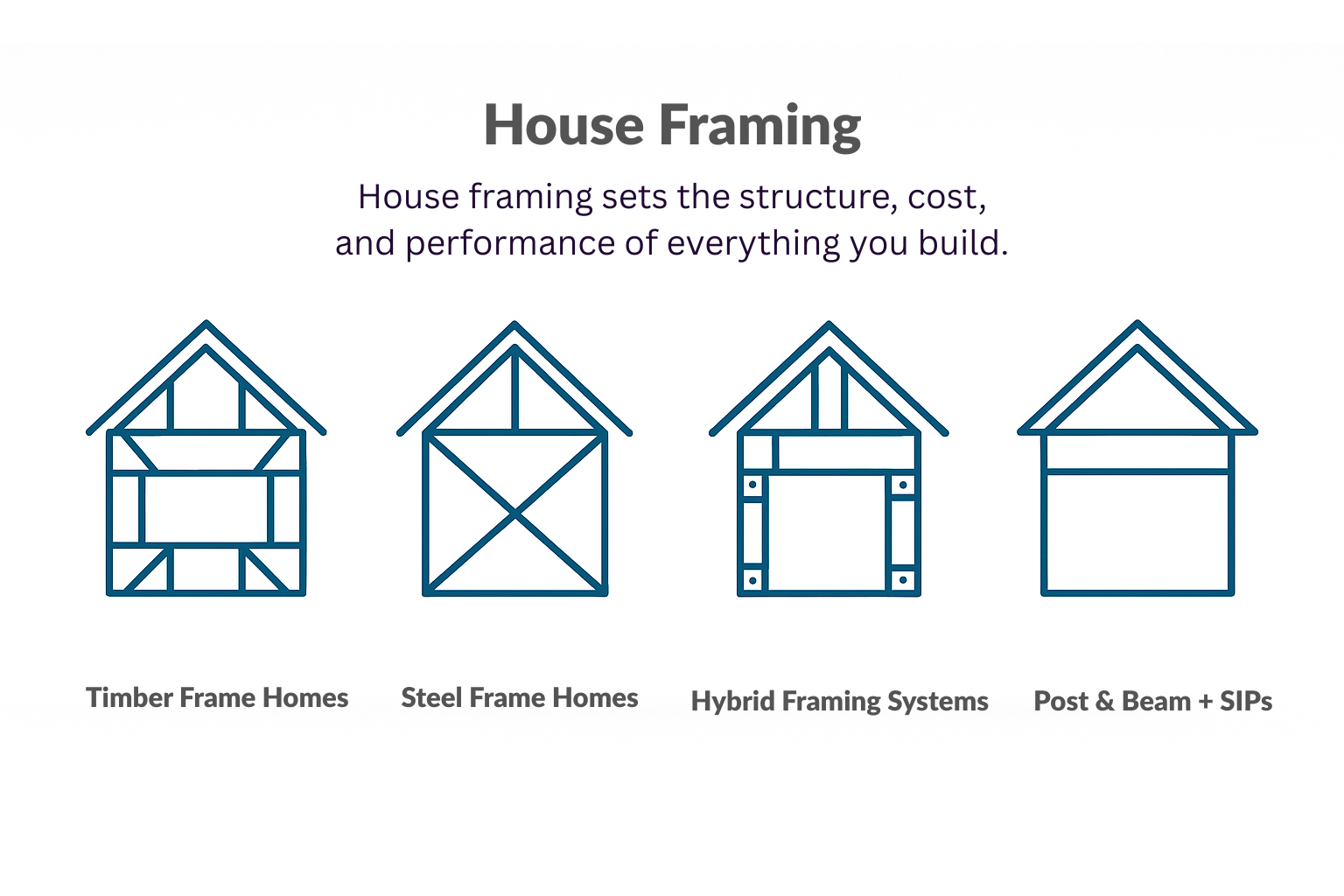
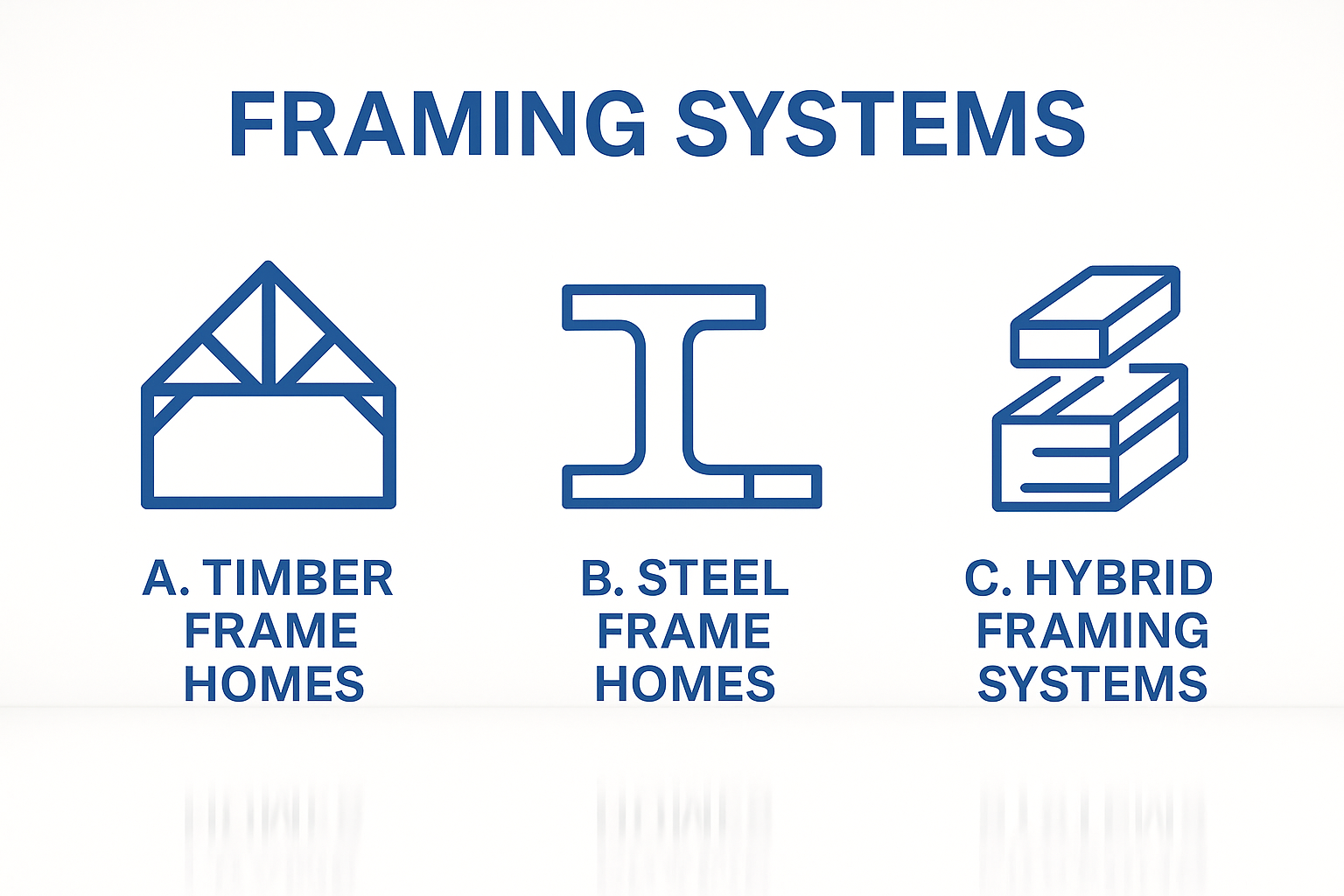
The alternatives are not interchangeable. Each one solves a different kind of house, site, span, or budget problem.
Timber and Post-and-Beam
These systems make sense when the structure is meant to stay visible, when large open rooms matter, or when the design wants fewer interior bearing walls. They are not better by default. They are the answer when the design gives them a reason.
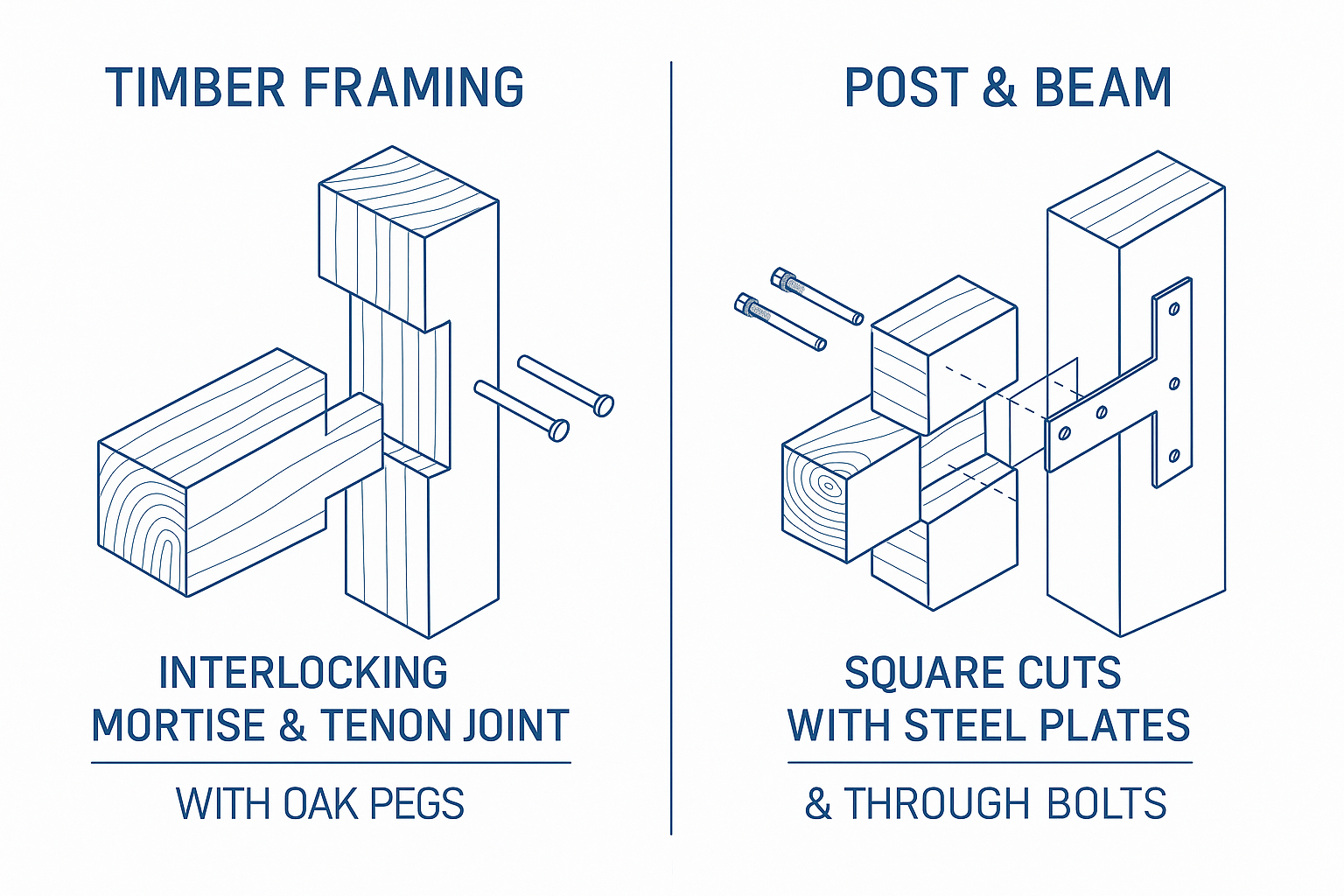
For exposed timber structure, read Timber Frame Beams and Posts.
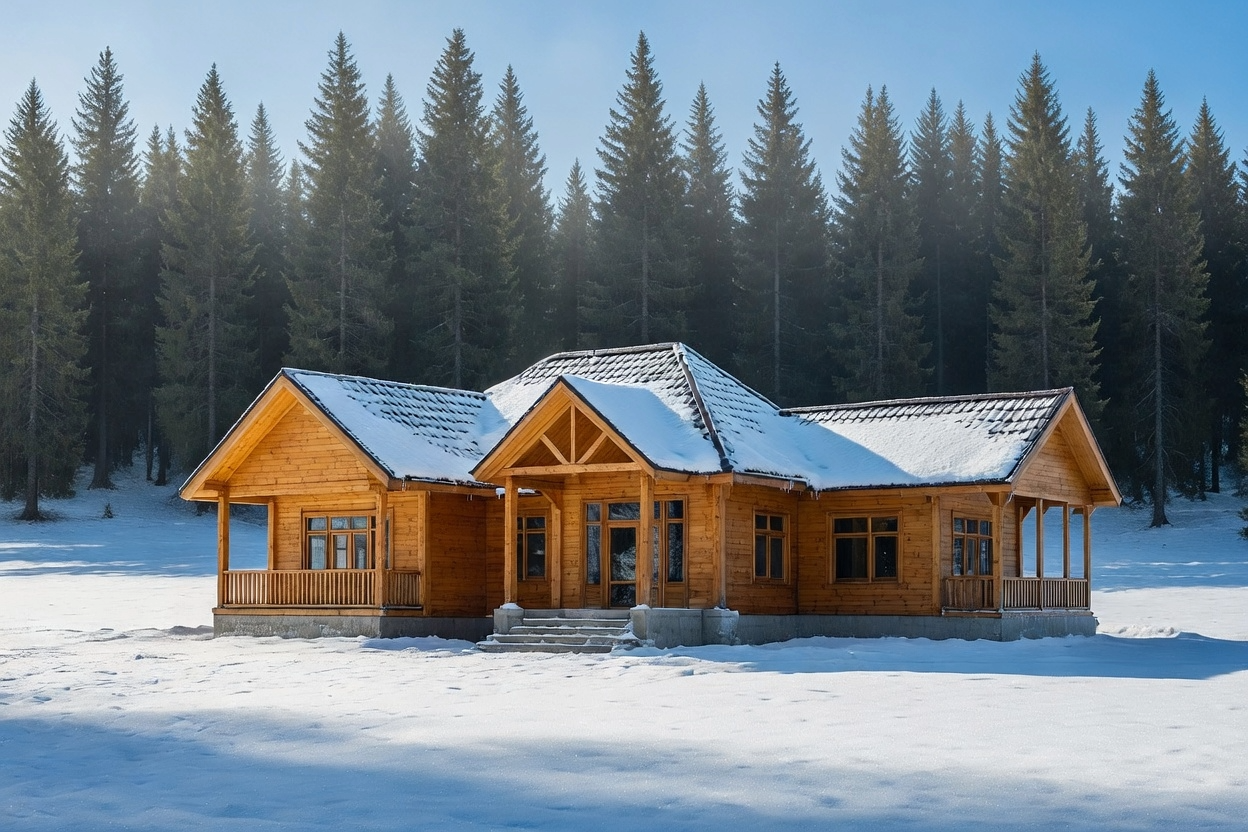
A-Frame and Steep-Roof Builds
A-frame logic belongs here because it changes the framing job itself. The steep roof is doing most of the structural work, which affects span behavior, insulation strategy, openings, and interior layout. It can be strong in snow country. It can also get awkward fast if the design is treated like a standard wall-and-roof house.
Balloon Framing
Balloon framing still matters because old houses still exist. It is not the standard modern answer, but it comes up in restoration, remodeling, and diagnosis. Full-height studs change fire blocking, wall cavities, load transfer, and repair logic.
For older balloon-framed houses, read Balloon Framing and Balloon Framing in American Houses.
Steel and Hybrid Systems
Steel earns its place where fire, pests, dimensional stability, long spans, or local risk conditions push the project there. Hybrid framing earns its place when one material does not solve the whole job well enough on its own. The trade-off is coordination. Hybrid systems reward planning and punish casual changes.
Panelized and high-performance hybrid builds can also make sense when speed and enclosure performance matter more than site flexibility. That is where factory tolerances, cleaner air sealing, and better insulation continuity start to outweigh the loss of on-site improvisation.
SIPs and ICF systems belong in the broader framing conversation too, especially on high-performance or disaster-resistant builds. But they are alternatives, not the default answer for most standard houses, and they usually deserve their own deeper page instead of swallowing a general framing pillar.
Post-Frame and Rural Builds
Post-frame work can be efficient and practical in the right setting, especially where large covered volume matters more than basement space or conventional residential sequencing. It is not just cheap framing. Done well, it is a different structural logic with different strengths and different limits. Rural sites, workshops, barn-style houses, and large garages are where it tends to make more sense than a standard suburban infill lot.
Common Framing Mistakes That Turn Into Expensive Repairs
The worst framing mistakes are rarely dramatic on day one. They sit quietly and wait. Then the trim crew finds them. Or the drywall crew. Or the roofer. Or the owner, two winters later.
Bad layout at the start
If plates, openings, bearing points, or joist layout are marked carelessly, the error spreads. A small mistake at the floor line becomes an alignment fight at the wall, then a roof problem, then a finish problem. This is the sort of mistake that makes a house feel sloppy even when nobody can name the cause.
Undersized members and over-spanned floors
Trying to win cost back by stretching joists, downsizing beams, or pushing a span farther than the structure wants to go is one of the fastest ways to build softness into the house. It may not fail outright. It just never feels right.
Weak opening details
Headers, jack studs, king studs, cripple layout, rough-opening accuracy, and bearing at each side of the opening are not side notes. A lot of visibly bad framing shows up at openings first because that is where load transfer has been interrupted on purpose and then rebuilt.
Bracing That Gets Treated as Temporary Thinking
Some crews are good at standing walls and less good at stabilizing them. That is a problem. Long walls, roof packages, and trusses need disciplined bracing, not confidence.
Ignoring the Load-Bearing Question During Renovations
This one keeps repeating because interior remodeling makes walls look optional. They are not. Before any removal, the project needs a clean answer about load path, support below, support above, and the member replacing what gets removed.
Before removing a wall, read Load-Bearing vs Non-Load-Bearing Walls.
The Link Between Framing and Energy Efficiency
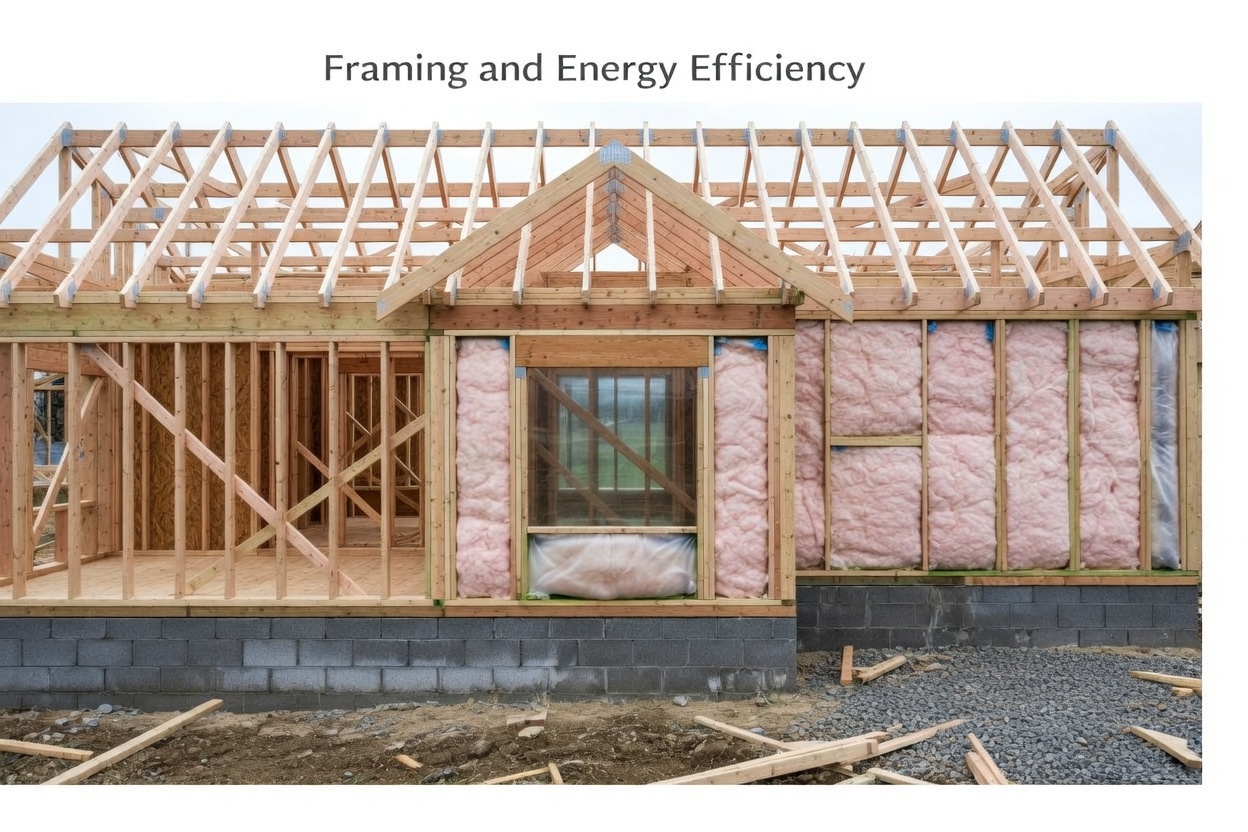
Illustration by ArchitectureCourses.org. Framing layout affects energy performance by shaping insulation space, thermal bridging, and how cleanly the enclosure goes together.
Good house framing does not stop at structure. It sets up the building envelope too. That means the frame can either support insulation, air sealing, and clean enclosure details, or keep sabotaging them.
Advanced framing is the obvious example. Wider stud spacing, aligned framing, insulated headers, fewer redundant members, and cleaner load paths can reduce thermal bridging and free up more room for insulation. It works when the design, the code path, and the crew all agree on the logic. It works badly when someone copies the look of advanced framing without understanding the structure.
The detail people miss is that energy performance usually gets lost in the framing layout long before insulation shows up. Oversized rough openings, unnecessary extra studs, poorly planned corners, and headers that were sized by habit instead of need all eat away at enclosure performance.
- 24-inch on-center framing can reduce thermal bridging, but only where the structural layout and local code path support it.
- Insulated headers and fewer redundant studs help more than many readers expect.
- Aligned framing matters because the loads and insulation strategy need to work together, not fight each other.
- Right-sized openings are part of the energy story too, not just the finish carpentry story.
Climate matters here. In colder regions, the wall assembly, insulation depth, air sealing strategy, and moisture control details may matter more than the framing pattern by itself. In milder regions, simpler framing improvements can still move the needle without turning the whole build into a specialty assembly.
The frame is not separate from comfort. A sloppy frame creates more work for insulation, air sealing, HVAC sizing, and finish trades. A disciplined frame makes all of that easier.
For enclosure prep and panel layout, see House Sheathing 101.
What’s Next
Still comparing framing methods? Start with Construction Framing Types.
If the next problem is wall layout, studs, plates, and openings, go to How to Frame a Wall.
If the roof is where the job starts getting complicated, read Introduction to Roof Structures.
Official Sources and Government Guides
- HUD — Residential Structural Design Guide, Chapter 5: Design of Wood Framing (PDF)
- USDA Forest Products Laboratory — Wood Handbook: Wood as an Engineering Material
- USDA Forest Products Laboratory — Use of Wood in Buildings and Bridges (PDF)
- FEMA — IRC Wind-Resistant Provisions Compilation (PDF)
- FEMA — Fact Sheet 3.2: Wall Systems and Openings (PDF)
- FEMA — Home Builder’s Guide to Coastal Construction (PDF)
- FEMA — Improving Windstorm and Tornado Resilience (PDF)