
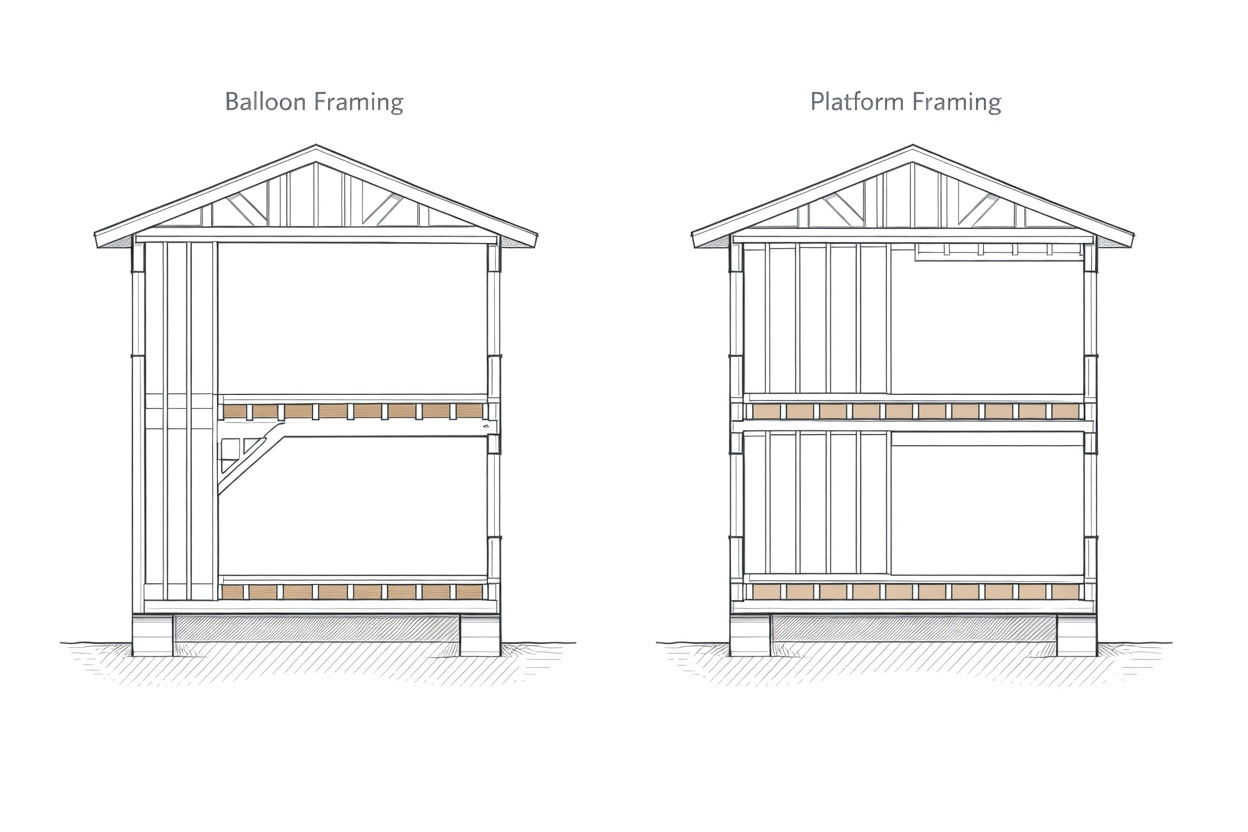
Illustration by ArchitectureCourses.org. Comparison of balloon framing and platform framing showing continuous wall studs versus stacked floor platforms.
Balloon framing is an older wall-framing method that still affects how many houses are identified, repaired, insulated, and renovated today.
Open up an older wall and the framing may run past the floor instead of stopping at each level. That is balloon framing.
It spread fast because it used long studs, lighter lumber, and nails instead of heavy timber joinery. That made houses quicker and cheaper to build. It also created a wall system that behaves differently once you start opening it up.
That difference still matters. Balloon-framed houses handle insulation, rewiring, fire-blocking, and renovation work differently from platform-framed ones. So the first job is knowing what you are looking at, how the frame goes together, where it causes trouble, and what changes when you work on one now.
Balloon Framing at a Glance
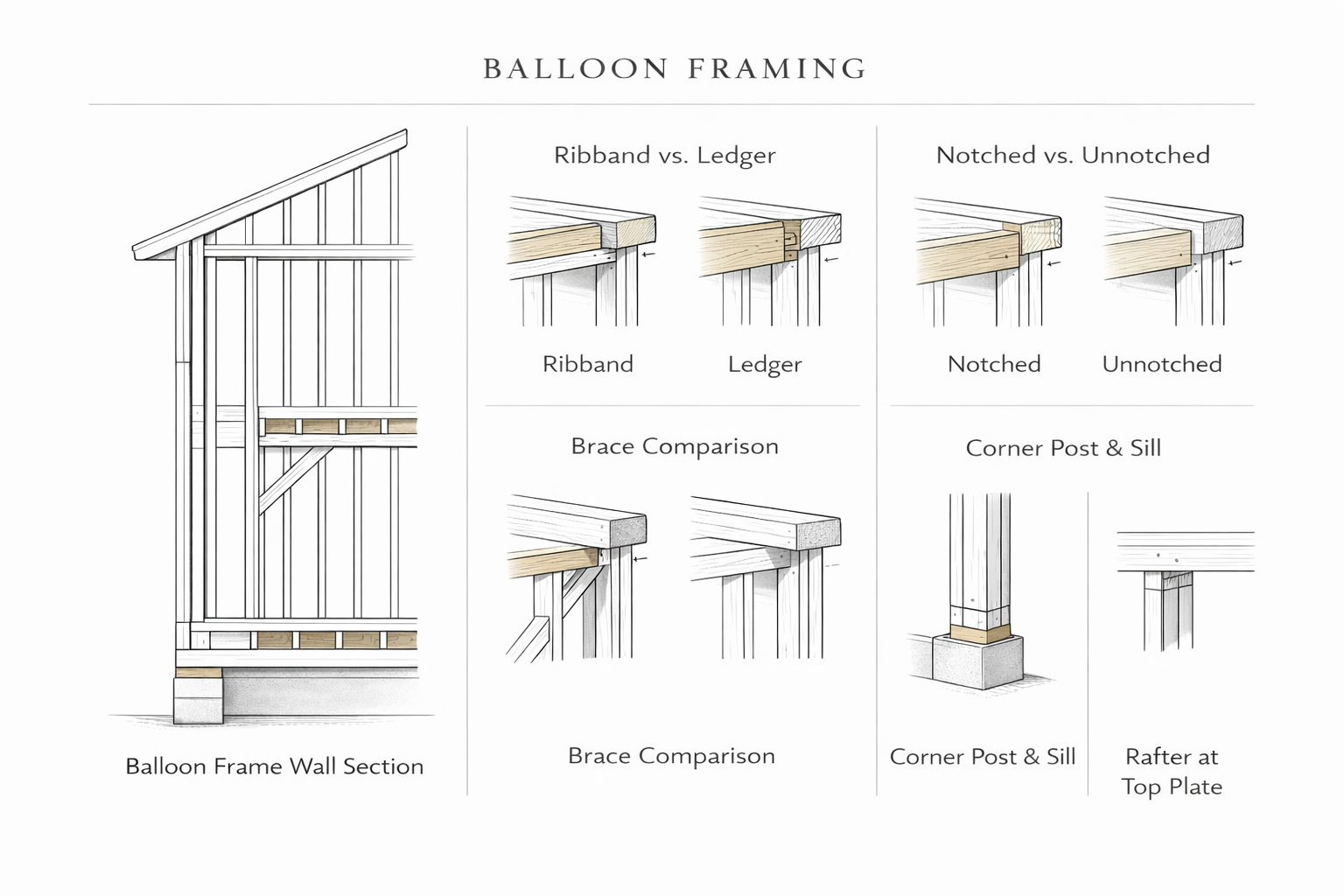
Illustration by ArchitectureCourses.org. Balloon framing plate showing the main wall section and key details including ribband vs. ledger support, notched stud framing, brace comparison, corner post and sill, and rafter bearing at the top plate.
| System | Main Structural Logic | Main Advantage | Main Weak Point | Where You See It Most |
|---|---|---|---|---|
| Balloon framing | Long studs run past the floor line in one continuous wall | Tall walls and fast light-frame construction | Open wall cavities and harder retrofit work | Older houses, barns, and historic buildings |
| Platform framing | Each floor is built as its own platform, then the next wall sits on top | Easier to build, brace, and fireblock | More joints and stacked framing lines | Most modern wood houses |
| Heavy timber framing | Large beams and posts joined with traditional carpentry | Strong and durable with exposed structure | Slow, skilled, and expensive | Older timber buildings and custom work |
What Balloon Framing Is
Balloon framing is a light wood framing method that uses long vertical studs running from the sill area toward the roof instead of stopping at each floor.
In a two-story house, those studs often run past the second-floor line. The floor joists are then supported off the side of the wall framing by ledger boards, ribbons, or later metal hardware rather than sitting on a full framed platform below.
That is the big visual and structural difference. The wall is continuous. The floor is hung into it.
Compared with heavy timber framing, balloon framing uses smaller lumber and far less joinery. Compared with platform framing, it creates tall uninterrupted wall cavities and taller continuous wall lines, but it is harder to fireblock and harder to modify cleanly later.
Why It Spread So Fast
Balloon framing took off in the 1800s because the materials finally made it practical.
Mechanized sawmills produced standard lumber. Mass-produced nails became cheap enough to replace a lot of slower joinery work. In places like early Chicago, that changed the speed and cost of building in a big way.
The method mattered because it lowered the skill barrier. You still needed competent builders, but you did not need a full heavy-timber crew with advanced joinery skills for every house.
- Long studs and standardized boards made wall framing faster.
- Nails replaced a lot of labor-heavy timber joints.
- Rail transport made it easier to ship framing lumber into fast-growing towns and rural areas.
That is part of why balloon framing shows up so often in nineteenth-century and early twentieth-century houses across the Midwest, Northeast, and other regions where industrial lumber supply got established early.
How It Changed House Design

Balloon framing did more than speed up construction. It changed what builders could do with ordinary houses.
Tall walls became easier. Stacked window lines made more sense. Bay projections, towers, porches, and more complex shapes became easier to frame without jumping back to heavy timber methods.
Related: How Balloon Framing Changed the Shape of American Houses
Why It Still Matters in Old Houses
If you own or work on a pre-1940 house, balloon framing is not just a history lesson. It changes what you find once the walls open up.
Fire risk changes
Continuous wall cavities can act like chimneys if they are left open. That is one of the biggest practical differences between balloon framing and platform framing.
Renovation work gets trickier
Wiring, plumbing, insulation, and air sealing do not behave the same way in a tall open stud bay. A lot of old-house surprises start there.
Budgeting gets more honest
Long studs, added blocking, awkward floor connections, and hidden repairs all affect cost. If you identify balloon framing early, your estimate is usually better.
Historic details are often tied to the frame
Tall walls, deep trim, and stacked openings often make more sense once you understand the framing method behind them.
How to Spot a Balloon-Framed House
The fastest clue is not a style clue. It is a framing clue.
You are looking for wall studs that continue past the floor line instead of stopping at a platform, plus floor framing that is supported off the wall rather than stacked on top of a lower wall.
| What You See | What It Suggests | Why It Matters |
|---|---|---|
| Studs running past the floor line | Continuous wall framing | Strong clue you are looking at balloon framing |
| Floor joists tied into the wall with a ledger or ribbon | Platform floor is missing | Changes repair and reinforcement work |
| No full horizontal wall break between stories | Wall cavity may run upward without interruption | Raises fireblocking and air-sealing issues |
| Tall stacked window lines in an older house | Possible full-height wall logic | Good clue, but not proof by itself |
| House built roughly before World War II | Higher chance of balloon framing | Worth checking before renovation |
Quick field check
- Look in the basement or crawl space at the sill area and wall line.
- Check the attic edge to see whether long studs continue upward.
- Look for floor joists supported into the wall instead of sitting on a platform.
- Check whether the wall cavity appears open past floor levels.
- Confirm with a careful inspection opening before planning major work.
Age alone is not enough. Exterior appearance alone is not enough either. You need to see the framing logic.
How the Frame Goes Together
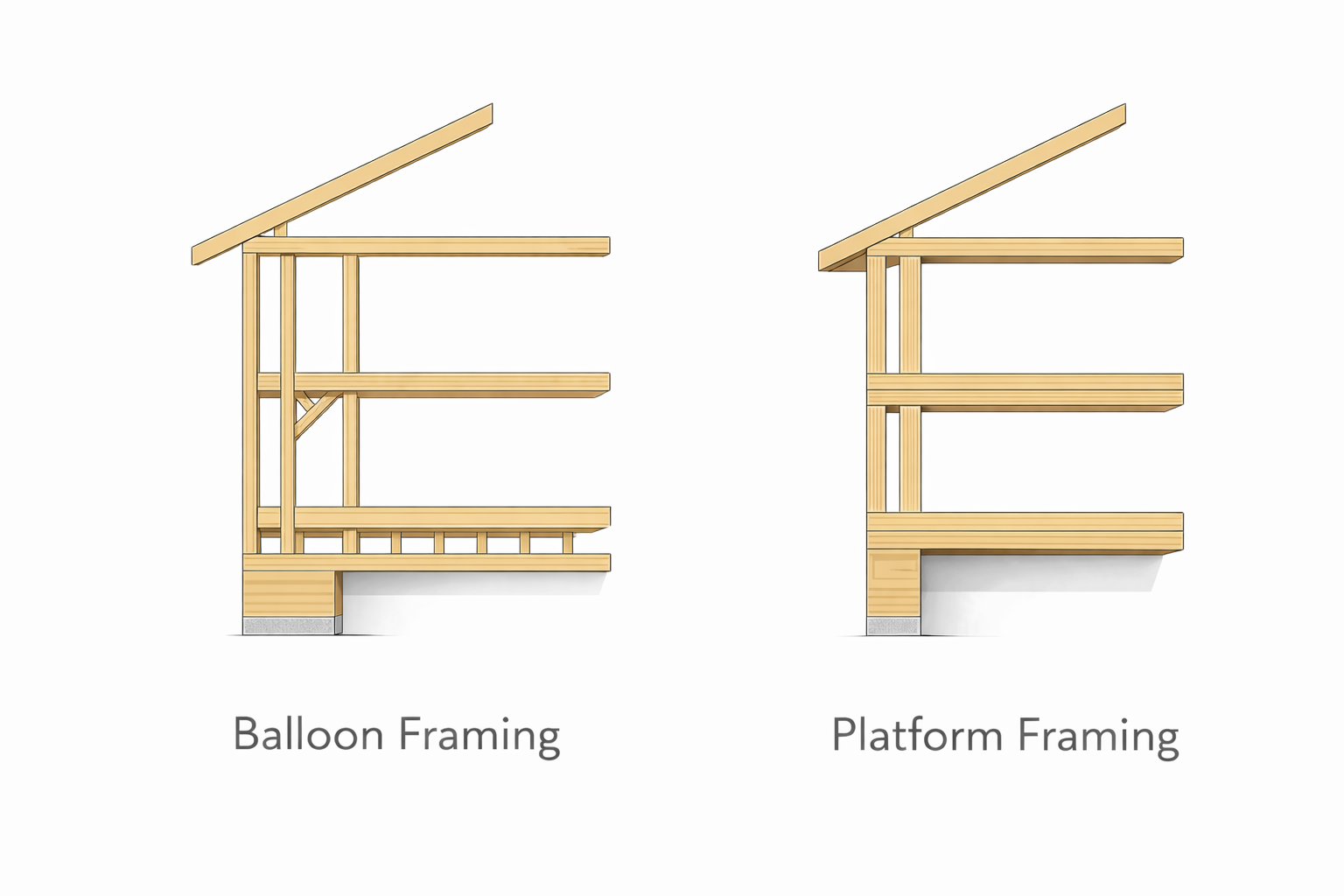
Balloon framing is simple once you understand the sequence.
1. Sill plate goes on the foundation
The base of the wall starts at the foundation line, usually at the sill. In older houses this may be heavy old-growth lumber. In new work or repair it is usually treated material where it contacts masonry.
2. Full-height studs are raised
This is the defining move. Studs run in long pieces instead of being cut story by story.
3. Floor joists tie into the wall framing
Instead of sitting on a framed platform below, floor joists are supported off the studs with a ledger, ribbon, or equivalent support detail.
4. Top plate and roof framing finish the wall line
Once the wall is up, the roof framing ties into the top of the continuous stud wall.
5. Sheathing stiffens the frame
Older houses may use diagonal or horizontal board sheathing. Later work may use plywood or OSB. In every case, the sheathing is doing more than just giving siding something to sit on. It helps stiffen the wall.
6. Fireblocking becomes critical
In an old balloon-framed house, this is often where the wall underperforms by modern standards. Once the wall cavities are exposed, blocking matters.
Where Balloon Framing Usually Goes Wrong
The method itself is not the problem. Neglect is the problem.
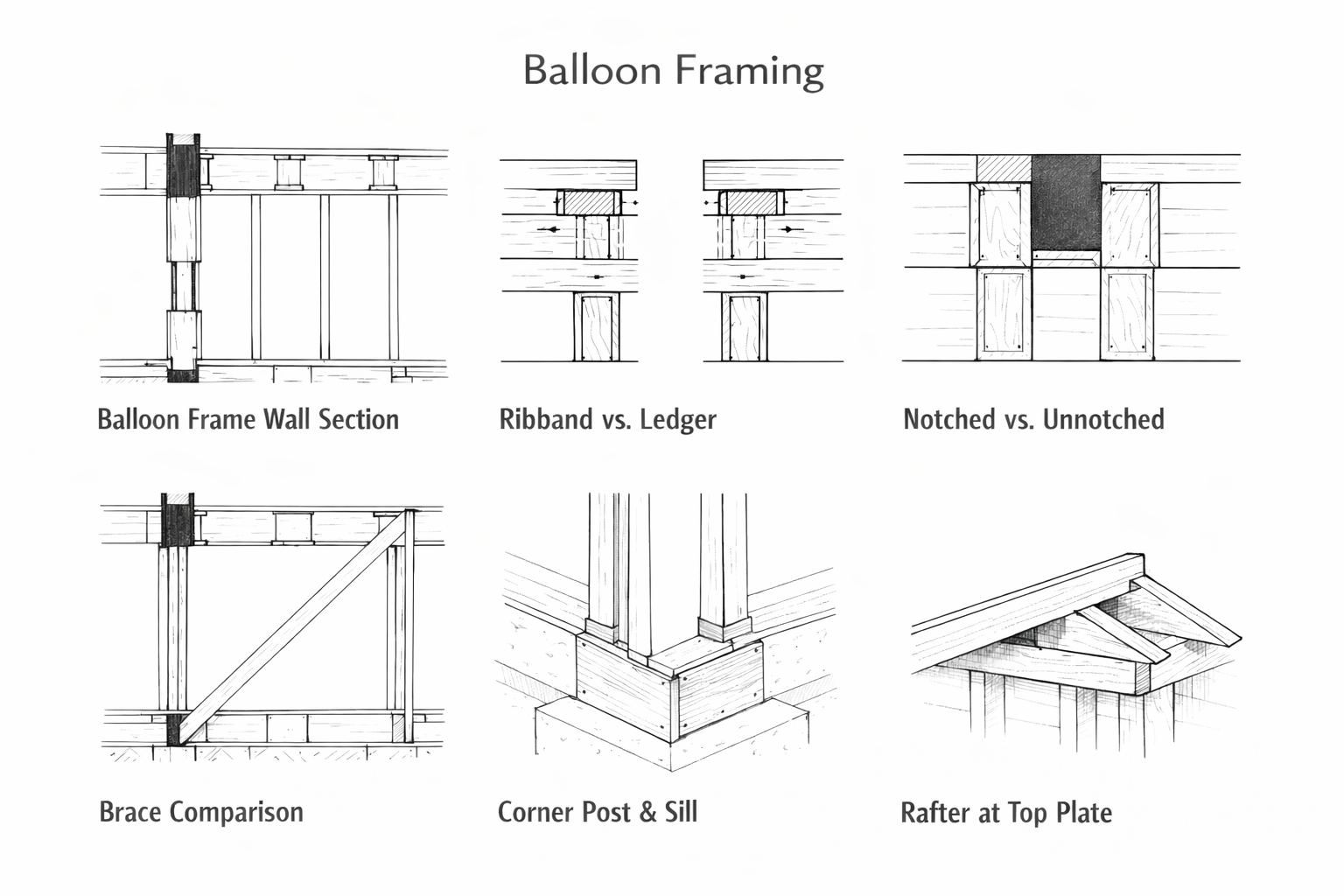
Illustration by ArchitectureCourses.org. Balloon framing details that matter during renovation, including ribband support, notched studs, bracing, and top-plate roof bearing.
- Open stud bays. Unblocked wall cavities create a fast path for fire and air movement.
- Weak floor connections. Old ledger or ribbon support can loosen, rot, or pull away.
- Long stud movement. Tall studs can bow, twist, or move if they are damaged or under-braced.
- Sheathing failure. Shrunk, rotten, or loose sheathing reduces wall stiffness.
- Moisture problems. Once water gets into an old balloon-framed wall, it can travel farther than people expect.
- Bad retrofit cuts. Random openings, notches, or service work can weaken the assembly if nobody is thinking about load path.
The common mistake in old-house work is treating balloon framing like ordinary modern wall framing. It is not.
Balloon Framing vs Platform Framing
| Question | Balloon Framing | Platform Framing |
|---|---|---|
| Stud length | Continuous, often past the floor line | Story-height studs stacked floor by floor |
| Floor framing | Hung into the wall framing | Built as a platform, then wall framed on top |
| Fireblocking | Needs more attention because cavities can run vertically | Each floor naturally interrupts the wall cavity |
| Ease of construction | Harder to handle because studs are long | Easier to build and brace in stages |
| Retrofit difficulty | Usually harder | Usually easier |
This is why platform framing replaced balloon framing in most ordinary house construction. It is easier to build, easier to brace, easier to fireblock, and easier to modify.
Is Balloon Framing Allowed Now?
Existing balloon-framed houses are common and can absolutely still be repaired, renovated, and upgraded.
New construction is a different question. The bigger issue is not a simple yes-or-no label. It is that modern codes require concealed spaces to be controlled, and balloon framing does not naturally solve that problem on its own.
In practice, that means fireblocking and related safety detailing become part of the conversation very quickly. On renovation work, once concealed framing is opened, fireblocking upgrades are often part of doing the job properly.
The smart move is simple: check the local building department before assuming anything. Existing old houses and new replication work do not get treated the same way.
What Changes in Renovation
Renovating a balloon-framed house is not impossible. It just needs a different plan.
Fireblocking comes first
If the wall is open, this is the moment to slow the vertical chimney effect.
Air sealing and insulation take more planning
Deep open stud bays can be useful, but they can also hide air leakage, convective loops, and moisture trouble if the retrofit is lazy.
Structural repair has to respect the long wall line
Replacing a decayed section or adding reinforcement is not the same as patching a short platform-framed wall.
Mechanical work needs coordination
Electricians and plumbers may like the open vertical runs. That does not mean the wall should be chopped up without a plan.
In cold climates, insulation and air sealing tend to drive the work. In seismic or high-wind areas, sheathing, anchorage, and lateral stiffness matter even more.
Where It Still Makes Sense Today
Balloon framing is not the default for modern houses, but the logic still shows up in a few places.
- historic restoration and preservation work
- museum or heritage replication
- some tall-wall custom conditions where continuous vertical framing is useful
- hybrid systems that borrow the idea without copying the old method exactly
That does not make it the best framing system for ordinary new houses. It just means the method still matters where the wall height, historic accuracy, or existing structure calls for it.
FAQ
What makes balloon framing different from platform framing?
Balloon framing uses long studs that continue past floor levels, with floors supported into the wall framing. Platform framing builds one floor at a time and stacks the next wall on top of that floor.
When was balloon framing most common?
It spread in the nineteenth century and stayed common into the early twentieth century before platform framing took over in most ordinary house construction.
Are balloon-framed houses still strong?
Yes, if they have been kept dry, properly braced, and repaired well. The framing method itself is not automatically weak. Neglect is what causes most trouble.
What is the biggest fire risk?
Open wall cavities that let fire and smoke move upward fast.
How can you tell if a house is balloon framed?
Look for long studs continuing past floor lines, floors supported off the wall framing, and the absence of a full platform break between stories.
Can you insulate a balloon-framed wall?
Yes, but it needs planning. Air sealing, fireblocking, and moisture control matter more than just stuffing material into the cavity.
Why did builders move away from balloon framing?
Platform framing was easier to build, easier to fireblock, easier to brace, and easier to do with shorter lumber lengths.
Is balloon framing cheaper today?
Usually not. Long studs, extra safety detailing, and more complicated retrofit or approval work take away the old cost advantage.
Read This Next
If the bigger question is how framing changed house design, read How Balloon Framing Changed the Shape of American Houses. If you want wider background on older housing shifts, use How U.S. Homes Changed Over 300 Years. And if you need the broader framing context first, start with wood construction.