
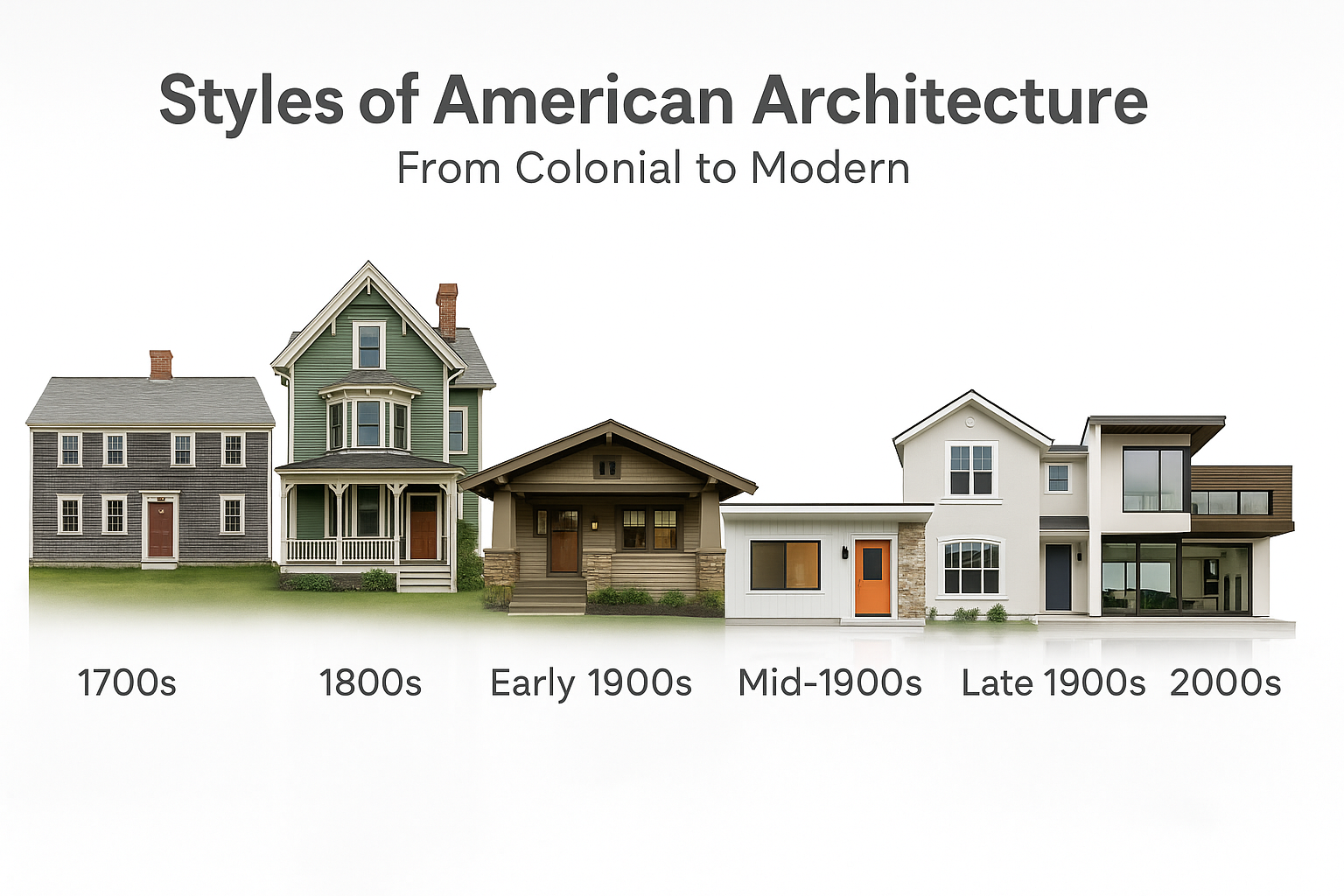
Every Major American House Style and What Defines It
American House Styles From Colonial to Modern
The full guide to American house styles. See what each era built, why it worked, and what still holds up today.
American homes are a timeline you can walk through. Each style came from the tools, materials, and priorities of its time. Some were built to survive harsh winters. Others to impress the neighbors. A few still work as well now as they did 200 years ago.
Here’s the straight breakdown. What each style looked like. Why it worked. And what’s worth keeping today.
American Home Design: What Changed and Why It Worked
American Houses: Styles, History, and How to Spot Them
From Timber Frames to Smart Homes: The Chain Keeps Going

The Complete Guide to U.S. House Styles
American houses did not just evolve in the past. The same forces of materials, technology, money, and taste still push them forward today. Steel framing, factory-built modules, solar roofing, and smart home systems are simply the newest step in a timeline that began with split logs and brick chimneys.
The pattern repeats itself. A style appears. People copy it. Builders adjust it. Another style moves in. Sometimes the change is a complete break, like Modernism after the Victorian age. Other times it is a remix, like Colonial Revival reshaping 1700s forms for 20th-century suburbs.
If you walk through a historic district and pay attention, you can almost see this chain in real time. Early houses sit on the oldest streets, with newer styles spreading outward. In between, you might spot hybrids: a Craftsman porch on a Queen Anne, a Ranch with Tudor gables. These are signs of owners updating their homes without rebuilding from scratch.
The real point is this: house styles show how people live and the future they’re building toward.
MUST READ — Colonial to Modern
A Field Guide to American Houses by Virginia Savage McAlester
The definitive reference for spotting, naming, and dating American house styles. Packed with drawings, photos, and real street examples.
→ Buy on Amazon
How to Apply This Knowledge
-
Walk new areas with fresh eyes — train yourself to date houses within a decade or two just from the roof and windows.
-
Photograph and label — keep your own visual style log.
-
Talk to local historical societies — they know the builders, the dates, and the quirks.
-
Use it in renovation planning — matching proportions and materials matters more than copying every trim detail.
-
Teach others — pointing out style clues to friends or kids sharpens your own eye.
The Story of American Houses: How One Style Led to the Next

American houses didn’t happen overnight. They stacked one idea on top of another, each shaped by climate, materials, budgets, and the skills of the people building them. If you know what to look for, you can walk down a street and read this history in the roofs, windows, and porches.
Colonial Beginnings: 1600s to early 1780s

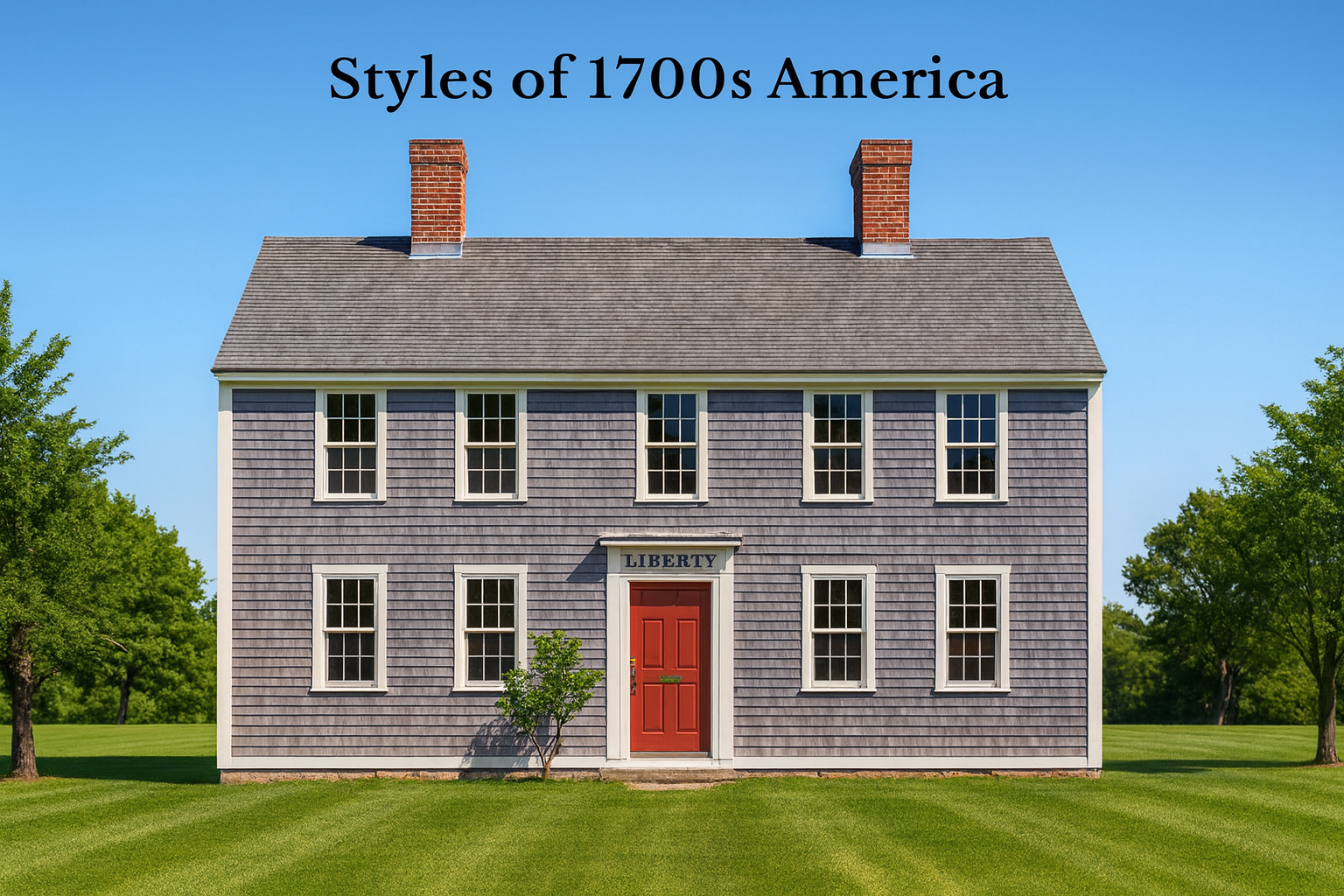
The first English settlers built for survival. They used whatever they could cut, split, or nail with the tools they had. Most houses were timber-framed boxes with steep roofs so rain and snow slid off fast. A thick chimney sat in the middle because that was the only heat source. Windows were small because glass was rare and expensive.

Colonial houses were symmetrical because that was the easiest way to frame them. Front doors usually sat in the center. Inside, rooms were small to hold heat. Ornament didn’t matter. Survival did.
Spot it today: Wide clapboard siding, steep rooflines, a centered front door, small multi-pane windows. New England towns still have originals standing.
American Colonial House Essentials
What They Looked Like
Simple boxes. One or two rooms deep. Wood in New England, brick in the South. Small windows. Steep roofs. Built to get through a winter without falling apart.
Key Features
● Steep gable roof
● Central chimney in cold regions, end chimneys in warmer ones
● Small, evenly spaced windows with shutters
● Symmetrical front
● Minimal trim or decoration
Why They Worked
Quick to build with hand tools. Compact enough to heat. The layout made sense and could be expanded later.
Keep This in a Renovation
The roof pitch. Narrow trim. Modest proportions. Avoid oversized modern details.
MUST READ
A Field Guide to American Houses – Virginia Savage McAlester. Clear photos and diagrams for spotting styles fast.
→ Buy on Amazon
Georgian Homes (1700–1780)
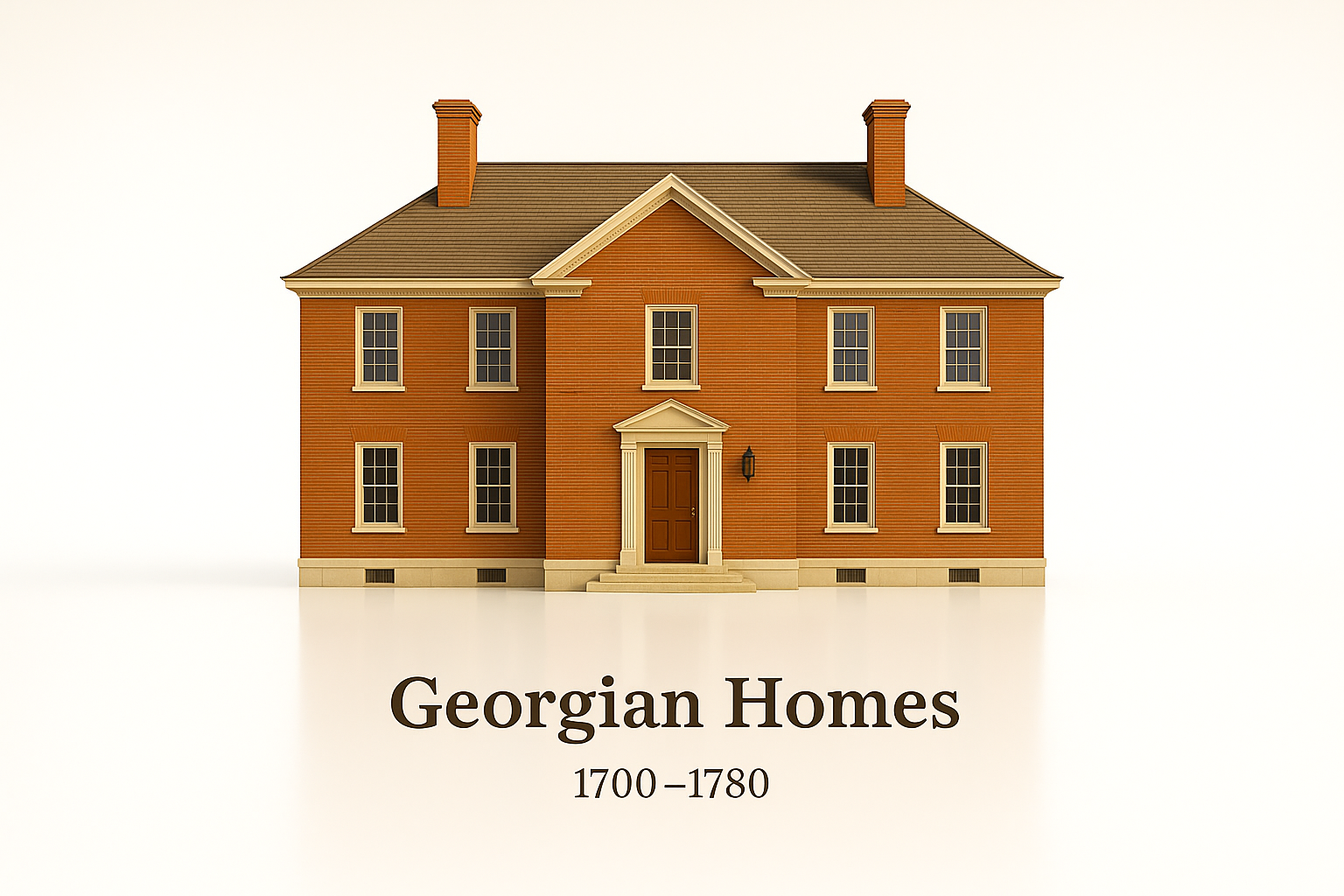
What They Looked Like
Colonial bones but with polish. Perfectly balanced front. Brick or wood clapboards. Wider trim. Better masonry and finer carpentry.
Key Features
● Symmetrical facade
● Paneled front door with crown or pediment
● Double-hung sash windows with small panes
● Central hallway inside
● Brick or wood siding
Why They Worked
Better tools meant cleaner lines. The look projected wealth and order in growing towns.
Keep This in a Renovation
Thin mortar joints on brick. True window proportions. Simple but exact details.
FIELD PICK
Marshalltown Brick Jointer – For sharp Georgian mortar work.
→ Buy on Amazon
Federal Style: Late 1700s to early 1800s
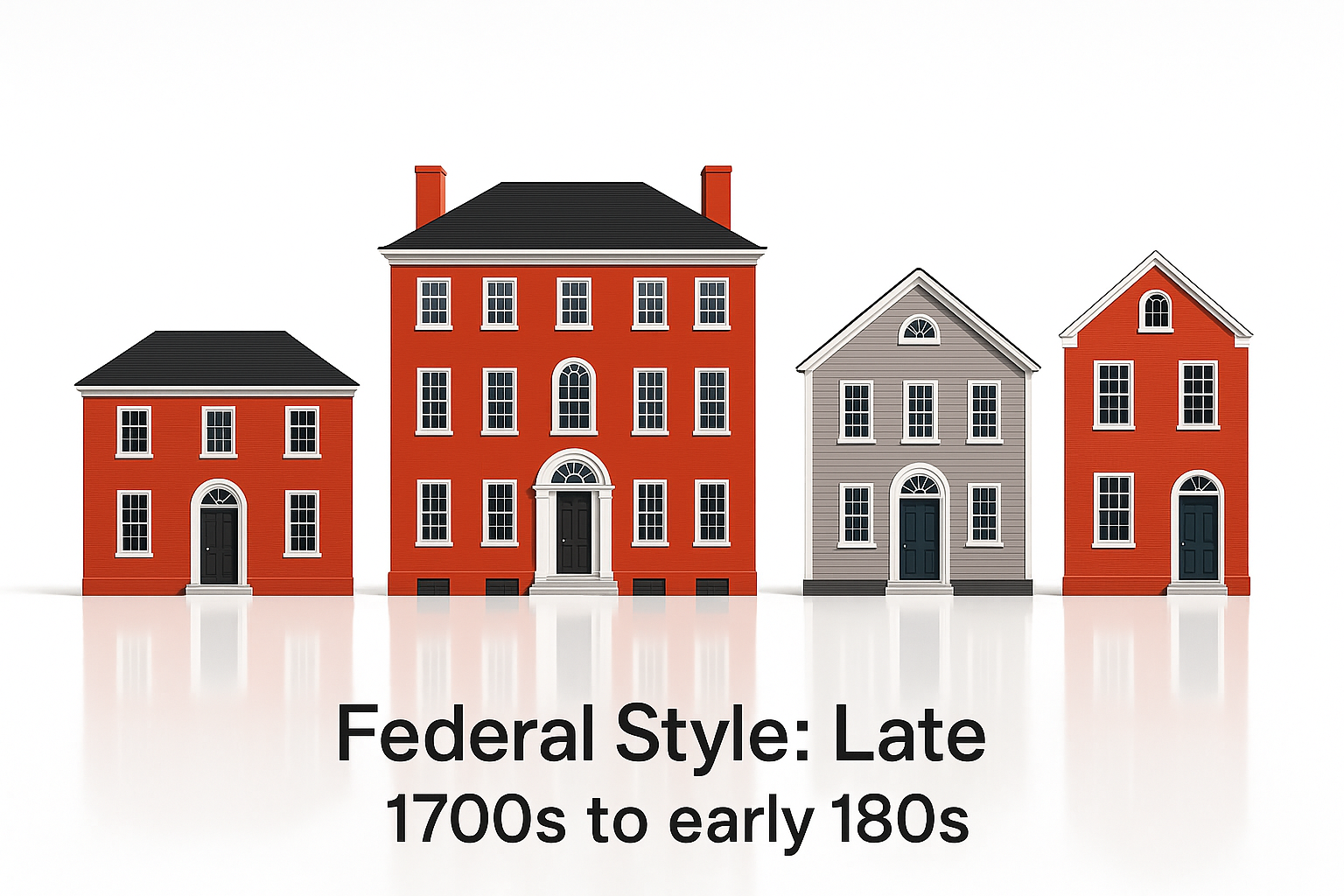
By the late 1700s, America wasn’t just surviving — it was feeling confident. Trade brought wealth, and houses started showing it. Federal style came straight from British Georgian architecture but trimmed down and lightened for the American market.
Builders like Charles Bulfinch in Boston and Samuel McIntire in Salem added details that had nothing to do with survival and everything to do with taste. Fan-shaped windows over the door. Thin muntins dividing window glass. Delicate cornices. The proportions stayed balanced, but the trim work spoke of refinement.
Spot it today: Fanlights above doors, slender window frames, brick or wood siding painted in soft historic colors, low-pitched roofs. Everything looks measured and polite.
Federal Homes Essentials
What They Looked Like
Slimmer and lighter than Georgian. Tall windows. Fanlight over the front door. More ornament, but fine and restrained.
Key Features
● Fanlights and sidelights at entry
● Low-pitched roofs, sometimes hidden with a railing
● Light-colored brick or wood
● Slim moldings, swags, and urn details
● Taller windows with thin muntins
Why They Worked
Kept the symmetry but added elegance. Ideal for cities and big towns.
Keep This in a Renovation
If restoring glass, choose reproduction hand-blown panes for the right shimmer.
MUST READ
Restoring a Federal House – Steven Parissien. How to keep historic lines without losing comfort.
→ Buy on Amazon
The Age of Mass Materials: Mid-1800s
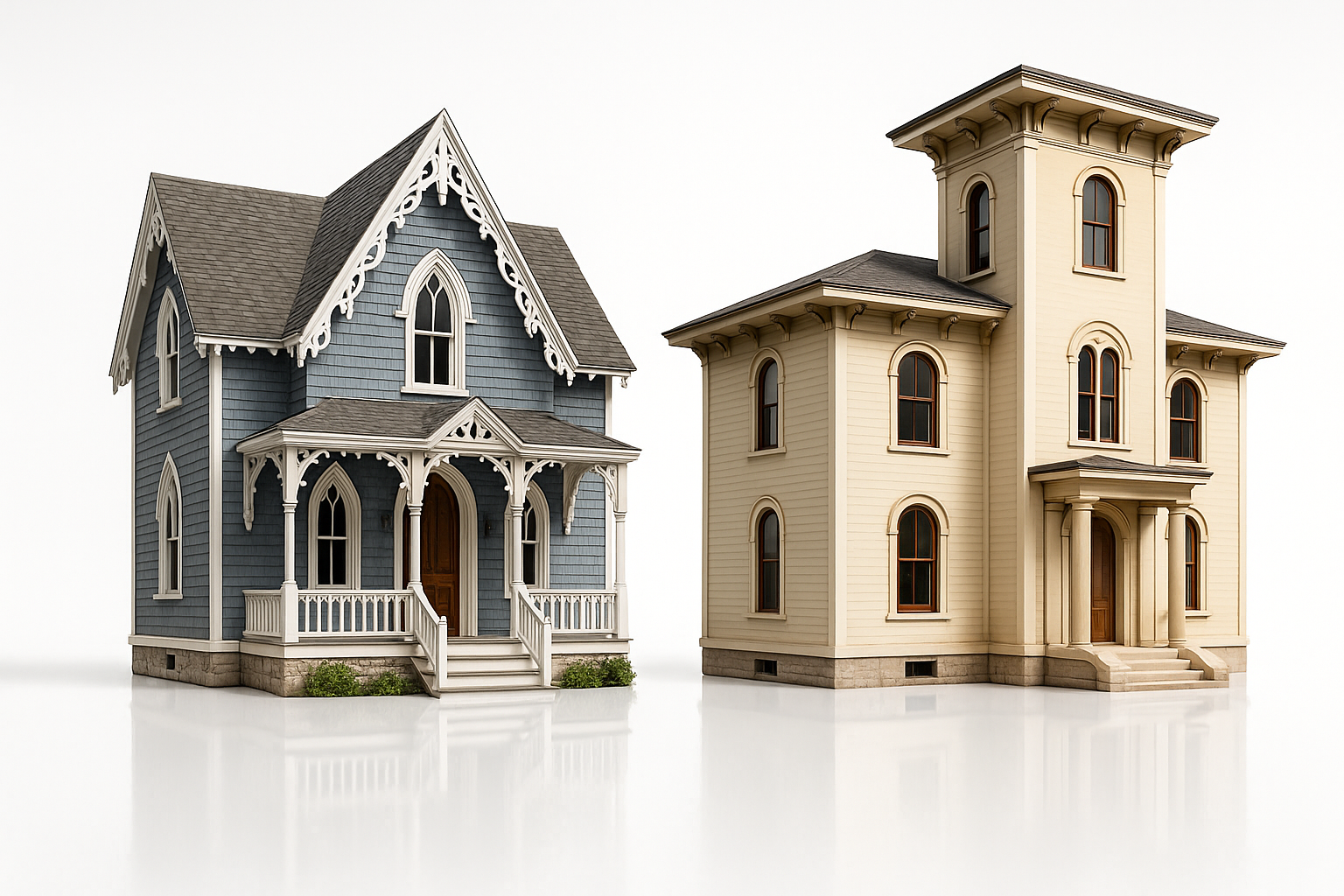
The Industrial Revolution changed the game. Railroads could now deliver lumber, nails, glass, and even decorative parts anywhere in the country. This meant you didn’t have to live near a mill or a port to get good materials.
Architects started pushing styles that would have been too expensive to build by hand.
Gothic Revival made its way from Europe to the U.S. with architects like Alexander Jackson Davis designing pointed arches, steep gables, and carved wooden vergeboards that hung from the roof edges. Churches loved it. Wealthy homeowners loved it too, because it made their houses look romantic and old-world.
Italianate houses also spread fast thanks to pattern books from Andrew Jackson Downing. They had tall, narrow windows, wide overhanging eaves, and decorative brackets under the roof. These looked nothing like the steep Gothic gables — they were softer, with a Mediterranean feel.
For the first time, styles became truly national because you could order the parts by train. A farmer in Kansas could have the same carved brackets as a banker in Boston.
Spot it today: For Gothic Revival, look for steep roofs, pointed window tops, and trim that looks like lace cut from wood. For Italianate, find square towers, long windows, and deep roof eaves with big brackets.
Greek Revival Homes (1825–1860)

What They Looked Like
Bold. White-painted wood or light brick meant to look like stone. Columns or pilasters up front. Heavy cornices. Wide trim. Often front-facing gables shaped like a temple roof.
Key Features
● Front gable with full-width pediment
● Tall, square columns or flat pilasters
● Wide frieze board under the roofline
● Symmetrical shape, though rural ones could be side-gabled farmhouses
● Entry doors with transoms and sidelights
Why They Worked
America was flexing its cultural muscle and copying ancient Greece. It made even modest houses feel official.
Keep This in a Renovation
Crisp white paint, sharp trim edges, and full-height shutters. Avoid over-ornamenting the gable — it should stay clean and strong.
FIELD PICK
Purdy 3-inch Angled Brush – For sharp trim lines in white paint jobs.
→ Buy on Amazon
Gothic Revival Homes (1840–1870)
What They Looked Like
Romantic and vertical. Pointed arch windows. Steep cross-gables. Decorative vergeboards (gingerbread trim). Often painted in earthy or deep tones instead of white.
Key Features
● Steeply pitched roofs with multiple gables
● Pointed arch or tall, narrow windows
● Decorative bargeboards at gable edges
● Asymmetrical layouts with porches and bays
● Vertical emphasis in every element
Why They Worked
Broke away from symmetry. Offered a dramatic profile and worked well on wooded lots or rural estates.
Keep This in a Renovation
The steep roof and tall windows. If replacing trim, match the depth and cut patterns exactly — thin plywood copies ruin the look.
MUST READ
A Field Guide to American Houses – Virginia Savage McAlester (Gothic Revival chapter shows all the variations).
→ Buy on Amazon
Italianate Homes (1840–1885)
What They Looked Like
Tall, boxy, and dressed up. Brackets under the wide eaves. Tall narrow windows with arched or curved tops. Sometimes paired with cupolas or towers for height.
Key Features
● Low-pitched or flat roof
● Wide overhanging eaves with brackets
● Tall narrow windows, often with hood moldings
● Square cupola or tower in larger houses
● Two or three stories
Why They Worked
They fit urban lots but still looked grand. Worked with brick, stone, or wood. Brackets made the style instantly recognizable.
Keep This in a Renovation
Replace missing brackets with solid wood copies. Match the roof overhang depth — shallow replacements ruin proportion.
FIELD PICK
DeWalt Cordless Brad Nailer – For secure bracket installation without splitting.
→ Buy on Amazon
Second Empire Homes (1855–1885)
What They Looked Like
Recognizable by their mansard roof. The roof alone gave a whole extra floor of living space. French-inspired details like dormers, cresting, and molded window hoods.
Key Features
● Mansard roof with slate shingles
● Dormer windows projecting from roof
● Brackets under eaves
● Tall windows, often with paired shutters
● Cresting or ironwork along roofline
Why They Worked
More space without widening the footprint. Popular for both city rowhouses and rural mansions.
Keep This in a Renovation
Preserve the mansard roof pitch. Use real slate or high-grade synthetic slate — cheap asphalt shingles destroy the profile.
MUST READ
Slate Roof Bible – Joseph Jenkins. Complete guide to preserving and restoring slate roofs.
→ Buy on Amazon
Stick Style Homes (1860–1890)
What They Looked Like
Early attempt to show the “bones” of the house. Decorative wood trim was arranged in grids or diagonals across the walls to suggest framing. Rooflines were steep, often with cross-gables.
Key Features
● Vertical, horizontal, and diagonal “stickwork” trim on walls
● Steeply pitched roofs with cross-gables
● Overhanging eaves with exposed rafters
● Tall narrow windows, often grouped
● Porches with diagonal or curved braces
Why They Worked
Made wood-frame construction look intentional and stylish. It was the in-between stage from Gothic Revival to Queen Anne.
Keep This in a Renovation
Replace missing stickwork with solid wood, not thin plywood. Paint trim in a contrasting color to the wall so it reads clearly.
FIELD PICK
Kreg Pocket Hole Jig 520PRO – For building precise wood trim details.
→ Buy on Amazon
Shingle Style Homes (1880–1900)
What They Looked Like
The relaxed cousin of Queen Anne. Same complex shapes, but covered in continuous wood shingles instead of painted clapboard and ornament.
Key Features
● Entire exterior covered in wood shingles
● Complex rooflines, often with gambrels
● Asymmetrical layouts with porches and verandas
● Large windows grouped together
● Minimal decorative trim — texture came from shingles
Why They Worked
Coastal durability and casual elegance. Shingles aged gracefully and handled salty air.
Keep This in a Renovation
Use cedar shingles and let them weather naturally, or stain in muted coastal tones. Avoid plastic siding — it kills the style.
FIELD PICK
Western Red Cedar Shingles – Clear grade for smooth, even weathering.
→ Buy on Amazon
Queen Anne: Late (1880–1910)
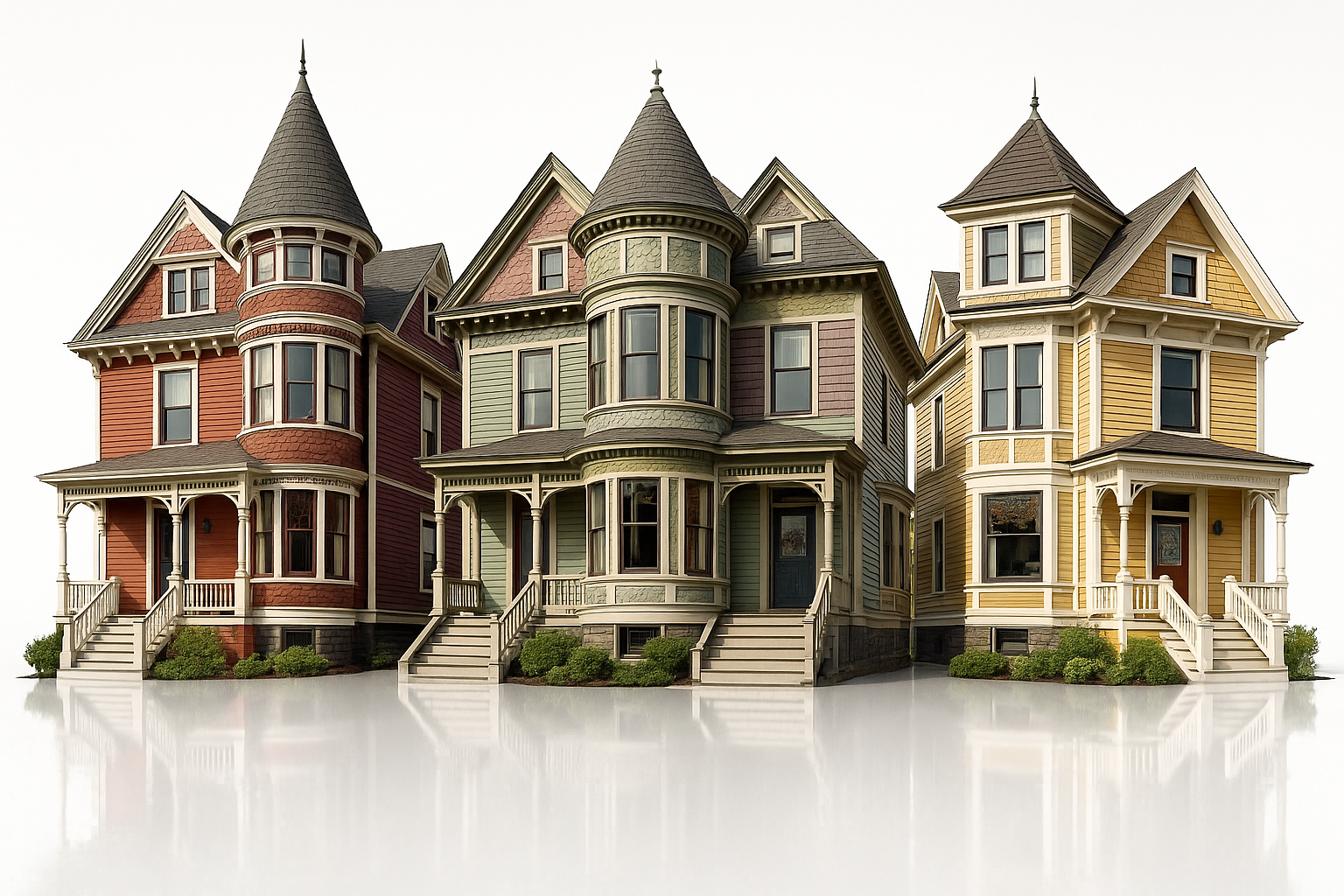
By the 1880s, ornament was no longer a luxury — it was a selling point. The Queen Anne style took full advantage of steam-powered saws that could cut curves, scallops, and complex patterns in wood.
These houses were playful. A single Queen Anne might have three or four types of siding — shingles, clapboard, patterned panels — all on the same wall. Rooflines jumped and twisted, with turrets pushing up like castle towers. Wraparound porches invited social life. Stained glass appeared in entryways and stairwells.
Carpenters could now build details quickly and cheaply, which meant middle-class families could own a house that looked like a custom showpiece.
Spot it today: Towers or turrets, mix of siding textures, busy rooflines, turned porch posts, stained glass windows. The more decorative variety, the more likely you’re looking at a Queen Anne.
American Queen Anne Homes Essentials
What They Looked Like
The high-drama style of the Victorian era. Complex rooflines, towers, wraparound porches, fancy shingles, and no surface left plain. Asymmetry was a badge of honor.
Key Features
● Steep irregular roofs with multiple gables
● Towers or turrets on corners
● Patterned shingles in gables
● Wraparound porches with turned posts and spindles
● Stained glass or leaded windows
Why They Worked
Showed off craftsmanship and wealth. Every surface was a chance to add detail.
Keep This in a Renovation
Don’t strip away the variety. Keep the mix of textures — clapboard, shingles, and ornamental trim. Replacing windows? Match the stained or leaded glass patterns.
MUST READ
The Victorian House Manual (2nd Edition)
If you own or work on a Victorian home, this is gold. It walks you through everything from fixing original woodwork to choosing paint that matches the period. The advice is clear, practical, and rooted in real restoration work.
Colonial Revival Homes (1880–1955)
What They Looked Like
A return to early American symmetry. Inspired by Georgian and Federal styles. Perfectly balanced windows, centered door, and classical details.
Key Features
● Symmetrical facade, often two stories
● Centered entry with pediment or portico
● Multi-pane double-hung windows with shutters
● Side-gabled or hipped roof
● Brick or clapboard siding
Why They Worked
Felt stable and “American.” Fit city lots and suburban plots alike.
Keep This in a Renovation
Match original window proportions and muntin patterns. Keep the shutters the right size — they should actually cover the window if closed.
MUST READ
Colonial Revival in America – Richard Guy Wilson. Packed with case studies and details.
→ Buy on Amazon
Craftsman Bungalows: 1900 to 1930s
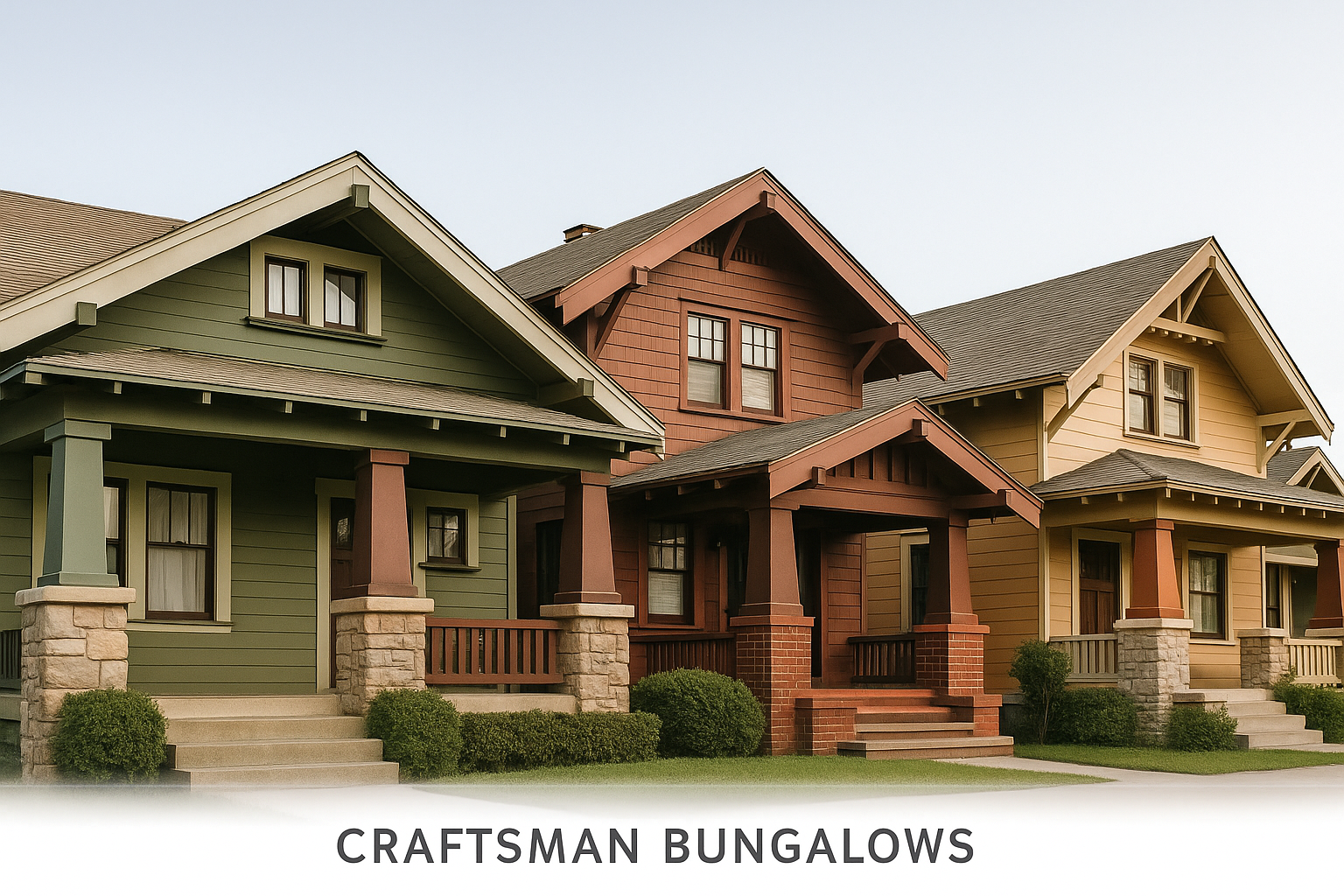
By 1900, some Americans were tired of the excess. The Queen Anne look felt busy, almost chaotic. The Arts and Crafts movement pushed back, valuing handmade work, honest materials, and simpler forms.
The Craftsman bungalow became its most popular expression. Architects Charles and Henry Greene in California led the way with homes that felt warm and grounded. Roofs were low-pitched with wide eaves. Rafters and beams were exposed, not hidden. Porch posts sat on heavy stone or brick piers. Inside, built-in cabinets, benches, and bookcases were standard.
This wasn’t just a style — it was a philosophy. You could see how the house was made. Wood joined to wood. Materials left in their natural finish. Even mass-produced bungalows kept that handcrafted look, thanks to kit houses from Sears and Aladdin that shipped across the country.
Spot it today: Deep porches with chunky posts, wide eaves with exposed rafters, stained wood trim, earth-tone paint, and low, welcoming rooflines.
MUST READ
Bungalow Style: Creating a Classic American Home
A beautiful, practical guide for making your Craftsman feel authentic—not staged. Covers interiors, materials, lighting, and built-in details. If you want that bungalow warmth without the fuss, this book shows how.
American Craftsman Homes Essentials
What They Looked Like
Low-slung, wide-porched bungalows with visible structure. Exposed rafters, tapered porch posts, and earthy colors. Built for human scale and comfort.
Key Features
● Low-pitched gabled roofs with wide overhangs
● Exposed rafters and decorative beams
● Tapered or square porch columns on stone or brick piers
● Built-in cabinetry, benches, and bookcases inside
● Earthy materials: wood, stone, brick
Why They Worked
Affordable, well-built, and human-friendly. Perfect for the new suburbs of the early 20th century.
Keep This in a Renovation
Don’t strip the built-ins. Use natural materials and warm tones. Keep the low, horizontal emphasis.
FIELD PICK
Minwax Provincial Wood Stain – Matches many original Craftsman interiors.
→ Buy on Amazon
Period Revivals: 1920s and 1930s
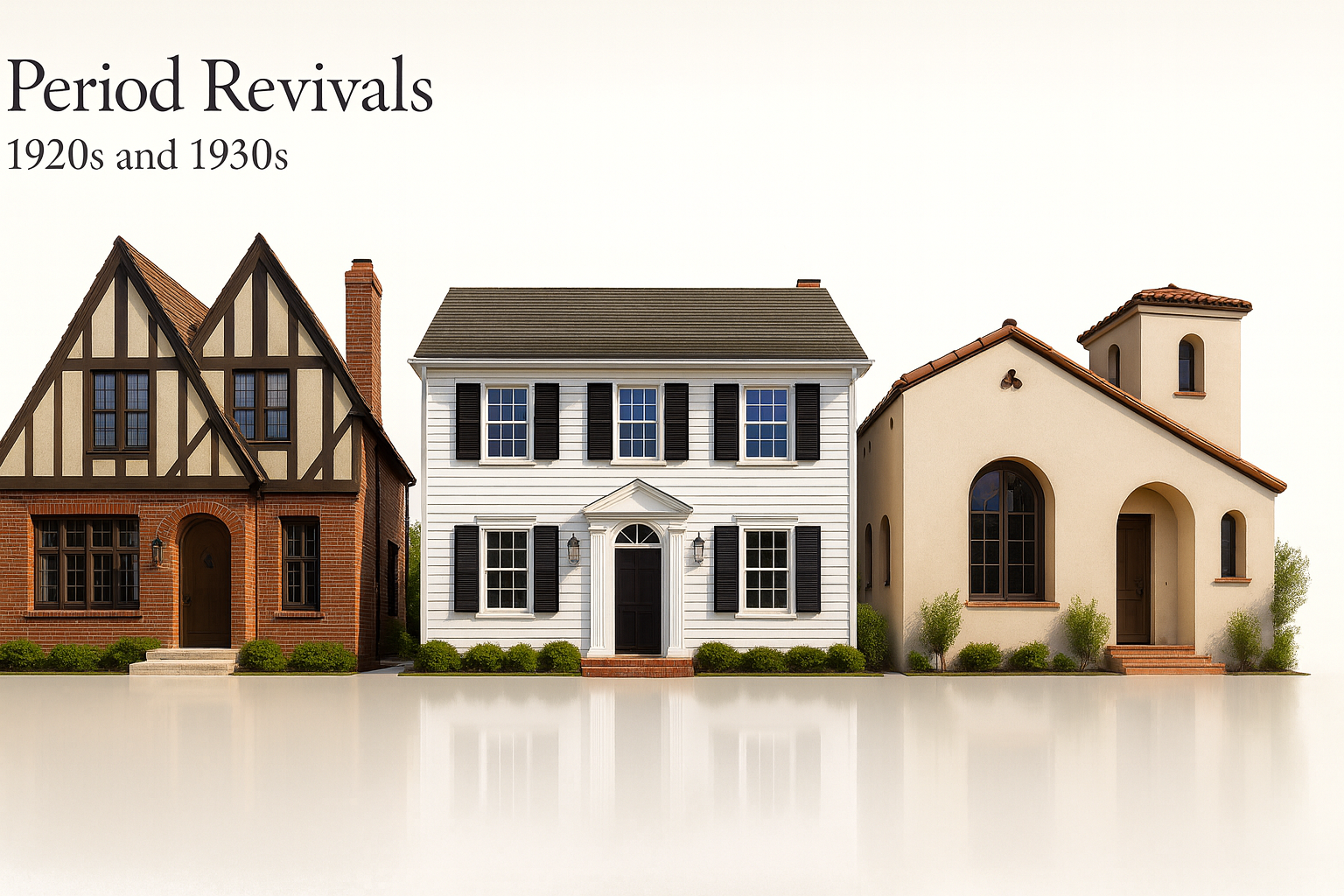
The 1920s roared, and with it came a fascination with the past — or at least a romanticized version of it. Builders borrowed details from European architecture, blending them into suburban homes that looked like they belonged in storybooks.
The Tudor Revival pulled steep gables, decorative half-timbering, and tall chimneys from medieval England. The Colonial Revival reimagined early American houses with symmetrical facades, paneled front doors, and shuttered windows. Spanish Colonial, French Provincial, and even Norman farmhouses all found their way into American suburbs.

These weren’t exact historical copies. They were modern houses with indoor plumbing, central heating, and electrical wiring — but they wore costumes that made them feel older and more charming.
Spot it today: For Tudor Revival, look for steeply pitched roofs, brick mixed with stucco and half-timbering, and tall, narrow windows. For Colonial Revival, look for perfect symmetry, central doors, and evenly spaced windows.
Tudor Revival Homes (1890–1940)
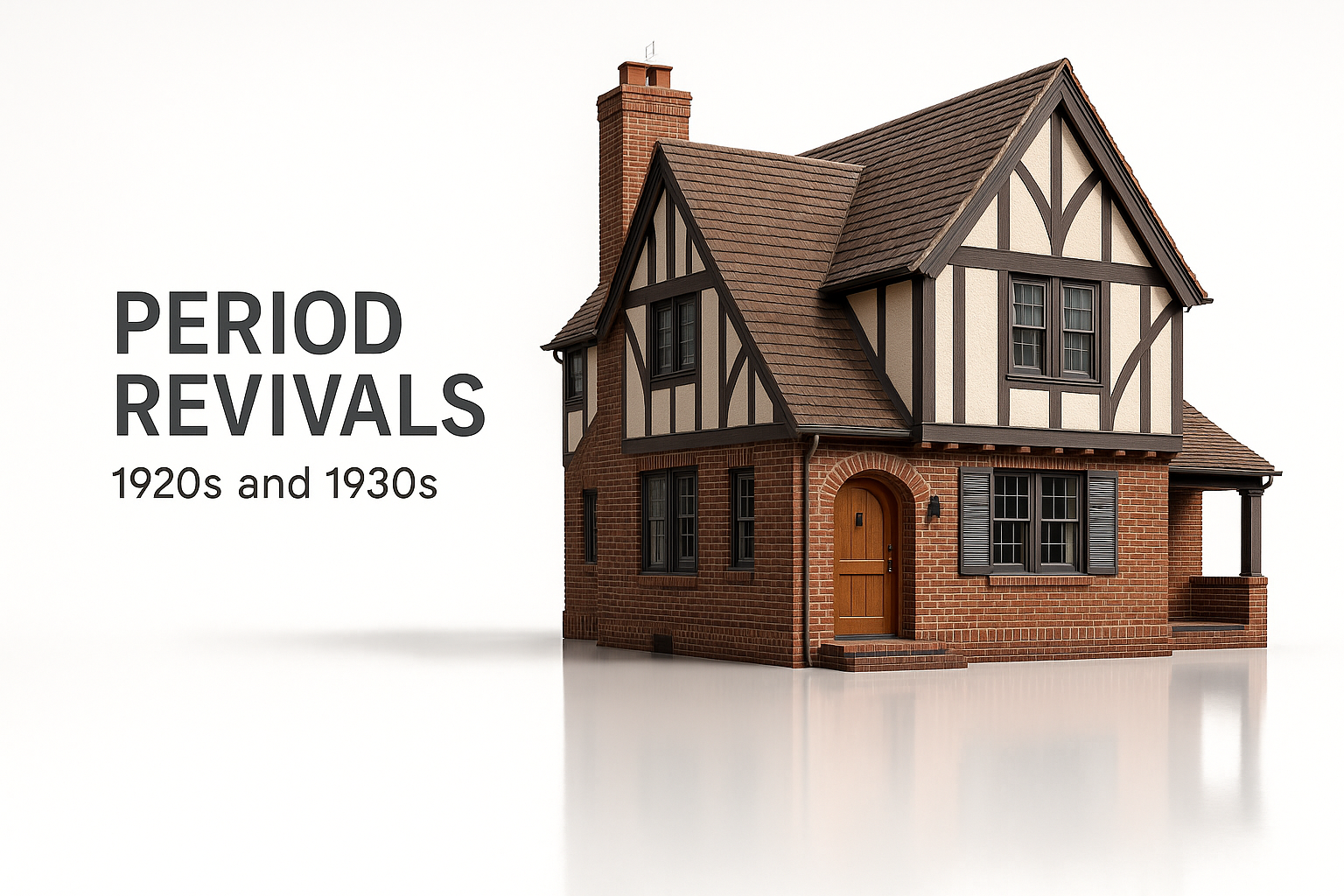
What They Looked Like
Storybook houses with steep gables, half-timbering, and tall narrow windows. Inspired by English medieval and Renaissance cottages. Popular in wealthy suburbs before WWII.
Key Features
● Steeply pitched roofs, often cross-gabled
● Decorative half-timbering with stucco infill
● Tall, narrow casement windows with multi-pane glass
● Massive chimneys, often with decorative chimney pots
● Arched doorways and leaded glass
Why They Worked
They looked romantic and rooted in tradition. Solid brick or stone construction gave them real presence.
Keep This in a Renovation
Match the half-timber pattern. Use real wood and plaster, not plastic panels. Keep the brick or stone chimney — it’s often the house’s best feature.
FIELD PICK
KILZ Exterior Masonry Primer – Protects and seals older brickwork before repainting.
→ Buy on Amazon
Minimal Traditional Homes (1935–1950)
What They Looked Like
The stripped-down cousin of Colonial and Tudor Revival. Built quickly during the Depression and post-war housing shortages. Simple roofs, little ornament, and compact layouts.
Key Features
● Low- to medium-pitched roofs
● Simplified trim and detailing
● One story or story-and-a-half
● Asymmetrical front with minimal porch
● Wood siding or brick veneer
Why They Worked
They were affordable, easy to build, and fit small lots. Perfect for first-time buyers in the 1940s.
Keep This in a Renovation
Don’t overwhelm them with fake ornament. Keep the simplicity, but update with fresh paint, better windows, and modern insulation.
MUST READ
A Field Guide to American Houses by Virginia Savage McAlester – The go-to visual reference for identifying styles like this.
→ Buy on Amazon
The Birth of the Ranch House: 1940s and 1950s

World War II reshaped the country — and housing with it. After the war, millions of veterans came home, started families, and needed houses fast. Builders learned speed from wartime production, and new suburbs spread like wildfire.
The Ranch house became the era’s signature style. Inspired by Spanish ranch buildings and early Modernist ideas, architects like Cliff May created single-story homes with open floor plans, sliding glass doors, and attached garages.
The garage moving to the front was no small change — it showed how cars had become central to daily life. Backyards became extensions of living rooms, with patios and grills replacing formal gardens.
The style was cheap to build, easy to expand, and perfect for flat suburban lots. Ranch houses were everywhere by the 1950s, stretching across entire neighborhoods from California to New Jersey.
Spot it today: Long, low rooflines, attached garage, large front windows, sliding glass doors, and a horizontal emphasis instead of vertical height.
What to Look For While Walking
● Roof shape: steep gables for Gothic or Tudor, low and wide for Ranch, flat planes for Modern.
● Window style: multi-pane sash in Colonials, tall narrow in Italianates, floor-to-ceiling in Contemporary.
● Porch design: wraparound in Queen Anne, heavy square posts in Craftsman, minimal or recessed in Modern.
● Materials: wood shingles, brick, stucco, stone — each era had its favorite.
When you see these clues together, you start to see the timeline. One style borrowing a roof from the last, another keeping the porch but changing the columns. It’s a chain of ideas stretching from the first timber frame in New England to the custom smart homes going up right now.
American Ranch Homes Essentials
What They Looked Like
The house that defined postwar America. Long, low, and open inside. Sliding glass doors to the backyard, attached garages, and single-level living.
Key Features
● Low-pitched roof with wide eaves
● Horizontal layout
● Large picture windows
● Attached garage
● Open floor plan
Why They Worked
Perfect for suburban sprawl and car culture. Easy indoor-outdoor flow.
Keep This in a Renovation
Open up the kitchen to living spaces. Keep the connection to the backyard. Avoid adding a second story — it ruins the long, low lines.
FIELD PICK
Andersen 400 Series Sliding Glass Door – Keeps the original look but with modern insulation.
→ Buy on Amazon
MUST READ — Modern & Mid-Century
Mid-Century Modern: The Complete Sourcebook
If you want to understand the clean lines, warm woods, and indoor-outdoor life of mid-century homes, this is it. Tons of floor plans, profiles, and interiors to show exactly how the look comes together—for real modernists, not stylists.
Mid-Century Modern Homes (1945–1970)
What They Looked Like
Flat or low-pitched roofs, big glass walls, and open plans. Blurred the line between inside and outside.
Key Features
● Flat or gently sloped roofs
● Floor-to-ceiling glass walls
● Post-and-beam construction
● Open floor plan with minimal walls
● Natural materials like wood, stone, and brick
Why They Worked
They felt fresh, optimistic, and in tune with the landscape.
Keep This in a Renovation
Preserve the glass walls and open spaces. Use slim window frames to keep the lightness. Avoid heavy trims that break the clean lines.
FIELD PICK
Philips Hue Smart Lighting – Works perfectly with open-plan, glass-heavy interiors without adding clutter.
→ Buy on Amazon
Split-Level Homes: 1960s to 1970s

The split-level wasn’t an accident. It was a response to two big things: sloped suburban lots and the need to separate living areas without adding more building height. Instead of stacking full floors, builders staggered them. The entry was often halfway between levels, with a short set of stairs up to bedrooms and a short set down to the family room or basement.
Inside, living spaces were connected but not fully open. The lower level often had a rec room, laundry, and direct garage access. The upper floor had the kitchen, dining, and bedrooms. Split-levels made it easier to fit houses into uneven sites while giving families more distinct zones.
Architect/Renovator Focus:
● Keep the flow logical when updating.
● If you open walls, make sure you don’t kill the unique level changes — they’re the character here.
● Entry stairs are visual focal points; choose railings and flooring that set the tone for the whole house.
American Split-Level Homes Essentials
What They Looked Like
Half-stair designs that separated living, sleeping, and recreation areas without taking up a larger footprint.
Key Features
● Multiple short staircases
● Living room, kitchen, dining on main level
● Bedrooms upstairs, family room or garage down
● Low-pitched roofs and horizontal lines
● Often combined brick and siding
Why They Worked
They fit hilly lots, separated noise, and felt bigger than they were.
Keep This in a Renovation
Update railings and finishes to modern safety codes. Open up the entry area to make it feel less chopped up.
MUST READ
Atomic Ranch: Midcentury Interiors – Even split-levels can rock mid-century style inside.
→ Buy on Amazon
Contemporary and Modernist Experiments: (1970–Present)
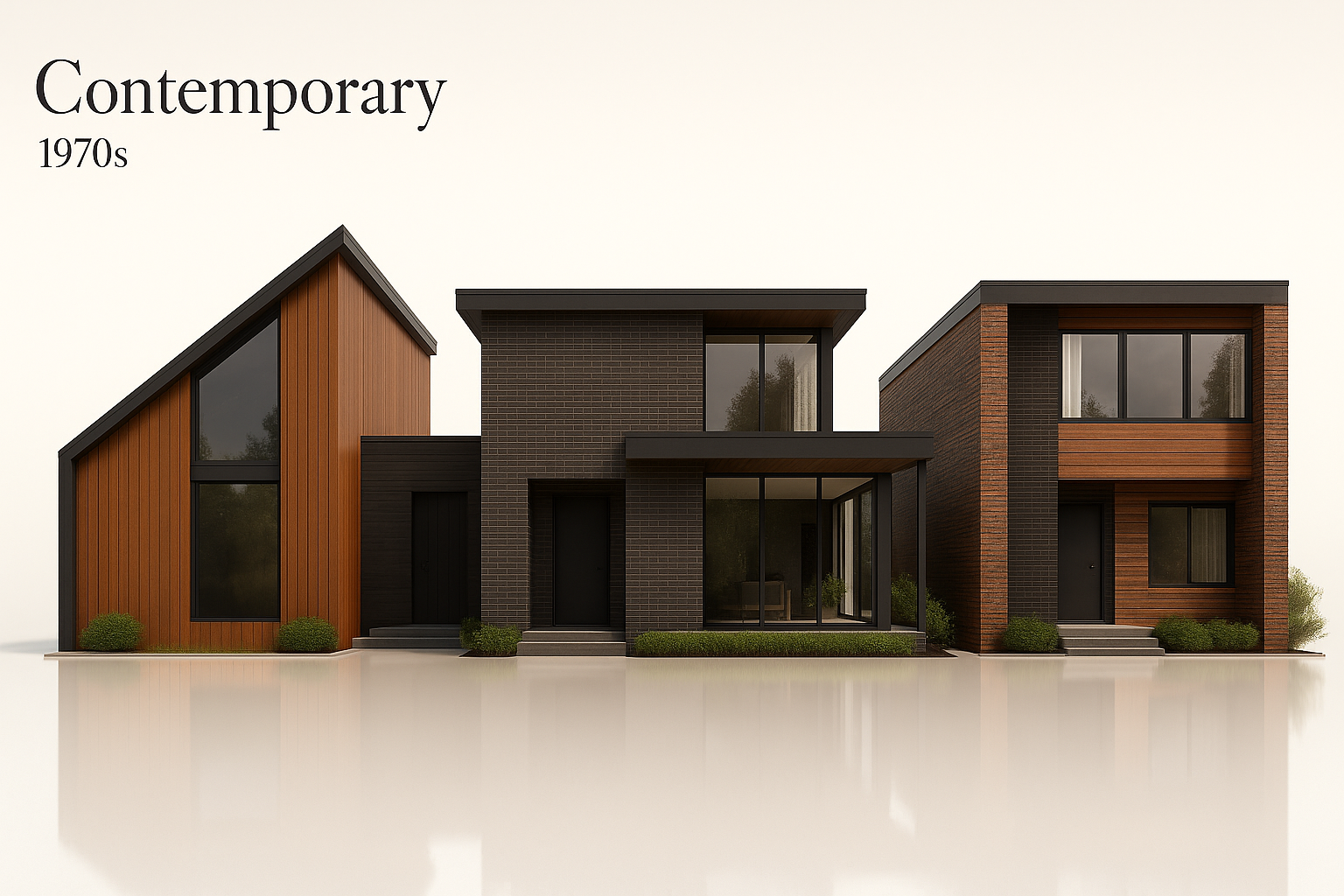
By the 1970s, some architects were pushing past the cookie-cutter suburb. Borrowing from Mid-Century Modern, they used flat or shed roofs, floor-to-ceiling windows, and geometric forms. Cedar siding and brick brought warmth to otherwise stark shapes. Atriums and interior gardens appeared in some designs.
Energy concerns after the oil crisis led to smaller windows on the north side, better insulation, and passive solar strategies. While not as widespread as Ranch houses, these homes showed how forward-thinking design could work in a residential setting.
Architect/Renovator Focus:
● Don’t strip away original geometry when modernizing — it’s the point of the style.
● Upgrade insulation and glazing for comfort without losing the big glass effect.
● Keep materials honest: real wood, brick, and stone age better than fakes.
MUST READ
Homes of Our Time: Contemporary Houses
If you want to understand what modern architecture looks like in the real world—not abstract lines but livable homes—this book is a goldmine. It explores homes that blend smart tech, high performance, and modern design in a way that feels grounded.
American Contemporary Homes Essentials
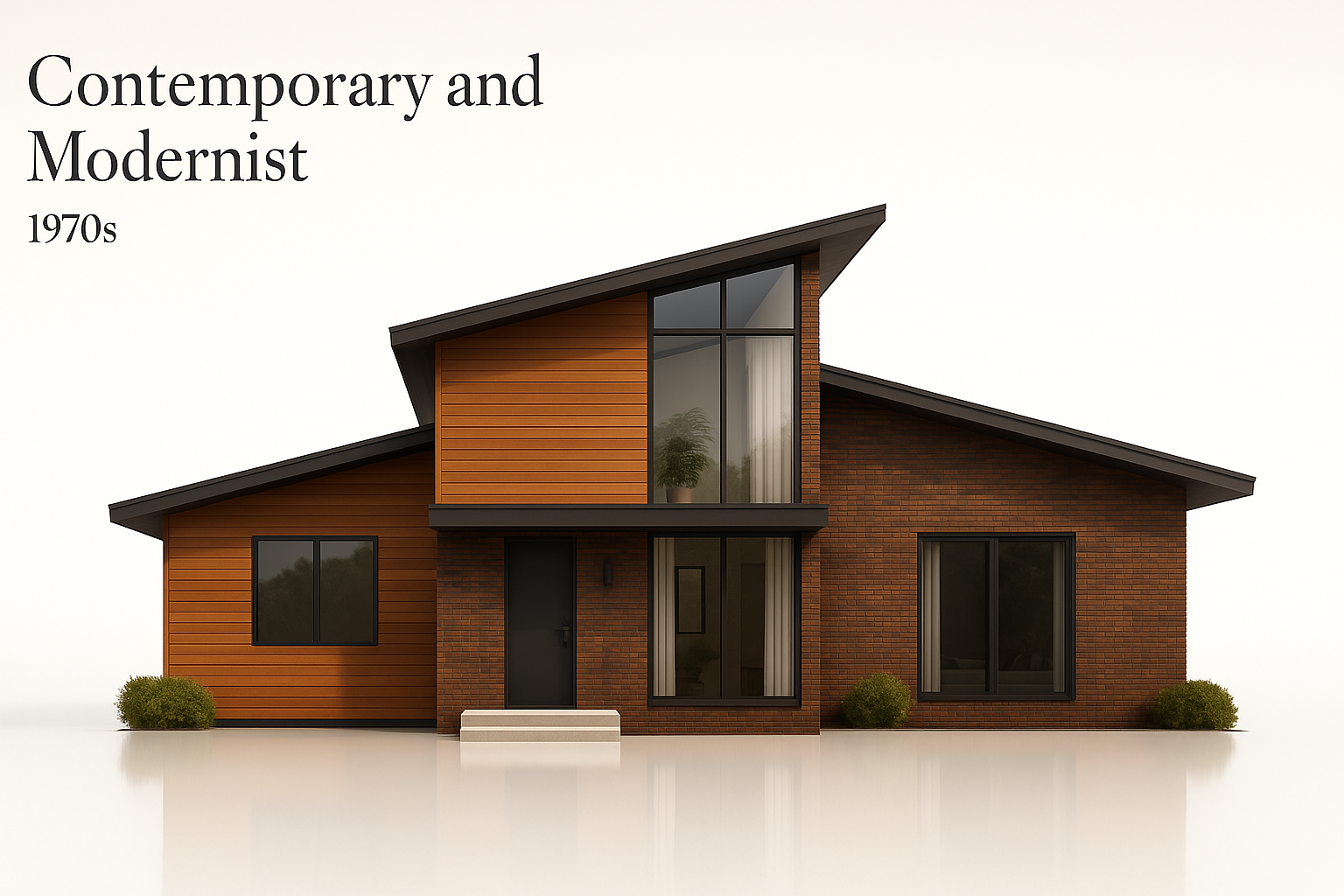
What They Looked Like
A broad term for houses that use the styles, tech, and materials of their moment. Often asymmetrical, with big windows and open interiors. Not tied to one historical influence.
Key Features
● Mixed materials: wood, steel, glass, stone
● Open floor plans
● Lots of natural light
● Integration with the site and landscape
● Energy-efficient systems
Why They Worked
They adapt to the client, climate, and budget. Architects use whatever works best — modern tech, reclaimed materials, or regional traditions.
Keep This in a Renovation
Focus on energy performance first. These homes are often good candidates for solar panels, triple-glazed windows, and heat-pump systems.
FIELD PICK
EcoSmart Tankless Water Heater – Space-saving and energy-efficient upgrade.
→ Buy on Amazon
Neo-Eclectic and Postmodern Mixes: 1980s to 1990s
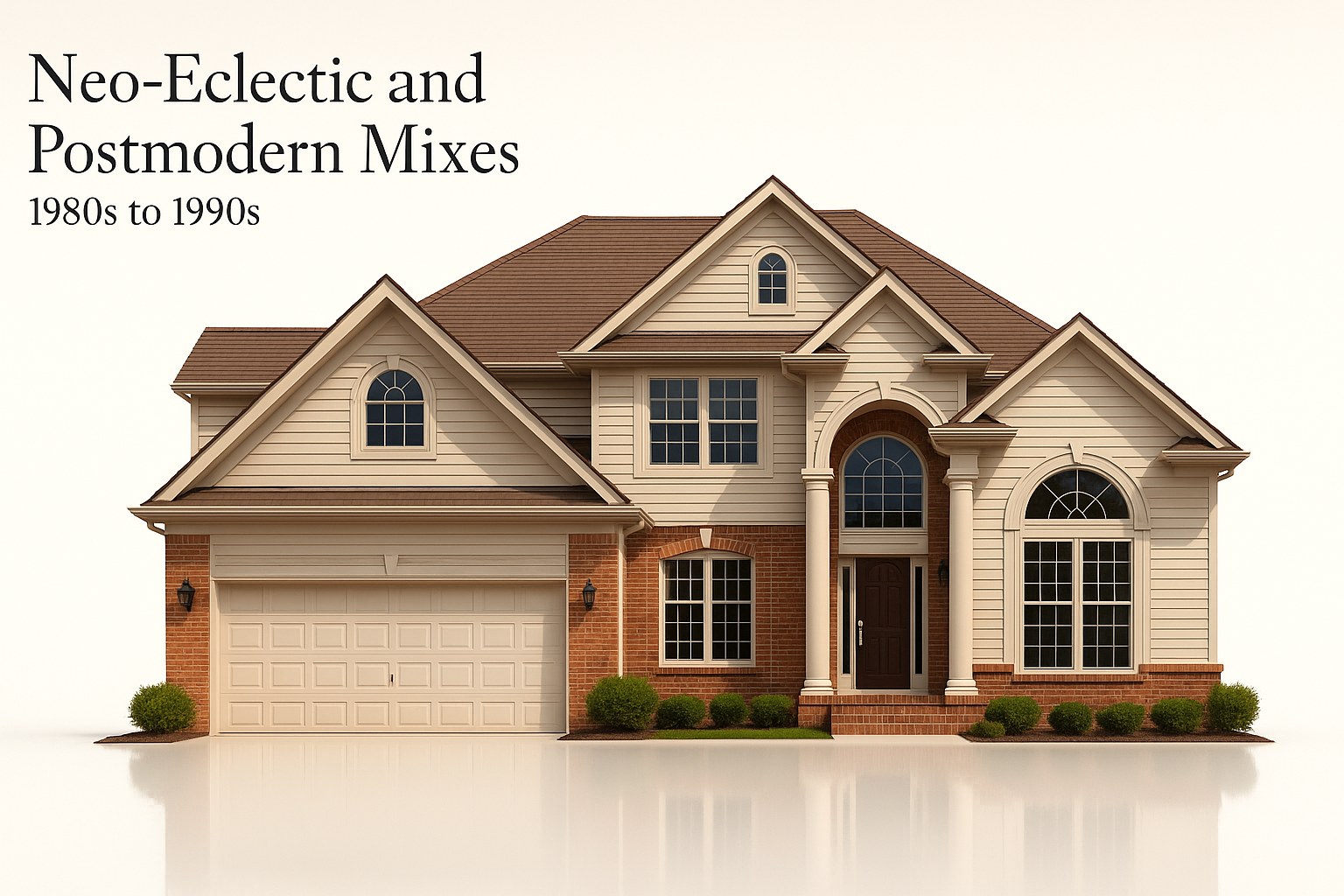
This era was about choice — and often about mixing too much. Builders pulled from every style, sometimes all in one house. Columns from Greek Revival, arches from Mediterranean, rooflines from Tudor, all mashed together. Some were well-executed, others turned into “McMansions” — oversized homes with decorative details that didn’t match the structure.
National builders could replicate these quickly, offering “upgrades” for every taste. This was less about architectural purity and more about visual impact and curb appeal in developments.
Architect/Renovator Focus:
● Simplify if you’re renovating — pick one or two key style cues and make them consistent.
● Watch proportions. Oversized columns or windows that don’t match scale can make a house feel awkward.
● Good landscaping can tone down overcomplicated facades.
Neo-Eclectic Homes Essentials
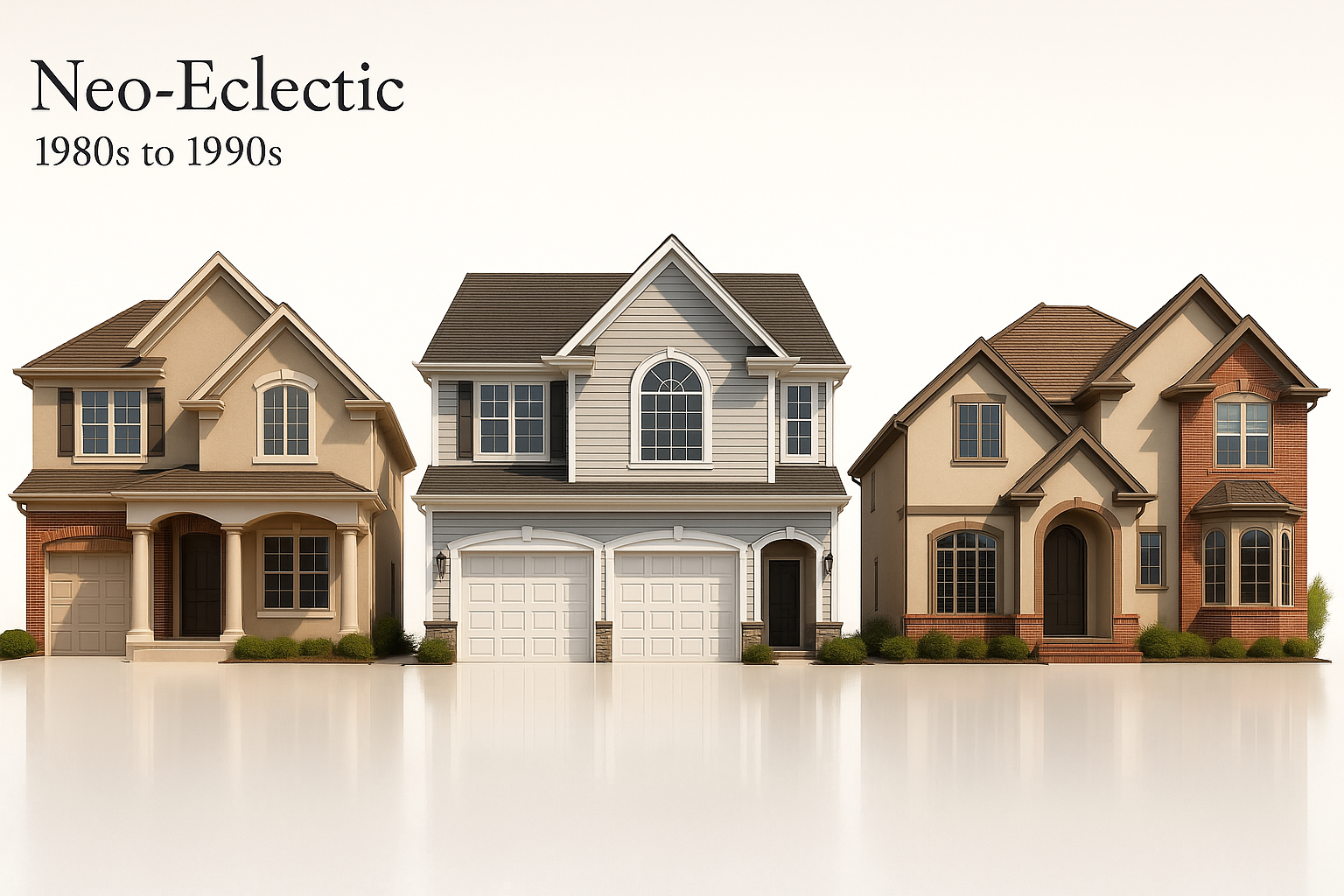
What They Looked Like
Mix-and-match designs pulling details from several historical styles. A single house might have Colonial windows, a Tudor gable, and Mediterranean arches.
Key Features
● Varied rooflines and complex shapes
● Decorative detailing borrowed from multiple styles
● Large footprints, often two stories
● Brick, stucco, stone, and siding all on one facade
Why They Worked
They gave builders flexibility and allowed for “custom” looks without custom budgets. Popular in large suburban developments.
Keep This in a Renovation
Simplify the exterior if it feels too busy. Cohesive paint and trim colors can pull together mismatched details.
MUST READ
A Visual Dictionary of Architecture – Useful for identifying the mix of features on these houses.
→ Buy on Amazon
McMansion Era (1990–2010)
What They Looked Like
Oversized, high-impact homes often built on the cheap. Grand entrances, multiple gables, oversized garages, and interiors loaded with decorative columns and double-height spaces.
Key Features
● 3,000+ square feet
● Two-story foyer
● Complex, steeply pitched roofs
● Large windows, sometimes poorly placed
● Stucco, vinyl siding, or fake stone
Why They Worked (Sort Of)
They made a statement in suburbs where size mattered more than proportion or detail.
Keep This in a Renovation
Improve curb appeal by editing down overcomplicated details. Upgrade insulation and replace builder-grade windows for better efficiency.
FIELD PICK
Ring Video Doorbell Pro – Fits well with large entryways and adds modern security.
→ Buy on Amazon
New Urbanist Homes (1990–Present)
What They Looked Like
A reaction to suburban sprawl. These homes are part of walkable neighborhoods with front porches, narrow lots, and garages hidden out back.
Key Features
● Traditional proportions with modern efficiency
● Narrow frontage, deeper lot
● Front porches and pedestrian-friendly design
● Detached or rear garages
● Mix of uses in the neighborhood
Why They Worked
They put community life back in focus. Porches and sidewalks encouraged neighbors to talk.
Keep This in a Renovation
Update kitchens and baths without losing the human-scale exterior. Keep porch railings and posts in proportion — they make the street feel right.
MUST READ
Suburban Nation by Andres Duany, Elizabeth Plater-Zyberk, and Jeff Speck – The book that explains New Urbanism’s goals and designs.
→ Buy on Amazon
The Modern Custom Home (2010–Present)
What They Look Like
Anything goes — as long as it works for the owner. Some are minimalist boxes. Others are net-zero energy builds. Many blend historical references with modern performance.
Key Features
● Tailored to site and client needs
● Smart home systems integrated into design
● High-performance materials and insulation
● Often designed by architects, not just builders
Why They Work
They solve for lifestyle, not just appearance. They can be scaled up or down without losing quality.
Keep This in a Renovation
Use the house’s flexibility to future-proof it: wiring for EV chargers, solar-ready roofs, and adaptable floor plans.
FIELD PICK
Nest Learning Thermostat – Smart climate control for both comfort and energy savings.
→ Buy on Amazon
The 2000s to Today: Custom Mixes and High-Tech Homes

Now, the “style” of a new American home is often a blend. You might see a farmhouse silhouette with black steel windows, or a mid-century low roofline with concrete and cedar siding. Tech integration is standard: smart thermostats, security, solar panels, and high-efficiency HVAC.
Some designers are also rethinking space — smaller footprints but better layouts, multi-use rooms, and outdoor areas treated like interior spaces. Sustainability is driving material choice, with recycled wood, permeable paving, and energy-efficient glazing becoming common.
Architect/Renovator Focus:
● Don’t copy trends without context — modern black windows look out of place on some historic streets.
● Integrate tech in ways that don’t dominate the space.
● Invest in building envelope performance first — insulation, windows, and sealing — before adding cosmetic upgrades.
Balloon Framing and Its Role in American Architecture

IMAGE: In balloon frame construction (1820s–1860s), the wall studs run uninterrupted from the sill plate at the foundation all the way to the top plate under the roof — one continuous piece for two stories.
Balloon framing changed how American houses looked and how fast they could be built. Before the 1830s, builders relied on heavy timber or solid masonry. Both were slow, expensive, and limited in shape. A Georgian mansion or early farmhouse was usually a simple box because every extra corner meant more labor and complex joinery.
In the early 1830s, Chicago builders began using long, lightweight studs that ran from the foundation to the roof in a single piece. Boards were nailed together instead of joined by hand-cut mortise and tenon. Lumber was milled to consistent sizes, so walls went up quickly with less skilled labor.
This shift made complex shapes affordable. Bay windows, turrets, and wraparound porches were no longer luxuries for the wealthy. By the mid-1800s, styles like Queen Anne and Second Empire flourished, using irregular layouts that balloon framing made practical.
Balloon framing dominated until the 1930s, when platform framing replaced it. But its legacy is in every American neighborhood. The variety of rooflines, asymmetrical facades, and playful floor plans that define Victorian suburbs and beyond all trace back to that 1830s breakthrough.
See also: How Balloon Framing Changed the Shape of American Houses
The Moment a House Becomes More Than a Building
Every era has that turning point when a house stops being just shelter and becomes a symbol.
In the 1700s, a grand doorway with a fanlight told the neighbors you had made it.
In the Victorian age, a turret and stained glass window meant you were part of the modern world.
In the midcentury suburbs, a sliding glass door said your life now flowed from kitchen to backyard barbecue.
Today, it might be solar panels, a green roof, or a black-framed wall of glass. In twenty years, it could be something we have not seen yet.
These moments matter because they show what a generation values. Comfort. Status. Innovation. Privacy. Openness. Sometimes all at once.
When you stand in front of an old house and notice the details, you are not just seeing wood, brick, and glass. You are looking at a time capsule of what people once dreamed life could be.
Why Knowing These Styles Makes You a Better Designer or Owner
If you understand how American house styles developed you stop guessing. You can design with intent instead of throwing features together because they look nice.
For professionals it means you can pick the right proportions, rooflines, and materials for the project instead of fighting the house’s DNA. If you are restoring you will know which details to keep and which updates will actually work.
For students it is a shortcut to designing houses that feel right in their setting. You will see why a Craftsman porch looks wrong on a Colonial or why certain window shapes ruin a Modern profile.
For homeowners and enthusiasts this knowledge helps you read your own house. You will know what was original, what was added later, and how to upgrade without wrecking the character.
The best designers and renovators are not just building. They are speaking the same visual language that has been in play for centuries and knowing the grammar is what makes the work timeless.
THE FULL LIST
American House Styles From 1600 to Today
The Real Story of American Homes and Their Features
The Visual Spotting Guide: Reading a Street Like a Timeline
If you know what to look for, a neighborhood is like a history book in 3D. Roofs, windows, porches, and materials tell you not just the style, but the period — and sometimes the exact kind of builder or architect who was active there.
Step 1: Start With the Roof
Roof shape is the fastest way to narrow down the era.
Steep and Symmetrical
● Colonial and Colonial Revival — steep gables, equal pitch both sides. Often with a central chimney in early examples.
● Gothic Revival — steep but with cross-gables and fancy trim at the edges.
● Tudor Revival — steep but broken up with secondary gables and dormers.
Low and Wide
● Ranch — one long sweep, often with deep eaves.
● Mid-century Modern — low pitch or even flat, with deep overhangs.
Complex and Ornamental
● Queen Anne — turrets, cross gables, odd angles.
● Neo-Eclectic / McMansion — multiple rooflines mashed together, sometimes with fake dormers.
Step 2: Read the Windows
Windows tell you the technology of the time.
Small, Multi-Pane
● Early Colonial — tiny because glass was expensive.
● Federal — bigger than Colonial but still divided panes. Look for thin muntins.
Tall and Narrow
● Italianate — often with arched tops and hood moldings.
● Second Empire — paired with mansard roofs.
Big Sheets of Glass
● Mid-century Modern — floor-to-ceiling panes.
● Contemporary — large but with energy-efficient framing.
Step 3: Check the Porch
The porch isn’t just decoration — it’s a climate adaptation.
Wraparound
● Queen Anne — social, decorative, often with turned spindles and railings.
● Folk Victorian — simpler trim but same idea.
Heavy Posts and Low Roof
● Craftsman — thick square or tapered columns on stone or brick piers.
Minimal or Recessed
● Modernist and Contemporary — entry set back, no ornate trim.
Step 4: Feel the Materials
Every era had its “go-to” materials, often driven by cost and technology.
Wood Clapboard
● Colonial, Federal, and Greek Revival — painted light colors in early years.
● Craftsman — stained or painted darker for earthy tones.
Brick
● Georgian, Federal, and many Colonial Revivals.
● Mid-century Modern — used as accent walls or fireplaces.
Stucco and Stone
● Spanish Colonial Revival — smooth stucco, clay tile roofs.
● Tudor Revival — stone at the base, half-timbering above.
Step 5: Look for Details That Date It
These are like timestamps on a house.
● Fanlight over the door — Federal period, late 1700s to early 1800s.
● Vergeboards (decorative gable trim) — Gothic Revival, mid-1800s.
● Half-timbering — Tudor Revival, 1920s–30s.
● Sliding glass doors to backyard — Ranch, post-1950s.
● Palladian windows — popular in 1980s Neo-Eclectic builds.
How to Train Your Eye
-
Pick one feature (roof, window, porch) and scan a whole block just for that.
-
Compare neighbors — newer builds often copy details from older homes nearby.
-
Notice additions — a Victorian with vinyl siding isn’t “new,” it’s covered.
-
Ask locals — long-time residents know who built what and when.
-
Visit historic districts — styles there are well-preserved and easier to learn from.
Why This Matters
When you can read a house’s style and era, you see more than just “old” or “modern.” You see the chain of ideas — how one generation borrowed from another, how new materials opened new shapes, and how culture shaped the streets we walk every day.
FAQs
1. Basics and Definitions
-
What’s the most common house style in the U.S.?
Answer: The Ranch. One story, low roofline, open flow, built by the millions after WWII. -
What’s the difference between a modular and a manufactured home?
Answer: Modular meets local building codes and is delivered in sections. Manufactured is built on a steel frame and follows HUD code. -
Are townhouses and rowhouses the same?
Answer: Rowhouses are identical in style and connected in a row. Townhouses may vary and can be part of newer planned communities. -
What counts as a bungalow?
Answer: One to one-and-a-half stories, wide porch, low roof, often with a dormer and open interior. -
What is an American Foursquare?
Answer: Boxy two-story, four equal rooms per floor, big porch, central dormer—popular 1890–1930. -
What makes a house “contemporary”?
Answer: A right-now design with clean shapes, big glass, energy efficiency, and often mixed materials. -
What’s the difference between a Cape Cod and a Colonial?
Answer: Cape Cod is smaller, steeper roof, dormers. Colonial is larger, more formal symmetry, central entry. -
What’s the smallest common American home style?
Answer: The shotgun house—narrow, rectangular, rooms in a straight line. -
What does “vernacular architecture” mean?
Answer: Local building style based on climate, available materials, and regional traditions. -
Are duplexes considered single-family?
Answer: No. They’re two separate units under one roof, usually counted as multi-family.
2. Style Spotting
-
How do I spot a Colonial Revival home?
Answer: Symmetrical front, central door with sidelights, multi-pane windows, often shutters. -
What defines a Craftsman bungalow?
Answer: Low-pitched roof, overhanging eaves, exposed rafters, and porches with thick square columns. -
How do you identify a Tudor Revival?
Answer: Steep gables, half-timbering, tall narrow windows, large chimneys. -
What features signal Queen Anne style?
Answer: Towers, wraparound porches, decorative wood trim, mixed siding textures. -
What are key indicators of Gothic Revival?
Answer: Pointed arches, steep roofs, ornate wooden vergeboards. -
What makes an Italianate house?
Answer: Tall narrow windows, low-pitched roof, decorative brackets under eaves. -
What is Prairie School architecture?
Answer: Long horizontal lines, wide eaves, flat or hipped roof, grouped windows. -
How about Spanish Colonial Revival?
Answer: Stucco walls, red tile roof, arches, wrought iron, colorful tile. -
What are the hallmarks of Mid-century Modern?
Answer: Flat planes, large glass, open floor plans, connection to outdoors. -
How do you spot a Ranch house?
Answer: Single story, long profile, low roof, sliding doors to the backyard.
3. History and Origins
-
Why were early Colonial homes so plain?
Answer: Limited tools, scarce materials, focus on survival over decoration. -
How did the Industrial Revolution change home styles?
Answer: Railroads allowed mass distribution of building parts, enabling nationwide styles. -
What made Queen Anne houses possible?
Answer: Steam-powered saws and mass-produced decorative wood trim. -
Why did the Craftsman style become popular?
Answer: Reaction to Victorian excess, focus on handcraft and honest materials. -
Why did Ranch houses dominate postwar America?
Answer: Cheap land, fast construction, GI Bill loans, suburban boom. -
Who was Cliff May?
Answer: California architect credited with popularizing the Ranch house. -
Why did split-level homes appear?
Answer: Sloped lots and desire for separated living spaces without full second floors. -
How did energy crises in the 1970s affect house design?
Answer: Smaller windows on cold sides, better insulation, and passive solar experiments. -
What drove the Neo-Eclectic boom of the 1980s and 90s?
Answer: Developers mixing historical details to market large suburban homes. -
Why are McMansions criticized?
Answer: Oversized, inconsistent design, often cheaply built with poor proportions.
4. Regional Styles
-
Where are Cape Cod houses most common?
Answer: New England and the Northeast. -
What’s the dominant style in the Southwest?
Answer: Spanish and Pueblo Revival with stucco and tile roofs. -
Where are Foursquares common?
Answer: Midwest and older streetcar suburbs. -
What’s the classic Southern style?
Answer: Greek Revival and plantation-style homes with large porches. -
What is popular in Florida?
Answer: Mediterranean Revival and coastal contemporary. -
Why do Pacific Northwest homes use so much wood?
Answer: Readily available lumber, wet climate requiring deep overhangs. -
Where will you find Shotgun houses?
Answer: New Orleans and other Southern port cities. -
Why do houses in desert areas have flat roofs?
Answer: Minimal rainfall makes pitched roofs unnecessary. -
What’s popular in the Rocky Mountains?
Answer: Rustic lodge style with logs, stone, and steep roofs for snow. -
Why are basements rare in the South?
Answer: High water tables and soil conditions make them impractical.
5. Renovation and Restoration
-
How can I modernize a Victorian without losing character?
Answer: Upgrade systems and kitchen/baths while keeping woodwork, trim, and exterior details. -
Can I paint brick on a historic home?
Answer: You can, but it’s irreversible and can trap moisture. -
How do I restore original wood windows?
Answer: Strip paint, repair rot, add weatherstripping, and use storm windows. -
What’s the best siding for a Craftsman renovation?
Answer: Wood shingles or lap siding in historically accurate colors. -
Can you open up a floor plan in a Colonial?
Answer: Yes, but you’ll need structural work—most walls are load-bearing. -
What’s the cheapest way to add curb appeal?
Answer: Fresh paint, new lighting, landscaping, and a cleaned-up entry. -
Should I remove aluminum siding from an old house?
Answer: Only if the original siding underneath is salvageable. -
How do you add insulation to an old brick home?
Answer: Interior insulation or exterior cladding—never fill solid brick walls with foam. -
What’s the best roof for historic homes?
Answer: Match the original—slate, wood shake, or standing seam metal. -
Can I put solar panels on a historic house?
Answer: Yes, but place them on rear-facing roofs to avoid visual conflict.
6. Buying and Selling
-
Which styles hold value best?
Answer: Timeless ones—Colonial, Craftsman, mid-century Modern. -
Are Victorian homes expensive to maintain?
Answer: Yes—ornate details and age drive up upkeep. -
Do modern homes sell faster?
Answer: In some markets, yes—buyers like move-in ready. -
Which styles are cheaper to insure?
Answer: Newer builds with fire-resistant materials. -
Are flat-roof homes harder to sell?
Answer: Sometimes—they need more maintenance and don’t appeal to everyone.
7. Interiors and Layouts
-
What’s an open-concept floor plan?
Answer: Few walls, merging kitchen, dining, and living into one space. -
Why do older homes have small kitchens?
Answer: Cooking was isolated work, not part of entertaining. -
What’s a parlor in old houses?
Answer: A formal sitting room for guests, now often a den or office. -
Why are ceilings higher in historic homes?
Answer: Better air circulation before AC, and a sign of wealth. -
What’s the point of a formal dining room?
Answer: Tradition. It’s mostly for special occasions now.
8. Materials and Construction
-
Why did so many mid-century homes use asbestos?
Answer: It was cheap, fireproof, and common before health risks were known. -
What’s balloon framing?
Answer: Continuous wall studs from foundation to roof—now replaced by platform framing. -
Why is plaster better than drywall?
Answer: More durable and soundproof, but labor-intensive. -
Why did lead paint last so long?
Answer: It was durable, glossy, and resistant to mold. -
Are stone houses more energy efficient?
Answer: They’re slow to heat and cool—good thermal mass but poor insulation.
9. Future Trends
-
Will modern farmhouses last as a trend?
Answer: Likely yes—simple lines and rustic materials adapt well. -
What’s the future of suburban homes?
Answer: Smaller lots, more shared spaces, better energy use. -
Will 3D-printed homes become common?
Answer: Possibly for affordable housing, but codes and acceptance take time. -
What’s replacing granite countertops?
Answer: Quartz, sintered stone, butcher block in some markets. -
Are tiny homes here to stay?
Answer: As a niche, yes—downsizers and eco-minded buyers love them.
10. Homeowner and DIY Questions
-
How do I find my home’s style?
Answer: Look at roof shape, window arrangement, siding, and porch. -
Can you mix architectural styles?
Answer: Yes—if you do it intentionally with balance. -
How do I add storage without ruining style?
Answer: Built-ins that match trim and materials. -
What’s the easiest style to maintain?
Answer: Ranch or modern—simple rooflines, fewer details to paint. -
Should I keep original hardwood floors?
Answer: Yes—refinish instead of replacing.
11. Odd and Specific
-
Why do some houses have fake shutters?
Answer: Decorative only—too small to actually close. -
What’s with split front doors?
Answer: Dutch doors—keep animals out, let air in. -
Why are garages bigger now?
Answer: Cars are bigger and people store more stuff. -
Why do some houses have transom windows?
Answer: To let light and air flow between rooms. -
Why are staircases so steep in old houses?
Answer: Smaller footprints meant saving space.
12. Climate and Performance
-
What styles work best in hot climates?
Answer: Spanish, Mediterranean, or Modern with shading. -
What’s best for snow country?
Answer: Steep roofs like A-frame or chalet. -
Why are raised houses common in flood zones?
Answer: To protect living space from water damage. -
Do basements make houses colder?
Answer: Not if insulated—can even help regulate temperature. -
Which styles are best for wind resistance?
Answer: Low, compact shapes like Ranch or dome homes.
13. Culture and Lifestyle
-
Why do Americans love porches?
Answer: Social space, shade, and connection to the street. -
Why do homes have “formal” and “informal” spaces?
Answer: Tradition—public rooms up front, private in back. -
What’s the appeal of mid-century Modern?
Answer: Clean lines, indoor-outdoor flow, iconic furniture. -
Why are fireplaces still popular?
Answer: Comfort and tradition—even with modern heating. -
Why do newer homes have more bathrooms?
Answer: Privacy and convenience—one per bedroom is common now.
14. Learning and Careers
-
Why should architecture students study old styles?
Answer: To understand proportion, materials, and detail logic. -
Can knowing styles help in real estate?
Answer: Yes—it builds trust with clients and adds expertise. -
Is it worth hiring a historic consultant?
Answer: For major restorations, absolutely—saves costly mistakes. -
How do you photograph houses well?
Answer: Shoot at dawn or dusk, avoid distortion, frame details. -
Can you design a “new” historic style?
Answer: Yes—adapt old proportions with modern materials.
15. Just for Fun
-
What’s the rarest house style in America?
Answer: Octagon houses—popular for a short time in the 1850s. -
What style did Frank Lloyd Wright pioneer?
Answer: Prairie School and later Usonian homes. -
Which style has the fanciest woodwork?
Answer: High Victorian or Queen Anne. -
Which style has the most glass?
Answer: Mid-century Modern and Contemporary. -
Which style ages best?
Answer: Craftsman and Colonial Revival—solid materials, timeless lines.
Resources
Books and online guides—to help you understand, identify, and work with American house styles. They come from experts, enthusiasts, and preservationists.
Key Books You’ll Actually Use
-
A Field Guide to American Houses (Revised) by Virginia Savage McAlester
The definitive reference. Packed with photos, drawings, and breakdowns of nearly fifty house styles—from Colonial to Ranch. A favorite of architects, students, and home enthusiasts alike. -
Bricks and Brownstone: The New York Row House 1783–1929 by Charles Lockwood (updated by Patrick W. Ciccone & Dylan Chandler)
The visual history of NYC brownstones—from Federal to Romanesque Revival—packed with photos and stylistic context. Great for urban style spotting.
Helpful Online References
-
National Register of Historic Places – Architectural Style Categories
Official national classifications with examples like Greek Revival, Queen Anne, Pueblo Revival, and more—perfect for preserving and restoration work. -
Library of Congress – House History Guide: Architectural Styles
A thorough guide to identifying your home’s style and period—great for historical research or renovation planning.