

Greek Revival: Working with a Classic
Greek Revival is often painted as marble fronts and postcard columns. In practice, it is proportion, rhythm, and getting balance into walls and openings so a building feels steady.
I’ve used it on projects where clients wanted presence without ornament overload. A pair of Doric shafts at the entry can hold more weight than a dozen decorative gestures. Symmetry in windows and doors calms a façade even when budgets are tight. Pediments and gable lines give focus. These are not just borrowed shapes—they’re moves that make a plan read clean.
If you want to see how earlier builders worked with proportion and stone, Ancient Roman Architecture: Techniques, Structures, and Impact is worth reviewing. Rome’s lessons on mass and order fed directly into the Greek Revival boom of the 1800s.
📘 FIELD PICK
Ten Books on Architecture – Vitruvius
The oldest surviving manual by an architect. Dry at times, but it forces you to think about proportion and site the way builders did two thousand years ago.
Greek Revival Under Pressure

Greek Revival caught on because it solved a problem. Cities wanted buildings that looked permanent without the cost of carved stone. Builders answered with wood fronts cut to mimic marble, plaster columns that could be raised in weeks, and proportions that read strong even when budgets were thin. It was a style born from compromise, not luxury.
In America the push was political too. Courthouses and banks needed a skin that projected stability. Columns and pediments delivered that signal fast. I’ve worked on restorations where you peel back the plaster and see rough timber frames holding the whole thing up. It’s theater, but it works—the façade carries the weight of trust even when the structure behind it is ordinary.
That tension—between what’s real and what’s projected—is why the style still hooks people today. A pair of tall, balanced openings can give a house dignity without a dollar wasted on ornament. That move is as useful on a job site now as it was in 1830.
For a sense of how older builders managed the same balance of mass and order, see Ancient Roman Architecture: Techniques, Structures, and Impact. The Roman playbook fed into the Greek Revival boom, not through marble temples, but through the logic of how to make civic buildings read strong.
📘 FIELD PICK
Ten Books on Architecture – Vitruvius
Dry in places, but it makes you confront proportion, weight, and site like a working builder. That voice still cuts through two thousand years later.
Related: Understanding 1850 House Styles
KEY CHARACTERISTIC
Greek Revival Moves That Hold Up
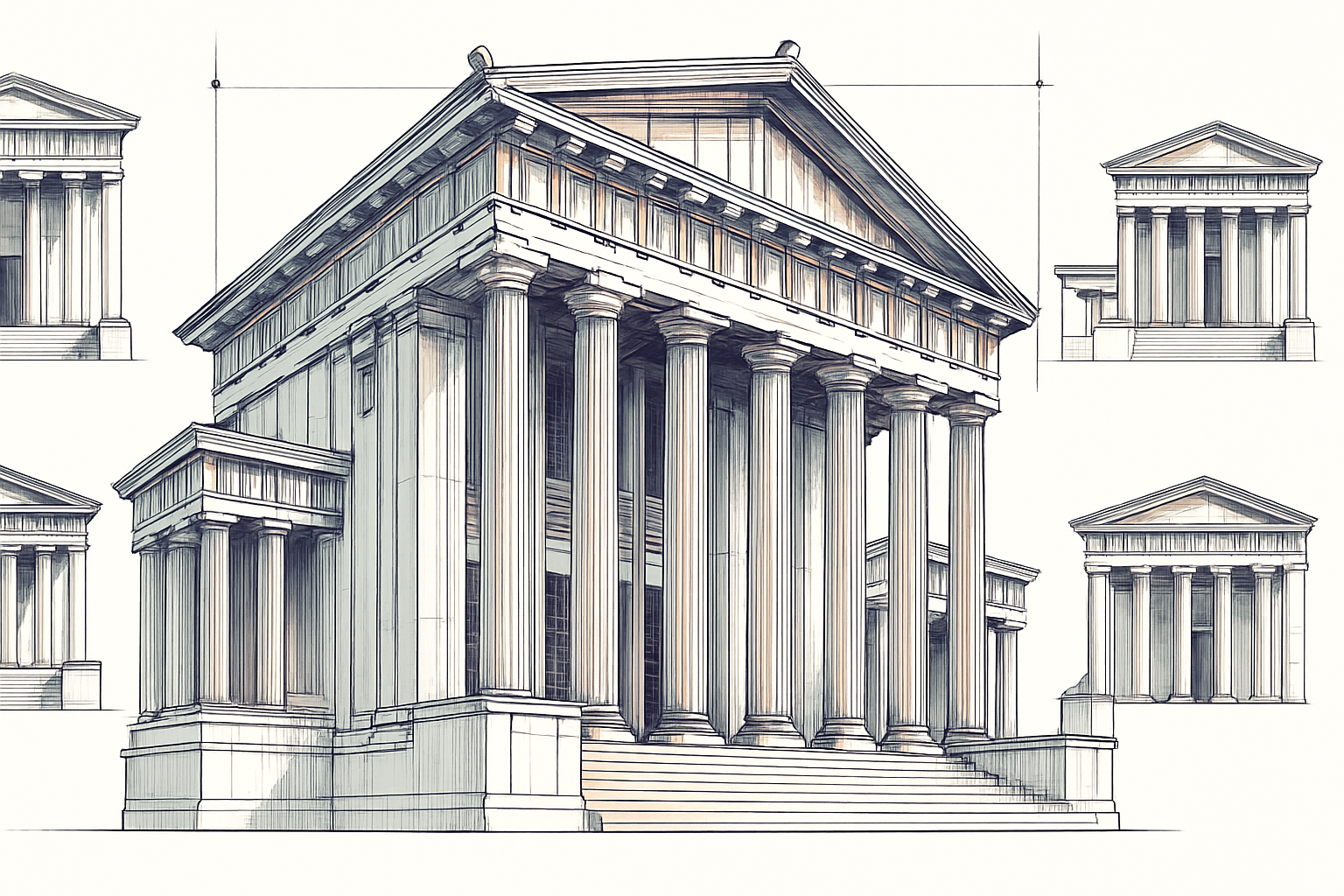
Columns that Set the Tone
Clients always notice the columns first. On drawings they look decorative. On site they’re what makes the entry stand. Doric and Ionic carry most of the load in houses because they’re quicker to cut, easier to stand, and still read strong. Corinthian looks impressive but I’ve only seen it worth the cost on banks and courthouses. Too much carving, too much upkeep for homes.
Proportion That Doesn’t Forgive
Line up doors, windows, and stairs or the whole façade slips. One off-center opening ruins the calm. I’ve had to tear out a wall once because a framer “eyeballed” a window bay. That mistake read from the street. If you want to trace where this obsession started, see Ancient Greek Architecture: Foundations, Features, and Influence.
Materials You Can Trust
Nineteenth-century builders often faked stone with painted wood. It fooled from a distance, not up close. I tell clients now: put stone where people touch, use wood where it can weather, skip the thin veneers. Once they peel, the whole design looks cheap.
Details that Carry Weight
Cornices and friezes don’t need to be fancy. One heavy cornice at the roofline can hold the whole composition. I’ve seen projects collapse into costume when every edge was dressed up. Shadows from a clean cut often do more than carving.
Windows that Lift
Tall, narrow windows bring in light and pull façades upward. Add shutters only if they fit the frame. Badly sized shutters look like props nailed on. Done right, this one move can carry a whole house.
📘 FIELD PICK
Architecture: A Visual History – Jonathan Glancey
I keep this one at the desk. Not for theory, but for the cutaway drawings that remind you how pieces actually fit. The Pantheon pages alone save arguments in studio.
How Greek Revival Shows Up in Real Homes
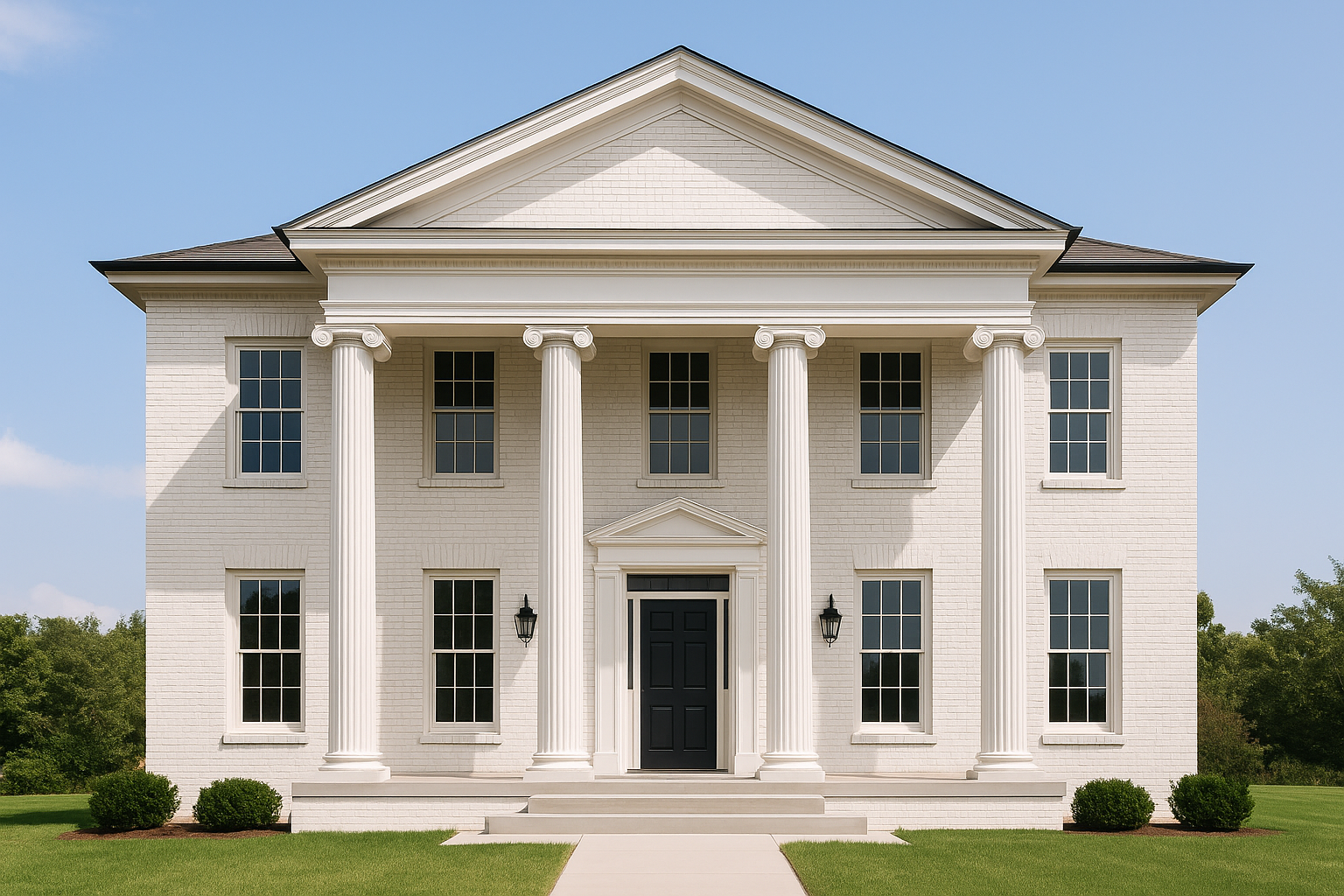
Entry that sets the tone
The doorway does more than welcome guests. A pair of Doric shafts can steady a façade, even on a plain farmhouse. I’ve seen one strong portico turn a modest house into something with presence. It’s not ornament first — it’s rhythm and balance.
Porches with purpose
These porches weren’t stage sets. They caught breezes, shaded rooms, and stretched small houses into civic scale. When clients want the look without full reconstruction, I start with the porch. Get the proportions right and the whole house suddenly feels composed.
Rooms that breathe
Tall ceilings cooled interiors and gave timber framing space to run. I’ve walked through remodels where dropped ceilings for ductwork killed the calm. Leave the height if you can — the difference in how a house carries sound, light, and air is immediate.
Small moves inside
You don’t need a temple front indoors. One clean crown, a centered stair, or aligned openings can hold the style. In one project, just straightening the sightline down a hall gave more dignity than any amount of trim.
Materials that read honest
Nineteenth-century builders faked stone with painted wood. It worked when budgets were thin. Today, I push for stone at touch points, wood that will age instead of peel. A bit of mass where people notice is worth more than thin veneer everywhere.
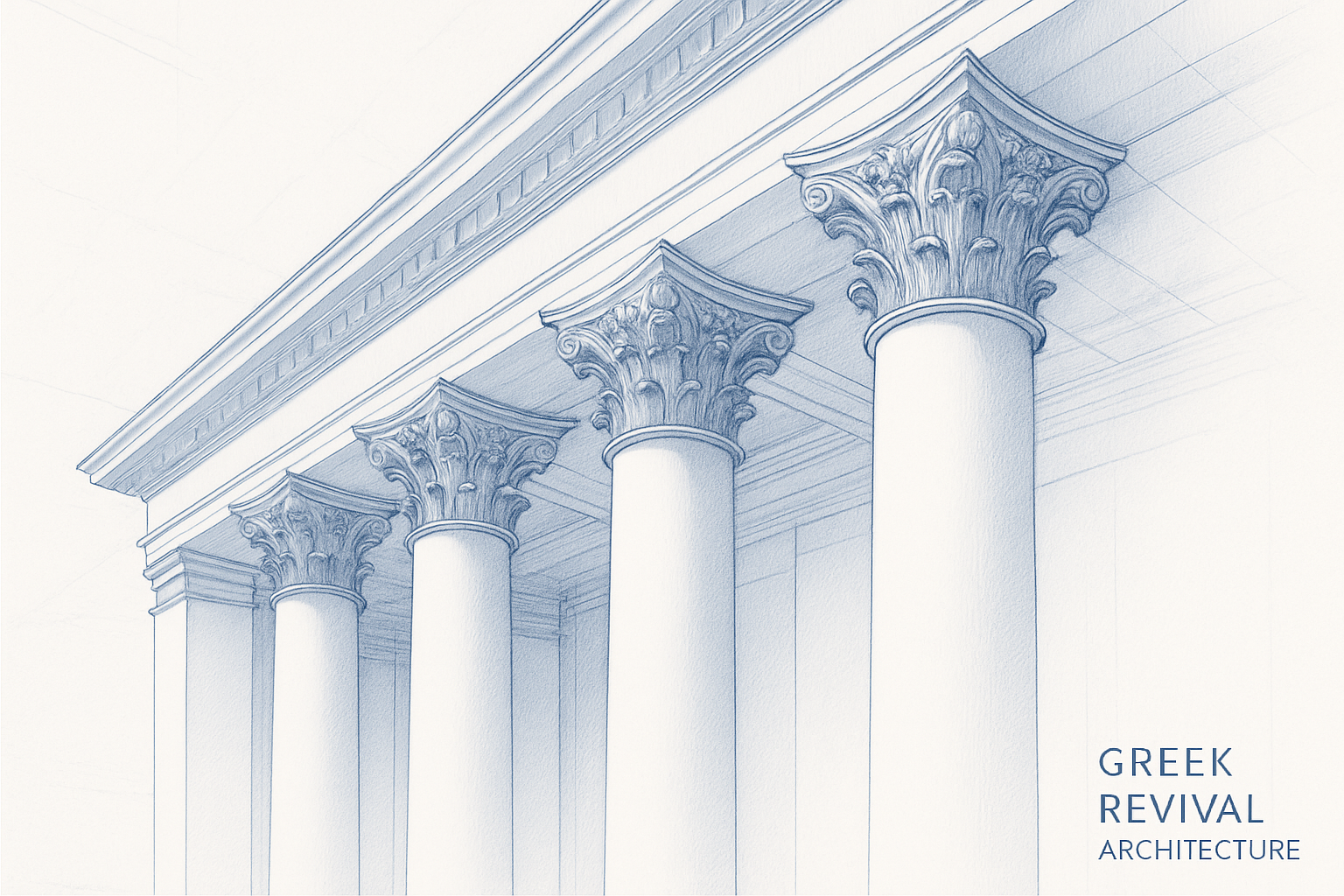
Modern interpretations
I’ve seen Greek Revival paired with glass and steel. It can work if proportions stay disciplined. The danger is costume — too many copied details without weight behind them. Keep the bones steady and the style adapts to contemporary work.
Field lesson in proportion
If you want to see where these moves came from, review Ancient Roman Architecture: Techniques, Structures, and Impact. Rome’s problem-solving with mass and order fed directly into the Greek Revival boom of the 1800s.
📘 STUDIO PICK
Architecture: A Visual History – Jonathan Glancey
Clear diagrams, sharp photos, and proportion stripped to essentials. I use it to show clients what matters — shadow, rhythm, mass — not decorative costumes.
Why it holds up
The strength of Greek Revival is restraint. Balance first, details second. Get symmetry right, let materials carry their weight, and the house will stand with quiet authority. It’s a style that works because it leaves room for space and air, not because it piles on gestures.
Greek Revival Details You Might Miss

A political move in America
Greek Revival wasn’t just style. In the early U.S., it was branding. Columns and white fronts tied the republic to the idea of Athens — democracy, civic order, learning. Builders knew it sent a message as much as it shaped a street.
The whitewash myth
The real Greeks painted in color. Blues, reds, even gold. Early American architects only saw sun-bleached stone and copied that. The result is the white façades we now link to the style. What began as a mistake turned into an icon.
Prefab before prefab was a word
By the mid-1800s, carpenters and mill shops were cranking out pre-cut columns, cornices, and trims. A house could get the “temple look” without hiring a stone crew. That efficiency is part of why the style spread so fast through small towns and farms.
For more on how ancient problem-solving fed later design choices, see Characteristics of Roman Architecture: Arches, Columns, and Innovation. The jump from Rome’s systems to Greek Revival carpentry is closer than people think.
📘 MUST READ
A Global History of Architecture – Francis D.K. Ching
Clear drawings, cross-cultural context. Shows how Greek Revival fits in a bigger sweep of global design, not just as a nostalgic copy.
Case Study: Building a Real Greek Revival in 2025

This isn’t a postcard. It’s how we actually got one built last year: a 2-story, 3,400-sf Greek Revival on a tight suburban lot, modern systems inside, classical calm outside. Composite story, real field lessons.
1) Start With the Brief, Not the Columns
We sat with the client and killed the mood board. No “temple.” Just how they live: morning light in the kitchen, a front room that holds twelve for a holiday, a porch that works in July. Only then did we talk frontage, portico, and rhythm. If you need a refresher on the base logic of orders and spacing, see Greek Architecture: Styles, Techniques, and Influence on Modern Design.
2) Proportion Study Before Plans
We laid out a façade grid first. Window spacing set the whole house. Centerline of the door. Two flanking windows. Upper windows stacked clean. We tested three spans and two story heights on trace until the openings read calm at 60 feet away. Only after the elevation felt steady did we lock the floor plan behind it.
3) Pick the Order Like You Pick Structure
Doric for speed and durability. Ionic looks great, but the capitals chip and collect grime. We used 10-inch round, fiberglass-reinforced columns at the porch for weather and maintenance, with a solid wood entablature where hands and eyes read the detail. Stone only at touch points: plinths, steps, thresholds.
4) Porch That Works, Not Just Looks
Depth at 8 feet minimum so you can sit without baking. Ceiling at 10 feet so heat lifts. We aligned posts with window bays so the shadows make sense. Beadboard ceiling, not drywall, to move humidity. Fans on separate switches. This one space sold the house.
5) Tall Rooms Without Killing the Envelope
We kept 10-foot ceilings on the main level, 9-foot upstairs. Mechanical runs went in a dropped spine over corridors and closets, not across living rooms. The biggest mistake we see is lowering ceilings for ductwork. Route smarter. Keep the volume.
6) Energy and Water First
High-performance windows with true narrow muntins. Exterior insulation continuous at 1.5 inches so the trim still projects. Copper flashing at every horizontal break. Weep where water wants to sit. Greek Revival hates bad water management more than any style; flat crowns become rot farms if you fake the metal.
7) Materials That Age, Not Pretend
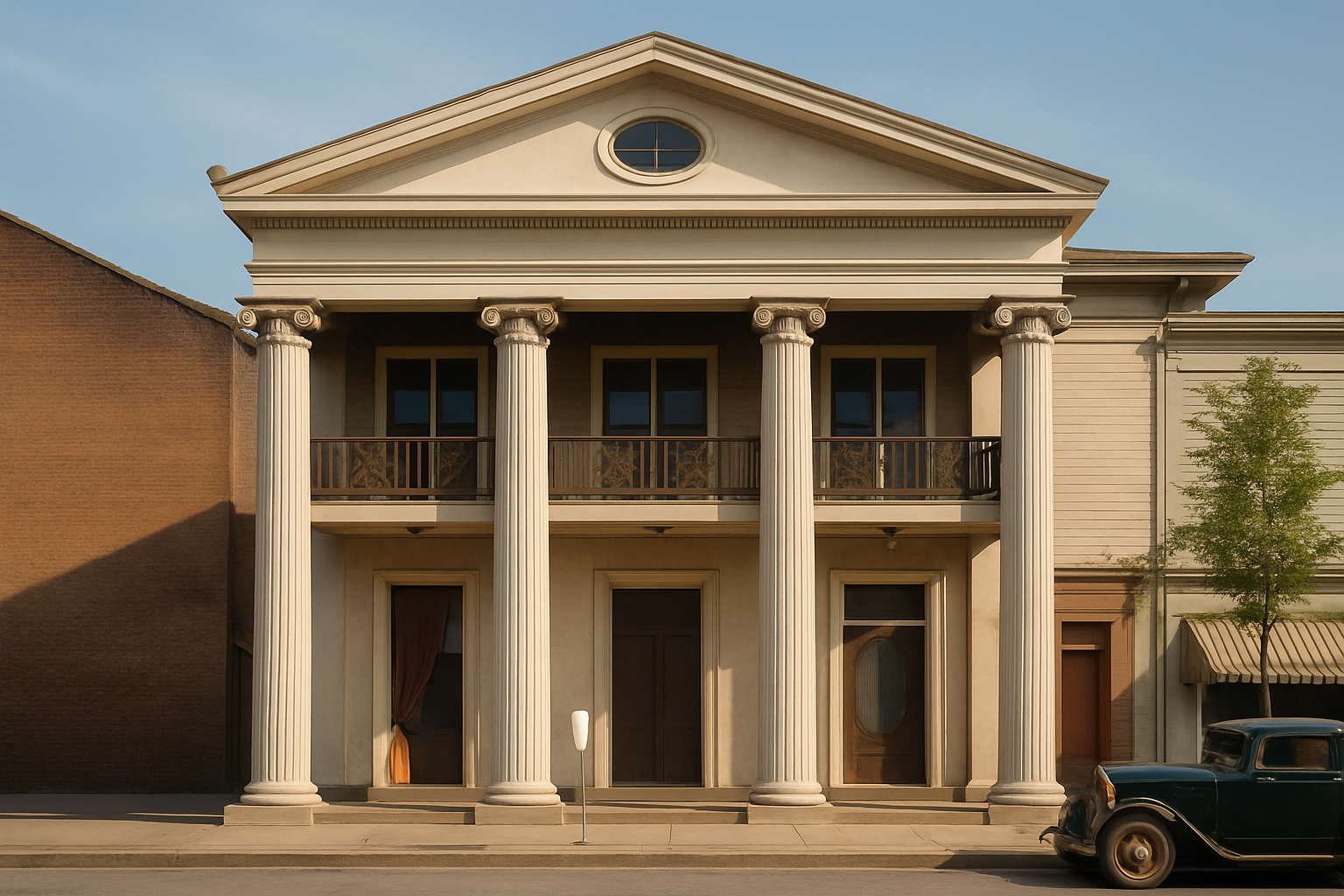
Limewash over mineral base on the body, oil on the wood touch points, real stone at ground level. We skipped thin stone veneer entirely. It looks right day one, wrong by year three. Shutters only where they’d actually cover the opening, sized to the clear width, hung on proper hardware. Fixed, undersized shutters are costume.
8) The Roadmap We Followed
- Week 0–2: Site brief, sunlight study, façade grid.
- Week 3–6: Schematic plan behind the grid, porch depth tests, stair position.
- Week 7–10: Envelope and structure: roof pitch, ridge height, column spec, beam sizes, shear layout.
- Week 11–14: Details: cornice profile, frieze height, sill and head trim, shutter schedule.
- Week 15–18: Energy and water: window package, insulation, WRB, flashing kit, HVAC routing.
- Permitting parallel: Early check-ins with the reviewer so the frontage doesn’t fight modern code.
- Procurement: Order columns, windows, door unit, and copper early.
- Build sequence: Foundation and drainage first, frame to weather, set windows and flash right, WRB continuous, then trim and cornice, then paint. Interior runs while porch finishes cure.
9) Field Moves That Saved Us
We laser-snapped the façade centerline and pulled every opening from that. The framer hates it until the siding starts. We mocked the cornice in foam full-size before millwork. One tweak saved a thousand bucks of bad cut. We dry-fit one column base at grade and lived with it a day. Too tall by an inch. We cut it. That inch reads forever.
10) Where People Go Wrong
- Columns too skinny. They look like broomsticks.
- Shutters undersized and screwed flat to the wall.
- Overbuilt trim stacks. One strong cornice beats five fussy bands.
- Mechanical soffits chopping the living room. Route in the hallway spine.
- Paint as armor. Use the right materials and the paint works less hard.
11) Budget Reality
We put money into windows, exterior trim, porch structure, and flashing. We saved inside on secondary spaces and casework. If the façade reads right, the house carries itself. The greenest square foot is the one you don’t build, so we tightened the plan instead of adding wings that only create more roof edge to fail.
12) Handover and Maintenance
We left the owners a one-page care plan: wash, inspect, re-oil touch points, clear gutter outlets, check copper laps. A Greek Revival stays handsome if you treat water like the enemy and shadow like a tool.
Pull-Desk Reference
When we needed to sanity-check proportion and spacing mid-design, this stayed open: Architecture: Form, Space and Order – Francis D.K. Ching Not for style obsession. For the bones. It keeps the drawings honest.
FAQ
Can I work Greek Revival into a modern home?
Yes. A pair of columns at the entry or a clean symmetrical window layout can nod to the style without changing the whole plan.
Are Greek Revival houses energy-efficient?
The old walls carried thermal mass but leaked at joints. Today you can retrofit insulation and glazing without losing the look. The bones carry style, not the performance.
Does it work on small houses?
Absolutely. A tight façade with one strong portico or bold cornice can give a cottage the same presence as a mansion. Scale the details, not the ambition.