
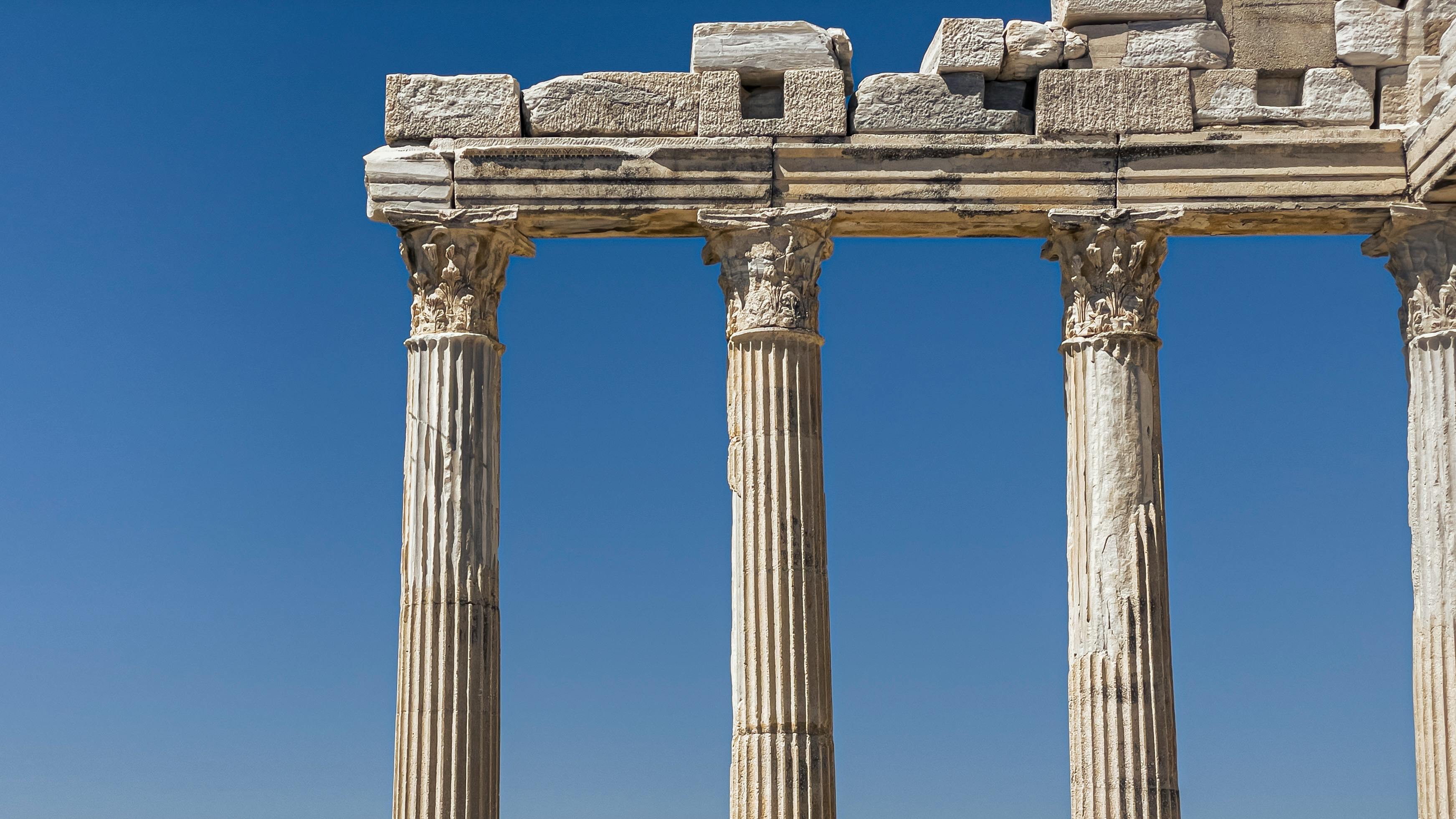
Greek columns gave architecture a clearer sense of order, rhythm, and visual weight.
Doric, Ionic, and Corinthian are not just three old types to memorize. Each one handles proportion, detail, and visual weight differently, and those differences still shape how facades and public buildings are designed.

That is the useful reason to study them now: not as decoration, but as one of the clearest early systems for giving architecture rhythm, structure, and presence.
Ancient Greek Pillars (aka Columns)

Yes, “pillars” and “columns” are the same thing here: both refer to the vertical supports that defined ancient Greek architecture.
Greek columns come in three main styles (called “orders”): Doric, Ionic, and Corinthian, each one with a different look, function, and vibe.
Where It All Began
Greek columns started showing up in early public buildings long before the classical age. Over time, Greek builders refined them into a kind of architectural language.
Greek columns were designed to feel ordered, stable, and clear.
What we now call Doric, Ionic, and Corinthian columns became the backbone of Greek design, d set the tone for much of Western architecture that followed.
The 3 Greek Column Styles (And How to Spot Them)

▪ Doric
→ Thick, no-nonsense, and tough. No base. Plain top (capital). Built to feel grounded and solid.
→ Used in: The Parthenon in Athens

▪ Ionic
→ Thinner, elegant, with scrolls (volutes) on top. Has a proper base. More graceful than Doric.
→ Used in: The Temple of Athena Nike
▪ Corinthian
→ Detailed, floral, and ornate. Topped with carved acanthus leaves. Feels rich and luxurious.
→ Used later in Roman copies of Greek buildings, and modern neoclassical buildings
Quick Tip: Look at the capital (the top of the column). If it’s plain, it’s Doric. Scrolls? Ionic. Leaves and flair? Corinthian.
What It Changed
Greek columns weren’t just decoration—they were about proportion, harmony, and human-scale design. You’ll still see their influence in everything from museums and courthouses to high-end interiors and custom homes.
Good Reading:
- The Elements of Classical Architecture – Georges Gromort
Why read it: Teaches how to read and apply ancient proportions today
Design and Influence of Ancient Greek Architecture
How Greek Columns Still Shape Modern Spaces
Greek columns are old but useful.
Their shape, balance, and rhythm still guide how we design buildings today. You’ll spot them in courthouses, porches, museums, even small homes, because they just work. Clean lines, good proportions, and a sense of order never go out of style.
You’ll find echoes of their design not just in museums or government halls, but in homes, commercial spaces, and even public infrastructure.
Where You’ll See Greek Influence Today
● Façades with purpose → Columns are often used to frame entrances or courtyards, lending a sense of order and elegance.
● Interior accents → Designers use column-style detailing inside buildings to define open-plan spaces or create visual rhythm.
● Structural framing → Though often decorative today, Greek-style columns can still function as support elements in modern builds.
Also Read:
- Classical Architecture: The Poetics of Order – Alexander Tzonis & Liane Lefaivre
Why read it: Goes beyond shapes—explains why these styles endure
How to Use Greek Design in Modern Architecture
▪ Get the proportions right
→ Greek design is all about symmetry. Use column heights and spacing that feel balanced with your building’s scale.
▪ Keep materials modern
→ You don’t need stone. Concrete, steel, or fiber-reinforced materials can mimic the look with less weight and better durability.
▪ Make it fit the space
→ Greek columns work best when they serve a purpose—framing a view, marking a transition, or subtly reinforcing a layout.
Modern Examples
▪ The White House, Washington, D.C.
→ Uses Ionic columns to project formality, structure, and leadership—core values in civic design.

▪ British Museum, London
→ Its Corinthian-style columns frame the main entrance, showing how ancient geometry can still impress in modern civic architecture.
Why This Style Works Today
Greek-inspired columns bring:
→ Visual order to asymmetrical spaces
→ A sense of permanence without needing heavy materials
→ Historic reference without religious symbolism
They aren’t just for “classical” buildings either. A skilled designer can rework column features into minimalist, industrial, or even brutalist structures, proving how versatile the style really is.
Must Read
- Greek Architecture and Its Sculpture – Ian Jenkins
Why read it: Great for anyone interested in decorative history of columns
Practical Applications of Greek Columns in Modern Architecture
Greek columns aren’t just about the past—they still work today. When used smartly, they bring structure, elegance, and clarity to modern buildings without making them feel dated.
Real-World Ways to Use Greek Columns
▪ Modern Proportions
→ Slim down traditional forms to fit today’s minimal and functional spaces. You don’t need a temple, just thoughtful lines.
▪ New Materials, Same Look
→ Use concrete, engineered stone, or composite resin to replicate the look of marble, but with better durability and lower cost.
▪ Blend with Modern Forms
→ Combine columns with glass, steel, or exposed concrete for a clean contrast. It’s a bold look that respects tradition while moving forward.
Quick Tips from Architects
✓ Don’t overdo it: use columns to frame, support, or break up space, not to decorate every corner.
✓ Match column size and spacing with the scale of the structure.
✓ Stick to one order (Doric, Ionic, or Corinthian) to avoid clashing styles.
Examples That Got It Right
▪ New York State Education Building
→ Ionic columns used for symmetry and rhythm—ideal for a civic building promoting clarity and knowledge.

IMAGE: The New York State Education Building in Albany showcasing grand Corinthian columns across its neoclassical facade.
▪ Lincoln Memorial (Washington, D.C.)
→ Doric columns used for strength and permanence. Not decorative—just clean and commanding.
What Carries Forward
Greek columns still work when they fit the building. Used well, they give porches, facades, and public buildings more order and balance.
Good Reading
- Vitruvius: The Ten Books on Architecture – Translated by Morris Hicky Morgan
Why read it: Learn what Roman and Renaissance builders learned from Greece
How Greek Columns Shaped Architecture
Greek columns were built to carry load, but also to control how a building looked. The spacing, profile, and proportion were handled carefully so the building felt ordered, stable, and deliberate. That is why later architects kept returning to them.
Courts, schools, museums, and civic buildings still borrow from Greek columns for the same reason. The forms bring rhythm, balance, and visual authority without much extra work.
Three things still carry forward:
▪ clear geometry that makes a building feel steady
▪ proportion that keeps the facade balanced
▪ flexibility to work as structure or as a formal design element
Architects do not keep using Greek columns out of nostalgia alone. They keep using them because the system still works.
Using Greek Columns Now
Greek columns still work because they solve a clear design problem. They give a building order, balance, and a stronger sense of form.
The mistake is using them as decoration first. Start with purpose. Get the scale right. Match the column type to the building. Let the proportions do the work instead of piling on detail.
That is why they still show up in houses, civic buildings, schools, museums, and institutional facades. Used well, they make a building feel steadier and more composed. Used badly, they just make it feel dressed up.
One well-placed column, used at the right scale and in the right material, can do enough.
Read This Next: If you want to see how Greek forms carried forward into houses, go to Greek Revival Architecture.
Good Reading:
- The Classical Orders of Architecture – Robert Chitham
Why read it: Combines tradition with technical clarity
FAQ
What are the three main styles of Greek columns?
● Doric – Thick, plain, and sturdy. No base.
● Ionic – Slim with scroll-shaped capitals (volutes).
● Corinthian – Decorative, with carved acanthus leaves.
How do Greek columns influence modern architecture?
They’re used to add structure, balance, and elegance. You’ll often see them in courthouses, universities, museums, and homes—anywhere that needs a strong, classic feel.
Are Greek columns still structural, or just for show?
Both. While often decorative today, they can still serve as functional load-bearing elements when built to code.
What materials were used for ancient Greek columns?
Mostly marble or limestone—chosen for strength, availability, and clean finish.
Can different Greek styles be mixed in one project?
Yes—but it’s tricky. Mixing Doric with Corinthian, for example, takes careful planning to avoid visual conflict. Designers often use one style per level or section.
Can Greek-style columns work in small spaces or homes?
Absolutely. Scaled-down versions are popular in porches, entryways, or open-plan interiors to subtly define space.
Do Greek columns always need classical surroundings?
Not at all. You’ll find modern designers using them in industrial lofts, contemporary office lobbies, and even minimalist homes—especially when contrast is the goal.
Best-Selling Books
1. "The Elements of Classical Architecture" – Georges Gromort
● A detailed yet visual guide to the Doric, Ionic, and Corinthian orders
● Great for students, architects, and designers
Why read it: Teaches how to read and apply ancient proportions today
2. "Classical Architecture: The Poetics of Order" – Alexander Tzonis & Liane Lefaivre
● Breaks down the logic, symbolism, and aesthetics of ancient design
● Excellent resource for understanding the philosophy behind the orders
Why read it: Goes beyond shapes—explains why these styles endure
3. "Greek Architecture and Its Sculpture" – Ian Jenkins
● Beautifully illustrated guide to architectural sculpture in Greek design
● Focuses on structure + art integration
Why read it: Great for anyone interested in decorative history of columns
4. "Vitruvius: The Ten Books on Architecture" – Translated by Morris Hicky Morgan
● The foundation of Western architectural thought
● Ancient text with practical design advice still referenced today
Why read it: Learn what Roman and Renaissance builders learned from Greece
5. "The Classical Orders of Architecture" – Robert Chitham
● Modern interpretation of ancient orders, with how-tos
● Great technical reference for practicing architects
Why read it: Combines tradition with technical clarity
Sources
-
Architect of the Capitol – Ionic Columns
The U.S. Capitol and Supreme Court buildings feature Ionic columns inspired by ancient Greek designs. -
National Park Service – Second Bank of the United States
An example of Greek Revival architecture with Doric columns, reflecting ancient Greek influence. -
Library of Congress – Thomas Jefferson Building
Showcases classical architectural elements, including columns, influenced by ancient Greek and Roman styles.
Academic & Research Publications
-
ResearchGate – The Enduring Legacy of Greek Architecture
A scholarly article discussing how ancient Greek architectural principles continue to shape modern design. -
Architectural Digest – Greek Architecture 101
An overview of Greek architectural elements and their lasting impact on Western architecture.