
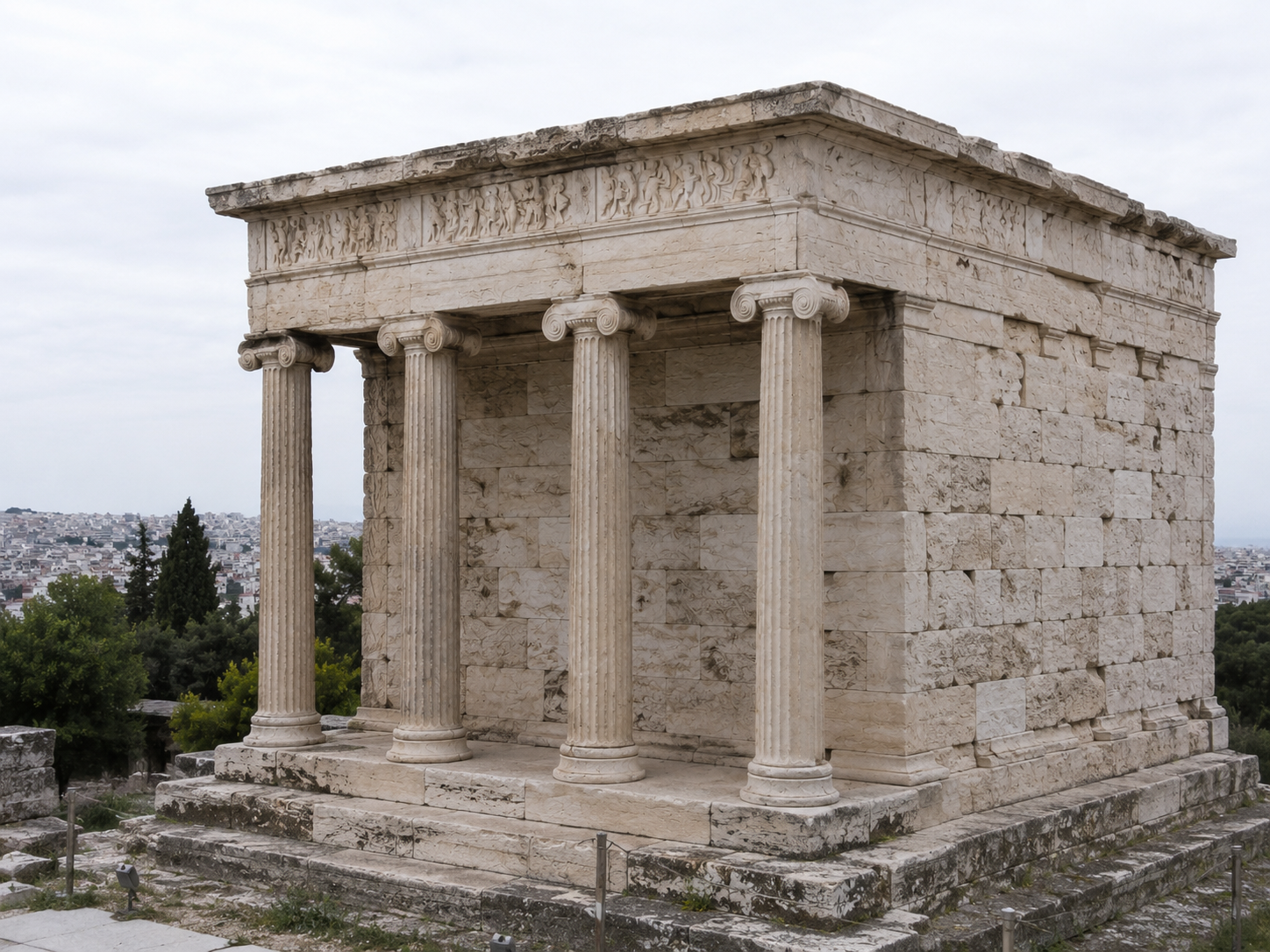
Image by ArchitectureCourses.org. Ionic columns show how fluted shafts, carved capitals, stone joints, and shadow lines gave Greek architecture a strong architectural presence.
Greek architecture still teaches because it solved hard problems with limited tools. No steel frame. No pumped concrete. No glass curtain wall. Just stone, timber, geometry, and labor.
That is where weak pages drift. They treat Greek architecture like a beauty lesson. It was a building lesson first. Greek builders had to span rooms, control weight, correct what the eye misreads, and make public space work in heat, glare, wind, and crowds.
The intelligence is in the corrections. Steps rise slightly in the middle so they do not look like they sag. Columns swell so they do not read weak from a distance. Corner supports thicken because edge conditions always get judged harder.
The calm came from work.
How Greek Architecture Changed
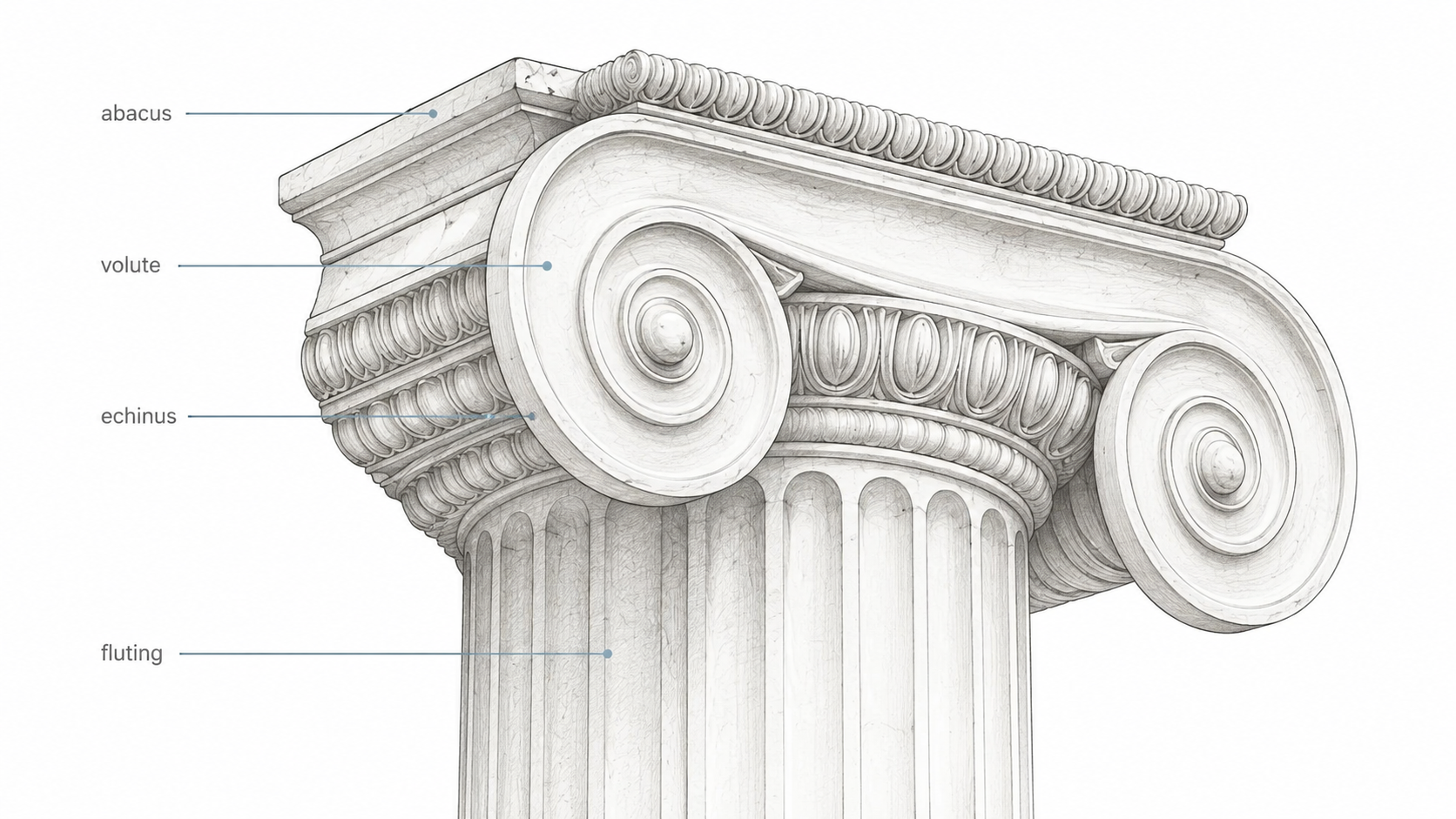
Illustration by ArchitectureCourses.org. The Ionic column is defined by its scroll-shaped volutes, thin abacus, carved capital detail, and fluted shaft, which give the order a lighter and more refined reading than Doric.
Greek architecture did not arrive fully formed. Early work is heavier and more cautious. Later work gets cleaner, thinner, and more controlled. The shift makes more sense once you stop looking for “style” and start looking for what the builders trusted themselves to do.
| Period | What You See | What Changed |
|---|---|---|
| Archaic | Heavy stone, thick columns, blunt massing | Builders stayed close to structural safety. |
| Classical | Cleaner proportions, tighter joints, stronger visual control | Refinement became part of the structure. |
| Hellenistic | More display, more ornament, larger civic and theatrical spaces | Greek building spread outward and absorbed broader influences. |
Doric starts thick and direct. Ionic stretches taller and introduces more delicacy in profile and detail. Corinthian arrives later, more carved and more decorative, but good work still depends on structure and proportion before ornament.
Worth knowing: Ancient Greek Architecture is the better handoff if you want the early building phase broken out more clearly. For the orders themselves, Ancient Greek Columns is the tighter follow-up page.
What Builders Had to Solve
Greek architecture gets flattened when it is taught as columns, pediments, and ruins. The stronger reading is simpler: what was the building trying to stop from going wrong?
Weight
Stone handles compression well. It punishes bad span decisions. Push a beam too far and it fails. Make a support too thin and the elevation starts looking weak before the structure becomes weak. Early Greek work feels thick because the builders were buying safety with mass.
Optical Distortion

Illustration by ArchitectureCourses.org. Greek columns were shaped by more than ornament. Fluting, capital form, entasis, inward lean, thicker corner columns, and a slight stylobate curve all helped the architecture read as stable and precise.
A straight line does not always look straight in bright light at large scale. A long platform can look like it sags. A column can look thinner than it is. The Greeks corrected for that with entasis, slight platform curvature, thicker corner columns, and small alignment shifts.
That is perception control.
Precision
The Greeks worked stone with punishing accuracy. That matters more than the marble itself. A bad cut stays visible. A poor joint keeps reading as weak. The force of many ruins comes from fit, not size.
Climate
Colonnades, courtyards, open edges, and shaded transitions handled heat, glare, and airflow. Greek architecture is full of outdoor-to-indoor thresholds because the climate allowed buildings to work with shade and air instead of sealing everything up.
This gets missed when the tradition is reduced to monument fronts. The intelligence was also in theaters, stoas, civic edges, houses, and everyday spaces shaped for weather and movement.
One more thing: if you are using this page as part of a larger history path, Architectural History and Theory and Classical Architecture History are the broader parent reads.
Public Space, Not Only Monuments
Greek architecture worked at the scale of the city, not only the single building. The agora, stoa, theater, gymnasium, council house, and street edge all mattered because Greek public life needed places for trade, debate, movement, shade, and spectatorship.
The stoa is one of the clearest examples. It is simple: a long covered edge with columns. But that simple form solves several problems at once. It gives shade. It protects movement. It creates a public threshold between open space and enclosed rooms. It lets people gather without blocking the whole square.
Theater design is another place where the intelligence shows. Seating follows the slope instead of fighting it. The plan organizes crowds, sightlines, and sound. The building does not need to shout. The ground is already doing part of the work.
This is the Greek lesson that gets lost when everything turns into a front elevation. The strongest work is not only about the object. It is about how edges, shade, steps, sightlines, and gathering spaces make public life possible.
Building Moves That Still Work
Ashlar Fit
Well-cut stone laid with tight joints does more than look expensive. It distributes load clearly, reduces visual noise, and exposes weak craftsmanship. Nothing hides in thick filler.
Modular Layout
Once column diameter, spacing, and beam depth start working together, the whole building calms down. Repetition was not laziness. It was control.
Readable Hierarchy
Base, shaft, capital, beam, frieze, pediment. Each part had a job and a visual weight. That hierarchy is why the buildings stay legible from far away. The eye can read the structure in layers.
Geometry with Judgment
Greek architecture is often described as proportional, but that can sound vague. The practical point is narrower. Parts were related on purpose. A column was sized against the beam above it. Spacing worked with height. Edges were adjusted where they would be judged hardest.
That is judgment, not theory.
What the Ruins Hide
This part gets skipped too often. Most people meet Greek architecture as ruins, not as finished buildings. They see bare stone, broken pediments, missing roofs, and washed-out surfaces, then mistake that for the original design intent.
That reading is incomplete. Many Greek buildings carried color. Roofs and fittings mattered. Sculptural programs were part of the public message. The buildings had more visual weight, more contrast, and more civic force than the white ruin image suggests.
The consequence is easy to spot. People copy the ruin instead of the building. They imitate blank stone calm and miss color, shadow depth, roof edges, painted surfaces, and the fuller civic setting that made the work legible in the first place.
The Parthenon as Design Reference

The Parthenon belongs here because it condenses so many Greek design decisions into one building. The weak reading treats it like an isolated monument. The better reading looks at proportion, optical correction, stone discipline, civic image, and the control of every visible edge.
Its refinements are not random tricks. The stylobate rises slightly. The columns lean inward. The corner columns are adjusted because the edge of a building is always judged more harshly by the eye. Doric corner contraction solves a spacing problem where the rhythm of columns, triglyphs, and corners has to land without looking careless.
That is the part worth slowing down for. The building is not “perfect” because every line is mathematically straight. It works because the lines were corrected until they looked stable, calm, and intentional from human distance.

Illustration by ArchitectureCourses.org. The Parthenon works as a design reference because its layout, column rhythm, optical corrections, corner treatment, and frieze system were controlled as one architectural composition.
Doric order dominates, but Ionic elements appear where the composition needs them. That mix matters because it shows Greek architecture was not frozen into one rulebook. It was disciplined, but not mechanical.
The Parthenon also shows how architecture can carry civic meaning without losing structural clarity. Sculpture, procession, proportion, and edge control all worked together. Related reading: The Parthenon’s Architecture and Purpose.
What Copies Get Wrong
This is the part people usually discover after they already committed to the look.
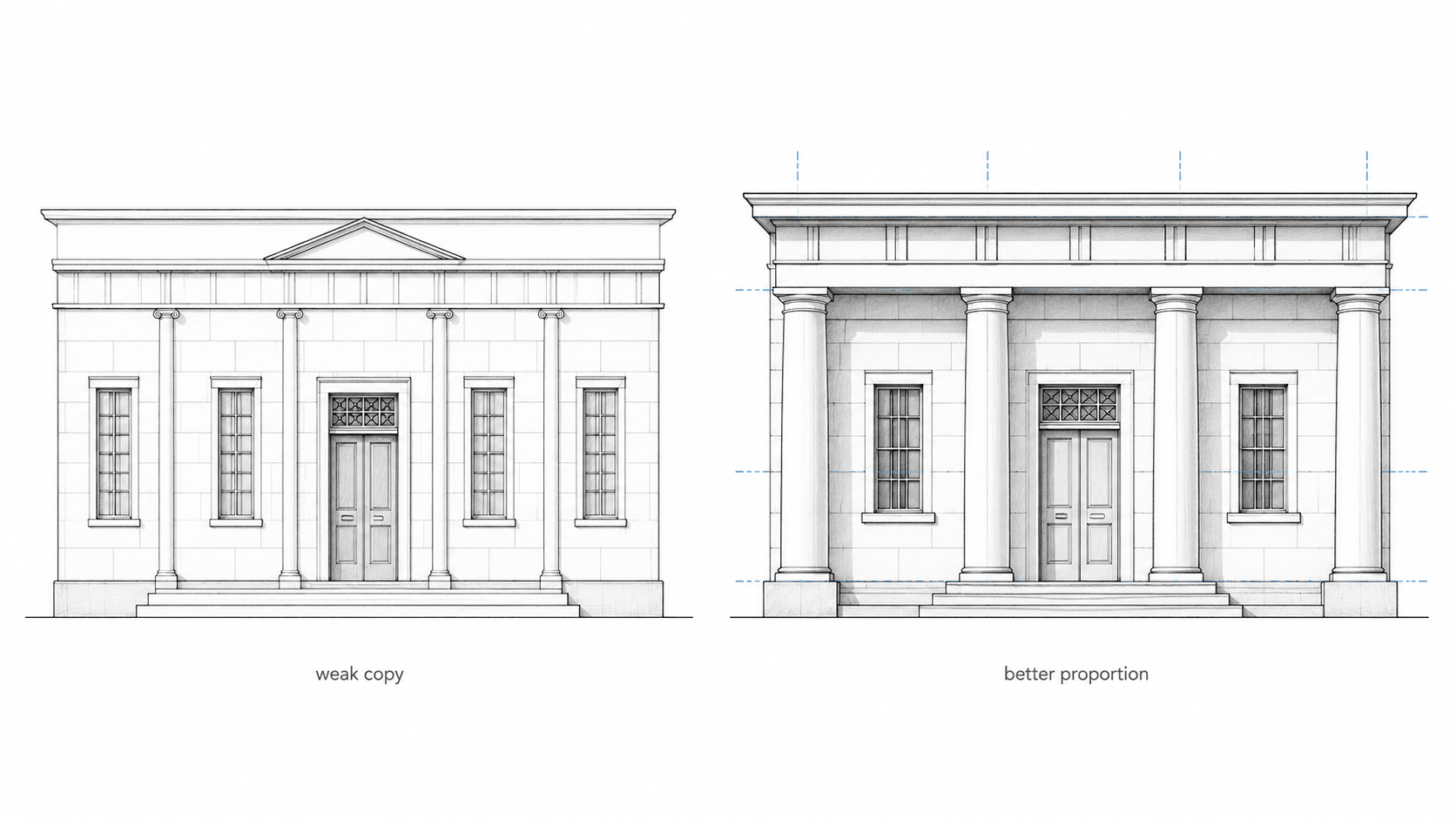
Illustration by ArchitectureCourses.org. Copying Greek-looking parts is not the same as using Greek architectural discipline. Better proportion, stronger depth, calmer spacing, and clearer structural rhythm make the corrected version more believable.
Greek architecture does not stay convincing when you copy the symbols and skip the system. A column by itself does not create authority. A pediment by itself does not create order. If the spacing is wrong, the entablature is too shallow, the roof pitch is off, or the material has no depth, the façade starts looking theatrical instead of structural.
This is where money gets wasted in revival work and civic imitations. Owners pay for the visible signals first, then discover the effect still looks thin. The shadow lines are weak. The columns are undersized. The trim has no weight. The openings do not align with the structural rhythm.
They bought the image, not the discipline underneath it.
The problem gets worse with cheap exterior packages. Thin applied trim, foam columns, shallow pediments, and sealant-heavy joints flatten the building fast. Sunlight exposes the weakness. Water finds the joints. The front still “references Greece,” but the authority is gone and the maintenance starts early.
That is why better Greek Revival work still feels expensive even when it is simple. The heavy lifting is in spacing, depth, roof profile, and material thickness, not in the column alone. If you want that later branch separated cleanly, use Greek Revival Architecture as the next page.
What Later Buildings Kept and Lost
Later architecture borrowed Greek forms because they were useful shorthand. Columns, pediments, symmetrical fronts, and clear proportions could make a building read as ordered, public, and permanent. Courthouses, banks, museums, campuses, and government buildings used that language because people already knew how to read it.
But something was often lost in the transfer. The copied version kept the front but not always the discipline behind it. It kept the column but not the careful spacing. It kept the pediment but not the depth, shadow, or structural weight that made the original language convincing.
That is the difference between influence and costume. Good classical work understands proportion, mass, edge, and rhythm. Weak imitation treats Greek architecture like a set of parts that can be pasted onto any façade.
The Roman handoff is different. Rome borrowed Greek visual language, then pushed engineering and urban scale much harder. Greek architecture refined the proportional system. Roman building widened what could be done with enclosure, infrastructure, concrete, and span. That is why Roman Architecture Style and Roman Architecture and Engineering make sense as the next historical step.
What Greek Architecture Still Teaches
Proportion is stronger than decoration.
Small corrections can carry more force than big gestures. A slight curve in the stylobate, a thickened corner support, a cleaner joint, a better shadow line. Small moves can change how the whole building reads.
Climate and circulation also belong inside the architecture from the start. Courtyards, shaded edges, and open transitions were not afterthoughts.
Copying a style is easy. Reproducing the discipline underneath it is the hard part.
What did the Greeks invent in architecture?
They did not invent columns outright, but they refined column orders, proportion systems, optical corrections, civic composition, and public-space design into a disciplined architectural language that later cultures reused constantly.
Why are Greek buildings still standing?
Because of material durability, tight stone fit, structural caution, and later repair. The surviving examples were not casual construction.
Is Greek architecture only about columns?
No. Columns dominate the popular image, but theaters, stoas, courtyards, council spaces, houses, and civic edges matter if you want to understand how the architecture worked.
What is entasis?
Entasis is the slight swelling in a column shaft used to correct the way a perfectly straight column can look thin or weak to the eye.
Why did later government buildings copy Greek architecture?
Greek forms became shorthand for order, law, permanence, and public authority. That is why courthouses, museums, banks, and capitol buildings kept borrowing columns, pediments, and symmetrical fronts.
What can architects still learn from Greek architecture?
That proportion, fit, edge correction, shade, and public-space planning do more work than most people think. If the rhythm is wrong, ornament will not save the building.