

Architectural History and Theory, Without the Museum Voice
I’ve watched a “brilliant” precedent argument die in five minutes.
Not because the reference was wrong. Because the section was lying: thin walls, fake spans, daylight that only works in a photo, and no place for water to go.
This is the version of history + theory that survives studio. Plan/section/assembly. Consequences. Then the story.
Most “history + theory” writing is either a timeline of styles or a motivational poster about culture. Neither helps when your scheme hits review and someone asks the questions that actually matter: what spans, what drains, what’s the daylight depth, what’s the egress logic, and why your clean section is lying.
History is a studio tool when you treat it like a record of constraints. Not “influence.” Constraints. Weight. Weather. Labor. Material limits. Politics. Maintenance. The parts that don’t show up in the hero shot.
And theory, if we’re being honest, is mostly a way to explain (or defend) why you made certain trade-offs. It can sharpen your decisions. It can also cover up weak ones. Same as any narrative.
If you want the framing in plain language, not as a sermon, keep this nearby: why architectural history matters.
Quick test:
if your “history/theory” argument can’t answer these, it’s probably just style talk.
1) Water: where does rain go, and what’s the first thing that stays wet?
2) Structure: what’s spanning, what’s lateral, and where does it get ugly?
3) Daylight: where does the light give up in section?
4) People: where do crowds bottleneck and where do they get out when it’s real?
That’s the lens here. Not a museum tour. A stress test.
How to Read Precedent Like a Reviewer (Not Like a Fan)

You can get through school (and even early practice) by collecting pretty precedents and stitching them together. It works until it doesn’t. The failure is predictable: you’re borrowing surface moves without importing the logic that made them work.
Structure: What is the span strategy and where does it change? Don’t accept “it’s a grid” as an answer. What’s doing the long span? What’s doing lateral? Where is the system compromised by openings, corners, and program exceptions? If the building looks effortless, assume someone worked hard to hide the work.
Thickness: Draw the wall and floor thickness early. Not as a detail later. Thickness is where your budget and your net-to-gross go to die. It’s also where you solve real problems: fire, acoustics, thermal control, durability, tolerances, and routing space for services. Thin drawings make thick problems.
Daylight depth: Don’t fall for the “bright interior” photo. Ask where the light gives up. Ask what happens on an overcast day. Ask what happens when you add partitions, furniture, and actual use. If a precedent relies on courtyards or perimeter-loaded plans, that’s the point. Don’t copy it into a deep plate and act surprised.
Circulation and egress: The plan that reads as “clear” in a diagram can still fail basic movement logic once you layer in doors, queues, choke points, turning radii, and the fact that people don’t walk like arrows. Rules vary by jurisdiction and occupancy, so verify locally, but the bigger truth is universal: circulation is a performance system, not a graphic.
Water and ground: Ask where the runoff goes. Ask how the building meets the grade. Ask what gets wet and how it dries. Half the “timeless” precedents are just good at being honest about plinths, drip edges, sacrificial surfaces, and maintenance cycles.
If you need a broad map of eras to orient a precedent quickly (without turning into a glossary exercise), use this as the index: architecture complete history.
Ancient Work: Mass, Ground, and Construction Logic
Ancient architecture is where you relearn two things modern drawings try to forget: gravity and labor. Not labor as an abstract conversation. Labor as scaffolding, hauling, quarrying, formwork, tolerances, and the reality that time and hands are part of the structural system.
Massive construction buys you stability and thermal buffering, but it demands thick walls, careful foundations, and a serious relationship with the ground. You can’t “suggest” mass with a thin cladding layer and expect the same performance. You might get the look. You won’t get the behavior.
When people borrow ancient precedents badly, they borrow the silhouette and delete the thickness. Then the project fails the first technical review because nothing has a buildable section: no real bearing, no drainage layer, no moisture strategy, no tolerance for movement, and no plan for how the assembly gets built in sequence.
A better use of ancient precedent is blunt: learn how early builders solved the boring stuff. Platforms that manage water and settlement. Wall sections that accept erosion and protect the vulnerable layer. Openings sized for what the material can actually do.
Start here if you want the wide sweep without the tourist voice: ancient architecture, unpacked.
Early Urbanism: Systems Before “Style”
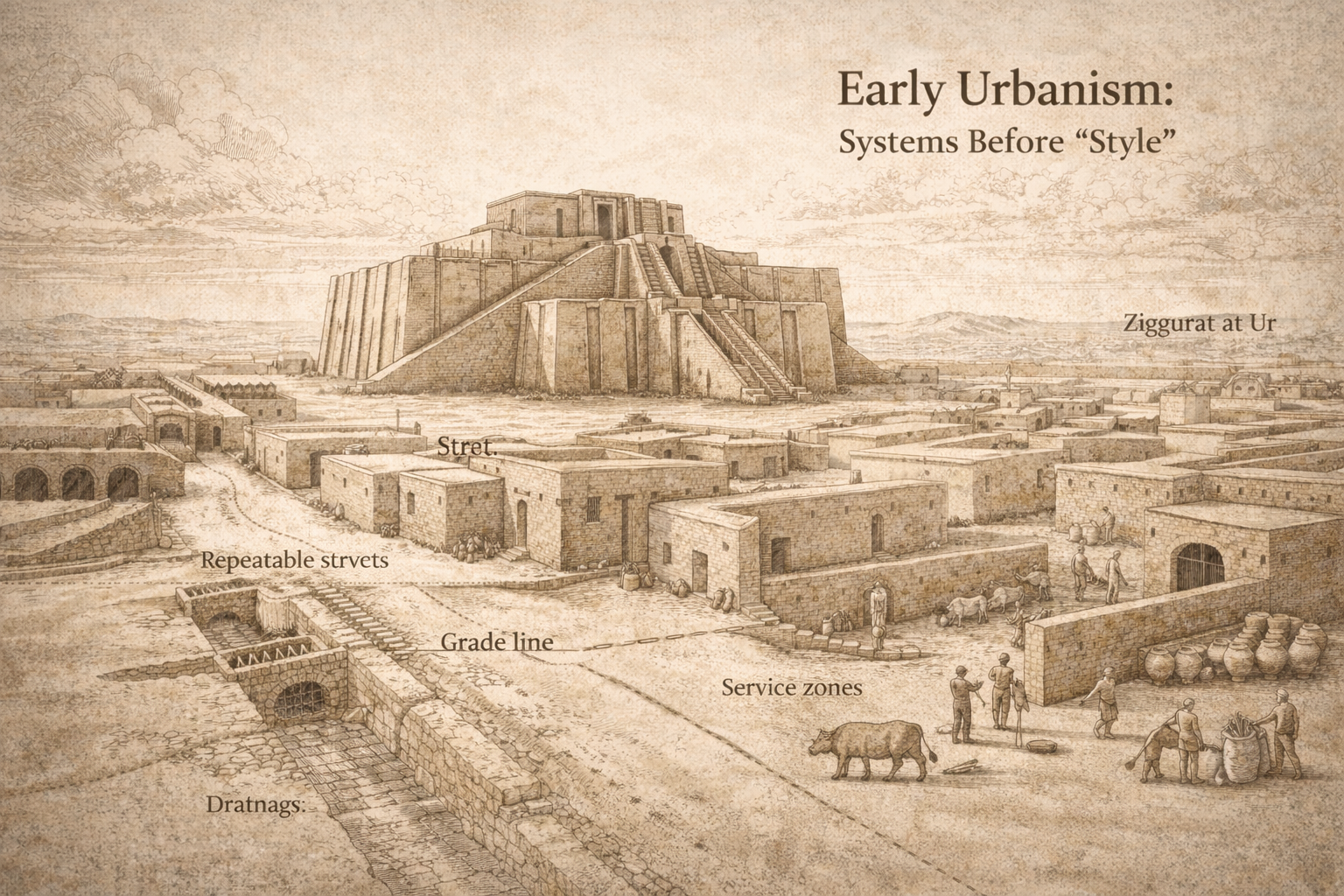
The big shift in early cities isn’t a decorative language. It’s the appearance of repeatable systems: streets, drainage, storage, shared infrastructure, and rules—formal or informal—about how construction happens at scale.
In studio, this is where your “site plan” stops being a diagram and starts being an argument with reality. Grades matter. Runoff paths matter. Access routes matter. Service zones matter. The nice clean object in the center of the site is usually the first lie you have to unlearn.
One reason these precedents keep coming back is that they’re not precious. They’re pragmatic. They assume repair. They assume weather. They assume the city will change around them. That’s a mindset you can use immediately: design assemblies and layouts that tolerate change, because the client, the tenant, and the regulations will change whether you like it or not.
If you want a focused example of early monumentality as a lesson in ground, massing, and weathering (not vibes), this is the right anchor: the Ziggurat at Ur.
Classical to Imperial: Orders Don’t Carry Loads, Systems Do
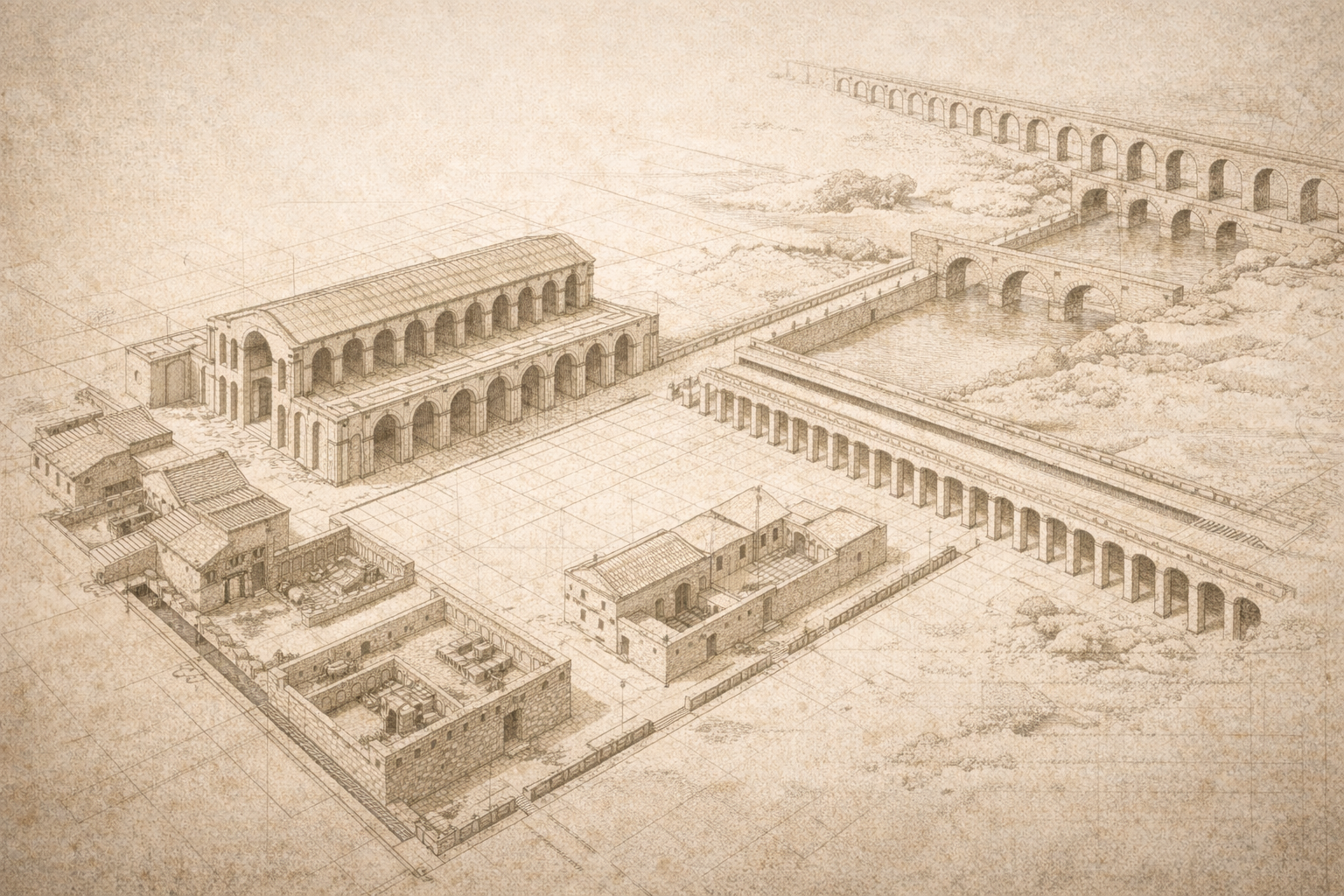
This is where people get stuck on “rules” and miss the more useful lesson: legibility. Classical and imperial-era work often reads clean because the structural and spatial logic is explicit. Bays are bays. Loads go where you think they go. The plan is not apologizing for itself.
The common failure when borrowing from this territory is turning colonnades and arcades into costume. You paste a rhythm onto a facade while the structure behind it does something unrelated, and the building feels hollow because it is hollow—an image wrapped around a different machine.
Use these precedents for what they’re good at: disciplined repetition, clear hierarchy, and the way circulation, public space, and infrastructure interlock. Think streets, forums, markets, baths, bridges, aqueducts—places where performance is visible because it has to be. Those are the moves that survive contact with modern constraints.
If you want the “how they built strong” lens (the one that pays off when you’re detailing structure and routing services), keep this in rotation: Roman architecture and engineering.
And if you’re trying to connect buildings back to city logic—streets, movement, servicing, and growth patterns—this one stays practical: urban planning in ancient Rome.
Medieval to Early Modern: Big Openings Cost You Something
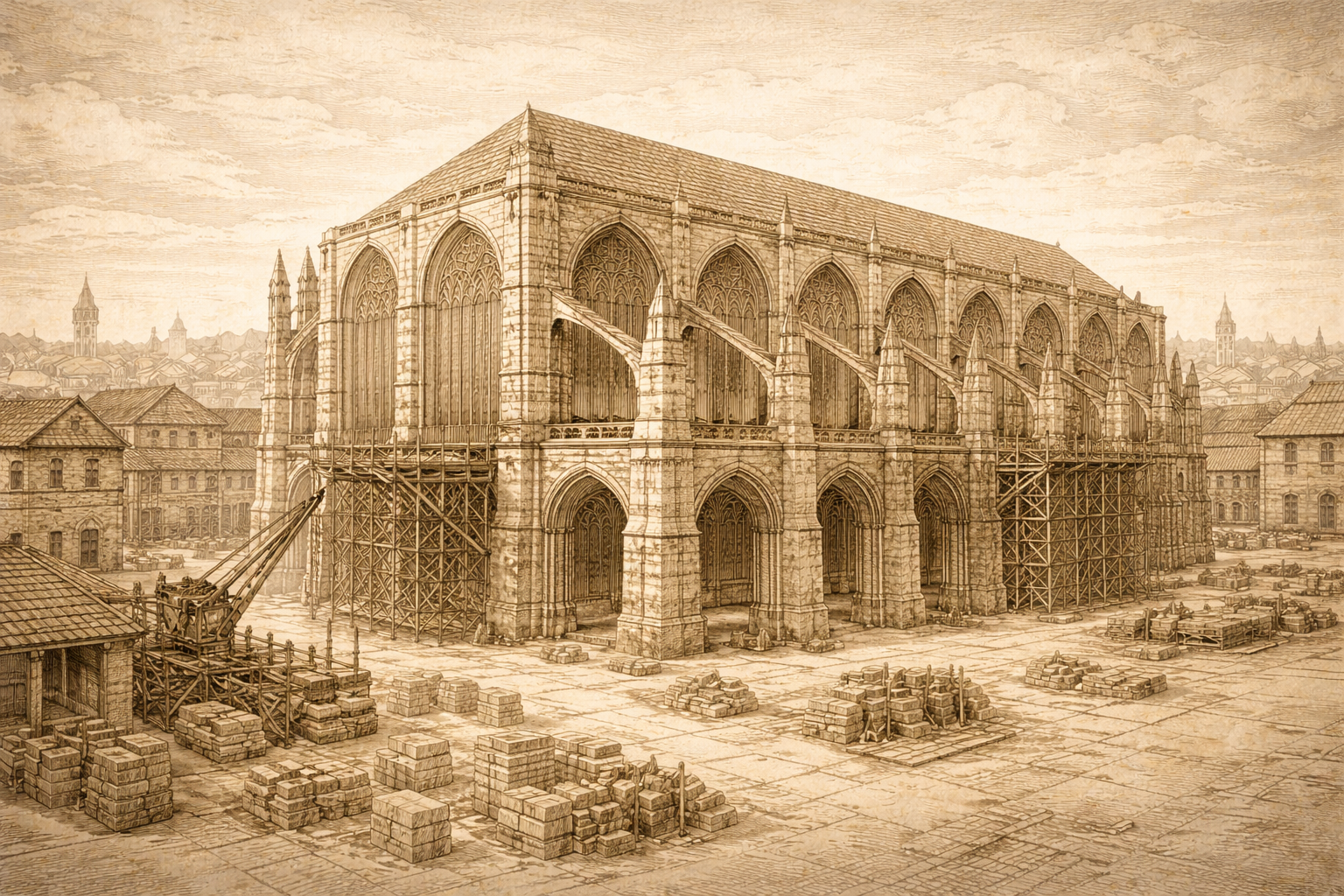
Here’s the real takeaway from late medieval structural thinking: if you want taller volumes, larger openings, and thinner-looking enclosures, you pay somewhere else. You pay in buttressing. You pay in thicker piers. You pay in more explicit lateral strategies. You pay in construction staging and craft. There is no free lunch, just moved costs.
In crit, the failure mode is predictable: students copy the verticality and the “lightness,” then draw paper-thin walls and heroic spans that have no credible section. In practice, the failure mode is the same, just more expensive: the architect sells openness and slenderness, then the structure and enclosure budgets explode because the building is being asked to do something physically demanding.
Also: circulation and egress get real here, fast. A lot of historic layouts were designed for different occupancy expectations and movement patterns. When you adapt or reinterpret them, you can’t assume the old plan logic maps cleanly onto contemporary use. Jurisdictions vary. Verify locally. But don’t leave it to the end. If you do, the plan will get torn apart when it’s already too late to fix gracefully.
For the broader context (not just a list of “features”), this is a solid internal base: medieval architecture.
And if you’re tracking the structural shift from rounded-arch logic into pointed-arch logic (again: as load paths, not decoration), use the birth of Gothic architecture.
Renaissance: Clarity is Easy; Coordination is the Hard Part
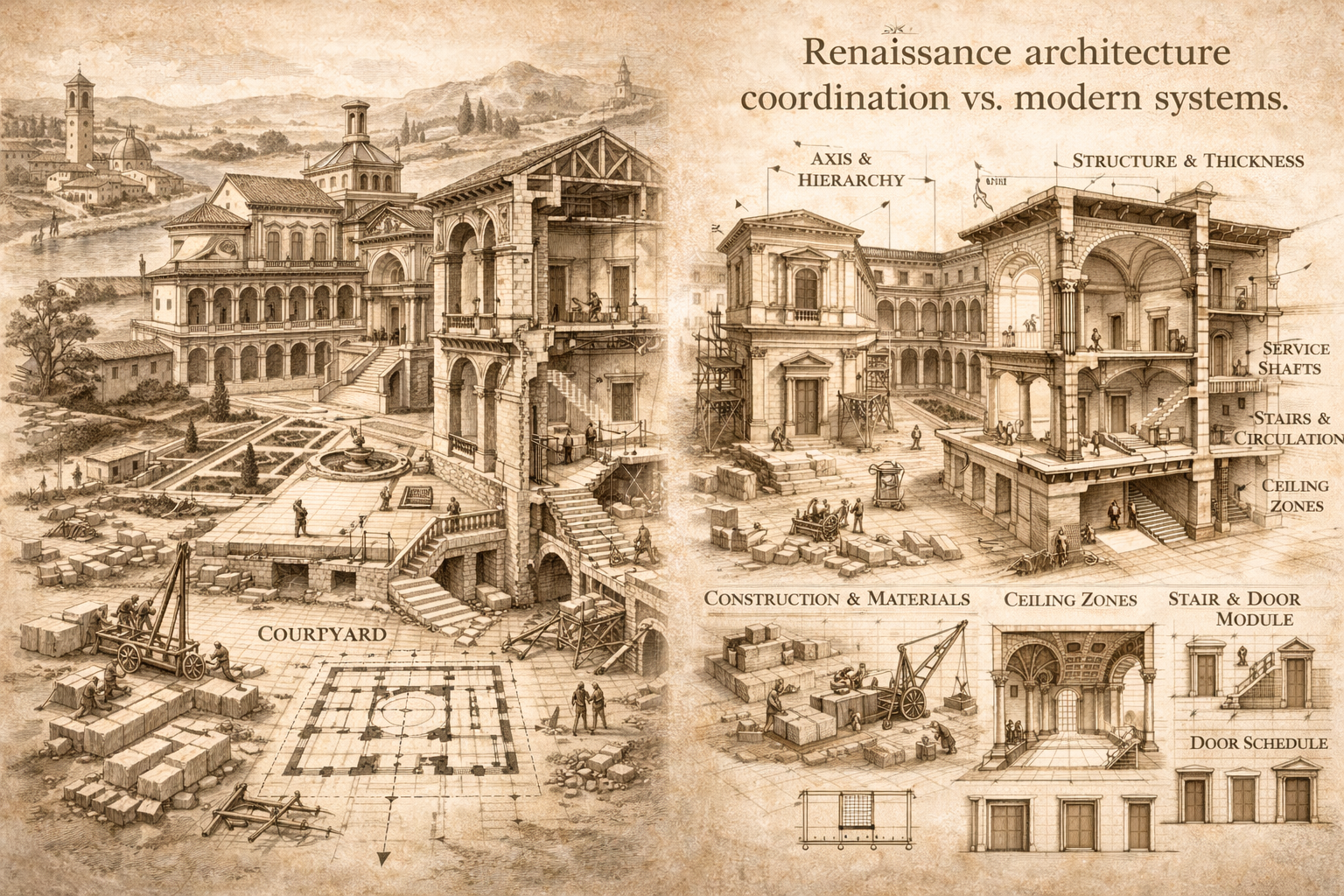
Renaissance precedent is catnip in studio because it makes decisions look clean. Clear axes. Clear hierarchy. Rooms that read as rooms. Sections that feel composed. The danger is that you start believing clarity is the same thing as simplicity.
The moment you translate that clarity into a contemporary building, thickness shows up. Ceiling zones deepen. Services need routing. Structure needs depth. Accessibility requirements reshape stairs, landings, and door swings. Fire and acoustics add layers. The “pure” diagram can survive, but only if you accept coordination as part of the design, not an engineering cleanup pass.
This is where drawings and schedules start to matter as much as the concept. If your precedent relies on a disciplined module, then your door schedule, glazing schedule, structural grid, and reflected ceiling plan have to line up. If they don’t, the building stops being “clear” and starts being “almost clear,” which is worse because it reads like you lost control.
For a period anchor that you can actually use without turning into trivia, here’s the internal reference: Renaissance architecture.
Baroque and Later: Architecture as Sequencing, Not Ornament
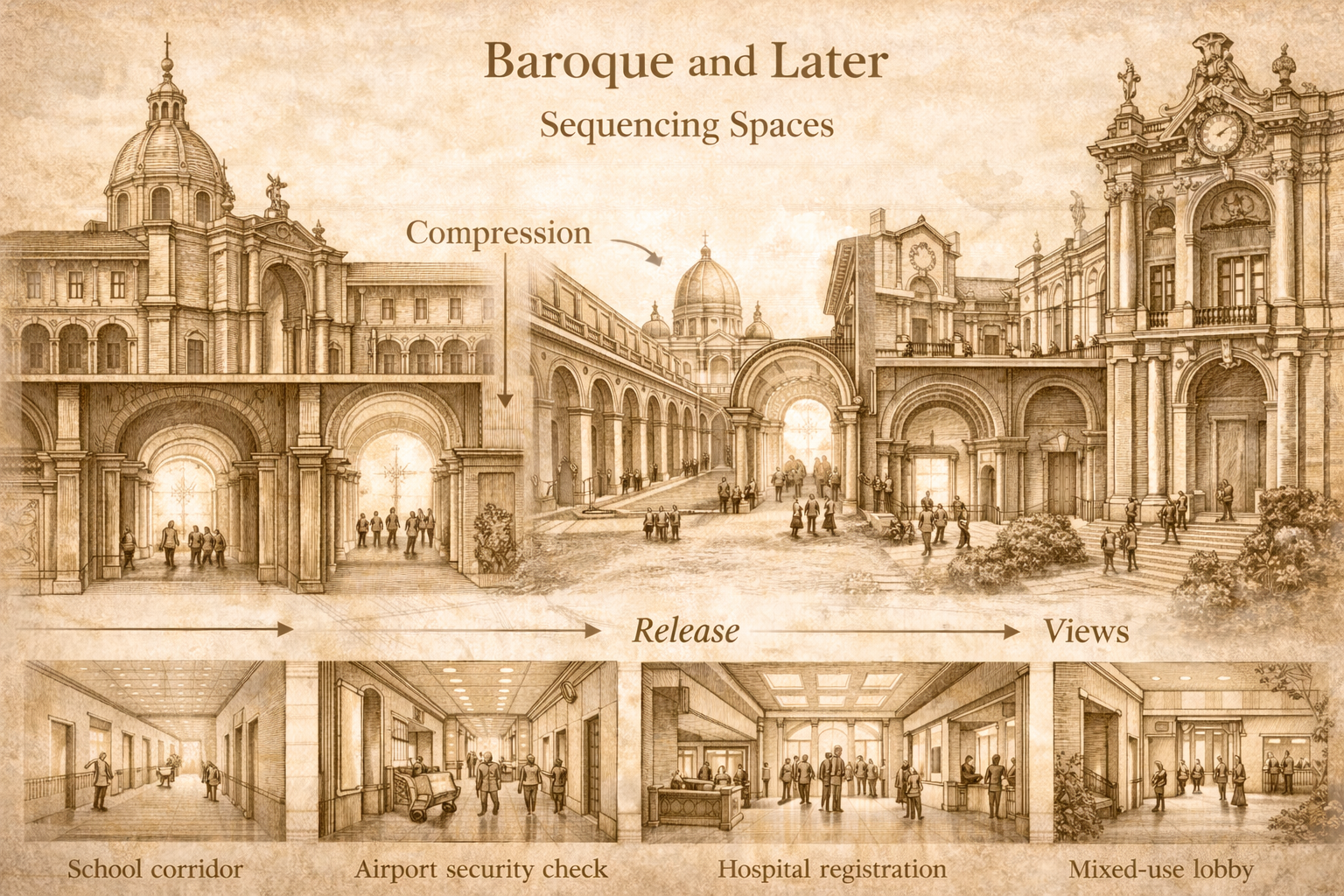
People think Baroque is about decoration. That’s the shallow read. The useful read is sequencing: compression and release, controlled views, staged thresholds, and the way movement becomes part of the design brief.
That matters today because most real projects still need to choreograph people—just in less glamorous ways. Schools, airports, hospitals, mixed-use lobbies, public buildings with security, retail environments, even small multifamily entries. You’re constantly managing pace, legibility, queuing, and how people decide where to go without asking for directions.
The practical warning: sequencing costs area and money. If you design generous thresholds, you’re spending net-to-gross. If you design long axial moments, you’re spending on structure and facade. If you design layered envelopes and deep reveals, you’re spending on details and maintenance. That’s fine—sometimes it’s worth it—but don’t pretend it’s free.
If you want a clean internal overview of Baroque moves (with enough grounding to steal intelligently), use Baroque architecture explained. And if you’re trying to understand how that splinters into adjacent styles and extremes, Baroque and Rococo helps connect the dots.
Industrial and Modern: Materials Changed, Problems Didn’t
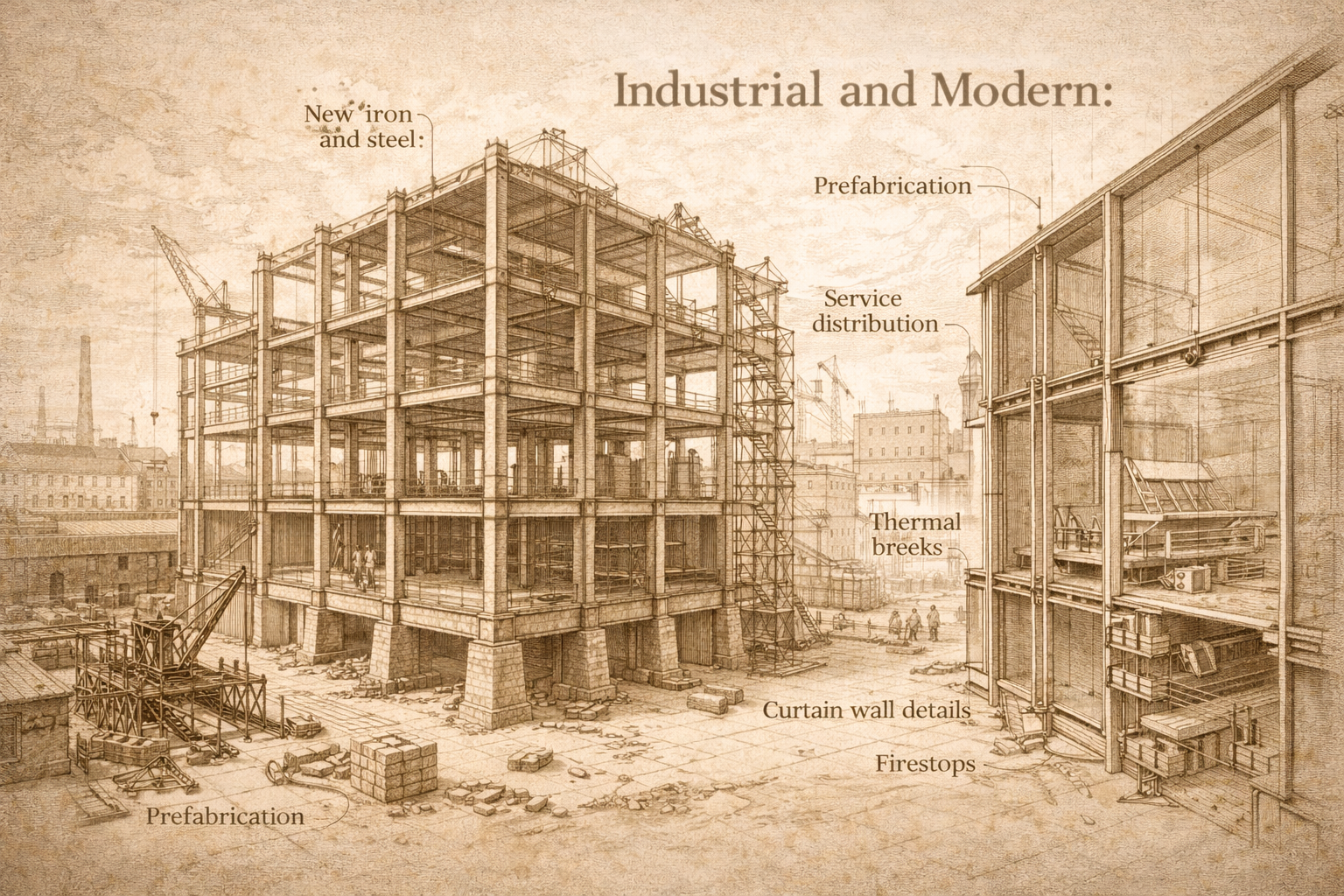
Industrial-era shifts are usually taught as “new materials.” Iron. Steel. Glass. Reinforced concrete. Prefabrication. That’s true, but the deeper change is logistics: repetition, standardization, and the ability to build at a scale where coordination becomes the primary design problem.
Modern work is full of clean diagrams that look simple because the mess was pushed into systems: curtain wall details, thermal breaks, fire protection, acoustic separation, expansion joints, service distribution, and increasingly, energy policy constraints. If you’re honest, a lot of modern “purity” is just extremely managed complexity.
In review language, modern projects fail when the diagram refuses to acknowledge thickness and performance. The glass box that ignores heat gain and glare. The open plan that ignores acoustics and privacy. The long-span space that ignores structural depth and vibration. The minimal detail that ignores water management and maintenance access. None of these are new failures. We just keep rediscovering them with new materials.
If you want to keep the material story grounded, this is a solid internal anchor: metal in architecture.
And for the “what really started it” thread—useful when you’re locating your project’s lineage without making up a narrative—use modern architecture history.
Vernacular and Climate: The Stuff That Actually Performs
If you want a humbling studio exercise, stop looking at monuments and look at ordinary buildings that worked for centuries with minimal technology. Not because they’re romantic. Because they’re often brutally optimized for climate, maintenance, and available skills.
Vernacular precedent is where you see real passive strategies without slogans. Courtyards that regulate microclimate. Deep shade and layered screens that manage sun and privacy. Thick walls that buffer temperature swings. Roof forms that shed water fast. Plans that accept seasonal use and shifting patterns of occupation.
The trap is fetishizing it. Copy-pasting a courtyard plan into the wrong climate, or importing a shading language without understanding sun angles, prevailing winds, and urban context. The win is learning how to think in assemblies and microclimates instead of facades.
For a specific “screen + climate” move-set that still shows up in contemporary work (and often gets drawn badly), start with mashrabiya designs.
If you’re tracking earthen construction as a real assembly—durability, water, maintenance, and the modern constraints that come with it—this is the internal reference worth using: rammed earth.
Turning History Into Something You Can Draw
Here’s the uncomfortable truth: you don’t “know” a precedent until you can draw it in plan and section at a real scale and it still makes sense. Not a diagram. A buildable slice. A wall section that deals with water. A structural bay that has depth. A stair that has landings, headroom, and door swings that don’t collide.
Try this workflow when you’re using history in studio or concept design:
Start with one system. Pick the structural idea, or the daylight strategy, or the ground interface. One. If you try to import everything at once, you’ll end up with a collage.
Redraw it at 1:200 and 1:50. The 1:200 tells you if the plan logic is coherent. The 1:50 tells you if the building is lying about thickness and construction. Your own redraw will expose the gaps faster than any essay.
Write the failure modes. Literally: “This breaks when…” Crit, permit, site, occupancy. Crit: the concept is inconsistent. Permit: the movement and safety logic doesn’t work (verify locally). Site: the assembly can’t be built or drained. Occupancy: it’s uncomfortable, loud, leaky, or expensive to maintain.
Only then add theory. Use theory to explain trade-offs you actually made, not to decorate a concept that hasn’t survived basic coordination.
If you want a cleaner “start here” entry point for history study on the site (useful for students building a mental timeline they can actually work with), this is the base: introduction to history of architecture.
And if you’re trying to track how materials drive form over time—because that’s usually where your section problems live—this timeline is a strong companion: timeline of building materials.
Roadmap: Studying History & Theory So It Survives Studio
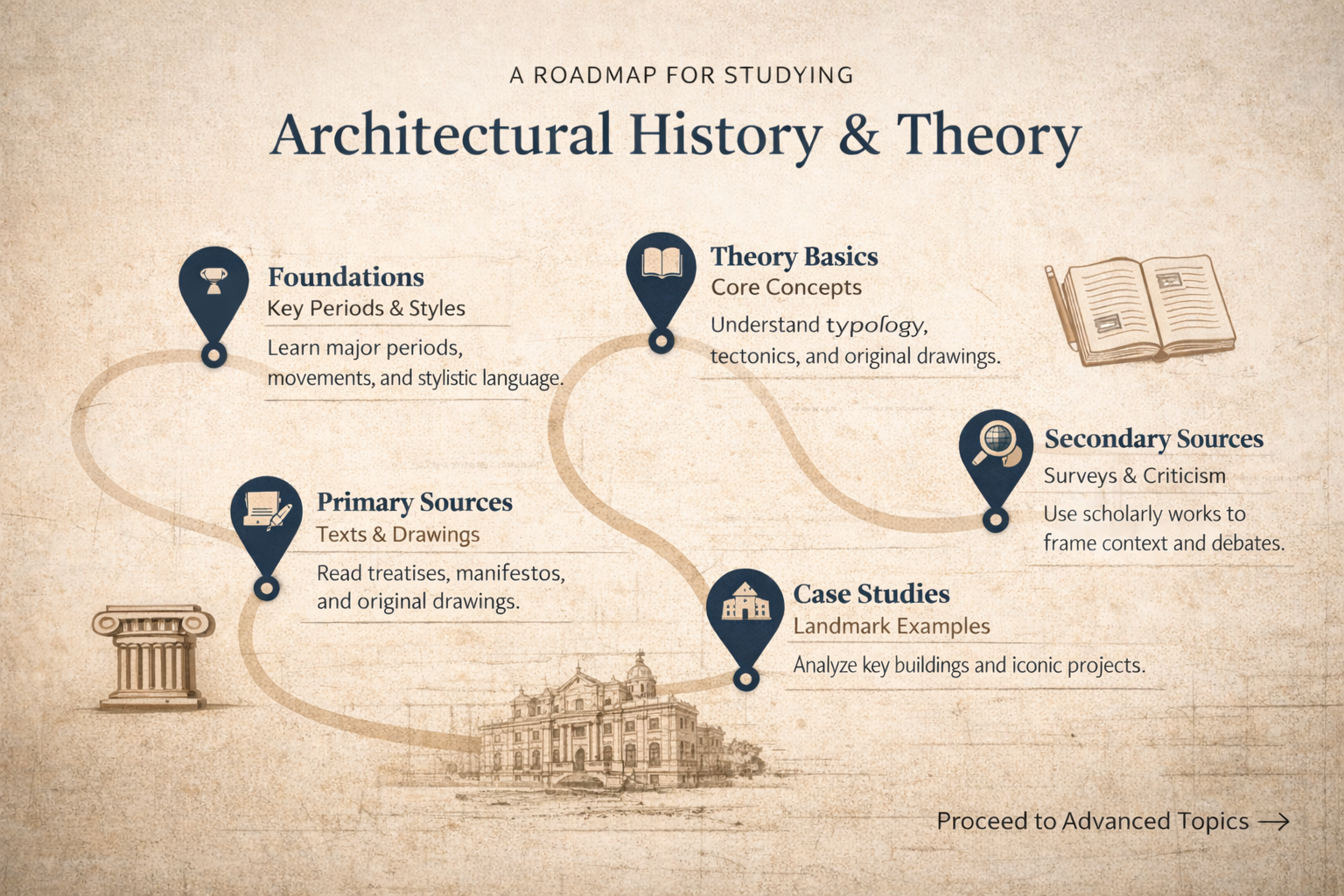
Most “history + theory” study plans are built for exams, not for design. So they feel like punishment: memorize names, memorize dates, then forget it all the second you’re back in studio.
I’d rather you treat history as a library of tested systems under constraint. And theory as a way to talk about trade-offs without hiding behind vibes. Same move, different language.
If you need a quick timeline spine to hang everything on (so you’re not lost), use this start-here history map. Keep it open. Don’t romanticize it. It’s just orientation.
Step 0: Stop “covering eras.” Build a spine + loops.
The mistake is thinking you “finish” history. You don’t. You build a working map, then you loop back when studio forces the question.
Spine = the rough sequence so you can place a precedent without guessing. Loops = the recurring problems that actually matter in design: spans, enclosure thickness, daylight depth, servicing, circulation under load, and how assemblies age.
Most legit course structures do some version of this (survey first, then thematic deep dives, then methods). Not because they love chronology. Because students need a scaffold before they can argue with it.
Step 1: Study buildings like you’re issuing a set (even if you’re not).
If your notes are mostly images and adjectives, you’re collecting aesthetics. Fine for Pinterest. Useless in crit.
What holds up in review is boring evidence. Plan logic. Section logic. Assembly logic. Circulation that works when people actually show up. This is why so many architecture history/theory courses still assign plan/section analysis and drawing-based readings: it forces you out of “style talk” and into “how the thing is put together.”
Quick self-check: can you redraw one key plan and one key section from memory at a rough scale and still explain the load path, daylight path, and the messy service zone? If not, you don’t know it yet. You’ve seen it.
Step 2: Pick a weekly rhythm that doesn’t collapse in Week 5.
This is where students either become consistent or disappear into all-nighters.
Here’s a rhythm that’s actually survivable during studio (and it matches how a lot of syllabi quietly expect you to work):
- 1 day “spine”: 30–45 minutes. One era pass. Just enough to place things.
- 2 days “one building”: pick one precedent and do plan + section + one assembly sketch (even ugly).
- 1 day “one idea”: one theory claim, translated into plain language, then tested against the building you just drew.
- 1 day “studio tie-in”: write a paragraph you could actually say in crit: “I’m stealing X because it solves Y under Z constraint.”
Notice what’s missing: “memorize 200 dates.” Students complain about that constantly (and yeah, sometimes profs still demand it). But even when exams are brutal, the people who survive aren’t memorizing harder — they’re building a map and attaching facts to a system so the facts stick.
Step 3: When theory feels like nonsense, translate it into a testable claim.
A lot of students hit the same wall: the writing sounds like it was designed to keep outsiders out. They’re not wrong. You’ll see this complaint everywhere.
So do this instead:
Take one paragraph and rewrite it as: “This author thinks architecture does ____ in society, and you can see it when ____ happens in plan/section/use.”
If you can’t translate it without losing the meaning, either you don’t understand it yet (common), or it’s not useful for what you’re doing right now (also common). Park it. Come back later when a studio project drags you back into that question.
Step 4: Build your own “precedent kit” (small, mean, useful).
Not a giant archive. A kit. 12–20 buildings you can actually use.
Mix types and climates. Mix scales. Mix materials. Include a few that failed (or aged badly) because those teach faster than “icons.” Keep one page per building:
Program / plan type / structural span strategy / enclosure thickness logic / daylight depth move / circulation pinch points / what will leak first.
This is where the bigger web helps, because the “single storyline” version of history makes you think there’s one correct lineage. There isn’t. If you want that wider map without turning your brain into soup, keep this eras-and-lessons overview around as a reference grid.
Step 5: Use fieldwork as a cheat code (even in your own city).
You don’t need to travel internationally to learn architecture. You need to look like you’re annoying. Stand too long. Walk the edge conditions. Watch how people actually move. Notice where the building is tired.
When students say “I can’t comprehend history,” half the time it’s because they’re trying to understand buildings as text. Buildings aren’t text. They’re weather + maintenance + budget decisions that hardened into matter.
Do quick visits like this:
One photo of the whole. Then one of the ground interface. Then one of the roof/drainage clue. Then one interior shot looking toward the brightest opening. Then one “failure” shot: stain, crack, patch, warping, weird retrofit. That last one teaches more than the hero angle.
If you’re prepping for exams, don’t pretend it’s the same task.
Some schools still run history exams like endurance sports: giant image IDs, redraws, long essays, the whole thing. If that’s your reality, separate the work:
Studio-use knowledge (systems + constraints) and exam knowledge (ID drills + dates) can overlap, but they’re not identical. Don’t sabotage studio by spending every night on flashcards. And don’t sabotage exams by pretending “I understand the concept” replaces the required IDs. Two lanes. Manage both.
What tends to work (and students keep repeating this in the wild) is drawing-based studying: sketching plans/sections, not just rereading notes. It’s slower, but it sticks.
What “good progress” actually looks like
Not: “I finished a survey book.”
It looks like this instead:
You can name the constraint. You can point to the evidence in plan/section. You can say what you stole. You can say what it costs (area, thickness, labor, money, maintenance). And you can defend it in crit without sounding like you swallowed a museum label.
That’s the whole point. History and theory that survives contact with studio.
So What’s the Point?
The point isn’t to memorize eras. It’s to stop being surprised by the same failures.
When you read history as a record of constraints, you get faster at diagnosing your own work. You start seeing where your plan is pretending. You start drawing thickness earlier. You stop trusting daylight diagrams that don’t match the section. You get less sentimental about “influence” and more serious about performance and buildability.
That’s the version of architectural history and theory that actually pays rent. In studio. In practice. On site. At occupancy.
What Survives Contact With Studio
Most “history + theory” writing dies the moment it hits a desk. Too clean. Too linear. Too obsessed with names and not enough with consequences.
If you’re here, you already know the timeline. What you probably want is the part nobody teaches well: how history shows up in crit, in permit, and later when the building is leaking and the owner is mad.
So this is not a tour. It’s a stress test. Structure. Thickness. Daylight depth. Egress logic. Site reality. Drawings and schedules. Materials that age badly. The politics that quietly redesign your plan.
For a clean “start here” map you can point interns to (or use when you need a timeline fast), keep this parked in another tab: Introduction to History of Architecture: Where Every Architect Should Start.
FAQ
(questions that come up constantly in the real world)
“Is architectural theory actually useful, or is it just academic punishment?”
Useful when it gives you language for trade-offs and criticism. Useless when it’s treated like scripture. The practical move is: translate theory into a testable claim about space, use, power, comfort, or construction. If it can’t survive that translation, it’s just vibes with footnotes.
“What’s the point of studying architectural history if I’m not trying to be an architect?”
History is a shortcut to pattern recognition. You learn why certain layouts keep reappearing, why certain materials keep failing the same way, why some “innovations” are just old moves in new packaging. Even if you never draw a plan, you start seeing the built environment as decisions—not fate.
“How do I do a precedent study that doesn’t look like a Pinterest collage?”
Start with a section cut that explains structure + daylight + ventilation + water shedding. Then diagram circulation under load. Then list the assemblies you’d actually have to detail if you were issuing a permit set. If you can’t name those assemblies, you’re still in image land.
“Where do I start with architecture history books without drowning?”
Pick one survey book to build a timeline spine, then go regional or typological based on what you’re designing. If you try to read “everything,” you’ll just collect fragments. The goal is a usable mental map, not completion.
“I love history. Can I make a career in architectural history?”
You can, but treat it like a narrow pipeline with gatekeeping and funding realities. Plan for adjacent paths: preservation, archives, research support inside firms, policy/heritage roles, writing/criticism, or teaching support. The romantic version is common. The job postings version is not.
“How do architects actually start a new project?”
They triangulate constraints fast: site + code + budget + schedule + procurement. Then they pull precedents (sometimes shamelessly), not to copy the look, but to steal a working system. The “pure concept” story usually gets written after the fact.
“How original do I need to be?”
Originality is overrated. Coherence is not. Most strong projects are recombinations of known moves, tuned hard to a specific site and program. The real sin is copying a form without copying the logic that made it viable.
“How do I train myself to think more ‘theoretically’ in studio?”
Practice criticism on real buildings. Pick one claim—about power, comfort, access, labor, or perception—then prove it using plan/section and lived experience. If you can argue it without hiding behind jargon, you’re doing theory in the only way that matters.
“I hate reading theory. Any survival tactics?”
Skim for the claim, not the poetry. Write the argument in plain language in three sentences. Then test it against a building you’ve actually been inside. If the idea doesn’t touch reality, you’re allowed to let it go.