
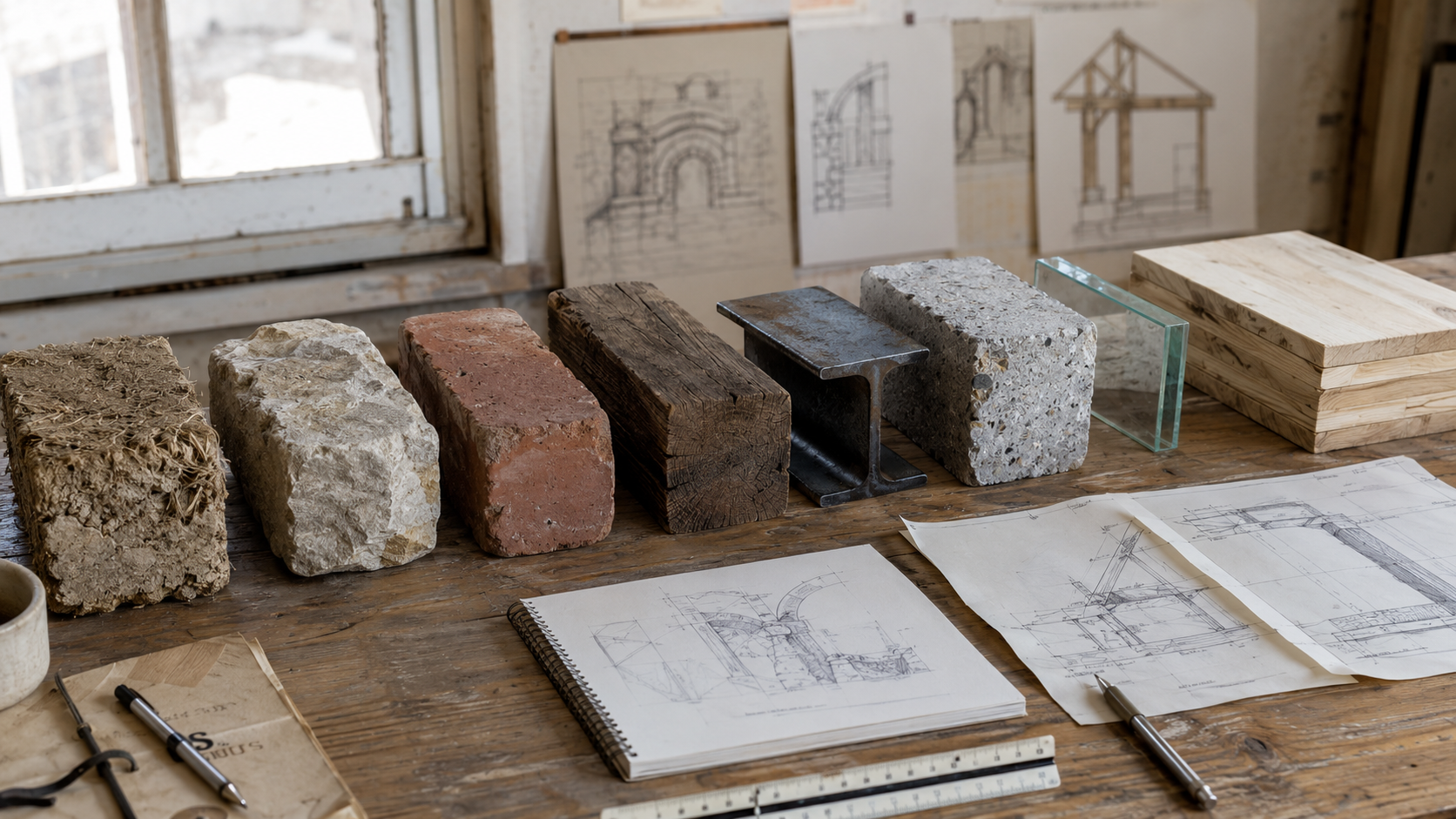
How Materials Changed and What Each Change Solved
Building materials change when the old one stops working for the next job.
It burns. It rots. It cannot span far enough. It leaks. It weighs too much. It takes too long to build with. Or it costs too much to move.
The history of building materials is not a clean march from primitive to advanced. Stone never disappeared. Timber never disappeared. Brick never disappeared.
New materials came in because they solved a problem. They also created new ones. Some made cities taller. Some made walls lighter. Some made buildings faster to put up but harder to repair later.
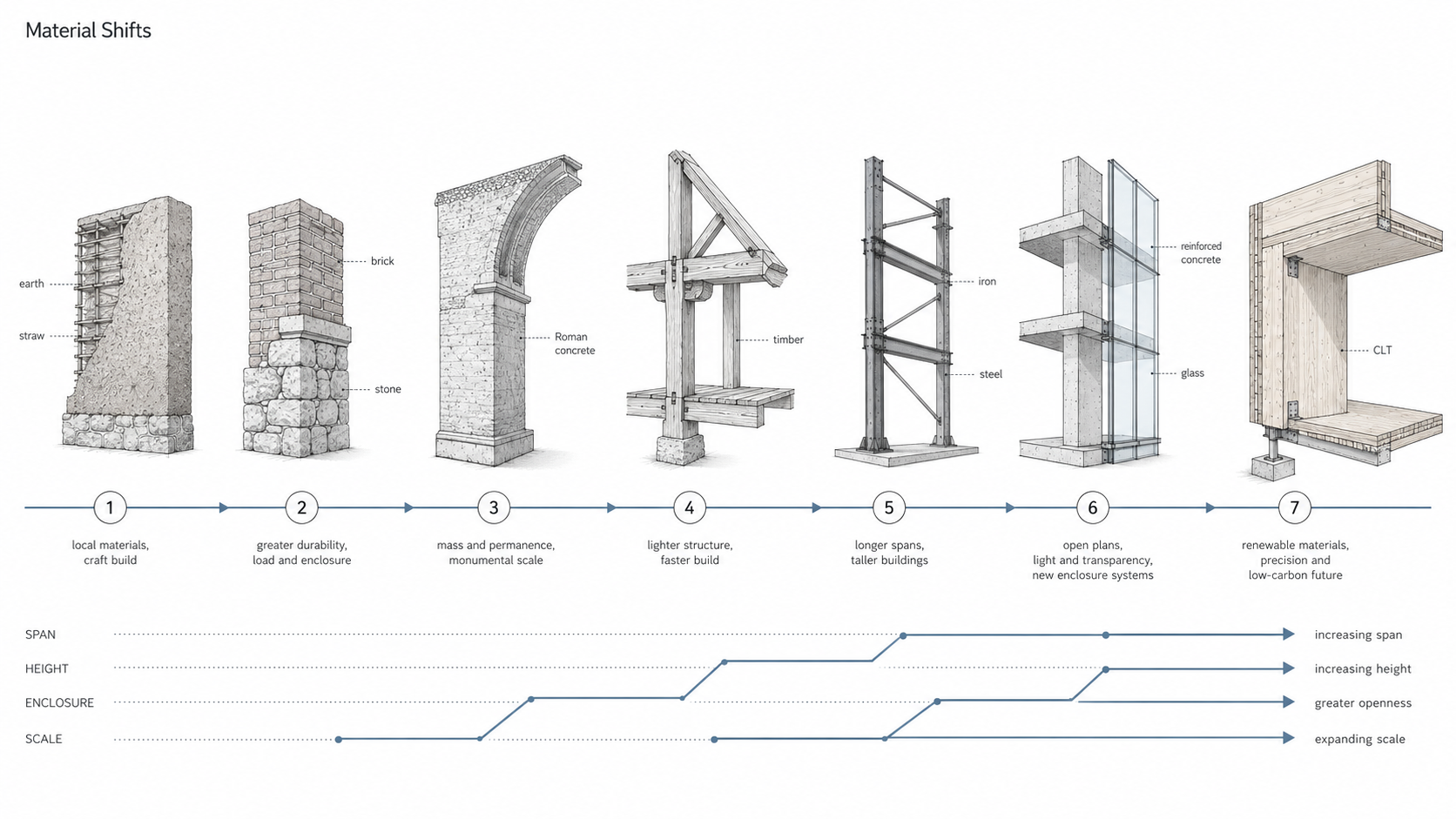
The useful way to read the timeline is simple: span, fire, weight, labor, durability, repair, and now carbon.
Also useful: if you want the broader material map after this, read Building Materials and New Sustainable Building Materials: What’s Legit and What’s Noise.
Start with the short version
| Period | Main materials | What changed | What stayed hard |
|---|---|---|---|
| Early settlements | Earth, straw, timber, stone | Local shelter became repeatable building | Weather, fire, span, maintenance |
| Ancient and classical eras | Stone, fired brick, lime mortar, Roman concrete | Bigger public works, arches, vaults, infrastructure | Weight, labor, transport |
| Medieval to early modern | Timber framing, masonry, glass | Better roof systems, bigger openings, urban craft traditions | Fire, decay, consistency |
| Industrial era | Iron, steel, mass brick, Portland cement | Taller buildings, longer spans, faster urban growth | Corrosion, heat movement, new repair problems |
| 20th century | Reinforced concrete, steel frames, glass, aluminum | Skyscrapers, curtain walls, global modernism | Embodied carbon, thermal bridging, maintenance |
| Today | Engineered wood, improved concretes, bio-based and recycled materials | Carbon and lifecycle are now part of the material choice | Scale, codes, supply chain, repair logic |
If there is one pattern worth keeping in mind, it is this: every new material solves a real problem first. The marketing comes later.
Before kilns and steel, builders used what they could carry
The earliest building materials were not chosen from catalogs. They were chosen from the ground, the nearest stand of trees, or whatever could be cut, stacked, dried, or shaped by hand.
That meant earth, straw, timber, and stone.
Adobe and mud-based building lasted because they answered a real need. They were local. They were cheap in material terms. They could be formed without advanced tools. Straw and grass were not decorative extras. They helped bind the mix and reduced cracking. In hot and dry regions, that basic material logic still makes sense today.
Stone solved a different problem. It lasted. It resisted fire. It could take load. But it also demanded labor, quarrying, transport, and skill. That is why stone became the material of monuments, fortifications, temples, and the parts of a settlement that needed to outlast everything else.
Timber sat in the middle. Easier to shape than stone. Faster to build with. Better for roof spans and framed walls. But vulnerable to fire, insects, moisture, and bad detailing.
The point is not that one of these materials was better. The point is that each one matched a place, a climate, and a level of labor and technology.
Brick and lime mortar changed permanence
Once people could fire clay reliably, masonry changed.
Brick made wall construction more regular. It was easier to stack consistently than rough stone. It could be made in quantity. It moved better than large cut stone. More important, it worked with mortar systems that let walls behave as assemblies instead of just piles of units.
Lime mortar matters here more than people usually admit. It is easy to talk about brick and skip the binder, but mortar is where a lot of the real wall logic lives. It controls movement, moisture behavior, and the way repairs happen later.
That is one reason old masonry buildings can still perform well when repaired with compatible materials and fail badly when repaired with the wrong hard cement.
In plain terms, fired brick and lime mortar made longer-lasting urban building more repeatable. Not glamorous. Just important.
Roman concrete changed span and infrastructure
Roman concrete gets overhyped sometimes, but it does deserve the attention.
Not because it was ancient magic. Because it changed what could be built at scale.
Roman concrete used lime and volcanic ash in ways that let the material hold up extraordinarily well, especially in marine conditions. What mattered for architecture was not just strength. It was freedom. Concrete let Roman builders shape vaults, domes, harbor works, baths, and infrastructure with a level of continuity and mass that cut stone alone could not match as efficiently.
The best way to think about Roman concrete is not that it invented modern concrete. It did not. It is that it supported a different kind of empire: roads, ports, aqueducts, markets, baths, and large civic interiors.
Related reading: Roman Architecture Style | Materials, Tools, and Style is the better next page if you want the Roman material story through actual buildings instead of a broad timeline.
MUST READ
Roman Building: Materials and Techniques is the stronger deeper read if you want the Roman concrete and masonry part without the usual fluff.
Timber never left. It just kept changing
A lazy timeline makes timber look like a primitive phase that iron and concrete replaced. That is not how the built world works.
Timber stayed because it solved jobs that heavy masonry did not solve well. It framed roofs efficiently. It handled lighter walls. It could be worked quickly. In forest regions, it was often the most sensible structural material available.
What changed over time was the level of processing and control. Rough timber became milled lumber. Simple framing systems became more standardized. Joinery traditions changed region by region. Then engineered wood products entered the picture much later and pushed timber into much larger structural roles again.
That is why the modern return of mass timber is not really a return to the past. It is timber with a different manufacturing logic.
One more thing: Where Wood Belongs in Architecture Today and Engineered Wood Explained: Types, Benefits, and Installation show what happened when wood stopped being treated as only a small-building material.
Iron and steel made tall urban buildings practical
The real urban break is not just that builders discovered metal. It is that metal let structure get thinner and taller.
Cast iron and wrought iron started loosening masonry’s grip on building form. Then steel changed the whole equation. Once the frame stopped being a thick load-bearing wall, the lower floors opened up. Window area changed. Floor area changed. The facade stopped doing the same structural job it did before.
That is a bigger shift than steel is strong. It changed the whole relationship between structure and skin.
By the late 19th century and early 20th century, you can already see the next problem starting. Once structure and facade separate, the building gets new freedoms, but also new leakage paths, new thermal problems, new maintenance burdens, and new cladding questions.
Worth knowing: 19th Century Building Materials: Innovations That Changed Construction Forever is useful if you want the iron, steel, brick, and cement shift on its own.
Reinforced concrete changed speed, span, and routine construction
Roman concrete gets the romance. Reinforced concrete changed everyday construction more completely.
Once steel reinforcement and modern cement-based concrete became normal, foundations, slabs, frames, bridges, parking structures, apartment blocks, and civic buildings could all be built with a material system that handled compression and tension together.
That changed more than form. It changed labor and sequencing. Concrete could be poured into formwork with repeatable geometry. It could make flatter floors, larger spans, parking decks, towers, retaining walls, and utilitarian infrastructure on a scale that older systems made slower or more expensive.
It also brought a new repair future with it: cracking, spalling, corrosion, rebar cover issues, bad curing, poor mixes, and carbon-heavy cement production. Every material win comes with its own repair chapter later. Concrete is no exception.
Glass and aluminum made the facade lighter, but also fussier
Once steel and concrete frames carried the load, the wall could change jobs.
That is where glass and aluminum start to matter less as decoration and more as enclosure technology. Curtain walls, larger windows, lighter skins, and repetitive facade systems changed office towers and commercial buildings across the 20th century.
This made buildings look cleaner and brighter. It also made them more dependent on seals, gaskets, thermal breaks, coatings, shading, and maintenance discipline.
That trade-off is still with us now. A lighter facade can mean speed and daylight. It can also mean overheating, glare, difficult repairs, and short-cycle sealant problems if the system is not detailed and maintained well.
That is one reason material history is worth reading. The cleaner the facade looks, the more work may be hidden in the joints.
Today the material question is carbon, labor, and repair
Modern materials are not just about strength anymore.
They are judged on carbon, transport, health, moisture behavior, maintenance, and whether a real site crew can actually install them correctly.
That is why today’s material discussion is split. One side keeps trying to improve old heavy systems: lower-carbon concrete, supplementary cementitious materials, recycled content, better durability. The other side keeps pushing bio-based and lower-mass systems: hemp-lime, cork, bamboo, mass timber, cellulose, reused materials, and hybrid assemblies.
Neither side gets to skip repair logic.
A material that looks sustainable on paper but fails early, traps moisture, or depends on impossible craftsmanship is not a smart material choice. This is where a lot of bad future-material writing still falls apart.
Also useful: Natural Building Materials: A Comprehensive Guide for Builders and Students helps if you want to compare older low-tech material logic with today’s lower-carbon material discussion.
FIELD PICK
Sustainability Principles and Practice (3rd Edition) is a good follow-up if you want to connect older material logic to today’s carbon and lifecycle decisions.
The part most timeline pages skip
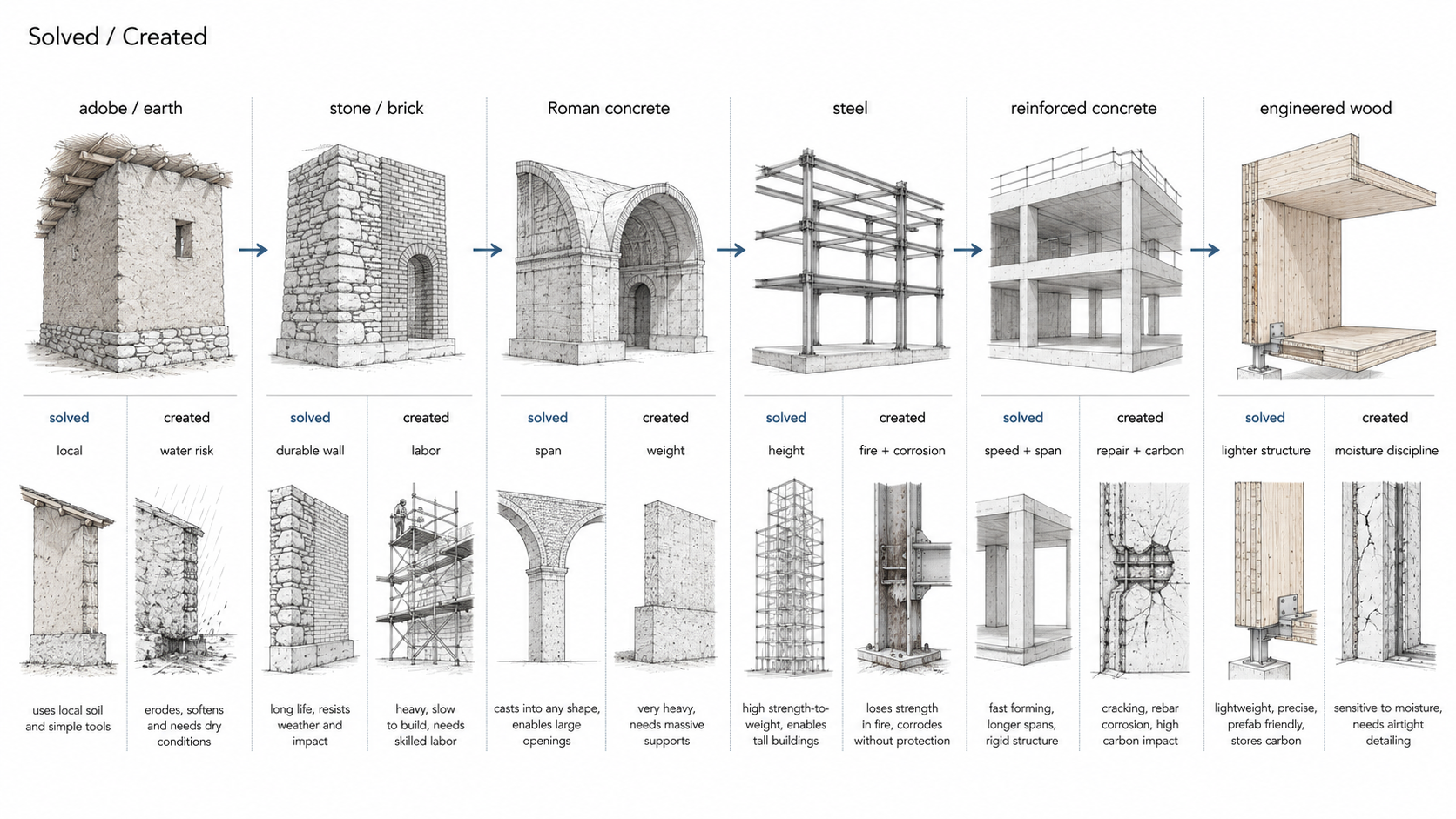
A new material does not just solve an old problem. It creates a new repair problem.
That pattern shows up over and over.
Adobe needs maintenance and protection from prolonged water. Brick depends on mortar compatibility and movement joints. Steel needs corrosion and fire protection. Reinforced concrete needs cover, curing, and long-term corrosion control. Glass walls need sealants, drainage paths, and thermal logic. Engineered wood needs moisture discipline and detailing that respect how the product is made.
This matters because the material choice is never just about the day the building opens. It is about what the next owner inherits, what the maintenance crew has to understand, and what fails first when the detailing is cheap.
That is the lesson a student or homeowner can actually use. Material history is not just a museum shelf. It is a warning that every material carries a maintenance culture with it.
What this timeline is good for now
If you are choosing materials today, the history helps in three ways.
First, it stops you from treating any material like a miracle. There are no miracle materials. There are materials that fit a job and materials that do not.
Second, it shows that the winning material is usually the one that solved the pressure of its time: durability, span, speed, height, cost, or now carbon.
Third, it reminds you that the best move is often not the newest one. Sometimes stone is still the right answer. Sometimes wood is. Sometimes concrete is. Sometimes the smartest choice is keeping an older material and fixing the assembly around it instead of replacing it with something trendier.
Worth knowing: Core Structural Materials in Architecture: What Really Holds Buildings Up is the better next step if you want to move from history into actual present-day material decisions.
FAQ
What is the oldest building material still widely used?
Stone and earth are both still in use, but stone is the easiest answer because it still appears in structure, cladding, paving, and landscape work across many building types.
Why does Roman concrete still matter?
Because it proved that a concrete material could radically expand what infrastructure and public architecture could do, and it is still teaching researchers about durability today.
Did steel replace masonry?
Not completely. It changed what masonry had to do. Once metal frames carried more of the load, masonry could become thinner, more cladding-like, or more specialized.
Is timber really a modern structural material again?
Yes. Timber never left small-scale building, but engineered wood and mass-timber systems pushed it back into larger structural roles.
What is the biggest lesson from the history of building materials?
New materials win when they solve a real construction problem. They last when builders also learn the repair and detailing problems those materials create later.