
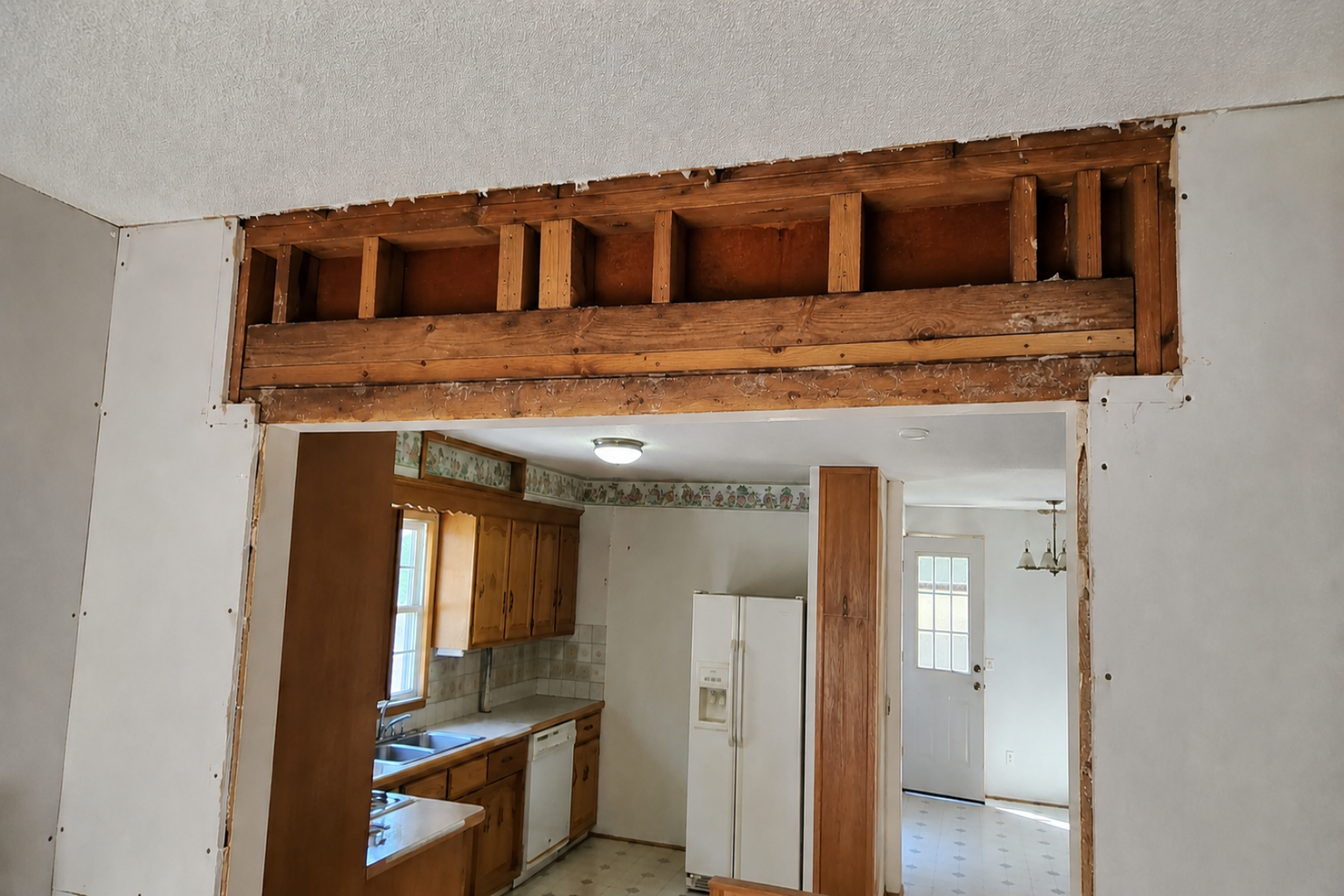
This page helps you understand wall types before planning a remodel. It does not replace a structural assessment for wall removal.
Some walls divide rooms. Other walls hold up the house.
That difference matters before you cut anything. A partition wall may be easier to remove, but it still needs checks for wiring, plumbing, HVAC, fire separation, and code requirements. Removing a load-bearing wall often means a beam, posts, temporary support, permits, and an engineer.
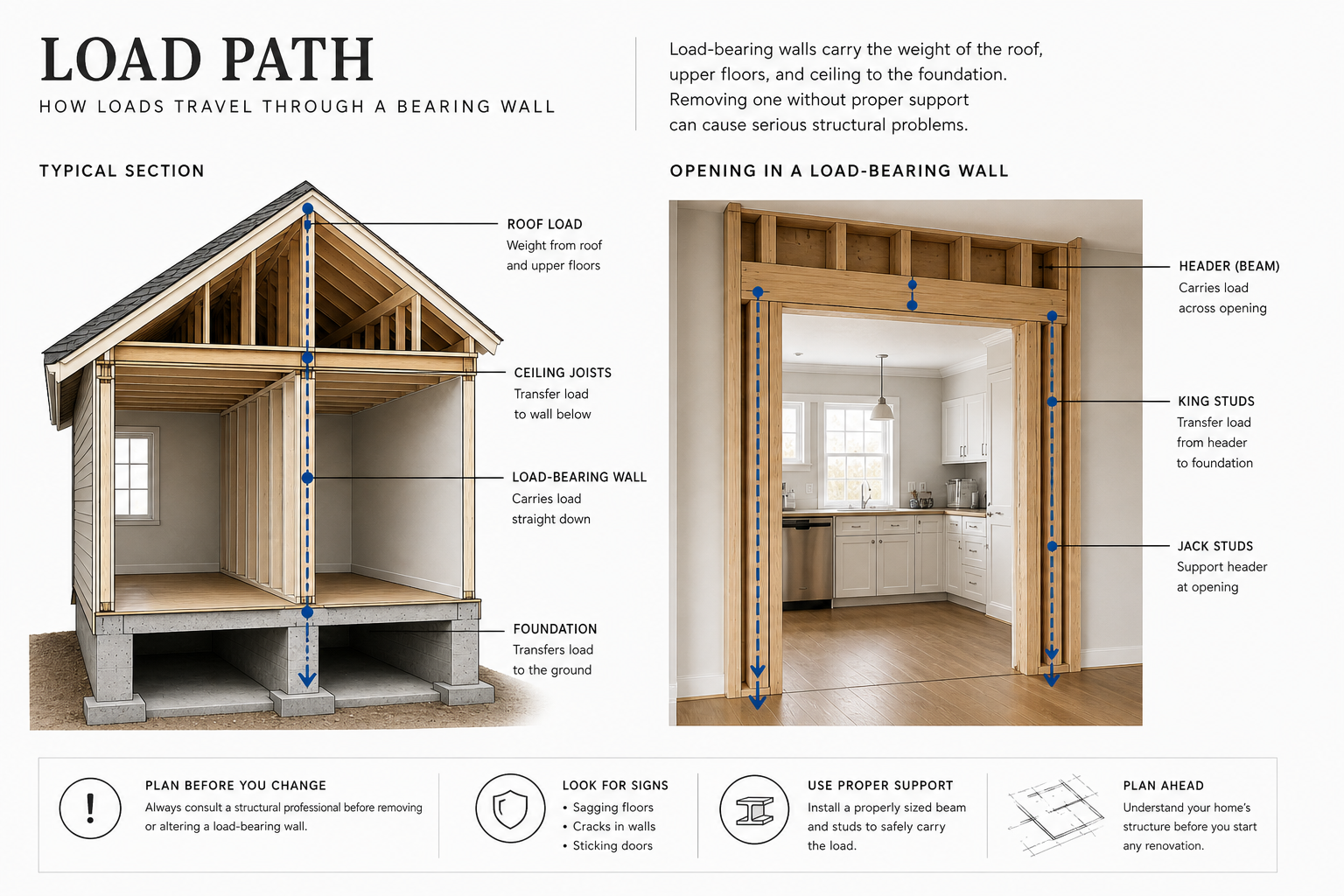
Load-bearing walls carry weight from above and transfer it down to the foundation. That weight may come from roof framing, floor joists, beams, upper walls, furniture, snow loads, or people.
Non-load-bearing walls mainly divide space. They may still contain wiring, plumbing, HVAC, blocking, or fire separation, but they are not supposed to carry the main structural load.
If you are not sure, do not guess. A wrong cut can lead to sagging floors, cracked ceilings, twisted openings, or a repair bill much larger than the remodel itself.
MUST HAVE
Graphic Guide to Frame Construction by Rob Thallon
A useful reference if you want to understand framing, wall structure, joists, headers, and load paths without guessing.
View on Amazon
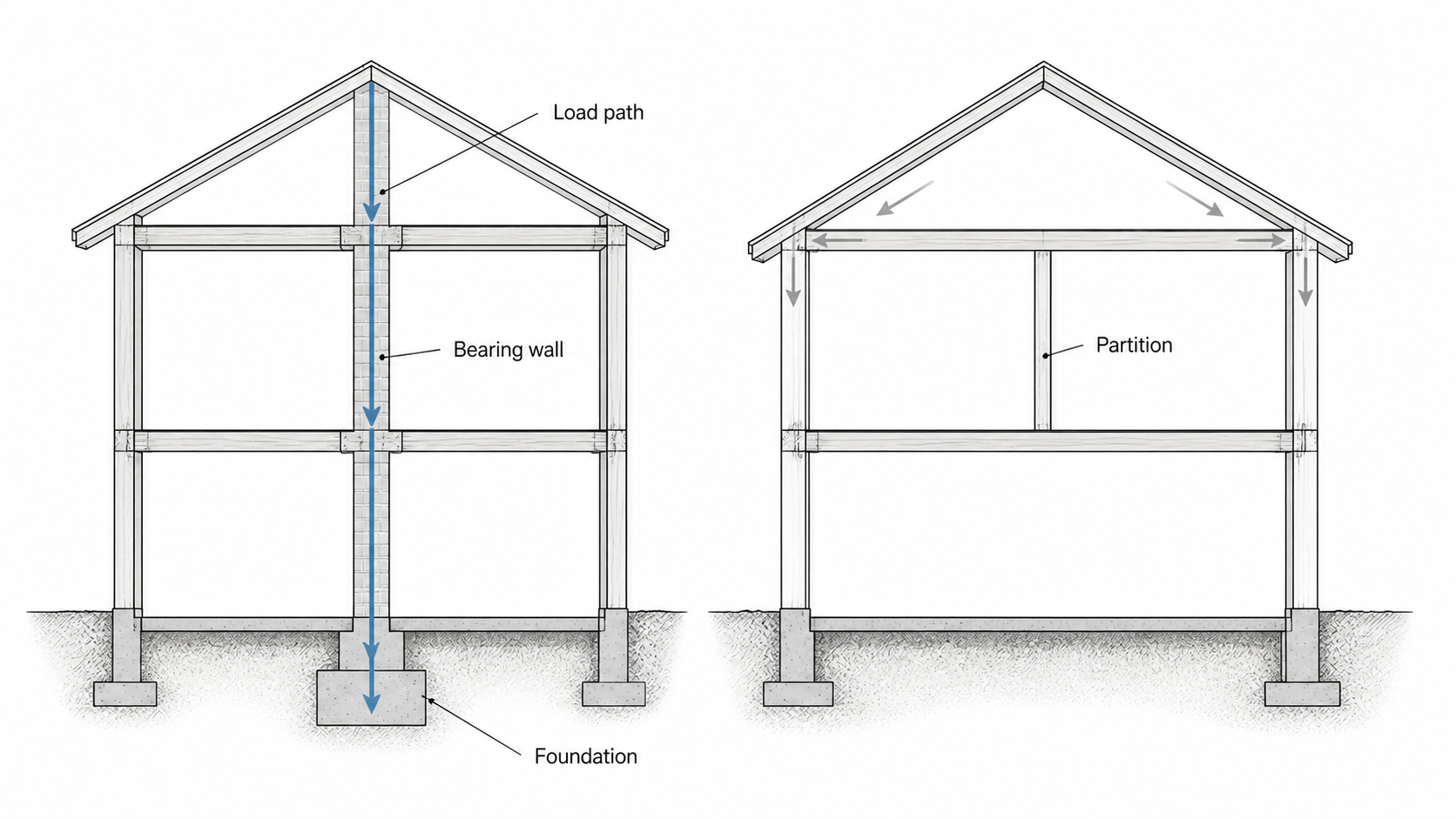
Illustration by ArchitectureCourses.org. A bearing wall carries roof and floor loads down to the foundation; a partition only divides space.
What a Load-Bearing Wall Does
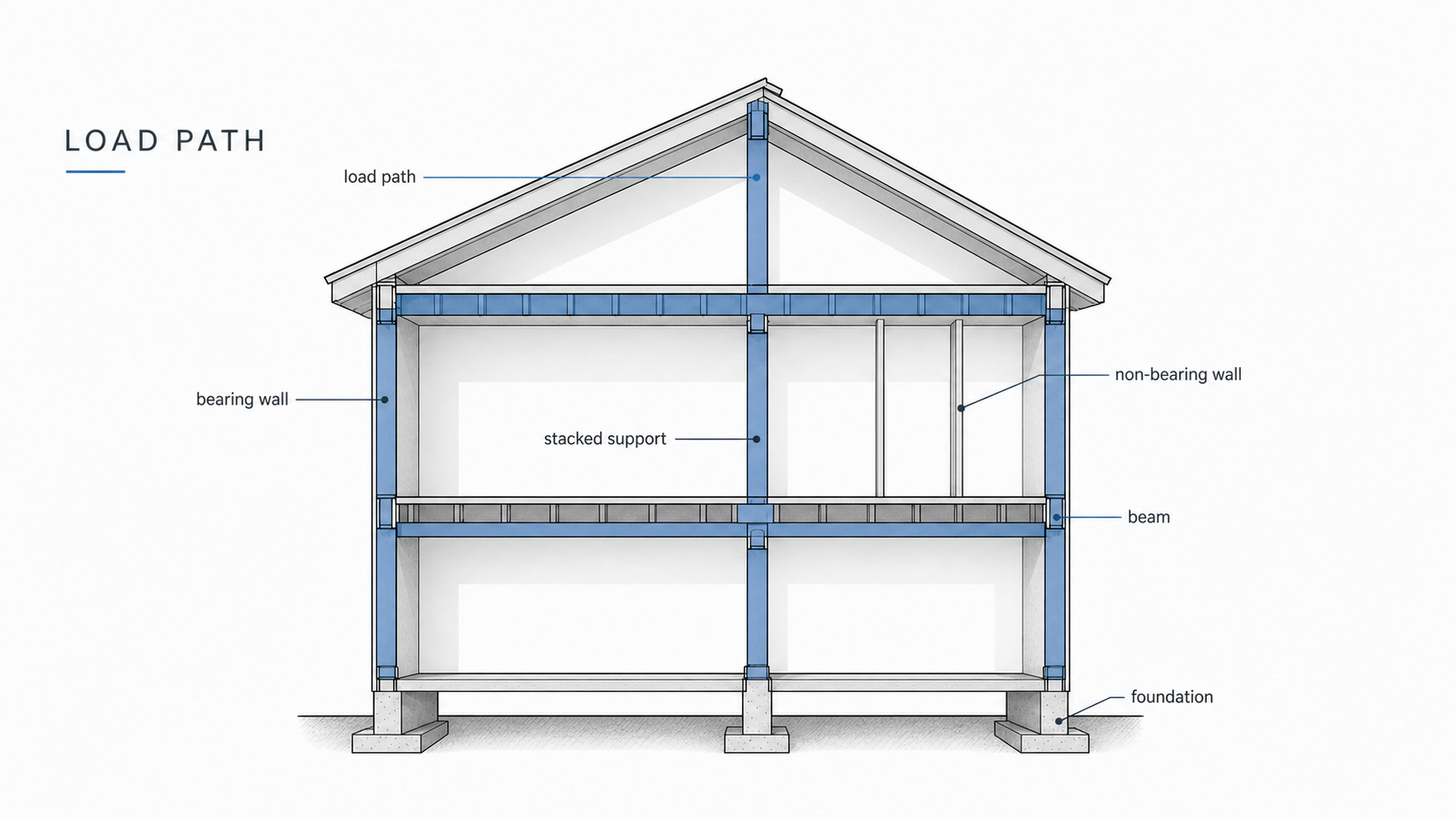
A load-bearing wall is part of the building’s structural path. It takes load from above and passes it down through framing, posts, beams, foundation walls, footings, or slabs.
In a simple house, the load path might run from the roof rafters or trusses into ceiling joists, then into a central bearing wall, then into a beam or foundation below. In a two-story house, the same wall may also support second-floor joists or another wall stacked above it.
Where Load-Bearing Walls Usually Show Up
- Exterior walls, especially in conventional wood framing.
- Interior walls near the center of the house.
- Walls that line up with beams, posts, girders, or foundation walls below.
- Walls that run perpendicular to floor joists.
- Walls stacked in the same location from one floor to the next.
- Masonry, concrete, or block walls carrying roof, floor, or lateral loads.
For the bigger structural logic behind this, read structural design basics and types of structural loads.
Example: Two-Story House
In a two-story house, a wall directly below a second-floor beam or bearing line may be carrying the floor above. If that same load continues down to a basement beam, post, or foundation wall, the wall is part of the load path. Removing it without support can make the floor above flex, sag, or crack finishes.
What a Non-Load-Bearing Wall Does
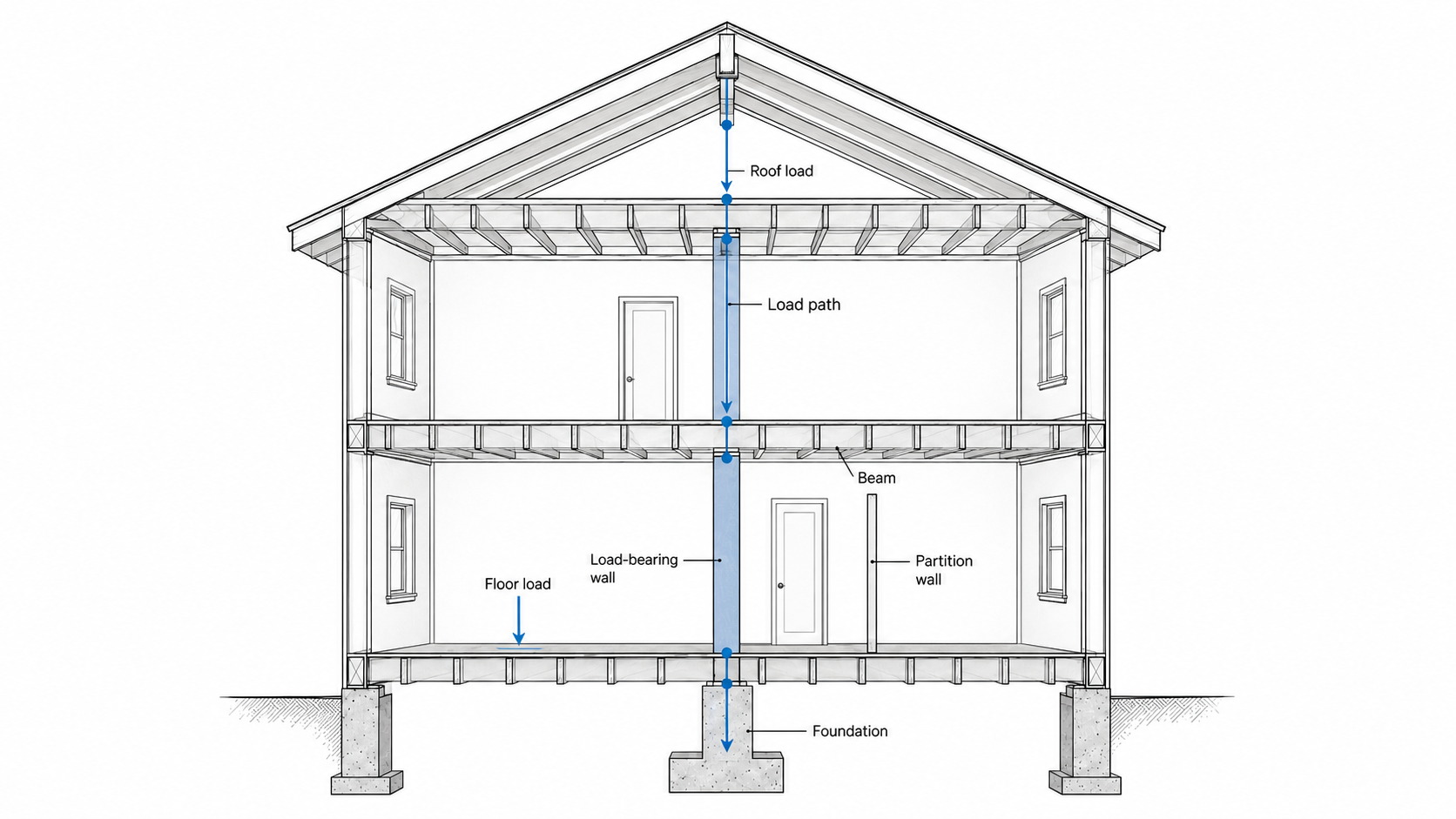
Illustration by ArchitectureCourses.org. A load-bearing wall transfers roof and floor loads through the framing and down to the foundation.
A non-load-bearing wall is usually a partition. It separates rooms, creates closets, hides mechanical runs, or gives privacy. It may be framed with wood studs, metal studs, drywall, glass, or light blocking.
That does not mean it is safe to remove blindly. A non-bearing wall can still contain:
- Electrical wiring.
- Plumbing lines.
- HVAC ducts or returns.
- Gas lines in some older homes.
- Blocking for cabinets, railings, or fixtures.
- Fire-rated separation in multi-family or garage-adjacent walls.
The better question is simple: what is this wall doing besides dividing the room?
Load-Bearing vs Non-Load-Bearing Walls: Quick Comparison
| Feature | Load-Bearing Wall | Non-Load-Bearing Wall |
|---|---|---|
| Main job | Carries structural load | Divides space |
| Risk if removed | High | Lower, but still needs checks |
| Common clue | Lines up with joists, beams, posts, walls, or foundation below | No clear structural alignment above or below |
| Common materials | Wood framing, steel, masonry, concrete, block | Wood studs, metal studs, drywall, glass |
| Can it be moved? | Yes, but only with a designed replacement load path | Often yes, after utility and code checks |
| Who should confirm it? | Structural engineer or qualified builder | Builder, inspector, or trade contractor depending on utilities |
Why Wall Type Matters Before a Remodel
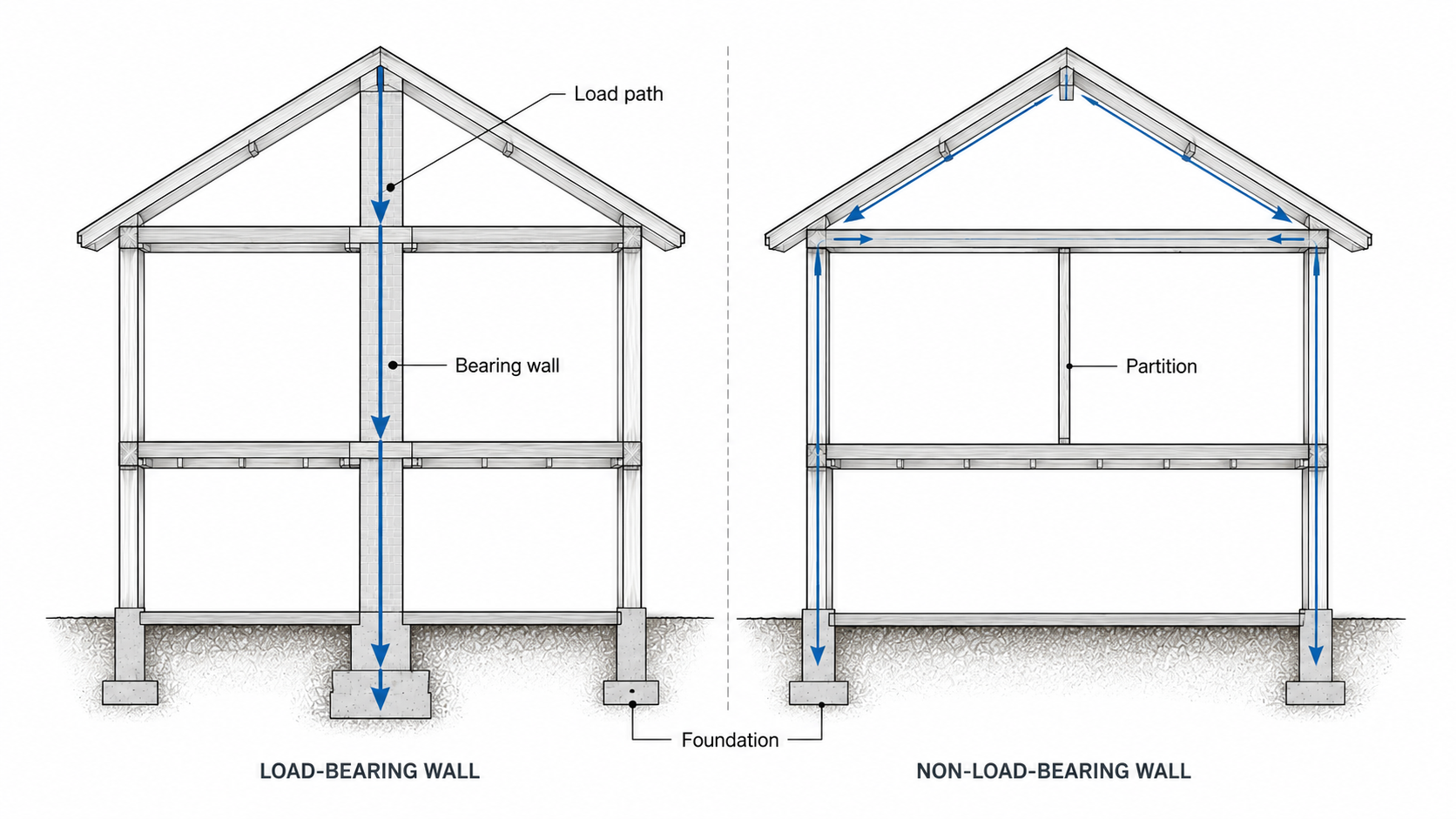
Illustration by ArchitectureCourses.org. A load-bearing wall carries roof and floor loads down to the foundation; a non-load-bearing partition only divides rooms.
Wall removal looks simple on TV. On a real house, the wall may be holding floor loads, roof loads, ceiling loads, or a stacked wall above. The risk is not just dust and drywall repair. It can change how the house carries weight.
Some Walls Hold More Than You Think
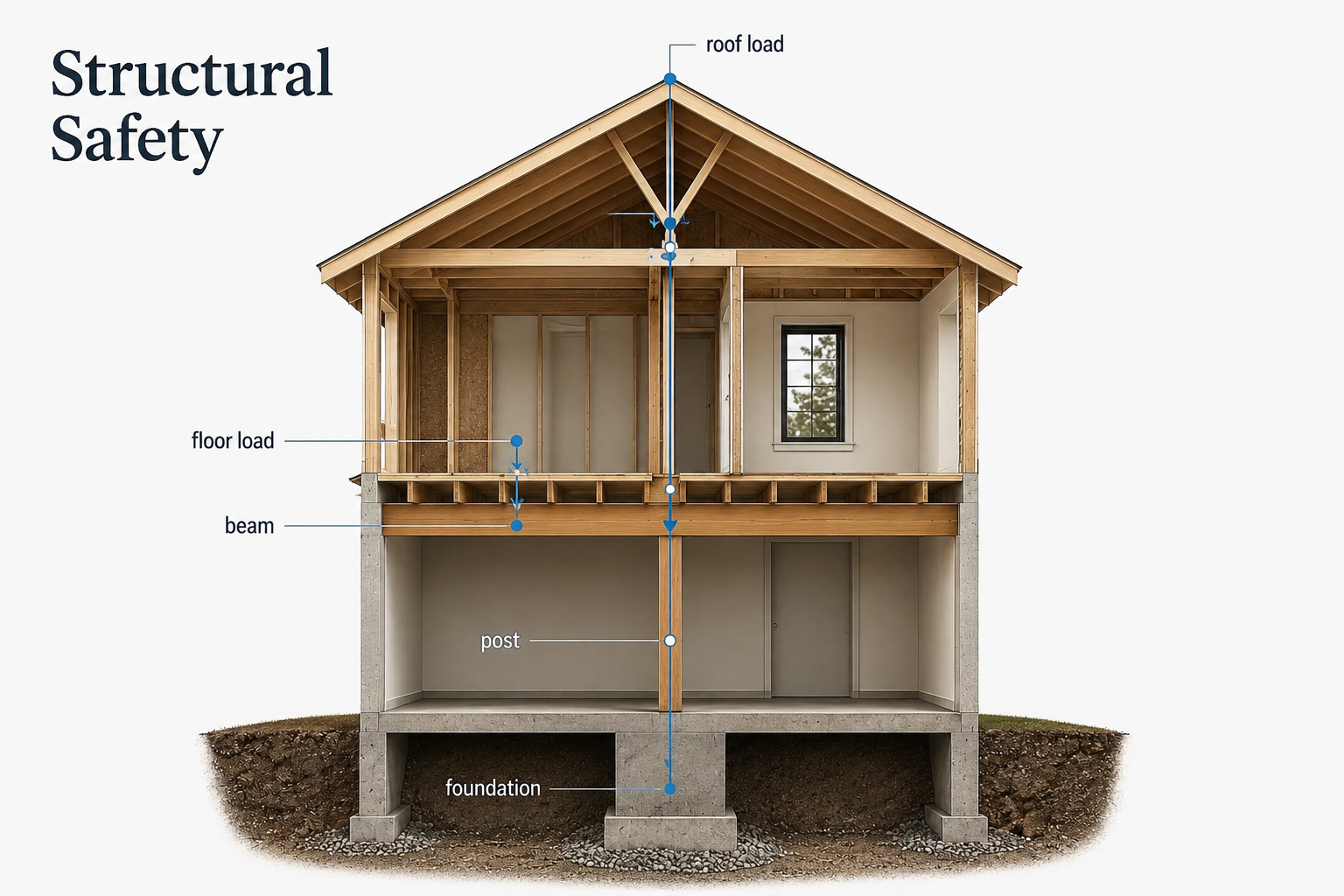
Illustration by ArchitectureCourses.org. Structural safety depends on a continuous load path, solid connections, lateral bracing, foundation support, and review before major structural changes.
A kitchen wall, hallway wall, or bedroom wall can look ordinary and still be structural. The wall may sit under second-floor joists, a roof bearing line, or a beam hidden in the ceiling.
That is why the first step is not demolition. The first step is tracing the load path.
Open Plans Still Need Structure
You can remove many load-bearing walls, but you are not removing the load. You are moving it. The load still needs a beam, posts, and a safe path down to the foundation.
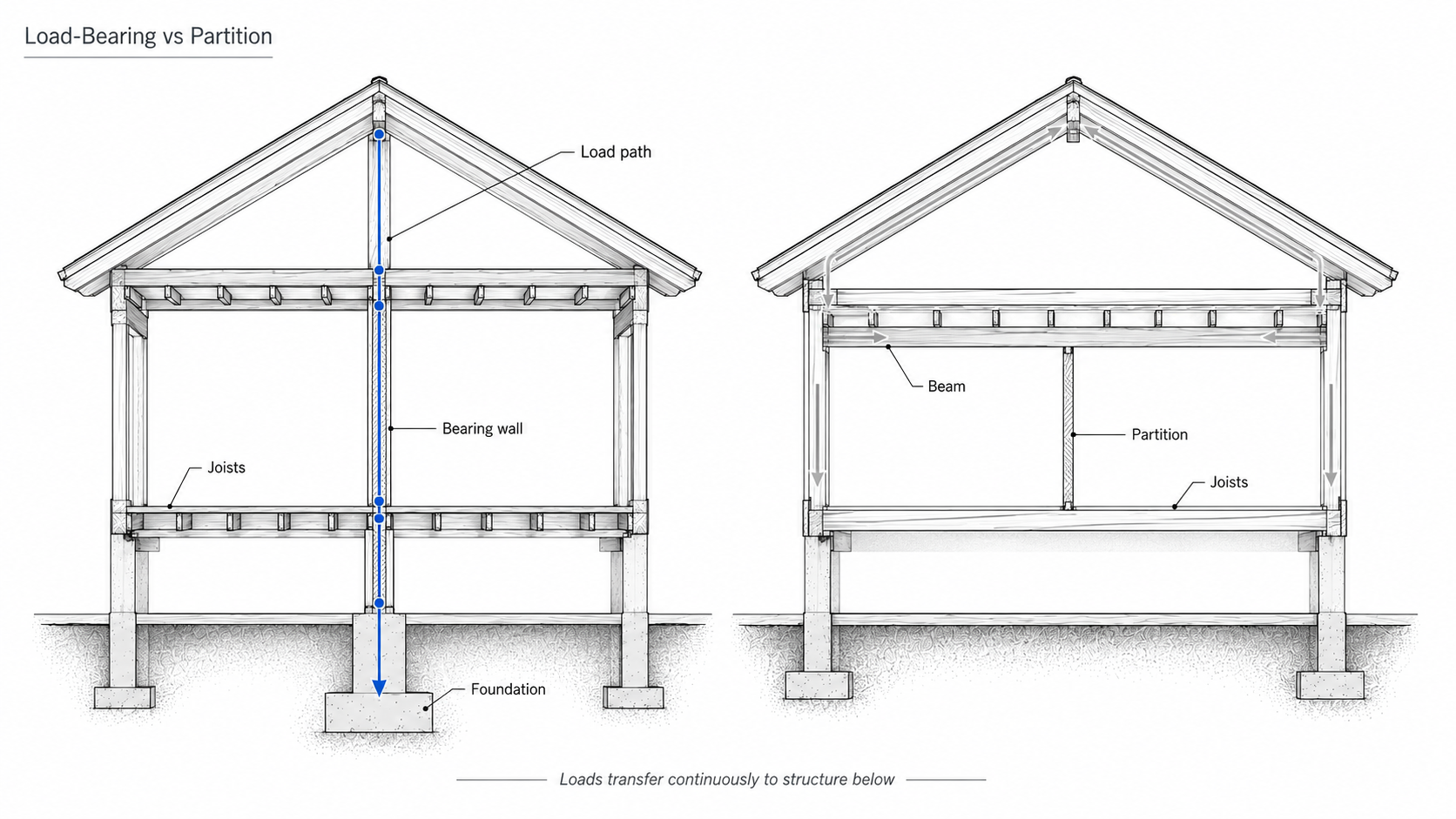
Illustration by ArchitectureCourses.org. A bearing wall carries loads down to the foundation; a partition divides space while loads bypass it through beams or other supports.
A clean open plan comes from good structural planning, not from guessing which wall can disappear.
Costs Add Up Fast
A non-bearing partition may be a small job once utilities are handled. A bearing wall removal can involve engineering, permits, beam sizing, temporary walls, posts, drywall repair, floor patching, and inspection.
The expensive mistake is finding out after demolition that the opening needs more structure than expected.
Good Teams Catch Problems Early
Architects, engineers, and builders do different parts of this work. The architect may care about layout and light. The engineer checks the load path. The builder figures out how the work can be safely staged.
When those decisions happen early, the project is less likely to stall halfway through demolition.
How to Tell If a Wall Is Load-Bearing
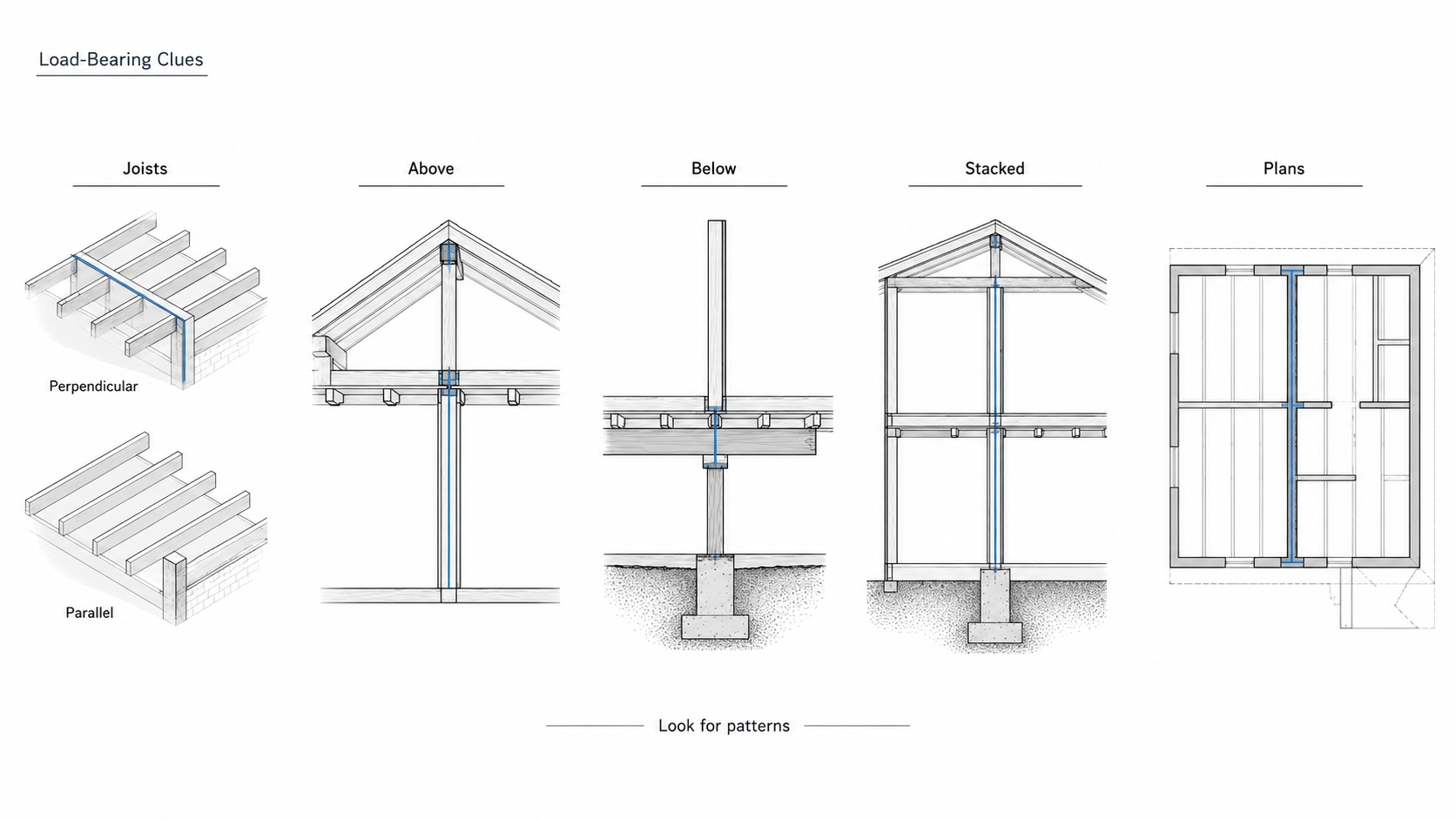
Illustration by ArchitectureCourses.org. No single clue confirms a load-bearing wall. Joist direction, framing above, support below, stacked walls, and structural plans work better when read together.
No single clue proves everything. You look for a pattern. One clue may be wrong. Three or four clues together are much stronger.
Check the Joist Direction
In many houses, a wall that runs perpendicular to the floor joists is more likely to be load-bearing. A wall that runs parallel to the joists is often less likely to carry floor load, but there are exceptions.
Joist direction is a clue, not a final answer. Beams, doubled joists, hidden posts, and altered framing can change the situation.
Look Above the Wall
Check the attic, second floor, or roof framing above the wall. If rafters, ceiling joists, trusses, or another wall bear directly over it, the wall may be structural.
Most exterior walls are designed to support roof or floor loads in conventional framing. But not every exterior wall in every building works the same way. Steel frames, post-and-beam layouts, major additions, or altered framing can shift loads elsewhere.
Look Below the Wall

Illustration by ArchitectureCourses.org. Load-bearing walls transfer roof and floor loads continuously down to the foundation, while partition walls divide space without carrying major structural loads.
Go to the basement, crawl space, or lower floor. If the wall sits over a beam, girder, post line, foundation wall, or thickened slab area, that is a serious clue.
A wall that continues down to a footing is not something to treat casually.
Check for Stacked Walls
In two-story houses, bearing walls often stack. A wall on the second floor may sit directly above a wall on the first floor. That first-floor wall may then sit above a beam or foundation wall.
For this specific case, read how to tell if a wall is load-bearing in a two-story house.
Read the Plans If You Have Them
Original drawings may show bearing walls, beams, posts, headers, lintels, and structural notes. Look for thicker wall lines, beam callouts, post symbols, and framing plans.
Plans help, but they are not perfect. Older homes may have undocumented renovations. Always compare the drawings with what is actually built.
Ask What Is Actually Supporting the Structure
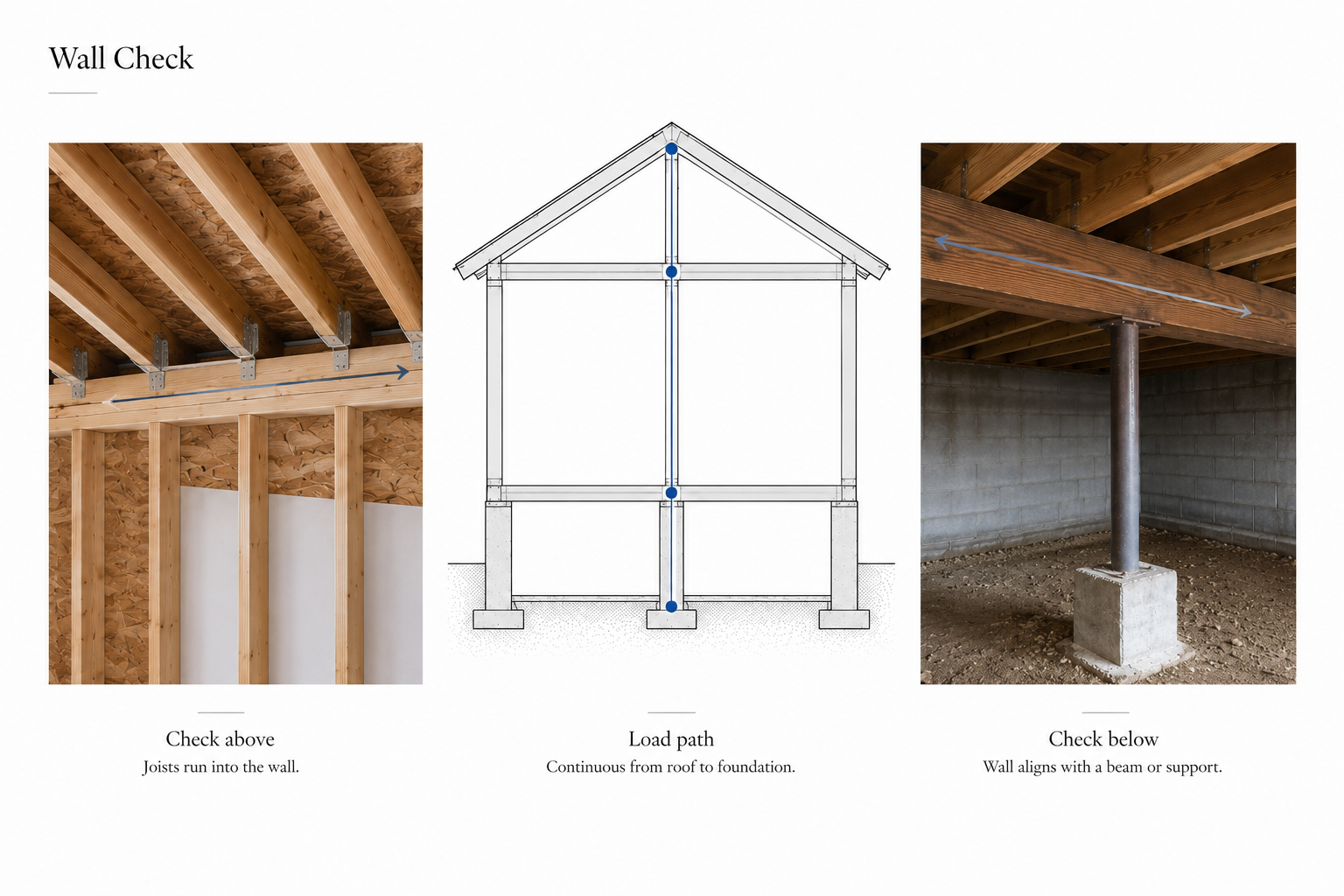
Illustration by ArchitectureCourses.org. This wall-check diagram shows three clues to look for before opening a wall: joists meeting the wall above, a continuous load path, and a beam or support line below.
Structural engineers use drawings, framing direction, beams, posts, materials, and support below to understand the load path. They are not just asking whether the wall looks thick. They are asking what load lands on it and where that load goes next.
If a wall sits directly under a main beam or girder, treat it as suspect until confirmed. If it is masonry, concrete, or block, be even more careful. Heavy walls may carry gravity loads, lateral loads, or both.
When It Is Not Obvious
Not every load-bearing wall looks important. Open-concept renovations, additions, old houses, and mixed framing can make the load path hard to read.
Look above and below. If a wall is directly under another wall, beam, or roof bearing line, especially near the center of the house, slow down. If the floor dips near a past opening, that may be a sign a structural wall was removed or altered badly.
For less invasive checks, use how to check without removing drywall.
Quick Checklist: Is This Wall Carrying Load?
- It aligns with beams, joists, girders, posts, or foundation walls.
- It continues down through a basement or crawl space to support below.
- It is made of concrete, brick, stone, block, or heavy masonry.
- It lines up with a wall directly above it.
- Floor joists run perpendicular to it.
- Roof framing or ceiling joists bear near or over it.
- It sits near the middle of a simple house plan where spans are divided.
Clues that may point away from bearing include a lightweight partition with no structural alignment above or below, a wall that stops between framing members, or a wall that runs parallel to joists with no beam or point loads landing on it. Still, none of these are proof by themselves.
Exterior Bearing Walls
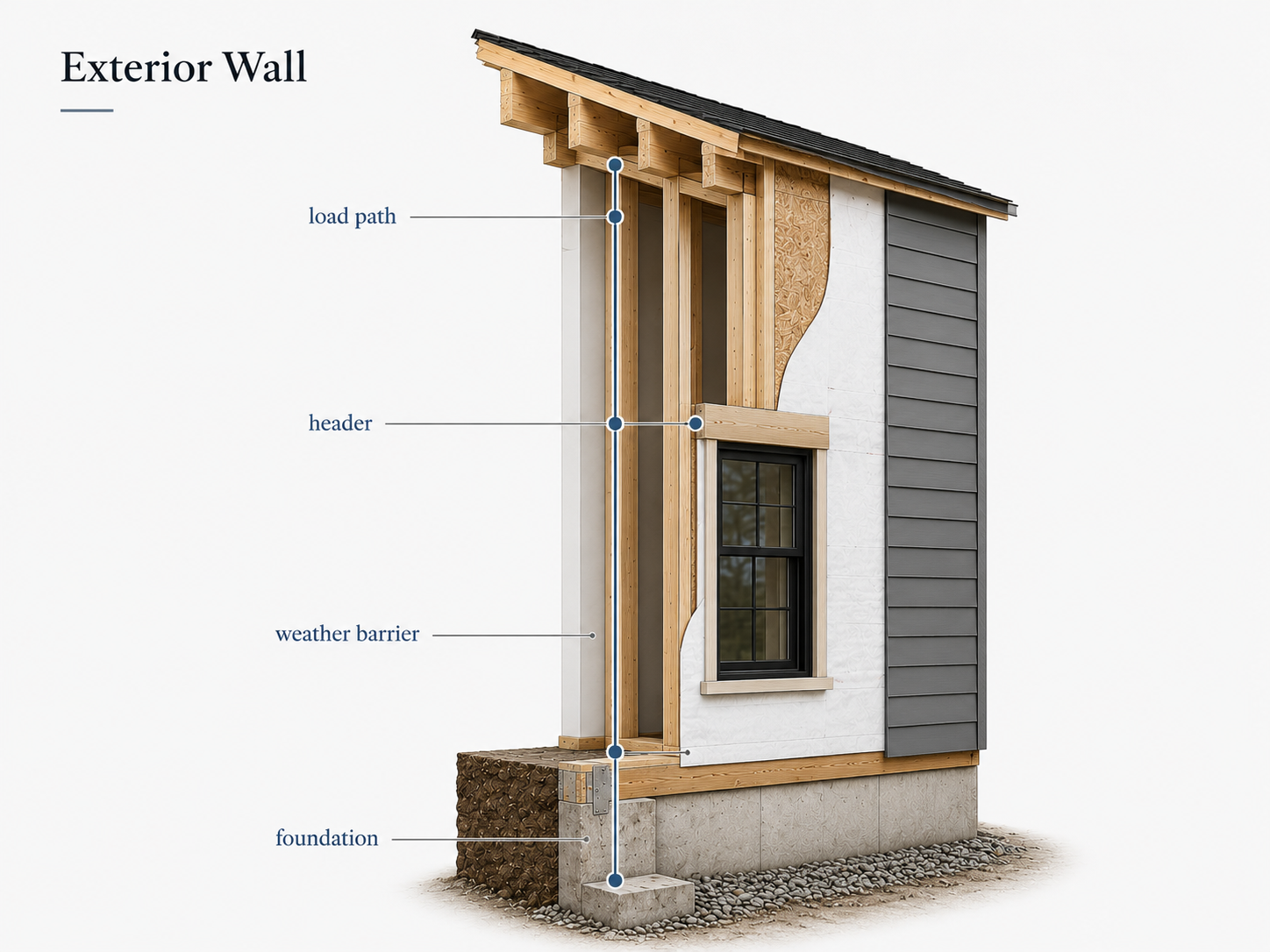
Illustration by ArchitectureCourses.org. Structural safety depends on keeping the load path continuous: roof and floor loads need a beam, post, and foundation support before a wall is removed.
Illustration by ArchitectureCourses.org. An exterior bearing wall carries loads down to the foundation while the sheathing, weather barrier, siding, and window header manage the wall opening and building envelope.
Exterior walls often do more than enclose the house. They may support roof loads, floor loads, wind loads, wall openings, sheathing, insulation, siding, and water-control layers.
That is why cutting a new opening in an exterior wall is not only a design decision. It affects headers, king studs, jack studs, sheathing, bracing, flashing, air sealing, and water control.
What Exterior Bearing Walls Must Handle
- Gravity loads: roof, floors, upper walls, and sometimes attic storage.
- Lateral loads: wind pressure, seismic forces, and bracing demands.
- Openings: windows and doors need headers or lintels to carry load around the opening.
- Weather: rain, snow, heat, cold, air leakage, and moisture movement.
For more on the assembly side, read exterior wall assembly basics and roof-to-wall connections.
Materials Used in Exterior Bearing Walls
- Wood framing: common in residential construction.
- Concrete block or CMU: common in basements, commercial work, and some homes.
- Reinforced concrete: used where strength, fire resistance, or durability is needed.
- Brick or stone masonry: common in older buildings, but the actual structure must be verified.
- SIPs: can carry load when designed as structural panels.
What Goes Wrong at Exterior Bearing Walls
- New openings are cut without a proper header.
- Posts do not land on proper support below.
- Bracing is weakened around large windows or doors.
- Water control is ignored after structural changes.
- Old masonry is assumed to be sound without inspection.
Designing Around Load-Bearing Walls
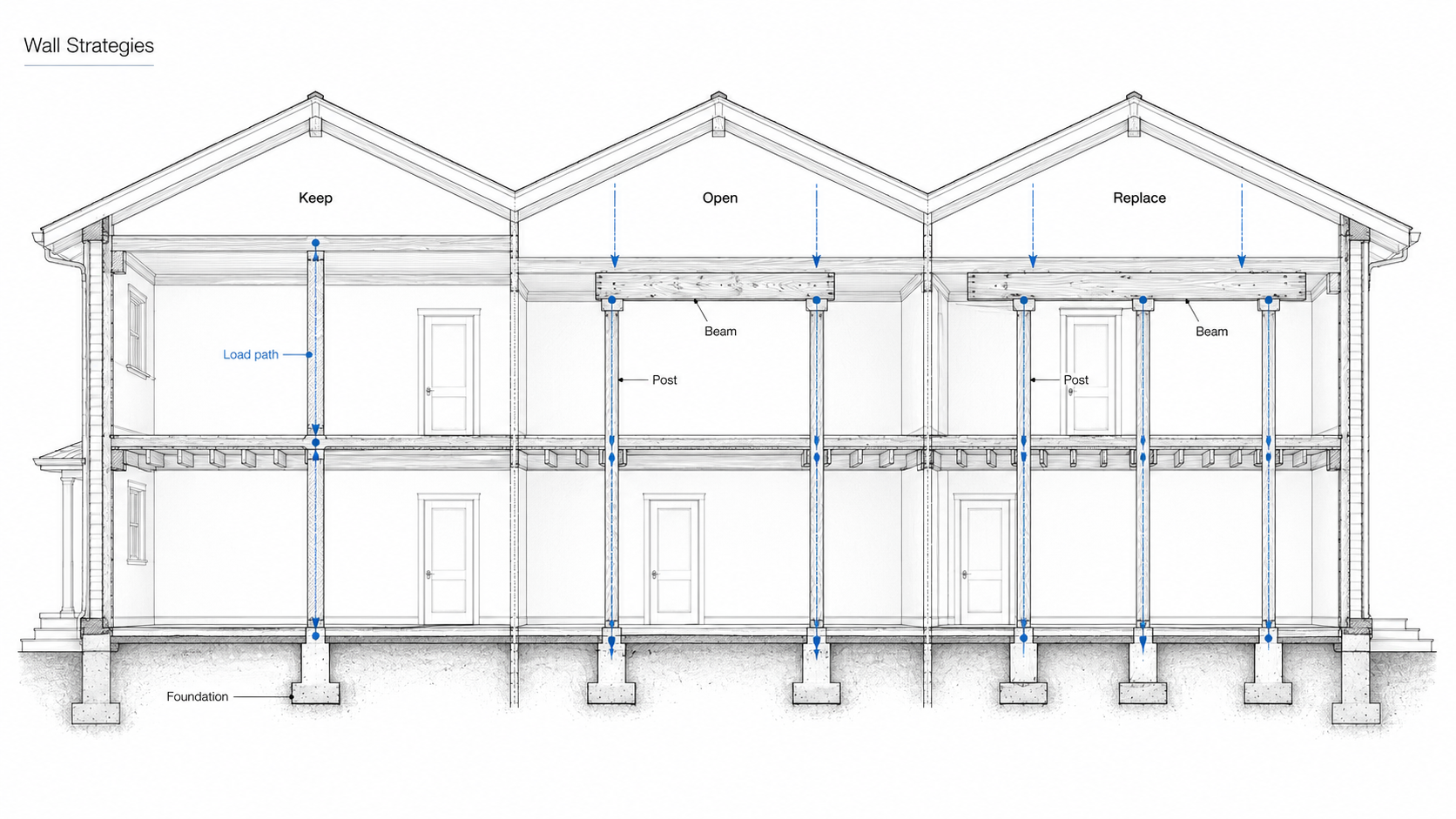
Illustration by ArchitectureCourses.org. Keeping, opening, or replacing a load-bearing wall changes how loads move through beams, posts, and foundations.
A bearing wall is not always a problem. Sometimes it gives the plan a useful spine. The mistake is treating every wall as something to remove.
Before opening a plan, ask:
- Does the wall block light, or does the layout just need better openings?
- Can a partial wall, cased opening, or wider doorway solve the problem?
- Will a beam create an awkward ceiling drop?
- Can posts land in places that make sense?
- Will the new opening make floors, ceilings, or roof framing harder to support?
Sometimes the cleanest design is not the biggest opening. It is the opening that respects the structure.
Open Spaces Need a Replacement Load Path
Open layouts are common, but taking down a bearing wall requires strategy, not just demolition. A beam over the opening must carry the load that the wall used to carry. Posts at the ends must send that load down to something strong enough below.
Common replacement materials include steel beams, LVL beams, glulam beams, and built-up wood beams. For engineered wood basics, see glulam beams.
Old Buildings Need Extra Care
Older buildings often have undocumented changes. A wall may have been moved, a beam may have been boxed in, or an opening may have been widened without enough support. Brick or stone walls may also be carrying load even when they look like old partitions.
In old houses, do not trust appearance alone. Trace the structure and check for past repairs.
Builders Need Safe Staging
Even when the beam is designed correctly, the work can still go wrong during installation. Temporary support matters. The ceiling or floor above often needs to be supported before the wall is cut.
Shortcuts during this stage can create cracks, movement, or a dangerous work area.
Residential vs Commercial Wall Examples
| Building Type | Load-Bearing Example | Non-Load-Bearing Example |
|---|---|---|
| Residential | Central wall in a two-story house carrying floor joists | Bedroom divider with no structural load above |
| Commercial | Masonry or reinforced wall supporting a mezzanine or roof system | Office partition used to divide tenant space |
| Older building | Brick wall supporting joists or lintels | Later stud partition added during a renovation |
Always inspect before demolition. Non-structural does not mean non-essential.
Who Does What
Architect
- Plans layout and design flow.
- Coordinates openings, circulation, light, and space.
- Works with the engineer when structure changes.
Structural Engineer
- Analyzes load paths.
- Sizes beams, posts, and connections.
- Checks whether support below is adequate.
Builder or Contractor
- Opens the wall carefully.
- Installs temporary support.
- Coordinates trades and inspections.
- Builds the structural change safely.
Civil Engineer
- May be involved where foundations, site loads, retaining conditions, or ground support matter.
- Can help evaluate durability, foundation behavior, and below-grade conditions.
The key point is simple: structure, design, and construction have to line up. When they do, wall changes are safer and usually cheaper.
Common Myths About Load-Bearing Walls
- “All exterior walls are structural.” Many are, especially in conventional framing, but some systems shift load to posts, beams, or frames.
- “You can’t remove a bearing wall.” You can, but only by replacing its job with a properly designed load path.
- “A thin wall cannot be structural.” Not always true. Stud walls can carry load.
- “If the wall sounds hollow, it is safe.” No. Sound is not a structural test.
- “A scanner can tell me everything.” A scanner may find studs or metal, but it cannot approve a wall removal.
Signs a Wall Was Already Removed Wrong
Sometimes the risk is not the wall you want to remove. It is the wall someone already removed.
Watch for ceiling cracks near wide openings, floors that dip along an old wall line, or doors that started sticking after a remodel.
Also look for boxed-in beams, random short posts, patched flooring, or ceiling bulkheads that do not match the rest of the room. These clues often mark an old structural change.
If you see these, slow down. You are not starting from a clean structure.
Wall Failure Lessons
Wall failures usually come from the same few mistakes: wrong identification, missing support, undersized beams, poor temporary bracing, weak bearing below, or ignored permits and inspections.
Common Failure Causes
- Removing a bearing wall without a beam.
- Installing a beam without proper posts.
- Letting posts land on weak framing below.
- Cutting openings in exterior walls without proper headers.
- Ignoring old renovations or hidden beams.
- Skipping temporary support during demolition.
Warning Signs
- Ceiling cracks near a large opening.
- Floors dipping near an old wall line.
- Doors rubbing after a renovation.
- New cracks around windows or door frames.
- Trim joints opening after wall removal.
- Visible movement in a beam, post, or ceiling line.
Prevention
- Confirm the load path before demolition.
- Use original plans, but verify the actual building.
- Check above and below the wall.
- Use a structural engineer when the wall may carry load.
- Use temporary support before cutting structural framing.
- Get permits and inspections where required.
Tools and Resources
Tools can help you investigate, but they do not replace structural judgment. Use them to gather clues, not to approve a wall removal.
Load Calculators
Load calculators and beam calculators can help estimate spans and loads, but they are not a substitute for engineered design. They are most useful for learning, early planning, or checking the scale of a problem before calling a professional.
Wall Scanners and Stud Finders
Wall scanners can help locate studs, metal, wiring, and some hidden objects. They cannot tell you the full load path, size a beam, or confirm a footing.
Bosch GMS120: Why It Helps
The Bosch Professional Wall Scanner can be useful for locating hidden materials before opening a wall. It is not a structural approval tool, but it can help you avoid cutting blindly into framing, wiring, or metal.
- Useful for investigation: Helps locate hidden objects before exploratory openings.
- Clear display: Helps identify object location and scanning feedback.
- Jobsite-friendly: Better suited to repeated use than very cheap scanners.
Do not rely on a scanner alone. If the wall may be structural, confirm the framing above and below and bring in the right professional.
Structural Analysis Software
Tools like Revit, Tekla, and structural analysis programs can help teams model loads, framing, and material choices. They are useful in professional workflows, but the output still depends on correct assumptions and qualified review.
For general background, see structural design.
Temporary Support and Reinforcement Tools
Structural wall work may require temporary walls, posts, jacks, steel beams, LVL beams, glulam beams, or other reinforcement. These tools are only safe when used correctly and in the right sequence.
- Hydraulic bottle jacks
- Temporary support walls
- Adjustable steel props
- Engineered beams and posts
Codes and Standards
Building codes, local permit rules, and engineering standards matter whenever structure is changed. Requirements vary by location, building type, and scope of work.
Can You Remove a Load-Bearing Wall?
Yes, but you are not removing the load. You are moving it.
That usually means a beam over the opening, posts at both ends, and a safe path down to the foundation. The beam cannot just sit on the floor framing and hope for the best.
Temporary support also matters. The wall often needs to be supported before it is cut, not after the ceiling starts to move.
If the opening includes a door or window nearby, header sizing and jack-stud support also matter. Related: glulam beams, king and jack stud framing, and window header framing.
Homeowners: What to Do Before Removing a Wall
- Do not assume a wall is non-structural because it is thin.
- Check above and below the wall.
- Look for joist direction and stacked walls.
- Check for utilities before opening the wall.
- Ask whether the work needs a permit.
- Bring in a structural engineer if the wall may carry load.
Pros: What to Keep Sharp
- Document the existing framing before demolition.
- Confirm beam and post loads before layout changes.
- Check the support below posts, not just the beam above.
- Coordinate with trades before cutting walls with utilities.
- Keep records, drawings, calculations, and inspection notes.
Read This Next
- How to Tell If a Wall Is Load-Bearing in a Two-Story House
- How to Tell If a Wall Is Load-Bearing Without Removing Drywall
- How to Tell If a Wall Is Load-Bearing in a Single-Story House
- Wall Framing Basics
- How to Frame a Wall
- House Framing Diagrams
- Ceiling Cracks: What They Can Mean
Recommended Books
- Building Structures Illustrated by Francis D.K. Ching.
- Structural Design for Architects by Angus Macdonald.
FAQ
What is a load-bearing wall?
A load-bearing wall supports structural weight from above, including floors, roofs, beams, or upper walls. It transfers those loads down to the foundation or another structural support.
What is a non-load-bearing wall?
A non-load-bearing wall divides space but does not carry the main structural load. It may still contain electrical wiring, plumbing, HVAC ducts, blocking, or fire-rated separation.
How do I identify a load-bearing wall?
Check joist direction, stacked walls, beams, posts, foundation alignment, wall material, and what sits above and below the wall. One clue is not enough. Look for a pattern.
Can I remove a load-bearing wall?
Yes, but only if the load is safely redirected with a designed beam, posts, and proper support below. This usually requires permits, inspections, and a structural engineer.
What happens if a load-bearing wall is removed without support?
The building may sag, crack, shift, or fail. Problems can show up immediately or slowly over weeks and months.
Can a non-load-bearing wall ever become load-bearing?
Usually no, but later renovations or added loads can change how a building behaves. If heavy new loads were added above, confirm the structure before removing walls below.
Do non-load-bearing walls serve any important purpose?
Yes. They may divide rooms, control sound, support cabinets, hide utilities, or provide fire separation. Non-structural does not mean unimportant.
How much does it cost to remove a load-bearing wall?
Costs vary by span, beam type, permits, engineering, finish repair, and support below. A small project may cost a few thousand dollars. Complex removals with steel, long spans, or foundation work can cost much more.
Do I need permits to alter a load-bearing wall?
Usually yes. Structural changes commonly require permits, inspections, and sometimes stamped engineering documents. Check local rules before work begins.
What materials replace a load-bearing wall?
Common solutions include steel beams, LVL beams, glulam beams, built-up wood beams, posts, columns, and proper bearing below. The right material depends on load, span, design, budget, and code requirements.
Can load-bearing walls be altered in historic buildings?
Yes, but older buildings need more care. Materials may be irregular, past changes may be hidden, and preservation rules may limit what can be changed.
How long does it take to remove and reinforce a load-bearing wall?
Simple projects may take a few days of construction after planning and permits. More complex work can take weeks once engineering, approvals, demolition, beam installation, inspections, and finish repairs are included.
Who should I call before modifying a wall?
Start with a structural engineer or qualified contractor experienced in structural alterations. Depending on the wall, you may also need an architect, electrician, plumber, HVAC contractor, or building inspector.
Bottom Line
Do not judge a wall by how simple it looks. Some of the most ordinary walls carry serious load.
Before you cut, trace the load path. Look above. Look below. Check the joists. Check the foundation. Then get the right confirmation before the wall comes out.