
A window opening breaks the wall framing and interrupts the load path.
The header carries that load across the opening. If it is too small, built badly, or set wrong, the signs usually show up later: cracks, sagging, sticky windows, and openings that stop staying true.
What matters is header size, bearing, how the opening is framed, and where bad installation starts causing trouble.
What Is a Header in Framing?

A header is a beam built into a wall to carry load across an opening. Windows, doors, wide cased openings, garage doors. Same idea every time.
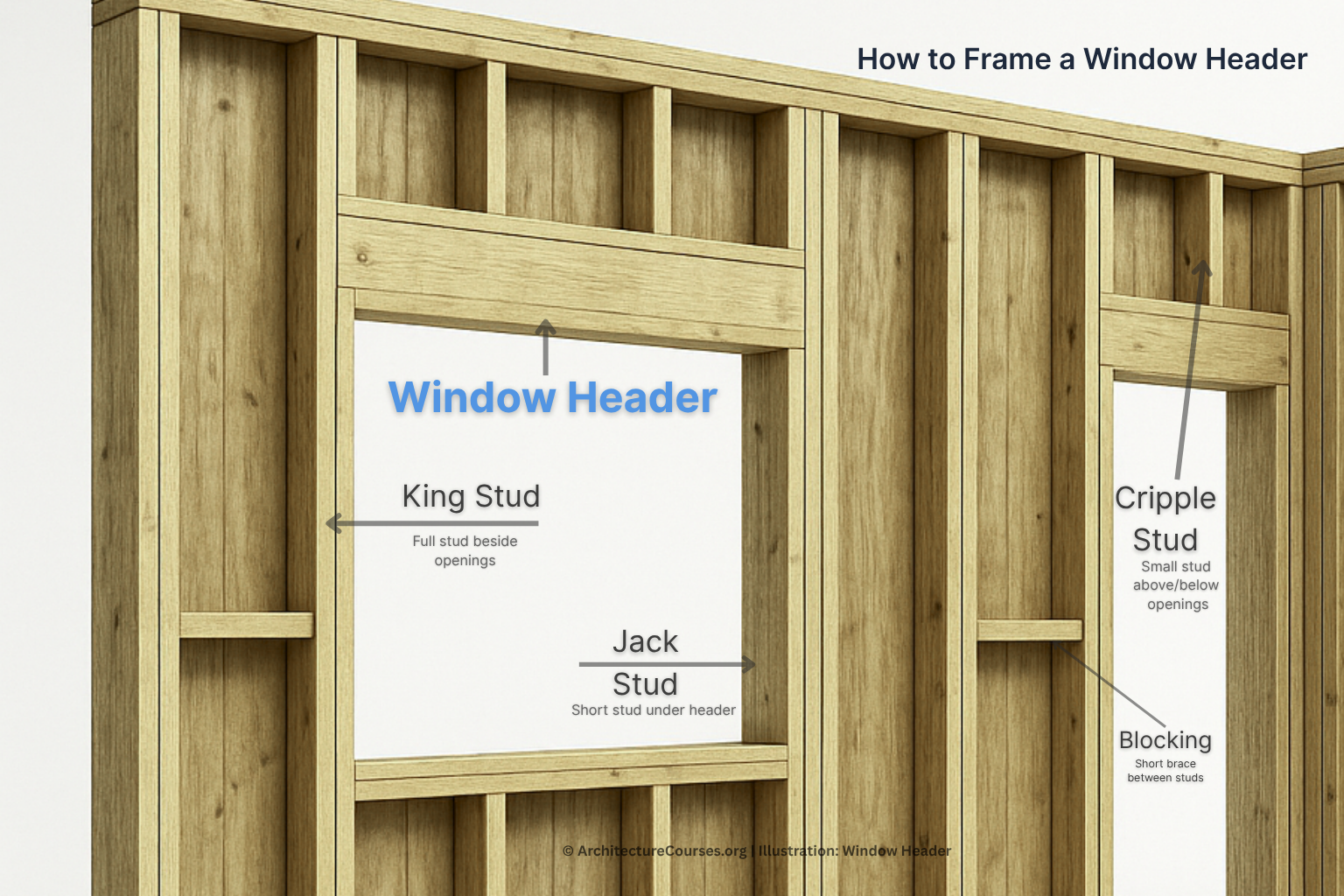
In a stud wall, the header sits on jack studs, sometimes called trimmers. Those jacks push the load down to the plate and floor. The king and jack stud layout matters more than people think. If the jacks are loose, undersized, or badly nailed, the header is not doing much no matter how expensive the beam was.
Small spans can use built-up dimensional lumber. Wider or heavier openings move into LVLs, box headers, or steel. The job stays the same. The loads do not.
What the Header Has to Do
- Carry gravity load from roof, floor, or both.
- Push that load around the opening and back into the studs at each side.
- Keep the opening stable so the window or door stays square.
- Limit deflection so drywall, trim, and finishes do not start telling on the framing.
On clustered windows, tall walls, and heavier openings, the header also affects lateral stiffness. That does not make it a shear wall. It does mean sloppy header framing can make the wall feel weaker than it should.
Basic Window Header Layout
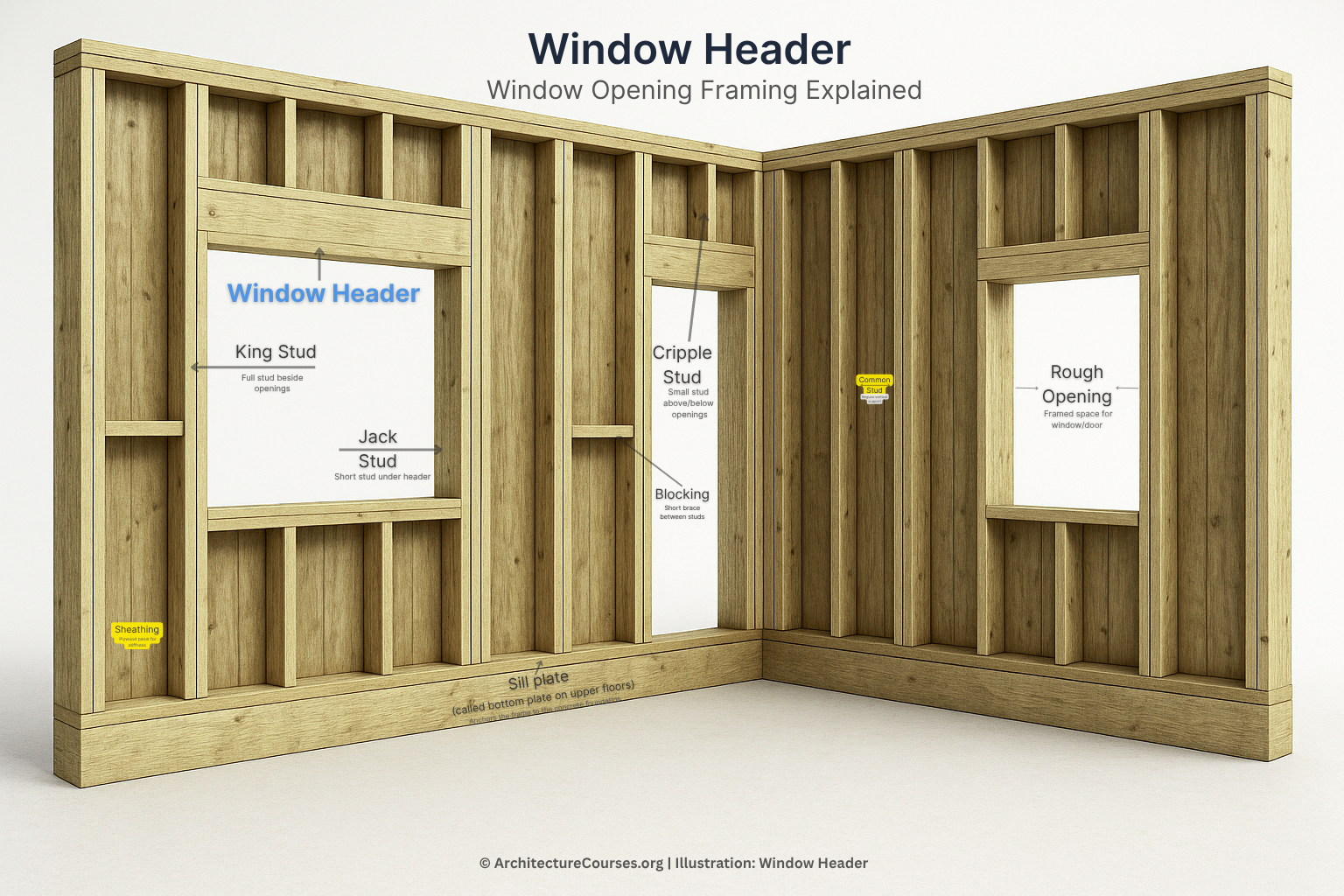
A standard framed window header usually includes:
- Double top plate tying the wall together
- Header sized for the span and load
- King studs full height on each side
- Jack studs under the header ends
- Rough sill set level between the jacks
- Cripple studs below the sill and above the header as needed
This is the standard layout for most platform framing. It is simple on paper. The trouble starts when the load above is heavier than assumed, the rough opening shifts in the field, or the framers build the wall like every opening is the same.
What Code Tables Assume
Prescriptive code tables such as IRC R602.7 make header sizing look simpler than it feels on site. That is because the tables assume a specific set of conditions:
- standard species and grade of lumber
- standard wall heights
- known roof or roof-plus-floor loading
- snow and wind loads within the limits of the table
- proper bearing on jack studs
That is why one opening can use a built-up 2x10 in one house and need engineered lumber in another. Same width. Different load. If you want the bigger picture on how those loads move through the wall, start with this guide on load paths.
Box Headers
A box header is a built-up header assembly that leaves room for insulation instead of filling the whole cavity with solid wood. That makes it useful in exterior walls where thermal performance matters.
You see them in better cold-climate work, high-performance houses, and walls where a solid lumber header would turn into a thermal bridge. They are light, efficient, and easier on the wall assembly than a bulky solid header. They still have to be sized for the load. Warm walls still need real structure.
Pair that approach with wall sheathing that works and the wall starts performing better as a whole, not only at the opening.
Metal Stud Headers
Steel stud walls handle headers differently. Smaller openings may use doubled track and nested studs. Larger ones usually move into cold-formed steel sections, built-up channels, or angle lintels.
The usual problem here is not raw strength. It is deflection. A steel header that is technically adequate can still show itself later in drywall dips and cracked joints if it was sized too close to the line.
When the Opening Gets Much Wider
The logic stays the same at garage doors, porch openings, and other wide spans. The member gets deeper or stronger, the bearing gets more serious, and the connection below it matters more.
At that point you are often into LVL, PSL, or steel. Multiple jack studs each side become common. If the wall is carrying a second floor, roof trusses, or heavy snow load, this stops being a casual framing choice. It becomes real structural work. For a quick sense of how one-story and two-story wall loads change that decision, see this framing load comparison.
Window Header Framing Sequence
For a typical window opening, the field sequence is straightforward:
- Lay out the rough opening on the plates.
- Mark king studs, jack studs, and sill height.
- Build the header to the scheduled size.
- Nail or fasten the header into the king studs.
- Set the jack studs tight under each end.
- Install the rough sill level.
- Add cripple studs below the sill and above the header as needed.
- Sheathe and brace the wall so the opening stays true.
The sequence is easy to rush. That is how you end up with a good header sitting on bad framing.
Box Header vs LVL vs Steel
| Type | Best for | Strength | Thermal performance | Cost |
|---|---|---|---|---|
| Box header | Exterior walls in cold climates | Medium | Good | Low to medium |
| LVL or PSL | Wider openings and heavier roof or floor loads | High | Weak unless insulated around | Medium to high |
| Steel | Very wide spans or tight depth conditions | Very high | Weak unless wrapped or separated | High |
Where Header Framing Starts Going Wrong
Water at the opening. A header that stays dry lasts. A header that gets wet at the ends does not. Rot at the bearing points is a quiet failure.
Oversizing for no reason. Bigger is not always safer. It can kill insulation, complicate finishes, and add weight where the wall did not need it.
Loose or undersized jack studs. The header only works if the load actually gets into the jacks cleanly.
Bad alignment. Header height controls the visual rhythm of the room more than people expect. When head heights drift, the whole wall starts looking off.
Steel chosen for depth without enough stiffness. Steel solves some tight conditions fast. It also shows movement fast when the section was pushed too hard.
Treating the code chart like a substitute for judgment. The table works when the assumptions match the wall. When they do not, the table stops being enough.
FAQ
How do I know if my window header is sized right?
Use the applicable code table or engineered schedule for the actual span and load. Width alone is not enough.
Can I insulate a header cavity?
Yes, when the assembly is designed for it, as with box headers or insulated engineered details.
What is the difference between a king stud and a jack stud?
The king stud runs full height. The jack stud sits under the header and carries the load from it.
Do I need metal hangers for a wood header?
Not in standard bearing conditions. A typical wood header bears directly on jack studs unless the detail says otherwise.
How much bearing should a header have?
At least the code minimum, and often the full width of the jack stud in ordinary framing.
Can I reuse an old header during a remodel?
Only when span, load, condition, and fit all still work. Most remodels go cleaner and safer with a new one.
Do non-load-bearing walls still need headers?
Sometimes for fastening, trim, or stiffness around the opening. They do not need structural headers the way load-bearing walls do.