
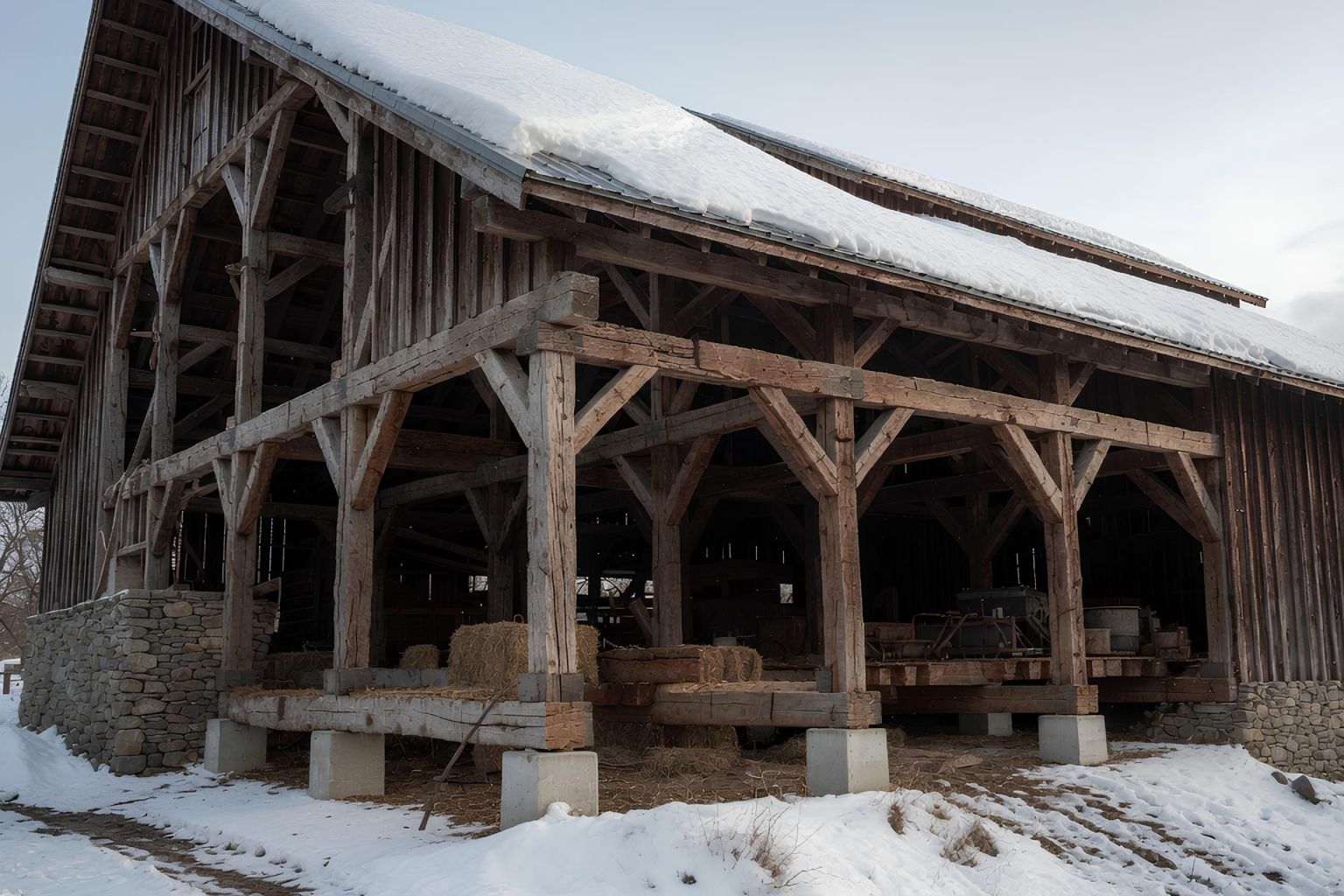
Loads are where structural design starts.
If the load is wrong, the beam size does not matter. The calculation may look clean, but the building is solving the wrong problem.
A structural load is any force a building has to carry, resist, or pass into the ground. Some loads push down. Some push sideways. Some lift. Some only show up during storms, earthquakes, construction, bad drainage, or soil movement.
The name of the load matters. The path matters more.
A roof load should move into rafters, joists, beams, walls or columns, then into the foundation and soil. Wind and earthquake loads need a lateral path through diaphragms, bracing, shear walls, anchors, and foundations. Soil and water pressure push from the side. Construction loads may hit the structure before the final system is ready.
When a load is missed, the damage is not abstract. It shows up as sagging, cracking, racking, uplift, bowed walls, settlement, broken connections, or collapse.
For the bigger design process, start with Structural Design. For what happens after loads are known, use Structural Analysis and How to Analyze Beams.
Start With the Load Path
Do not size the beam first.
First ask what the beam is carrying, where that load comes from, and where it goes next. The same rule applies to slabs, columns, walls, trusses, braces, foundations, and connections.
A load path is the route force takes through the structure.
A simple gravity load path may look like this:
roof or floor load → joists or slab → beam → column or bearing wall → foundation → soil
A lateral path is different. Wind or earthquake force may move through the roof or floor diaphragm, into shear walls or braced frames, down through anchors and foundations, then into the ground.
A building can stand up under gravity and still fail sideways. That is why load paths need to be checked in more than one direction.

Main Types of Loads in Structural Design
The load names are easy to learn. The hard part is knowing where each load can hurt the building.
| Load type | What it means | Where mistakes show up |
|---|---|---|
| Dead load | Permanent weight of the structure and fixed materials. | Heavy slabs, masonry, roofing, cladding, fixed equipment. |
| Live load | Movable or changing load from use. | Storage rooms, stairs, balconies, offices, assembly spaces, vehicles. |
| Wind load | Pressure, suction, uplift, and lateral force from wind. | Roof edges, wall bracing, cladding, anchors, light buildings. |
| Snow load | Weight of snow on the roof, including drift and sliding snow. | Low-slope roofs, roof steps, valleys, parapets, drift zones. |
| Rain and ponding load | Water weight when drainage is blocked, slow, or badly detailed. | Flat roofs, clogged drains, undersized scuppers, sagging bays. |
| Seismic load | Inertia force created when earthquake ground motion moves the building. | Soft stories, heavy irregular buildings, weak lateral systems. |
| Soil and water pressure | Earth pressure, hydrostatic pressure, frost, surcharge, and settlement effects. | Retaining walls, basements, footings, slabs, below-grade spaces. |
| Construction load | Temporary load during the building process. | Uncured slabs, shoring, formwork, stockpiles, incomplete frames. |
| Impact or blast load | Sudden force from vehicles, equipment, debris, or pressure waves. | Garages, loading docks, barriers, columns, industrial buildings. |
| Thermal load | Expansion, contraction, and restraint caused by temperature change. | Long buildings, bridges, facades, roofs, slabs, expansion joints. |
ASCE 7 is the main U.S. standard for minimum design loads and load combinations for buildings and other structures. It covers hazards such as dead, live, soil, flood, tsunami, snow, rain, ice, seismic, wind, and fire loads.
Canada uses the National Building Code of Canada and related structural commentaries. European work uses Eurocodes. Other countries use their own national standards.
This article does not replace the code. It explains what has to be checked before the numbers are trusted.
Dead Loads: The Weight That Is Always There
Dead load is the permanent weight of the building.
It includes slabs, beams, columns, walls, roof framing, roofing, ceilings, cladding, finishes, fixed equipment, and permanent service systems.
Dead load is not a guess. It comes from material weight, thickness, area, and tributary width.
A 6-inch normal-weight concrete slab is about 75 psf before finishes and ceiling systems are added. Wood framing is much lighter. Masonry, stone veneer, concrete topping, green roofs, and rooftop equipment can change the numbers fast.
Getting dead load wrong affects more than one member. It changes beam reactions, column loads, foundation loads, seismic weight, deflection, and sometimes wind uplift checks.
Live Loads: The Building in Use
Live load comes from how the building is used.
People, furniture, movable equipment, stored material, vehicles, movable partitions, and maintenance loads can all count. Codes set minimum live loads by occupancy because a bedroom, office, library, corridor, balcony, stair, warehouse, and assembly space are not the same.
The mistake is designing for what the room contains today.
A room can become storage. A roof can receive workers and equipment. A garage can see heavier vehicles than expected. A balcony can be crowded. A library stack area can load a floor far more than a normal office.
Live load is not decoration added after the design. It can control the design.
Gravity Loads and Lateral Loads Behave Differently
Gravity loads move mostly downward.
Lateral loads move sideways, lift, twist, or overturn parts of the structure.
| Question | Gravity loads | Lateral loads |
|---|---|---|
| Main direction | Down. | Sideways, uplift, overturning, or shaking. |
| Common examples | Dead load, live load, snow, rain, construction stockpiles. | Wind, seismic force, soil pressure, water pressure, impact. |
| Main resisting parts | Slabs, joists, beams, columns, bearing walls, footings. | Diaphragms, shear walls, bracing, moment frames, anchors. |
| Common failure signs | Sagging, cracking, punching shear, settlement. | Racking, sliding, uplift, overturning, soft-story failure. |
A floor can carry people and furniture well and still have no clear lateral path. In a wind or seismic zone, that is not a small miss.
Wind Loads: Push, Pull, Uplift, and Twist
Wind does not only push on one wall.
It can press on the windward side, pull on the leeward side, lift roof edges, load cladding, and twist irregular buildings. Light buildings, tall buildings, open sites, coastal zones, large overhangs, and weakly braced frames are more exposed.
Wind load depends on location, height, exposure, terrain, shape, openings, roof form, and risk category. The same building in an open field does not see the same wind as that building in a dense city block.
The design question is plain: after the wind hits the building, where does the force go?
The answer runs through sheathing, diaphragms, bracing, shear walls, roof-to-wall ties, hold-downs, anchor bolts, and foundations. If one connection is weak, the load path can fail there.
Snow Loads: Weight, Drift, and Roof Shape
Snow load starts with the region, but the roof decides where snow collects.
Low-slope roofs, valleys, roof steps, parapets, upper roofs that shed onto lower roofs, and wind drift areas can create heavier local loads than a simple uniform snow load.
A roof may pass the basic snow check and still fail at a drift pocket.
Added roof equipment, solar panels, screen walls, and later additions can also change snow behavior. Snow can pile against obstructions. Meltwater can refreeze. Drifts can load one bay harder than another.
This is why roof load design cannot stop at “snow zone.” Roof shape, drainage, and obstructions matter.
Rain and Ponding Loads
Rain becomes a structural load when water stays on the roof.
Flat and low-slope roofs need working primary drains and emergency overflow. If drains clog or scuppers are too small, water can pond. Water adds weight. Weight increases deflection. More deflection can hold more water.
That loop can overload a roof.
Ponding is not only a roofing problem. It becomes a structural problem when the roof cannot shed the water or resist the added deflection.
The bad assumption is simple: rain runs off. It only runs off when slope, drains, scuppers, overflow paths, and stiffness all do their job.
Seismic Loads: Ground Motion Becomes Building Force

Earthquake load is not the ground shaking by itself.
The ground moves. The building’s mass resists that movement. That resistance creates inertia forces. Those forces move through floors, walls, frames, braces, anchors, foundations, and soil.
Heavier buildings can attract more seismic force. Soft soil can amplify shaking. Irregular buildings can twist. Weak first stories can concentrate damage. Poor detailing can break the path before the system has a chance to work.
Seismic design is not only about strength. It is also about ductility, drift control, continuity, and collapse prevention.
In many systems, cracking or yielding is expected in controlled places. What cannot happen is a sudden break in the lateral path.
Keep the separate seismic page for deeper coverage: Seismic Loads. This article only explains where seismic loads fit in the load family.
Soil, Foundation, and Water Loads

Foundations do more than hold vertical weight.
Basement walls and retaining walls can be pushed by soil. Groundwater can push against walls and slabs. Footings can settle if the soil compresses. Clay can shrink and swell. Frost can lift shallow elements in cold climates.
The same building can behave differently on gravel, loose sand, soft clay, fill, or expansive soil.
Foundation loads are not only a framing issue. They are also a site, water, soil, drainage, and frost issue.
Common misses include:
- basement walls checked without enough attention to water pressure
- footings sized before soil bearing is confirmed
- retaining walls loaded by wet backfill, driveways, nearby footings, or stored material
- slabs placed over soil that moves with moisture or frost
- surface drainage aimed toward the foundation after the structure is already built
For related foundation reading, use Foundation Building Materials, Slab-on-Grade Foundation, and Basement Foundations.
Construction Loads: Temporary Does Not Mean Minor

Some dangerous load cases happen before the building is finished.
During construction, the final load path may not exist yet. Concrete may not have reached strength. Bracing may be temporary. Shoring and formwork may be carrying loads. Materials may be stacked in one bay. Equipment may sit where it was not expected.
ASCE 37 covers design loads on structures during construction. The reason is simple: construction-stage loading can control because the structure is incomplete.
Watch these conditions:
- heavy pallets stored on a young slab
- shoring or formwork removed too early
- partly built walls left without bracing
- equipment placed on framing before the system is complete
- temporary openings, missing diaphragms, or incomplete connections
A temporary load can still cause permanent failure.
Impact, Blast, and Sudden Loads
Impact loads are sudden forces from vehicles, falling equipment, dropped materials, machinery, or debris.
Blast loads are short-duration pressure loads. Most ordinary buildings do not need blast design, but it matters in secure facilities, some public infrastructure, military work, industrial sites, and buildings near specific hazards.
Impact loads are more common.
Think about parking garage barriers, columns near vehicle lanes, loading docks, forklift routes, warehouse floors, bollards, and service yards. These are ordinary places where a sudden concentrated force can hit the structure.
The answer may be a protected column, stronger barrier, ductile detailing, better separation from traffic, or a redundant load path.
Loads on Beams, Slabs, and Foundations

Loads matter because they change the design of actual members.
A bedroom floor beam is not the same problem as a beam under library stacks, a storage mezzanine, a roof drift zone, or a mechanical unit. A slab under foot traffic is not the same as a slab under a forklift. A footing on competent soil is not the same as a footing on soft clay or uncontrolled fill.
The first check is tributary area.
Each beam, joist, column, wall, or footing carries a share of the load based on the framing layout.
Example:
- floor load: 50 psf total
- tributary width to the beam: 12 ft
- line load on beam: 50 psf × 12 ft = 600 plf
That line load then creates shear, bending moment, and deflection. The span, support type, material, connection, and serviceability limit all matter after that.
For beam examples, read How to Analyze Beams. For a simple structural geometry example, read Truss Design 101.
Load Combinations
Buildings do not see one neat load at a time.
A roof may carry dead load, snow load, wind uplift, rain ponding, equipment load, and construction load at different times. A wall may see gravity load, wind, seismic force, earth pressure, or water pressure depending on its location.
Codes give load combinations so designers check conservative cases that can act together. The exact combinations depend on the code, material, risk category, building type, and design method.
| Check | Question | Failure if missed |
|---|---|---|
| Strength | Can the member resist the factored load? | Yielding, crushing, buckling, shear failure, rupture. |
| Serviceability | Does it move too much under normal use? | Sagging floors, cracked finishes, roof ponding, vibration. |
| Stability | Can the system resist sliding, overturning, racking, or buckling? | Wall movement, frame sway, uplift, collapse mechanism. |
| Long-term behavior | Will moisture, creep, shrinkage, corrosion, or soil movement change the response? | Cracks, settlement, corrosion, repeated repair. |
Do not copy one load combination and assume the work is done. Strength, serviceability, stability, construction-stage checks, and connections answer different questions.
Where Load Mistakes Start
Most load mistakes start before anyone sizes a member.
- A storage room is treated like a normal office.
- A heavy partition is treated like a light partition.
- A roof drain is assumed to work during the worst storm.
- A garage column is left exposed to vehicle impact.
- A basement wall is checked without the water condition.
- A construction stage is treated like the finished building.
- A lateral load path stops at a diaphragm, wall, anchor, or foundation connection.
- A renovation adds heavy finishes without checking the old framing.
- A rooftop unit gets added after the roof was designed for a lighter load.
These are not vocabulary mistakes. They are the places where buildings get damaged.
A Practical Load-Checking Order
Use this order before sizing members.
- Identify the building use, occupancy, location, risk category, and code.
- List permanent materials and calculate dead load.
- Add code live loads and any concentrated loads.
- Check wind, snow, rain, seismic, flood, soil, and groundwater conditions.
- Check special loads such as impact, vibration, thermal movement, equipment, and construction loads.
- Trace gravity and lateral load paths separately.
- Check connections, anchors, diaphragms, bracing, and foundations.
- Apply the correct load combinations.
- Check strength, serviceability, stability, and long-term movement.
A clean calculation can still be wrong if it starts with the wrong load case.
FAQ
What are the main types of loads in structural design?
The main types are dead loads, live loads, wind loads, snow loads, rain or ponding loads, seismic loads, soil pressure, hydrostatic pressure, construction loads, impact loads, blast loads, and thermal loads.
What is a dead load?
A dead load is the permanent weight of the structure and fixed materials, such as slabs, beams, walls, roofing, cladding, finishes, and fixed equipment.
What is a live load?
A live load is a movable or changing load from people, furniture, vehicles, stored material, equipment, or building use. Codes assign minimum live loads by occupancy.
What is the difference between dead load and live load?
Dead load stays with the building. Live load changes with use. A concrete slab is dead load. People, movable furniture, and storage loads are live load.
What are wind loads?
Wind loads are forces from wind pressure, suction, uplift, and lateral push. They affect walls, roofs, cladding, diaphragms, bracing, anchors, and foundations.
What are seismic loads?
Seismic loads are inertia forces created when earthquake ground motion moves the building. They depend on building mass, site conditions, hazard level, structural system, and detailing.
What loads act on foundations?
Foundations receive vertical building loads, soil bearing reactions, lateral earth pressure, hydrostatic pressure, surcharge loads, frost effects, and settlement-related forces.
What are construction loads?
Construction loads are temporary loads from workers, formwork, shoring, equipment, cranes, stored materials, and incomplete structural conditions during the building process.
What are load combinations?
Load combinations are code-prescribed ways to check load cases that may act together, such as dead load with live load, wind, snow, seismic, rain, soil, or other effects.
Why are load paths important?
A load path shows how force moves through the building to the ground. If the path is broken, forces collect in the wrong place and can cause sagging, cracking, uplift, racking, settlement, or collapse.
Useful References
- ASCE/SEI 7-22: Minimum Design Loads and Associated Criteria for Buildings and Other Structures
- ASCE Hazard Tool
- ASCE/SEI 37-14: Design Loads on Structures During Construction
- 2024 International Building Code: Chapter 16, Structural Design
- FEMA P-749: Earthquake-Resistant Design Concepts
- National Building Code of Canada 2020
- Structural Commentaries for the National Building Code of Canada 2020
- Eurocode 0: Basis of Structural Design
- Eurocode 8: Design of Structures for Earthquake Resistance