
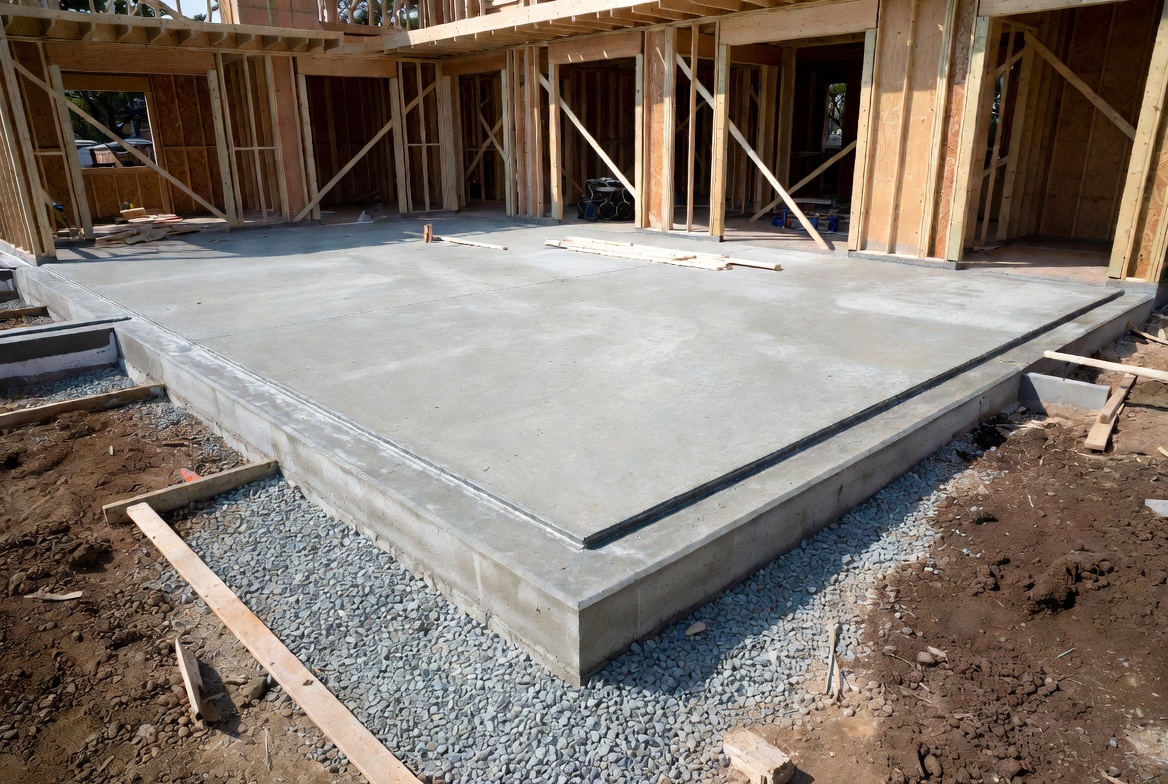
A slab-on-grade foundation is a concrete slab poured directly on the ground. There is no basement below it and no crawl space to work with later.
That simplicity is exactly why it gets used so often. A slab-on-grade foundation is usually faster to build, needs less excavation than a basement, and can cost less when the site and climate suit it. It also asks you to get the basics right the first time, because there is not much forgiveness once the concrete is down and the house is sitting on it.
If you want the wider foundation picture first, start with House Foundations Before Construction. If the site conditions are still unclear, Foundations, Soil Analysis, and Site Investigation should come before any confident slab decision.
Why Builders Choose Slab-on-Grade

Slab-on-grade makes the most sense when the site is fairly straightforward, the plan is simple enough to lay out cleanly, and there is no strong reason to pay for a deeper system.
| Foundation Type | Main Advantage | Main Drawback | Best Fit |
|---|---|---|---|
| Slab-on-Grade | Fast, efficient, and lower excavation cost | Little access below the floor later | Flat sites, simpler house plans, tighter budgets |
| Crawl Space | Utility access below the floor | Moisture and air-sealing problems if handled badly | Sites where some elevation and access help |
| Basement | Full-height usable space | Higher cost and more water-management risk | Cold climates, sloped sites, or houses that benefit from below-grade space |
If you are still comparing options, Crawl Space Foundation 101 and Basement Foundations Basics are the right next pages.
What a Slab-on-Grade System Includes
Site Prep and Subgrade
The slab is only as good as the ground under it. Organic material, soft spots, loose fill, and poorly compacted soil turn into settlement, cracks, and floor problems later. This is where a lot of bad slabs get decided before the concrete truck even shows up.
Base Material and Vapor Control
A compacted stone base helps with support and drainage. Under-slab vapor control helps keep ground moisture from moving up into the slab and into finishes later. Once the house has flooring, cabinets, adhesives, and conditioned air depending on that slab, this stops being a small detail.
Footings or Thickened Edges
Many slab-on-grade houses do not rely on a uniform slab thickness alone. Loads at the perimeter and bearing points often need thickened edges or footing details designed for the structure and the soil. That is why slab work is never just a flat piece of concrete with no structural thinking behind it.
Also Useful. Concrete Foundation Footings goes deeper into bearing, footing width, and where footing jobs usually start going wrong.
Reinforcement
Concrete handles compression well and handles tension badly. Reinforcement is what helps the slab deal with shrinkage, movement, and load in a more controlled way. The exact reinforcement pattern depends on the slab design, the loads, and local practice, but the big rule stays the same: reinforcement has to sit where it can actually work, not dropped on the ground and buried at the bottom.

Reinforcement has to stay in the slab where it can do its job, not sink uselessly to the bottom during the pour.
Concrete Placement, Joints, and Curing
The pour is the part people focus on. It is not the only part that matters, but it is the part that can go bad quickly. The slab has to be placed, leveled, finished, jointed, and cured in the right order. Joints should be planned, not guessed after the slab starts cracking where it wants.
This is also where crews get tempted to speed things up. A little too much water in the mix. Joints cut late. Curing treated like an afterthought. The slab may still look fine when the truck leaves. That does not mean it was built well.
Drainage and Final Grading
A slab foundation still needs water control. Bad grading, short downspouts, and water collecting at the slab edge can slowly turn a simple foundation into a moisture and movement problem. Slab-on-grade does not excuse lazy site drainage.
If water control at the perimeter still looks weak, Exterior Foundation Waterproofing helps explain what proper outside water management should look like.
How Slab-on-Grade Is Usually Built
- Strip topsoil and organic material, then excavate to the required depth.
- Compact the subgrade and install the base material properly.
- Lay out plumbing, sleeves, vapor control, and insulation where required.
- Set forms, check level and square, and place reinforcement correctly.
- Pour, screed, finish, and cut the planned control joints.
- Cure the slab properly and make sure final grading moves water away from the house.
That list looks simple on paper. On site, this is where trouble starts. The base gets rushed. Reinforcement gets left too low. The slab gets too much water added during placement. Joints get cut late. The curing period gets ignored because everyone wants to move on to the next task.
What Commonly Goes Wrong
The Ground Was Never Properly Prepared
If the soil below the slab is loose, uneven, or still full of organic material, the slab may settle and crack no matter how nice the finish looked on pour day.
Moisture Was Treated Like a Small Detail
Under-slab moisture is easy to ignore because you do not see it right away. Later it shows up as damp floors, finish problems, adhesive failure, and that musty smell nobody can quite explain. Slabs do not need a dramatic leak to have a moisture problem.
Reinforcement Was There in Name Only
This is common. The rebar or mesh was technically present, but it ended up sitting too low to do much useful work. That is not the same thing as a properly reinforced slab.
Control Joints Were Late or Weak
Concrete is going to crack somewhere. The whole point of control joints is to help decide where. If that decision happens late, the slab often makes its own decision first.
Water Was Allowed to Sit at the Perimeter
Even a simple slab-on-grade foundation needs roof-water discharge, slope away from the house, and enough attention at the edge that water is not continually being driven back toward the slab.
What Actually Works vs What People Commonly Do Wrong
| Do This | Instead Of This | Why It Matters |
|---|---|---|
| Compact the subgrade and base properly | Pour on loosely leveled dirt | The slab follows the weakness underneath it |
| Keep reinforcement supported in the slab | Let it drop to the bottom during the pour | Steel that sits too low does far less useful work |
| Plan control joints and cut them on time | Wait and hope the slab cracks nicely on its own | Random cracks are harder to control and harder to hide |
| Use vapor control and manage perimeter water | Assume a dry-looking slab means a dry assembly | Ground moisture often becomes a finish problem later |
| Plan plumbing and penetrations before the pour | Patch and cut the slab later whenever needed | Late changes are messy and expensive |
What Affects Cost Most
Slab-on-grade can be cost-effective, but that does not mean cheap in every case. The big cost drivers are usually boring, structural, and hard to glamorize. That is usually where the real money goes.
| Cost Driver | Why It Changes the Price | Where Cheap Work Backfires |
|---|---|---|
| Site stripping and excavation | Bad soil, extra cut, fill import, and awkward access add labor and equipment time | A slab built on poor prep costs far more later |
| Base prep and compaction | More base material, more passes, and better control take time | Settlement and cracking often start here |
| Reinforcement and edge detail | Thickened edges, load points, and heavier reinforcement increase material and labor | Weak edges and underbuilt slabs do not stay quiet |
| Under-slab insulation and vapor control | Climate, energy targets, and floor-finish expectations change the assembly | Skipping these creates comfort and moisture problems later |
| Plumbing and embedded work | Once lines and sleeves are in the slab, layout mistakes get expensive fast | Late changes mean cutting concrete later |
| Concrete placement and curing conditions | Weather, access, pump needs, and crew timing can move the cost hard | Rushed finishing and weak curing shorten the slab’s life |
The good use of budget here is plain: ground prep, reinforcement, concrete quality, curing, and drainage. That is where slab money earns its keep. The waste is usually cosmetic panic or trying to save on the invisible parts that decide whether the slab behaves later.
FAQ
How thick should a slab-on-grade foundation be?
It depends on the design, loads, edge detail, and local requirements. Many residential slab fields are around 4 inches thick, but houses often use thickened edges or additional footing detail where the loads are higher. Garage slabs, bearing points, and perimeter conditions may need more. The important point is not chasing one magic number. It is building the slab as the design intended.
Do I need rebar in a slab-on-grade foundation?
Often yes for residential work, though the exact reinforcement can vary by design. Small non-structural slabs may use lighter reinforcement strategies, but house slabs and garage slabs usually need more than good intentions and smooth concrete. In practice, this often means a designed rebar layout or another reinforcement pattern sized for the loads, not just throwing steel in and hoping for the best.
Do I need a vapor barrier under a slab?
In many residential situations, yes. Once interior finishes, flooring, and conditioned living space depend on that slab, under-slab moisture control becomes much harder to ignore. Many modern assemblies use a more durable under-slab vapor retarder, often thicker than the flimsy plastic people picture, because tears and sloppy seams defeat the point.
Can a slab-on-grade foundation work in cold climates?
Yes, but the frost strategy, insulation detailing, and edge conditions have to be handled properly for that climate. A slab that works in one region is not automatically detailed well enough for another. In colder regions, under-slab insulation, slab-edge insulation, and frost-protected design logic matter much more.
How long does a slab-on-grade foundation last?
A well-built slab can last for decades. A badly built slab can start arguing with you much earlier. The difference is almost always in the prep, reinforcement, curing, and water management.
What’s Next
A slab-on-grade foundation can be one of the cleanest and most efficient foundation choices for a house when the site suits it. The trade-off is simple: you lose the forgiveness that comes with later access below the floor, so the early decisions matter more.
Get the subgrade, edge support, vapor control, reinforcement, curing, and drainage right together, and a slab foundation can stay quiet for a very long time. Miss two or three of those, and the floor keeps reminding you.
- House Foundations Before Construction if you are still deciding between slab, crawl space, and basement.
- Foundations, Soil Analysis, and Site Investigation if the ground conditions are still a question mark.
- Basement Foundations Basics and Crawl Space Foundation 101 if you want to compare the other main residential options.
Resources
- Natural Resources Canada: Keeping the Heat In
- National Research Council Canada: Site Grading and Drainage
- Natural Resources Canada: Details of the R-2000 Standard
- Natural Resources Canada: Effective Thermal Resistance Tables
- National Research Council Canada: Foundations on Swelling or Shrinking Subsoils
Also, keep the Government of Canada slab-on-grade publication attached below for reference.