
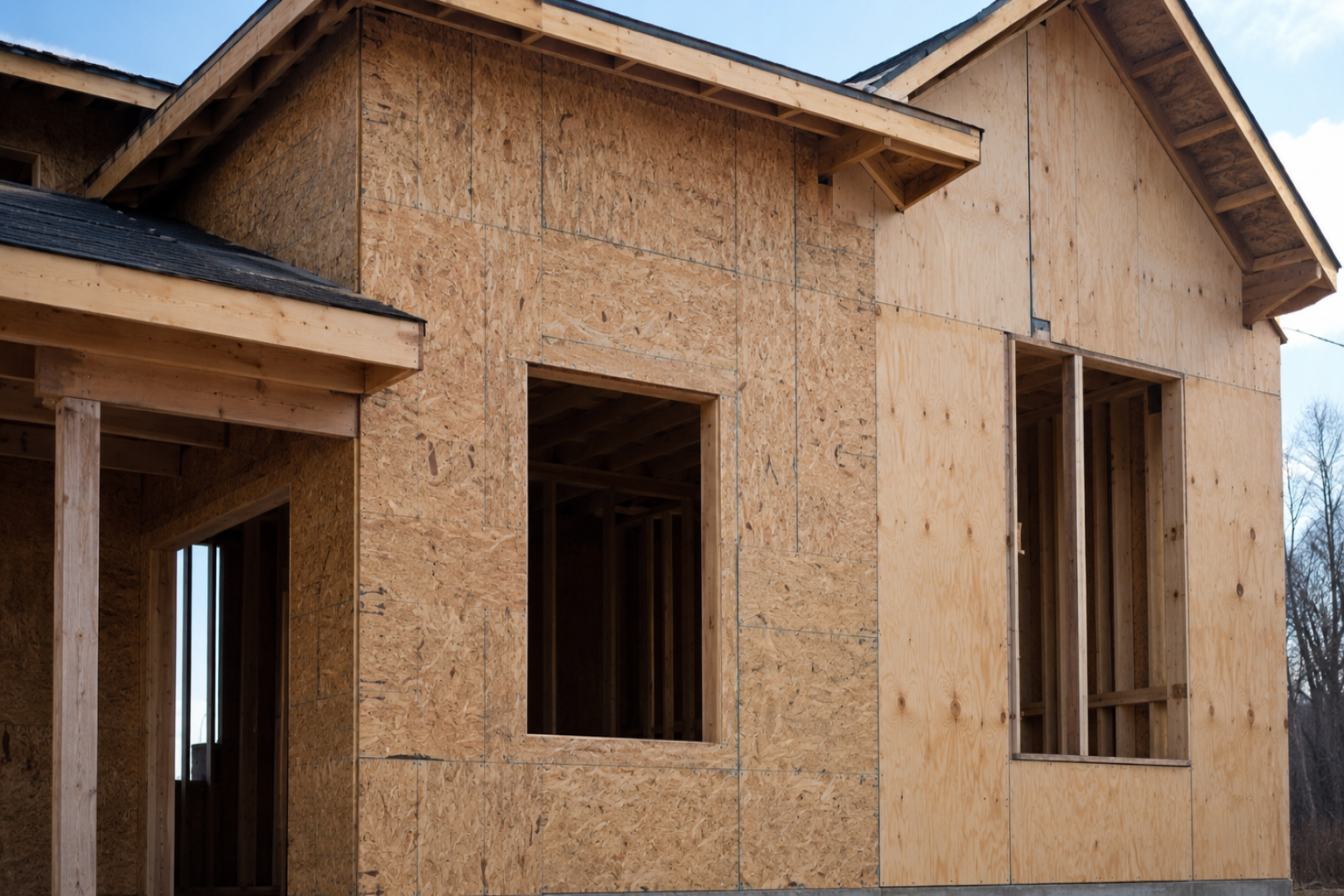
Exterior wall sheathing is the layer that makes a framed wall stiff, flat, and ready for weather-control work.
When it is missing, too thin, wet, badly nailed, or treated like a water barrier by itself, the problem shows up later as wavy siding, swollen OSB, loose fasteners, mold, rot around windows, or a wall that fails inspection before siding even starts.
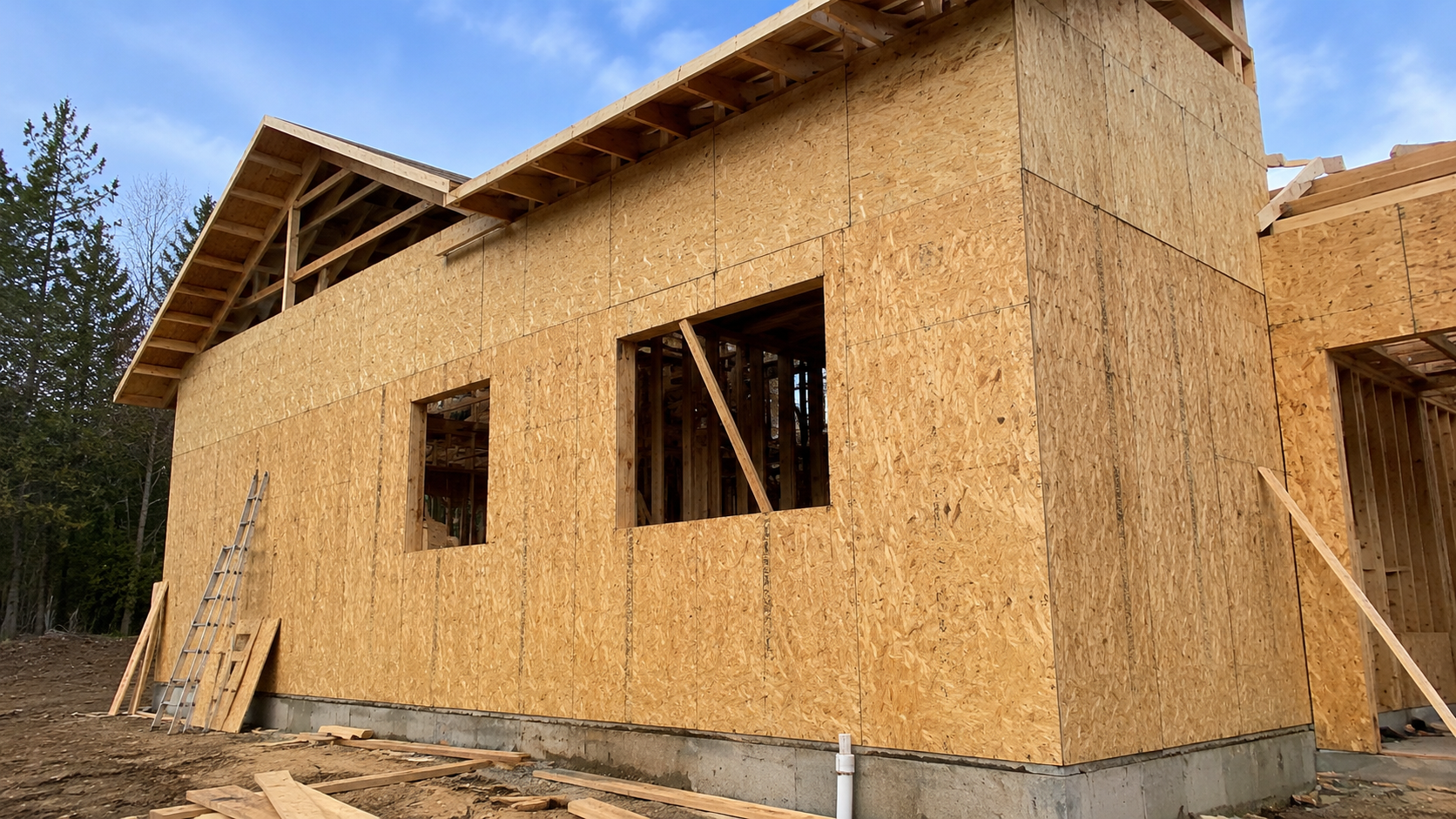
This page is about exterior wall sheathing: OSB, plywood, exterior gypsum board sheathing, foam, insulated exterior sheathing, ZIP-style panels, thickness, WRB, flashing, siding support, and water damage. For the broader sheathing overview, start with house sheathing. For roof deck panels, use roof sheathing. For older board roof decks instead of panels, see roof planking.
What exterior wall sheathing does
Studs, plates, headers, and corners make the wall frame. Sheathing turns that frame into a braced wall plane.
It also gives housewrap, flashing, furring, and siding something continuous to work against. Bare studs behind siding are a problem for that reason. The siding may hang for a while, but there is no flat structural backing, the WRB is harder to support, and the fasteners have fewer good places to bite.
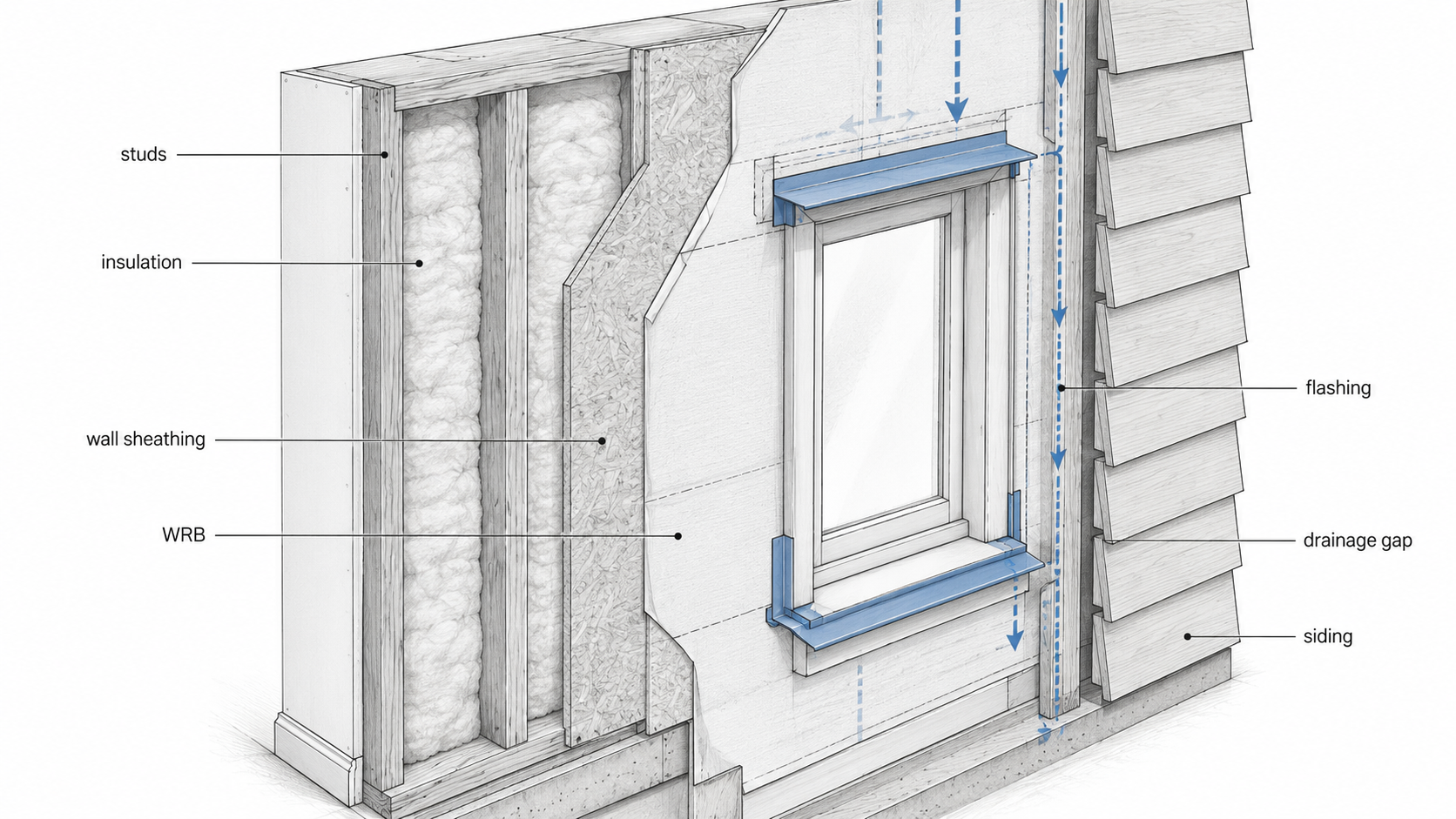
Good wall sheathing does four jobs at once:
- Braces the frame against racking from wind and movement.
- Creates a flat base for siding, trim, and water-control layers.
- Helps transfer loads through the wall assembly when installed to the required fastening schedule.
- Protects the wall cavity during the short period before the wall is wrapped, flashed, and sided.
It does not replace flashing or a WRB, and it does not make foam structural unless the wall has another approved bracing system.
Exterior wall sheathing thickness
Exterior wall sheathing thickness depends on framing spacing, wind exposure, seismic design, cladding, braced wall requirements, panel rating, local code, and the plans. Do not treat one thickness as the answer for every house.
On many residential walls, 7/16 inch OSB or plywood is common. That is not automatically the best choice, though. A simple vinyl-sided wall in a mild spot asks far less of the sheathing than a fiber-cement wall, a tall gable, a high-wind site, or a wall that may sit exposed through bad weather.
| Thickness | Where it fits | Watch point |
|---|---|---|
| 7/16 inch | Common OSB wall sheathing for many standard residential walls. | Needs proper gaps, fastening, WRB, and fast dry-in. Thin panels show waves faster when the wall is wet or uneven. |
| 1/2 inch | Good upgrade for flatter walls, better fastener feel, heavier claddings, and wet-risk faces. | Still fails if windows, decks, and WRB details are wrong. |
| 5/8 inch | Used where stiffness, shear design, high wind, impact, or specific engineered details call for a heavier panel. | Costs more and weighs more. Use it where the wall actually needs it. |
Thicker everywhere is rarely the smart move. Put the strength where the wall is vulnerable: corners, braced wall lines, tall walls, window-heavy walls, deck-ledger areas, and the sides that take wind-driven rain.
Exterior wall sheathing materials
Exterior sheathing is not one product but several, and they solve different problems. Some brace the wall, some support a fire-rated assembly, some add insulation, and some act as part of an air- or water-control system when the seams and openings are detailed correctly.
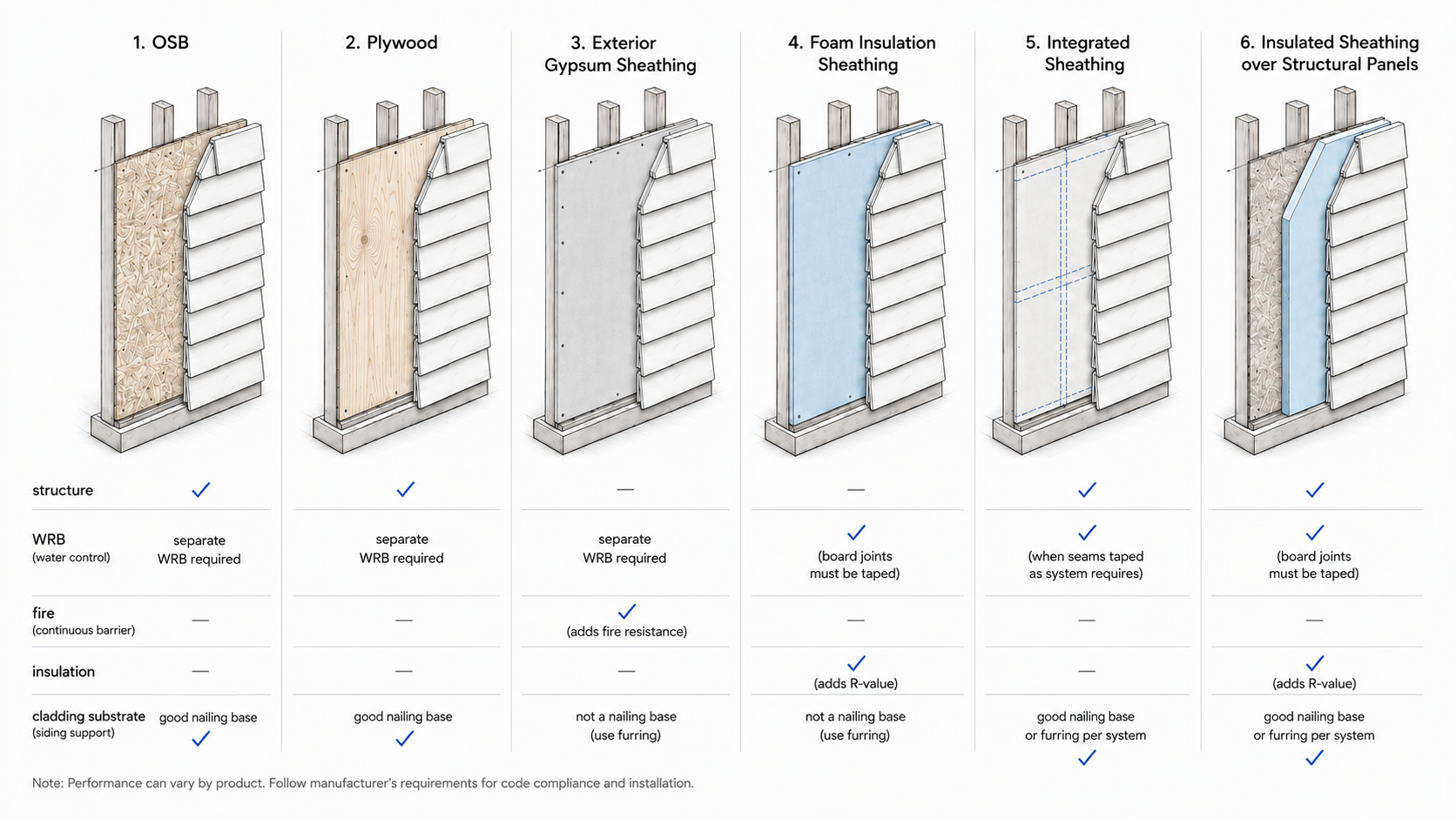
| Material | Best use | Big mistake |
|---|---|---|
| OSB exterior sheathing | Standard structural wall sheathing where cost matters and the wall will be wrapped and dried in correctly. | Leaving edges wet, skipping panel gaps, or assuming OSB is the water barrier. |
| Exterior plywood sheathing | Wet-risk areas, corners, window-heavy walls, custom work, and walls where stronger fastener hold matters. | Paying more for plywood but still using weak flashing or poor WRB laps. |
| Exterior gypsum board sheathing | Commercial, multifamily, stucco, veneer, and fire-rated assemblies where the listed wall system calls for it. | Treating it as structural bracing unless the assembly has another bracing path. |
| Foam sheathing | Exterior insulation and thermal-bridge control over a structural wall. | Using foam as the only bracing or as a direct siding nail base without the right furring and fasteners. |
| Integrated panels | Structural panel plus factory water-control layer when seams and openings are taped or sealed correctly. | Skipping rollers, taping dirty or cold surfaces, or ignoring cut edges and transitions. |
Best sheathing for exterior walls depends on the risk
The best sheathing for exterior walls depends on what the wall has to survive. OSB is common and cost-effective for broad wall fields. Exterior plywood sheathing is more forgiving around windows, corners, and wet-risk areas. Exterior gypsum board sheathing fits fire-rated or noncombustible assemblies. Foam and insulated exterior sheathing help with thermal bridging, but they still need a structural bracing plan behind them.
Do not choose by price alone. Choose by climate, cladding, wall height, exposure, fire rating, fastening needs, and how soon the wall will be wrapped and dried in.
OSB exterior sheathing vs plywood exterior sheathing
OSB exterior sheathing is common because it is available, consistent, and cost-effective. It works when it is installed with the right gaps, nailed properly, and protected by a complete WRB and flashing system.
Exterior plywood sheathing costs more in many markets, but it is more forgiving when wetting and drying are likely. That matters around windows, doors, deck ledgers, roof-wall intersections, corners, and walls that may sit exposed during construction.
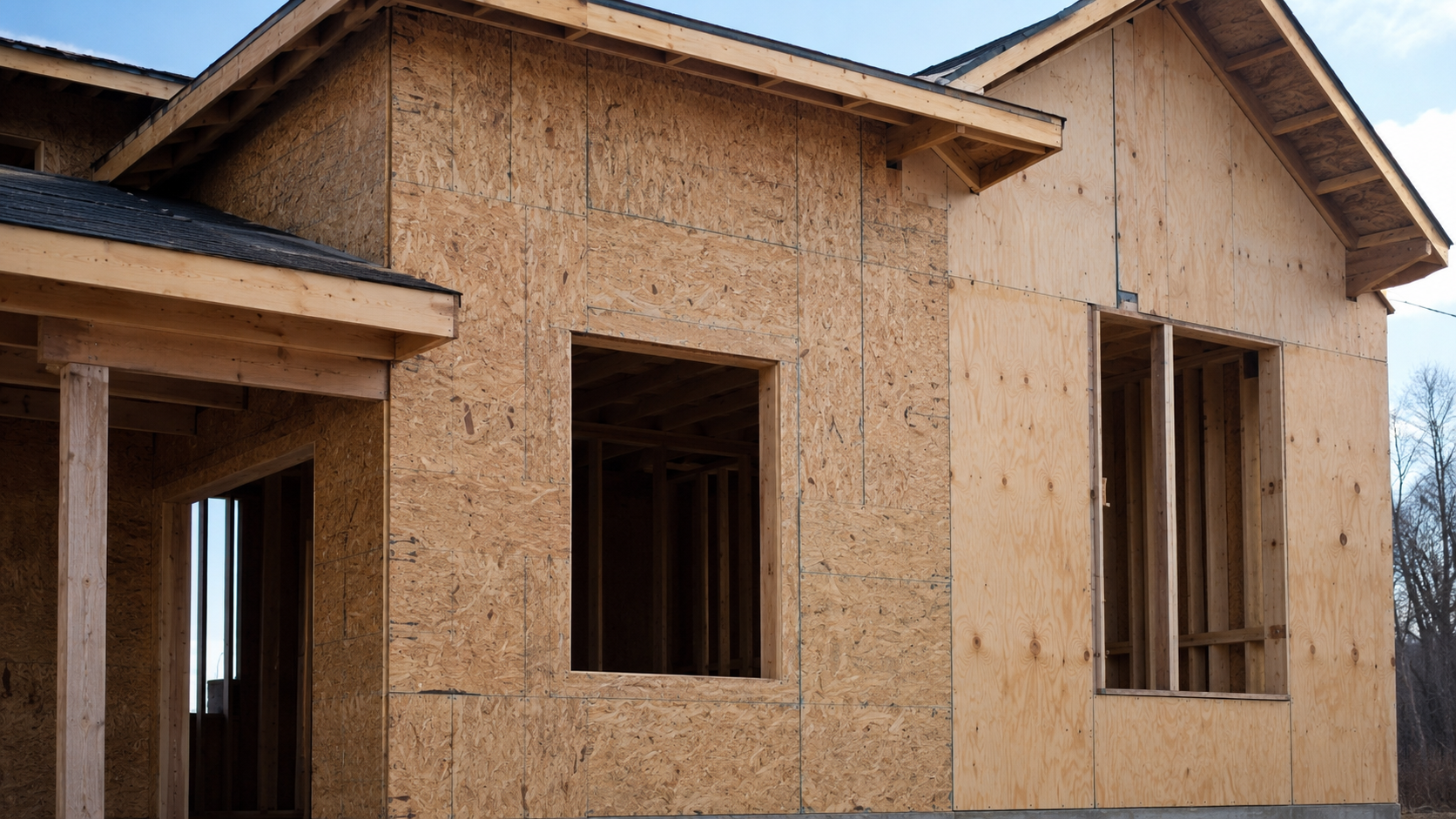
A simple way to decide:
- Use OSB for broad, protected wall fields where cost control matters.
- Use plywood where wetting risk, fastener holding, or repair tolerance matters more.
- Use the project drawings and local requirements where braced wall panels, high-wind details, or engineered shear walls are involved.
“Plywood good, OSB bad” is the wrong takeaway. Any panel fails if the wall leaks, cannot dry, or is nailed wrong.
WRB, flashing, and the water-control layer
Exterior wall sheathing sits behind the water-control layer, and that changes how you think about it.
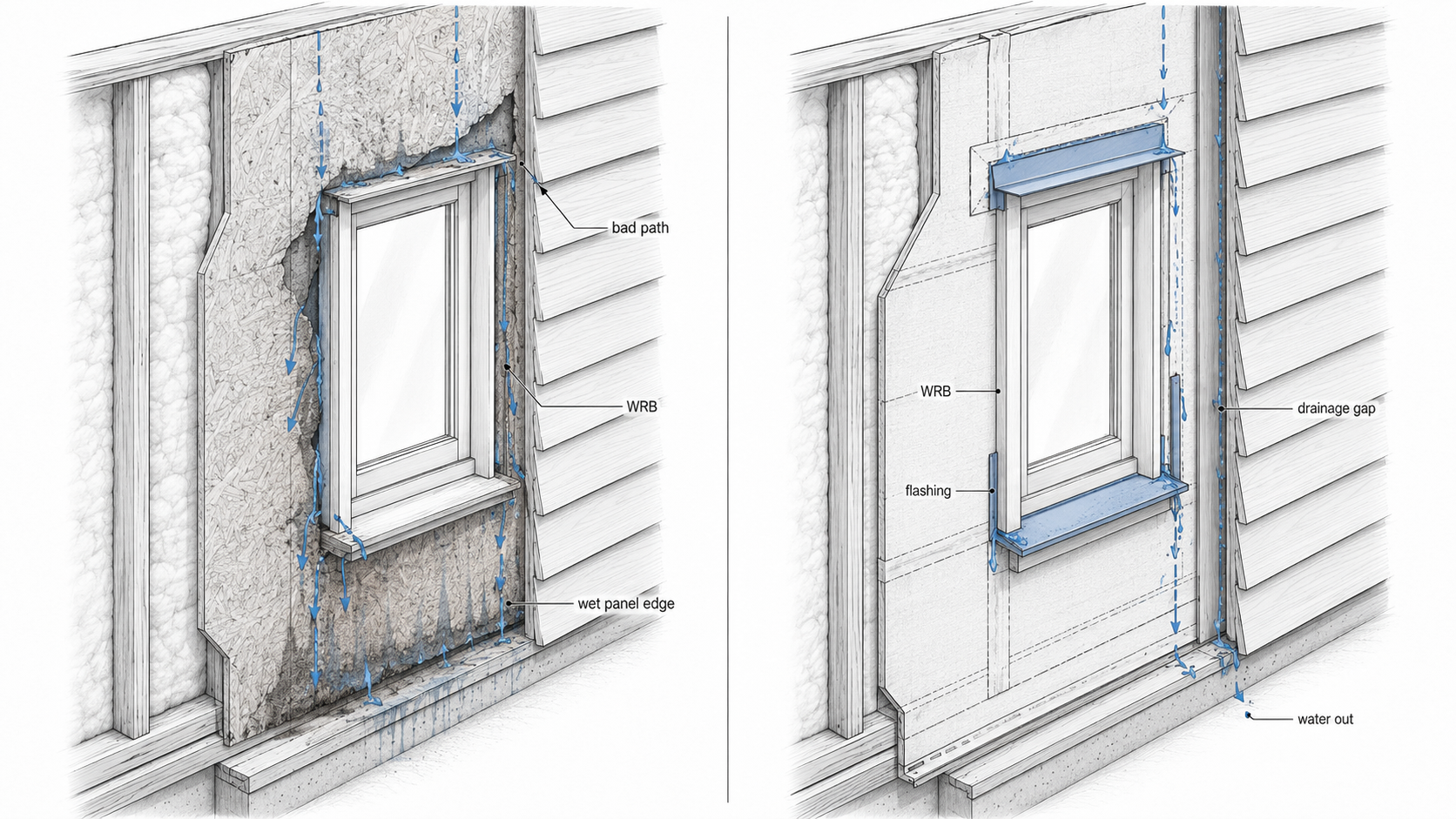
A water-resistive barrier can be housewrap, felt, a fully adhered membrane, a liquid-applied product, or an integrated sheathing system. The product matters less than the sequence: water has to shed outward and downward, not behind the panel edges.
Windows and doors are the hard part. A wall can have perfect sheathing and still rot if the sill pan is missing, the head flashing is wrong, or the WRB is lapped backward.
Watch the order:
- Install sheathing flat, gapped, and fastened to framing.
- Install or complete the WRB in shingle-lap sequence.
- Flash rough openings so water exits out, not into the wall cavity.
- Add rainscreen or furring where the cladding or climate needs better drainage and drying.
This is where cheap work gets expensive. A missed sill pan or a bad deck-ledger detail can turn a small opening into a full siding-removal job.
Waterproof exterior sheathing is not enough by itself
Some products are sold as water-resistant, weather-resistant, or integrated sheathing systems. That can be useful, but it does not make the wall waterproof just because panels are on the studs.
A wall still needs correct laps, taped or sealed seams where required, flashing at openings, drainage behind cladding, and a clear path for water to exit. If water gets behind the siding and sits on panel edges, the label on the sheathing will not save the wall.
Instead of asking whether a panel is “waterproof,” ask where the water goes once it gets behind the cladding.
Estimate wall sheathing before buying panels
Before ordering OSB, plywood, gypsum, or integrated panels, estimate wall area, openings, gables, waste, and panel size. A wall with many windows can use fewer full sheets but more labor. A tall gable can eat waste fast.
Use the Wall Sheathing Calculator to estimate exterior wall sheathing sheets, openings, gable areas, panel size, and waste before buying material.
If the project includes siding removal, WRB replacement, flashing tape, rot repair, access problems, or restoration after opening the wall, use the Wall Sheathing Cost Calculator after you understand the wall condition.
For broader roof, wall, floor, OSB, plywood, and gable tools, use the main sheathing calculators page.
Panel gaps, fastening, and layout
Those panel gaps do real work. Wood structural panels need room to move, and when sheathing is jammed tight and then gets wet, the edges swell, buckle, and push the cladding plane out of shape.
Fastening matters just as much. A panel nailed into nothing braces nothing, overdriven fasteners lose their grip at the edges, and lazy nailing tends to look fine right up until inspection, wind load, or siding installation exposes it.
Check these before covering the wall:
- Panel edges have the required gap and land on framing or approved blocking where needed.
- Fastener spacing follows the plans, panel stamp, local code, or engineered schedule.
- Openings, corners, and braced wall segments are not treated like random filler areas.
- Damaged or swollen panel edges are replaced before WRB and siding hide them.
If the wall will receive vinyl siding, fiber cement, stucco, metal panels, or wood cladding, the sheathing plane has to be flat before siding starts, because siding will not straighten a wavy wall.
Foam and insulated exterior sheathing need structure behind them
Exterior foam, mineral wool, wood-fiber panels, and other continuous insulation products can improve comfort and thermal performance. They also change the wall thickness, window details, cladding attachment, and drying behavior.
Most insulation boards do not brace the wall on their own; foam is not plywood, and mineral wool is not OSB. The wall still needs a structural strategy, whether that is plywood, OSB, engineered bracing, let-in bracing, straps, or another approved system. Then the insulation layer needs furring, long fasteners, or a cladding-attachment plan that matches the thickness and loads.
Cold climates add another issue. Exterior insulation can help keep the sheathing warmer, but only if the ratio between exterior insulation and cavity insulation is right for the climate. Too little exterior R-value can leave the sheathing cold enough for condensation, which is worse than skipping it.
Where exterior wall sheathing fails first
Wall sheathing fails first where water gets in and drying is poor.
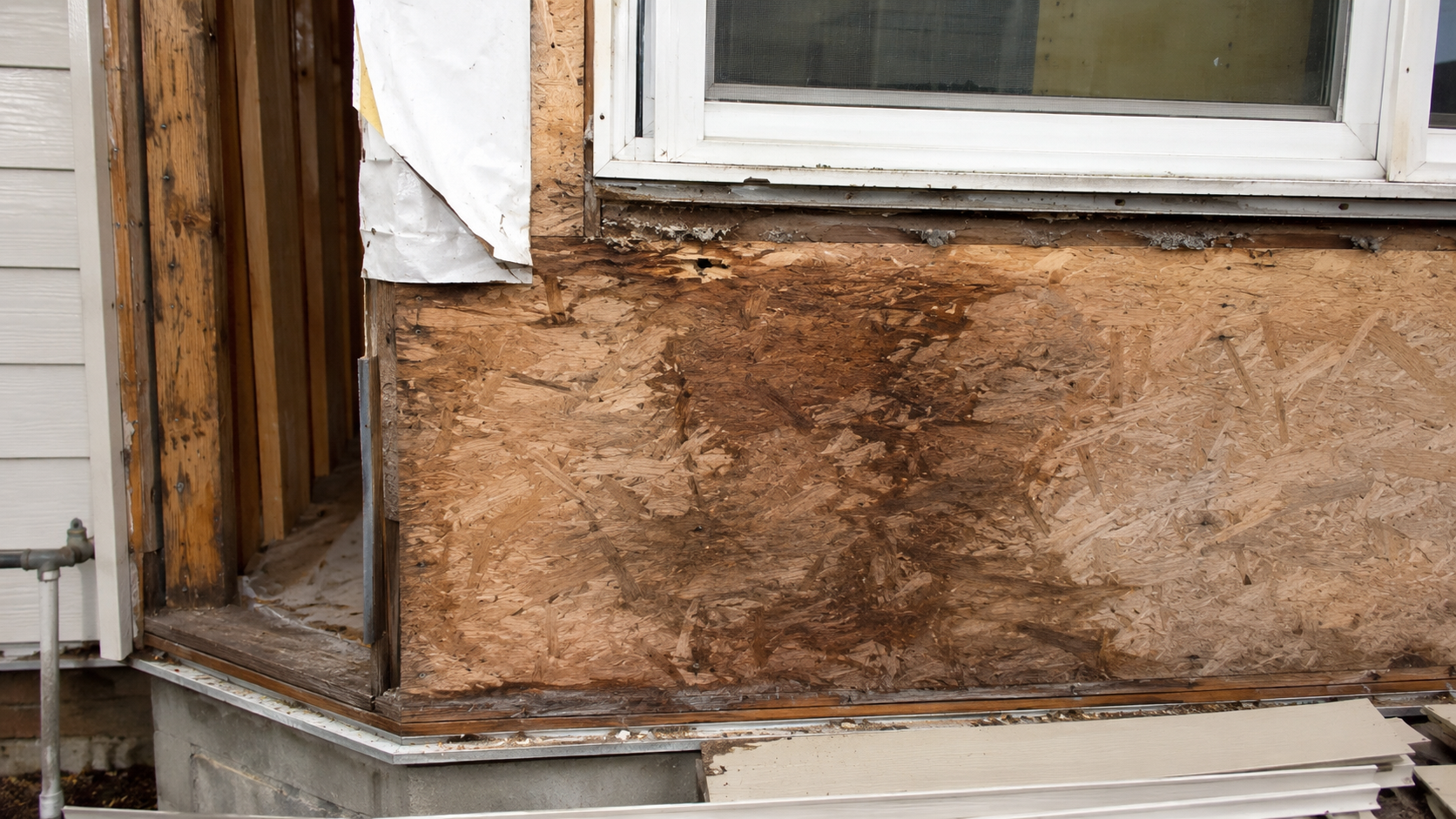
The first bad areas are not random. Look at:
- Window sills and lower corners where flashing mistakes collect water.
- Deck ledgers where bolts, flashing, and siding cuts interrupt the wall.
- Roof-wall intersections where kick-out flashing is missing or wrong.
- Bottom edges near splashback, bad grading, or cladding too close to grade.
Soft OSB, black staining, swollen edges, loose siding fasteners, a musty smell, and siding that bulges near windows are all warning signs. Do not just swap the panel; find the water path first.
If the sheathing is already soft, swollen, mold-stained, rotted, or water damaged, use the Water-Damaged Sheathing Repair Cost Calculator only after the leak source has been identified. Pricing panels before diagnosis is how small repairs turn into repeat repairs.
The one flashing everyone forgets
If I had to name the single detail that rots the most wall sheathing, it would not be the panel, the nails, or the housewrap. It would be a small bent piece of metal called a kick-out flashing, and it is missing on an alarming number of houses.
Here is where it belongs. Anywhere the eave of a sloped roof runs down and dies into a vertical wall, a garage roof meeting the two-story wall of a house is the classic case, the step flashing carries a growing stream of roof water down to the bottom of that intersection. A kick-out flashing is the angled piece at the very bottom that sticks out past the siding and throws that water clear of the wall, ideally into the gutter. Leave it off and the whole column of water pours off the last piece of step flashing and runs straight down behind the siding at that corner.
That is a bad place to send water. It soaks the sheathing, wicks into the framing, and rots the wall from the inside while the outside still looks fine. Old wood siding used to warn you with peeling paint, but fiber cement, vinyl, stucco, and brick veneer hide it for years. I have pulled siding off that corner and found black, crumbling OSB and soft framing behind a wall that looked perfect from the street. By then the fix is not a piece of metal, it is new sheathing, new framing, and a mold cleanup.
The maddening part is why it gets skipped. It sits right on the seam between two trades: the roofer figures the siding crew will handle the transition, the siding crew figures the roofer already did, and nobody owns it. A diverter here has been required since the 2009 IRC, carried in later cycles as Section R903.2.1, and inspectors still find it missing on brand-new houses. Checking for it takes five seconds: stand where a roof eave meets a wall above a gutter and look for a small flared piece of metal kicking water out and away from the siding. If you see caulk, or nothing, that is the problem.
A missing one can usually be retrofitted by lifting the bottom courses of shingles and pulling a little siding, but it has to be woven in behind the WRB and under the shingles the right way, not smeared over the top with sealant. Get a roofer or a flashing-savvy contractor on that specific detail, because the layering with the housewrap, siding, and roofing is exactly where a rushed job leaks, and the correct sequence shifts with the cladding and the WRB you already have.
Common exterior wall sheathing mistakes
Hanging siding over studs.
Vinyl, fiber cement, and many other claddings need a flat backing and a weather-control layer. Bare studs are not a finished exterior wall assembly.
Skipping the WRB.
OSB and plywood are not the WRB. Some integrated sheathing products can be part of the WRB system, but only when seams, openings, cut edges, and transitions are handled as the manufacturer requires.
Butting panels tight.
Tight panels swell after rain. Once the wall gets wrapped and sided, the buckling can show up as waves, cracked finishes, or cladding that will not sit flat.
Treating foam as structure.
Foam adds R-value. It does not brace the house unless the wall has another approved bracing method.
Forgetting the bottom of the wall.
Sheathing near grade, decks, stoops, and splash zones takes more abuse. If water cannot drain away, the bottom edge rots first.
The wall gets judged after it is covered
The hardest part about exterior wall sheathing is that the most important mistakes disappear.
Once housewrap, tape, siding, trim, and paint cover the wall, nobody can see whether the panel gaps were left, the fasteners hit framing, the corners were braced, the window flashing was layered correctly, or wet OSB was hidden instead of replaced.
That is why the moment to inspect is before cover-up. Take photos of corners, openings, WRB laps, flashing, and ledger areas before siding starts. If a leak shows up two winters later, those photos can show whether the problem was panel damage, missing flashing, bad siding sequencing, or a later penetration.
This is also where a crew's incentives can quietly work against the house. A team trying to keep siding moving may not want to stop for a swollen panel edge or a missed piece of flashing tape; the homeowner sees a delay, and the wall takes on the risk.
When wall sheathing becomes a repair job
Repair is a different animal from new work. In new work the panel is open and obvious. In a repair, the siding, WRB, trim, insulation, and sometimes the interior finish are all hiding the real damage.
Repair scope changes fast when the siding comes off. One bad window corner can become a larger sheathing patch. A deck-ledger leak can involve sheathing, rim joist, flashing, siding, and fasteners. A stucco wall can hide damage farther from the leak source than expected.
Do not cover damaged sheathing with new wrap and siding. Cut back to sound material, fix the water path, patch the wall plane flat, restore the WRB, and then reinstall cladding.
If the roof deck is the damaged area, move to replacing roof sheathing instead. Roof sheathing has different loads, underlayment sequence, and access issues.
FAQ
What is exterior wall sheathing?
It is the panel or board layer installed over wall framing before the WRB and siding. It can brace the wall, support cladding, and provide a backing for water-control layers.
What is the best sheathing for exterior walls?
There is no single best panel for every wall. OSB is common and cost-effective. Exterior plywood sheathing is more forgiving in wet-risk areas. Exterior gypsum board sheathing fits fire-rated or noncombustible assemblies. Foam and mineral wool add insulation but need structure behind them.
Is OSB good for exterior wall sheathing?
Yes, when it is rated for the use, gapped, fastened correctly, protected by a WRB, and kept from repeated wetting. OSB failures are often water-detail failures, not just material failures.
Is plywood better than OSB for exterior sheathing?
Plywood is often better where water exposure, fastener holding, and repair tolerance matter. OSB is still common and acceptable on many walls when the detailing is right.
Is there waterproof exterior sheathing?
Some products handle exposure better than others, and integrated sheathing systems can be part of the water-control layer when taped and detailed correctly. But exterior wall sheathing should not be treated as waterproof by itself. The wall still needs a WRB, flashing, a drainage path, and correct laps.
What is kick-out flashing, and why does it matter?
Kick-out flashing is a small diverter installed where a sloped roof eave meets a vertical wall, at the bottom of the step-flashing run. It throws roof runoff away from the wall and into the gutter. Without it, water pours behind the siding at that corner and rots the sheathing and framing, often hidden for years. It has been required by the IRC since 2009 (Section R903.2.1 in later cycles) and is still one of the most commonly missed details.
Do exterior walls need housewrap over sheathing?
They need a continuous water-resistive barrier. That may be housewrap, felt, a membrane, a liquid-applied WRB, or an integrated sheathing system installed according to its instructions.
Can vinyl siding be installed over studs without sheathing?
No. Vinyl needs a flat, nailable wall surface and a WRB behind it. Stud-only installation invites waves, leaks, weak fastening, and inspection problems.
Is exterior gypsum board sheathing structural?
In most wall assemblies, exterior gypsum sheathing is not the structural bracing layer. It is used for fire, moisture-resistant backing, veneer, stucco, EIFS, or rated assemblies. Follow the listed assembly.
Can foam insulation replace wall sheathing?
Not by itself. Foam can be part of the exterior insulation layer, but the wall still needs bracing and a cladding-attachment plan.
How do I know if wall sheathing is water damaged?
Look for swollen edges, dark staining, soft panels, loose siding, a musty odor, rot near windows, or damage at deck ledgers and roof-wall intersections. Find the leak path before replacing panels.
None of this replaces a qualified builder, and where structure or serious water damage is involved, an engineer. Wall height, cladding, climate, exposure, and the local code cycle change the right answer from one wall to the next, so treat this as a way to see the work clearly, not as a spec for your own house.
Read This Next
- House Sheathing
- Roof Sheathing
- Replacing Roof Sheathing
- Roof Planking
- Wall Sheathing Calculator
- Wall Sheathing Cost Calculator
- Water-Damaged Sheathing Repair Cost Calculator
References
Sources used for this article
- APA: panel spacing and wood structural panel installation guidance
- International Residential Code: wall covering and water-resistive barrier requirements
- International Residential Code R903.2.1: flashing at roof-wall intersections and kick-out diverters
- U.S. DOE Building America Solution Center: step and kick-out flashing at roof-wall intersections
- Vinyl Siding Institute Installation Manual
- Gypsum Association: exterior gypsum sheathing
- Building Science Corporation: controlling cold-weather condensation with insulation