
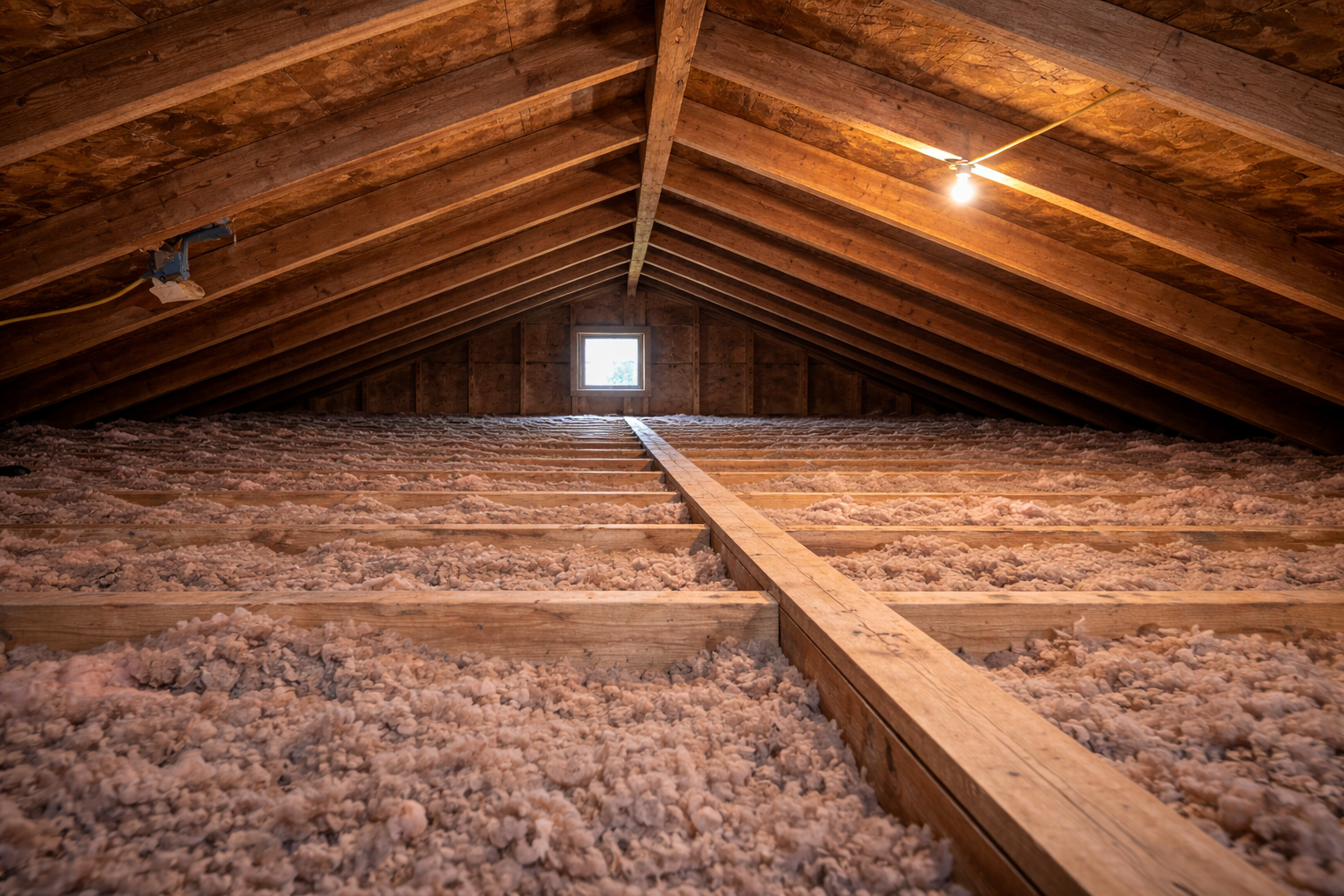
You can ruin a weekend (or a ceiling) by guessing wrong. The goal here is simple: confirm the load path with the least mess possible, then decide if you need an engineer before you touch framing.
- The fast checks that work in most U.S. wood-framed houses.
- What joist direction really tells you (and what it doesn’t).
- Truss roofs vs. stick-framed roofs: why “rules” change in newer homes.
- When to stop and call a pro before demolition.
Which Check Fits Your House
Use this page when you want a low-mess, whole-house load-path check (basement/crawl space + attic). If you have clean attic access and just want the attic logic, use the attic-only version. If you’re in a two-story and the “stacked wall” question is the whole fight, use the two-story checklist.
- Attic-only load-bearing checks when you can see framing overhead.
- Two-story load path checks when walls stack and spans get tricky.
What Makes a Wall Load-Bearing
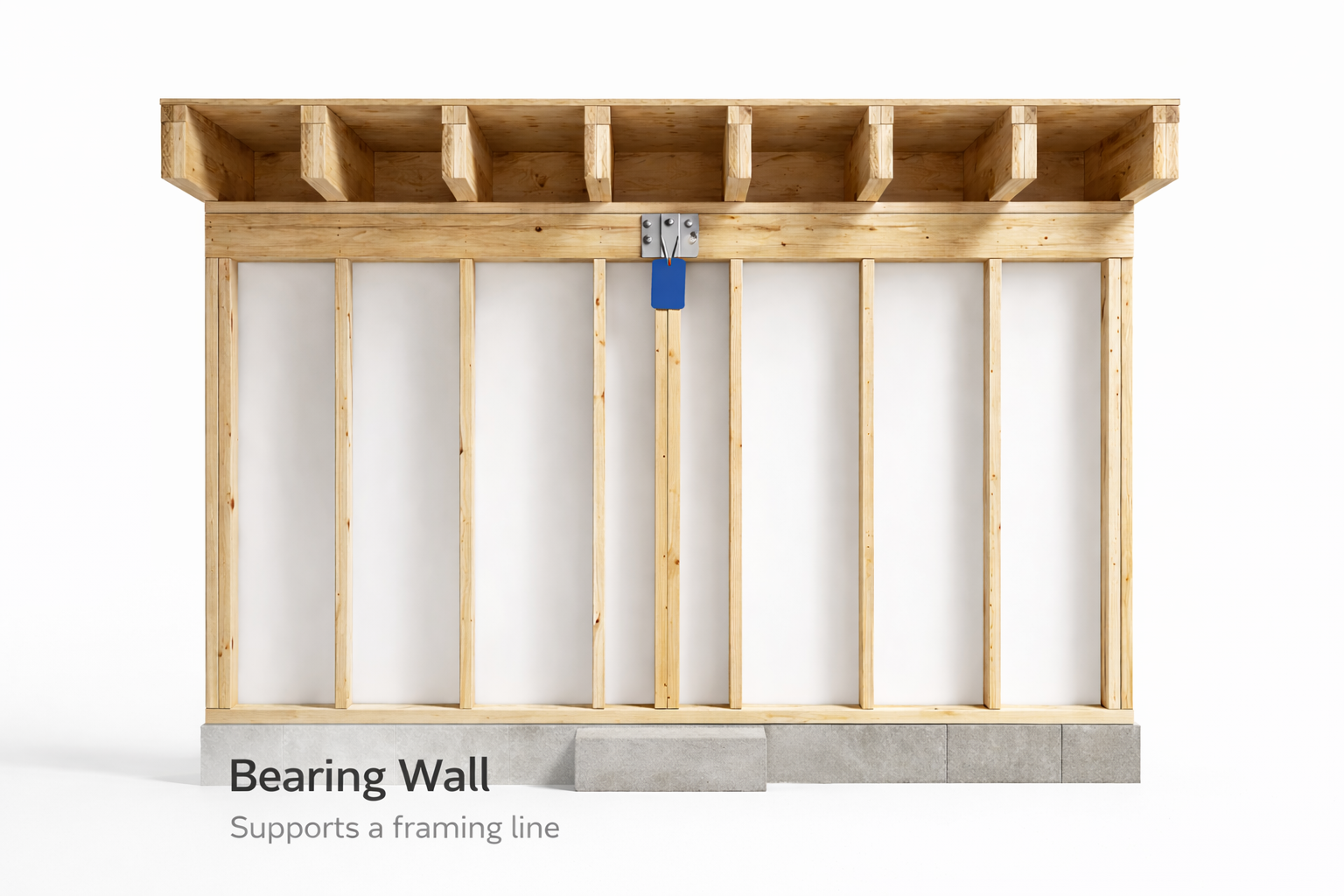
A load-bearing wall carries weight from above (roof, floor, beams) and transfers it down to something that can take it (foundation, beam, post, slab). That’s it.
The part people miss: a wall can be “not load-bearing” for gravity loads and still matter for lateral bracing, plumbing stacks, HVAC chases, or fire blocking. So even “non-bearing” doesn’t always mean “safe to delete.”
The Big Misread
Most DIY checks get obsessed with wall thickness and stud count. Helpful clues. Not proof.
The clean way to think: follow the weight. Roof/floor load → joists/trusses → beams → posts/walls → foundation. If your wall sits in that chain, treat it as structural until proven otherwise.
Pick a Proof Clue
Don’t try to “collect every clue.” Pick one proof path you can actually confirm in your house, then run it to ground. These three cover most real-world situations.
Proof A: Joist Splice Over Wall
This is the cleanest attic proof in older floor systems: ceiling joists (or floor joists) splice or lap right over the wall line. That wall is being used as a bearing line to break the span.
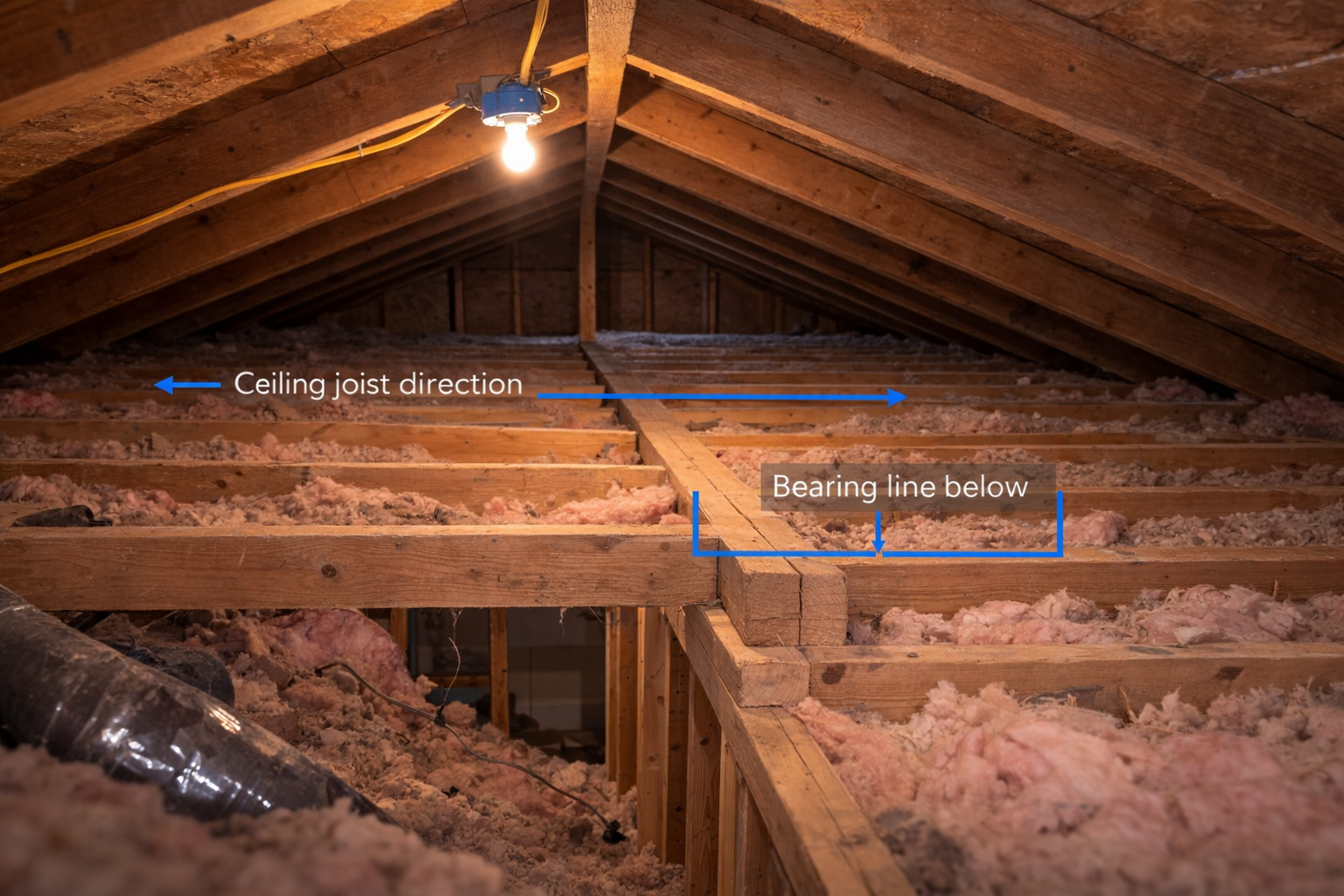
Proof A: Splice or lap directly over the wall line.
- What you need to see: a clear lap/splice directly above the wall, not just “near it.”
- What fakes people out: random blocking, catwalk planks, or insulation bridges that hide the real joist line.
- How it fails: remove the wall and you remove mid-span support. Sag and cracks can show up same day, or after the first seasonal swing.
Proof B: Joist Ends on Wall
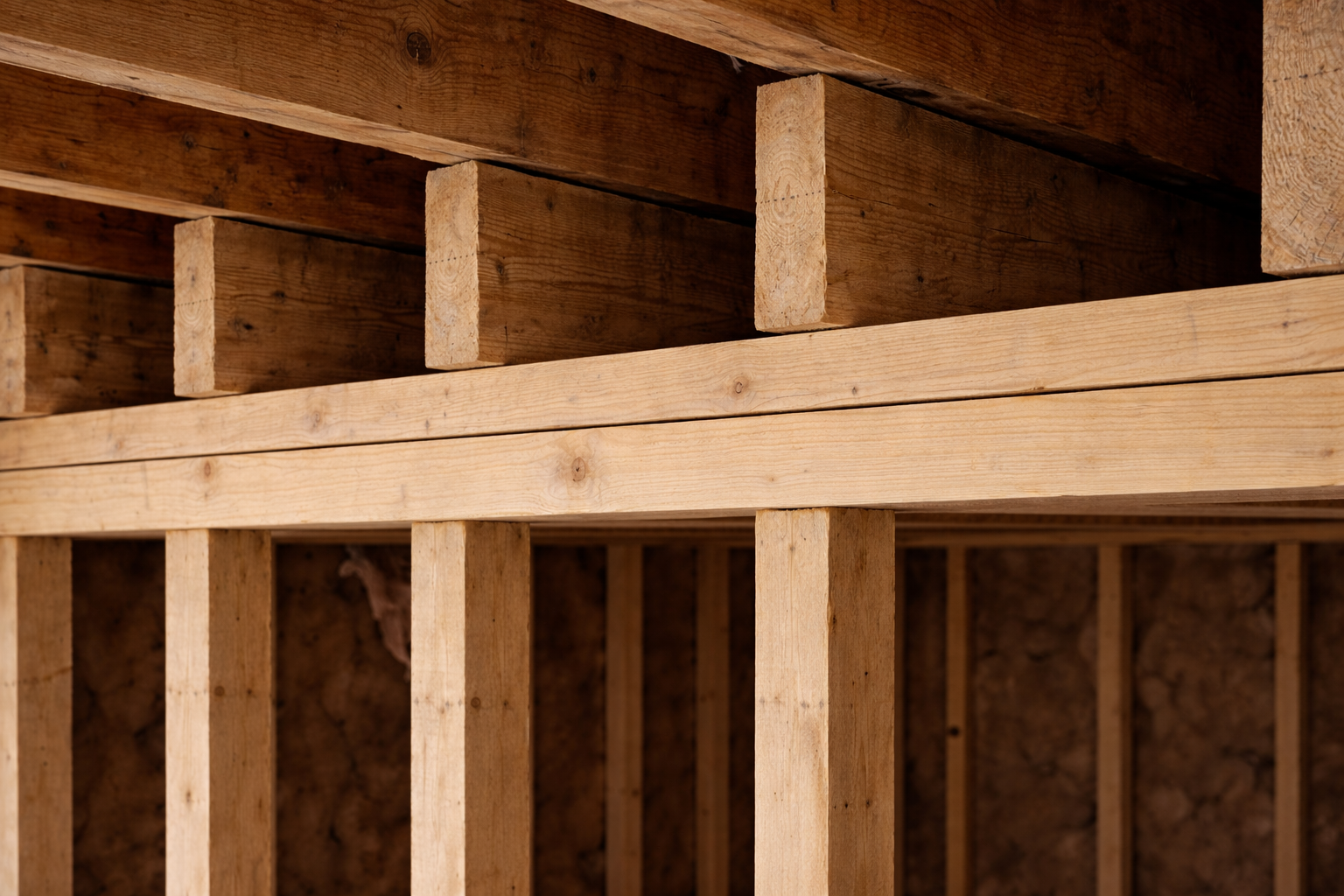
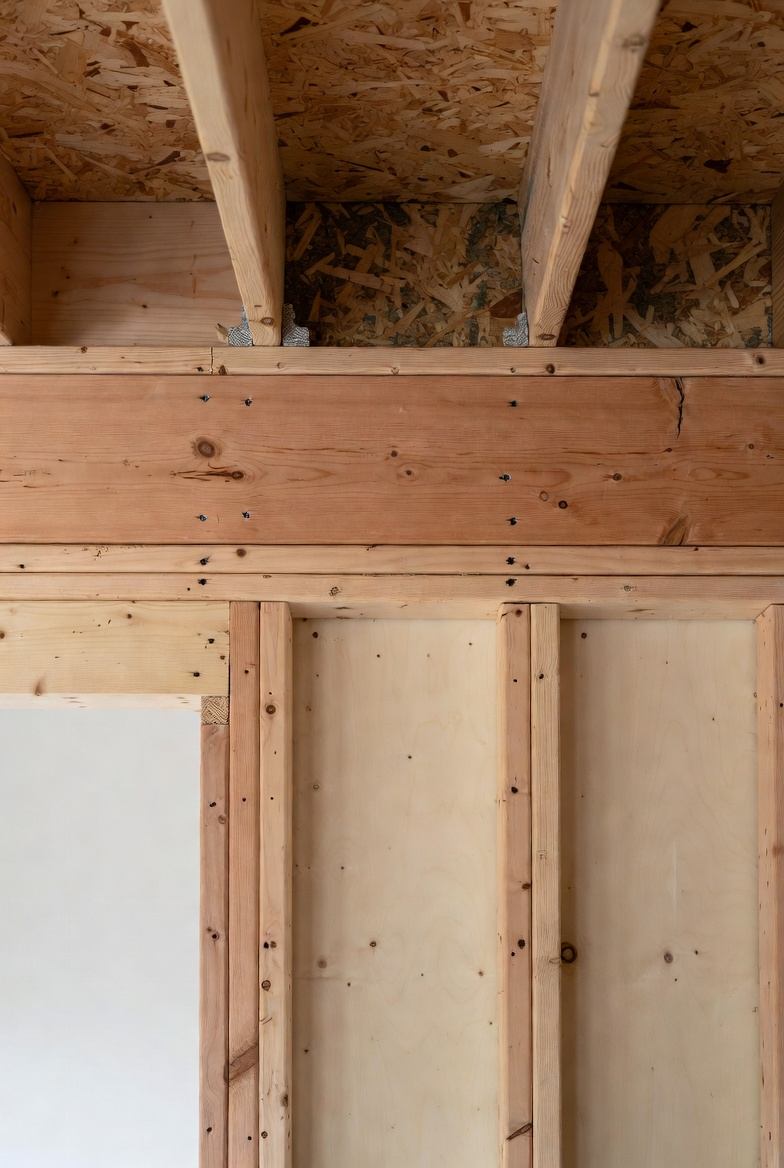
Floor joists can sometimes bear directly on a framed wall through the double top plate, transferring loads straight down into the stud wall below.
If joists run perpendicular and terminate on that wall (or hang off a header/beam that lands on it), that’s a bearing condition.
- What you need to see: joist ends sitting on the wall plate, or a beam/header that clearly transfers load to that wall.
- What fakes people out: joists that look “close” but actually bear on an adjacent beam, rim, or dropped girder.
- Where it bites: long openings (kitchen/living) where a “small” bearing wall was doing a lot of work.
Proof C: Beam and Posts Below
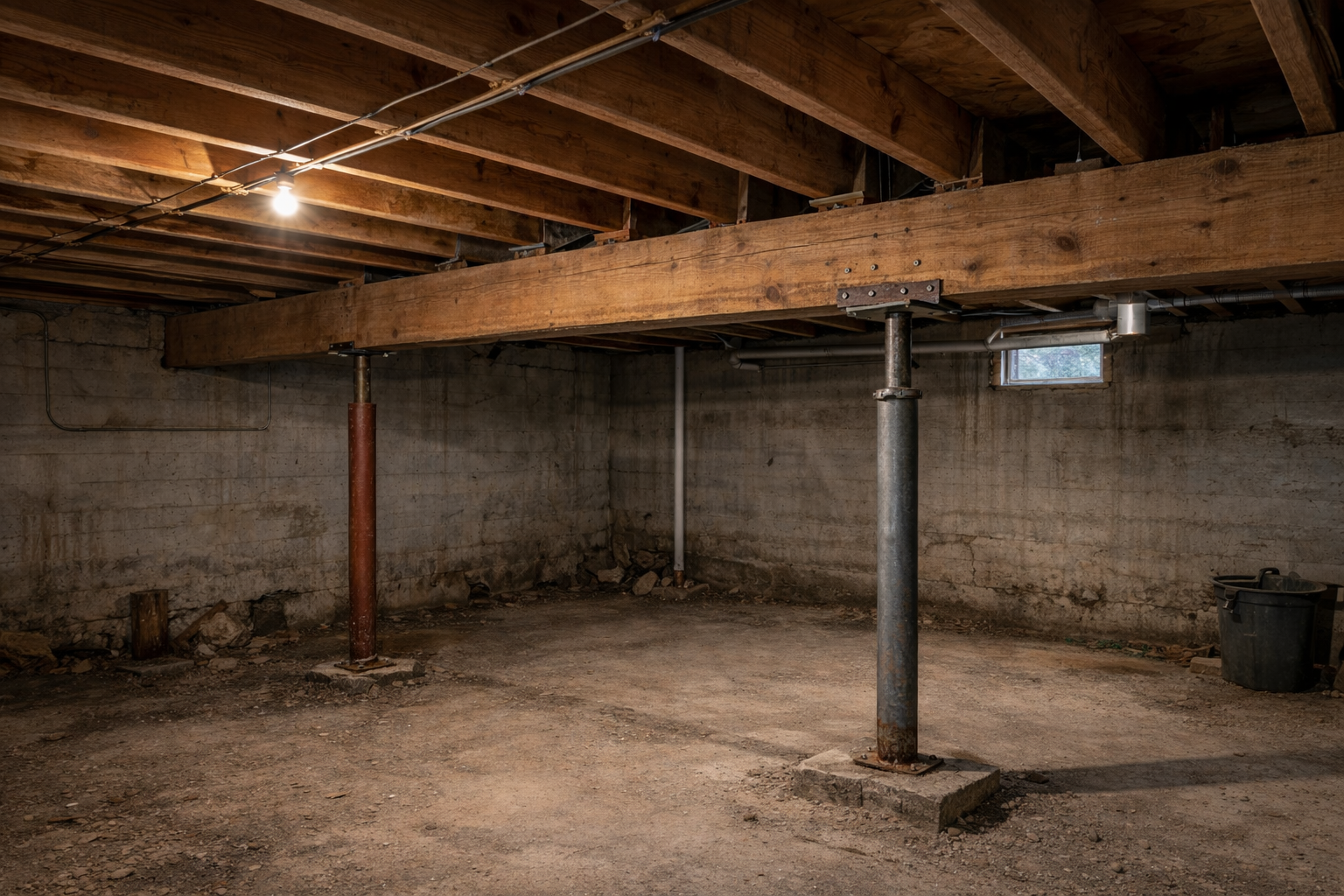
This is the basement/crawl proof. If there’s a main beam/girder and a line of posts directly under the wall line, that wall is usually part of the load path.
- What you need to see: a beam/post line that matches the wall location above (within reason; framing isn’t always laser-straight).
- What fakes people out: random lally columns added later, or a beam that supports something else but happens to run nearby.
- Timing reality: demo first, discover structure later, and you’ve already created movement you can’t undo.
If none of these can be confirmed cleanly (finished ceilings, no access, truss oddities), that’s not failure. It’s a stop point. A small inspection opening in a smart location or a short pro visit beats guessing.
Fast Checks With Minimal Damage
Start in the basement/crawl space, then the attic. That order saves time and prevents bad assumptions.
Check the Basement or Crawl Space
This is where the truth usually shows up. In a lot of houses, this is essentially Proof C.
- Look for: a beam, girder, or line of posts directly under the wall line.
- Why it matters: if a wall lands on a main beam or posts, it’s often carrying floor/roof loads.
- Timing reality: if you cut first and discover posts below later, cracks can show up same day, or after the first temperature swing.
Check the Attic or Roof Framing
Joist direction is a strong clue because joists typically bear on walls/beams at their ends. This is where Proof A and Proof B show up.
- Joists perpendicular to the wall: often bearing, especially if they terminate on that wall line.
- Joists parallel to the wall: often non-bearing, but still verify because a beam can run parallel and drop onto posts.
- Overlaps, splices, or a beam line above: treat as structural until confirmed.
Check for Stacked Walls
If a wall on the second floor sits directly over a wall on the first floor, that’s a classic load path. Same logic for a wall directly under a roof bearing point.
Check Openings and Headers
A header over a door/window can be structural, but it doesn’t automatically mean the whole wall is bearing. What matters is whether loads are landing on that header, and where the header is supported.
Use Plans If You Have Them
Original plans (or permit drawings) often show beams, posts, and joist directions. If you don’t have them, your local building department may have archived permit sets. Availability varies by jurisdiction.
Truss Roofs vs. Stick-Framed Roofs
Yes, this matters. It’s one of the reasons “my neighbor did it” advice goes sideways.
| What You’re Looking At | Common Pattern | What It Means for Walls | Where People Get Burned |
|---|---|---|---|
| Truss Roof (Many 1980s+ Homes) | Factory-built trusses spanning exterior walls; interior walls often just partitions. | Many interior walls are not carrying roof load, but some trusses create concentrated bearing points (girder trusses, special supports). | They assume “all interior walls are non-bearing,” remove one, and discover a girder/bearing point later. Cracks can show within days or after the first seasonal movement. |
| Stick-Framed Roof (Common in Older Homes) | Rafters/joists framed on site; loads may drop onto interior beams/walls depending on layout. | Interior bearing walls and beams are more common, especially where spans are broken up. | They rely only on “joists are parallel” and miss a beam line or post stack. Sag shows up as bounce first, then cracks. |
Non-U.S. note: framing conventions are broadly similar, but truss layouts, code language, and inspection expectations vary by jurisdiction. When in doubt, treat it as “varies” and verify locally.
Tools That Help Without Opening Walls
These don’t replace structural verification, but they reduce blind guessing when the ceiling is finished.
RECOMMENDED TOOL
A decent wall scanner saves you from random holes when you’re trying to confirm framing through drywall.
Search Zircon StudSensor e50 on Amazon
FIELD PICK
If you need deeper scan plus wire/metal detection, step up to a pro-grade scanner and use it slowly (multiple passes).
Search Bosch GMS120 on Amazon
Don’t Guess on These Cases
These are the stop points where a quick consult saves real money.
- You see a beam/post line below the wall and can’t confirm how it ties in.
- Trusses land on the wall in a way that looks “special” (girder truss, multiple plies, unusual web layout).
- The wall is near a stair opening, long span, or big opening (kitchen/living open-concept zones).
- You already have cracking, bounce, or doors that changed alignment (movement often shows up first at trim and door reveals).
If You Plan to Remove the Wall
In most U.S. jurisdictions, removing or altering a load-bearing wall is a permit/inspection situation. The usual sequence is: confirm load path → get an engineered header/beam spec if required → install temporary support → demo → install beam/posts → inspection → close up.
Cost ranges vary hard by span, finishes, and access. A quick engineer visit is often a few hundred dollars, while “we guessed wrong” repairs can run into five figures once drywall, flooring, and finishes get involved.
Related reading: load-bearing vs. non-load-bearing basics.
FAQ
Can I Confirm Load-Bearing Without Attic or Basement Access?
You can gather clues (scanner results, stacked walls, header locations), but “confirm” is harder without seeing framing. If access is blocked, that’s where a pro visit or a small inspection opening (in a smart location) often beats guessing.
Are Exterior Walls Always Load-Bearing?
In typical U.S. wood-framed houses, exterior walls are often load-bearing and almost always part of the lateral system. Treat exterior walls as structural until you verify otherwise.
If Joists Run Parallel to the Wall, Is It Non-Bearing?
Often, but not guaranteed. A beam can run parallel and still drop onto posts, and truss bearing points don’t always follow simple “parallel/perpendicular” rules. Verify the whole load path.
Do I Need a Permit to Remove a Load-Bearing Wall?
Usually yes for structural changes, but it varies by jurisdiction. Call your local building department before demo. It’s cheaper than redoing work after a failed inspection.
What’s the First Sign I Messed Up?
New cracks at ceiling/wall corners, doors that start rubbing, floor bounce, or trim gaps opening. Sometimes it’s immediate. Sometimes it shows after seasonal movement.
Do Truss Homes Mean Interior Walls Are Never Load-Bearing?
No. Many interior walls are partitions, but truss systems can create concentrated bearing points. If you can’t identify the truss type and supports, treat it as “needs verification.”
Final Notes
Don’t start with drywall. Start with the load path. Basement/crawl space, then attic, then plans/tools. If any part of the path is unclear, pause and get it confirmed before you create movement you can’t hide later.