
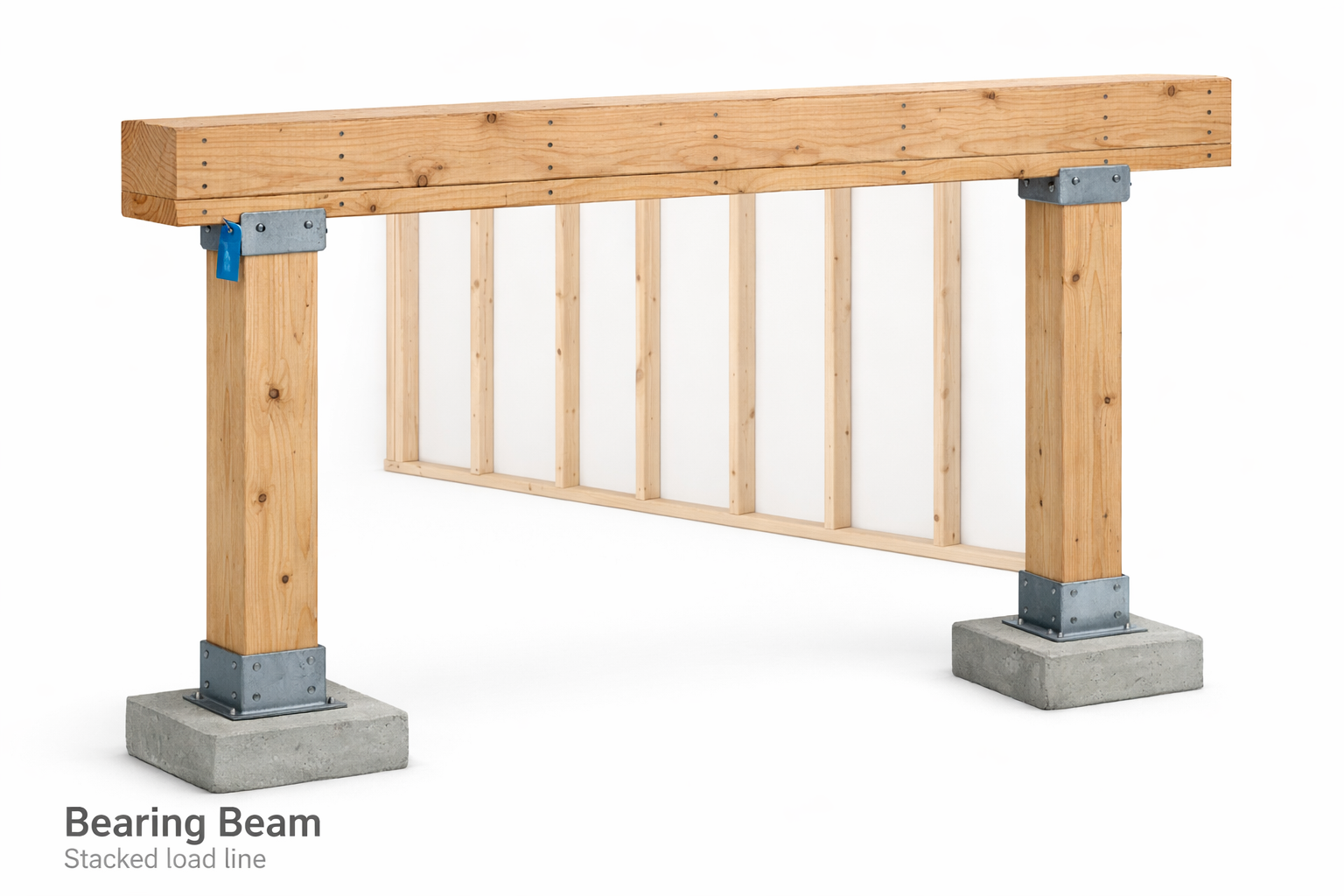
Two-story demos don’t fail like one-story demos. You can “get away with it” for a weekend, then Monday hits: a stairwell crack that wasn’t there, a bedroom door that starts rubbing, a ceiling line that looks a little tired. That’s the house telling you the load moved.
The goal is simple: prove the load path with the least mess possible, before you touch framing. In a two-story house, the wall you’re eyeing might be holding up the second floor, not the roof. Different clues. Higher cost if you’re wrong.
Start With This One Question
What sits directly above the wall?
If you have a wall upstairs (or a stair header, long hallway, or bathroom partition) that lines up over your first-floor wall, treat the first-floor wall as structural until you prove otherwise. Roof framing can be engineered to span exterior walls and still leave the second-floor system needing support in the middle.
If you want the quick refresher on what “bearing” actually means (and why “non-bearing” can still be complicated), keep this nearby: load-bearing vs. non-load-bearing walls.
The Three Proof Moves
Don’t collect ten weak hints. Pick one proof move you can actually verify in your house. These three cover most real two-story layouts.
Proof 1: A Wall Stacks Above
If a second-floor wall lands over the wall you want to remove, that’s a load path in plain sight. Frame carpentry is lazy in the best way: crews love stacking loads because it’s efficient.
- Count it as proof when: the upstairs wall tracks the same line closely (a few inches of drift happens; a foot-plus offset changes the game).
- Where people get fooled: closets and chase walls that “look aligned,” but the real load hops onto a beam or doubled joist line a few feet over.
Proof 2: Something Bears On It From Above
If second-floor joists terminate on that wall line, or a header/beam drops into studs/posts within that wall, it’s carrying load. This is the one that gets missed because finished ceilings hide the truth.
- Count it as proof when: you can see joist ends bearing on the top plate, or a beam/header landing on a built-up point in the wall.
- Where people get fooled: “joists run parallel, so it’s fine.” Parallel joists don’t stop a parallel beam from dumping load onto posts at two or three points.
Proof 3: A Beam or Post Line Sits Under It
Basement or crawlspace access is a gift. If there’s a main girder/beam and a line of posts/piers under the wall line, that wall is commonly part of the load path.
- Count it as proof when: the beam/post line tracks the wall location above (use a tape from a foundation wall to match the line).
- Where people get fooled: a “mystery post” added later that supports a different beam, or a post that was installed to patch a sag without fixing the real load path.
If you can’t confirm any of those cleanly, that’s not a failure. That’s a stop sign. A small inspection opening in the right spot or a short engineer visit is cheaper than chasing cracks and doors later.
Where To Look First
Basement Or Crawlspace
This is the fastest truth source in a two-story house. Bring a flashlight and a tape. Pick one fixed reference (foundation wall, chimney, plumbing stack) and measure.
- Look for: a main girder (built-up lumber, LVL, steel) running across the house.
- Look for: posts/piers under that girder, especially mid-span and near large openings.
- Fast check: measure the wall location from a foundation wall above, then measure that same offset below and see what structure sits on that line.
Slab-on-grade homes take this advantage away. In slab houses, your “proof” is usually stacked walls upstairs or ceiling/framing checks.
Second Floor Walkthrough
Walk the rooms directly above the wall line and call out the heavy zones:
- Stairs: stair openings create doubled joists and headers. Walls near stairs are often doing more than they look like.
- Bathrooms: tubs, tile, and wet-wall framing concentrate loads and tend to sit near bearing lines.
- Hallways: long straight partitions are frequently used as a bearing line because they’re easy to frame and easy to stack.
Two-Story Failure Patterns You See in Real Houses
These are the scenarios that show up over and over in remodels and inspections. If you recognize one, slow down.
The Stair Surprise
A homeowner removes a first-floor wall near the stairs because “it doesn’t support the roof.” The stair header and doubled joist package above was relying on that wall line for bearing at one end. The first sign isn’t collapse. It’s a hairline crack running out of the stair corner, then a door upstairs that starts rubbing in humid weather.
The Offset Wall Trick
Upstairs wall is offset 12–24 in. from the wall below, so it “must be fine.” Sometimes the load transfers through a short beam or a doubled joist line that lands right where you’re about to demo. You don’t see it until you open the ceiling or trace the beam ends in the basement.
The “Why Is There a Post Here?” Basement
One lonely lally column sits near your target wall, no matching post line, no obvious reason. That can mean someone tried to fix a sag after the fact. It can also mean the load path was altered in a previous remodel and nobody documented it. Either way: treat it as a red flag, not a decoration.
The Old Remodel Patch
Look for clues like: patched soffits, weird bulkheads, mismatched flooring, or a beam wrap that doesn’t line up with anything. Houses remember old work. If something looks “off,” assume structure was changed and verify before you add another change on top.
What Not To Rely On
These are useful as hints, but they’re not decision-makers by themselves.
- “It’s an interior wall, so it’s non-bearing.” Two-story houses routinely use interior lines to carry second-floor loads.
- “Joists run parallel, so it’s safe.” Parallel doesn’t rule out beams, headers, or point loads landing on that wall.
- “There’s a header, so the whole wall is bearing.” A header can be a local condition around an opening, not proof of the entire wall line.
- “The attic says it’s fine.” The attic tells you roof load path. In two stories, the floor system is often the real issue.
If your situation is “finished ceilings, no access, lots of unknowns,” use the low-damage workflow here: check a load-bearing wall without removing drywall.
When To Stop and Bring In Help
Two-story houses have more ways to hide load transfer. If any of these are true, pause.
- You see a beam/post condition below but can’t confirm what it supports.
- The wall is near the stairs, a long hallway, or a large open area you’re trying to create.
- You see evidence of a previous remodel (patched framing, mystery posts, wrapped beams, weird offsets).
- You already have movement: cracks, bounce, doors that changed alignment, trim gaps opening.
If you need a simple load/stress primer before talking to a pro, this one makes the conversation cleaner: structural support basics.
If You’re Removing the Wall
In most U.S. jurisdictions, removing or altering a load-bearing wall triggers permits and inspections. The order that avoids regret is usually:
- Prove the load path (stacked wall, bearing from above, or structure below).
- Confirm what loads are involved (second floor, roof, point loads at stairs/headers).
- Get a beam/header design if required (engineer or qualified designer where allowed).
- Install temporary support before demo.
- Demo and install the new beam/posts/bearing exactly as specified.
- Inspection (where required), then close up.
If you’re actually dealing with attic-only questions, use the attic-specific page instead: spot load-bearing walls from the attic.
FAQ
Are Exterior Walls Always Load-Bearing in Two-Story Houses?
In typical U.S. wood-framed construction, exterior walls are often load-bearing and commonly part of the lateral system. Treat exterior walls as structural unless you have documentation proving otherwise.
If There’s a Wall Upstairs, Does That Automatically Make the Wall Below Load-Bearing?
Often, yes. But offsets and transfers exist. If the wall above is noticeably offset, loads may transfer through a beam or doubled joist line. Verify before you commit to demo.
Do Trusses Mean Interior Walls Aren’t Load-Bearing?
No. Truss roofs can create concentrated bearing points (girder trusses, special supports), and independent of the roof, the second-floor framing may still need support below.
What’s the First Sign You Got It Wrong?
Cracks at ceiling corners, doors upstairs that start rubbing, floor bounce near the opening, trim gaps that open up. Sometimes immediate, often after weather load or seasonal movement.
Can I Confirm Load-Bearing Without Opening Anything?
You can get close if you have basement/crawl access and a clean stacked-wall situation. If everything is finished and hidden, true confirmation often requires plans, a small inspection opening in a smart spot, or a pro visit.
- What To Do Next
In a two-story house, stop thinking “roof” first. Think “second floor.” Prove one clean load path, then act. If the proof isn’t clean, don’t force it. Movement is expensive, and it tends to show up upstairs where you can’t hide it.
Single-Story Homes: Spot a Load-Bearing Wall Before You Demo