
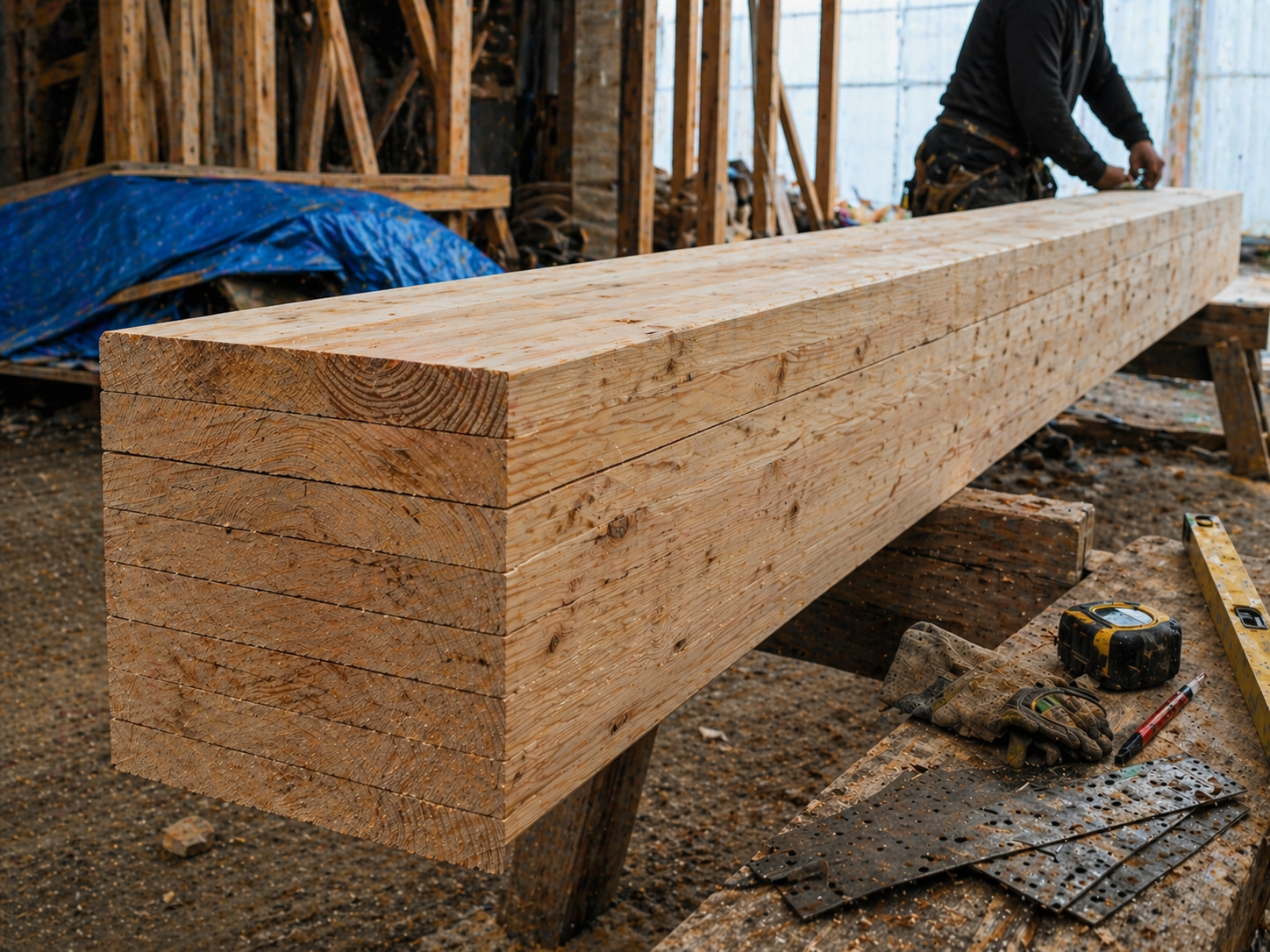
Image by ArchitectureCourses.org. A glulam beam is built from bonded wood laminations, giving it more predictable size, strength, and stability than a single sawn timber.
Glulam beams show up when regular lumber runs out of room.
People usually look them up because they are comparing beam sizes, prices, LVL, steel, or a ridge beam for a roof. Those are related questions, but they are not the same decision.
A normal 2x10, 2x12, or built-up wood beam can handle plenty of small residential jobs. But longer spans, open rooms, roof loads, vaulted ceilings, and exposed timber details can push regular framing past its useful limit. That is where glulam starts to make sense.
A glulam beam is made from layers of wood glued together so the grain runs along the length of the beam. Instead of cutting one huge timber from one tree, the beam is built from smaller boards. That gives the manufacturer more control over strength, size, appearance, and consistency.
If you have seen a large exposed wood beam in a modern house, a timber roof, a porch structure, or a public building with curved wood arches, there is a good chance it was glulam.
What glulam means
Glulam stands for glued laminated timber.
The beam is made from wood laminations bonded together with structural adhesive. The laminations run in the same direction, so the finished member acts like one long structural beam, not like plywood or a panel product.
That grain direction matters. Glulam is meant to carry loads along a span. It can be used as a beam, post, ridge member, arch, rafter, or other structural timber element depending on the design.
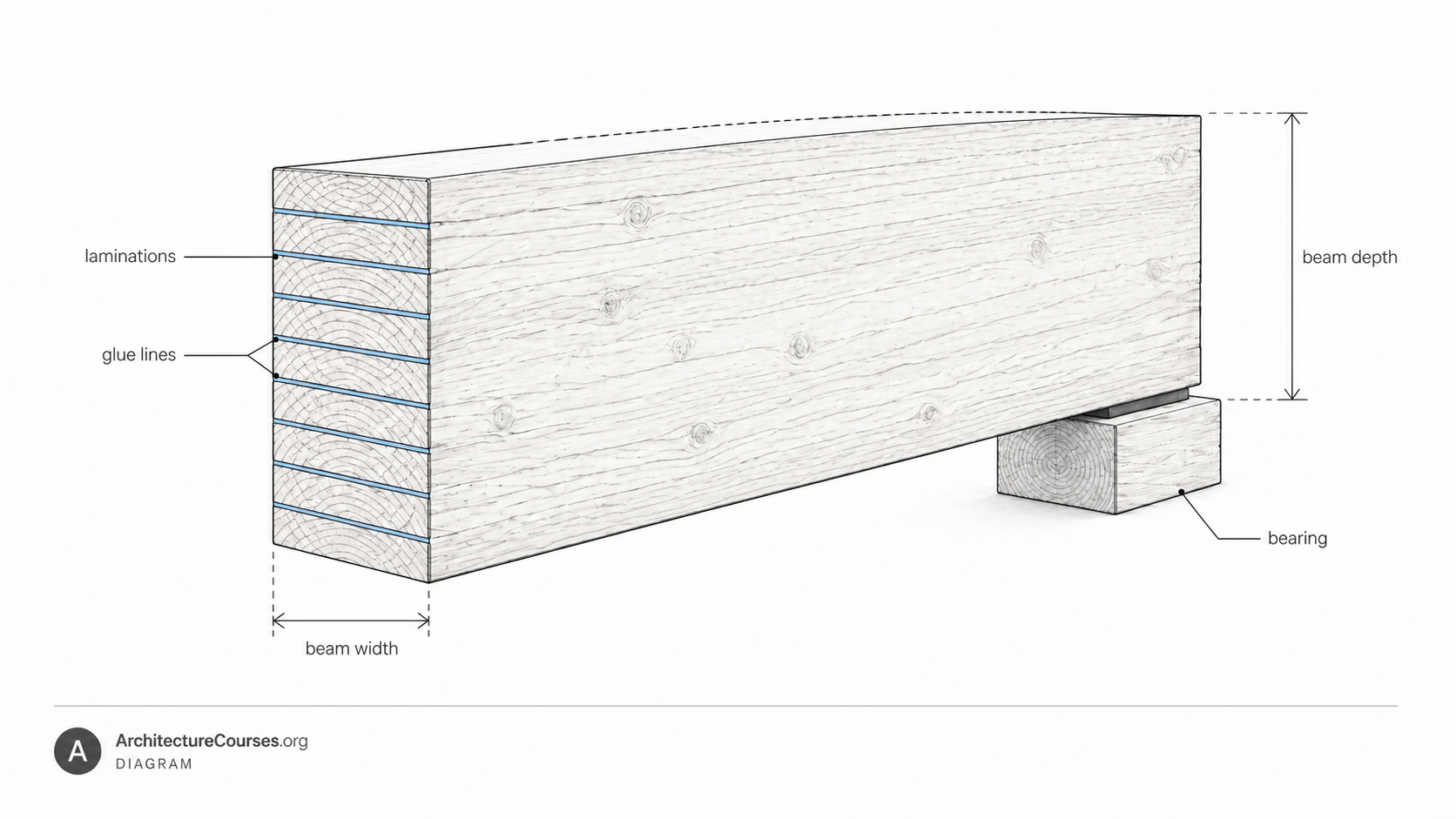
Illustration by ArchitectureCourses.org. This glulam beam cutaway shows the stacked wood laminations, thin glue-line rhythm, beam depth, beam width, and bearing support.
Why not just use solid timber?
Large solid timbers are beautiful, but they are not always practical.
Big solid beams can check, twist, shrink, or vary a lot from one piece to another. They also depend on large trees, which are harder to source consistently. Glulam gets around part of that problem by building the beam from smaller pieces of lumber.
That does not make glulam magic. It still behaves like wood. It still needs protection from water. It still needs proper bearing. It still needs an engineer when it is carrying real building loads.
But compared with a random large timber, glulam is usually more predictable.
Where glulam beams make sense
| Use | Why glulam helps | Watch for this |
|---|---|---|
| Open living spaces | Can span farther than ordinary framing lumber. | The load still needs posts, footings, or walls below. |
| Vaulted roofs | Works well as a structural ridge beam or exposed roof member. | A ridge beam is not the same as a ridge board. |
| Porches and covered outdoor areas | Gives a strong timber look with fewer posts. | Exterior detailing matters. Water sitting on the beam is trouble. |
| Post-and-beam homes | Can be part of a visible timber frame system. | Connections should look clean and actually carry load. |
| Curved or arched roof forms | Can be fabricated into shapes solid timber cannot easily make. | Curved beams are custom work and cost more. |
Glulam earns its keep in places where strength, span, and appearance all matter at the same time. If the beam is going to be buried inside a wall and never seen again, there may be cheaper or simpler options. If the beam is part of the room, the roof, or the architectural character of the building, glulam becomes more interesting.
The beam is only part of the job
This is where homeowners get misled.
They ask, “What size glulam beam do I need?” or “How much does a 20-foot glulam cost?” Those are fair questions, but they are not enough.
A beam does not work by itself. It needs something solid to sit on. It needs enough bearing at each end. It needs posts or walls below it that can carry the load down to the foundation. If the beam lands on weak framing, a thin slab, or a post with no real footing below, the strong beam did not fix the problem.
That is why beam replacement, open-concept remodeling, and vaulted roof work usually need structural help, not just a shopping list.
For basic framing context, see house framing and load-bearing vs non-load-bearing walls.
Glulam vs LVL, solid timber, and steel
Glulam gets mixed up with other beam materials all the time.
LVL is made from thin wood veneers. It is common in hidden structural work: headers, floor beams, wall openings, and places where the beam will be covered by drywall.
Glulam is made from thicker lumber laminations. It is often chosen when the beam will be exposed, when the timber look matters, or when the project needs a large wood member with architectural presence.
Solid timber is different again. It can look great, especially in older or rustic work, but large pieces can be harder to source and less predictable. Steel is the other major option. It can carry heavy loads with less depth, which matters when headroom is tight, but it brings different connection, fireproofing, lifting, and finishing problems.
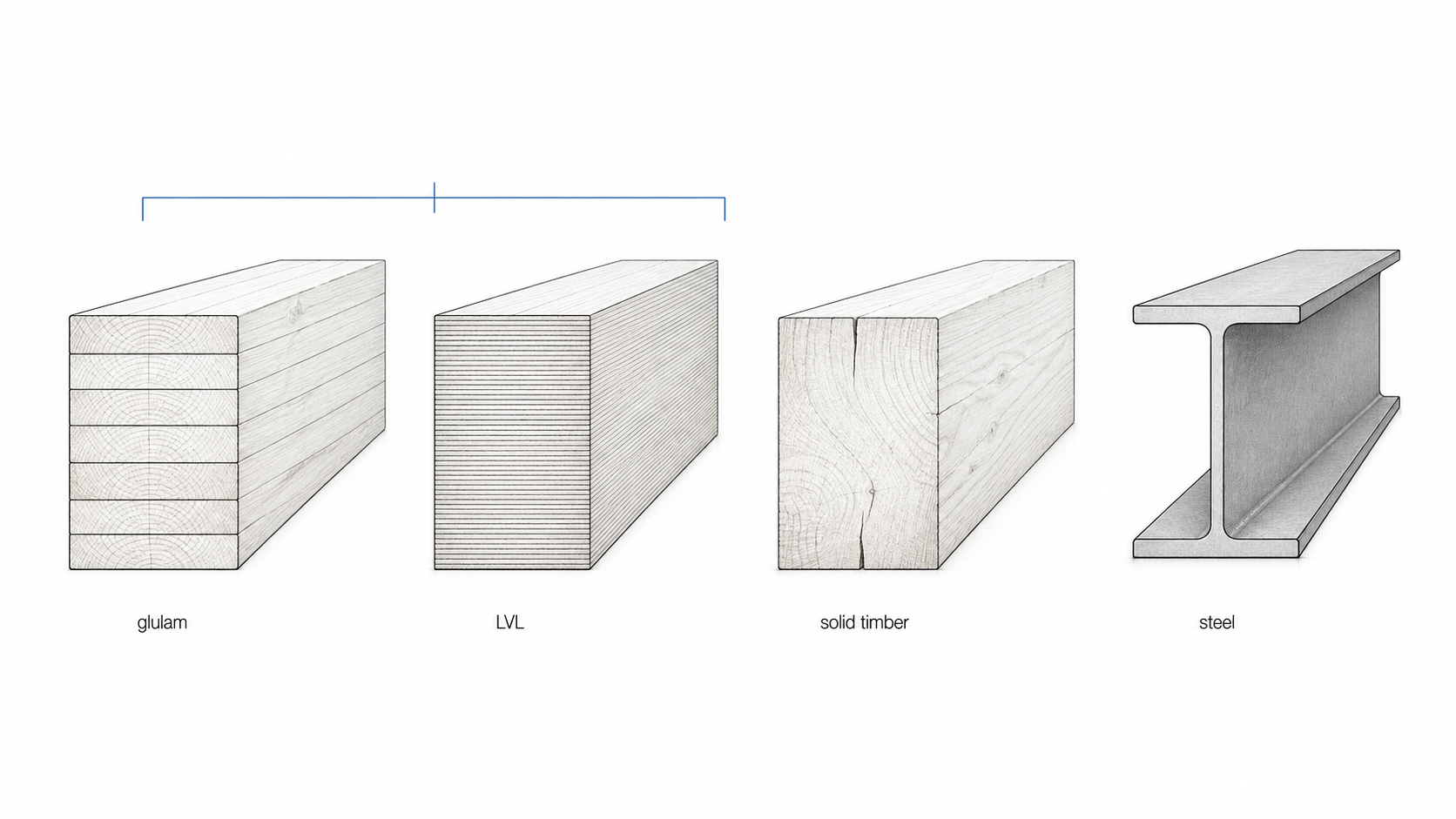
Illustration by ArchitectureCourses.org. Glulam, LVL, solid timber, and steel beams use different material logic, even when the basic beam shape looks similar.
In simple terms: LVL is often the practical hidden beam. Glulam is often the visible timber beam. Steel is often the headroom beam.
That is not a rule. Engineers may choose any of them depending on the span, load, depth limit, cost, exposure, and availability.
For the material side, start with wood moisture content and movement. That explains why even engineered wood still needs dry storage and careful detailing.
Glulam in roofs
Roof framing is one of the best places to understand glulam.
A glulam ridge beam can carry roof loads in a vaulted ceiling where rafter ties are missing or where the ceiling is open to the roof slope. That is different from a ridge board, which mainly gives rafters something to meet against during framing.
The difference matters. A structural ridge beam needs a load path. Posts below. Support at each end. Sometimes footings or foundation work. You cannot just install a large piece of wood at the top of the roof and assume it solved the thrust problem.
If you are comparing roof systems, start with ridge beams, rafter ties vs collar ties, and roof structures.
What glulam beam size actually means
Most people start with length: 16 feet, 20 feet, 24 feet. That is normal. Length is easy to picture.
But length is not the whole answer.
Beam depth usually matters more than people expect. A deeper beam is often better at resisting bending than a shallow one, though the real answer still depends on load, grade, span, deflection limits, and the exact product being used.
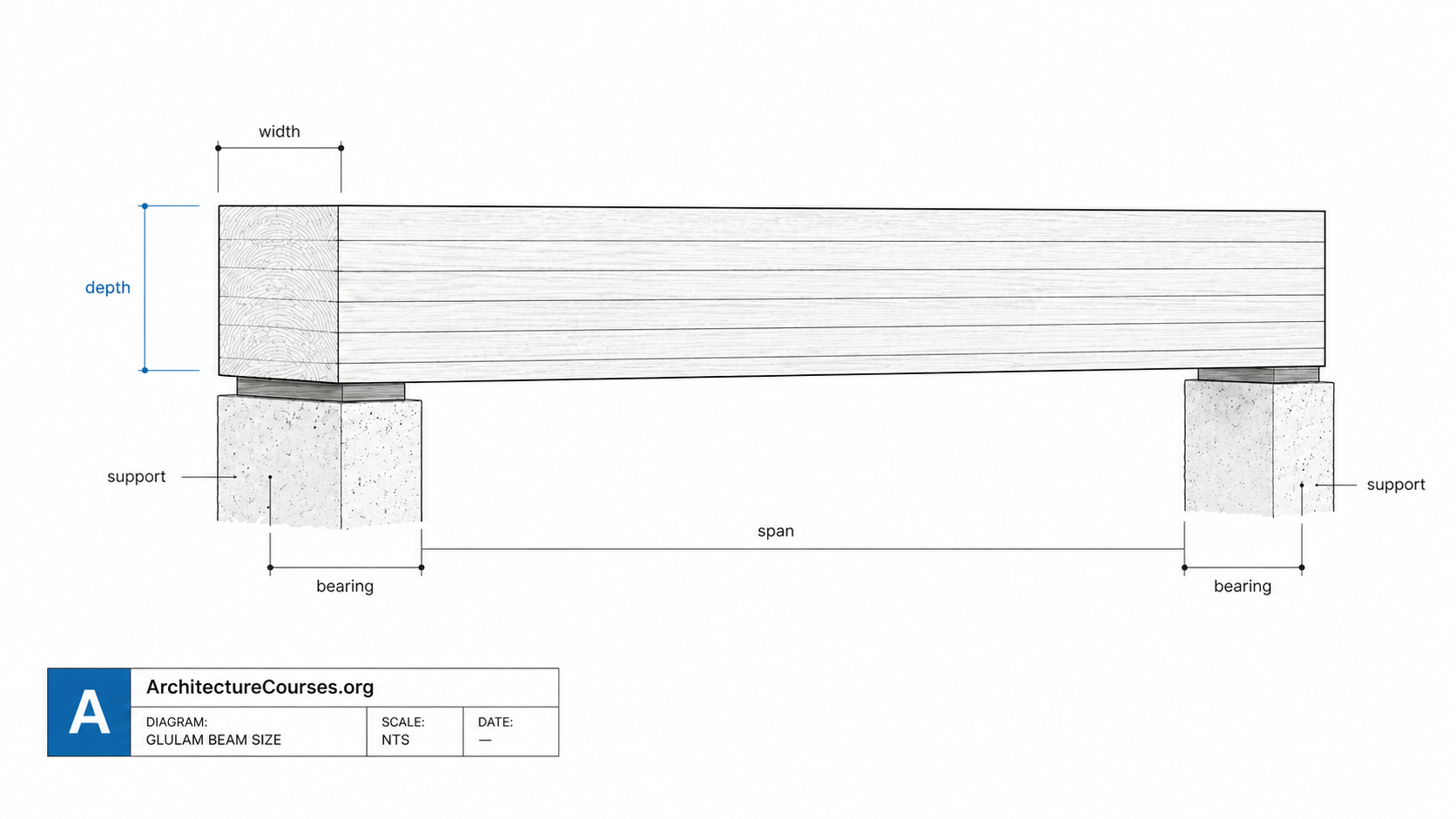
Illustration by ArchitectureCourses.org. Glulam beam size is described by width, depth, span, and bearing length, with visible laminations showing how the beam is built up.
Width matters too, but not always in the way homeowners assume. Wider can help with bearing and connection layout, but depth often controls the beam’s ability to span without sagging too much. That is one reason two beams with the same length can behave very differently.
A 20-foot glulam over a light porch roof is not the same as a 20-foot glulam carrying a second floor and part of the roof. Same length. Completely different job.
For the basic structural side, see types of loads in structural design and how to analyze beams.
What affects glulam beam size
| Factor | Why it matters |
|---|---|
| Span | The longer the beam reaches between supports, the harder it works. |
| Load | Floor load, roof load, snow load, and point loads change the beam design. |
| Beam depth | Depth often controls bending strength and deflection. |
| Bearing length | The beam needs enough solid support at each end. |
| Grade and species | Not all glulam products have the same structural rating. |
| Exposure | Interior, covered exterior, and fully exposed conditions are different problems. |
This is where online shortcuts can get dangerous. A span chart without the loading assumptions is not enough. A lumberyard can help with product options, but the structural design still has to match the actual house.
Interior glulam vs exterior glulam
Interior glulam is easier. Keep it dry, detail the connections properly, and protect it during construction.
Exterior glulam is less forgiving.
A beam under a deep roof overhang is not the same as a beam sitting fully exposed to rain, snow, sun, and wet end grain. Water is the real problem. It gets into the top face, sits around steel plates, collects in beam pockets, or enters through unsealed cuts.
Exterior glulam needs the right treatment, finish, cap, flashing, drainage, and connector detailing. If those are ignored, the beam may look fine for a while and still be taking damage where nobody checks.
For related moisture and building-envelope thinking, see home moisture, leaks, and water damage and roof-wall connections.
Before you order a glulam beam
Do not start with “I need a 20-foot beam.” Start with what the beam has to do.
A lumberyard or supplier will usually need more than length. They may ask for the span, load, use, exposure, grade, appearance requirement, and whether the beam is stock or custom. If the beam is structural, the clean answer usually comes from an engineer or a stamped beam schedule.
| Question | Why it matters |
|---|---|
| Will the beam be exposed? | Appearance grade may matter if it stays visible. |
| Is it indoors or outdoors? | Treatment, finish, connectors, and detailing may change. |
| What supports each end? | A strong beam still fails the job if bearing and posts are wrong. |
| Is headroom limited? | Steel or LVL may be better if the beam must stay shallow. |
| Can it be delivered and lifted? | Long beams create access, handling, and labor problems. |
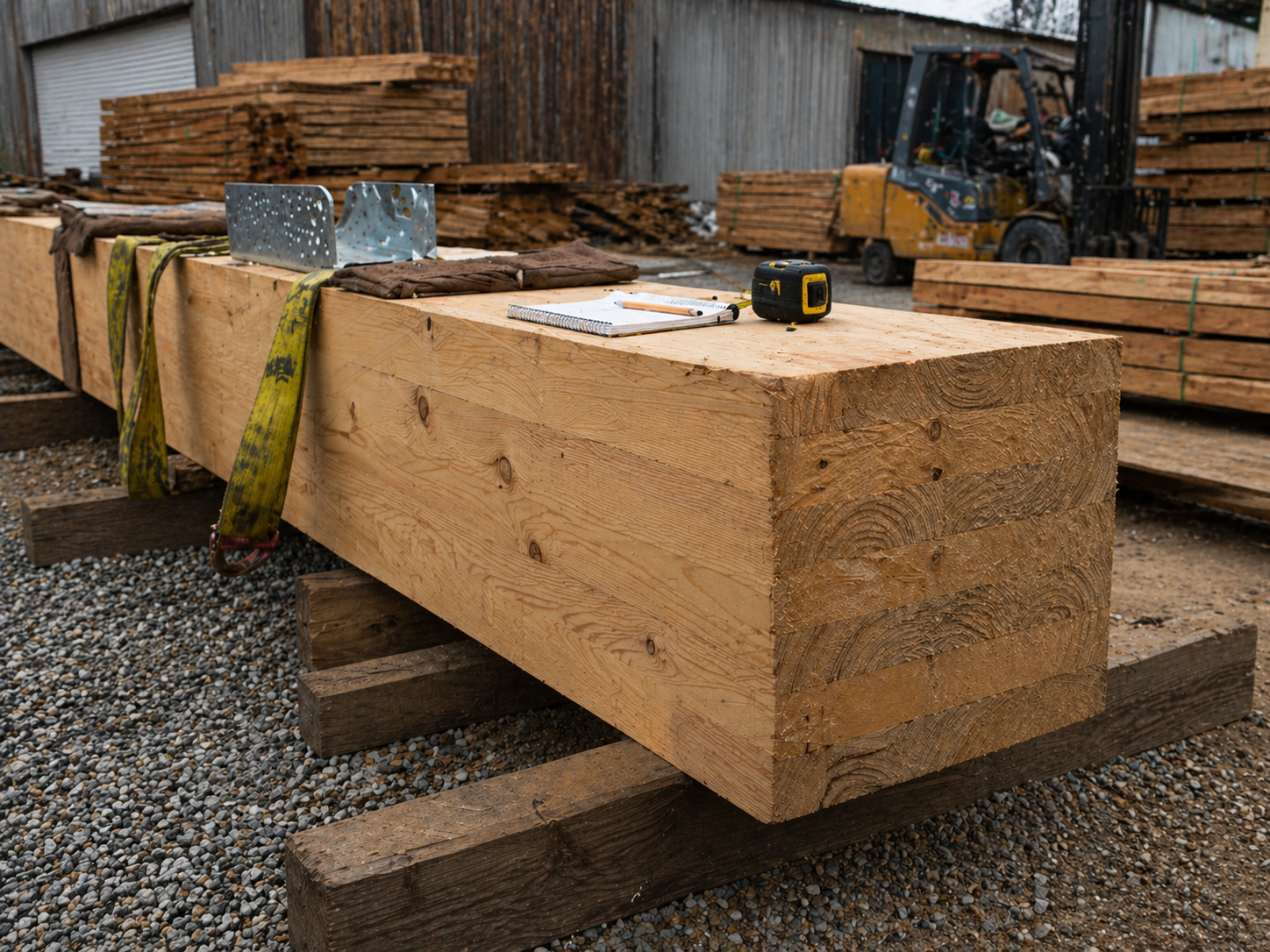
Image by ArchitectureCourses.org. Ordering a glulam beam usually involves more than the beam itself: delivery, hardware, lifting, treatment, and installation can change the real cost.
For bigger renovation work, the beam price may not be the main cost. Temporary shoring, cutting finishes, building posts, adding footings, and repairing the room after the beam is installed can cost more than the beam.
Common mistakes
The biggest mistake is treating the beam like the whole solution.
It is not.
The beam, posts, connectors, bearing points, lateral restraint, and foundation path all have to work together. A glulam beam can be perfectly strong on paper and still be badly installed.
Other mistakes are more ordinary: storing the beam in wet conditions, cutting or drilling it without approval, leaving exterior end grain exposed, using the wrong fasteners with treated material, or hiding a bad connection behind trim.
Most of these are not dramatic mistakes. They are small decisions that slowly ruin the job.
Glulam beam cost
The beam price is only one part of the cost.
Size matters. So do grade, appearance quality, treatment, delivery, hardware, engineering, lifting, and installation. A clean exposed beam in a finished room costs differently from a hidden beam inside a wall. A treated exterior beam costs differently from an interior stock beam. A curved glulam beam is a different conversation again.
For a renovation, the expensive part may not be the beam at all. It may be temporary shoring, opening the ceiling, building posts, cutting finishes, adding footings, or repairing everything after the beam is in.
This is why a simple “glulam beam price list” rarely tells the whole truth.
Curved and architectural glulam
One of glulam’s best uses is shape.
Because the beam is made from thinner laminations, it can be fabricated into curved or arched forms. That is hard to do with one large solid timber. This is why glulam shows up in churches, schools, public halls, long-span roof structures, and buildings where the structure is meant to be seen.
Curved glulam is not usually a cheap shortcut. It is custom work. The shape, radius, connection design, transport, and installation all matter. But when the structure and the architecture need to be the same thing, it can be the right material.
When glulam is too much
Glulam is not automatically better because it sounds engineered.
For short spans, regular lumber may be enough. For hidden beams, LVL may be cheaper and easier to frame around. For tight headroom, steel may do the job with less depth.
Glulam makes the most sense when one of these is true:
- the span is too long for ordinary lumber
- the beam will stay exposed
- the design needs a timber look
- the roof or room needs a cleaner open structure
- the project needs a curved or arched wood member
If none of those apply, glulam may still work, but it may not be the smartest buy.
What to know before you choose one
Glulam beams make sense when regular lumber cannot give you the span, strength, shape, or exposed timber character you need.
They are strong, useful, and often beautiful. But they are still structural members, not decorative lumber. The beam has to be sized properly, supported properly, protected from water, and connected into a real load path.
Get the load path wrong and the beam size barely matters.