
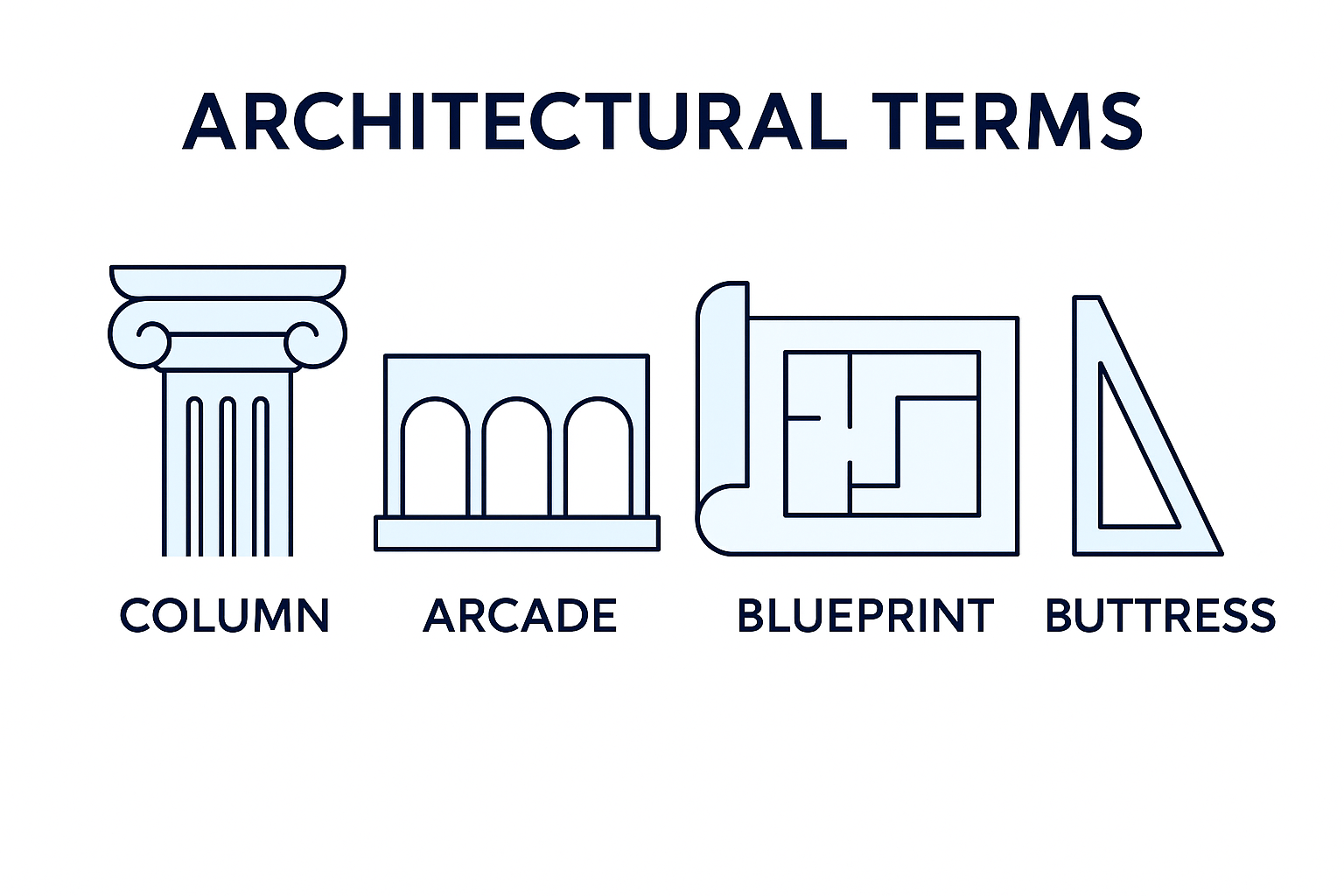
The Most Useful Architectural Terms Every Designer Should Know
Stop fumbling for words. If you want to design, draw, or explain architecture clearly, you need the right vocabulary.
Why These Terms Actually Matter
Architectural terms aren’t fluff — they’re tools.
You’re not just talking pretty. You’re describing how a space works, how a structure holds, how a building breathes.
● Writing a proposal? These terms make it sound like you know what you're doing.
● Teaching a concept? You need words that hit.
● On a site or sketching? Clear words avoid expensive mistakes.
This isn’t some bloated glossary. This is a real-world list of architectural terms that actually show up on drawings, plans, specs, and job sites.
When you speak the same language as engineers, builders, and clients — your ideas move faster and get taken seriously.
➡️ MUST READ:
The Language of Architecture by Andrea Simitch & Val Warke
Clean breakdown of key terms, concepts, and design elements — with diagrams and examples.
What Do Architects Mean When They Say That? Key Terms Decoded
Architecture Jargon Made Easy: Architecture Words A-Z
Why Architectural Terms Are Important
-
Clarity: You need clear words to describe form, space, structure, and function — especially on drawings and plans.
-
Speed: Knowing the term for a feature (like a lintel or clerestory) saves you paragraphs of explanation.
-
Accuracy: The wrong word leads to wrong materials, dimensions, or expectations — especially in construction.
-
Respect: Clients, collaborators, and builders trust you more when you speak the language fluently.
-
Documentation: All legal drawings and specs use these terms. If you don’t know them, you miss important details.
Confused by Design Talk? Here Are the Terms That Matter
Do You Have to Know Every Term?

No — but you should know the most common ones in your field, plus the terms that directly relate to your work (design, drafting, restoration, teaching, etc.).
Don’t try to memorize an entire glossary. Instead:
-
Master the core 20–30 terms that come up in every project.
-
Know your style-specific vocabulary (e.g., Gothic, Neoclassical, Modernist).
-
Learn as you work — look up and apply terms when needed.
Essential Architecture Vocabulary for Students, Builders & Curious Minds
Top 10 Architectural Terms Every Designer Should Know
These are essential across all types of architecture, from residential to public spaces.
-
Plan – A horizontal drawing showing room layout and structure.
-
Elevation – A flat drawing of a building’s façade.
-
Section – A cut-through drawing showing internal layers.
-
Facade – The front face of a building.
-
Column – A vertical structural element.
-
Beam – A horizontal support.
-
Lintel – A beam over a door or window.
-
Clerestory – High windows above eye level to bring in light.
-
Vault – An arched form used to provide space with a ceiling or roof.
-
Cantilever – A projecting structure supported only on one end.
Top 20 Terms (Including Materials and Style-Specific Vocabulary)
In addition to the top 10 above, every architect should also know:
-
Cornice – The uppermost projection of a wall or roof.
-
Truss – A framework for supporting roofs or bridges.
-
Buttress – A support built against a wall.
-
Pilaster – A shallow, rectangular column projecting from a wall.
-
Entablature – Horizontal structure above columns (architrave, frieze, cornice).
-
Pediment – A triangular gable above a doorway or façade.
-
Atrium – An open central court in a building.
-
Portico – A covered entrance supported by columns.
-
Cupola – A dome-like feature placed on top of a roof.
-
Eave – The edge of a roof that overhangs the wall.
Best-Selling Architecture Terms Book
A Visual Dictionary of Architecture by Francis D.K. Ching – A must-have reference for anyone in architecture. Clear visuals paired with concise definitions make it easy to grasp complex terms quickly.
Architectural vocabulary doesn't have to be complicated. We’ve simplified the most important terms so you can understand design like a pro.
Complete Architectural Terms Glossary (Organized by Function)
Modern Architectural Terms with Pictures
Image guide to modern architectural terms, featuring clear photos and visual explanations of key design elements
This guide brings together every essential architectural term, categorized for easier understanding. It’s not alphabetized — instead, it's grouped by concept and real-world application, making it easier to learn, remember, and use.
Terms marked with ★ are especially common or critical for design, construction, or communication.
The Illustrated Architecture Dictionary
100+ Architectural Terms and Drawings
I. Foundational Architectural Terms
Purpose: Core language every architecture student or practitioner should know.
- Architecture★ – The art and science of designing and constructing buildings.
- Architect★ – A professional who plans and oversees the building process.
- Blueprint – A detailed technical drawing used in construction.
- Facade★ – The front face of a building, often designed to be impressive.
- Elevation★ – A flat drawing of one vertical side of a building.
- Plan★ – A horizontal layout drawing (floor plan).
- Scale – The proportional ratio of a drawing to the actual building.
II. Classical & Historical Architecture Terms
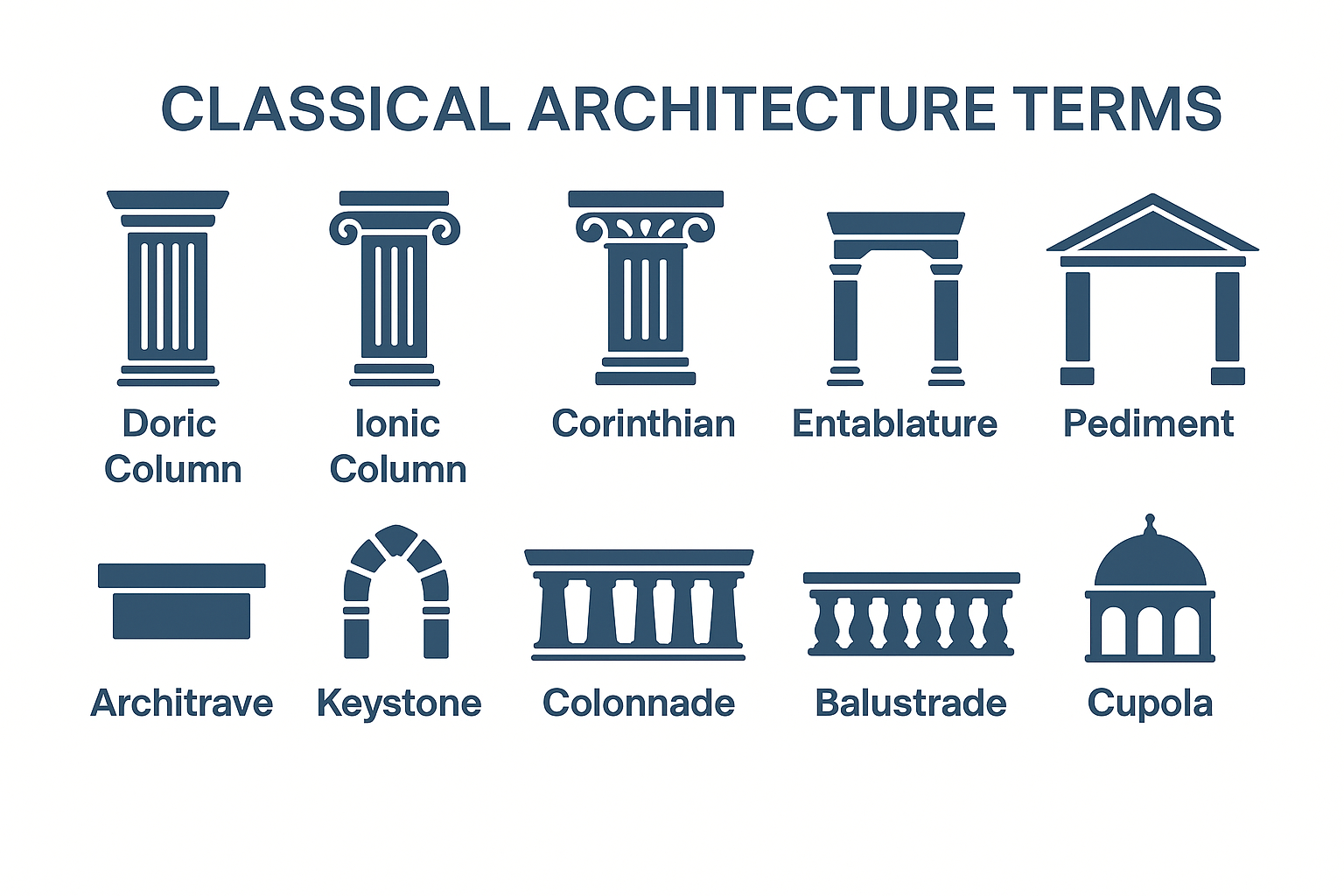
IMAGE: Essential classical architecture terms like columns, entablatures, and pediments, illustrating principles of Greco-Roman architectural design.
Purpose: Understanding forms and features from ancient Greek, Roman, and classical revivals.
- Doric Column★ – Simple, heavy column without a base.
- Ionic Column – Features scroll-shaped volutes.
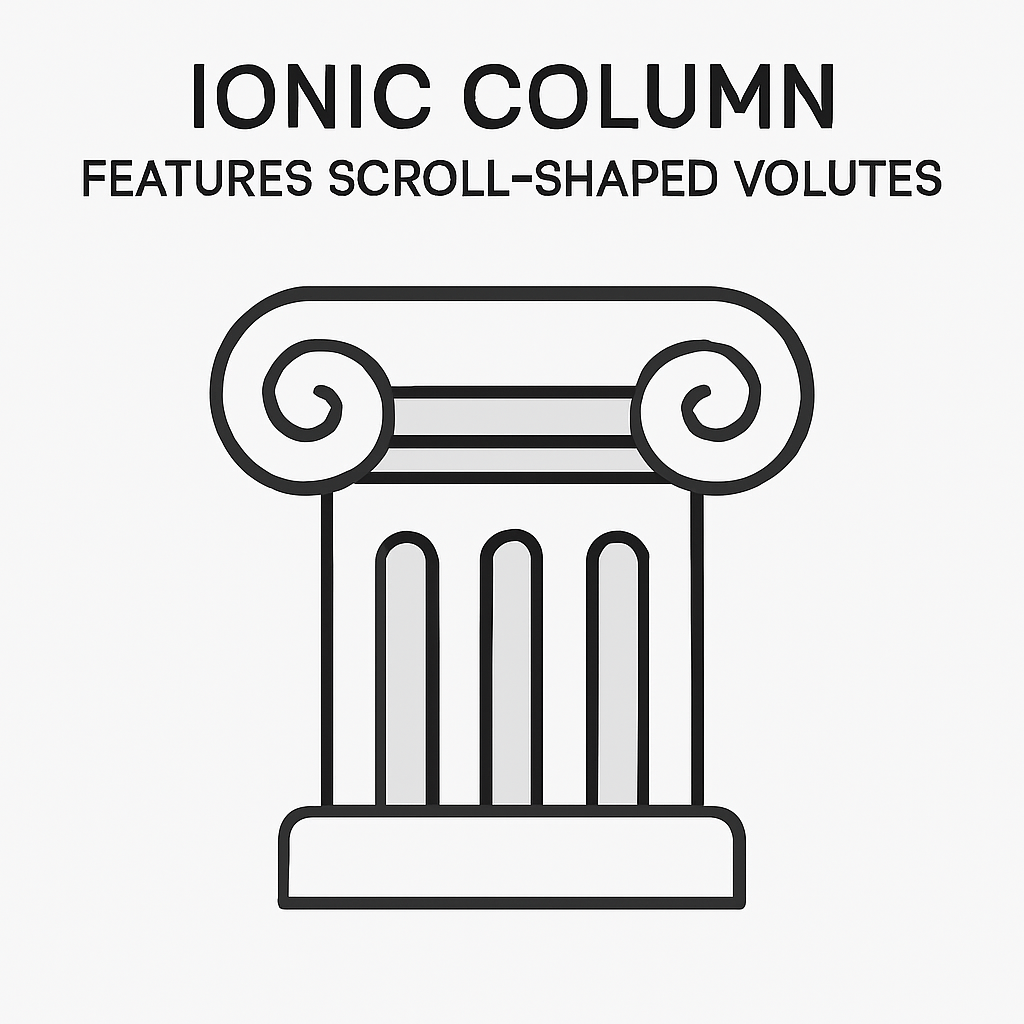
Image: Educational diagram of an Ionic column, highlighting its distinctive scroll-shaped volutes and elegant classical design elements.
- Corinthian Column – Ornate, with acanthus leaf capitals.
- Entablature – A horizontal structure above columns (architrave, frieze, cornice).
- Pediment★ – A triangular element above entrances or porticos.
- Architrave – The lowest band of the entablature.
- Keystone – The wedge-shaped top stone of an arch.
- Colonnade – A row of supporting columns.
- Balustrade – A railing with vertical supports (balusters), seen on balconies.
- Cupola – A small dome-like roof structure.
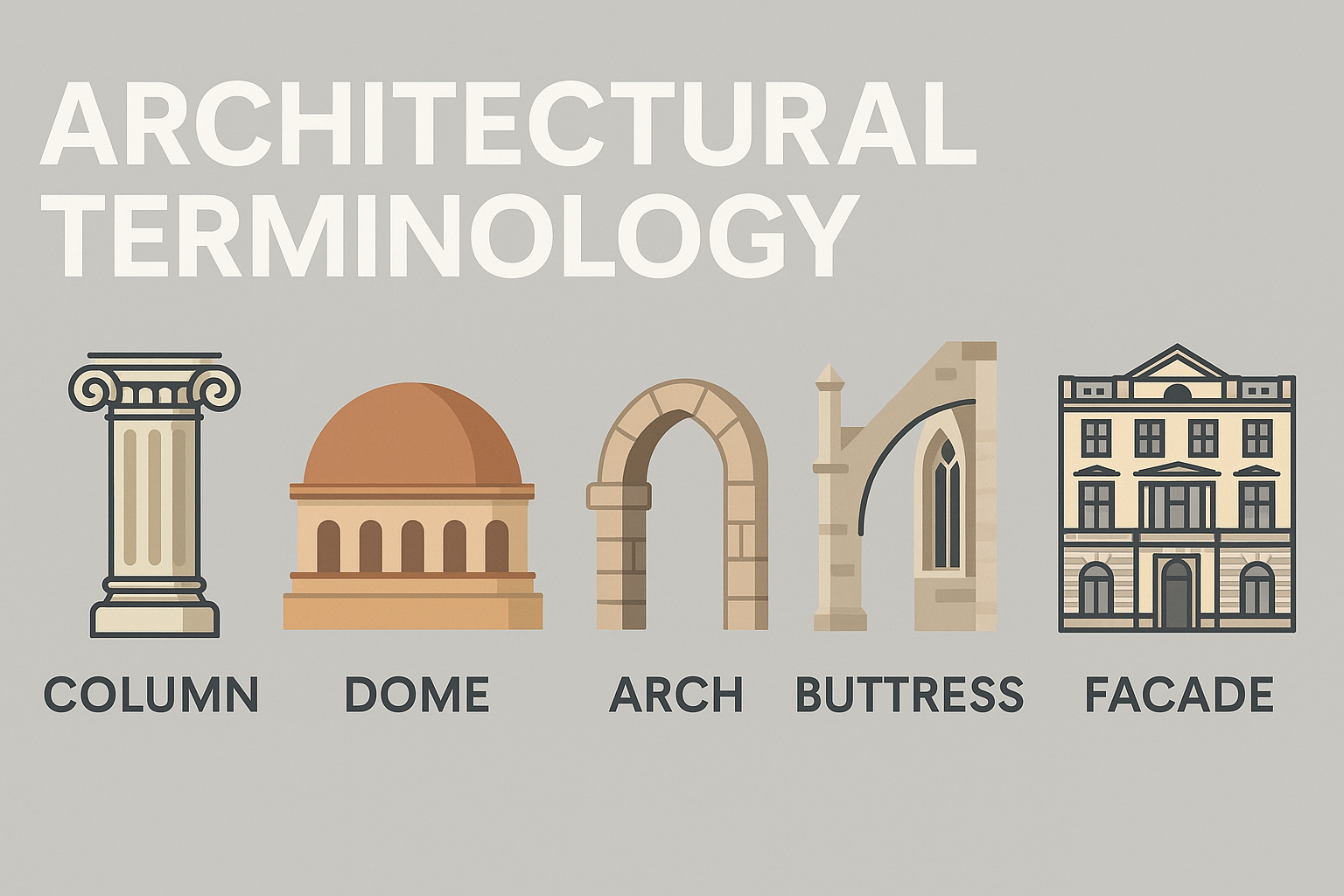
Image: Educational infographic showcasing essential classical and historical architectural terms highlighting key design concepts.
III. Medieval & Gothic Architecture Terms
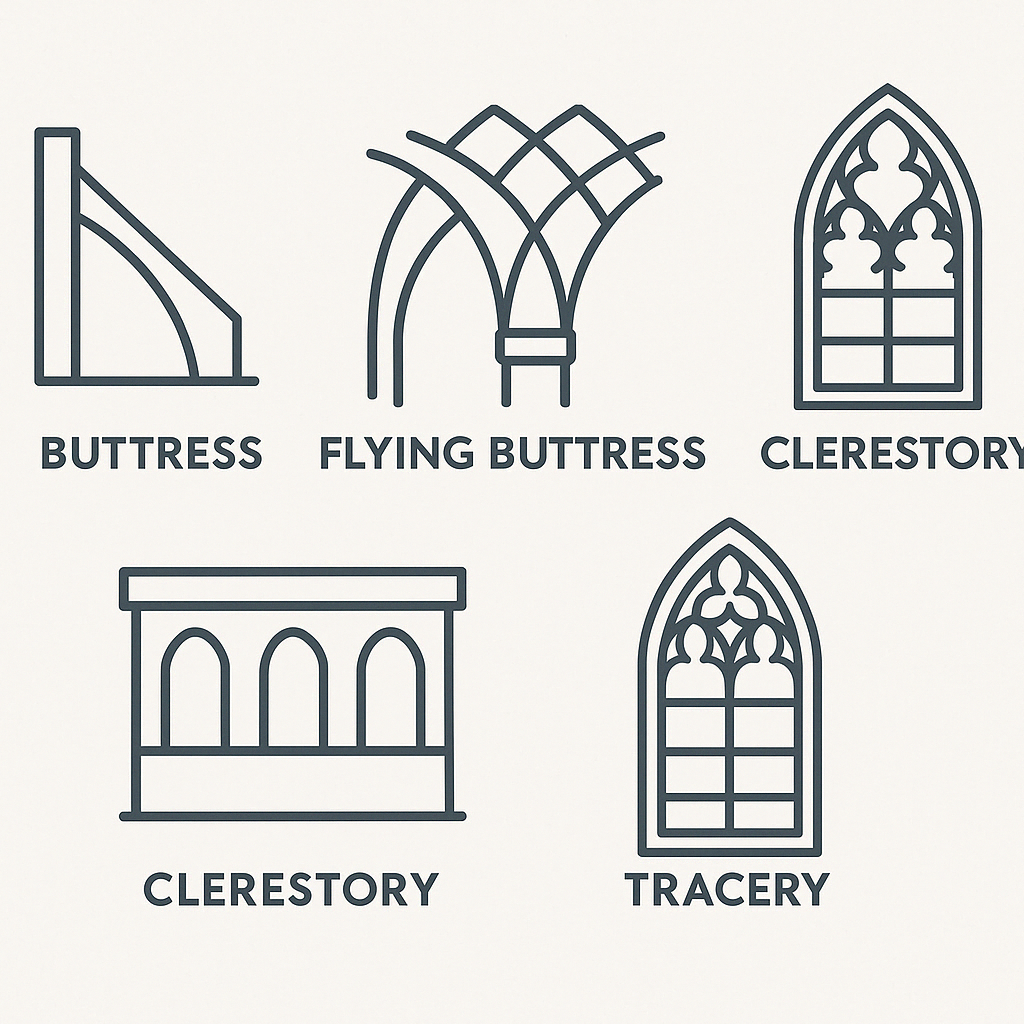
Image: Educational infographic highlighting key medieval and Gothic architecture terms, including buttress, flying buttress, ribbed vault, clerestory, and tracery.
Purpose: Identify features of Gothic revival buildings.
- Buttress – A support against a wall.
- Flying Buttress★ – External arch for roof support; iconic in Gothic design.
- Ribbed Vault – Intersecting arched ceilings with projecting ribs.
- Clerestory★ – High section of wall with windows, brings in light.
- Tracery – Decorative stonework in windows.
IV. Structural and Construction Terms
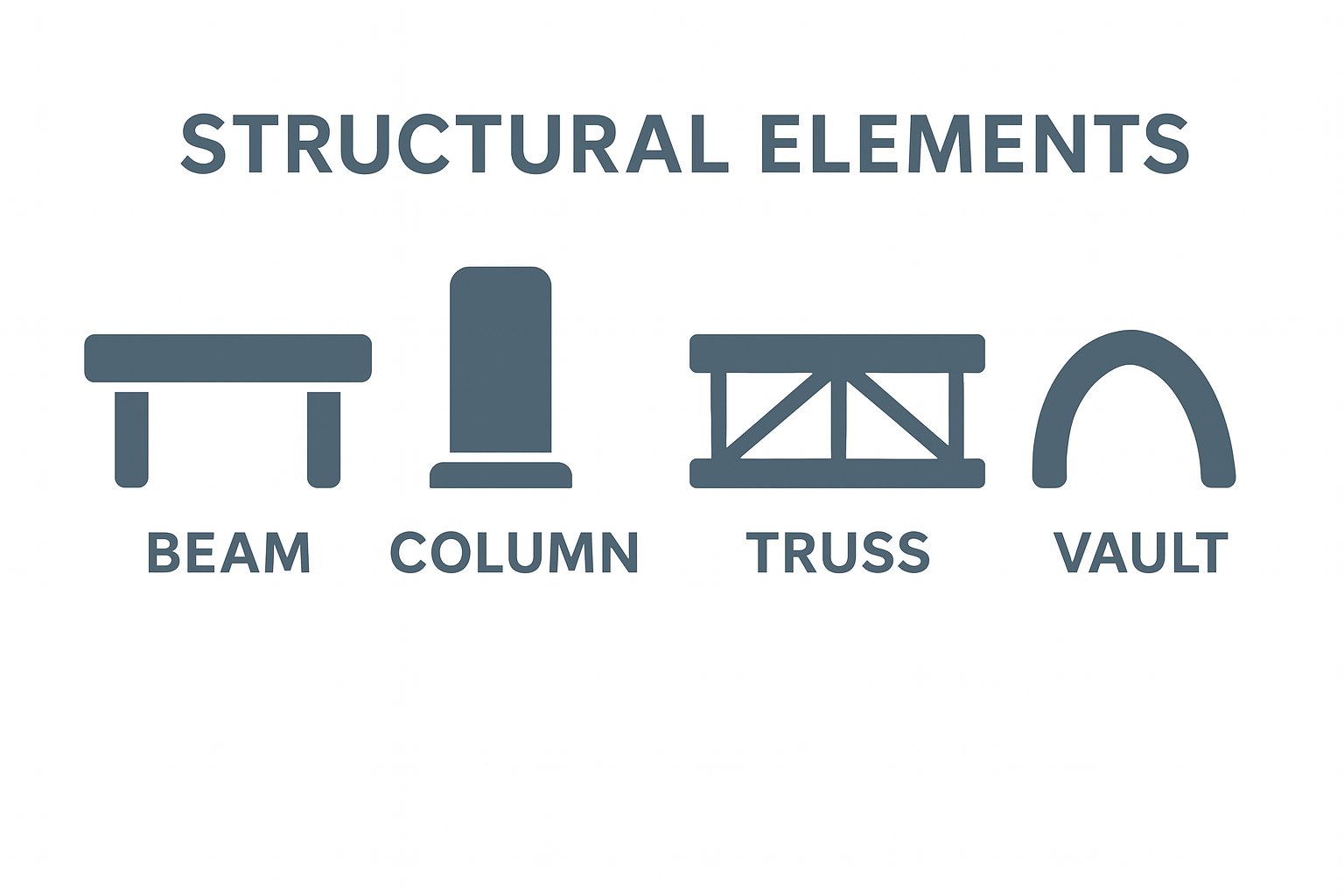
IMAGE: Showing four key structural elements—beam, column, truss, and vault.
Purpose: Understand how buildings stay standing.
- Beam★ – A horizontal load-bearing element.
- Column★ – Vertical support transferring weight downward.
- Truss★ – A framed triangle structure supporting roofs and bridges.
- Joist – Horizontal supports beneath floors or ceilings.
- Girder – A large beam supporting smaller beams or joists.
- Lintel★ – Beam over doors/windows.
- Vault – Arched structure forming ceilings/roofs.
- Cantilever★ – A beam fixed at one end and unsupported at the other.
- Foundation★ – Transfers the weight of the structure to the ground.
- Pier – A column used in foundations or bridges.
- Load-Bearing Wall★ – A wall that supports structural loads.
- Spandrel – Space between an arch curve and its frame.
- Tie Beam – Connects opposite walls or rafters to prevent outward spread.
- Stringer – Sloped beam that supports stairs.
V. Roofing & Ceiling Terms
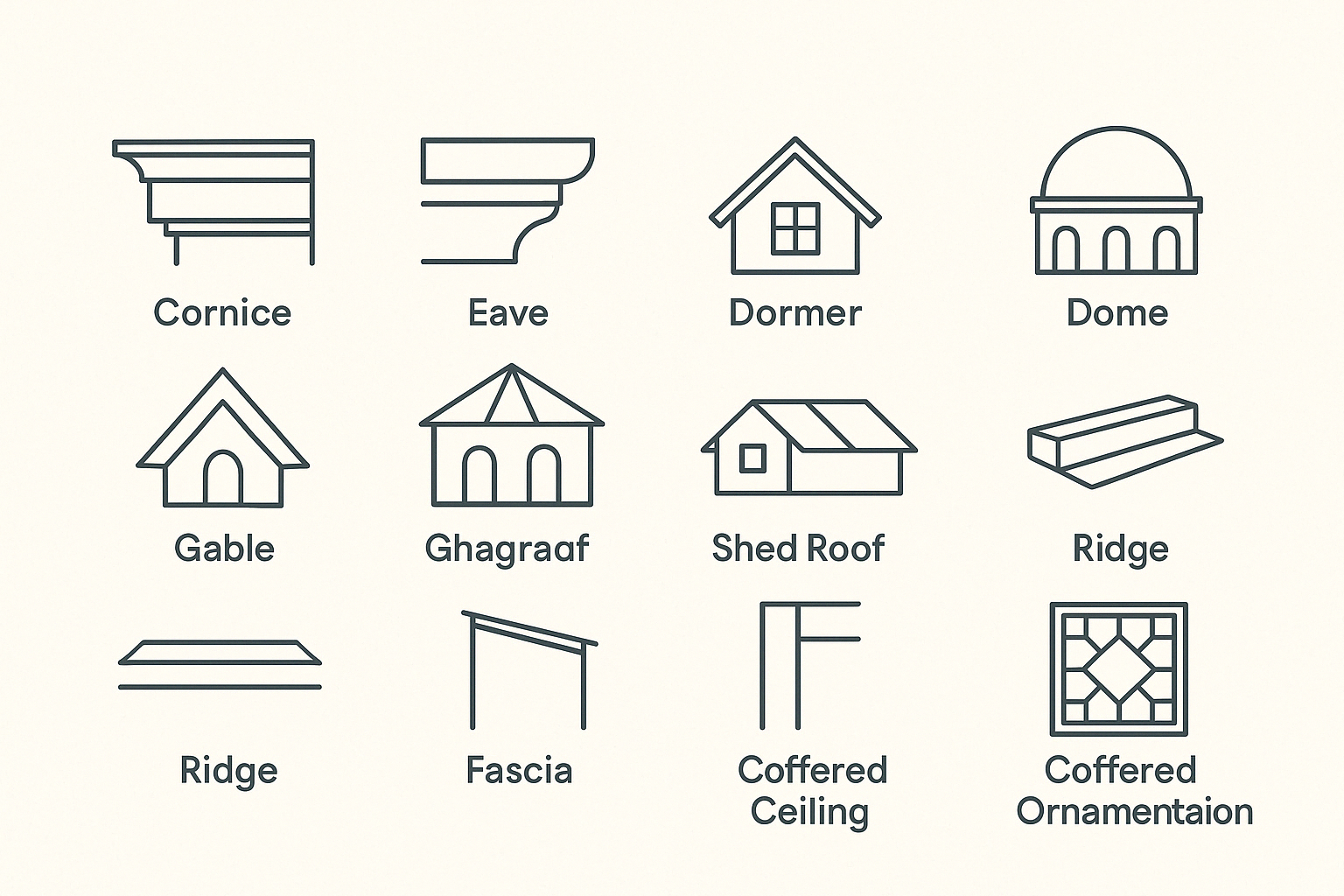
Image: Educational infographic detailing key roofing and ceiling terms, including cornice, dormer, gable, mansard, and more, with icons and descriptions of roof shapes and ceiling features.
Purpose: Features and shapes that define roof types and ceiling structures.
- Cornice★ – A projecting molding along the top edge of a wall.
- Eave – Lower edge of the roof overhanging the wall.
- Dormer★ – A roof extension with a vertical window.
- Dome – A hemispherical roof.
- Gable★ – The triangle formed by a pitched roof.
- Hip Roof – All roof sides slope downward to walls.
- Mansard Roof – Four-sided gambrel roof with two slopes per side.
- Shed Roof – A single slope roof.
- Ridge – Horizontal top edge where roof slopes meet.
- Fascia – Flat vertical surface covering rafter ends.
- Coffered Ceiling – Ceiling with recessed panel patterns.
VI. Residential Architecture Vocabulary
Purpose: Terms specific to house design and layout.
- Veranda – Covered platform extending from a house.
- Gable – Roof peak wall often seen on houses.
- Cupola – Small venting or decorative rooftop dome.
- Dormer – Windowed structure projecting from a sloped roof.
VII. Internal Spaces Architecture
Purpose: Features found inside large public or religious buildings.
- Aisle – Passage between rows of seating or pews.
- Apse – Semicircular recess, typically behind an altar.
- Chancel – Area around the altar.
- Vestibule – Small entry hall.
- Loft – Space near the ceiling, often open or elevated.
- Crypt – Underground chamber, often used for burials.
- Sacristy – Room for storing liturgical items.
- Choir – Space for singers, usually near altar.
- Baptistery – Area dedicated to baptisms.
- Narthex – Enclosed porch or entrance space.
- Ambulatory – Walkway around an apse.
- Gallery – Balcony or upper seating/viewing level.
- Oratory – Private chapel or prayer room.
- Chapter House – Meeting room in religious buildings.
- Refectory – Dining hall in monasteries/schools.
- Undercroft – Storage area or crypt beneath a building.
VIII. Window & Light Terms
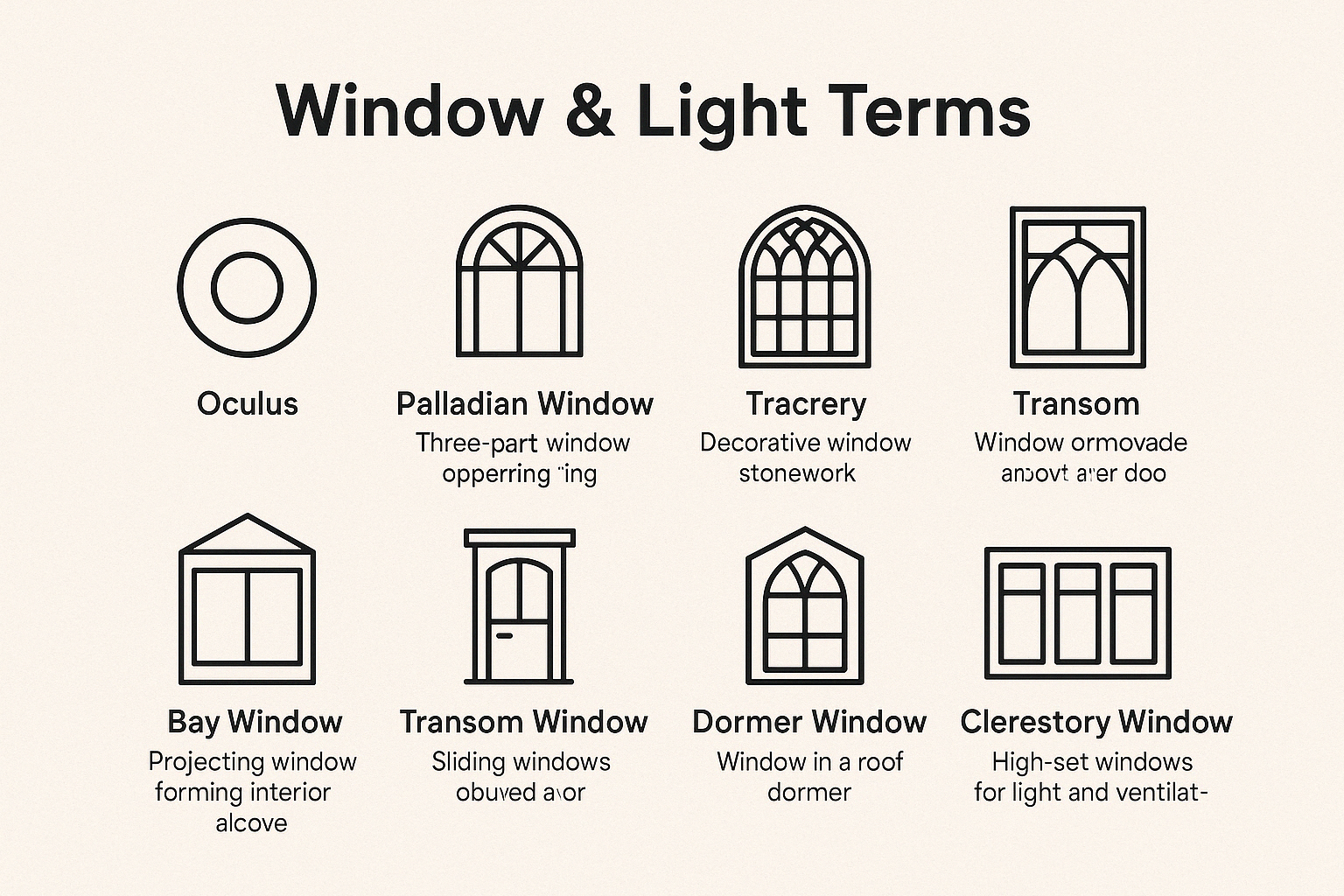
Image: Educational infographic highlighting essential window and light architecture terms, including oculus, clerestory, bay window, tracery, and more, with clear labels and icon visuals.
Purpose: Understanding openings, light flow, and styles.
- Oculus – Circular window or opening.
- Palladian Window – Three-part window with a large arched center.
- Tracery – Decorative window stonework.
- Bay Window – Projecting window forming interior alcove.
- Casement Window – Hinged window opening outward.
- Transom Window – Window above a door.
- Sash Window – Sliding or movable pane windows.
- Dormer Window – Window in a roof dormer.
- Clerestory Window – High-set windows for light and ventilation.
IX. Ornamentation & Detail Terms
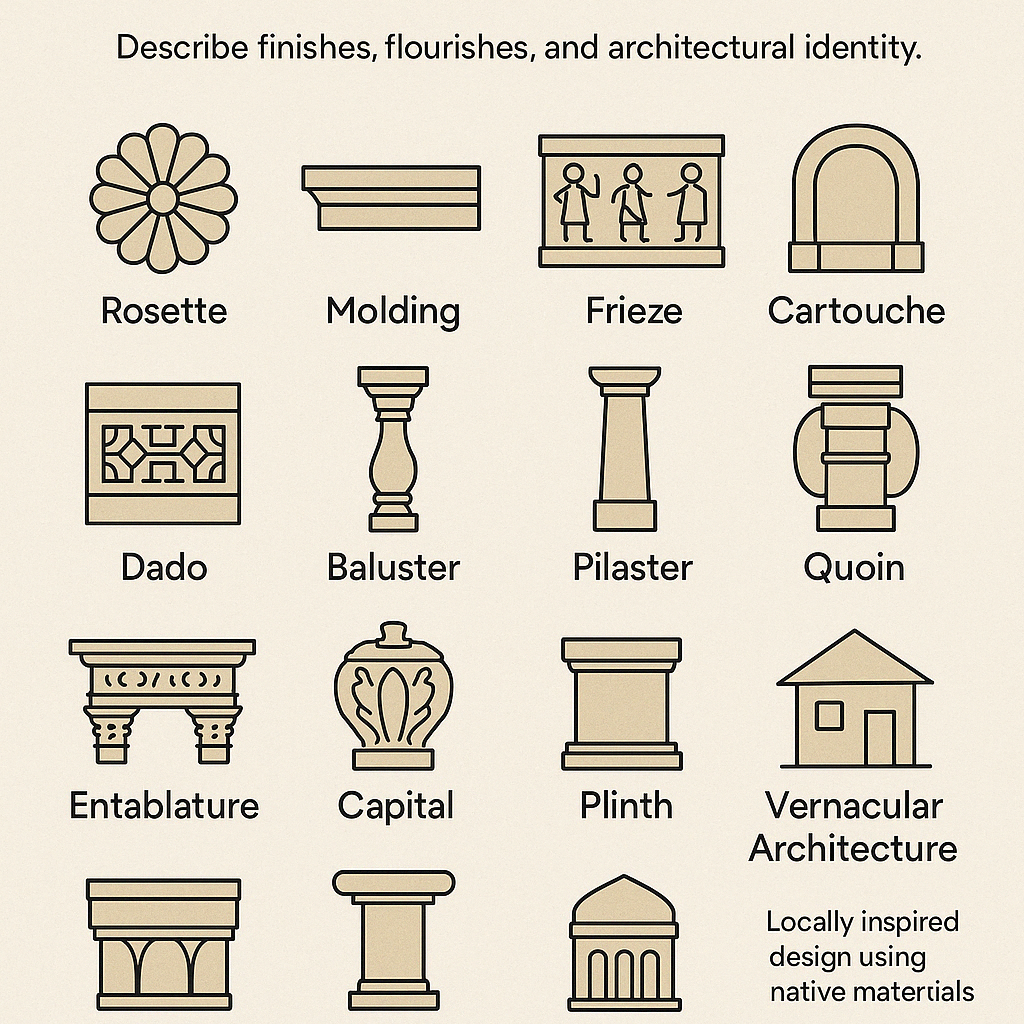
Image: Educational infographic presenting key ornamentation and architectural detail terms, including rosette, molding, pilaster, capital, corbel, and vernacular architecture, with icon-based labels.
Purpose: Describe finishes, flourishes, and architectural identity.
- Rosette – Floral design used in decorative carving.
- Molding – Shaped strip for decorative or structural transitions.
- Frieze – Sculpted or painted band in classical buildings.
- Cartouche – Framed decorative element, often oval.
- Dado – Lower part of interior wall with decoration.
- Baluster – One of the vertical posts in a balustrade.
- Pilaster – Flattened column attached to a wall.
- Quoin – Exterior corner blocks for emphasis.
- Entablature – Horizontal structure over columns.
- Capital – Decorative top of a column.
- Plinth – Base or platform under a column.
- Corbel – A projecting block from a wall to support weight.
- Vernacular Architecture★ – Locally inspired design using native materials.
X. Design Concepts & Architectural Theory
Purpose: Words that reflect how architecture is planned and interpreted.
- Parti★ – The big conceptual idea behind a design.
- Diagram – A visual or conceptual sketch showing layout/organization.
- Organization Diagram – A concept layout that shows space relationships.
- Axis – A line that structures spatial arrangement.
- Hierarchy – Visual or functional ranking of design elements.
- Symmetry – Balanced distribution of elements.
- Rhythm – Repeating elements to create movement or order.
- Proportion – Relationship between sizes or shapes.
- Scale – Relative size of elements to humans or other parts.
L. Islamic Architecture Terms ★
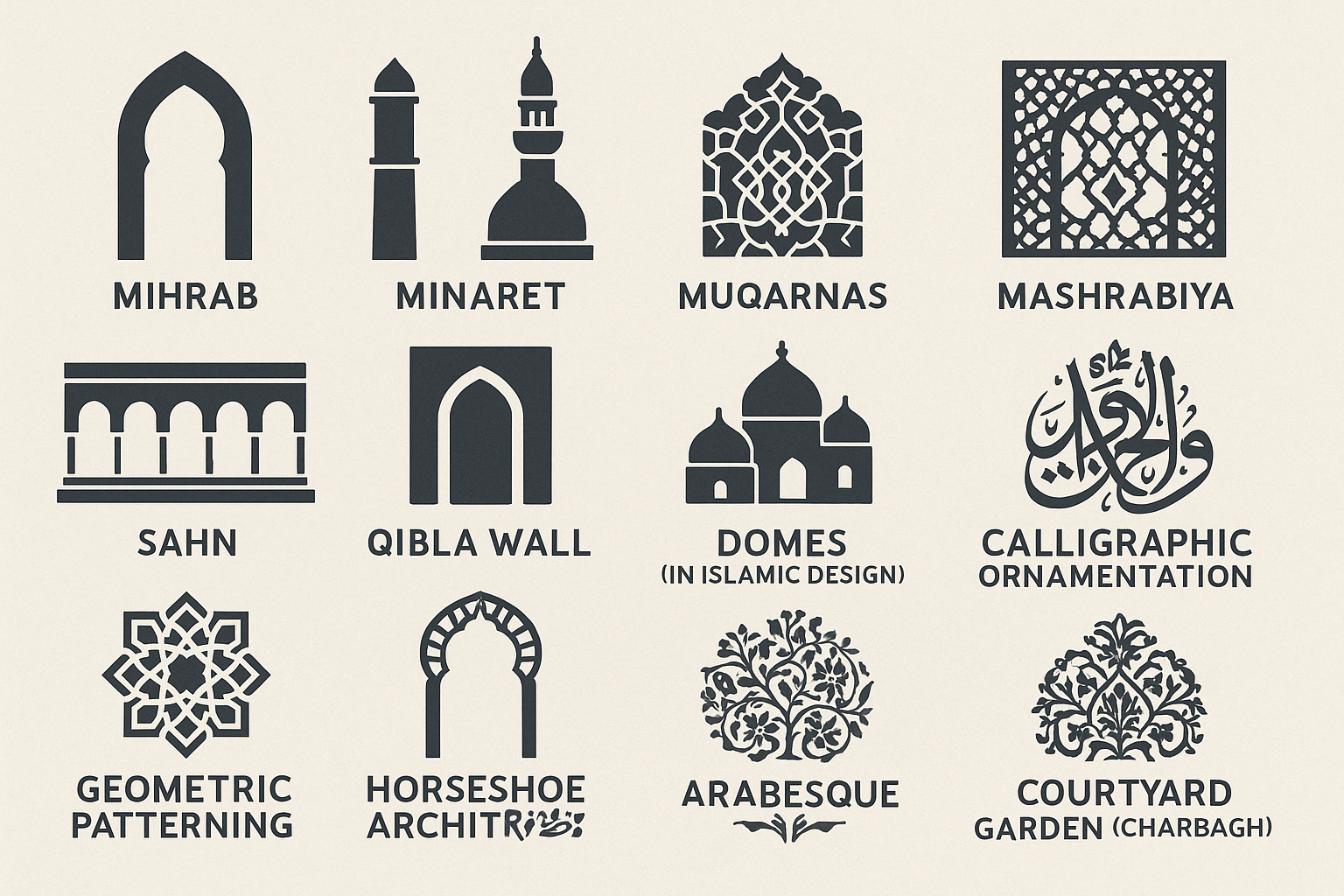
Image: Educational chart featuring key Islamic architecture terms, including mihrab, minaret, muqarnas, mashrabiya, and more, with icons and descriptions for each architectural feature.
Purpose: Highlighting Islamic architecture as a distinct and influential tradition that pioneered new design, geometry, and construction methods that continue to impact global architecture today.
Islamic architecture deserves its own section because it introduced innovations in structure, ornamentation, spatial flow, and geometry centuries ahead of their time.
Terms like muqarnas, mashrabiya, and minaret are unique to Islamic culture but widely admired and adopted across regions and eras. It’s not just historical — it shaped how the world understands space, light, and form.
- Mihrab: – A niche in a mosque wall indicating the direction of Mecca.
- Minaret★ – A tower from which the call to prayer is announced.
- Muqarnas: – A form of three-dimensional decorative vaulting, often called "honeycomb" or "stalactite" work.
- Mashrabiya★ – Latticed wooden screens used for ventilation, privacy, and shade.
- Sahn: – A central courtyard often found in mosques and Islamic homes.
- Qibla Wall: – The wall in a mosque that faces Mecca.
- Iwan: – A vaulted space open on one side, used in Islamic and Persian architecture.
- Domes (in Islamic design): – Often double-shelled, richly decorated, and symbolic.
- Geometric Patterning★ – Complex interlocking shapes, foundational to Islamic ornament.
- Calligraphic Ornamentation: – The use of stylized Arabic script as decoration.
- Horseshoe Arch: – A distinctively rounded arch wider than a semicircle, common in Moorish design.
- Arabesque: – Flowing floral or vegetal designs used to symbolize the infinite.
- Courtyard Garden (Charbagh): – A Persian-influenced, four-part paradise garden found in Islamic palace and mosque design.
Highly Recommended Starter Book
Architecture: Form, Space, and Order by Francis D.K. Ching
Explains the core principles of spatial design with clarity and precision. A fantastic starting point for beginners exploring architectural concepts.
A timeless classic found on nearly every architect's shelf — if you’re starting out or want to refresh your basics, this is the book to buy.
How Architectural Terms Are Categorized (And Why That Matters)
Learning terms in groups makes them easier to understand and remember. Here are the most useful categories:
-
Drawing & Representation Terms
(e.g., plan, elevation, section)
● Helps communicate design ideas clearly on paper or screen. -
Structural Terms
(e.g., beam, column, truss, cantilever)
● Essential for understanding how a building stands and holds weight. -
Design & Style Terms
(e.g., entablature, cornice, pilaster, portico)
● Useful when analyzing or replicating specific styles. -
Material & Finish Terms
(e.g., brick veneer, stone cladding, render)
● Tied to buildability and finish quality. -
Historical Style Terms
(e.g., Gothic vault, Romanesque arch, Neoclassical column)
● Helps you reference and apply traditional forms in modern ways. -
Residential Architecture Terms
(e.g., dormer, eave, veranda, gable)
● Especially relevant in housing projects and renovations.
Essential Read for Beginners
The Language of Architecture by Andrea Simitch & Val Warke
Presents real-world examples and terms in context. Ideal for building your architectural vocabulary through applied understanding.
Perfect if you prefer visuals and real-life references over dry definitions — a smart addition to your learning toolkit.
IN FOCUS: Why Architectural Vocabulary Shapes Good Design
Learning architectural terms isn't just academic — it changes how you think, draw, and explain ideas.
▪ Clear Vocabulary = Better Communication
Professionals use precise terms like “mullion” or “cantilever” to avoid confusion. Misunderstanding terms can lead to expensive design errors.
▪ Language Builds Design Thinking
Once you know the names of parts (e.g., frieze, fascia, spandrel), you start designing with more clarity and purpose. Language supports creativity.
▪ Terms Are Tools
Just like a hammer or CAD software, architectural terms are tools. Learn to use them well and you’ll work faster, communicate better, and design smarter.
Best-Selling Architecture Books (And Why They Help)
1. A Visual Dictionary of Architecture by Francis D.K. Ching
A must-have reference. Visuals + definitions = fast understanding.
2. Architecture: Form, Space, and Order by Francis D.K. Ching
Explains core principles of spatial design. Great for beginners.
3. The Language of Architecture by Andrea Simitch & Val Warke
Real examples and terms in context. Excellent for developing vocabulary with application.
4. 101 Things I Learned in Architecture School by Matthew Frederick
Simple insights you’ll never forget. Combines terms, drawing tips, and real-world logic.
5. Why Buildings Stand Up by Mario Salvadori
Focuses on structure. Helps you understand the forces behind the terms.
What are the key terms in architecture and design? This beginner-friendly glossary explains the words that shape the buildings around us.
New for 2025: Architectural Terms, Glossary & Definitions
A practical guide to the language of architecture — built for students, professionals, and anyone who wants to speak about buildings with confidence.
From ancient terms to modern innovations, this glossary helps you understand how architecture has been described across time, and why the right words still matter.
The Evolution of Architectural Terms: A Quick Timeline
Architecture and language evolved together. As building methods, styles, and needs changed, so did the words used to describe them. Here’s how that timeline unfolds:
-
Ancient Civilizations:
Early terms focused on temples, pyramids, and rituals. Think column, pylon, lintel. -
Greek & Roman Periods:
Greeks gave us formal terms like pediment, entablature, and Doric.
Romans added arch, vault, and wrote it all down (thanks, Vitruvius). -
Medieval & Gothic Eras:
New religious structures brought words like buttress, nave, and clerestory. -
Renaissance:
Classical ideas returned with terms like symmetry, perspective, and pilaster — thanks to Palladio and Alberti. -
Industrial Revolution:
Construction tech brought terms like cast iron, steel frame, and elevator. -
Modernism:
Simplicity and structure took over: curtain wall, cantilever, open plan. -
Postmodern & Late 20th Century:
Design got playful again. Add deconstructivism, contextualism, pluralism. -
21st Century:
Architecture meets tech and climate — now we use parametric design, green building, biophilic design.
Bottom Line:
These terms didn’t appear overnight. They reflect how people lived, how buildings were built, and how ideas changed. Learning them isn't just about language — it’s about understanding how architecture evolved and how to design with clarity today.
A Must-Have if You're New to Architecture
101 Things I Learned in Architecture School by Matthew Frederick
Packed with memorable insights, drawing tips, and practical advice. A quick, thoughtful read that simplifies essential architectural ideas.
If you want a no-fluff, highly readable book that actually sticks, this one’s worth picking up.
Architectural Terms Timeline: Evolution by Era
Purpose: Understand how architectural language developed over time, tied to major design shifts.
Ancient Civilizations (Pre–4th Century AD)
- Column – Vertical support for weight distribution.
- Capital – Decorative top of a column.
- Entablature – Horizontal structure above columns.
- Arch – Curved structure spanning an opening.
- Dome – Rounded roof, often on temples and baths.
Medieval (5th–15th Century)
- Buttress – External wall support.
- Flying Buttress – Gothic-style arch support.
- Gothic Arch – Pointed, load-distributing arch.
- Spire – Tall tapering tower.
Renaissance (14th–17th Century)
- Proportion – Balanced relationships in design.
- Fresco – Wall painting on wet plaster.
- Pediment – Triangular gable above a portico.
Industrial Revolution (18th–19th Century)
- Ironwork – Use of iron in decorative or load-bearing structures.
- Skylight – Roof window bringing in natural light.
Modernism (Late 19th–Mid 20th Century)
- Cantilever – Beam supported only on one end.
- Facade – External face of a building.
- Minimalism – Design stripped to essentials.
Postmodern & Contemporary (Late 20th–Present)
- Sustainable Design – Eco-conscious architecture.
- BIM (Building Information Modeling) – Digital planning and construction tool.
- Parametric Design – Algorithm-driven form and structure.
Top Pick for Aspiring Architects - A Classic Worth Adding to Your Shelf
Why Buildings Stand Up by Mario Salvadori
Focuses on structural principles in an accessible way. Helps you grasp the physical forces and logic behind architectural terms and building stability.
A great choice if you’ve ever wondered why buildings don’t fall — it’s technical without being intimidating.
A Smarter Way to Learn Architectural Terms
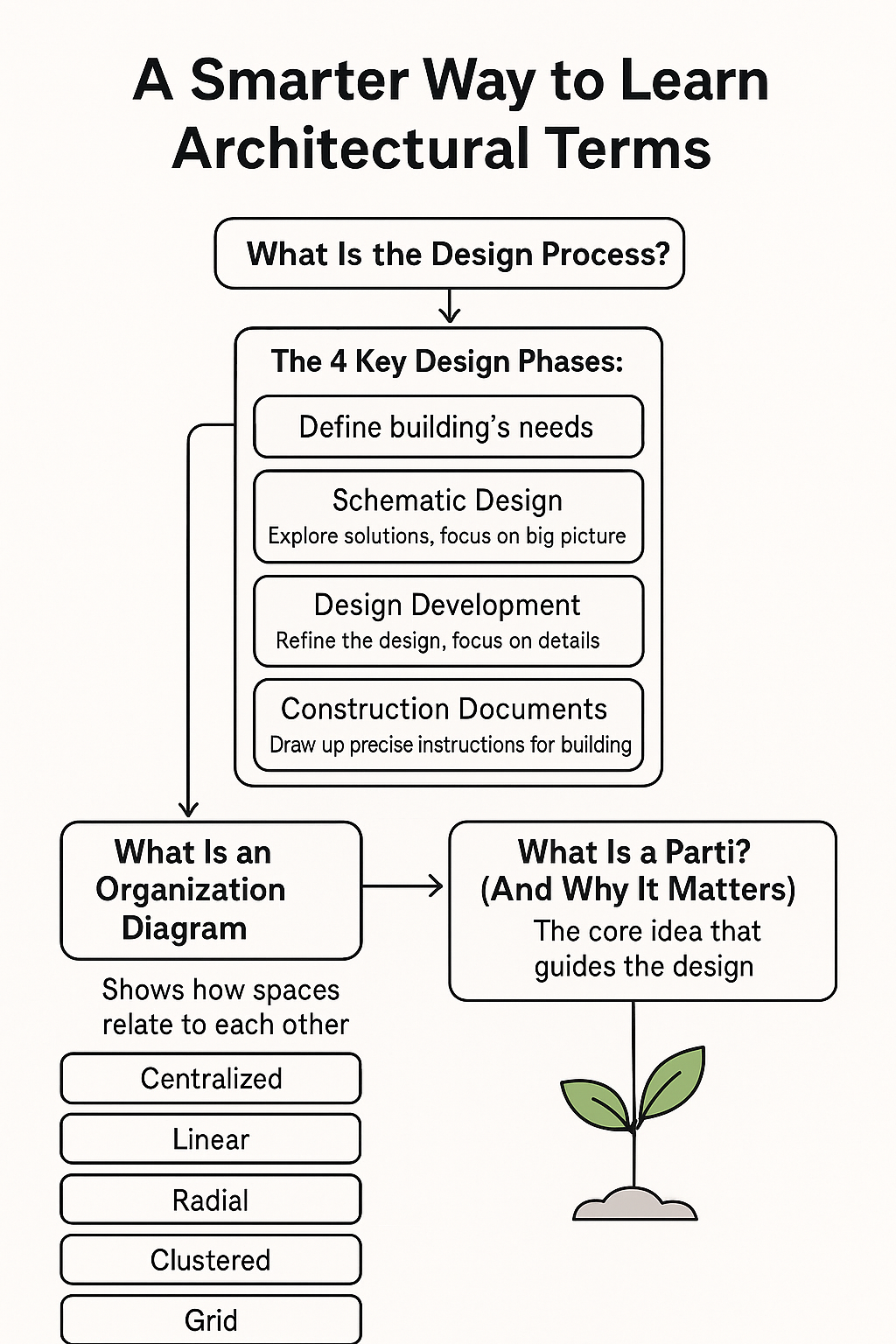
Image: Educational chart showing effective ways to learn architectural terms, including visual aids, flashcards, real-world examples, and contextual learning techniques.
Most beginners struggle with architectural vocabulary. And for good reason — if you don’t understand the basic terms, you’ll constantly feel lost. Architectural language isn’t just academic — it’s essential to every drawing, conversation, and decision you make.
This guide doesn’t just throw definitions at you. It introduces terms in the context of the design process, not alphabetically — so you learn how words actually work in real projects.
You’ll also see terms that rarely show up in standard glossaries, explained clearly with real meaning behind them.
What Is the Design Process?
Designing a building isn’t one straight line. It’s a layered process with multiple phases — and you often go back and forth as the project develops. Each stage builds on the decisions made earlier, and every term you learn fits into one of these phases.
The 4 Key Design Phases:
-
Programming Stage
Define the building’s needs. How many rooms? What functions? Who will use each space? -
Schematic Design
You move from identifying problems to exploring how to solve them. This is where the big-picture layout, shape, and flow are worked out — without getting stuck in small details yet. -
Design Development
Now, zoom in. Every room, wall, material, and connection starts to take shape. You refine the concept into real dimensions and decisions. -
Construction Documents
Final step: translating the design into precise instructions for building. Drawings, materials, measurements — everything must be crystal clear.
Note: In real projects, these phases often overlap and loop — you may jump back to revise something in the schematic when working on final documents.
What Is an Organization Diagram?
An organization diagram shows how different spaces relate to each other. It’s not about style or exact size — it’s about function, flow, and logic.
Think of it as the framework or “skeleton” of how a building works. It shows things like:
-
Which spaces need to be near each other
-
Where public vs. private areas go
-
How people move through the space
-
Where light or views should be focused
Common Types of Organization:
-
Centralized – Spaces grouped around a central point
-
Linear – A sequence of spaces in a line
-
Radial – Paths radiate outward from a central space
-
Clustered – Groups of spaces organized by function or use
-
Grid – A systematic, often modular layout
What Is a Parti? (And Why It Matters)
A Parti is the core idea behind a design — the big concept that holds everything together. It’s what guides every decision, from layout to structure to material.
The word comes from French: parti pris, meaning “a decision taken.” Architects use it to describe the organizing thought behind a project. You might represent it as a sketch, a diagram, a phrase — or all three.
Think of it like this:
🟢 If the building is a tree, the parti is the seed.
It sets the tone, the mood, the logic, and the purpose. Everything grows from that.
Parti: The Seed of Architectural Design
FAQ
This section answers real questions people search for — about vocabulary, practice, study methods, and what it’s like to work or think like an architect. Answers are short, practical, and to the point.
▪ What Is Architecture Terminology?
It’s the specialized vocabulary used by architects to describe designs, materials, and structural elements. Learning it is essential to read drawings, follow plans, and speak clearly about design.
▪ Do I Need to Know All the Terms?
No — but you do need to know the ones that come up constantly. Start with structural terms, then study drawing types, materials, and historical styles. Think of it like a toolbox: the more tools you know, the more you can build.
▪ What Are the 7 Phases of the Design Process?
- Pre-Design – Understand client needs and site.
- Schematic Design – Early concepts and layout ideas.
- Design Development – Refine, add materials and systems.
- Construction Documents – Full technical drawings.
- Bidding – Contractors quote the project.
- Construction Administration – Architect checks site progress.
- Post-Construction – Final walkthrough, corrections.
▪ What Are the 5 Core Elements of Architecture?
- Line – Defines space.
- Form – The shape or structure.
- Space – The area enclosed or created.
- Light – Impacts how space is felt.
- Color – Used for emotion, contrast, clarity.
▪ What Are the 4 Main Types of Architecture?
- Residential – Homes, apartments.
- Commercial – Offices, malls.
- Industrial – Factories, logistics.
- Civic/Public – Museums, schools, government buildings.
▪ How Can I Learn Architecture Vocabulary Fast?
- Use flashcards or quiz apps.
- Read drawings and try naming what you see.
- Watch architecture walkthroughs and note the terms.
- Practice speaking or writing with them.
▪ What Is an Architect’s Layout Called?
Usually a floor plan (interior) or a site plan (property).
▪ What Is Facade Architecture?
The facade is the building’s front face — often the most styled part. It defines the building’s character and visual impact.
▪ What’s the Top of a Building Called?
In general: roof. If it’s a feature like a spire or antenna, it’s called a pinnacle or crown.
▪ Can I Call Myself an Architect?
Only if you’re licensed in your country. If not, say “designer,” “graduate,” or “architecture student.”
▪ Do Architects Build or Just Design?
Architects design. Builders construct. But architects visit job sites and solve issues during construction.
▪ What’s Scale in Architecture?
It’s how the drawing compares to real-world size. Getting scale wrong can ruin the proportions of a design.
▪ What’s a Good Architecture Diagram?
Simple, readable, and includes:
- Clear relationships between parts
- Scale and orientation
- Labels
▪ How Do I Find My Architectural Style?
Look at lots of designs. Ask: what excites you? Modern, rustic, minimal, bold? Your values — like sustainability or tradition — guide your style.
▪ How Do Architects Study?
- Degree programs (B.Arch, M.Arch)
- Drawing + theory classes
- Site visits
- Studio work
- Internships
▪ What Is Architect Handwriting Called?
“Architect’s lettering” — clean, all-caps writing used for labels and drawings. It’s meant to be readable at a glance.
▪ What Language Do Architects Use?
Globally: English is standard in documents. In coding: Python, C#, or Java are good for design logic or BIM tools.
▪ What’s Architecture in Code?
In software: the way components are organized (the structure of a program). In buildings: it’s your system and layout logic.
▪ What’s the Role of Technology in Architecture?
It helps architects:
- Draw and model (CAD, BIM)
- Visualize (3D rendering, VR)
- Test (energy use, daylight, airflow)
- Innovate (3D printing, modular builds)
▪ How Do Architects Think About Sustainability?
- Use local, recycled, or low-carbon materials
- Maximize daylight and ventilation
- Minimize waste
- Plan for long-term use
▪ Can Architecture Influence Human Behavior?
Yes. Layouts affect movement, mood, and interaction. Good design can make people feel calm, inspired, focused, or connected.
▪ What’s the Difference Between Modern vs. Contemporary Architecture?
- Modern – Early 1900s–60s: clean lines, minimal, industrial materials.
- Contemporary – Today’s architecture: mixes styles, uses tech, often eco-focused.
▪ How Do Architects Include Culture in Design?
- Use local materials or styles
- Respect tradition and climate
- Reflect social values in space (communal vs private, etc)
▪ What’s the Link Between Architecture and Urban Planning?
- Architecture = individual buildings
- Urban Planning = whole neighborhoods, streets, infrastructure
Good planning makes space for good architecture — and vice versa.
Official References & Trusted Learning Resources
▪ U.S. National Park Service – Architectural Style Guide
https://www.nps.gov/articles/architectural-style-guide.htm
▪ British Architectural Library (RIBA)
https://www.architecture.com
▪ Glossary by the National Trust (UK)
https://www.nationaltrust.org.uk/discover/history/buildings/glossary-of-architectural-terms
▪ ArchInform International Architecture Database
https://www.archinform.net
▪ Architectural Glossary – Historic England
https://historicengland.org.uk/images-books/publications/building-glossary/
▪ Getty Art & Architecture Thesaurus
https://www.getty.edu/research/tools/vocabularies/aat/