
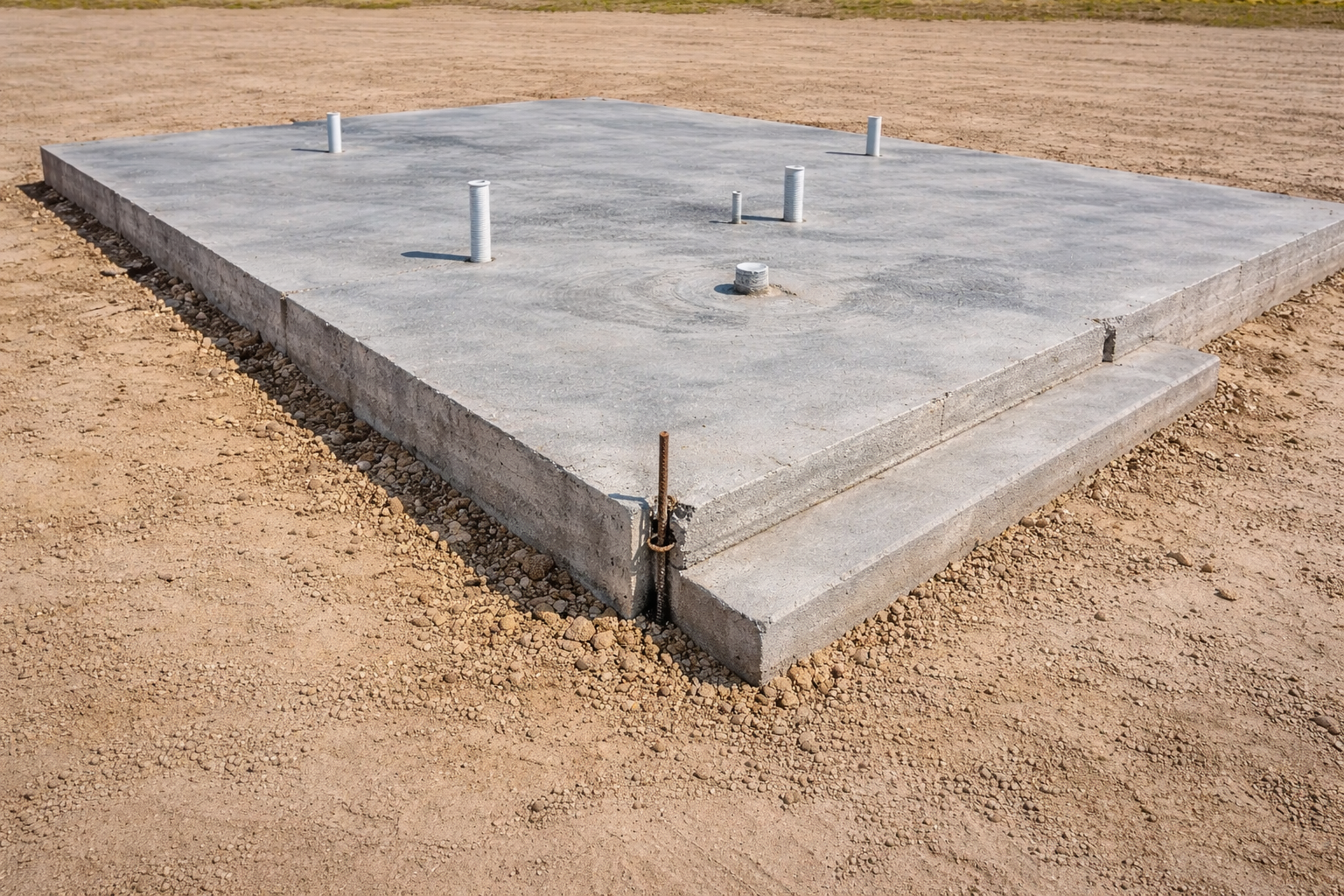
Foundation problems start low and show up late. Cracks. Doors that stick. A basement that never stops smelling damp. By the time you notice it upstairs, the trouble often started at the bottom.
A foundation carries load into the ground and deals with water at the same time. Concrete matters, but soil and moisture usually decide how the house behaves.
For the quick baseline, start with Concrete Foundations 101. If you want the bigger map of types, drainage, repairs, and costs, stay here.
What a foundation is (plain definition)

A foundation is the part of the building that transfers loads into the ground without letting the structure move in damaging ways. It’s also the bottom of your water-control system — because wet soil and moving soil are the two things that quietly turn “fine” houses into repair projects.
Concrete strength matters, sure. But most failures start earlier: bad soil assumptions, bad drainage, and details that let moisture live where it shouldn’t.
Read This Next: for the larger build sequence, see house construction from start to finish.
The most common misunderstanding
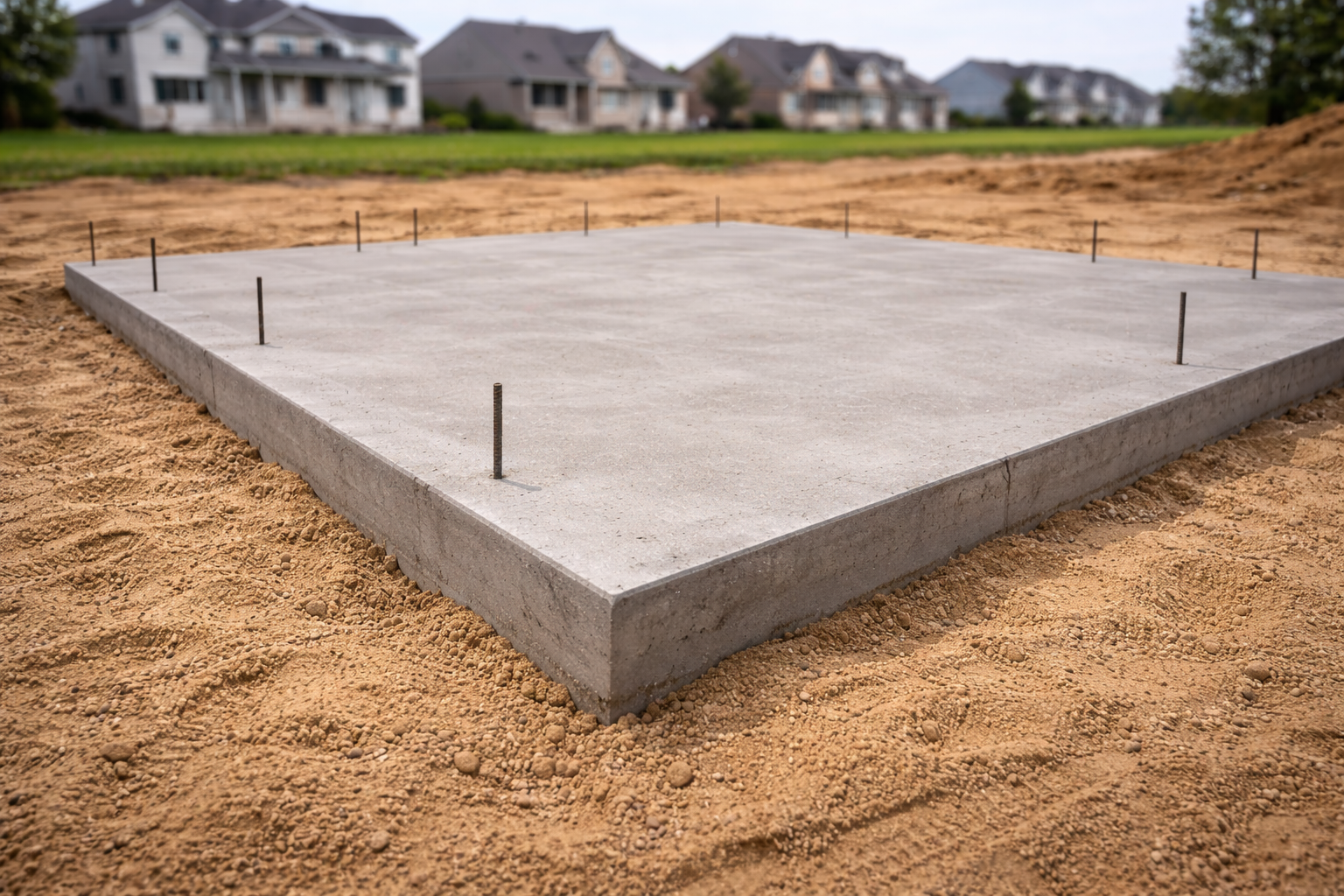
People think foundation performance is mostly about “stronger concrete.” It’s usually not.
Most real failures come from a simpler chain: water changes the soil, the soil moves, the foundation follows, the house complains. Fix the water path and soil assumptions early and the concrete suddenly looks “fine.” Ignore them and you can pour a perfect slab that still becomes an expensive apology.
Start where the ground starts
- Soil analysis and site investigation basics How pros think about bearing, drainage, and “surprises” across a lot.
- Exterior foundation waterproofing that actually works Systems, details, and why “paint-on” is rarely the full answer.
Foundation types (quick map)
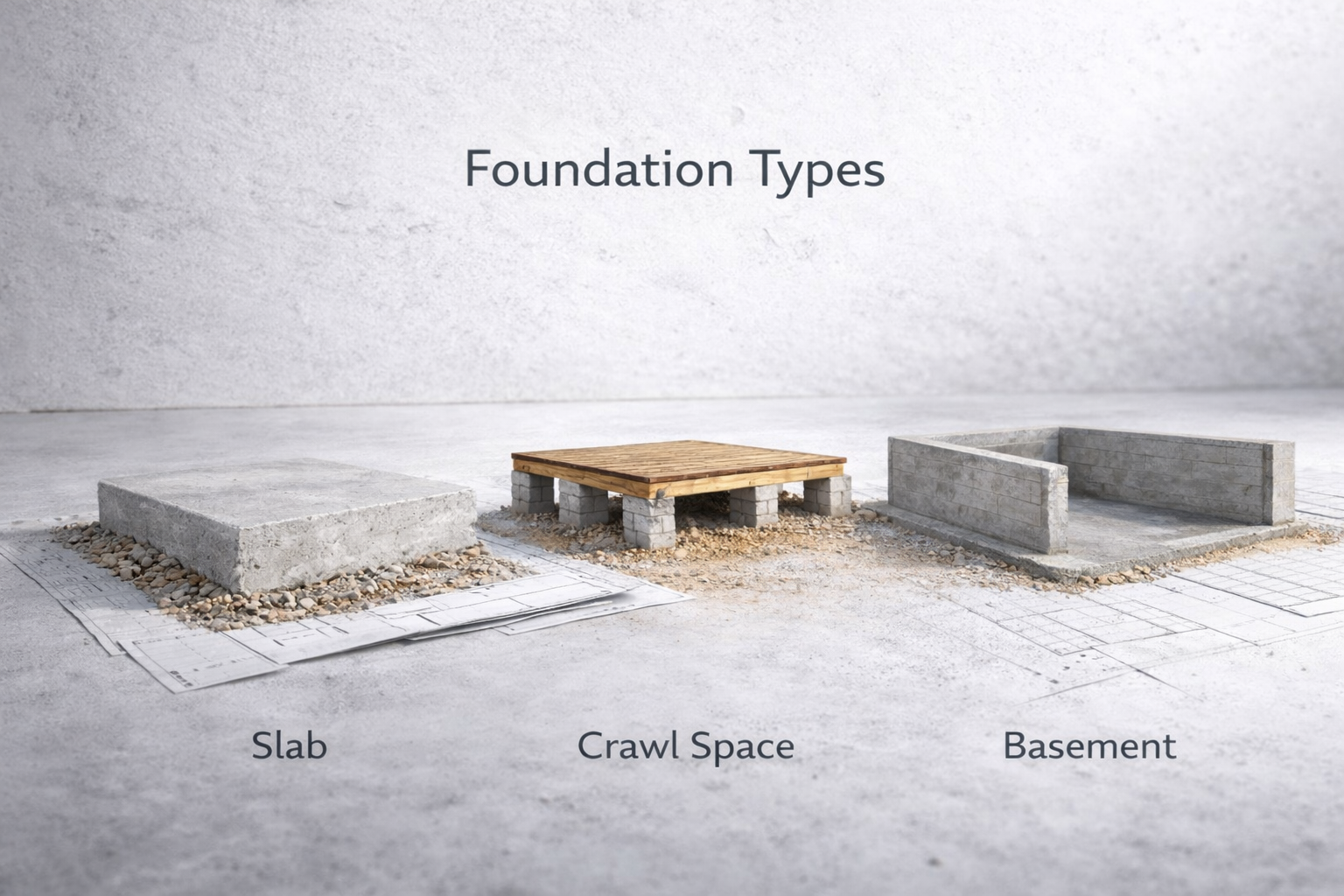
There isn’t a universal “best” foundation. There’s a best fit for your soil, climate, budget, and risk tolerance. Some choices cost more upfront but save you decades of moisture drama. Others are cheaper and faster but less forgiving.
- A plain-language overview of foundation types What each system is trying to do, and where it tends to fail.
- Slab on grade foundations, when they work Fast, common, and very sensitive to drainage and insulation decisions.
Basements and crawl spaces (the moisture realities)
Below-grade space is never “just extra square footage.” It’s a water and air-control problem you agreed to manage forever. Basements can be great. Crawl spaces can be fine. Both punish vague detailing and lazy drainage.
- Basement foundation basics Walls, slabs, drainage, and what makes basements stay dry long-term.
- Crawl space foundations explained Venting, vapor control, and why “musty” is usually fixable if you pick the right approach.
Footings, walls, and the parts that crack first
Most foundation drawings look clean because they hide the hard parts. The hard parts are edges, joints, penetrations, and transitions. That’s where water gets in and where stress concentrates.
- Concrete footings, sizing and basics What footings do, how loads spread, and where mistakes start.
- Foundation walls, step by step Rebar, forms, curing, and the details that decide durability.
Drainage and waterproofing (where money is usually saved wrong)
Waterproofing is not a single product. It’s a system. The cheapest “fix” is often the one that traps moisture in the wall, hides the leak, or pushes the problem to a new location.
- Foundation waterproofing, done as a system Membranes, drainage layers, and how to think about risk.
- French drain with sump pump, the right way Where people get it wrong and why “almost right” still floods.
Cracks, settlement, leveling (what to do when the house starts moving)
Not every crack is a crisis. Some are shrinkage. Some are seasonal. Some are the first sign of differential settlement. The trick is learning the patterns and checking the context before you panic or get sold a big repair.
- How to read foundation cracks in a house What’s common, what’s not, and what to document before calling anyone.
- Concrete foundation leveling basics What methods exist, when they work, and where scams show up.
Costs and hiring (where people get burned)
Foundation work is one of those categories where the cheapest quote can be the most expensive outcome. You’re paying for diagnosis, sequencing, and risk management, not just “materials.”
- Foundation repair cost reality check Price ranges, what drives them, and how to compare scopes.
- How to choose an excavation contractor Questions that reveal competence fast, before you sign anything.
DIY foundations (what’s realistic)
DIY can be fine for small work if you respect the limits. The risk is not the pour. The risk is layout, compaction, drainage, frost depth, and thinking “close enough” is a detail.
- DIY foundation construction tips that matter Practical checks before you dig, form, or order concrete.
- A slab foundation DIY walkthrough Where DIY slabs usually fail, and how to avoid the classics.
Concrete Slab Foundation Over Compacted Soil (With a Vapor Barrier)
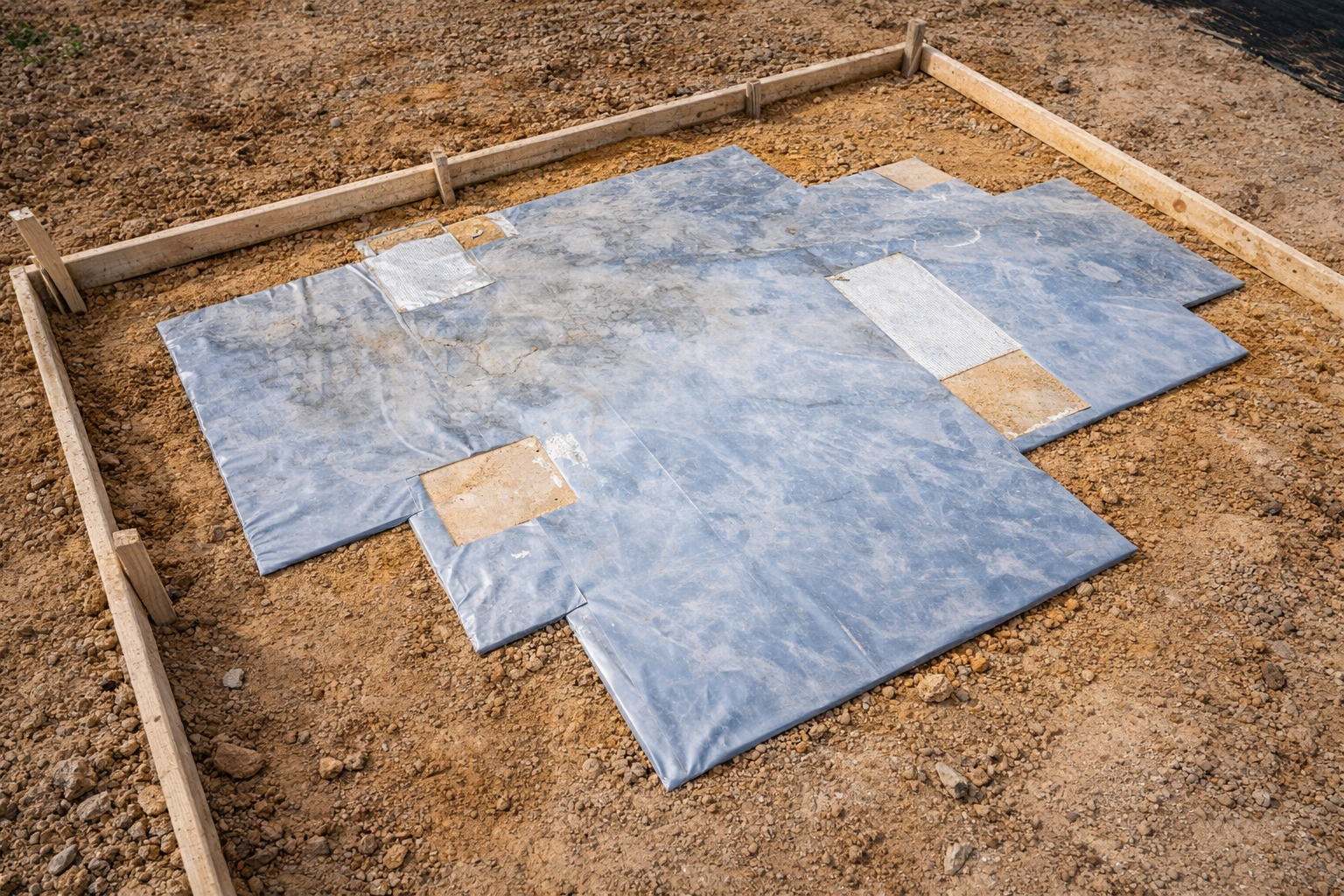
This is the most common “fast house” foundation for a reason. It’s simple, it’s cost-efficient, and it goes in quickly when the site is cooperative. But it’s also unforgiving. If you get the ground prep or moisture control wrong, you don’t “fix it later.” You live with it.
At its core, a slab-on-grade is just a thickened concrete plate that spreads loads into the soil. The vapor barrier is the line in the sand between your interior and the wet earth. The compaction is what keeps the slab from settling unevenly after you’ve already framed and finished everything.
What it is (in plain terms)
A concrete slab poured at or near ground level, sitting on a prepared base (usually granular), with a vapor barrier between the slab and the ground. The slab may have thickened edges or integral footings depending on the design and local frost/code requirements.
Why it matters
Slabs don’t have a “buffer zone.” No crawl space. No basement. Everything you do at the bottom shows up at the top. Moisture becomes smell, cupped flooring, rust, moldy baseboards, and a constant “why is it humid in here?” problem. Settlement becomes cracks, stuck doors, tile failure, and cabinets that never look level again.
- Compaction controls settlement. Not “no settlement,” just predictable settlement.
- Vapor barrier limits moisture vapor rising into the slab and interior finishes.
- Base material + drainage decides whether water moves away or camps under your house.
How it actually works (the load + moisture story)
The slab takes the building load and spreads it out. If the soil below is uniform and well-compacted, it behaves. If one area is soft (utility trench backfill, uncompacted fill, wet clay), that corner settles more. The slab cracks because concrete is strong in compression and weak in tension. That’s normal physics, not “bad concrete.”
The moisture story is separate but just as important. Soil moisture wants to move upward. Concrete is porous. Without a vapor barrier, the slab becomes a slow moisture pump. You might not see puddles, but you’ll see the consequences in finishes and indoor air.
Typical build-up (what you’re aiming for)
- Compacted subgrade (native soil shaped and compacted; bad stuff removed)
- Granular base (crushed stone / granular fill, leveled and compacted in lifts)
- Vapor barrier (taped seams, sealed penetrations, protected from punctures)
- Insulation (where required/wise: under-slab and/or slab edge)
- Reinforcement (rebar/mesh/fiber depending on design)
- Concrete slab (thickness + thickened edges as specified)
Common screw-ups (the ones that create callbacks)
- “Compacted enough” without testing. It looks flat, so everyone pretends it’s fine.
- Backfilled trenches not compacted in lifts. That line becomes the crack line later.
- Vapor barrier shredded by rebar chairs, boots, or gravel. Then it’s decorative plastic.
- Untaped seams and sloppy penetrations. Moisture finds the weak point every time.
- Bad drainage around the slab. Gutters dumping water at the edge is a classic.
- No plan for slab edges. Thermal bridging and condensation show up in weird places.
Decision rules (quick, practical)
- If you’re putting finish flooring directly on a slab, treat the vapor barrier like a critical system, not a checkbox.
- If your site has expansive clay or variable fill, don’t “just pour thicker.” Get soil advice and a foundation design that matches reality.
- If water sits near the building after rain, fix grading/drainage first. Concrete won’t outsmart hydrostatic pressure.
What to look for (new build or inspection)
- Evidence the base was compacted in lifts (not just rolled once and called done).
- Vapor barrier seams taped; penetrations sealed; barrier protected during the pour.
- Downspouts and grading moving water away from the slab edge.
- Control joints planned (not randomly sawcut wherever the crew felt like).
- Slab edge insulation / frost protection handled per local code and climate.
Bottom line: a slab with a vapor barrier is a clean system when the ground is honest and the water plan is real. If either one is sloppy, the slab will still “look fine” on day one. Then the building starts teaching you.
Quick checklist
(use this today)
- Walk the site after heavy rain. Where does water sit. Where does it run.
- Check grading. Soil should generally fall away from the house, not toward it.
- Look at downspouts. If they dump near the footing, expect trouble eventually.
- Document cracks with photos and dates. Track change, not just existence.
- Inside, check door swings and window operation. Sticking can be an early movement clue.
- In basements, sniff for musty air and look for efflorescence, not just visible puddles.
- Before any repair, confirm the water plan. Fixing structure without water control is often wasted money.
- Before any new pour, confirm compaction and base prep. That’s where slabs win or lose.
FAQ
Is a slab foundation “bad” compared to a basement?
Not inherently. Slabs can be great in the right climate and soil, and they’re efficient. They just demand discipline on drainage, insulation, vapor control, and plumbing layout because you don’t get easy access later.
Do hairline cracks mean the foundation is failing?
Not always. Concrete cracks. The question is pattern and movement. Wide, growing, stair-step, or diagonal cracks near openings deserve a closer look, especially if doors and floors are changing at the same time.
What matters more: waterproofing or drainage?
Drainage usually comes first. If water pressure builds against the wall, “waterproofing” becomes a stress test. Good systems do both, but moving water away from the foundation is the first win.
How do I know if settlement is active?
Time and documentation. Mark and date cracks, take repeat photos, watch door and window behavior through seasons. If things change month to month, treat it as active until proven otherwise.
Should I repair cracks from the inside?
Sometimes, but understand what that does. Interior crack injection can stop water at that crack, but it does not solve why water is there. If exterior drainage is wrong, another weak point often shows up next.
When do I call a structural engineer vs a foundation contractor?
If you want a diagnosis that is less tied to selling a specific repair method, an engineer can help. If you already know the scope (for example, you need piers, you need drainage work), a good contractor may be enough. If quotes are wildly different, get an independent opinion.
What’s the fastest “cheap” fix that usually backfires?
Anything that hides water without managing it. Interior coatings, random patching, or grading that still sends water toward the house. You end up paying twice.
Where to go next
If you’re planning a new build, start with soil assumptions and drainage planning before you pick a foundation type. If you’re troubleshooting an existing home, start with water. Every time.
Related Foundation Guides
- House foundations hub The full map. Types, problems, repairs, costs.
- Soil testing and site investigation basics If the ground is wrong, the concrete doesn’t save you.
- Foundation types explained (and when each one fits) Quick decision logic by soil, climate, and budget.
- Slab on grade foundations Fast and common. Also unforgiving if drainage is sloppy.
- Basement foundations Below grade space is a moisture plan you inherit forever.
- Crawl space foundation basics Vapor control, vents, insulation. The stuff that decides if it smells.
- Foundation excavation methods Digging is easy. Getting slopes, benches, and bearing right isn’t.
- Exterior foundation waterproofing Systems, not magic paint. Details matter more than brands.
- How to read foundation cracks What’s normal, what’s not, and what to document first.
- Foundation repair cost reality check What drives price, how scopes differ, where people get burned.