
Basement Waterproofing: When a French Drain + Sump Pump Combo Is the Right Fix
Most wet-basement advice breaks the problem in half.
It either promises a miracle coating. Or it jumps straight to an interior drain and pump as if the site outside the house does not matter.
Neither is enough on its own.
A French drain and sump pump combo can be the right fix. In a lot of basements, it is the right fix. But it only works properly when you understand what each part is doing, what water path you are trying to interrupt, and what other problems still need to be handled outside the wall.
The cleaner way to think about it is this: the drain collects water at the problem zone, the sump pump gets that water out, and the rest of the property still has to stop feeding the foundation in the first place.
What This System Does
| Problem | What Helps Most | What the Combo Can and Cannot Do |
|---|---|---|
| Water rising at the slab edge or wall-floor joint | Interior perimeter drain plus sump pump | Often a strong fit |
| Hydrostatic pressure under or beside the basement floor | Drainage path plus reliable discharge | Often needs both drain and pump |
| Roof runoff dumping beside the foundation | Gutters, downspout extensions, grading | The combo helps less if the roof water is still being dumped at the wall |
| Exterior wall cracks or failed exterior waterproofing | Drainage plus crack repair or exterior correction | The combo manages water; it does not erase every wall defect |
| Finished basement with chronic seepage | Interior collection plus discharge and humidity control | Often the most practical retrofit route |
| Standing water from surface runoff outside | Site drainage first | Do not ask an interior system to solve a yard problem by itself |
The short version: this system is good at collecting and removing water that is already reaching the foundation zone. It is not a substitute for bad grading, short downspouts, clogged gutters, or water discharged right back toward the house.
French Drain and Sump Pump: Different Jobs, Same Chain
The easiest way to understand the combo is to stop treating it like one product.
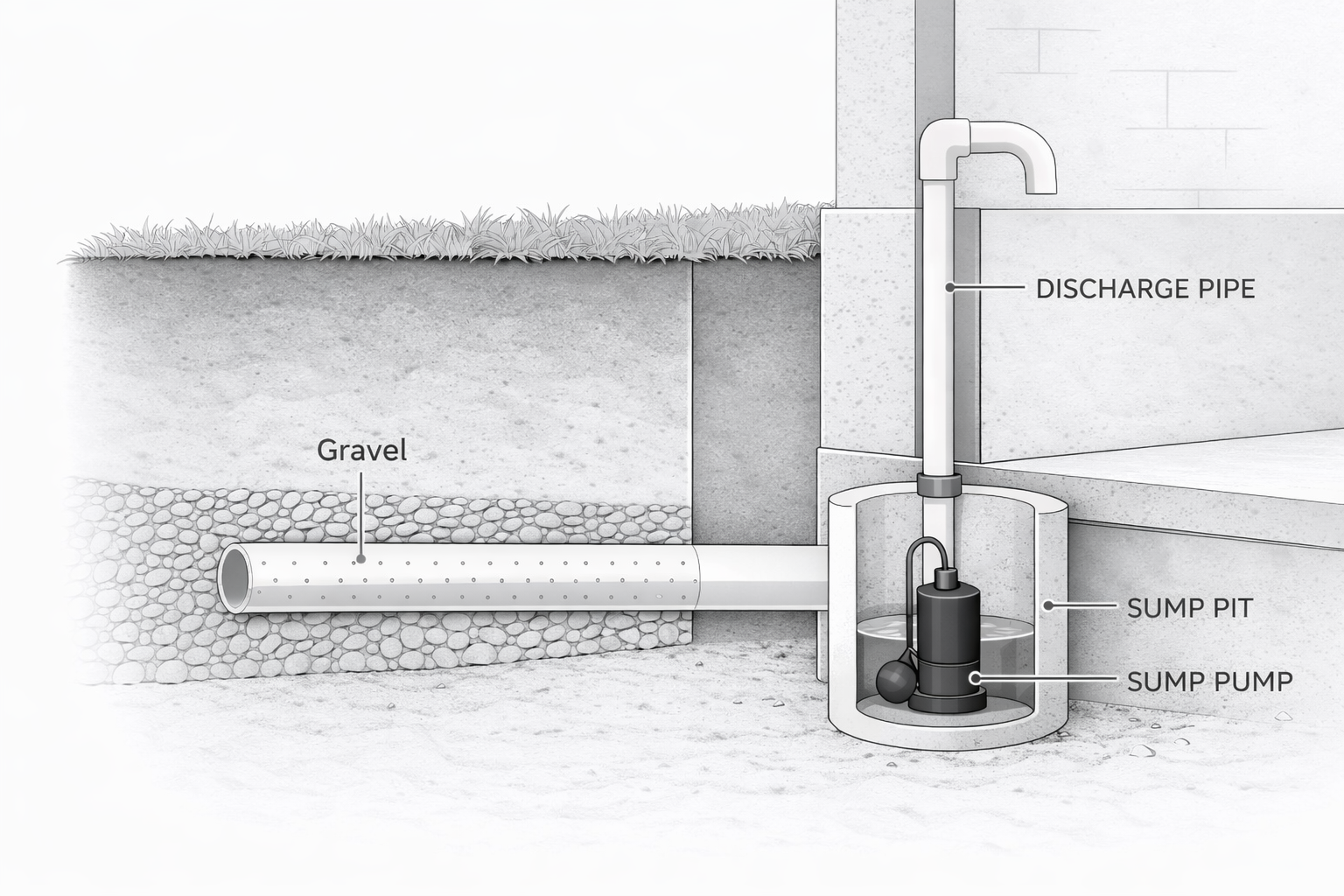
A French drain is the collection side. It gives water a lower-resistance path to enter gravel and perforated pipe instead of pushing through the basement edge.
A sump pump is the removal side. It takes the collected water from the pit and sends it away from the foundation.
That is why people often need both. One catches. One moves.
If you only install the drain, you still need somewhere for that water to go. If you only install the pump, you may still be leaving water pressure at the slab edge and wall joint with no collection path feeding the pit properly.
When You Actually Need the Combo

This setup earns its keep in pretty predictable situations:
- water is showing up at the perimeter of the basement floor
- the basement sits below a high or seasonally high water table
- the house is on clay or slower-draining soil and the foundation stays loaded after storms
- the basement is finished, so repeated seepage is now a durability and mold problem, not just an annoyance
- you are retrofitting an existing house where exterior excavation is either too disruptive or too expensive
- a gravity drain path is not realistic, so the water needs to be pumped away
That last point matters. In some sites, gravity can do the work. In many retrofit basements, it cannot. That is where the sump pump stops being optional and starts being part of the actual drainage design.
What People Get Wrong First
| If This Is the Main Problem | Start Here | Do Not Start Here |
|---|---|---|
| Roof runoff, short downspouts, or bad grading loading the foundation | Fix gutters, extend discharge, and correct the slope at the house | Cut the basement slab first |
| Water pushing in at the wall-floor joint or slab edge | Consider interior drainage tied to a sump system | Rely on coatings alone |
| Visible cracks, failed wall details, or exterior waterproofing defects | Pair drainage with crack repair or exterior correction | Pretend the pump alone solved the wall |
This is the part that saves money. You want the system that matches the water path, not the system that happens to be easiest to sell.
When the Combo Is Not the Whole Answer
This is where homeowners get sold sideways.
A drain-and-pump system is not a license to ignore the exterior.
If the grade is still pitched toward the house, if downspouts still dump next to the wall, or if roof water is saturating the backfill every storm, the interior system may still be forced to work harder than it should. That is how people end up saying the system “failed” when the bigger problem was that the property kept feeding it.
The combo also does not fix:
- settlement cracks that need repair
- failed exterior waterproofing details
- chronic humidity caused by poor ventilation and no dehumidification
- radon, unless that issue is addressed separately
- discharge lines that send the pumped water right back toward the foundation
If you are still dealing with visible wall leakage or crack-related entry points, foundation sealing tools and repair materials are part of the next conversation, not a replacement for it.
Interior vs. Exterior Drainage: Which Side Makes More Sense?

People ask this like one option is always “correct.” It is more situational than that.
Interior Systems
Interior perimeter drains are often the practical retrofit move in existing basements. They often cost less than full exterior excavation, avoid tearing up landscaping and walks, and connect directly to a sump pit. They are managing water after it reaches the foundation zone but before it can build up enough pressure at the slab edge.
Exterior Systems
Exterior drains and waterproofing are stronger when you are building new, already excavating, or doing major outside foundation work. They intercept water earlier. They also cost more, disrupt more, and are not small jobs on an existing house.
The Practical Answer
For many retrofit basements, interior drainage plus sump discharge is the realistic answer. For major rebuilds, new construction, or severe exterior water issues, outside work may be worth it.
What matters is not ideology. It is where the water is, what access you have, and what level of correction the house actually needs.
The Site Still Matters More Than People Want It To
A lot of basement articles treat grading and gutters like side notes. They are not side notes.
If your basement is wet, look outside before you romanticize the pump room.
- Are gutters undersized, clogged, or missing?
- Do downspouts discharge too close to the foundation?
- Has the backfill settled and reversed the grade near the wall?
- Is hardscape trapping runoff against the house?
- Does the lot send uphill water toward the foundation during storms?
Those are not extra questions. They are often the first questions.
A basement drainage system works better when it is part of a whole site-water strategy, not the only move anyone bothered to make.
What the Installation Really Involves
This is not the neat little weekend project some articles pretend it is.
An interior system often means:
- cutting and removing a strip of slab around the basement perimeter
- digging a trench at the foundation edge
- placing washed stone and perforated pipe
- routing that pipe to a sump basin at the low point
- installing the pump, check valve, lid, and discharge piping
- patching the slab back
That is why installed cost is driven less by the pump than by demolition, haul-out, trenching, disposal, concrete patch-back, access, and finish conditions. The article does not need fake-precise numbers to explain that. It just needs to be honest about where the money goes.
On an unfinished basement with easy access, the job is simpler. On a finished basement with utilities, framing, flooring, and careful patch-back needs, the job gets slower and more expensive fast.
What Usually Fails First
Not every bad outcome means the idea was wrong. A lot of these systems fail because the details are lazy.
| Failure Point | Why It Happens | What It Leads To |
|---|---|---|
| No backup power | Main pump loses power during storms | Flooding when you needed the system most |
| Discharge routed badly | Water exits too close to the house or into a bad location | Water cycles right back to the foundation zone |
| Poor maintenance | Pit fills with debris, float sticks, check valve fails | Silent failure until the basement is wet again |
| Weak site drainage | Roof runoff and surface water still load the foundation | System works harder than it should and may still be overwhelmed |
| No service access | The system was installed with no thought for inspection, cleaning, or repair | More invasive repair later |
| Open or sloppy sump pit | Cover, sealing, and moisture control were ignored | Odor, humidity, safety, and air-quality problems |
This is also where a lot of DIY confidence runs out. The hard part is not just putting pipe in the ground. The hard part is making the whole chain keep working when the ugly weather shows up.
What Pros Add That Homeowners Skip
These are the upgrades that often separate a workable system from a resilient one:
- battery backup or secondary backup pump for outages
- a sealed sump lid instead of an open basin
- check valve on the discharge line
- alarm or monitoring so pump failure is not discovered by stepping in water
- service access so the system can actually be maintained
- clear discharge planning that keeps pumped water away from the foundation and follows local rules
- freeze-aware discharge routing in cold climates so the line does not become its own problem
That does not mean every basement needs a deluxe setup. It does mean the cheapest version of the system is often not the smartest version of the system.
Do You Need a French Drain If Gutters and Grading Are Fixed?
Sometimes no.
If the basement moisture issue is mainly roof runoff dumped at the wall, short downspouts, clogged gutters, or shallow backfill settlement at the foundation, fixing those first may change the picture a lot.
If the basement is still taking on water from below or at the wall-floor joint after those corrections, then the drain-and-pump conversation becomes much more credible.
That is a better diagnostic order than jumping straight to a trench because the basement smelled damp once in March.
What About Crawlspaces?
Yes, sump pumps can make sense in crawlspaces too, especially low crawlspaces with chronic water entry or high seasonal groundwater.
But the same warning holds: a sump pump in a wet crawlspace does not replace drainage, grading, and vapor control. If the crawl stays damp, the job is not finished just because the pump runs.
FAQ
Do I always need both a French drain and a sump pump?
No. But in many retrofit basements, the drain and the pump solve different halves of the same problem. If gravity cannot carry the collected water away, the pump stops being optional.
Will an interior drain fix a wet basement permanently?
It can be a long-term fix when it is matched to the problem and supported by grading, gutters, downspouts, and discharge done correctly. It is not a magic patch for every exterior water issue.
Is an interior system better than exterior waterproofing?
Not automatically. Interior systems are often the more practical retrofit. Exterior correction is stronger when the outside wall is already accessible or the house has major exterior drainage failures that need direct correction.
Can I install this myself?
Only if you are comfortable with concrete cutting, trenching, slope, electrical coordination, discharge routing, and patch-back work. The system is simple in concept and unforgiving in execution.
Where should the sump discharge go?
Away from the foundation, with a route that does not send the water right back to the house and that complies with local requirements. This part is more local than many articles admit.
Do sump pumps need maintenance?
Yes. They need testing, pit cleaning, and occasional replacement. A system nobody checks is a system that fails in public.
Should the sump pit be covered?
In most basements, yes. A sealed or properly covered pit helps with moisture, safety, and air-quality issues and is a better long-run detail than leaving the basin open.
What To Do Next
If your basement problem also includes visible seepage through cracks, coatings and sealants belong in the next step, not as a substitute for drainage. Liquid rubber waterproof sealants are worth comparing once you know where a drainage system ends and where a wall-treatment decision begins.
If you are still sorting out crack repair and leak-stop materials more broadly, these foundation sealing tools and materials are the next practical read.
Bottom Line
A French drain and sump pump combo is not overkill when the basement is taking on water at the slab edge, below grade, or under pressure and gravity alone will not move it away.
It is overhyped when people sell it as the whole answer to a property that still sends roof runoff and surface water straight at the foundation.
The better way to judge the system is simple. First ask where the water is coming from. Then ask whether the site is still feeding the problem. Then decide whether you need collection, pumping, or both.
That is how the combo stops being a generic waterproofing package and starts acting like a real drainage strategy.