

Illustration by ArchitectureCourses.org. Foundation wall construction depends on footing support, reinforcement, waterproofing, drainage, and careful backfill working together.
A foundation wall can look straight and still be wrong.
That is the uncomfortable part. The wall may be plumb on pour day, the forms may come off clean, and the block courses may look tidy. None of that saves the job if the footing sits on weak soil, the rebar is in the wrong place, the drainage has no discharge path, or the wall gets backfilled before it can take the pressure.
The wall has to carry vertical load from the house. It also has to resist soil pressure, water pressure, frost movement, and the small mistakes that happen before anyone sees framing. Miss one buried step and the result can be wall cracks, basement leaks, mold, inward bowing, failed inspection, blocked service access, or wasted money after the house is already finished.
Read This Next: Foundation Footings if the footing depth, width, and bearing condition are not settled yet.
First, Know What the Wall Has to Do
| Job | What It Means in the Wall | What Fails When It Is Weak |
|---|---|---|
| Carry load | Transfer house loads down to the footing and soil | Cracks, settlement, sagging floors, distorted framing |
| Resist soil pressure | Hold back lateral pressure from backfill and wet soil | Wall thrust, bowing, horizontal cracks, inward movement |
| Control water | Work with membranes, drains, grading, and discharge | Leaks, trapped water, efflorescence, mold, damaged finishes |
| Connect to the frame | Hold anchor bolts, sill plates, and load paths in alignment | Air leakage, poor anchorage, failed inspection, weak uplift resistance |
| Survive backfill | Take soil load only after the wall is ready and braced as required | Cracking, bowing, shifted wall lines, expensive correction |
A foundation wall is not judged by the concrete alone. It is judged by the sequence around it.
Wall Type Comes Before the Schedule
The wall type changes the job. It changes crew skill, formwork, reinforcement, waterproofing details, schedule, access, and future repair risk.
| Wall Type | Where It Fits | Watch First |
|---|---|---|
| Poured concrete | Basements, taller walls, heavier loads, fewer joints | Form bracing, rebar placement, concrete consolidation, curing |
| Concrete block / CMU | Stem walls, crawl spaces, garages, smaller jobs, stepped sites | Reinforced cores, grout, mortar quality, joint water paths |
| Precast panels | Fast schedules, accessible sites, repeatable layouts | Crane access, panel joints, footing accuracy, sealant details |
| ICF walls | Basements and high-performance walls where structure and insulation are tied together | Bracing, concrete placement, penetrations, waterproofing compatibility |
CMU can work well. Poured concrete can work well. Precast can work well. The weak version of any of them leaks, cracks, or moves because the site and detailing were treated like side work.
Also Useful: Foundation Building Materials if you are still comparing concrete, block, ICF, precast, and other foundation systems.
Before the Wall: Soil, Layout, and Footing

Illustration by ArchitectureCourses.org. Site preparation and layout decide whether the wall starts on stable bearing or inherits a settlement problem from day one.
The foundation wall starts before the wall exists.
Strip organic material. Get to soil that can carry the load. Keep trench bottoms clean, firm, and not softened by standing water. Check the layout before forming. Check it again before pouring. A wall can be beautifully built in the wrong place, and that still gives you a bad foundation.
Frost depth matters in cold regions. Soil type matters everywhere. Clay, loose fill, wet bearing surfaces, and poorly compacted base material can turn a clean wall into a future crack story. Concrete does not correct bad ground under it.
This Part Matters: Foundations, Soil Analysis, and Site Investigation if the site has fill, clay, water, slope, or unknown bearing conditions.
The Sequence That Actually Matters

Illustration by ArchitectureCourses.org. Foundation wall work should move from layout and footing support to wall construction, waterproofing, drainage, and backfill in the right order.
1. Permits and layout
Get the required permit, survey or layout control, and structural drawings before excavation starts. This is not paperwork theater. A wall built without the right inspection path can hold up the project, fail inspection, or force expensive tear-out.
2. Excavate to the right bearing, not just the right depth
Depth alone is not enough. The bottom of the excavation has to be suitable bearing material, not soft fill, mud, frozen soil, roots, or loose debris. If the trench bottom is wet and smeared, stop. Pouring over a bad base locks the mistake under the house.
3. Build the footing forms and hold the steel where it belongs
Footing forms need to stay straight and level. Rebar needs proper cover and support so it does not sit on the ground or drift during the pour. “Rebar was present” is not the same thing as reinforcement doing useful work.
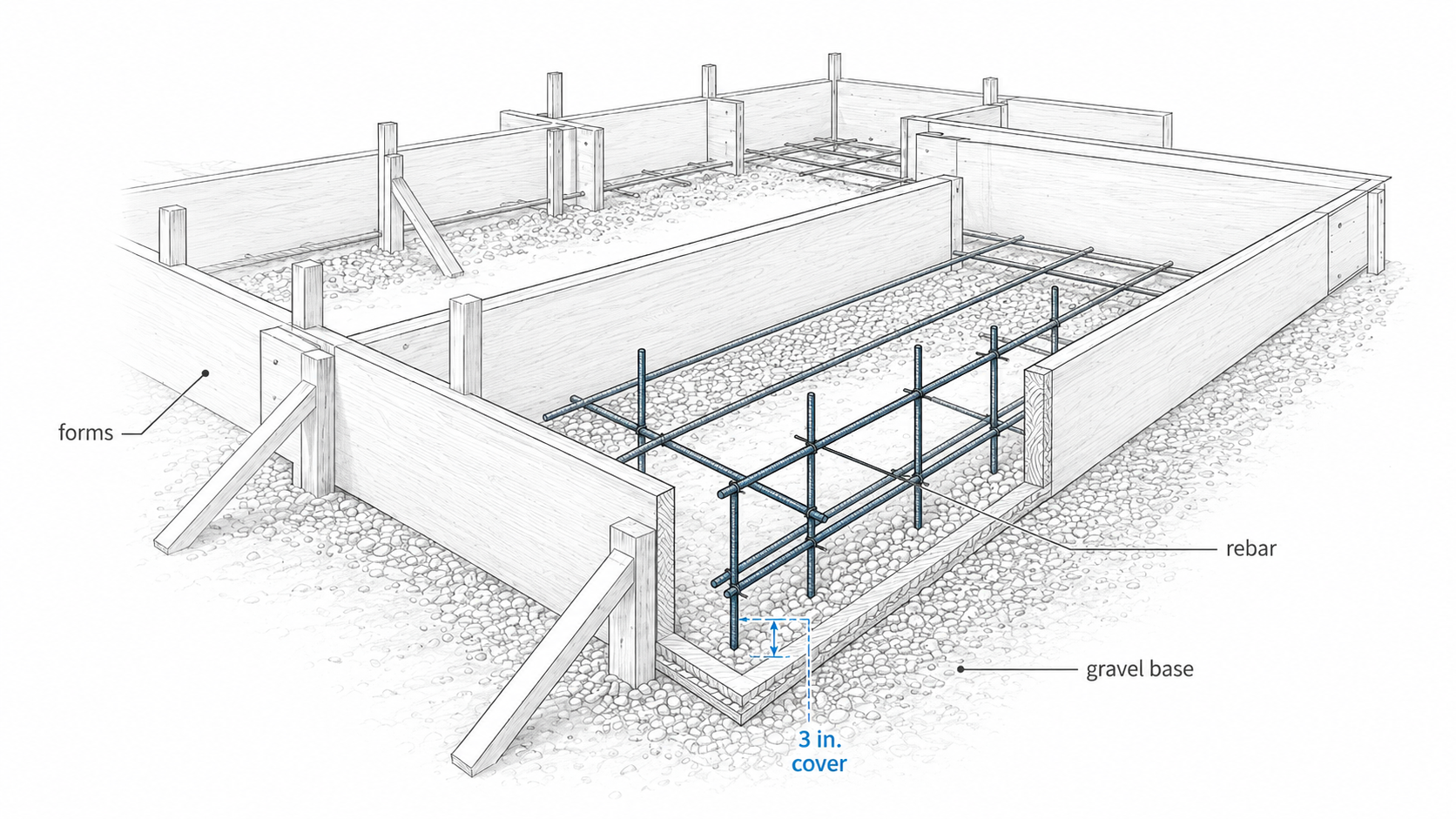
Illustration by ArchitectureCourses.org. Footing forms hold the concrete shape while rebar stays inside the pour with proper cover above the gravel base.
For wall dowels, vertical bars, and keyways, follow the drawings. Guessing here can break the load path between footing and wall.
4. Pour the footing and protect the cure
The footing is the base of the wall. Do not treat it like a disposable first step. Place concrete evenly, consolidate where needed, keep the top reasonably level, and protect the cure from drying too fast, freezing, or being loaded too soon.
5. Build the wall system
For poured concrete, the forms do a lot of the work before the concrete arrives. Weak bracing, poor ties, leaky corners, and sloppy alignment can show up as bulges, honeycombing, blowouts, or wall lines that make framing miserable.
For CMU block, the first course matters more than any other course. If it starts wrong, the wall keeps repeating the error upward. Keep units level, stagger joints, reinforce the required cores, grout properly, and do not pretend mortar alone is structural magic.
6. Set anchor bolts and the wall top carefully
Anchor bolts tie the framing to the foundation. They need the right spacing, embedment, edge distance, and alignment with the sill plate. A misplaced bolt is not just annoying. It can delay framing, force field fixes, or weaken the connection that should transfer wind and lateral loads.
7. Waterproof before the wall disappears
Exterior waterproofing and dampproofing are not the same thing, and neither one works well when applied over dirt, loose surface material, bad seams, or unsealed penetrations. Pipes, joints, cold joints, tie holes, and corners need attention before backfill hides them.
Worth Knowing: Exterior Foundation Waterproofing if the wall is below grade or the site has any serious water risk.
8. Drainage needs a destination
A perforated pipe beside the footing is not a drainage system unless the water has somewhere to go. Daylight outlet, sump, storm connection where allowed, gravel envelope, filter fabric, slope, and cleanouts all matter. A buried pipe with no real discharge path is decoration under soil.
9. Backfill slowly enough that the wall survives it
This is where good walls get damaged. Backfill too early, use heavy equipment too close, dump wet clay against the wall, or compact aggressively before the wall is ready, and you can create the wall movement you were trying to prevent.
Backfill in lifts. Protect waterproofing and insulation. Use drainage board where needed. Keep large rocks, debris, and construction trash away from the wall. Do not let the final buried step become the step that ruins the job.
10. Final grade and inspection
The grade should fall away from the wall. Gutters and downspouts need a discharge plan. The wall should pass the required inspection before framing piles more work on top of it.
Tools and Materials Worth Naming

Illustration by ArchitectureCourses.org. Foundation wall tools matter most when they control layout, level, reinforcement, bracing, and concrete placement.
The old version of this article had a long tool list. Long lists look helpful and usually are not. The important tools are the ones that keep the wall straight, reinforced, braced, placed, and inspected.
| Item | Why It Matters | Where It Goes Wrong |
|---|---|---|
| Laser level, builder’s level, mason’s line | Controls elevation, square, and wall line | Small layout errors become framing and door problems later |
| Forms, stakes, ties, bracing | Hold concrete in the right shape under pressure | Weak formwork bows, leaks, or fails during the pour |
| Rebar, chairs, ties, dowels | Keep reinforcement in the right position | Steel at the bottom of the pour does far less useful work |
| Concrete or CMU, grout, mortar | Forms the structural wall system | Wrong mix, too much water, poor consolidation, weak mortar joints |
| Waterproofing membrane, drainage board, footing drain | Controls below-grade water before it reaches the interior | Gaps, damaged membrane, blocked drains, no discharge path |
| Anchor bolts and sill gasket | Connect framing to the foundation and limit air leakage at the sill | Misplaced bolts, missing gasket, poor embedment |
Block Walls Are Less Forgiving Than They Look
Concrete block looks simple because it is built piece by piece. That does not make it casual.
Every joint is a potential water path. Every ungrouted reinforced core is a missed structural opportunity. Every sloppy first course forces correction higher up the wall. If the site is wet, the wall is tall, or the soil pressure is high, a lightly reinforced block wall is not the place to save money.
Block can be the right answer for garages, crawl spaces, short stem walls, and stepped conditions. It needs honest reinforcement, grouted cells where required, proper footing support, and exterior water control.
Poured Walls Depend on Formwork Discipline
Poured walls are often stronger and cleaner below grade because there are fewer joints than block. That does not mean they are mistake-proof.
The formwork has to resist wet concrete pressure. The reinforcement has to stay in position. The concrete has to be placed and consolidated so it does not leave honeycombing, voids, weak cold joints, or exposed reinforcement. The curing period still matters after the surface looks hard.
The expensive mistake is rushing from “forms stripped” to “backfill done” because the wall looks finished.
Waterproofing and Drainage Are One System
Water does not care which trade installed which piece.
A membrane without drainage can still sit under pressure. A footing drain without clean gravel and fabric can clog. A downspout dumping beside the wall can overwhelm a good detail. Final grade sloping toward the house can undo careful wall work in one rainy season.
The wall needs a water path that makes sense from roof to grade to footing drain to discharge. If that path is broken, the basement or crawl space gets the consequence: leaks, mold, wet insulation, damaged finishes, and repair bills that should have been avoided before backfill.
Related Reading: Basement Foundations Basics if the wall is part of a full basement system with drainage, waterproofing, and usable below-grade space.
Insulation Comes After Moisture Is Under Control
Foundation wall insulation can improve comfort and reduce heat loss. It can also trap condensation or hide dampness if the water problem is still active.
Do not insulate a leaking wall and call it upgraded. Fix the water source first. Then choose the insulation approach.
| Insulation Approach | Where It Fits | Main Risk |
|---|---|---|
| Exterior rigid insulation | New construction, high-performance basements, walls before backfill | Damage during backfill, insect detailing, poor protection board |
| Interior rigid foam | Retrofit basements after moisture is controlled | Trapping moisture if the wall is still wet |
| Spray foam | Irregular surfaces and rim/sill areas where air sealing matters | Wrong product, poor substrate, hiding active leaks |
| Framed wall with batt insulation | Finished basement interiors only with proper moisture strategy | Mold and rot if damp concrete, air leakage, or vapor control is wrong |
Exterior insulation often performs better because it keeps the concrete warmer and can protect the wall assembly, but it has to be detailed before backfill. Interior insulation is common in retrofits because it is easier to install later. Easier does not mean safer if the basement still leaks.
Where Foundation Wall Jobs Fail

Illustration by ArchitectureCourses.org. Foundation wall failures usually trace back to weak footing support, misplaced reinforcement, water pressure, early backfill, or poor inspection timing.
| Better Move | Common Mistake | Consequence |
|---|---|---|
| Confirm soil and footing design before wall work starts | Assume the trench is fine because it looks flat | Settlement cracks, sagging floors, uneven load transfer |
| Hold rebar in position with proper cover | Let steel sit low, drift, or get buried wrong | Cracking, weak tension resistance, failed inspection |
| Brace forms and corners heavily | Treat formwork like temporary carpentry that only needs to look close | Bulged walls, blowouts, wasted concrete, poor framing lines |
| Waterproof, drain, and protect the wall before backfill | Rely on concrete alone to keep water out | Leaks, mold, wet insulation, damaged finishes |
| Backfill after the wall can take the load | Push soil against fresh or unsupported walls too early | Wall bowing, cracking, lateral movement |
When This Is Not a DIY Job
A short block stem wall for a small detached building is one thing. A full basement wall carrying a house and holding back wet soil is another.
Call a structural engineer or qualified foundation contractor when the wall is tall, the soil is questionable, the site is sloped, the wall retains significant soil, the project is in a seismic or high-wind region, or the design has concentrated loads from beams, masonry, garage openings, or heavy framing above.
I would not treat wall design as a place to improvise. Once the wall is backfilled and framed over, every buried mistake becomes harder to inspect and more expensive to correct.
Fast Answers
What is the best foundation wall type?
There is no single best wall. Poured concrete is common for basements because it has fewer joints and good strength when reinforced and cured well. CMU works when the wall is properly reinforced, grouted, waterproofed, and drained. Precast works when the site has access and the layout fits the system.
Can I build a foundation wall myself?
For small, non-critical work, maybe. For a house foundation, basement wall, retaining condition, tall wall, or questionable soil, this is not beginner work. Bad wall work can mean leaks, bowing, failed inspection, and structural repair later.
How deep should the footing be?
It depends on frost depth, soil bearing, building load, and local code. Do not copy a generic number from the internet and pour. The footing needs to sit on suitable bearing and meet local requirements.
Do foundation walls need rebar?
Often, yes, especially in poured concrete and reinforced CMU walls. The exact layout depends on wall height, soil pressure, loads, seismic conditions, and code. Steel in the wrong place is not much better than missing steel.
Can a foundation wall be waterproofed from the inside?
Interior work can manage water after it enters. It does not remove exterior pressure from the wall. For new construction and serious below-grade work, the outside water path should be handled before backfill.
How soon can you backfill a foundation wall?
Only after the wall has cured or gained enough strength and is braced as required. The safe timing depends on wall type, concrete strength, weather, height, backfill material, and whether the floor system or temporary bracing is in place.
What is the most common expensive mistake?
Backfilling and grading like the wall is already finished. That is when waterproofing gets torn, drainage gets buried wrong, fresh walls get loaded too early, and future leaks get built into the job.
Read Next
This Part Matters: Foundation Footings if you need the wall support below grade sorted first.
Also Useful: Foundations, Soil Analysis, and Site Investigation if the soil, water, or slope is still unclear.
Worth Knowing: Exterior Foundation Waterproofing if the wall is below grade and water control is part of the job.
One More Thing: Reinforced Concrete Foundation if the reinforcement and concrete behavior need a deeper explanation.