
Crafting Better Buildings Through Computational Design
Parametric design gets treated like a visual effect, but it is more like a rule-based system for smarter building. Instead of drawing shapes one by one, you set conditions. The model updates itself. A curve shifts when the room widens. A facade panel rotates when the sun hits at 3 PM. The building responds.
If you want to see a basic application of this mindset, check this intro to parametric buildings.
What Parametric Design Really Means
Instead of sketching every angle, you define the logic. Example: every window must be 1.2 meters wide and tilt 20 degrees if the facade faces south. You write it once, then the whole building follows the rule. Change the rule, everything updates. That is the parametric cycle.
This is why tools like Grasshopper and Rhino are popular. You are not just modeling. You are building a system. If you need a breakdown of core tools and when to use them, see this tool guide for parametric work.
Parametric Design in Real Buildings
Parametric design is not here to make everything wavy. It makes buildings work harder. It gives glass, steel, and concrete the same flexibility as plant tissue or insect shells.
Adaptive Facades
A static wall is a thermal burden. A responsive one can cut heat, bend shade, or bounce wind. That is where parametrics matter. The geometry updates in real time, tied to inputs like sun angle, time of day, or temperature.
Example: Al Bahar Towers, Abu Dhabi
Each facade panel opens or closes depending on how the desert sun hits it. The geometric logic came from mashrabiya patterns, rebuilt as a sensor-driven parametric grid. It dropped heat gain by more than 50 percent, and the building looks alive.
Light and Temperature Logic
Plants patterned this logic first. Leaves rotate for light. Flowers open or shrink for heat. Buildings can do the same. Architects are now running daylight, shadow, and thermal maps before they even pick finishes.
Example: The Eden Project, UK. The biomes were shaped to match solar angles in the Cornish valley. Hexagon cells shift their pitch based on load and light requirements. The result: a giant greenhouse you can actually heat without an oil rig.
Structural Performance
Parametrics let you test 50 structural versions in one afternoon. Engineers can feed load cases straight into the form. The geometry bends or thickens based on stress.
Example: The Guangzhou Opera House. Zaha Hadid’s team didn’t sketch those smooth forms by hand. The script found the strongest shell layout against local wind and seismic forces. Steel count dropped. Stability went up.
How the Parametric Process Works
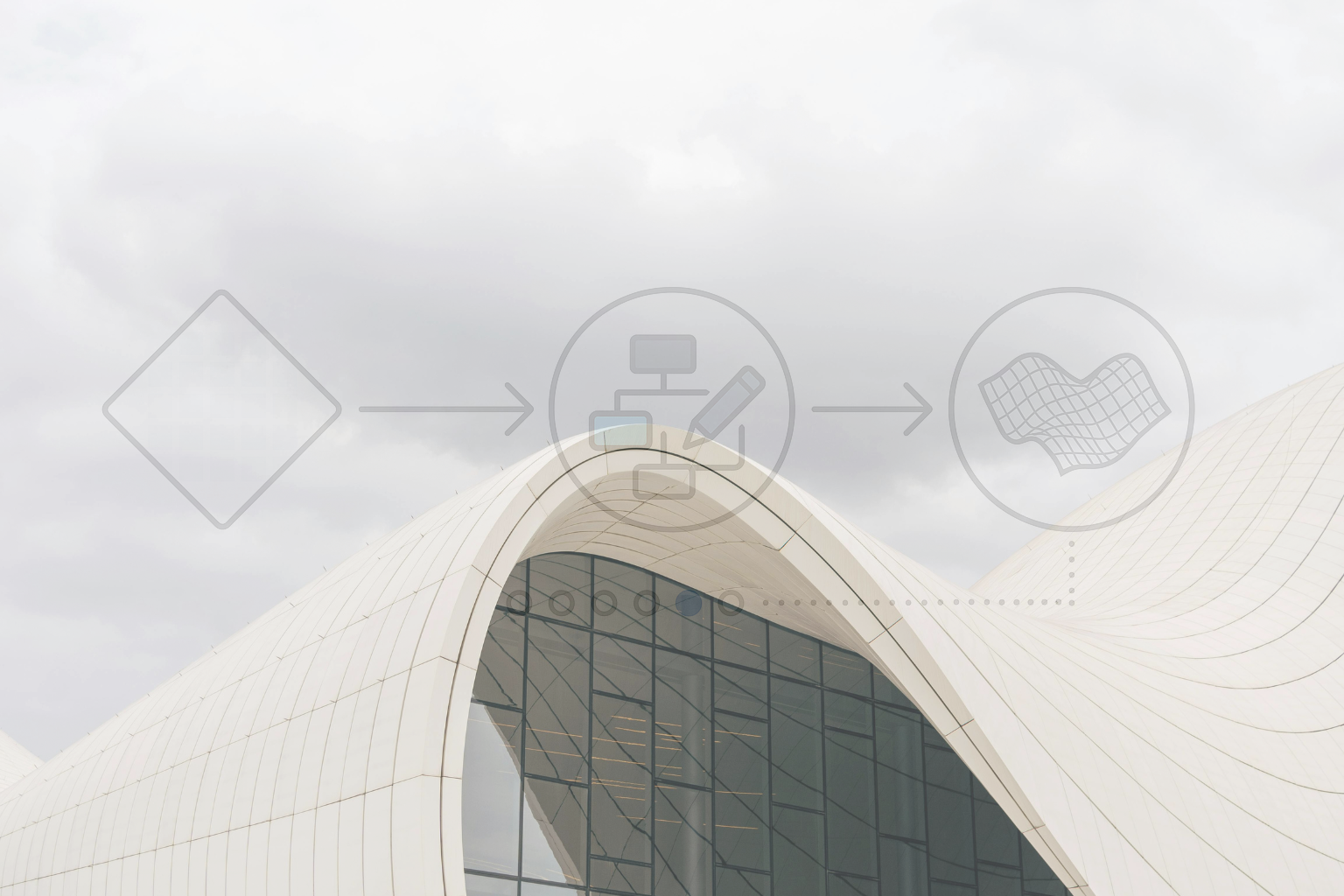
This is the loop most offices run. It works on towers, chairs, bridges, shading fins, and drainage. Same logic. Different inputs.
1) Set the parameters
- Basics: total floor area, max height, spans, glazing percentage, daylight targets, budget.
- Site and climate: sun path, prevailing wind, streets, views, noise, code clearances.
- Fabrication limits: panel sizes, stock lengths, bend radii, transport limits, lift capacity.
Real example, facade start: A team sets these inputs for a hot climate office block. Window-to-wall 45%. Max fin depth 350 mm. Target glare below 5000 cd/m² at eye level from 10 a.m. to 3 p.m. Panels must fit on a 1.5 m by 3.0 m pallet. Those numbers become the guardrails for every option.
2) Build the algorithm
- Tools: Grasshopper, Dynamo, or a light script.
- Nodes: geometry generators, solar vectors, daylight calc, wind pressure ranges, cost tags.
- Outputs: massing, structure lines, facade families, takeoffs.
Real example, shell and structure: The team maps column spacing to span limits. If a span jumps above 9 m, the graph thickens the slab or adds a beam. If wind load crosses a threshold, the shell stiffens at the ridge. No guessing. The node does the work.
3) Generate
- Spin 20 to 100 variants by moving sliders inside the limits.
- Keep a clean naming scheme. Option_14_Angled_Fins_300mm. No mystery files.
Real example, massing set: The office produces 36 massings for a mixed-use block. Same floor area. Different step-backs and courtyard sizes. The model tracks winter sun to the courtyard and shadows on neighbors. The weak ones drop out fast.
4) Test
- Solar and daylight: useful daylight, glare, direct beam control.
- Structure: deflection, utilization, weight.
- Comfort and energy: cooling loads, natural ventilation potential.
- Cost and buildability: part counts, panel families, shop repeats, install time.
Real example, fins that earn their keep: Five facade variants run through the daylight and cooling model. Variant C cuts glare 35% and trims cooling by 8% with a simple 12-family fin kit. Variant D looks exciting but adds 140 unique parts and longer install time. C wins on real numbers.
5) Refine
- Adjust inputs that move results the most. Leave the rest fixed.
- Lock a baseline. Save the state. Push one change at a time.
Real example, lobby roof: The roof shell is light but flutters near service bays. The team adds a shallow rib where analysis shows peak deflection. Weight rises 3%. Vibration drops below target. The model updates shop lengths and connections in one pass.
6) Document
- Drive drawings from the live model. Schedules, takeoffs, and details stay in sync.
- Freeze the rule set for issue. Keep a copy for late change control.
Real example, balcony family: One parametric family controls width, projection, drain slope, and guard height. Sales swaps finishes without redrawing. RFIs fall. The schedule pulls right from the family.
Full Loop Walkthrough: Large Cultural Building
Brief: 50,000 m² cultural venue. Two main halls. Big lobby. Target EUI under a strict cap. Limited budget for unique parts.
- Parameters: two spans at 24 m and 30 m. Max roof depth 1.2 m. Lobby daylight target 300–500 lux for 60% of open hours. Glass under 50% on the west. Panel size cap 1.2 × 3.0 m. Truck length 12 m.
- Algorithm: shell generator tied to spans; rib spacing linked to deflection; facade module linked to sun; cost node tied to part families.
- Generate: 42 massings with different roof slopes and lobby voids. Keep six best on daylight and structure.
- Test: shell utilization maps. Daylight for lobby. Cooling vs fin depth. Takeoff per option. Two finalists land within 2% cost and hit comfort targets.
- Refine: pick the lighter shell. Add ribs only where stress peaks. Swap glass spec on west. Lower fin count by grouping angles into families.
- Document: export rib schedules, panel maps, connection types. The shop gets clean families and repeats. The site team gets fewer unique parts.
Result: a roof that reads smooth because the structure follows forces, a lobby that feels bright without glare, and a facade kit that a factory can make and a small crew can install.
Same Logic, Other Scales
Chair, small run: Inputs are seat height, back angle, stock sheet size, and CNC bit diameter. The script nests parts on sheets, rounds tight corners that would burn, and keeps a minimum edge distance for screws. You change the seat angle by 3 degrees. The joints and toolpaths update. Waste drops. Time in shop drops.
Footbridge: Inputs are span, walking load, deck width, and stock steel lengths. The model limits member sizes to what a small crane can lift. If a node goes over stress, the script ups the section or adds a brace. You always stay inside parts a regional shop can cut and weld.
Shading fin kit for a school: Inputs are class times, glare limits at desks, and a fixed budget. The graph rotates fins by season and time of day, then snaps angles into a short list so the shop repeats parts. Teachers get soft light. The district gets a clean bid.
Drainage for a plaza: Inputs are slope, rainfall, inlet size, and max ponding depth. The surface model shifts paver elevations to keep slope within code. Inlet spacing adjusts to keep ponding below the cap. Maintenance gets simple repeats. No hidden low spots.
How To Make It Easy To Use
- Two sliders beat twenty. Let users move the variables that matter. Lock the rest.
- Name nodes in plain language. “Max fin depth” is better than “Parameter_07.”
- Group by purpose. Inputs, generators, tests, and outputs in four neat blocks.
- Save states. Keep snapshots with input values noted. You will need to defend choices.
- Tag cost early. A cheap counter at concept level prevents heartbreak later.
Common Mistakes
- Pretty but unbuildable. If it cannot be cut, bent, shipped, and fixed, it is a picture, not a design.
- Graphs that only one person understands. If the author gets sick, the project should not stop.
- Too many unique parts. Group parts into families. Shops like repeats. Budgets do too.
- No feedback loop. If you are not testing, you are guessing.
Cheat Sheet
- Write targets first. Lux, glare, EUI, spans, budget.
- Build a tiny graph. Ten nodes that do real work.
- Generate ten options. Kill eight fast. Compare two well.
- Lock a baseline. Then detail from the live model.
A full example of this loop is shown in this Heydar Aliyev Center breakdown.
Case Study: BIG’s 8 House, Copenhagen
The 8 House wasn’t a sketch. It was a rule. A loop of paths that always connects the ground to the roof. Every housing block was driven by daylight rules. Every void was controlled by community-space parameters. Parametric steps made the form look impossible, but the system kept it simple to build: slabs, courtyards, ramps, and terraces repeat through a single logic.
The project didn’t try to be iconic. It tried to run a neighborhood up a slope. That is what makes it last.
Parametric Design and Structural Engineering
Engineers use parametrics to shrink waste and improve stability. The Bird’s Nest (Beijing) is famous because of its shape. The real win was internal: the diagonal grid was tested by thousands of script iterations before steel was cut.
One version looked better. Another weighed less. A third needed fewer welds. The final design balanced visual impact with fabrication time. That is why parametrics matter. They give you control over the tradeoffs.
Thinking Parametrically
This is a mindset shift. Don’t draw forms. Draw rules. Don’t model glass. Model light. Stop thinking in “pieces” and start thinking in “relationships.” This is how plants, shells, waves, and bone all scale without breaking.
Example: The Gherkin uses 6-degree facade rotation per floor, which had nothing to do with style. It was airflow math. The form breathes through the skin. That’s where the “design” lives.
Software That Produces Work You Can Build

- Rhino + Grasshopper. Best for forms that need custom logic. Strong plugin ecosystem. Easy to test ideas fast.
- Revit. Strong when you need drawings, schedules, and coordination. Good for assemblies and families with rules.
- Fusion 360. Useful for parts, joints, and fixtures. Tight control of tolerances and motion.
- CATIA. Heavy but reliable for complex shells, stadium bowls, and aerospace-style precision.
For a plain-spoken tool map, use this overview of parametric tools for architects and engineers. If you want applied building logic, this building-focused guide is direct and practical.
Comparison of Parametric Design Tools
| Tool | Key Features | Best For | Notable Projects |
|---|---|---|---|
| Rhino | Freeform modeling, precision, plugin support | Complex 3D models | Heydar Aliyev Center |
| Grasshopper | Visual programming, parametric design integration with Rhino | Algorithmic design, complex forms | Gherkin Tower |
| Revit | BIM support, parametric modeling | Structural engineering, building design | Beijing National Stadium |
| Fusion 360 | Cloud-based, parametric and direct modeling | Product design, engineering | Various product designs |
| CATIA | Aerospace-grade parametric modeling, complex geometry | High complexity design, aerospace and automotive | Airbus A380 |
| SolidWorks | Parametric modeling, engineering-focused | Engineering, mechanical design | Industrial machinery |
Where It’s Heading
The next wave isn’t just geometry. It’s AI. Buildings won’t just adapt to weather. They’ll predict it. They’ll tune thermal mass at night and funnel wind in summer. The facade will train itself over years of data.
If you want a cleaned-up overview of AI meeting architecture, there's one here: parametric facades and adaptive skins.
FAQ
What problem does parametric design solve?
It removes the need to redraw every time a condition changes. One logic drives every output.
Do I need to code?
You need logic, not syntax. Grasshopper is visual. Start there.
Can I use parametrics in small architecture?
Yes. Pergolas, stair cores, canopies, benches. Anywhere rules help.
Does this replace architects?
No. It replaces repetition. Design decisions still need judgment.
How does it help sustainability?
By letting you test 500 orientations, shading angles, and facade skins before you build once. That saves energy and materials.
Final Word
The point of parametric design isn’t curves. It’s control. Rules in, clarity out. Whether you’re sculpting a stadium bowl or a sunshade bracket, the method is the same: build the logic before the thing.
You can read more about real façade cases in this practical guide to parametric buildings.