
Framing a Cottage Roof for Snow and Wind: Practical Details
Most people think you can “get away with a lot” on a cottage roof—like it needs less discipline because it’s smaller, older, or “just a cabin.” That mindset is how cottages get slow structural problems that nobody notices until doors start sticking and the ridge line looks tired from the yard.
A cottage is often more exposed than a house in town: open wind, drifting snow, fewer sheltered corners, and usually more temperature swing because it’s not heated consistently. Add in the usual cottage upgrades—opening a ceiling, cutting in a skylight, tying in a porch roof—and the framing starts telling on itself. Not dramatic failure. Just movement.
This is the practical framing logic that keeps walls from spreading, ridges from sagging, and roof sheathing from turning into a wavy trampoline.
-
Ridge board vs ridge beam, and why the difference matters
-
Rafter ties, collar ties, and what happens when you remove them
-
Bracing that stops sway, twist, and long-term “creep”
-
Sheathing thickness, fastening, and why some roofs feel soft underfoot
-
When trusses are the smarter choice for a cottage addition
The common misunderstanding: “the ridge holds the roof up”
Most small cottages have a ridge board, not a ridge beam. Those two words sound similar. Structurally, they are not even in the same category.
A ridge board is alignment. It gives the rafters something clean to land on so the roof planes meet neatly. It does not carry vertical load by itself. The load path is rafter to wall, and the opposing rafters push against each other at the ridge.
A ridge beam is structure. It carries roof load down into posts and bearing points. It lets you run a cathedral ceiling without relying on rafter ties to stop wall spread, because the rafters can hang off a beam instead of “leaning” on each other.
Decision rule. If you want an open ceiling and you plan to remove ceiling joists or rafter ties, you need a real load path that replaces what you removed. That is usually a structural ridge beam, or engineered alternatives. If the plan is “remove ties and add a few collar ties up high,” that is where cottages start to move.
People learn this the annoying way. They open the living room ceiling, love the look for a year, then doors start sticking and the ridge line looks tired from the yard. Not dramatic failure. Just slow geometry drift. A cottage is light. Light frames move sooner when you take away the parts that were quietly doing the hardest job.
If you want a deeper overview of how roof systems are supposed to work as a whole, this primer helps: roof structure basics.
For ridge specifics, this is the clean reference point: what ridge beams do in roof framing.
Rafter ties vs collar ties: stop mixing them up
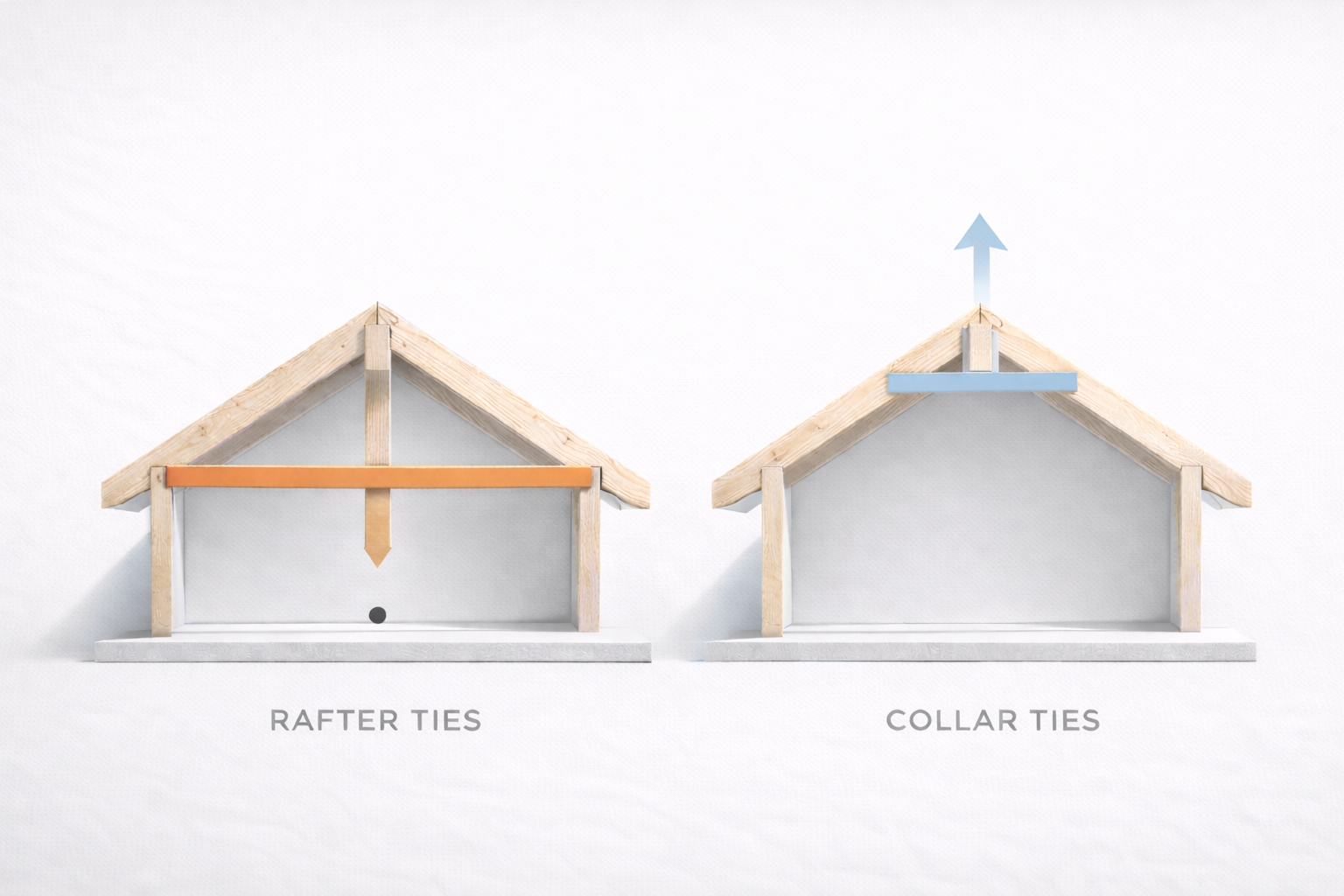
This is the forum classic: “I have collar ties, so I’m good.” The problem is collar ties and rafter ties solve different forces.
Rafter ties live in the lower third of the rafter height. In many cottages, the ceiling joists are doing this job by default. Their main role is to keep the exterior walls from spreading under roof load. Think of them as a tension strap across the building.
Collar ties live up high, closer to the ridge. Their main role is uplift resistance and keeping the ridge connection from peeling apart in wind. They do not replace rafter ties for wall spread control. They are not “the same thing but higher.” That is how people end up with a roof that looks fine until snow load shows up.
Decision rule. If your roof is framed with rafters and a ridge board (common in older cottages), and you want a vaulted ceiling, you cannot just delete the bottom ties and call it a day. You either keep rafter ties in the lower third, or you move the load path to a structural ridge solution, sized and supported for your span and snow zone.
Trade off. Keeping ties low is cheaper and simpler, but it limits the “open ceiling” look. A structural ridge beam buys you the open volume, but it adds posts, bearing, and point loads that your foundation and layout need to handle. Speed versus long term stability is the real choice here, not “open ceiling or not.”
This breakdown stays focused and clear: rafter ties versus collar ties. If you also want the vocabulary around collar beams, this page is useful: collar beams in roof construction.
How cottages fail quietly: spread, sag, and twist
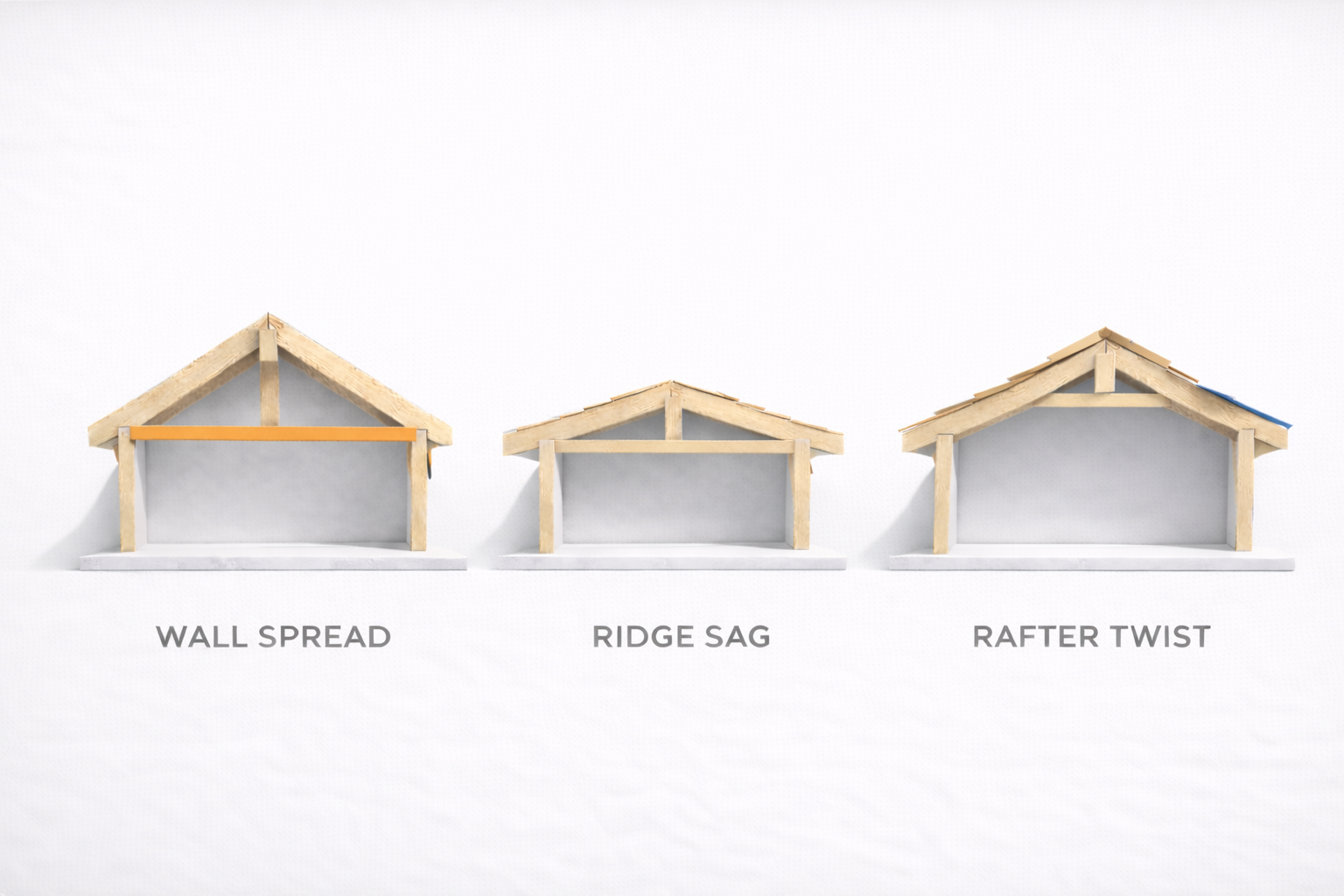
Most cottage roof framing problems show up as geometry issues before they show up as leaks. That’s good news, because it gives you time to catch it early.
Wall spread. Look for outward bow in the top of exterior walls, drywall cracks that mirror the roof slope, or a ridge that looks lower than it used to. In older cottages with plank roof decks, you can also see nail lines pulling or gaps opening at joints.
Ridge sag. A slight ridge dip is common in older structures, but fast change is a red flag. The cause is often cumulative creep: undersized rafters for current snow loads, missing ties, or a ridge board that was never meant to act like a beam.
Rafter twist. You see this as a wavy roof plane, shingle lines that look “drunk,” or sheathing edges that lift. Twist is not just aesthetic. Twisted rafters unload and reload connections with wind, and fasteners start to work loose over time.
Decision rule. If the roof line is changing, do not jump to cosmetic fixes first. Start by confirming what the roof is: rafter and ridge board, or truss, or ridge beam system. The correct fix is different for each, and the wrong fix can lock in movement instead of stopping it.
One more reality check: anything that changes load paths, removes ties, or adds point loads can be permit and engineer territory depending on jurisdiction. The framing concepts travel well, but the approval process does not.
Bracing: the boring wood that keeps the roof from “walking”
Bracing is where cottage roofs go from “fine on paper” to “fine after ten winters.” Most framing shortcuts are bracing shortcuts.
Rafter bracing and blocking. Long rafters want to buckle and twist. Solid blocking at bearing points, mid span bracing where needed, and clean connections at the ridge keep them behaving like designed members instead of long springs.
Gable end stability. Gable ends catch wind. If the gable wall is poorly braced to the roof diaphragm, the roof can rack. The shingles do not tell you this. The interior drywall does, later.
Lateral restraint. Trusses need bracing, rafters need restraint. Different details, same goal: stop slender members from moving sideways under load. Many cottage repairs ignore this and focus only on “stronger lumber,” then wonder why the roof still feels soft.
Trade off. Bracing costs time, not glamorous materials. Crews that are paid by speed tend to under do it, because the roof still stands on day one. The payback is long term stiffness, fewer nail pops, flatter roof planes, and less crack chasing indoors.
If you want a clean overview of bracing intent and why it matters, start here: what roof bracing is. If your cottage uses trusses anywhere, this is the companion piece: truss bracing and roof support systems.
Sheathing and fastening: why some roofs feel “spongy”
Cottages get a lot of “light rehab” work. New shingles, new underlayment, maybe a few sistered rafters. Then someone walks the roof and it still feels bouncy. That is usually sheathing and fastening, not shingles.
Thickness matters. Sheathing that is too thin for the rafter spacing will deflect between supports. You feel it underfoot, and shingles telegraph it with time. This is worse on 24 inch spacing, and worse again when rafters are not perfectly straight.
Edge support matters. Panel edges need support. If edges float, they lift and drop with load cycles. That movement loosens fasteners. Once fasteners loosen, panels squeak and the roof diaphragm gets weaker.
Nailing patterns are not trivia. Fastener spacing and placement change diaphragm behavior. Over drive the nails and you crush fibers and reduce holding. Under nail and the diaphragm is softer than you think. Both show up as movement.
Decision rule. If you are re sheathing a cottage roof, match the panel thickness and fastening to the framing spacing and the local wind and snow exposure. If the cottage is in a high snow zone or open wind exposure, do not assume “standard” is enough without checking.
This is the most practical reference for panel choices: roof sheathing thickness and material choices. If you are planning a tear off, this guide is a useful companion for scope and sequence: replacing roof sheathing basics.
Rafters versus trusses for cottage additions
Lots of cottages get the same upgrade: a small addition, a dormer, a bumped out kitchen, a new covered porch. The roof framing choice is where the project either stays simple or becomes a multi trade headache.
Stick framing with rafters. Great when you need flexibility, odd geometry, or you are tying into an existing rafter system and want field adjustability. The price you pay is more layout time, more potential for variation, and more reliance on good bracing and tie discipline.
Trusses. Great when you want repeatability and a clean engineered package. The price you pay is lead time, delivery logistics, crane or lift planning, and strict rules about cutting or modifying anything. People ignore that last part, then try to “fix” it with plywood patches. Bad idea.
Decision rule. If the addition roof is simple and you can keep the bearing and load path clean, trusses often reduce risk. If the addition needs to knit into messy existing framing, rafters can be easier to integrate. Either way, once you touch structural members, local code and permitting rules may apply.
If you want the baseline overview of truss types and where they fit, start with: roof trusses explained. For the mistakes that show up on real jobs, this is worth reading before you order anything: residential roof trusses and common mistakes.
Roof shape in cottages: keep it simple, keep it buildable
Most cottage roofs are some version of gable, shed, or a gable that got modified over time. The framing rules stay consistent, but the failure modes shift depending on shape.
Simple gable. Easiest load paths, easiest ventilation, easiest to brace. The usual problems are missing ties, under braced gable ends, and old rafters that were sized for a different era of snow assumptions.
Shed additions. Common on cottages because they are cheap and fast. The usual problems are low slope ventilation, ice dam risk at the transition, and ugly load transfers if the new roof dumps load into a wall that was never meant to carry it.
Saltbox and asymmetry. Great look, but it concentrates load and complicates bracing. It also tempts people to “wing it” on rafter lengths and bearing because the geometry feels familiar. This is where layout discipline matters.
If you want the basics of gable framing logic in one place, use: how gable roofs work. For saltbox, this is the cleanest reference: saltbox roof framing guide.
Checklist
- Identify the system: rafters with ridge board, rafters with ridge beam, or trusses
- Confirm what is acting as rafter ties (ceiling joists, dedicated ties, or engineered alternative)
- Keep rafter ties in the lower third unless a structural ridge solution replaces them
- Do not treat collar ties as a substitute for rafter ties
- Check ridge line from outside for sag and for change over time
- Look for wall spread signs: ceiling cracks near exterior walls, sticking doors, outward wall bow
- Verify bracing: gable end bracing, blocking, lateral restraint where members want to twist
- Match sheathing thickness and edge support to framing spacing
- Use correct fastener spacing and avoid over driven nails that crush panel fibers
- Before removing ties or cutting truss members, confirm local permit and engineering requirements
FAQ
Can I remove ceiling joists to make a vaulted ceiling in my cottage?
Not safely without replacing what those joists were doing. In many cottages, the ceiling joists are the rafter ties that keep walls from spreading. If you remove them, you need a structural ridge beam or an engineered alternative that provides a new load path. If your plan is “remove joists and add collar ties,” you are solving the wrong force.
What’s the difference between a ridge board and a ridge beam?
A ridge board is alignment for rafters. A ridge beam is a structural member that carries load into posts and bearings. If you need open ceiling space without low rafter ties, you are usually talking about a ridge beam, sized for span and snow load and supported down to something solid. The difference is big enough that forum answers routinely push people toward an engineer for confirmation, because the consequences are slow but expensive.
Are collar ties required, and do they stop my walls from spreading?
Collar ties help keep rafters connected near the ridge and resist uplift forces. They are not the main defense against wall spread. Wall spread is controlled by rafter ties in the lower third, or by a structural ridge solution. If your cottage roof relies on ceiling joists as ties, deleting them changes the whole system.
My ridge sags a bit. Should I jack it up and sister rafters?
Sometimes sistering rafters is the right move, but jacking first can create new cracking if you force the structure back too fast. The better sequence is diagnose, then reinforce: confirm the load path, check for missing ties or failed connections, and look for bearing problems at walls. If the sag is from wall spread, sistering rafters without restoring tie action is a band aid.
Can I raise rafter ties higher to get more ceiling height?
Raised ties can work, but the higher you move them, the more outward thrust you leave in the system. That increases wall spread risk unless the design accounts for it. In simple terms: the closer the tie is to the ridge, the less it behaves like a tie. For any meaningful raise, treat it as a structural design change, not a finish choice.
Do I need hurricane ties in a cottage roof?
If your cottage sees meaningful wind, uplift connectors are cheap insurance. Many older cottages were built before modern connector habits were common. The key is tying the roof to the wall, and the wall to the foundation, as a continuous chain. Exact requirements vary by jurisdiction and exposure category, so keep it general and follow local code where you are building.
Can I cut truss webs to fit a skylight or new ductwork?
Do not cut truss members without an engineered repair detail. Trusses are engineered systems, and one cut member can redistribute forces in ways that are not intuitive. If the skylight is non negotiable, the usual approach is ordering trusses designed for it or using a designed modification detail.
Why do cottages get ice dams even after “adding insulation”?
Because insulation alone does not fix air leakage and ventilation problems. Warm air escaping into the roof cavity melts snow from below, the melt refreezes at cold edges, and dams form. The fix is a three part approach: air seal, insulate correctly for the assembly type, and ventilate if the design is vented. Unvented assemblies exist, but those details are code sensitive and climate sensitive.
Conclusion
Cottage roof framing is mostly about load paths and restraint: keep walls from spreading, keep members from twisting, and keep the roof plane stiff enough that it does not slowly rearrange itself. If you are changing ceilings, removing ties, or adding openings, treat it as structural work, because that’s what it is.