
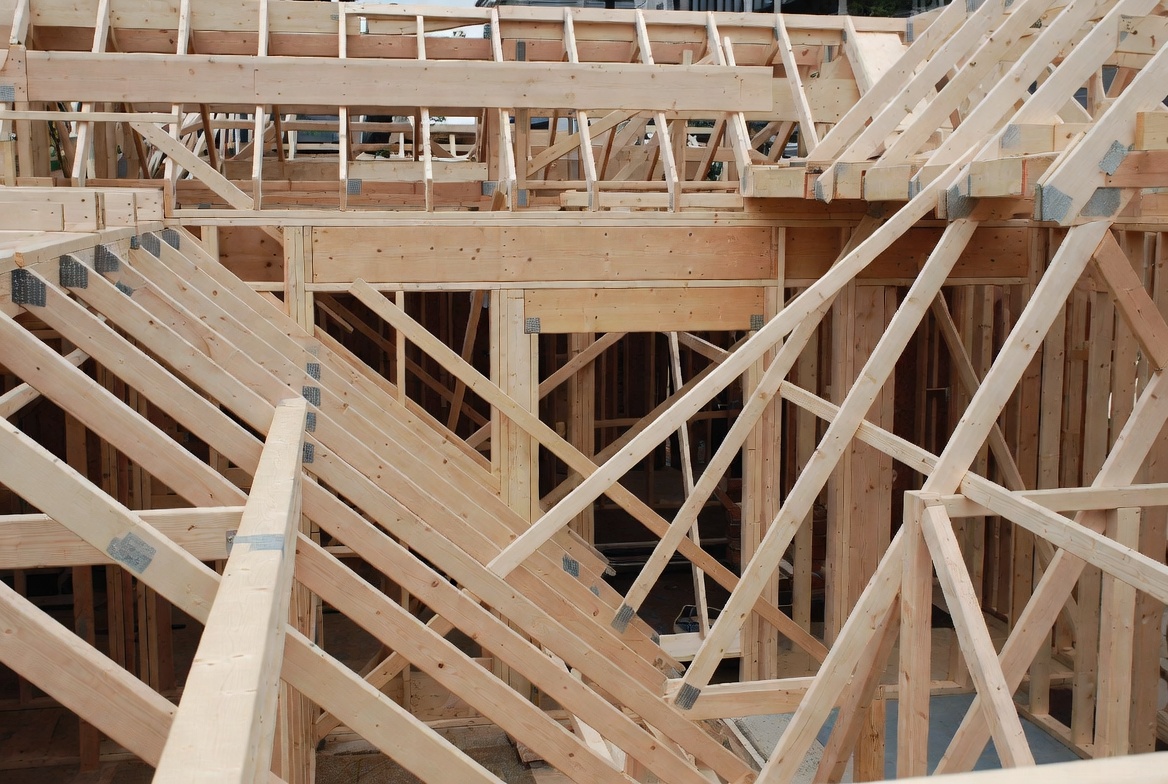
Roof bracing usually gets noticed after something moves.
The ridge line waves. A gable wall leans. Trusses start rolling during installation. A long roof span feels loose before the deck is even finished. Somebody says the sheathing will stiffen it later.
That is late.
Roof bracing is how movement gets controlled before it turns into bad geometry, overstressed connections, cracked finishes, or a roof system that never really settles down.
That matters in small houses, but it matters even more once the roof gets wider, the spans get longer, the plan opens up below, or the site starts seeing real wind or snow.
The useful way to think about roof bracing is not as a bag of extra members. It is a control system. It keeps compression members from buckling, keeps repeated framing lines from rolling out of plane, helps the roof act like one structure instead of a pile of separate parts, and carries lateral force into walls that can actually take it.
This article keeps the focus there. What roof bracing is actually doing. The difference between temporary bracing and permanent bracing. The main brace types. The spots where houses get into trouble. The details that cost money later when they get skipped early.
For the broader structural background first, see Roof Structures.
What Roof Bracing Is Really Doing
Roof bracing controls movement.
Some of that movement is vertical. Rafters, purlins, and trusses deflect under dead load, live load, snow load, and equipment load. Some of it is lateral. Wind pushes, suction lifts, and the whole roof wants to rack, drift, or roll if the load path is weak.
Good roof bracing usually does four jobs at once:
- restrains compression members so they do not buckle sideways
- keeps repeated framing lines aligned
- helps lateral loads move into walls and the rest of the structure
- stops the roof from behaving like a collection of isolated members
That last part is the one people miss. Roof failures do not always begin because one piece is too weak on paper. They often begin because the members, the restraints, the sheathing, the connectors, and the wall tie-ins never got treated like one system.
Temporary Bracing and Permanent Bracing Are Not the Same Thing
This is where a lot of roof articles go soft.
Temporary bracing is there to keep the roof framing stable during handling and installation. It is what keeps trusses from rolling, leaning, or dominoing before the whole system is tied together.
Permanent bracing is what the completed roof depends on in service. That includes restraint lines, diagonal bracing where required, gable-end support, diaphragm action from properly installed sheathing, and the actual load path into the walls below.
People confuse the two all the time. A roof can look stable halfway through installation and still be missing key permanent bracing. It can also be permanently designed correctly and still fail during erection because the temporary restraint was sloppy.
If your project uses trusses, Truss Bracing and Roof Support Systems is the right next read after this one.
The Main Types of Roof Bracing
| Bracing Type | What It Controls | Where It Usually Shows Up | What People Get Wrong |
|---|---|---|---|
| Diagonal bracing | Racking and system-wide lateral movement | Truss runs, long roofs, wind-exposed roofs, installation bracing | People treat it like optional stiffening when it is often carrying the whole stability story |
| Lateral restraint | Sideways buckling in compression members | Top chords, bottom chords, webs, rafters, purlins | A restraint line with nowhere for the force to go is not a finished solution |
| Continuous restraint | Alignment and buckling control across repeated members | Truss systems and repeated framing lines | It gets mistaken for layout convenience instead of structural restraint |
| Gable-end bracing | End-wall weakness under wind pressure and suction | Platform gable ends and end frames | Gable ends get underbuilt because they do not look dramatic until they fail |
| Roof diaphragm action | Lateral load transfer through the roof plane | Sheathed roofs tied properly to walls and collectors | People forget the deck is part of the bracing story, not just a finish substrate |
That table matters because roof bracing is not one thing. Different braces solve different instability problems. A roof can have enough of one type and still be missing another.
Do This Instead of This
| Do This | Instead of This | Why It Holds Up Better |
|---|---|---|
| Brace the first trusses and establish a stable line before chasing speed | Stand trusses fast and assume the deck crew will stiffen everything later | Many installation failures start before the roof system is tied together |
| Treat restraint lines and diagonal bracing as a pair when compression members need control | Run a single lateral member and call the job done | A restraint line can move with the member unless it is properly braced itself |
| Brace gable ends deliberately | Treat the end wall like it is just another piece of framing | Gable ends are often one of the weaker locations in residential roofs |
| Use the sheathing and fastening pattern as part of the structural plan | Think of roof panels as finish backing only | The roof deck often contributes diaphragm action and overall stiffness |
| Engineer long spans, vaulted roofs, and mixed roof geometry properly | Copy a brace pattern from a simpler house | Once geometry gets complicated, simple repetition stops being reliable |
| Spend money on connectors, tie-ins, and layout where the load path needs it | Save money by trimming hardware and edge conditions | Good members with weak connections still fail |
Diagonal Bracing Is Usually the First Thing People Notice
It is the part that looks structural, so it gets the attention first.
Fair enough. Diagonal bracing does a lot. It helps keep a run of framing from drifting out of square. It stabilizes the roof during installation. It helps repeated members act together instead of independently. On long roofs and trussed systems, it is often what makes the difference between a roof that stays in line and a roof that starts wandering before the job is dry.
But diagonal bracing is not magic.
It only works if it ties into something that can take the force. If the brace lands in weak framing, loose fasteners, or a wall line that was never meant to collect the load, the brace looks right and behaves badly.
That is why diagonal bracing is rarely a stand-alone answer. It usually works with restraint lines, the roof diaphragm, and roof-to-wall connections underneath.
Lateral Restraint Looks Small Until You Need It
This is the quieter part of roof bracing, but it is not minor.
Compression members do not fail only by crushing. They often fail by buckling sideways. That is the problem lateral restraint is there to control.
In roof work, that shows up in truss chords, some web members, rafters, and purlins. A member can look heavy enough, thick enough, and perfectly fine to the eye, then still get unstable because it was never restrained where it needed restraint.
The recurring mistake is to install a restraint line without asking what braces the restraint line itself.
That is the detail that separates real restraint from wishful thinking.
Gable Ends Deserve More Respect Than They Usually Get
Platform gable ends are one of those house details that keep getting underestimated.
They look simple. They are often not.
The problem is that gable-end walls take wind differently than the roof framing beside them. They can rack, lean, and fail out of plane if they are too tall, too lightly framed, or too casually tied into the rest of the roof and ceiling system.
This gets worse with:
- taller gable endwalls
- open floor plans with less interior bracing below
- cathedral or vaulted conditions
- high-wind exposure
- weak ceiling diaphragm tie-in
In ordinary house work, gable-end bracing is one of the places where “good enough” keeps turning into repair work later.
Roof Sheathing Is Not Just Skin
A properly installed roof deck does more than carry shingles or metal panels.
It can also help the roof plane act like a diaphragm. That matters for lateral load transfer. It matters for keeping the roof acting like one surface instead of a set of individual framing lines. And it matters a lot more once the building gets bigger, wider, or more exposed.
That is why sloppy panel layout, weak nailing, bad edge support, or poor attachment near edges and ridges can become structural problems, not just finish problems.
It is also why the common line “the sheathing will lock it together” is only half true. The sheathing can help the system do its job. It does not excuse a bad brace layout underneath.
Trusses, Rafters, and Long Spans Do Not Want the Same Conversation
Roof bracing gets easier to understand once you stop treating every roof like the same roof.
Trussed Roofs
Trussed roofs usually depend on restraint and bracing working together across repeated members. Installation stability matters a lot. Alignment matters a lot. Long runs can get unstable early if they are stood too quickly without a real bracing sequence.
For the wider truss background, see Roof Trusses.
Rafter Roofs
Rafter roofs are different. The brace story often shifts toward collar ties, rafter ties, purlins, knee walls, ridge design, and how the rafters are supported and tied back into the walls. There is still bracing logic. It just shows up differently.
Long-Span Roofs
Long spans are where roof bracing gets serious fast. Member slenderness, drift, repeated loading, connection quality, and roof diaphragm behavior all matter more. This is where copying a brace pattern from a standard house gets expensive.
Mixed or Complicated Roof Geometry
Valleys, hips, offset ridges, multiple pitches, dormers, and broken roof planes all make the brace layout more demanding. The cleaner the geometry, the easier the load path usually is. Once the roof gets busy, the bracing needs to get more deliberate.
Materials: Wood, Steel, and Engineered Wood
Material choice matters, but not in the way glossy articles usually frame it.
| Material | Where It Fits Best | Main Strength | Main Limitation |
|---|---|---|---|
| Dimensional lumber | Ordinary residential roof bracing and smaller buildings | Affordable, familiar, fast to work with | Less forgiving in long spans and harder loading conditions |
| Steel | Industrial buildings, heavier loads, long spans, higher-demand connections | High strength and stiffness | Higher cost and more specialized fabrication or installation |
| Engineered wood | Custom homes and larger residential spans where ordinary lumber starts running out of range | Better consistency and span performance | Still needs careful detailing and moisture control |
If the project is steel-heavy, Steel Truss Design is the better next step.
Where Houses Usually Get Into Trouble
Not every house needs an exotic bracing strategy. But some conditions keep showing up when things go wrong.
- Wide open plans below. The roof has fewer stiff interior lines to work with, so the load path gets cleaner on paper and harder in reality.
- Vaulted and cathedral ceilings. You lose some of the simpler ceiling-level tie-in logic and the roof starts doing more work by itself.
- Raised-heel or deep overhang conditions. These can be excellent assemblies, but the edge and overhang details need to be thought through.
- Tall gable ends. They get vulnerable quickly if they are not braced properly.
- Snow country. Vertical loading and drift loads stop being theoretical.
- High-wind sites. Roof-to-wall connections, gable behavior, and deck attachment move up the priority list fast.
This is why “normal house details” stop being enough once the house stops being normal.
The Installation Mistakes That Keep Repeating
- Standing too many trusses before establishing stability.
- Assuming the deck crew will correct bad alignment.
- Using restraint lines without proper diagonal bracing where required.
- Treating gable ends casually.
- Weak connections at the roof-to-wall interface.
- Ignoring temporary bracing because the permanent design looks fine on paper.
- Copying a standard brace pattern onto a non-standard roof.
None of those mistakes are exotic. That is the problem. They are ordinary enough that crews start getting comfortable with them.
What Roof Bracing Usually Costs
The real cost is rarely the brace member by itself.
It is the member, the fasteners or hardware, the labor, the access, the engineering attention, the interruptions from mechanical or architectural conflicts, and the time lost when the roof geometry is awkward.
In broad terms:
- basic wood bracing is usually the least expensive path
- engineered wood lands somewhere in the middle
- steel and more specialized layouts usually cost more once fabrication and installation are included
But the real money problem is usually not the brace package. It is the callback, the repair, the roof line correction, the rework around finishes, or the post-storm failure that started because bracing was treated like cheap trim work.
So the better question is not “what is the cheapest way to brace this roof.” It is “what is the cheapest way to keep this roof from moving where it should not.”
What To Check Before the Roof Deck Goes On
- Are the trusses or rafters aligned properly?
- Is the first run stable, or just standing up?
- Are temporary braces doing real work or just making the framing look organized?
- Are compression members restrained where the design requires it?
- Do restraint lines have their own bracing path?
- Are gable ends tied and braced properly?
- Are connections at walls, ridges, and brace ends actually finished?
- Is the deck fastening pattern ready to do its share of the work?
- Has anyone checked that the built geometry still matches the assumed geometry?
That last one matters more than it sounds. Roof bracing gets harder to fix once the wrong roof is already built.
FAQ
What is roof bracing supposed to do?
It controls movement. That includes buckling in compression members, lateral drift in the roof system, and load transfer into the walls below.
Is roof bracing the same as truss bracing?
Not exactly. Truss bracing is part of the larger roof-bracing conversation, but it focuses specifically on restraining and stabilizing the trusses themselves.
Does roof sheathing count as bracing?
Often yes. Properly installed roof sheathing can contribute diaphragm action and help the roof act like one plane. It does not replace the rest of the bracing logic underneath.
Why do gable ends fail so often in wind?
Because they are often underbraced, too tall for the way they were framed, or poorly tied into the ceiling and roof diaphragm.
Can a house roof be braced well with wood alone?
Yes, in many ordinary residential roofs. The issue is not whether the brace is wood. The issue is whether the layout, the connectors, and the load path are right.
What is the biggest roof-bracing mistake during installation?
Acting as if temporary stability and permanent bracing are the same thing. They are not.
What’s Next
For the broader structural picture, read Roof Structures.
For a closer look at the brace categories themselves, go to Types of Roof Bracing.
If the job is truss-based, Truss Bracing and Roof Support Systems is the better follow-up.
If you are still comparing truss systems, see Roof Trusses and Roof Truss Details and Connections.