
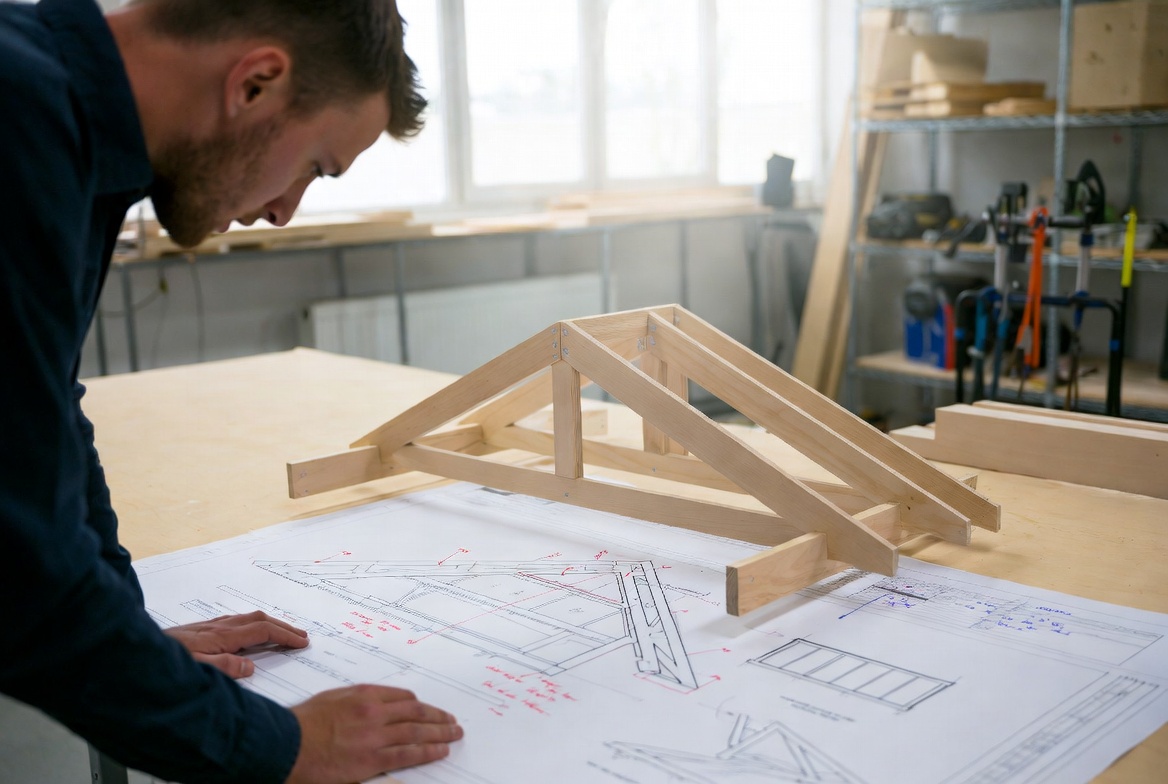
Image by ArchitectureCourses.org. A table-scale truss model helps explain basic geometry, span, and member layout during early design review.
Roof trusses do more than hold up the roof.
They control span, ceiling shape, attic space, bracing, load path, and how cleanly the roof goes together. Get that right and the structure works quietly. Get it wrong and the trouble shows up in sagging, cracked finishes, awkward field fixes, and wasted money.
This page keeps the subject practical. What roof trusses do. Which types matter most. When wood works. When steel makes more sense. What changes with span, pitch, and load. What to watch during installation. And where roof truss jobs usually go wrong.
Start Here: Common Roof Truss Types
| Truss Type | Best Fit | Why It Gets Used | Where It Starts Going Wrong |
|---|---|---|---|
| King post | Short spans, sheds, porches, small garages | Simple and low-cost | Too limited once the roof gets wider |
| Queen post | Moderate spans | More reach than a king post without getting too complex | Not the best answer once spans keep climbing |
| Fink | Standard house roofs | Efficient, common, and economical | Not ideal when you need open attic use or a vaulted ceiling |
| Scissor | Vaulted rooms and raised ceilings | Creates ceiling volume without switching to rafters | Insulation and service space get tighter |
| Hip | Wind-prone houses and wrapped roof forms | Balanced roof shape and better edge behavior | More framing complexity |
| Gable | Standard residential roofs | Simple shape, easy drainage, easy framing | Can feel too basic for more complex plans |
| Attic truss | Homes that want usable roof space | Builds storage or room space into the truss form | Gets deeper, heavier, and less forgiving |
| Gambrel | Barns, loft roofs, attic-heavy forms | Creates more usable roof space | Looks forced when the building does not suit it |
| Flat or low-slope truss | Commercial roofs and some modern houses | Wide spans with a low roof profile | Drainage problems if slope is ignored |
That table is the fast read. The rest of the page is where those types separate by span, room shape, material, and buildability.
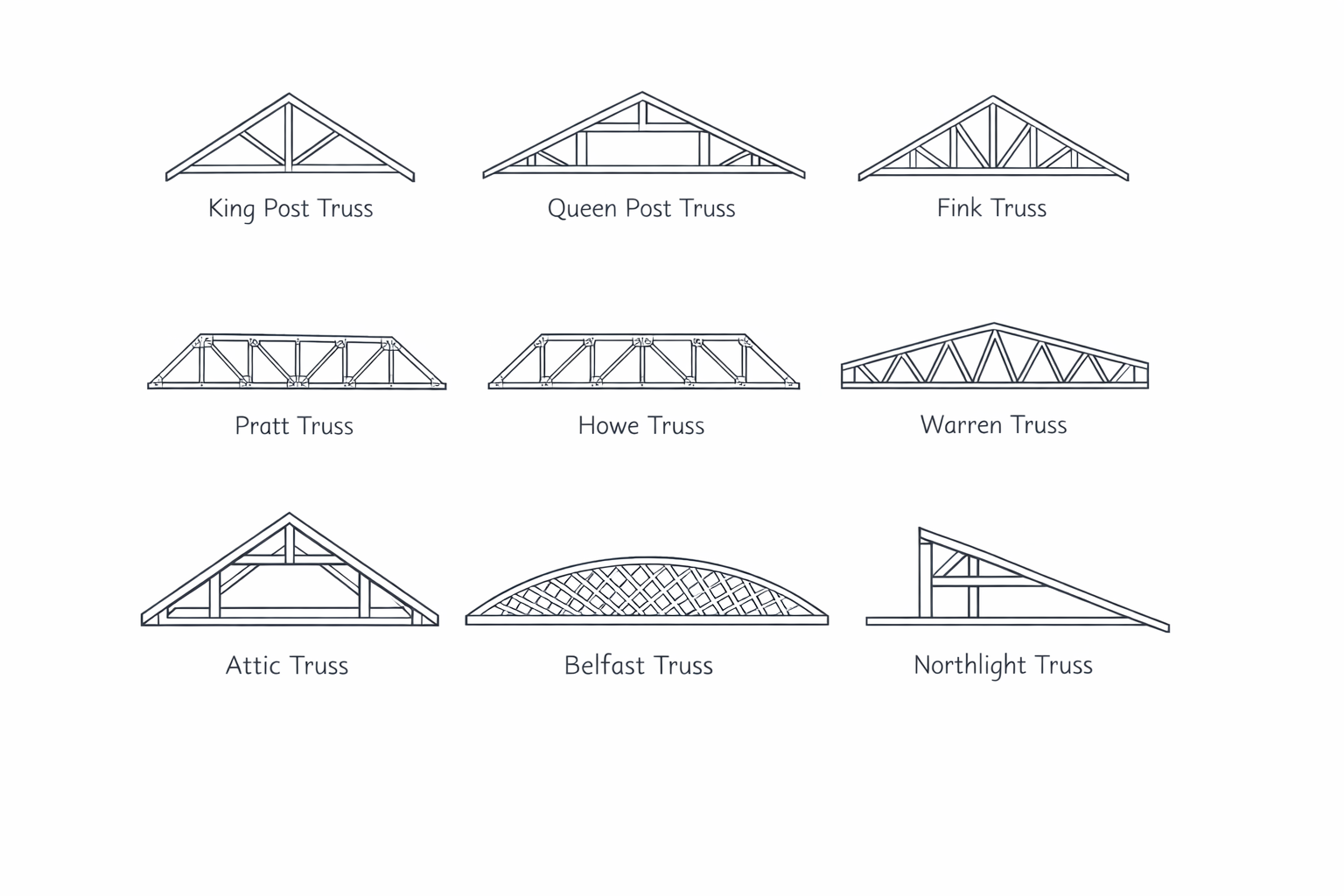
Illustration by ArchitectureCourses.org. Comparison of nine common truss types, including king post, queen post, Pratt, Howe, Warren, attic, Belfast, and northlight forms.
What Roof Trusses Do
A roof truss is a framed structural unit that carries roof loads to the walls below. Instead of building the roof one rafter at a time, the truss uses a designed arrangement of top chords, bottom chords, and web members to span the building efficiently.
In a house, that affects more than strength. Trusses shape the ceiling, control attic space, influence mechanical runs, and decide whether the roof wants interior bearing walls or not.
That is why a roof truss is not just a lumber package. It is part of the house structure. Once the truss choice is wrong, the whole roof starts paying for it.
If you want the design side first, go to Truss Design 101. If you want the details side, use Roof Truss Details: Types, Connections, and Installation Tips.
Main Roof Truss Types
King Post Truss

King post trusses are one of the simplest truss forms. They work for short spans, small roofs, sheds, porches, and modest outbuildings. They are easy to understand, easy to build, and still useful where the span stays honest.
The problem is range. Once the roof gets bigger, the king post stops being the clean answer. For the dedicated page, use King Post Truss.
Gable Roof Trusses

Illustration by ArchitectureCourses.org. Gable roof truss geometry used on a standard pitched residential roof.
Gable trusses are the standard pitched roof answer for a lot of houses. They are direct, familiar, and easy to coordinate. Water sheds cleanly, the roof form is easy to read, and the structure does not usually ask for heroic solutions.
That is why they keep showing up. They are the workhorse.
Hip Roof Trusses

Illustration by ArchitectureCourses.org. Hip roof truss geometry used where the roof slopes on all sides.
Hip roof trusses slope on all sides, which changes both the look and the wind behavior of the roof. They are common where the roof wraps the whole building more evenly or where the building wants a more settled roof form than a straight gable gives.
They can be the better answer in exposed wind conditions, but they also make the framing package more involved.
Fink Trusses
Fink trusses are one of the most common residential truss forms because they are efficient, familiar, and economical. They work well on standard house roofs where nobody is asking the roof to create usable attic volume or a dramatic interior ceiling.
They are common for a reason. They do the ordinary job well. For the dedicated page, use Fink Trusses Explained.
Scissor Trusses
Scissor trusses are used when the room wants more volume below the roof. The bottom chords rise instead of staying flat, which creates a vaulted ceiling without switching fully into a rafter-based roof.
They are a good answer when ceiling height matters. They are a bad answer when someone forgets that insulation space, service paths, and geometry all tighten up. For the deeper page, use Scissor Trusses.
Attic and Gambrel Trusses
Attic trusses are used when the roof needs to hold structure and also create usable space inside the truss zone. Gambrel trusses belong where loft space, barn-like form, or extra roof volume is part of the point.
Both solve space problems. Both also get deeper, heavier, and less forgiving than a standard roof truss.
Flat and Low-Slope Trusses

Illustration by ArchitectureCourses.org. Flat and low-slope truss systems still need drainage, layout discipline, and real fall.
Flat roof trusses are not truly flat in any practical sense. They are low-slope roof systems that still need drainage, layout discipline, and clean support logic. They are common in commercial buildings and in some modern house forms where the low profile matters.
The mistake is treating flat like dead level. Water does not forgive that. If the low-slope side is the real issue, go to Sloping Flat Trusses.
Wood, Steel, or Engineered Wood?
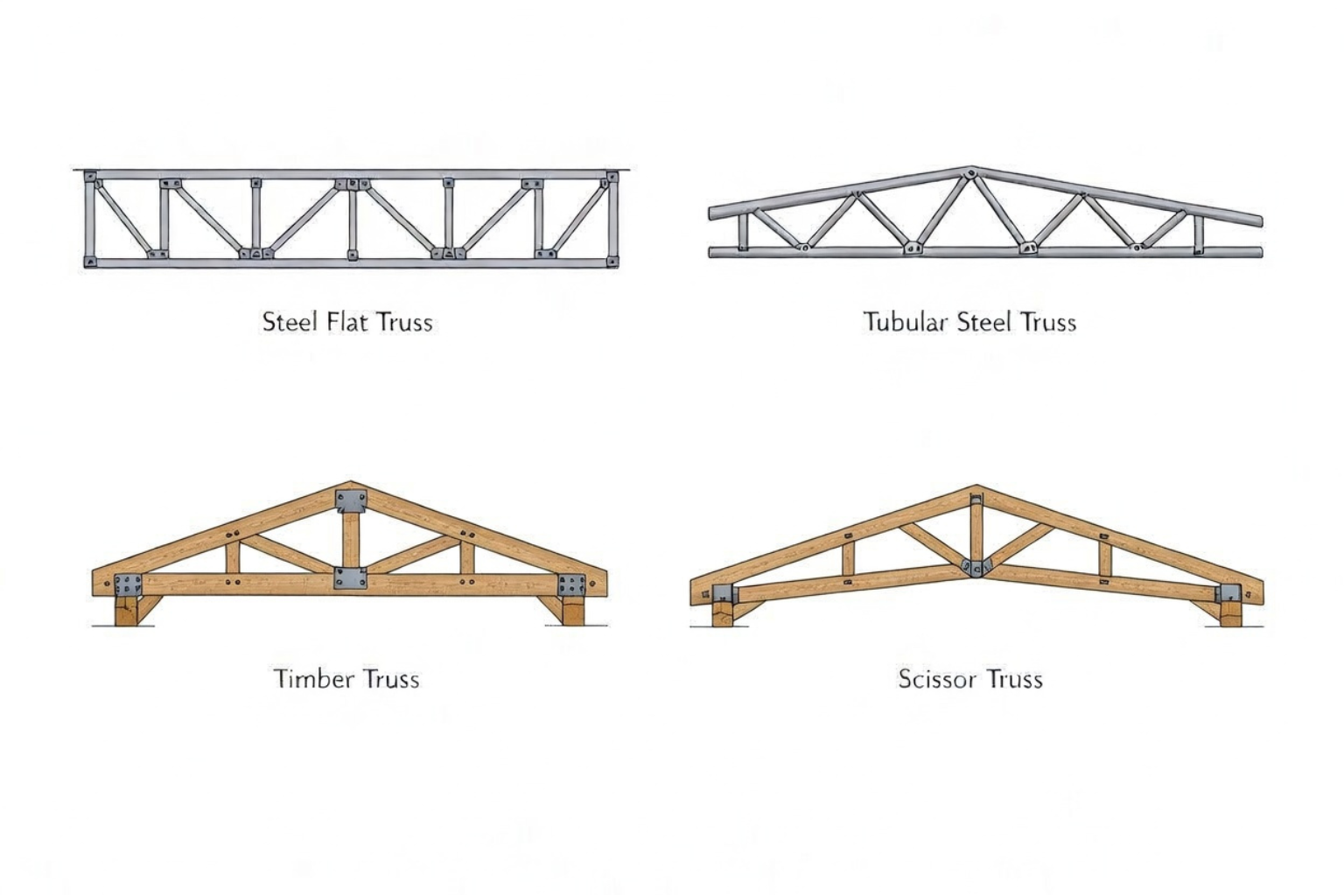
Illustration by ArchitectureCourses.org. Side-by-side comparison of flat steel, tubular steel, timber, and scissor truss systems.
| Material | Best Fit | Main Strength | Main Risk |
|---|---|---|---|
| Standard wood trusses | Most residential roofs | Affordable, easy to source, efficient for house spans | Moisture, damage during storage, bad field cuts |
| Engineered wood trusses | Projects needing more consistency and control | Better material predictability | Still depends on clean detailing and dry conditions |
| Steel trusses | Longer spans, commercial roofs, industrial buildings | High strength-to-weight ratio and long-span reach | Corrosion, bad detailing, thermal movement |
Wood is still the standard answer for a lot of house roofs because it is efficient and economical. Steel starts making more sense when the span gets bigger, the loads get tougher, or the building wants larger open space below.
If the project is clearly on the steel side, use Steel Truss Design. If the job is timber-led or exposed, go to Timber Trusses Explained.
What Controls Roof Truss Design
Roof truss design is not one clever shape. It is a group of decisions that have to agree with each other.
| Design Input | Why It Matters | Where People Slip |
|---|---|---|
| Span | Controls truss type, depth, and member forces | Trying to stretch a cheap truss too far |
| Roof pitch | Affects geometry, drainage, attic volume, and ceiling shape | Choosing pitch for looks only |
| Loads | Dead load, live load, wind, snow, and future weight all count | Ignoring regional conditions or later additions |
| Spacing | Affects sheathing, bracing, and roof behavior | Changing spacing without checking the whole system |
| Ceiling and attic use | Changes truss form and usable interior volume | Wanting storage or vaulted space without changing the structure |
| Bracing and restraint | Keeps the system stable during and after install | Treating bracing like cleanup instead of design |
This is where a lot of trouble starts. Someone treats trusses like a catalog item instead of part of the roof system. Then the roof, ceiling, HVAC runs, attic plan, and supports start fighting each other.
Span, Load, and Pitch
Span is not one number you pull from the air. It comes from the whole roof system.
Dead load includes the truss itself, sheathing, underlayment, roofing, insulation, and ceiling finishes. Live and environmental loads include snow, wind, construction traffic, maintenance access, and other temporary conditions. A truss that looks fine on paper can still become the wrong truss once those loads get more honest.
Pitch matters too. It changes roof geometry, drainage, attic shape, and the look of the building. A steep roof can help with snow and water. A lower roof can simplify form but tighten drainage and detailing. Neither is right by default.
The clean answer is not “what is the strongest truss?” The clean answer is “what span, load, roof shape, and room condition is this truss actually solving?”
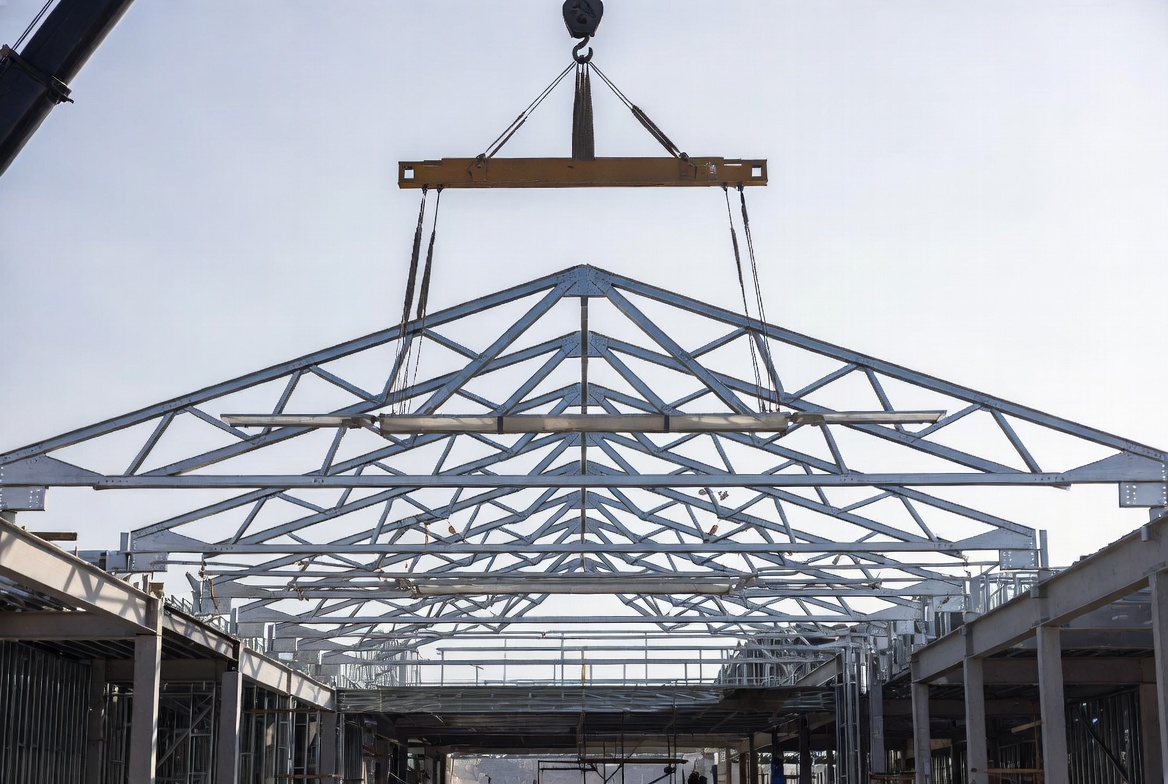
Image by ArchitectureCourses.org. Multiple steel roof trusses line up across the structure during roof framing.
Repetition helps, but repetition does not remove the need for correct spacing, layout, and restraint.
What to Watch During Installation
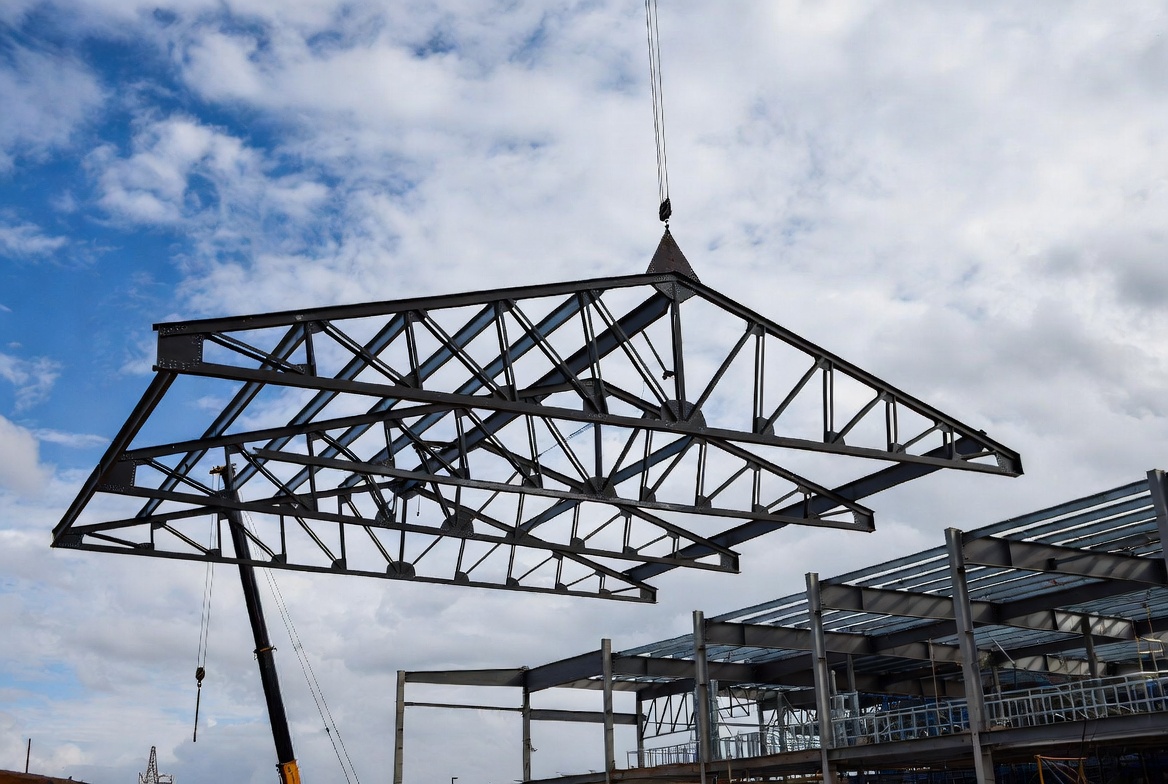
Image by ArchitectureCourses.org. A steel roof truss is lifted into place during structural erection.
A well-designed truss can still become a bad roof if the installation goes sloppy.
- Inspect on delivery. Damaged trusses should not go up just because the truck is already there.
- Set them in the right order. Layout errors get expensive fast once braces and sheathing start following the wrong line.
- Brace them early. Temporary bracing is not optional.
- Keep them aligned. A truss package that starts wandering out of plumb creates trouble for the whole roof plane.
- Do not field-cut members casually. That is how engineered parts get ruined.
- Match the supports. Loads need to land where the structure below can actually take them.
Most dangerous moments happen before the roof diaphragm is complete. That is when temporary restraint, sequencing, and clean site control matter most.
Prefab or Custom?
Prefabricated trusses win a lot of ordinary work because they are faster, more repeatable, and easier to quality-control before they hit the site.
Custom trusses make more sense when the roof is unusual, the room below is doing something specific, or the building has geometry that a standard package cannot handle cleanly.
| Option | Best Fit | Main Upside | Main Tradeoff |
|---|---|---|---|
| Prefabricated trusses | Standard roofs and repeated work | Faster, predictable, usually cheaper | Less flexibility |
| Custom trusses | Special roof shapes, vaulted rooms, unusual spans | Better fit for exact design needs | More design time and higher cost |
The mistake is pretending one method is always better. Prefab wins a lot of ordinary projects. Custom earns its place when the roof stops being ordinary.
Where Roof Truss Jobs Usually Go Wrong
- Loads were underestimated. Snow, wind, solar, equipment, or heavier roofing showed up after the design logic was set.
- The wrong truss type was used. A standard truss got asked to do an attic or vaulted job.
- Bracing was weak or ignored. This is where many decent-looking truss jobs get dangerous.
- Field changes were made without review. Cutting, drilling, or “just making it work” in place is where failures start.
- Drainage got treated casually. Flat and low-slope roofs pay for this first.
- Future loads were forgotten. The roof got solar panels, equipment, or storage it was never set up to carry.
Most roof truss failures are not mysterious. They start with wrong assumptions early, then the whole roof pays for them later.
Do This Instead of This
| Do This | Instead of This | Why |
|---|---|---|
| Match the truss type to the roof and room below | Use a standard truss for every roof | The ceiling plan changes the whole package |
| Check local loads early | Assume a standard package will work anywhere | Snow and wind change the answer fast |
| Plan drainage and pitch honestly | Treat low-slope roofs like they will sort themselves out | Water finds weak design fast |
| Brace the trusses as they go up | Wait until the roof feels stable | The unstable phase is where jobs fail |
| Get approval before any truss modification | Cut members on site and hope | Trusses are engineered parts, not guesswork lumber |
Maintenance and Repair
Roof trusses are not a set-it-and-forget-it part forever. They still need occasional attention, especially in older roofs or roofs that have seen leaks, heavy loading, or later alterations.
- watch for sagging or roof lines that start to look uneven
- check for water intrusion around the roof above the truss zone
- look for cracked connectors, split members, or rust where metal is involved
- do not assume an old field repair is a good repair
- check any roof that has had solar, HVAC, or added ceiling changes since the original build
A lot of truss trouble starts with one leak, one bad cut, or one extra load nobody recalculated.
FAQ
What is the most common type of roof truss?
In ordinary residential work, common pitched roof trusses such as gable-related and Fink-based forms show up constantly because they are efficient and economical.
What is the strongest roof truss?
There is no single strongest type in the abstract. Strength depends on span, load, material, geometry, support conditions, and connection quality.
Which truss is best for a vaulted ceiling?
Scissor trusses are one of the most common answers because they create interior volume while keeping the roof structurally organized.
Are steel trusses better than timber trusses?
Not across the board. Steel is often better for bigger spans and heavier loads. Timber is often better where house scale, exposed structure, or room character matters.
Can roof trusses support solar panels?
Yes, but only if those loads are accounted for from the start or properly reviewed before being added later.
Can I modify a roof truss after installation?
Not casually. Any meaningful cut, drill, notch, or field change should be reviewed first because trusses are engineered parts.
What usually causes roof truss failure?
Wrong loads, weak bracing, bad connections, sloppy modification, water damage, and poor coordination between design and field work.
Read This Next
If the next step is the design side, start with Truss Design 101. If you want the residential-specific version, go to Residential Roof Trusses Design. If you need the parts and connection side next, use Roof Truss Details. If the project is clearly timber-led, read Timber Trusses Explained. And if the roof is moving to steel, go to Steel Truss Design.