
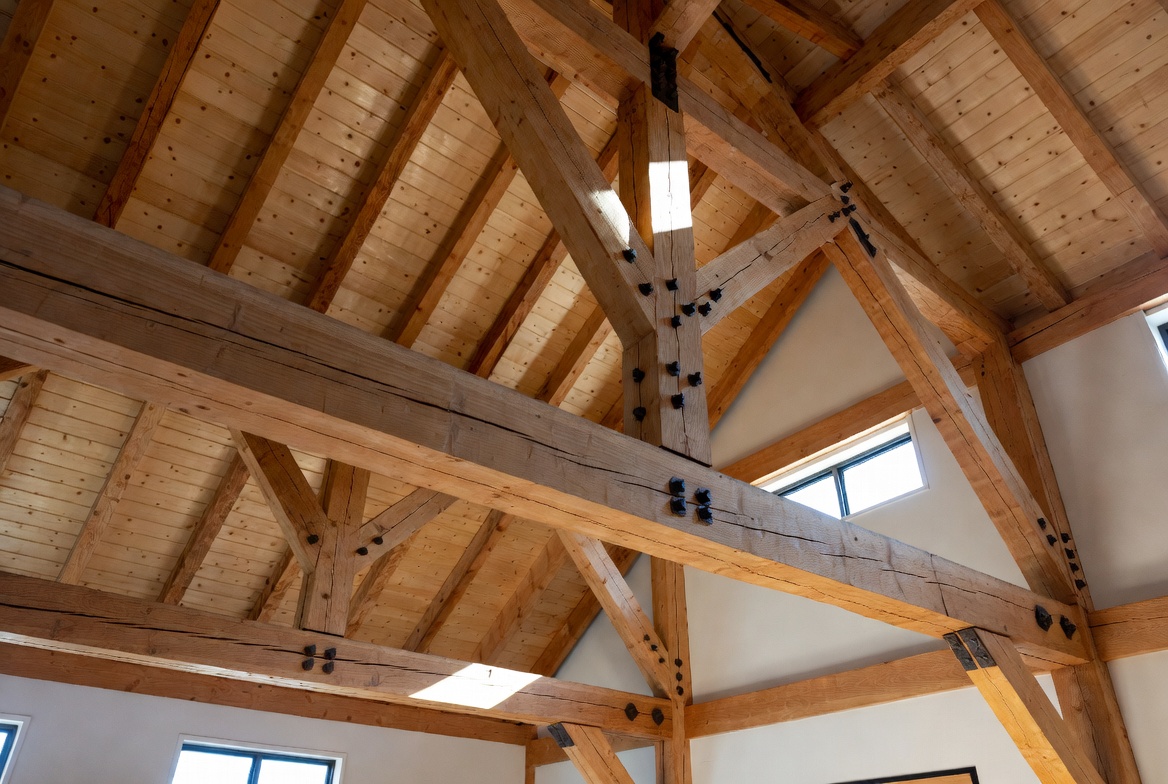
A timber truss makes sense when posts in the middle stop being a good answer.
The choice affects the span, the connections, the cost, and how the room feels once the structure is exposed. Get it right and the roof works cleanly. Get it wrong and the mistakes stay visible.
What a Timber Truss Is
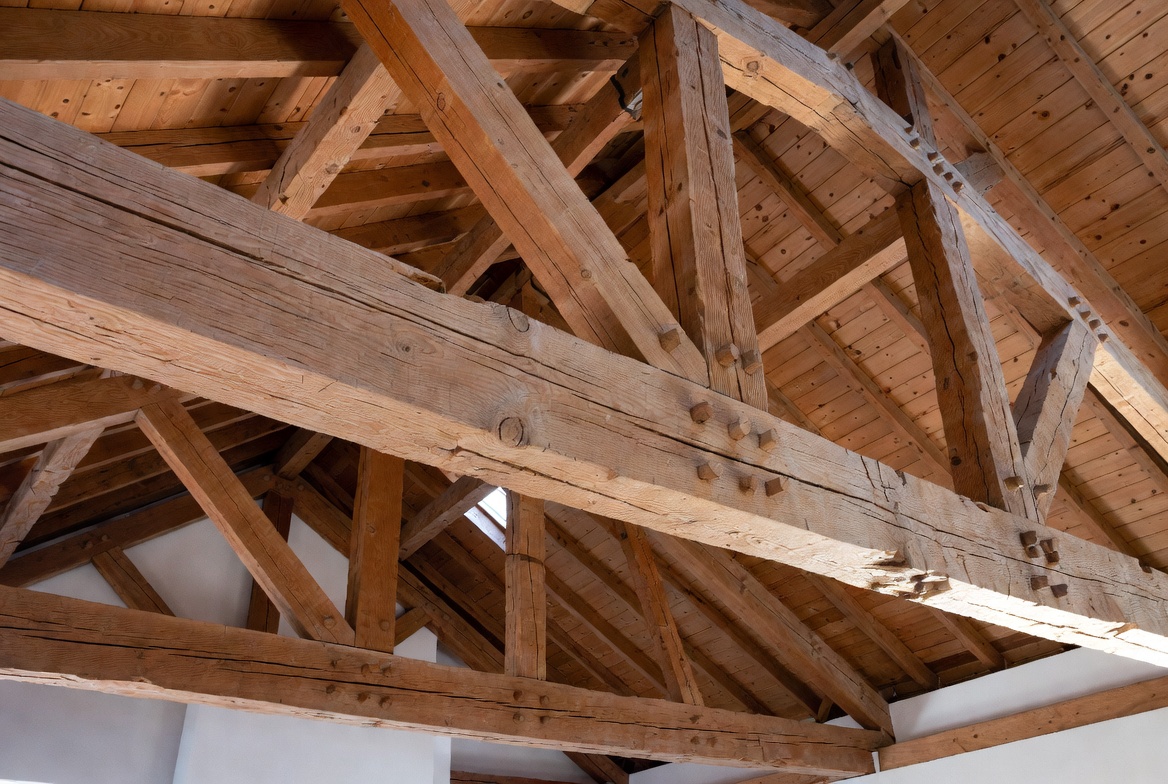
Image by ArchitectureCourses.org. Heavy timber truss framing with diagonal braces, a deep tie beam, and exposed roof decking.
A timber truss is a wood roof frame built to carry load across a span without filling the whole space with rafters, ties, and guesswork.
Put simply, it is a structural shape that does more with less. That is why trusses keep showing up in barns, halls, vaulted rooms, cabins, lodges, and bigger open interiors.
Some are plain. Some are exposed. Some are shop-built and craned in. Some are cut for one specific room.
The important part is this: a real truss has a load path. Every member is there to do something. If it is only there to look structural, then it is decorative, not structural. Those are not the same thing.
Main Timber Truss Types
| Truss Type | Best Fit | Why People Choose It | Where It Goes Wrong |
|---|---|---|---|
| King post | Small to medium spans | Simple, clean, lower cost | Starts looking too light in bigger rooms |
| Queen post | Medium spans | More capacity without getting too busy | Can feel crowded in smaller rooms |
| Scissor | Vaulted interiors | Opens the ceiling without losing structure | Roof detailing and insulation get tighter fast |
| Hammer beam | Large rooms and feature spaces | Strong visual impact | Costs rise fast and bad proportions look heavy |
| Howe | Heavier loads and longer spans | Strong, practical, dependable | Can feel more industrial than warm |
| Fink | Standard roof work | Efficient and cost-conscious | Usually not the one you want exposed |
One thing to keep straight early: exposed timber trusses and fake decorative trusses are not the same thing. Some carry the roof. Some just copy the look. That is fine as long as nobody is pretending one is the other.
King Post, Queen Post, Scissor, Hammer Beam
King Post
This is the plain one. One center post. Clear geometry. Easy to read. Good for smaller spans, cottages, porches, barns, and rooms that want timber overhead without too much visual noise.
It is a good truss when the room needs restraint, not drama.
Worth knowing. For the focused breakdown, go to King Post Truss.
Queen Post
Two vertical posts instead of one. It carries more, spans a little more, and still stays readable. It is the middle ground when a king post starts feeling too light but a feature truss would be too much.
Scissor
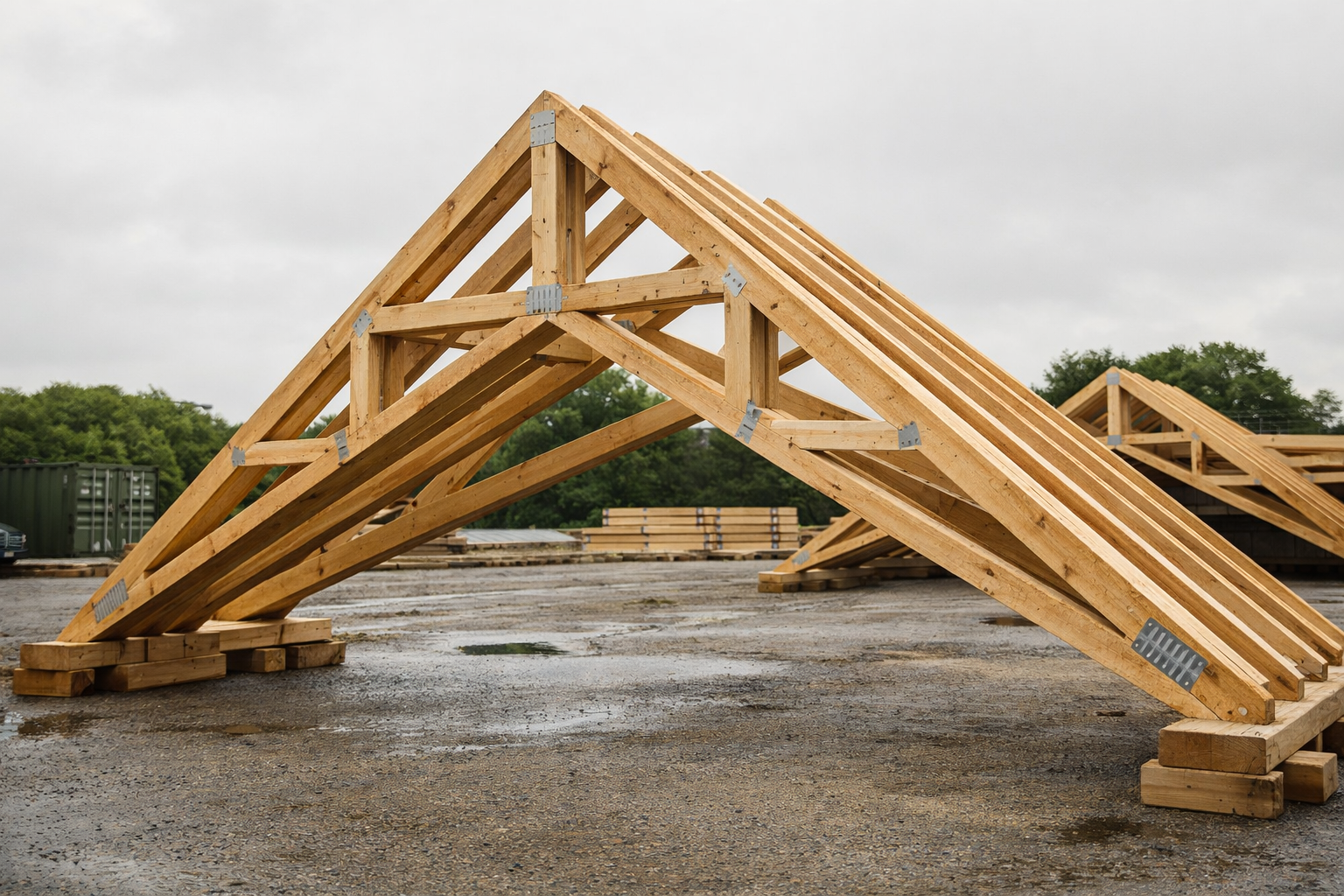
Image by ArchitectureCourses.org. A stack of wood scissor trusses staged on site before lifting and roof installation.
Scissor trusses solve a real problem. You get ceiling height and a vaulted feel without abandoning structural order.
That is why they show up so often. They are useful. But they are not easy money. The geometry is more demanding, insulation gets tighter, and sloppy roof detailing catches up later.
Also useful. If that is the truss you are really weighing, read Scissor Trusses: Design, Installation, and Mistakes to Avoid.
Hammer Beam
Hammer beam is the one with presence. In the right room, it can carry the whole space. Great halls, lodges, barn conversions, churches, and large gathering rooms can take it.
But this is where bad judgment gets expensive. Hammer beam trusses are easy to overdo. Too much timber, bad proportions, weak detailing, or fake old-world styling and the whole room starts looking forced.
This is not the budget move. It is the deliberate move.
Read this next. Hammer Beam Roofs: Types, Designs, and Real-World Applications.
Howe and Fink
Howe
The Howe truss is less about charm and more about doing the work. It is strong, clear, and good when the loads are heavier and the span matters more than the mood.
Snow country, harder-working buildings, and longer roof runs push this one higher on the list.
Fink
Fink trusses are the efficiency move. They are common because they are practical, repeatable, and cheaper to roll through a standard roof package.
They do a lot of work well. They just do not usually give you a great exposed ceiling.
If the truss stays hidden, that matters less. If it stays visible, it matters a lot.
One more thing. If you need the more focused page, go to Fink Truss or Fink Trusses Explained: Benefits, Costs, and Applications.
Prefab or Custom?
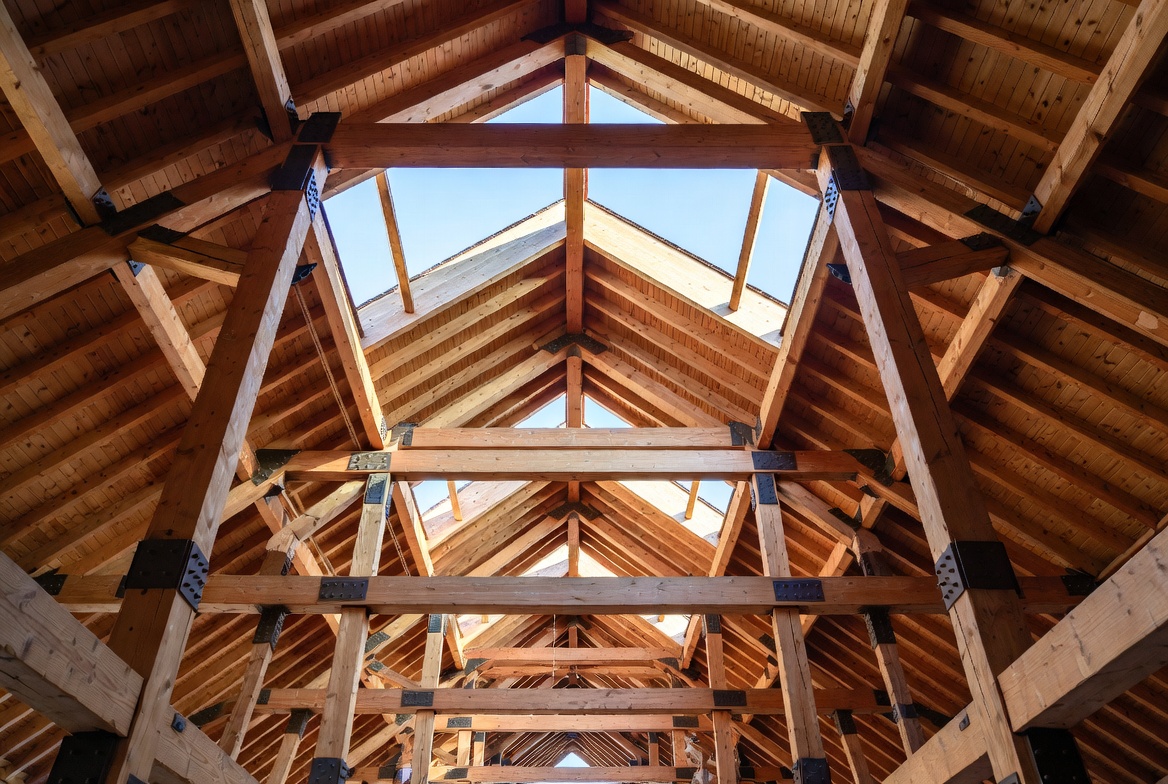
Image by ArchitectureCourses.org. A series of timber trusses spanning a large interior, showing repeated framing bays and visible steel connector plates.
| Choose This | When | Instead of This | Why |
|---|---|---|---|
| Prefabricated timber trusses | You have repeated spans, a clear roof plan, and need speed | Custom hand-built trusses | Prefab saves time and cuts site mistakes |
| Custom timber trusses | The room is exposed, unusual, or architecturally important | Generic stock trusses | Custom work lets the truss fit the room instead of fighting it |
| Decorative false trusses | The look matters more than structural expression | Pretending they are structural | Better to be honest than fake a load path |
Prefab is the smarter move on a lot of standard work. Faster. Cleaner. Easier to price.
Custom is the better move when the truss is part of the room and not just part of the roof.
The expensive mistake sits between those two. People want a custom exposed result, buy something close, and then spend the next six months trying to make “close enough” look intentional.
What Pushes the Cost Up
Timber truss cost is not just about span. It moves with the whole package.
- span
- timber species
- grade and moisture condition
- joinery type
- exposed finish quality
- shop fabrication vs site work
- craning and installation access
- engineering
- weather and regional labor rates
The cheap truss is simple, repeated, fabricated cleanly, easy to install, and hidden above a ceiling.
The expensive truss is long-span, custom, exposed, harder to lift, harder to detail, and expected to carry the room visually as well as structurally.
That is why broad price claims are mostly noise. Before you ask for numbers, figure out which job the truss is actually doing.
A basic roof support job is one thing. A big-span feature truss in a great room is another. Those are not close cousins.
Timber vs Steel Trusses
| Question | Timber Trusses | Steel Trusses |
|---|---|---|
| Best visual effect | Warm, textured, architectural | Clean, hard, industrial |
| Best for very heavy duty spans | Good, depending on design and species | Often better once spans and loads get extreme |
| Best for exposed residential rooms | Often the better fit | Works when the design wants a sharper, harder look |
| Ease of site modification | Easier to work with | Less forgiving once fabricated |
| Maintenance concerns | Moisture, pests, finish wear | Corrosion, coating failure, thermal movement |
Timber wins when warmth, texture, and exposed structure matter.
Steel wins when the spans get extreme, the loads get harsher, or the building wants a leaner industrial language.
The mistake is treating this like a personality test. It is a building decision.
If you need the fuller comparison, go to Steel Truss Design.
Where Timber Truss Jobs Go Wrong
- The room wants one thing and the truss says another. This happens fast in exposed interiors.
- The span was treated like a guess. Trusses do not forgive loose sizing.
- Cheap timber was asked to do feature-truss work. Every twist, check, and bad grain line ends up overhead where everyone can see it.
- The joinery was decorative, not structural. It looked convincing in a render. It did not hold up on site.
- The engineer came in too late. By then the design is already trying to force the wrong answer.
- The contractor priced the easy version and built the hard one. That is where the job starts bleeding money.
Most truss failures do not begin with some rare technical flaw. They begin with one bad decision early, then the whole roof keeps paying for it.
What to Ask Before You Order
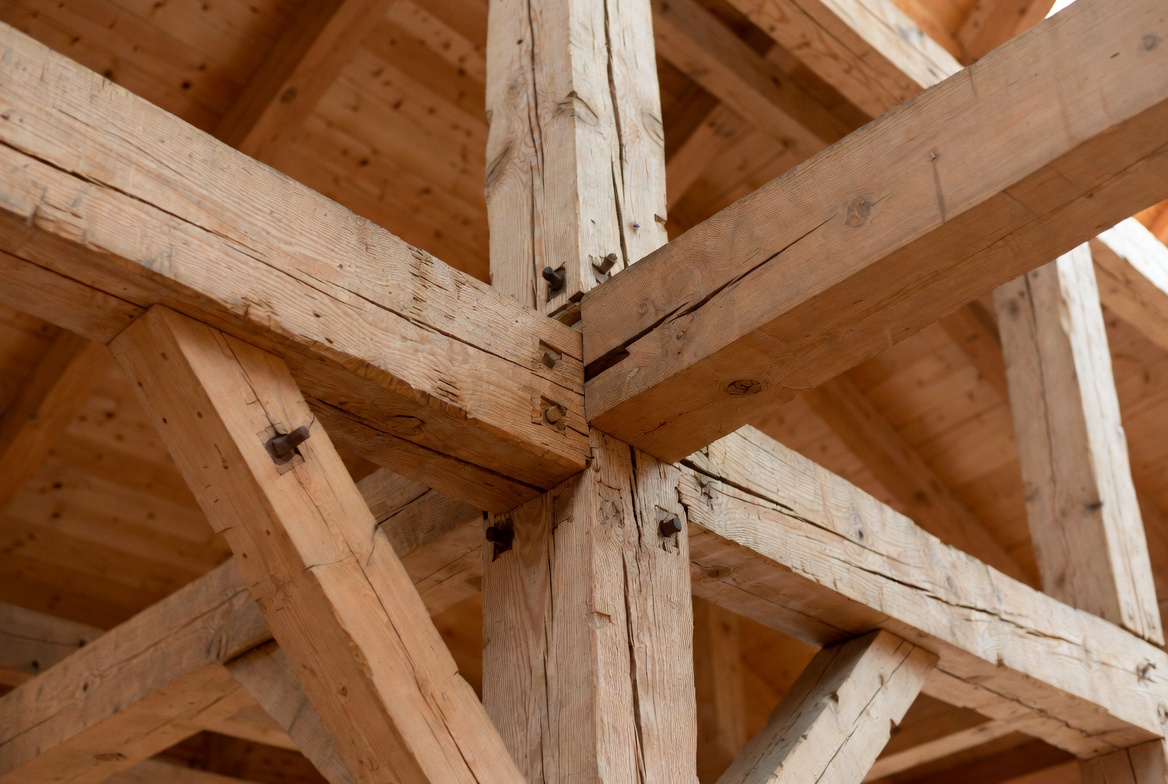
Image by ArchitectureCourses.org. Close-up of a timber truss joint showing how beams, braces, and connection details come together.
- Is this truss structural, decorative, or both?
- What span and loads is it designed for?
- Will it stay exposed or disappear above a ceiling?
- What timber species and grade are being used?
- Is it prefabricated, custom, or site-built?
- How will it be lifted and installed?
- What connections will be visible?
- What checking, color change, or movement should I expect later?
That last one matters more than people think. Timber moves. It dries. It checks. It darkens. Good jobs expect that. Bad jobs act shocked when wood behaves like wood.
Exposed Trusses Need More Control
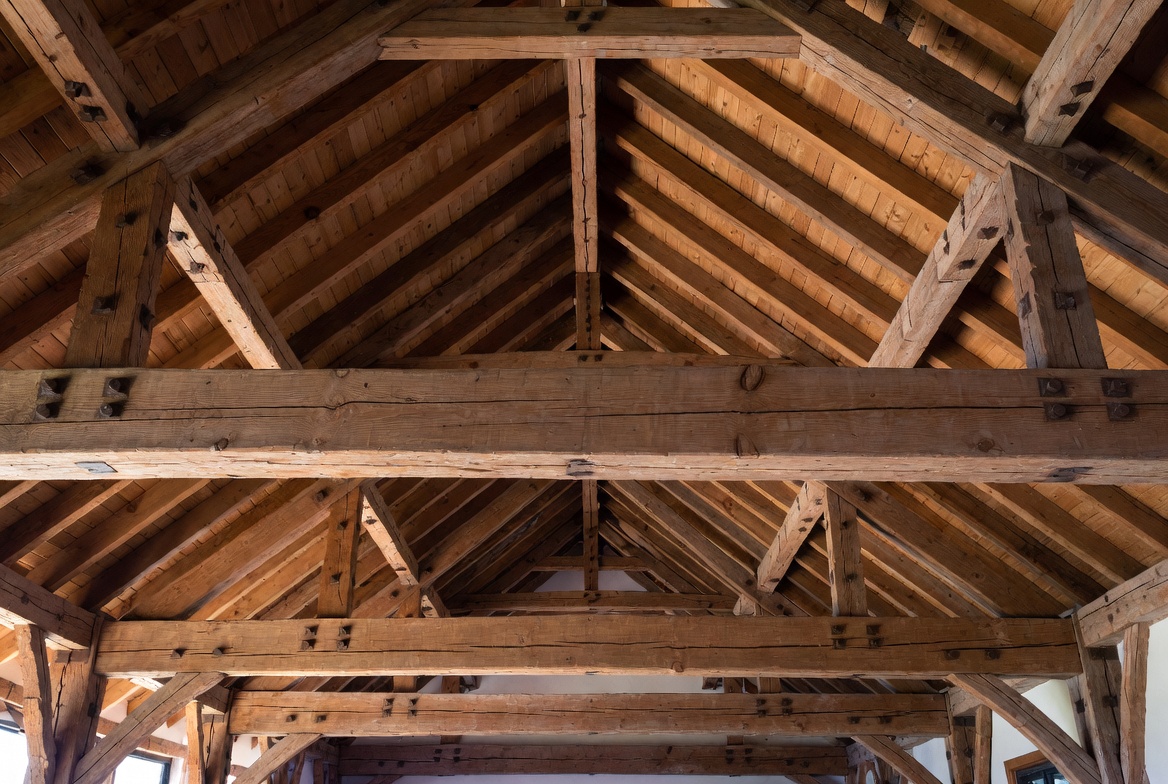
Image by ArchitectureCourses.org. Repeated heavy timber trusses shaping a vaulted interior and showing how exposed structure affects the whole room.
If the truss stays visible, the standard goes up.
Hidden trusses can be plain. Exposed trusses have to work structurally and visually at the same time. Member size, spacing, joint layout, finish quality, and even the way light hits the timber all start mattering more.
This is not where “a little bigger” is always better. Oversized exposed timber can make a room feel heavy fast. One well-scaled truss usually beats a ceiling full of lumber trying too hard to impress people.
FAQ
Are timber trusses structural or decorative?
They can be either. Some carry the roof. Some are there for appearance. Some do both. The important part is knowing which one you are buying.
Are timber trusses good for long spans?
Yes, if they are designed for the span and the load. Once the span gets large enough, steel starts competing harder.
What timber truss type is best for a house?
There is no single best type. King post works well in smaller, simpler rooms. Scissor fits vaulted spaces. Fink fits standard roof work. The room and roof decide.
Are exposed timber trusses worth the cost?
They can be. If the ceiling depends on them, they earn more budget. If nobody will notice them in the room, spend that money somewhere else.
Do prefabricated timber trusses save money?
Often yes on standard jobs. They save time, reduce site labor, and cut layout mistakes. They are not always the right answer for custom exposed spaces.
What wood works best for timber trusses?
It depends on the span, the finish, and the look you want. Douglas fir, oak, and glulam all show up for different reasons. Species matters. Grade matters too.
Read This Next
If you are comparing truss types one by one, start with King Post Truss, Scissor Trusses, and Hammer Beam Roofs. If the bigger question is whether timber is even the right material, compare it with Steel Truss Design. If you are narrowing down standard roof truss options, Fink Trusses Explained is the next useful stop.