
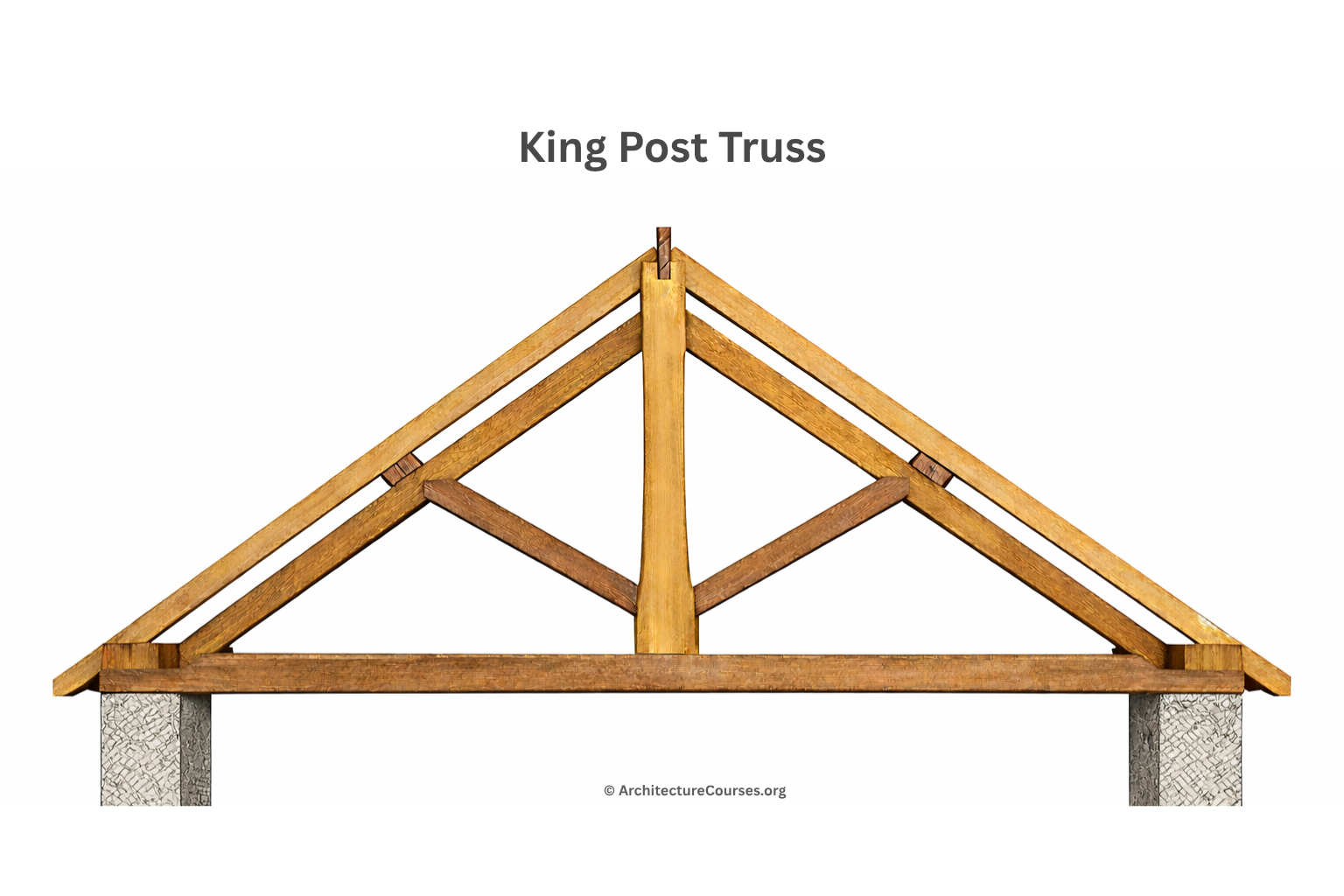
Illustration by ArchitectureCourses.org. A king post truss uses a simple triangular frame for short roof spans.
A king post truss works best when the roof span is small and the structure does not need anything more complicated.
It is one of the simplest truss forms you can build: a tie beam, two principal rafters, and a center vertical member doing a clear job in the load path. That is why it keeps showing up on small roofs, porch roofs, sheds, and modest additions. Once the span grows or the loads get heavier, its limits show up fast.
Start Here

Illustration by ArchitectureCourses.org. King post truss diagram with the main members labeled for quick reference.
| Question | Short Answer |
|---|---|
| What is it? | A small, simple truss with a central vertical king post, two top chords, a bottom chord, and usually diagonal struts. |
| Where does it work best? | Short roof spans on houses, sheds, porches, barns, garages, and similar smaller structures. |
| Why do people use it? | It is simple, economical, easy to understand, and can look great when left exposed. |
| Where does it fall short? | Once spans get wider or loads get heavier, other truss types usually make more sense. |
| Timber or steel? | Timber fits traditional and residential work. Steel can work on light utility or modern projects, but it is not the default answer for every small roof. |
That is the simple version. The rest of the page is about where the king post truss helps and where people start asking too much from it.
What a King Post Truss Is

Illustration by ArchitectureCourses.org. A king post truss uses a central post and tie beam to keep a small roof stable.
A king post truss is a triangular roof truss with one vertical member at the center. That central member is the king post.
In a typical king post truss, two sloped top chords form the roof shape, a bottom chord ties the base together, and diagonal struts help move load through the frame. The king post connects the apex back to the tie beam and helps organize the load path through the truss.
It is one of the oldest and most familiar truss forms because it works well on short spans without needing a lot of material or a complicated layout.
That is the reason it still matters. Not because it is old. Because it still solves a real structural problem cleanly.
Related: Roof Trusses
Main Parts of a King Post Truss
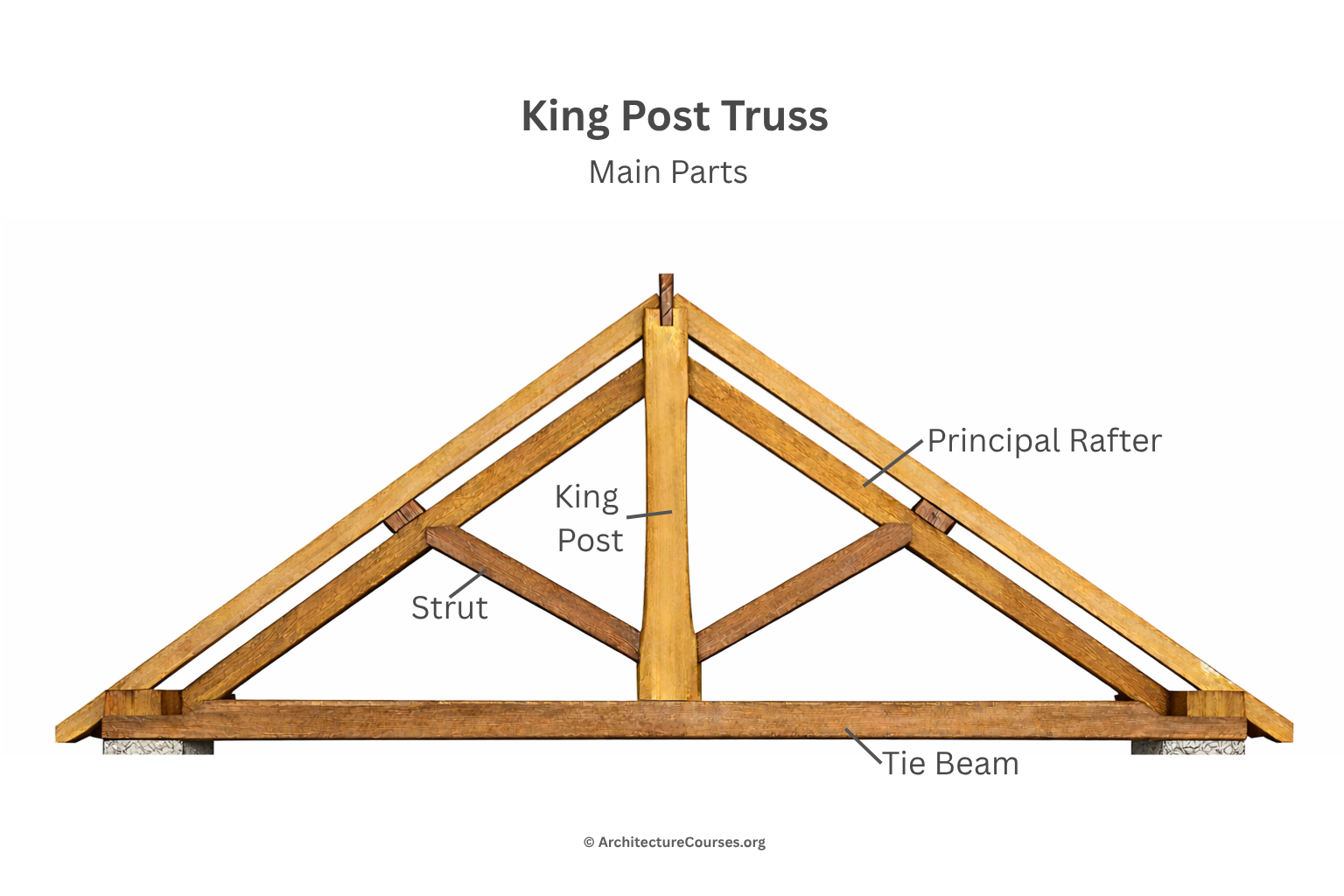
Illustration by ArchitectureCourses.org. Main structural members of a king post truss.
- King post. The vertical center member. It ties the apex back to the bottom chord and helps keep the truss working as one frame.
- Top chords. These are the sloped members that form the roof shape and carry roof loads down through the truss.
- Bottom chord or tie beam. This is the horizontal member at the base. It resists the outward spread of the rafters and helps keep the roof stable.
- Struts. These diagonal members help transfer load and stiffen the truss.
- Connections. The joints matter. In timber work that may mean bolts, plates, straps, or traditional joinery. In steel work it may mean welded or bolted connections.
None of those parts are decorative. Every member is there because the truss needs a clear load path.
Where a King Post Truss Works Best
This truss is not trying to solve every roof. It is best where the roof span stays modest and the framing wants to stay simple.
- Small houses and cottages. Especially where a simple pitched roof is enough.
- Sheds, garages, and outbuildings. This is one of the most common places for a king post truss.
- Barns and agricultural buildings. Traditional timber framing used the form for good reason.
- Porches and garden structures. The truss can be left exposed and still look clean.
- Some restoration work. It is useful when matching older framing logic matters.
- Occasional small bridges or utility structures. Not the main use, but it does show up there.
The best way to think about it is this: if the roof is small enough that simplicity is still helping, the king post stays in the conversation. Once the span or loading starts climbing, other trusses usually take over.
Why It Still Gets Used
The king post truss is still popular because it solves a short-span roof cleanly.
- It is simple. The geometry is easy to understand and easy to lay out.
- It uses less material than more complex trusses. That helps cost on smaller roofs.
- It can look good exposed. This matters in houses, cabins, porches, and traditional spaces.
- It is easier to build than many larger truss types. That helps both timber and light steel versions.
- It suits short spans well. That is where it earns its place.
The mistake is treating that as a reason to use it everywhere. It is a good truss because it stays in its lane.
Where It Stops Working
This is the part people skip. The king post truss is not the answer for every roof.
| Problem | Why It Matters |
|---|---|
| Longer spans | The king post truss is a short-span truss. As the span grows, member sizes and forces stop being efficient. |
| Heavier roof loads | Tile, snow, equipment, or unusual roof build-ups can push the truss beyond what makes sense. |
| Complex roof geometry | The more broken, layered, or irregular the roof becomes, the less this simple truss helps. |
| Need for usable attic space | If the roof has to create real room or storage, an attic truss or another system is usually better. |
That does not make the king post weak. It just means it has a job. Once the job changes, the truss should change too.
This is where people overbuild the wrong roof with the wrong truss. They like the shape, they like the simplicity, and they keep going past the point where it still makes structural sense.
If the span is already moving beyond the simple zone, the next comparison is often a queen post truss or a more developed roof truss family such as a Fink Truss.
Timber or Steel?
A king post truss can be built in timber or steel, but the choice changes the feel and the practical use.
| Material | Best Fit | Main Strength | Main Risk |
|---|---|---|---|
| Timber | Houses, barns, cabins, porches, traditional work, exposed trusses | Warm appearance, easy fit for residential work, strong visual character | Moisture, movement, poor joinery, storage damage |
| Steel | Light utility structures, modern detailing, some commercial or industrial small-span work | Cleaner thin members, higher strength in smaller sections, good for modern expression | Corrosion, thermal movement, bad connection detailing |
Timber is still the natural answer for most king post truss work because the form belongs so comfortably in residential and traditional buildings. Steel can work well too, but it changes the character of the truss and usually the reason you are using it in the first place.
Also useful: Timber Trusses Explained and Steel Truss Design
Design and Installation Basics
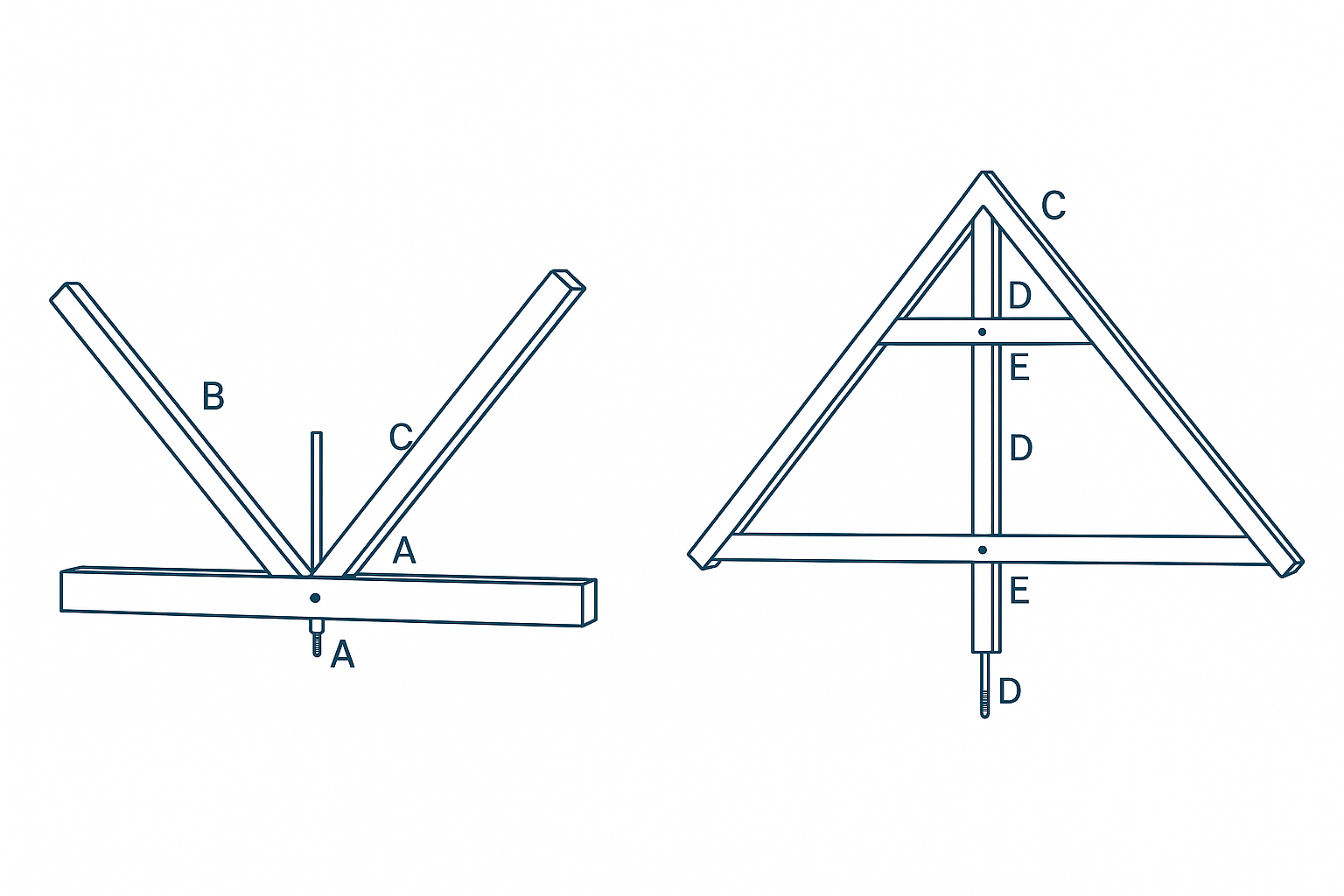
Illustration by ArchitectureCourses.org. Good king post truss work depends on clean member layout, accurate joints, and proper support at the ends.
A king post truss is simple, but it still needs careful setup.
Get the span right
This truss is best on short spans. If you are already pushing the width hard, do not force it. Change the truss instead.
Respect the supports
The truss still has to land on walls or beams that can take the load. A clean truss on weak supports is still a bad roof.
Keep the joints tight
Loose, badly aligned, or improvised joints are one of the fastest ways to ruin a simple truss.
Do not treat exposed work casually
If the truss will be visible, the structural work and the visual work become the same thing. Bad cuts and sloppy hardware show immediately.
Use prefab only when it helps
Prefabricated king post trusses can save time on repeat work, but they are not always the answer on small custom jobs where transport, lifting, or exact fit makes site-built work easier.
The main thing is not speed. It is getting the span, joints, bearing, and alignment right before the roof starts carrying load.
If the design side is the real issue, go to Truss Design 101.
Where Problems Usually Start
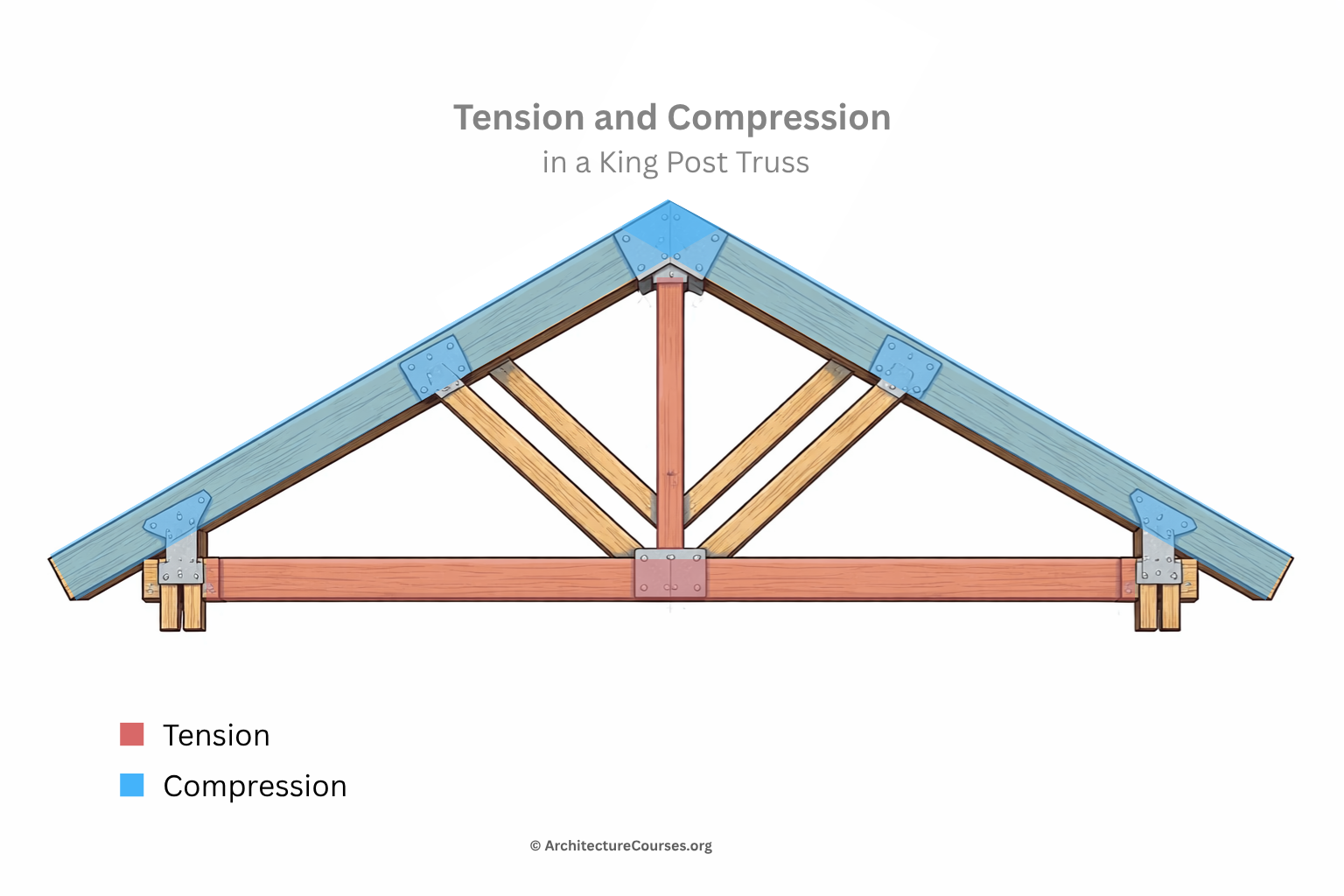
Illustration by ArchitectureCourses.org. A king post truss works properly only when the load path, joints, and member sizes work together.
- Trying to stretch it too far. This is the most common mistake.
- Ignoring connection quality. A simple truss still fails at the joints if they are weak.
- Using bad timber. Twist, moisture, and poor-quality members make the whole truss worse.
- Forgetting support conditions. Loads still need somewhere reliable to go.
- Treating it like decoration only. Exposed trusses still have to work structurally.
- Skipping review on custom work. A simple truss is not an excuse for lazy structural thinking.
Most king post problems are not mysterious. Someone just asked a very simple truss to solve a bigger problem than it was meant to solve.
FAQ
What is a king post truss used for?
It is used for short roof spans on houses, sheds, garages, porches, barns, and similar smaller structures.
Is a king post truss strong?
Yes, within the range it is meant for. It is a strong and efficient short-span truss. It stops being the right answer once spans and loads get bigger.
What is the difference between a king post and queen post truss?
A king post truss has one central vertical post. A queen post truss uses two vertical posts and is usually a better fit when the span starts growing beyond what a king post handles well.
Can a king post truss be made from steel?
Yes. Steel king post trusses are used in some modern, utility, and light commercial projects, though timber is still the more common choice for the classic form.
Can I use a king post truss for a house?
Yes, if the span and roof design suit it. It is often a good fit for smaller houses, cottages, porches, and exposed feature roofs.
Does a king post truss work for long spans?
Not well compared with other truss types. Once the span grows, it is usually smarter to move to another system instead of forcing this one.
Is it good for exposed timber work?
Yes. That is one of the places it still shines because the form is simple, clear, and visually strong.
Read This Next
If you want the wider roof-truss picture, go to Roof Trusses. If you want the design side first, use Truss Design 101. If the project is timber-led, read Timber Trusses Explained. And if the span is already pushing beyond a king post, compare it with Fink Trusses.