
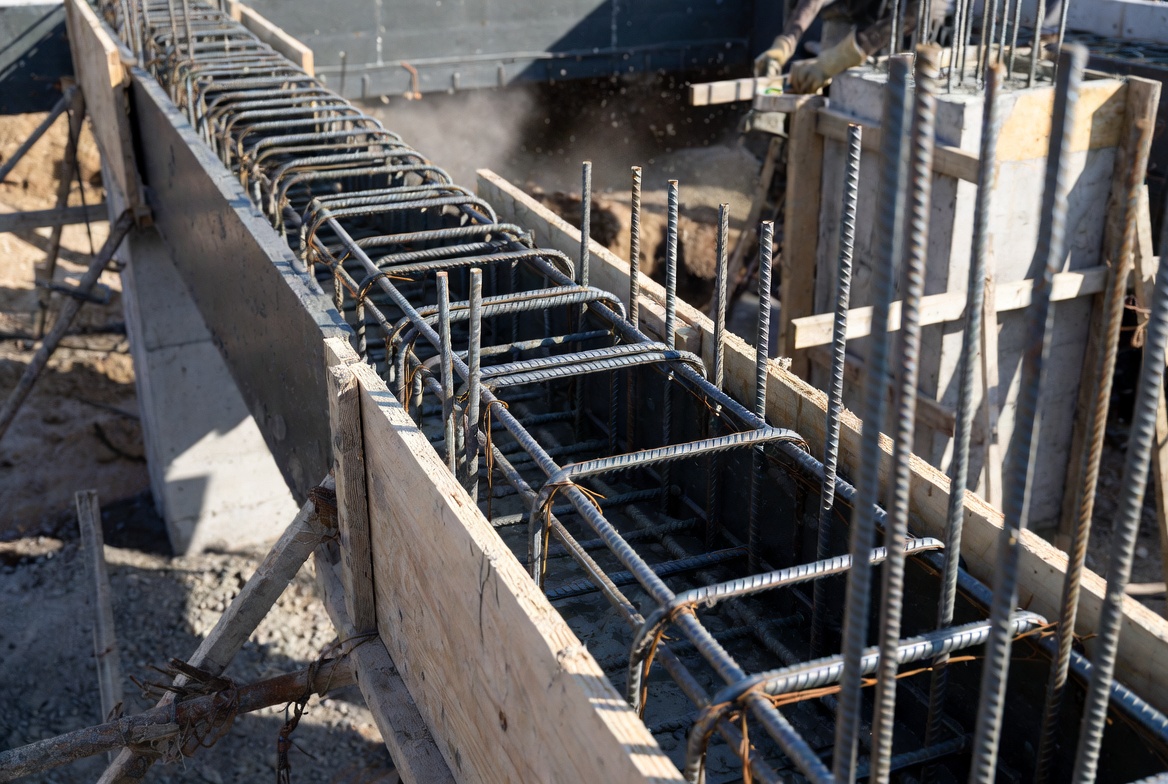
A tie beam is there to stop parts of the structure from pushing apart or drifting out of line.
The location can change from one building to another, but the job does not. A tie beam ties structural members together so the frame stays controlled under load. Problems start when the term gets used loosely and different members get treated like the same thing.
MUST READ
Reinforced Concrete Design
Useful when the conversation moves from general tie-beam logic into reinforcement, load path, and beam behavior.
What a Tie Beam Does

A tie beam is a horizontal structural member used to connect other structural members so they act together instead of independently.
Its main job is usually not to behave like a primary floor beam carrying major vertical gravity load across a room. Its main job is to tie supports together, reduce relative movement, and help the structure hold its geometry under load.
- Between columns, it can reduce unbraced movement and help keep the frame working together.
- At foundation or plinth level, it can tie supports together and help control differential movement.
- In roofs, it can resist outward thrust and help keep the roof from spreading.
- In masonry or reinforced concrete frames, it can help create a more continuous structural belt.
The exact role depends on the system. The name stays the same. The force path changes.
Where Tie Beams Usually Show Up

| Location | What the tie beam is doing there | What usually goes wrong |
|---|---|---|
| Between columns in framed construction | Ties vertical supports together and helps control relative movement | Weak connections, poor alignment, undersized sections |
| Foundation or plinth level | Helps tie supports together and control settlement-related movement | Treating it like a random strip of concrete instead of part of the frame |
| Roof framing | Resists outward thrust and helps keep the roof geometry stable | Confusing it with collar ties or ridge members |
| Masonry or seismic belt conditions | Helps create continuity and distribute movement through the structure | Interrupted runs, weak reinforcement, bad anchorage |
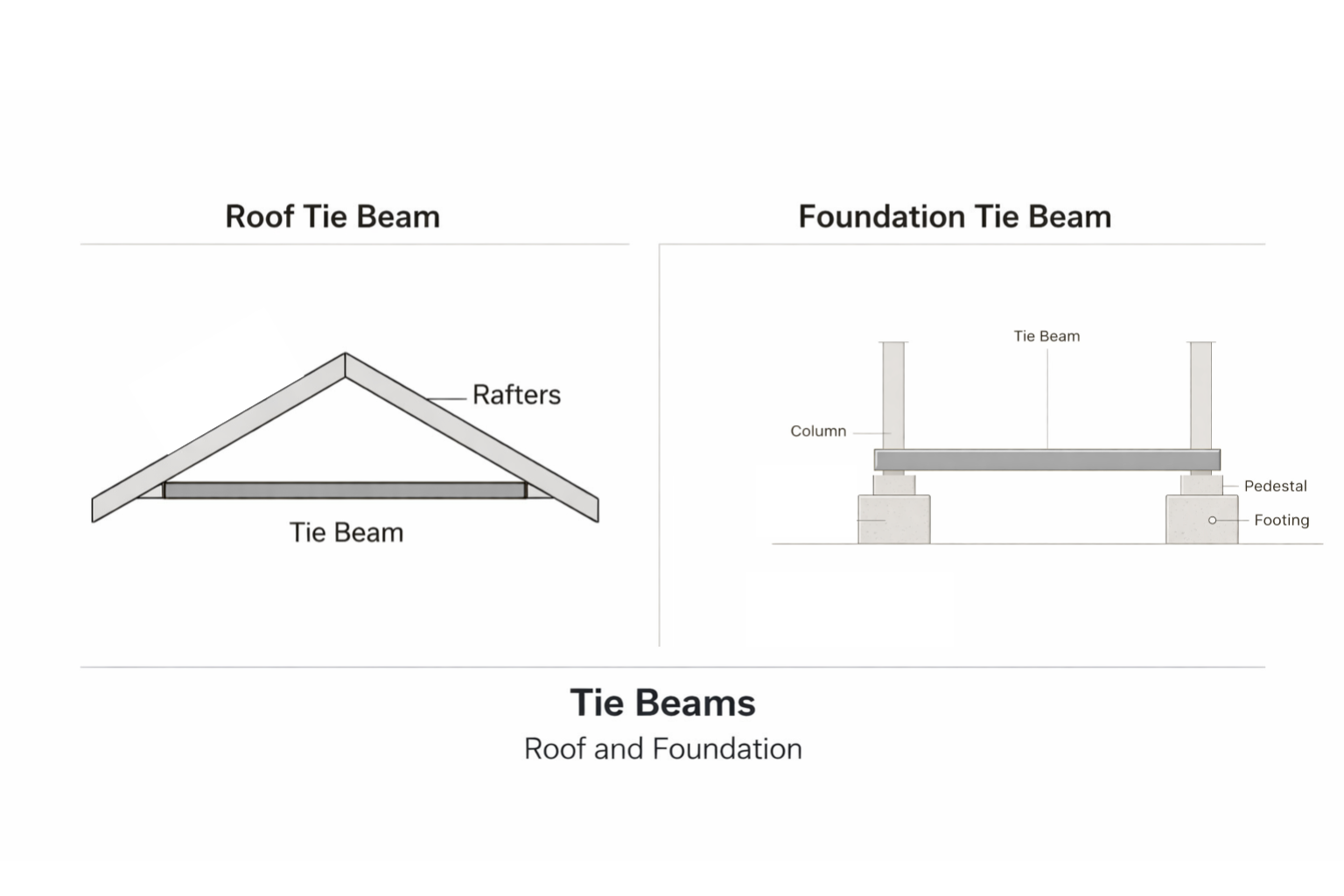
That is why a tie beam should always be read in context. A roof tie beam and a reinforced-concrete foundation tie beam are not interchangeable details, even if the word “tie beam” appears in both drawings.
Tie Beam, Plinth Beam, Lintel, Roof Tie Beam: Not the Same Thing
The names overlap, but the jobs do not.
| Member | Main job | Typical location |
|---|---|---|
| Tie beam | Ties structural supports together and controls movement | Between columns, at foundation level, or in roof/frame systems |
| Plinth beam | Runs at plinth level to support walls and help control settlement and cracking | At or near ground-floor wall base |
| Lintel beam | Spans over an opening and carries wall load above it | Above doors and windows |
| Roof tie beam | Resists outward thrust in a roof framing system | Low in the roof, tying opposite sides together |
If you need the dedicated breakdowns, continue with Tie Beams vs Plinth Beams, Plinth Beams and Wall Stability, and Roof Tie Beams.
Roof Tie Beams Need Their Own Explanation
In roof framing, a tie beam is there to resist the outward thrust created when rafters or roof members want to push the walls apart.
That makes it different from a collar tie high near the ridge. A collar tie works in the upper roof zone. A roof tie beam or lower tie works lower and is part of the thrust-control strategy.
This matters most in simple gable roofs, long spans, open rooms, and any roof where the lower tie strategy is being altered to make the ceiling look cleaner.
If the room is being opened up and the lower ties are going away, that is often the point where the roof needs a different answer entirely, sometimes a structural ridge beam with a proper support path below.
Tie Beams in Different Construction Systems
Reinforced Concrete
This is where the term is most common in general construction. Reinforced-concrete tie beams connect columns, pedestals, or supports and rely on proper reinforcement, anchorage, and concrete quality to do their job.
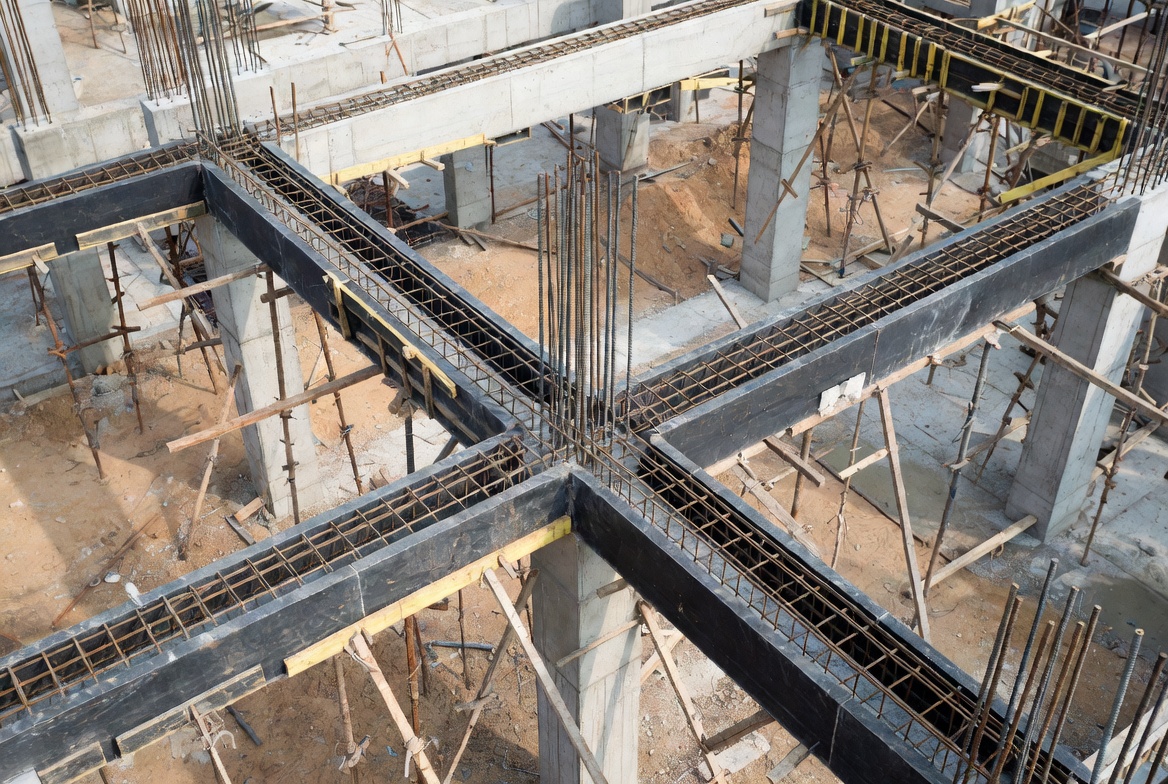
Image by ArchitectureCourses.org. Reinforced concrete tie beam formwork and rebar arranged at a multi-beam intersection before the concrete pour.
Masonry and Foundation Work
In masonry and low-rise reinforced work, tie beams can act like horizontal belts that help hold the structure together and limit uneven movement. At foundation or plinth level, they are often part of the strategy for dealing with settlement differences and frame continuity.
Steel Framing
In steel systems, the same tying logic may be handled by steel members and welded or bolted connections rather than a reinforced-concrete beam. The name may stay similar, but the detail changes.
Timber and Roof Framing
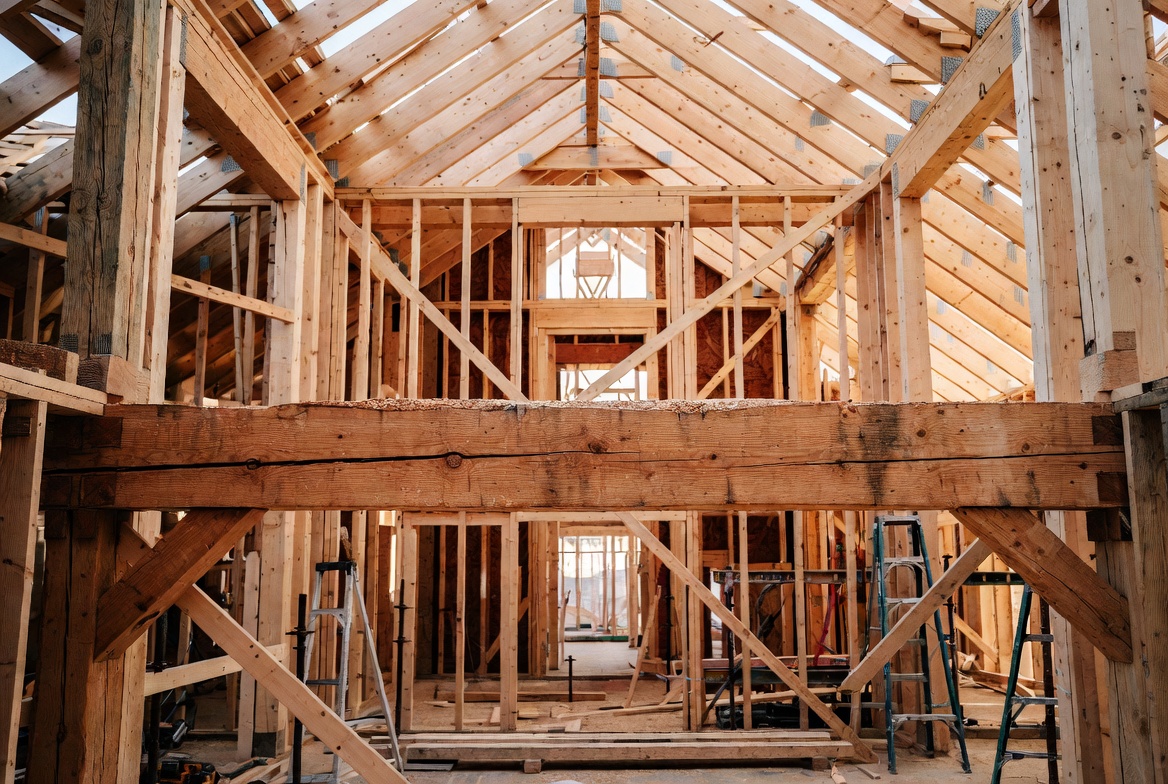
Image by ArchitectureCourses.org. Heavy timber tie beam spanning between main posts within a traditional timber roof frame.
In timber frames and roof framing, a tie beam often works in tension to keep opposite sides of the structure from spreading apart. That is why tie beams show up in roof-framing conversations even though the material and geometry look completely different from a reinforced-concrete tie beam.
What Makes a Tie Beam Work
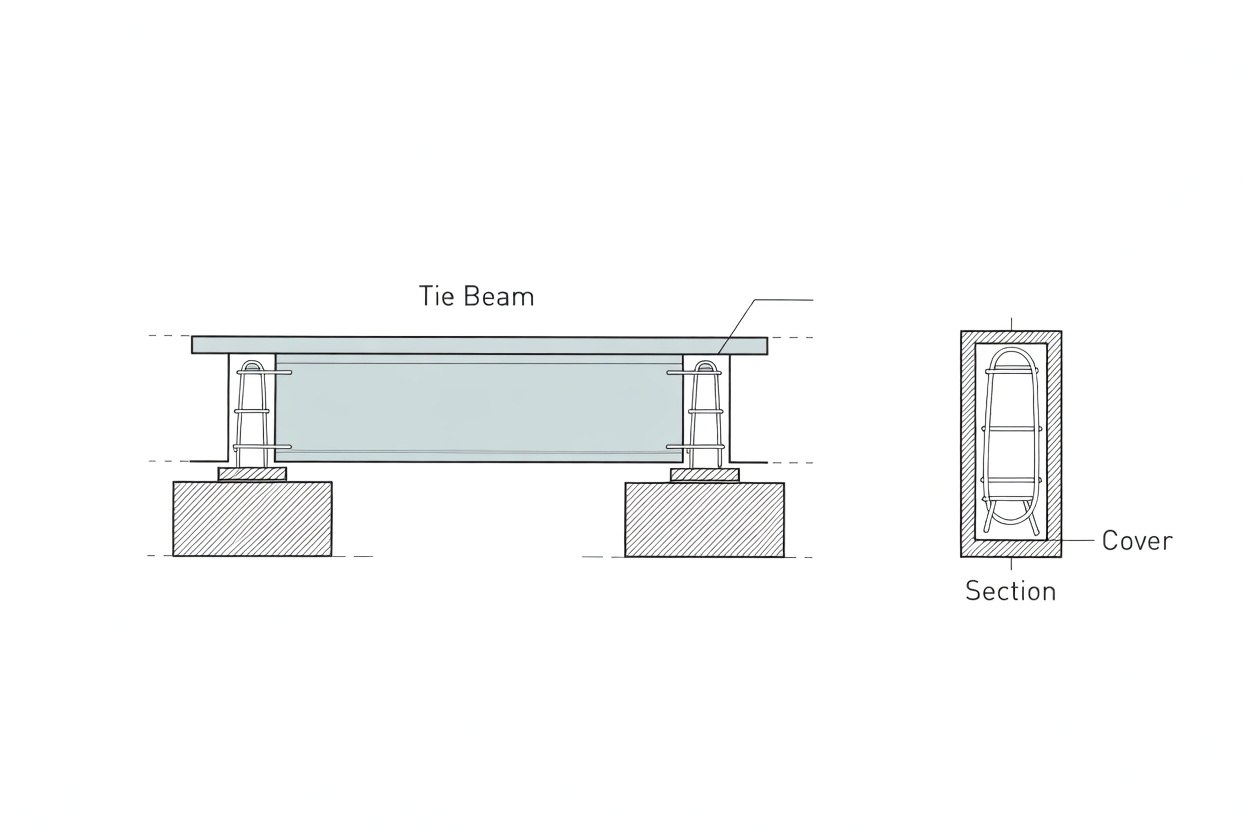
Illustration by ArchitectureCourses.org. Tie beam diagram showing the beam between two supports and a simplified cross-section with reinforcement cover.
A tie beam only works when four things are resolved together:
- Correct placement. It has to tie the members that are trying to move.
- Correct section size. The beam has to be sized for the forces it is meant to carry.
- Correct reinforcement or member selection. Concrete, steel, and timber each solve the problem differently.
- Correct connections. A tie beam with weak anchorage is not really tying much of anything together.
This is why guessing from appearance goes badly. A beam can look thick and still be badly connected. It can look modest and still be correct because the reinforcement, detailing, and support conditions were worked out properly.
If you need the broader load-path logic behind that, see Understanding Structural Support: Load Paths Explained and How to Analyze Beams.
When a Tie Beam Is Not the Right Answer
Not every structural problem wants a tie beam.
If the member needs to span an opening and carry wall load above, that is usually a lintel problem. If the issue is supporting wall load continuously at the base of a masonry wall, that may be a plinth beam problem. If the roof no longer behaves like a tied-rafter system because the room has been opened up, the structure may need a ridge beam or a larger redesign rather than one more horizontal member called a tie beam.
A tie beam helps when the structure needs supports tied together so movement stays controlled. It is the wrong answer when the real problem is unsupported span, missing bearing, bad load path, or a framing system that has already changed into something else.
Common Materials and Connection Logic
| Material | Best fit | Main advantage | Main caution |
|---|---|---|---|
| Reinforced concrete | Foundations, plinths, masonry frames, concrete column systems | Strong, durable, widely used | Needs correct reinforcement, cover, curing, and anchorage |
| Steel | Industrial frames, long spans, modular systems | High strength with slimmer sections | Connection detailing and corrosion protection matter |
| Timber | Roof framing, exposed frames, traditional work | Clear structural logic and easier handling in some systems | Movement, moisture, and connection detailing matter |
Connection design is not a side note. If the beam is meant to tie columns or walls together, the anchorage into those members is part of the beam’s job.
FIELD PICK
Simpson Strong-Tie BCS2-2/4
A useful connector reference when the job involves beam-to-beam hardware rather than cast-in-place reinforced-concrete tying.
How Tie Beam Work Goes Wrong
- Using a tie beam where the structure really needs a different member.
- Treating a tie beam like a generic horizontal strip without checking the force path.
- Undersizing the section or under-reinforcing the beam.
- Connecting into columns or supports poorly.
- Assuming a roof tie beam, collar tie, and rafter tie are all the same thing.
- Ignoring curing, cover, corrosion, or moisture exposure in concrete and steel work.
- Trying to clean up a room visually without reworking the actual structural strategy.
Those are the projects that look fine early, then start cracking, drifting, or opening up where the frame was supposed to stay locked together.
What Problems Show Up First
When tie beam work is missing or wrong, the first signs are often small enough that people ignore them.
- Cracks at wall corners or around openings
- Subtle spreading or drift between supports
- Sagging or movement in roof framing
- Trim joints opening or finishes cracking repeatedly
- Columns or walls that seem to move out of line over time
Those signs do not prove the tie beam is the only problem, but they often point to a larger issue in the tying, support, or load-path strategy.
When the Beam Below Matters More Than the Beam You See
One mistake keeps repeating in both foundation work and roof work: people focus on the visible tie beam and ignore the support conditions around it.
A tie beam between columns still depends on those columns being aligned, anchored, and supported properly. A roof tie beam still depends on the rafters, walls, and ridge strategy being correct. A plinth-level tie beam still depends on the foundation system behaving the way the design assumed.
That is why tie beams should be read as part of a system, not as isolated objects. The member matters. The load path matters more.
FAQ
Is a tie beam load-bearing?
Its primary job is usually tying and stabilizing, not acting as the main gravity beam over an open span. But the exact role depends on the system and the way the structure is designed.
Where should a tie beam go?
Where it can actually tie the members that are trying to move. In practice that may be between columns, at plinth level, in a roof system, or in another location defined by the structural design.
Is a tie beam the same as a plinth beam?
No. They can overlap in some projects, but the terms are not interchangeable and the structural job is not always the same.
Is a tie beam the same as a lintel?
No. A lintel spans over an opening and supports load above it. A tie beam is mainly there to tie structural members together and control movement.
Can wood be used for tie beams?
Yes, especially in roof framing and timber systems. But the material has to match the span, force path, environment, and connection detail.
What happens if a tie beam is omitted?
The structure may lose stiffness, supports may move more independently, walls may crack, and the load path can stop behaving the way the design expected.