
Flat roofs are not flat. They need slope to drain.
Sloping flat trusses do that job. They keep the low, clean roof line people want, but they build in enough fall for water to move instead of sitting there.
That matters more than the name suggests. A roof that looks flat but does not drain well turns into a leak problem, a membrane problem, or a ponding problem. Sometimes all three.
This page keeps the subject practical. What a sloping flat truss is. Why it gets used. How much slope usually makes sense. When wood is enough. When steel is the better move. How far these systems can span. And where the job starts going bad.
What a Sloping Flat Truss Is

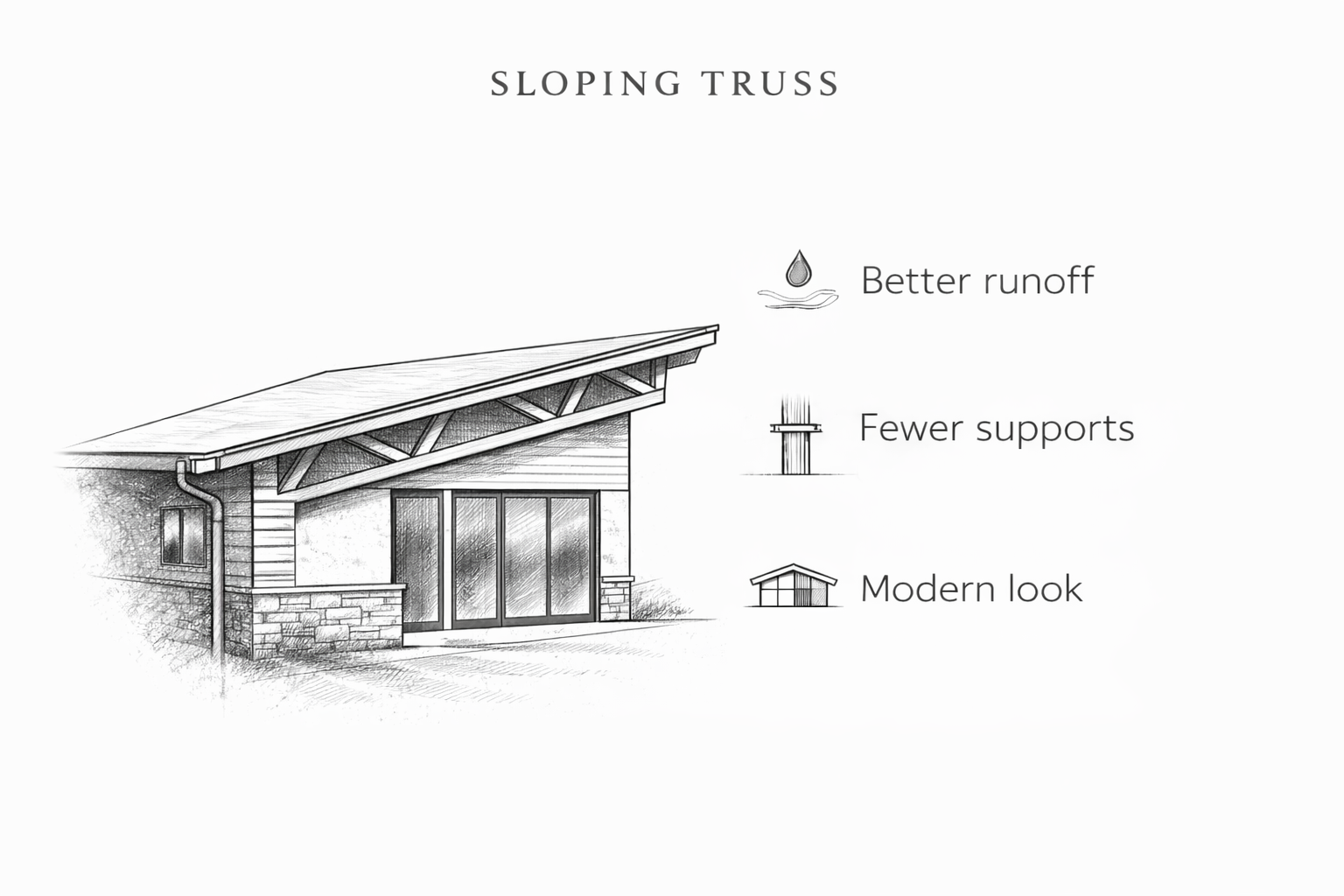
Illustration by ArchitectureCourses.org. A sloping flat truss keeps the roof profile low while still creating fall for drainage.
A sloping flat truss is a roof truss built for a low-slope roof, not a dead-flat one.
From the outside, the roof can still read as flat or nearly flat. Inside the structure, the truss geometry creates the fall needed to move water toward drains, scuppers, or gutters.
That is the whole point. Keep the low-profile roof. Lose the standing water.
In most projects, these trusses show up in commercial buildings, warehouses, schools, multifamily work, and modern houses that want a flat-roof look without the maintenance problems of a roof that barely drains.
Why These Trusses Exist
The first reason is drainage.
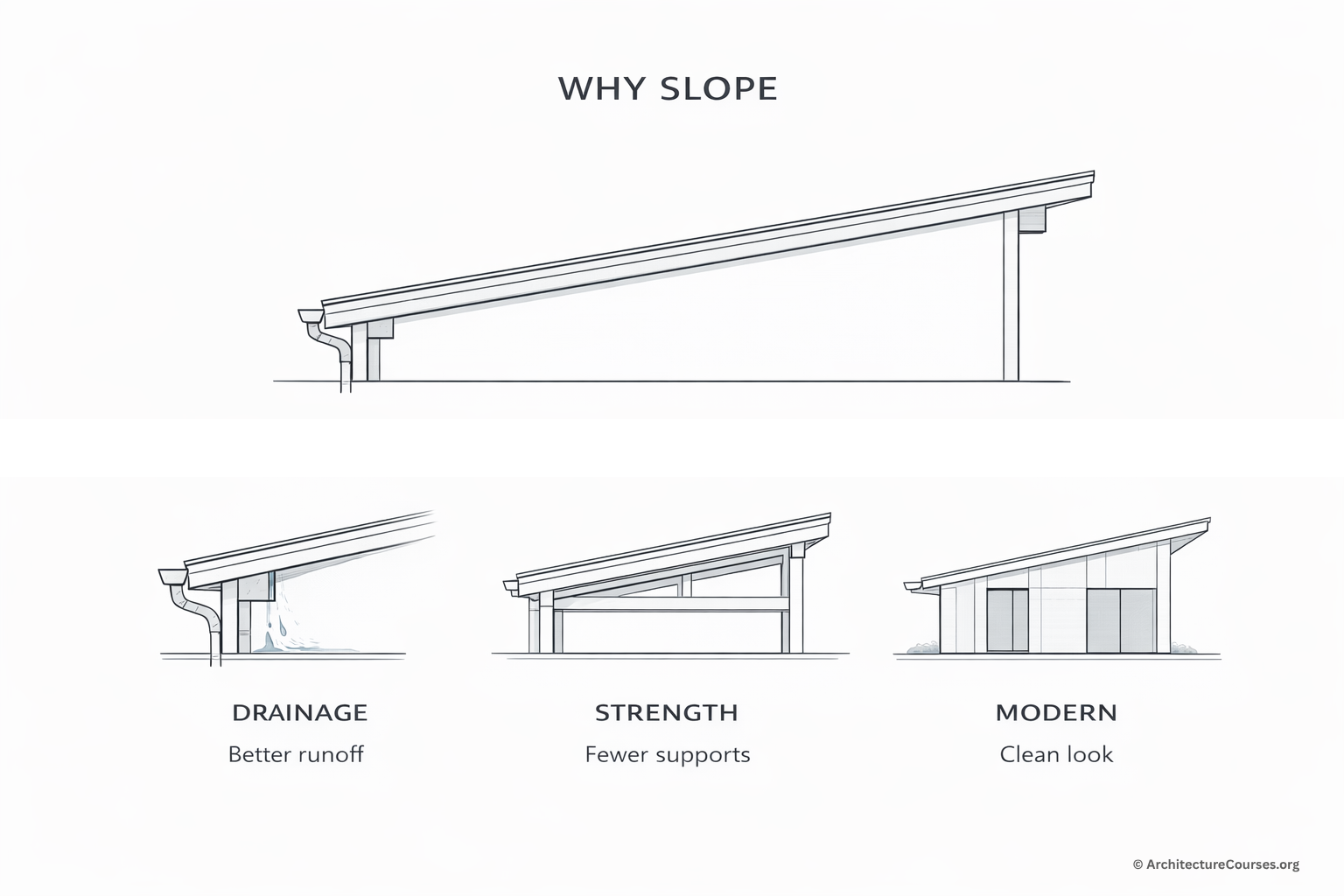
Illustration by ArchitectureCourses.org. Explainer plate showing why a single-direction sloped roof helps drainage, reduces support complexity, and creates a cleaner profile.
Low-slope roofs still need enough fall to shed water. Building code sections for roof coverings set minimum design slopes, and NRCA also recommends positive drainage for low-slope roof systems.
The second reason is span. Trusses let you cover wider spaces with fewer interior supports than a simpler stick-framed low-slope roof.
The third reason is profile. A sloping flat truss lets the building keep a clean roof line instead of turning into a visibly pitched roof just to make water move.
| Why Use a Sloping Flat Truss | What It Gives You | What It Prevents |
|---|---|---|
| Drainage | Built-in fall toward drains or edges | Standing water and ponding |
| Longer spans | Fewer interior supports | Extra columns and broken-up interiors |
| Low profile | Cleaner exterior roof line | A bulky pitched roof where the design wanted a flatter form |
| Coordination | Space for structure, roof build-up, and services | Ad hoc framing fixes later |
How Much Slope Is Enough
This is usually the first design call.
A common starting point for low-slope roofs is 1/4 inch per foot. That is often treated as the minimum practical fall for drainage, but it is not the answer for every roof. Roof system type, local code, drain layout, climate, and reroofing conditions all change the right number.
In plain language: mild climate, short run, clean drain layout, and careful detailing is one condition. Snow, heavy rain, long runs, rooftop equipment, and awkward drain placement is another.
| Slope | Where It Often Works | What To Watch |
|---|---|---|
| 1/4 inch per foot | Many standard low-slope roofs | Needs good drain layout and clean execution |
| 1/2 inch per foot | Roofs that want faster runoff or more margin | Can affect parapet heights and roof build-up |
| Less than 1/4 inch per foot | Usually a bad place to get casual | Ponding, membrane stress, and drainage complaints |
The common mistake is simple: the designer says “flat roof,” the structure gets drawn too casually, and someone assumes the membrane or tapered insulation will rescue a weak drainage plan later.
Sometimes it does. A lot of times it does not.
Wood or Steel?
This is the next big split.
Wood works well for many houses, smaller commercial buildings, and moderate spans. Steel makes more sense once the roof gets wider, heavier, more open, or more demanding.
| Factor | Wood Truss | Steel Truss |
|---|---|---|
| Best fit | Residential and smaller commercial work | Commercial, industrial, and long-span roofs |
| Typical economy | Better on smaller jobs | Better once spans and loads climb |
| Span potential | Good, but more limited | Much greater long-span potential |
| Weight | Heavier for the same long-span ambition | Higher strength-to-weight ratio |
| Main risk | Moisture, deflection, overreaching the span | Corrosion, detailing errors, thermal movement |
Wood is not weak. Steel is not automatically better. The question is what the building is asking the truss to do.
Worth knowing. If the roof is already pushing into larger structural territory, Steel Truss Design is the better next read.
How Far These Trusses Can Span
Span depends on material, truss depth, spacing, loading, roof build-up, and how much the designer is willing to pay for the structure.
In ordinary work, wood low-slope trusses often land in the rough range of about 40 to 60 feet. Steel roof trusses can go much farther and are the more common answer once long open spans start driving the building. WoodWorks case studies and education material show long-span wood systems in the 60- to 160-foot range for some engineered wood applications, while steel trusses commonly serve much larger roof spans in commercial and industrial work.
That does not mean every wood sloping flat truss should be pushed that far. It means span is not just a material question. It is a system question.
- Wider spacing may save pieces but can force heavier decking.
- Shallow trusses look efficient on paper until deflection and service coordination catch up.
- Snow, rooftop units, and concentrated loads change the whole game.
The short version: for a house or smaller commercial roof, wood is often enough. For a wide warehouse, big box, gym, or large open commercial plan, steel or engineered long-span wood systems usually make more sense.
What Controls the Span
People like span charts because they look clean. Roofs are not clean.
Roof load
Dead load, live load, snow load, wind uplift, mechanical units, solar, screens, and maintenance access all matter.
Truss depth
A deeper truss usually buys structural efficiency. The problem is that it also affects parapets, heights, and coordination with ducts and drains.
Spacing
Truss spacing is not just a material count issue. Wider spacing can push cost into heavier deck, purlins, or secondary framing.
Drain layout
A roof with poor drain locations can force awkward geometry or leave low points even when the truss is technically sloped.
Build-up above the truss
Tapered insulation, roof deck, membrane system, curb heights, and parapets all affect how much slope you really end up with.
That is why a sloping flat truss should be designed with the roof system, not before it.
Use This Instead of This
| Do This | Instead of This | Why |
|---|---|---|
| Build slope into the structure early | Hope tapered insulation fixes everything later | Structure-first drainage is cleaner and more reliable |
| Use steel for very wide, open spans | Push ordinary wood trusses too far | Long spans punish weak structural choices |
| Coordinate drains, scuppers, and low points with the truss layout | Let roof drains be an afterthought | The water has to know where to go |
| Check wind uplift and anchorage early | Treat a low-slope roof like a quiet gravity-only roof | Uplift can control the whole edge and connection strategy |
| Use the truss system that fits the building | Pick by initial material cost only | The cheap system can become the expensive roof later |
Where These Roofs Usually Fail
Most sloping flat truss failures are not exotic.
- Too little slope. The roof technically drains, but not well enough.
- Bad drain placement. The structure slopes one way, the water wants to go another.
- Too much faith in the membrane. Membranes are not there to compensate for weak drainage planning.
- Undersized trusses. The span looked manageable until the full loads showed up.
- Weak edge anchorage. Wind gets ignored until the perimeter starts talking back.
- Poor coordination. Ducts, curbs, rooftop units, and drains start fighting the truss geometry.
Most of these failures start in design, not after the building is finished.
When a Sloping Flat Truss Makes Sense
Use one when the building wants a low roof profile but still needs drainage and decent span.
- modern houses with a flat-roof look
- commercial buildings that want open space under a low roof line
- warehouses and light industrial buildings
- schools, offices, and multifamily roofs with repeated low-slope geometry
Skip it when the roof wants a steeper pitch, the drainage is too awkward, or the building would be simpler and safer with a different roof form.
Quick Checklist Before You Lock the Roof
- Is the structural slope clear on the drawings, not just implied?
- Are drain locations coordinated with the real low points?
- Does the roof system match the climate and code path?
- Are the truss depth and spacing realistic for the span and loads?
- Has wind uplift been treated as a design input?
- Is wood still the right answer at this span, or is steel the cleaner move?
FAQ
What is a sloping flat truss?
It is a truss for a low-slope roof that looks flat but still has enough fall to drain water.
What is the minimum slope for a flat roof truss?
A common starting point is 1/4 inch per foot, but the right answer still depends on the roof system, drainage layout, climate, and code path.
Can wood sloping flat trusses span 100 feet?
Ordinary wood trusses usually are not the clean answer there. Very long wood spans are possible in engineered systems, but once the building wants big open span, steel is often the simpler and more practical move.
Are sloping flat trusses better than pitched trusses?
Not better across the board. They are better when the design wants a low roof profile and the building still needs drainage and span efficiency.
What is the biggest mistake with these roofs?
Treating “flat” like “no slope needed.” That is where the trouble starts.
Read This Next
If the next question is basic truss behavior, start with truss basics. If uplift and bracing are becoming the real issue, read Truss Lateral Bracing. If the roof is getting wider and steel is starting to make more sense, go to Steel Truss Design.