
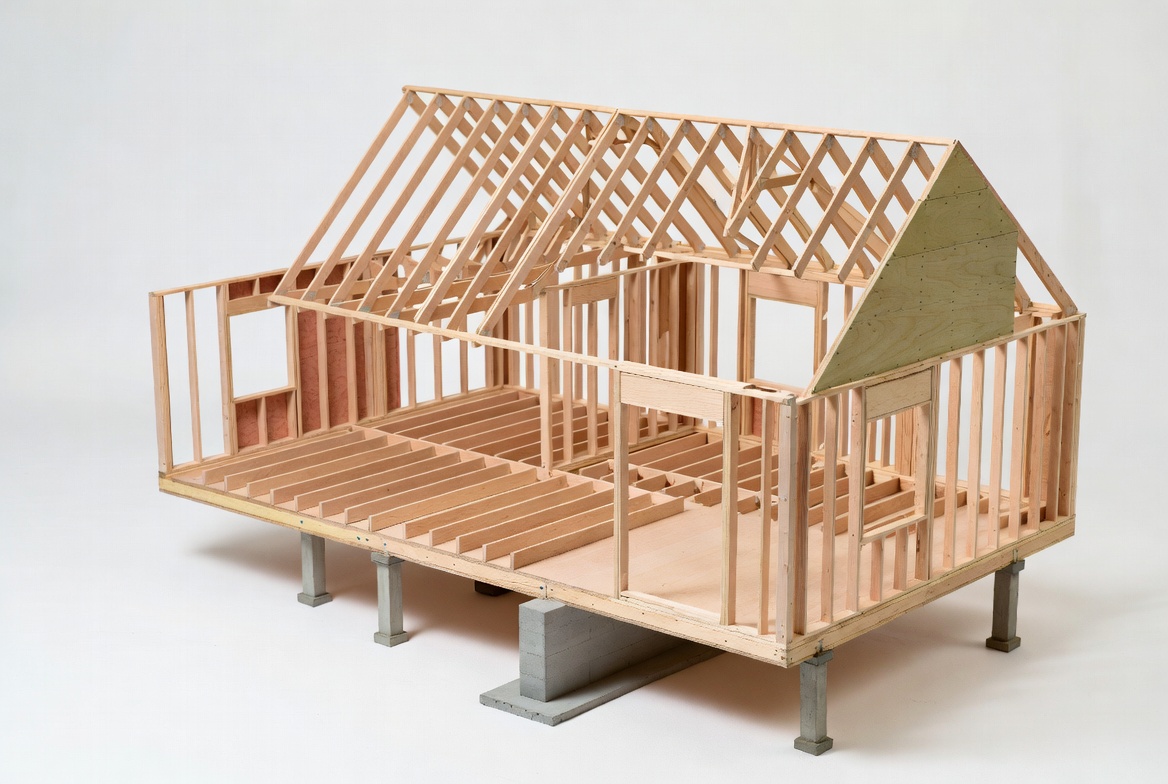
Roof bracing is not a side detail.
Once the span gets bigger, the wind gets harder, the snow gets heavier, or the trusses get more complicated, bracing becomes part of what keeps the roof stable.
The real question is not just which brace goes where. It is what force you are controlling, where the roof is weak, and what starts moving when the bracing is wrong.
If you want the broader primer first, start with Roof Bracing: What It Is and Why It Matters.
What Roof Bracing Is Really Doing
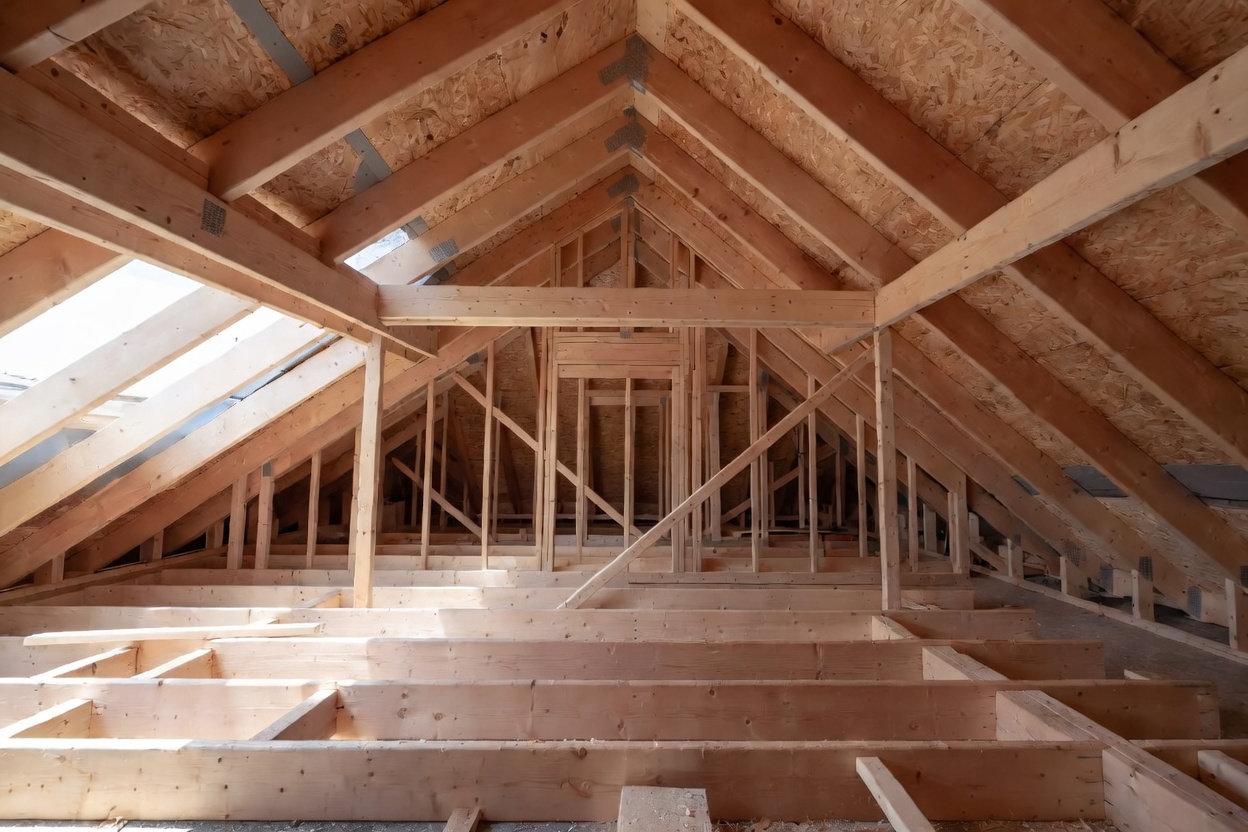
Image by ArchitectureCourses.org. Interior roof framing with diagonal and horizontal members working together to control movement during construction.
Roof bracing is there to control movement.
Some movement is vertical. Roof members bend under dead load, live load, snow load, and equipment load. Some movement is lateral. Wind pushes, suction lifts, and the whole assembly wants to rack, roll, or drift if the load path is weak.
Good bracing helps the roof do four things well:
- keep compression members from buckling
- help long spans stay in shape
- transfer lateral force into walls and the rest of the structure
- keep the roof acting like one system instead of a collection of individual parts
That last part matters more than it sounds. A roof does not fail only because one member is weak. It often fails because the members, sheathing, connectors, and brace lines were never made to work together cleanly.
Roof Bracing and Truss Bracing Are Related, but Not the Same Job
This confusion shows up all the time.
Roof bracing is the bigger structural conversation. It deals with the stability of the roof system as part of the building.
Truss bracing is narrower. It deals with restraining and stabilizing the trusses themselves so they stay aligned, resist buckling where required, and keep their intended geometry during installation and in service.
In practice, the two overlap. But they are not interchangeable terms.
If your project uses factory-built trusses, start with Truss Bracing and Roof Support Systems. If you are still sorting out the truss itself, see Roof Trusses and roof truss details and connections.
The Main Types of Roof Bracing
| Bracing Type | What It Mainly Controls | Where It Usually Shows Up | What People Misunderstand |
|---|---|---|---|
| Diagonal bracing | Racking and lateral movement | Roof planes, truss runs, long-span systems, wind-exposed structures | People treat it like optional stiffening when it is often doing real structural cleanup |
| Longitudinal or continuous restraint | Buckling in repeated members | Truss top chords, bottom chords, and some web members | It is not there just to keep members lined up neatly |
| Lateral bracing | Sideways instability in members under compression | Trusses, rafters, purlins, and secondary roof framing | It only works if the restraint has somewhere for the load to go |
| Gable end bracing | Wind pressure and end-wall weakness | Gable ends and end frames | People underestimate how exposed gable ends can be in storms |
| Roof diaphragm action | System-wide lateral load transfer | Sheathed roof planes tied to walls and collectors | Sheathing is not just enclosure; it can be part of the structural bracing story |
The point is not to memorize the list. It is to understand that each type is solving a different instability problem.
Diagonal Bracing: The One People Notice First
Diagonal bracing is the easiest one to spot because it looks like it is doing something structural. Usually it is.
It helps stop the roof system from drifting out of square under lateral force. In trussed roofs, it often works together with restraint lines so the trusses do not just stand there individually and hope the sheathing fixes everything later.
Diagonal bracing matters most when:
- the roof span is long
- the site sees strong wind
- the building is open and flexible below
- the truss layout creates long repeated runs that want to move together
The mistake is thinking one or two diagonal members automatically solve the whole problem. They only work when their ends tie into a load path that can actually take the force.
Lateral and Continuous Bracing: Smaller Pieces, Bigger Job Than They Look
This is where a lot of roof bracing gets misread.
Continuous restraint or lateral bracing is often there because a member in compression wants to buckle sideways before it ever reaches its theoretical capacity. The brace is not decorative. It is keeping the member from failing in a very ordinary way.
That shows up often in truss top chords, some web members, purlins, and other repeated framing lines.
One ugly truth here: a restraint line that is not itself properly braced can just move with the member it was supposed to restrain. That is why restraint and diagonal bracing so often have to work together instead of being treated as separate topics.
Roof Sheathing Is Part of the Bracing Story Too
A roof that is properly sheathed and fastened does more than give shingles or metal roofing something to sit on.
It can also help the roof plane act like a diaphragm, which matters for lateral load transfer. That is one reason sloppy panel layout, weak nailing, or bad edge support can turn into a bigger structural issue than people expect.
This is also why roof bracing cannot be read only as loose boards or steel straps added after the fact. In many buildings, the brace logic includes the sheathing, the connectors, and the wall tie-in below.
For the wider roof-system view, see roof structures.
Which Bracing Makes Sense for Sheds, Houses, and Long-Span Buildings
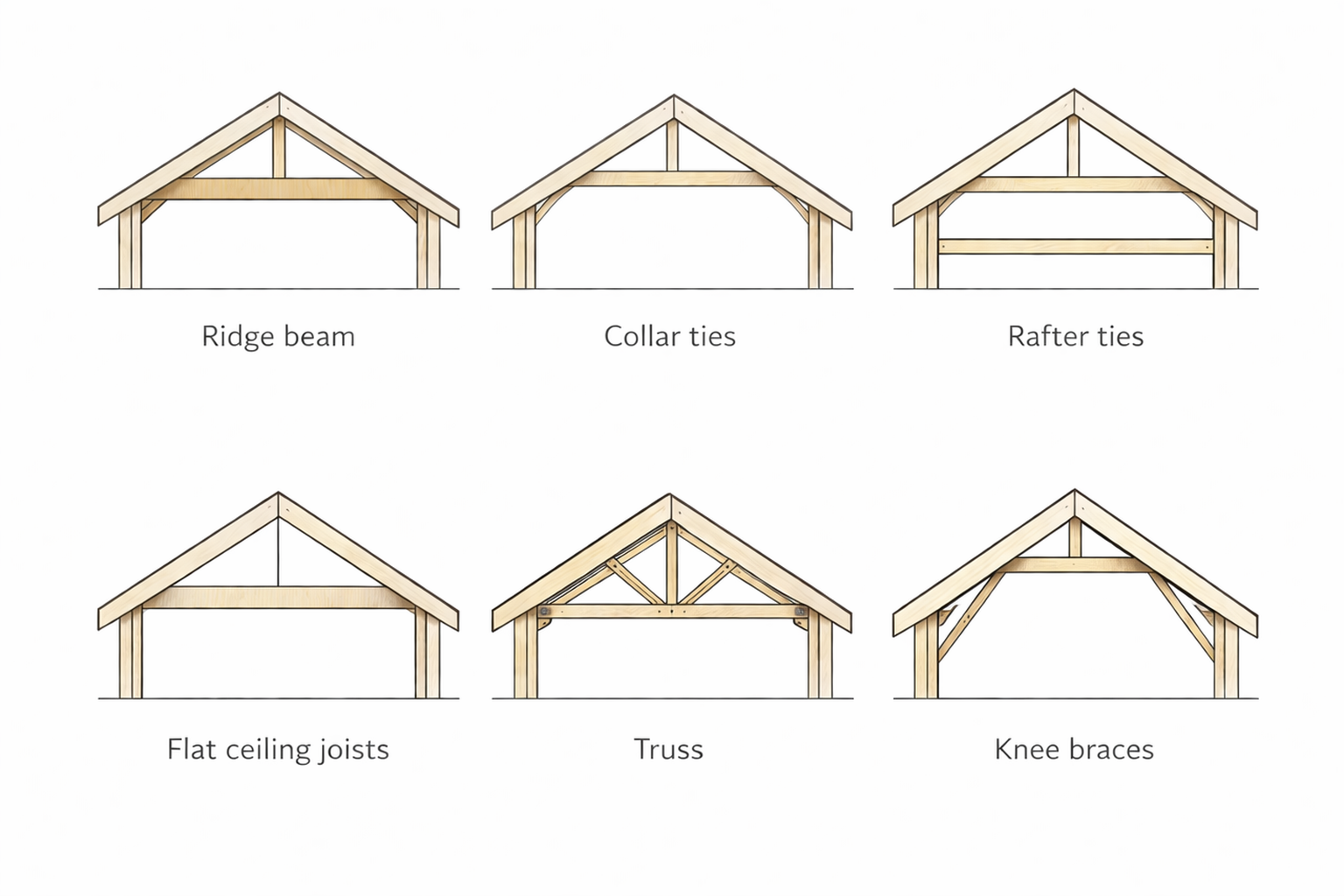
Illustration by ArchitectureCourses.org. A roof bracing comparison plate showing six common framing approaches and how each changes the roof structure.
| Building Type | What Usually Matters Most | Typical Bracing Logic | What Commonly Goes Wrong |
|---|---|---|---|
| Sheds and small outbuildings | Keeping cost and detailing simple | Basic diagonal bracing, clean roof-to-wall tie-in, adequate sheathing | Under-bracing because the building looks too small to fail |
| Standard houses | Wind, snow, openings below, truss or rafter layout | Roof-plane bracing, truss restraint where required, gable-end support, good connectors | Treating truss installation stability as if permanent bracing has already been solved |
| Large custom homes | Long spans, vaulted ceilings, mixed roof shapes | More engineered brace layouts, cleaner load paths, more attention to connections | Architecture outruns the structural discipline |
| Warehouses and industrial buildings | Long spans, rooftop units, lateral loads, repeated frames | Steel bracing, rod bracing, diaphragm action, stronger connection design | Ignoring how much the braces are doing once the spans get long |
Materials: Wood, Steel, and Engineered Wood
Material choice is less about fashion than people make it sound.
Wood
Standard lumber still makes sense in a lot of residential roof bracing because it is familiar, available, and easy to install. It is strongest where the spans are ordinary, the detailing is straightforward, and the crew knows the system well.
Steel
Steel earns its place once the loads get heavier, the spans get longer, or the environment gets harsher. It is common in larger commercial and industrial structures because it handles stress better and gives engineers more flexibility.
Engineered Wood
Engineered wood sits in the middle. It can solve span and stiffness problems cleanly in custom residential work or mixed-use projects where ordinary lumber starts running out of range.
| Material | Where It Usually Fits Best | Main Advantage | Main Trade-Off |
|---|---|---|---|
| Dimensional lumber | Ordinary residential roofs and smaller buildings | Affordable, familiar, easy to work with | Less forgiving on long spans and tougher load conditions |
| Steel | Industrial buildings, longer spans, heavier loads | High strength and durability | Higher cost and more specialized installation |
| Engineered wood | Custom homes, bigger rooms, cleaner exposed structure | Better span performance with a warmer material language | Costs more than ordinary lumber and still needs careful moisture management |
If the roof system is steel-heavy, see steel truss design.
What Actually Decides the Bracing Layout
Roof bracing is not chosen from a universal menu. The right layout depends on a few blunt realities:
- Span. Long roofs behave differently from short ones.
- Roof shape. A simple gable is easier to stabilize than a roof full of valleys, hips, and broken geometry.
- Loads. Snow, wind uplift, seismic demand, rooftop equipment, and ceiling loads all change the problem.
- Member type. Rafters, site-built roofs, light wood trusses, steel trusses, and hybrid systems do not brace the same way.
- Wall system below. The roof only behaves as well as the structure it is tied into.
- Build sequence. Some roofs are most vulnerable during installation, before the permanent system is complete.
That last one gets skipped too often. A truss package can be most unstable when it is half-installed. Temporary restraint and permanent bracing are not the same thing.
The Mistakes That Keep Repeating
- Assuming the sheathing will fix everything. Sheathing matters, but it is not a magic correction layer for weak restraint and bad geometry.
- Using brace terms loosely. Not every lateral restraint is diagonal bracing, and not every diagonal member solves buckling.
- Ignoring the installer phase. A lot of failures happen before the roof system is fully tied together.
- Weak connections. Good braces with bad fasteners or bad tie-ins still fail.
- Over-simplifying long spans. Once the building gets wider or more open, the brace logic gets more demanding fast.
- Cutting cost at the wrong place. Saving money on bracing or connection hardware is one of the dumber ways to create expensive structural repair later.
The pattern is consistent. Connection quality, restraint layout, and system continuity matter more than the simplified “just add a brace here” version people like to repeat.
What Roof Bracing Usually Costs
The real cost is not just the brace member.
It is the material, the connection hardware, the labor, the access, the roof geometry, and whether the system requires engineering attention beyond a simple standard layout.
In broad terms, wood bracing is usually the lowest-cost path, engineered wood lands in the middle, and steel tends to be the highest-cost option once fabrication and installation are included. Labor climbs fast when the roof shape is awkward, the truss run is long, or the brace lines have to work around mechanical and architectural conflicts.
The better budgeting question is not “what is the cheapest brace.” It is “what keeps the roof stable without inviting a repair bill later.”
What Engineers and Good Crews Check Before They Trust the Roof
Not formulas first. Conditions first.
- Are the spans and loads what the truss or rafter design assumed?
- Are compression members restrained where they need restraint?
- Do the restraint lines have their own bracing and load path?
- Are gable ends and roof-to-wall connections treated seriously?
- Is the sheathing and fastening pattern part of the structural intent, not just a finish substrate?
- Has temporary installation stability been handled, not just the finished state?
That is usually where trust in the roof starts: not with one brace detail in isolation, but with the whole system behaving like it belongs together.
FAQ
What is the main purpose of roof bracing?
To control movement and keep the roof system stable under gravity, wind, uplift, and sometimes seismic forces.
Is roof bracing the same as truss bracing?
No. Truss bracing is part of the larger roof-bracing conversation, but it focuses more specifically on restraining and stabilizing the trusses themselves.
Which type of roof bracing matters most in high winds?
Usually the answer is not one brace type by itself. It is the combined system: diagonal bracing, proper restraint, diaphragm action, and strong roof-to-wall connections.
Can wood roof bracing be enough for a house?
Often yes, for ordinary residential work. The issue is not whether it is wood. The issue is whether the layout, connections, and load path are right.
Why do long-span roofs need more bracing attention?
Because longer members and wider roof planes are more likely to drift, buckle, or deflect if the system is not tied together properly.
Does roof sheathing count as bracing?
In many roof systems, yes. It can contribute diaphragm action and help the roof act as one plane, but only when it is detailed and fastened correctly.
What’s Next
If you need the roof structure itself before the bracing details, read roof structures.
If your project is truss-based and the installation phase is the part causing trouble, go to Truss Bracing and Roof Support Systems.
If you are comparing different truss layouts, see Truss Design 101 and Scissor Trusses.
Official Sources
ICC: 2024 IRC Chapter 8 Roof-Ceiling Construction
SBCA: Building Component Safety Information (BCSI) Guide
FEMA: Hurricane Wind Retrofit Technical Review
FEMA: Local Officials Guide for Coastal Construction
APA: Shear Walls and Diaphragms
American Wood Council: Wood Frame Construction Manual Workbook