
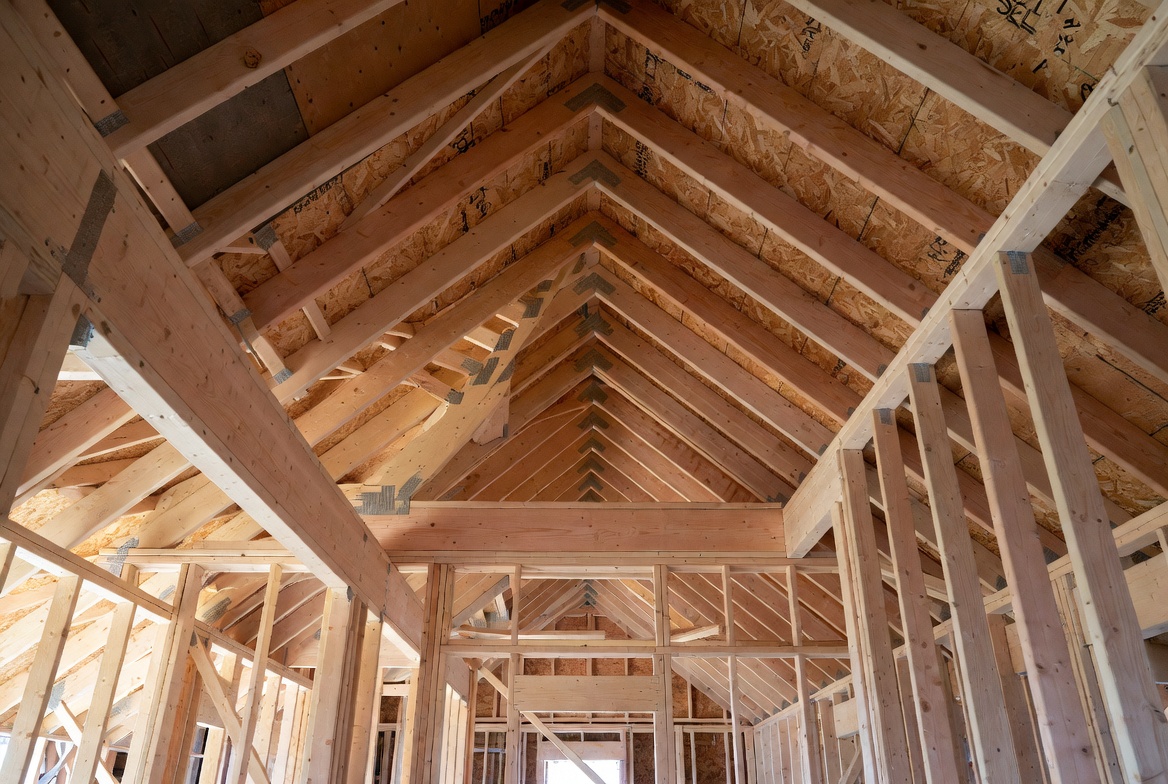
Roof structures get reduced to roof shape too often. Gable. Hip. Shed. Mansard. That part is easy to point at.
The harder part is the frame underneath: what is carrying the load, where that load lands, how the roof stays stable in wind, and which details start causing trouble years later. That is the part that decides whether the roof stays straight, stiff, and dry or starts sagging, spreading, leaking, or moving.
This page is the broad introduction. It explains how roof structures work, what the main parts do, where the common framing systems differ, and which mistakes are worth catching early.
- how rafters and trusses do the job differently
- which roof framing types are common and where they make sense
- what snow, wind, span, and roof shape change in the structure
- where failures usually start
- what to inspect before small problems turn expensive
What the Roof Frame Has to Do

A roof structure does three basic jobs.
- It carries the weight of the roof itself.
- It carries temporary loads like snow, workers, equipment, and sometimes drifting rainwater or ice.
- It transfers those loads into the walls, beams, and foundation below without letting the roof rack, spread, twist, or lift.
That sounds simple until the conditions change. A long span changes it. A vaulted ceiling changes it. A high-wind zone changes it. Heavy snow country changes it. So does a skylight, a dormer, a chimney, or a roof shape with too many intersections.
That is why roof structures are not just about “holding up the roof.” They are about load path, restraint, geometry, and buildability.
The Main Framing Parts
Most residential roof structures are built from the same core pieces, even when the overall shape changes.
Rafters or Trusses
These are the main sloped framing members that create the roof plane.
Rafters are usually cut and assembled on site. They are common in custom framing, renovation work, smaller additions, and roofs where the geometry does not suit a standard truss package.
Trusses are engineered assemblies, typically built off site and delivered ready to set. They are common in production housing and anywhere speed, repeatability, and predictable spans matter.
Ridge, Bearing, and Support Points
The ridge is where two roof slopes meet. Depending on the system, that top condition may be a ridge board, a structural ridge beam, or simply the meeting point of truss geometry.
At the lower end, the roof has to bear correctly on the wall or beam below. That bearing condition matters more than people think. If the roof lands in the wrong place, or does not have the support the design assumed, the problem is already in the frame before the roofing goes on.
Ties, Joists, and Connectors
Roof structures also rely on smaller members and hardware to stay stable.
- Ceiling joists or rafter ties help keep walls from spreading.
- Collar ties may help resist separation higher in the roof under some conditions.
- Straps, clips, and hurricane ties hold the roof down and keep the load path continuous.
- Bracing keeps the frame stable during installation and in service.
The names change from one detail set to another. The job does not.
Sheathing
Roof sheathing is not just a surface for shingles or metal panels. It also helps tie the roof plane together. That only works, though, when spacing, fastening, and support conditions are right.
Trusses vs Rafters
This is one of the first decisions that changes the whole roof package.
| System | Best Fit | What It Gives You | Where It Gets Hard |
|---|---|---|---|
| Site-built rafters | custom homes, additions, irregular roof shapes, renovation work | flexibility, easier field adjustment, more room for custom geometry | slower labor, more field layout, more chances for inconsistency |
| Standard wood trusses | repeated house plans, straight runs, production framing | fast installation, engineered spans, consistent geometry | harder to modify, delivery coordination matters, openings must be planned early |
| Raised-heel trusses | energy-conscious roofs with thicker insulation at the eaves | better insulation room, cleaner eave performance | changes fascia and soffit proportions, needs coordination with wall height and exterior details |
| Scissor trusses | vaulted ceilings without full site-built rafter framing | open interior volume with prefab speed | more sensitive geometry, less forgiving insulation space, support details matter more |
There is no universal winner here.
Trusses make a lot of sense when the roof geometry is straightforward and speed matters. Rafters start making more sense when the roof is irregular, when the framing has to respond to an existing structure, or when the design wants exposed work or more custom shaping.
Also useful. For a closer look at how common truss families work, read Roof Trusses: Types, Design, and Installation Guide.
Common Roof Frames
Roof structure and roof shape are not the same thing, but they do push on each other. Some roof forms are simpler to frame and brace. Some are cleaner in wind. Some give you more usable space. Some create more intersections, more special pieces, and more places for water and framing errors to collect.
Gable Roofs
A gable roof is one of the simplest and most common roof structures. Two sloped sides meet at a ridge. The framing is direct, drainage is straightforward, and the overall geometry is easy to understand.
The weak spot is often the gable end. That end wall and roof edge need enough support and bracing, especially in higher wind zones. The shape is simple. The end condition is where jobs can get light.
Hip Roofs
Hip roofs slope on all sides. They are often stronger in wind because there are fewer large vertical end walls, but they ask more from the frame. More corners. More layout. More special framing pieces. More places where the geometry has to stay tight.
Hip roofs can look calm and resolved when they are done well. They are not beginner framing.
Shed Roofs
Shed roofs frame as a single slope. They can be clean, efficient, and useful for additions, modern forms, porches, and smaller structures.
The simplicity can be deceptive. The high wall, drainage direction, and uplift exposure need attention. On long spans, the structure starts carrying bigger consequences fast.
Mansard, Gambrel, and Other Compound Roofs
These roof types create more usable volume, more character, or both. They also increase framing complexity and detail sensitivity. Breaks in slope mean more transitions, more support logic, and more places where waterproofing and structural coordination have to be right.
They can be worth it. They are not the place to wing the framing.
What Changes the Design
Roof structures are not designed in the abstract. They are designed for load.
Dead Load
Dead load is the weight of the roof assembly itself: framing, sheathing, underlayment, roofing, ceiling finish, insulation, and sometimes mechanical equipment or solar components. A tile roof and an asphalt-shingle roof do not ask the same thing from the frame.
Live Load
Live load covers temporary loading. Workers walking the roof. Equipment during repairs. Construction loading. In some cases, maintenance access. These loads can be brief, but the structure still has to take them.
Snow Load
Snow load is one of the biggest regional variables in roof design. Roof pitch changes how snow behaves, but pitch does not make snow irrelevant. Drifting, sliding, and accumulation near valleys or step-down conditions can concentrate weight where the framing needs extra thought.
A roof that works in one climate may be undersized in another. This is where local code and engineering stop being optional.
Wind Load and Uplift
Wind does not just push sideways. It also lifts. Roof edges, corners, overhangs, and gable ends are especially vulnerable. That is why connectors, straps, clips, and fastening schedules matter so much. Wind load is not just about the shape of the roof. It is about whether the whole load path stays tied together.
Read this next. Roof Bracing gets into the restraint and stability side of that problem.
Seismic and Special Conditions
In seismic regions, the roof structure still has to fit into the broader lateral system of the building. On larger or more complicated projects, the roof diaphragm, wall bracing, and connection details all start talking to each other in a more serious way.
Then there are project-specific conditions: heavy solar arrays, rooftop equipment, deep overhangs, exposed timber, long cantilevers, or large openings cut into the roof plane. All of those can change the framing logic.
Where Roof Framing Problems Start
Roof failures rarely start with the finished roofing material alone. More often, they start in the frame or at a detail that got treated like a small thing.
Weak Bearing
If rafters or trusses do not bear where the design expects them to, loads do not land cleanly. That can mean crushed framing, rotation, sagging, or stress showing up in the wrong place.
Field Modifications
Cutting, notching, or drilling trusses without engineering approval is one of the quickest ways to turn a designed system into guesswork. People do it because an opening changed, a duct got in the way, or something did not fit. That does not make it safe.
Skipped Bracing
Roof frames are vulnerable during installation. A truss standing upright is not the same thing as a stable roof system. Temporary bracing and permanent restraint both matter. Skipping them to move faster is how roofs rack, lean, or fail before the job is even dried in.
Load Creep
One late design change can trigger several structural changes. Heavier roofing. Bigger overhangs. Skylights added after the truss package was ordered. Mechanical units landed where nothing was sized for them. That is how trouble creeps in. Not from one dramatic mistake. From a few quiet ones.
Moisture and Ventilation Problems
Roof structures also fail slowly. Small leaks, repeated condensation, blocked ventilation paths, and wet insulation can damage framing over time. Wood rots. Fasteners corrode. Connector plates lose the dry, stable conditions they were expecting.
Once moisture gets into the frame, the repair is usually more expensive than the leak looked at first.
Better Moves vs Expensive Shortcuts
| Better Move | Bad Shortcut | What It Leads To |
|---|---|---|
| size the roof for local snow, wind, and use conditions | assume a standard roof package works everywhere | undersized framing or missed connector requirements |
| coordinate skylights, dormers, and penetrations early | figure them out after framing starts | field cuts, patch framing, and messy load rerouting |
| brace trusses as they are set | wait until the whole run is standing | temporary instability and avoidable jobsite risk |
| use raised heels when the roof assembly needs insulation room | compress insulation at the eave and hope for the best | weak thermal performance and harder air-sealing |
| review bearing and support below girder or concentrated loads | focus only on the roof piece itself | overload lower framing and hidden deflection problems |
What to Check in the Attic
Roof structures do not need constant panic. They do need attention.
If you are inspecting an attic, reviewing an older house, or trying to catch trouble early, these are the things worth looking at first:
- sagging ridges or roof planes that no longer look straight
- cracked, split, or water-stained framing members
- signs of connector corrosion or loose hardware
- cut or altered truss members
- roof leaks near valleys, penetrations, or step-down transitions
- blocked soffit vents or weak attic ventilation
- gable-end movement, especially in exposed wind areas
A small stain does not always mean a major structural problem. But it is often the early warning that the roof structure has been living with moisture longer than it should.
What Newer Roof Systems Change
Roof framing is not stuck in one era. A lot of the logic is old. The products are not.
Engineered Wood
LVL, glulam, and other engineered wood products make longer spans and more predictable performance possible. They are especially useful where straightness, strength, and dimensional consistency matter.
Prefabrication
Prefab roof packages reduce site labor and can improve consistency, especially on repeated plans. They also demand more coordination up front. The less forgiving the system is in the field, the more important the early planning becomes.
High-Performance Roof Assemblies
Better insulation targets, tighter air-sealing, raised-heel trusses, and more careful ventilation detailing have changed what a “normal” roof needs to do. The structure is still structural, but it also has to work with the thermal and moisture layers around it.
That is one reason older framing habits do not always translate cleanly to newer assemblies.
Where the Roof Assembly Gets Crowded
The roof does not end at the top chord or the rafter line. It ends where structure, insulation, ventilation, and water control all have to work together.
That is why eaves, overhangs, raised heels, ridge conditions, and penetrations matter so much. The framing may be strong enough, but the roof can still underperform if those transition zones get crowded or improvised.
A lot of roof problems live in that gap between “structurally fine” and “built with enough room for the assembly to work.”
Common Questions
Are trusses better than rafters?
Not across the board. Trusses are faster and more consistent on many straightforward roofs. Rafters are more flexible for custom shapes, additions, and renovation work.
Does roof shape decide the structure?
It influences it, but it does not decide everything. Span, load, insulation goals, ceiling shape, and build sequence all matter too.
Can a roof look fine and still have structural trouble?
Yes. Early movement, weak bearing, hidden leaks, altered members, and poor connections do not always show up clearly from the outside.
Why do gable ends need extra attention?
They often take more wind pressure and can be under-braced if the framing is treated too lightly.
When should a structural engineer get involved?
On unusual spans, major modifications, visible sagging, altered trusses, complicated roof shapes, heavy new loads, or any condition where the existing support logic is unclear.
Read This Next
This page is the overview. The next move depends on where your question is getting narrower.
- Roof Trusses: Types, Design, and Installation Guide if you want the main truss families broken down more clearly.
- Roof Bracing if your question is more about restraint, stability, and what keeps the roof frame from moving.