

Sustainable architecture sounds like one field until you look at the jobs.
One graduate spends the day inside energy models. Another works on housing resilience after floods. Another checks embodied carbon numbers against material declarations. Another helps an office keep a building on track for code, comfort, and certification.
Those are not the same career.
That is why choosing a sustainable architecture degree by school name alone is risky. The important question is not “Which program sounds green?” The question is what kind of work the program trains you to do every day.
A strong sustainable architecture degree should make you useful. Not vague. Not inspirational. Useful.
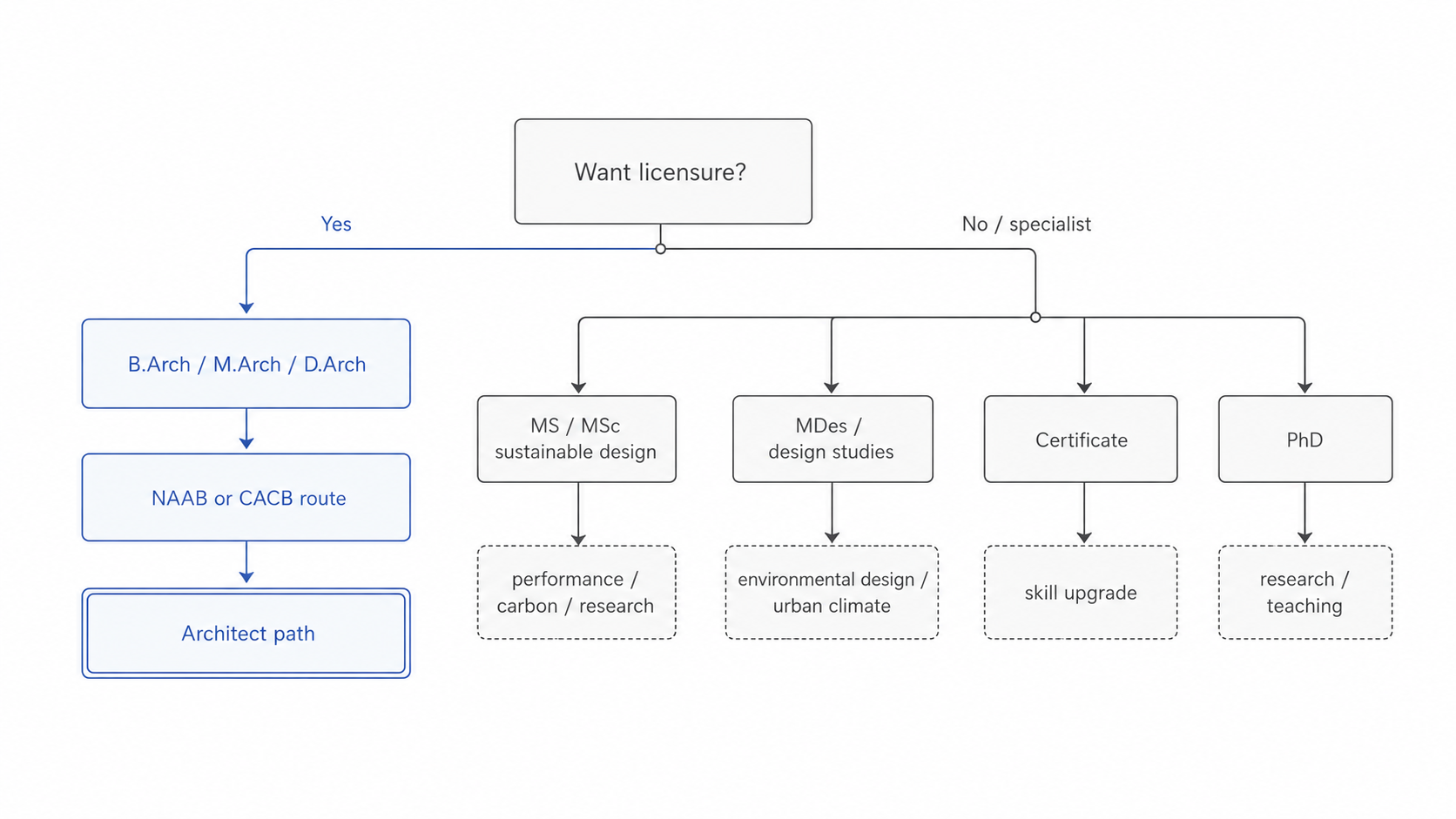
Start With the Work, Not the Slogan
Sustainable architecture education usually splits into four working lanes. Some programs mix them, but most lean harder in one direction.
| Track | Daily work | Best fit | Watch out for |
|---|---|---|---|
| Building performance | Energy modeling, daylight studies, facade testing, comfort analysis | Students who like numbers, tools, and proof | Pretty projects with no measurable result |
| Environmental design | Climate-responsive buildings, shading, airflow, outdoor comfort, site strategy | Students who like moving between rooms, streets, and climate | Programs that stay too conceptual |
| Carbon, materials, and lifecycle | Embodied carbon, LCA, EPDs, material choices, reporting, compliance | Students who can handle data and regulation | Weak design culture or no real building context |
| Resilience and emergency design | Post-disaster housing, climate risk, humanitarian design, rebuilding strategy | Students who want difficult social and field-based work | Romanticizing crisis work |
Before picking a degree, choose the lane you can live with. “I want to design sustainable buildings” is too broad. A better answer is: “I want to model daylight and overheating,” or “I want to work on low-carbon materials,” or “I want to design housing in flood-prone places.”
That level of clarity changes the school list, the portfolio, and the job path.
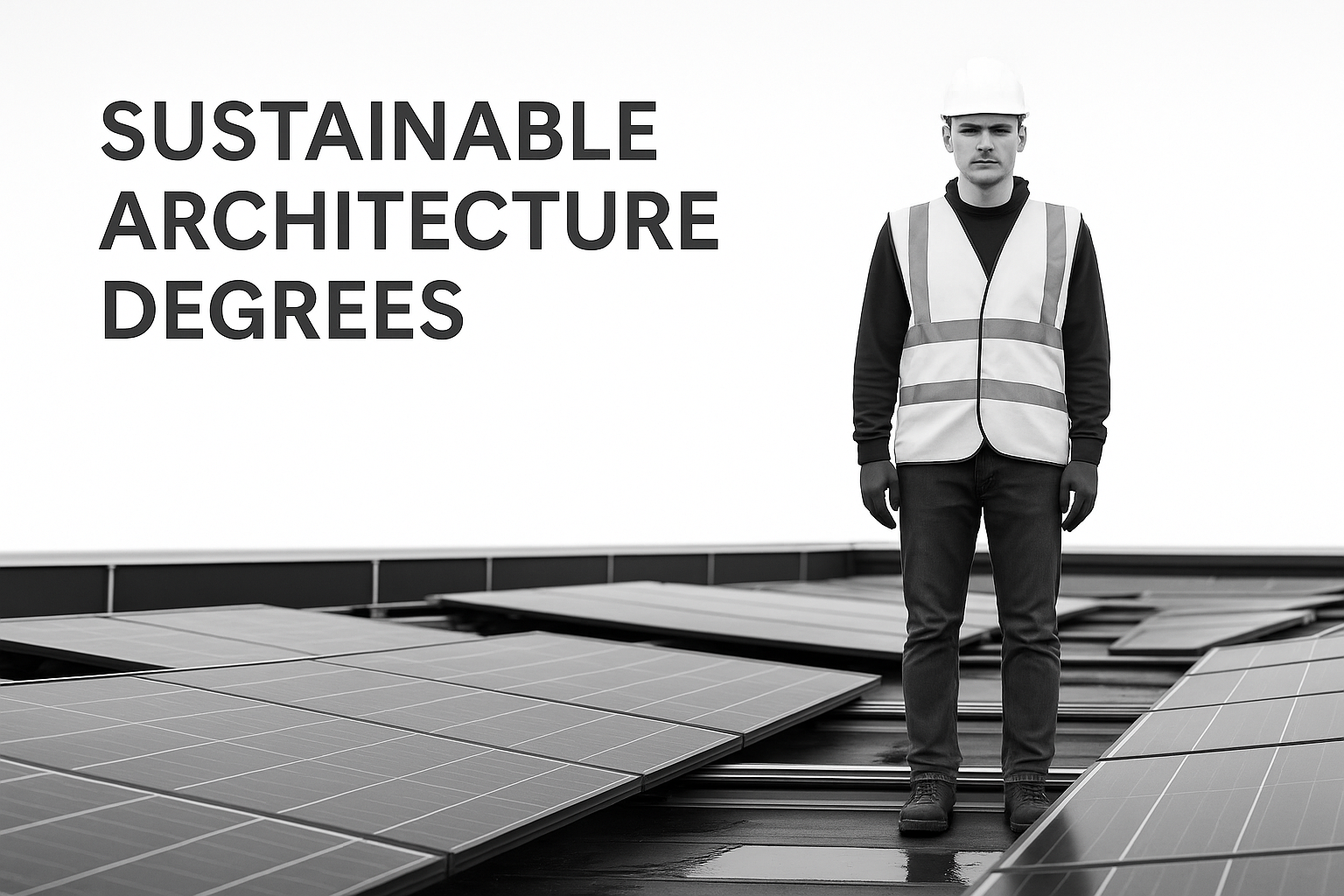
Building Performance
This is the numbers-heavy side of sustainable architecture.
The work is about proving that a building performs better, not only claiming that it does. Students learn to test daylight, overheating, energy use, envelope design, ventilation, solar gain, and comfort.
The portfolio has to show results. A shaded facade study is stronger when it shows what changed: lower cooling load, better daylight distribution, fewer glare problems, or reduced overheating hours.
Common tools include Rhino, Grasshopper, Ladybug Tools, EnergyPlus, Radiance, ClimateStudio, IESVE, and spreadsheet workflows. The exact software changes by school and office, but the expectation is stable: you need to connect design decisions to measurable performance.
This track fits students who are comfortable with technical uncertainty. Models disagree. Assumptions matter. Weather files matter. The strong student learns how to explain the limits of the model instead of pretending the graph is magic.
Environmental Design
Environmental design sits between architecture, comfort, climate, and site.
It is not only about energy. It asks how buildings feel and behave in real conditions: heat, shade, wind, glare, humidity, streets, courtyards, public space, and seasonal use.
This is a good lane for students who do not want to choose between buildings and cities. You may test a room one week and a plaza the next. You may study a wall section, then zoom out to a heat-island map.
Good programs make students connect climate analysis to design choices. Weak programs use sustainability language but still produce generic renderings.
This track connects closely to sustainable architecture and to building-design issues such as natural lighting in architectural design, especially when comfort, daylight, heat, and site conditions shape the work.
Carbon, Materials, and Lifecycle
This is the track many students ignore because it looks less glamorous from the outside.
That is a mistake.
Embodied carbon, lifecycle analysis, environmental product declarations, material reuse, disclosure rules, and low-carbon construction are now part of serious sustainable design work. Clients, public agencies, and large firms increasingly need people who can translate design choices into carbon and compliance language.
The work can be dry. It can also be valuable.
A student who can compare two wall assemblies by embodied carbon, durability, thermal performance, availability, and maintenance will often be more useful than a student who only says “natural materials are better.”
This lane rewards precision. It punishes vague claims.
Material-focused students should also read sustainable building materials, because carbon claims are weak when they are separated from durability, availability, repair, and construction logic.
Resilience and Emergency Design
Emergency and resilience design is not a style.
It is work under pressure: flooding, fire, displacement, infrastructure failure, heat waves, refugee housing, temporary shelter, and rebuilding after disaster.
This track is not for students who want sustainability as a clean portfolio theme. It asks harder questions: What can be built fast? What can be repaired locally? Who controls the project? What happens after the first grant money runs out?
Good programs in this area teach low-tech assemblies, climate risk, housing systems, public health, community process, and field constraints. The work is less glossy than studio culture often suggests.
The strongest portfolio here shows judgment under constraint. Simple, buildable, repairable work beats dramatic images that ignore logistics.
The Licensure Question Comes First
Do not assume a sustainable architecture degree is a professional architecture degree.
In the United States, NAAB accredits professional degree programs in architecture. A NAAB-accredited professional degree is the normal education route for architecture licensure in most U.S. jurisdictions, though some states allow alternative paths with extra requirements.
Canada is also specific. CACB says all accredited architecture programs offered in Canada are Master of Architecture degrees.
That distinction matters because many sustainability programs are specialist degrees. They may be excellent for building science, urban climate, research, design studies, or carbon work. That does not mean they make you eligible for the architect license path by themselves.
Ask the school directly:
- Is this a professional architecture degree?
- Is it accredited for the jurisdiction where I want to practice?
- If not, what professional degree would I still need?
- What do graduates actually do after finishing?
The broader professional route is explained in how to become a licensed architect. If graduate school is the missing step, compare this page with master’s degree in architecture before assuming a sustainability degree replaces the professional path.
If graduate study is the main question, read Master’s in Sustainable Architecture and Sustainable Design before comparing programs.
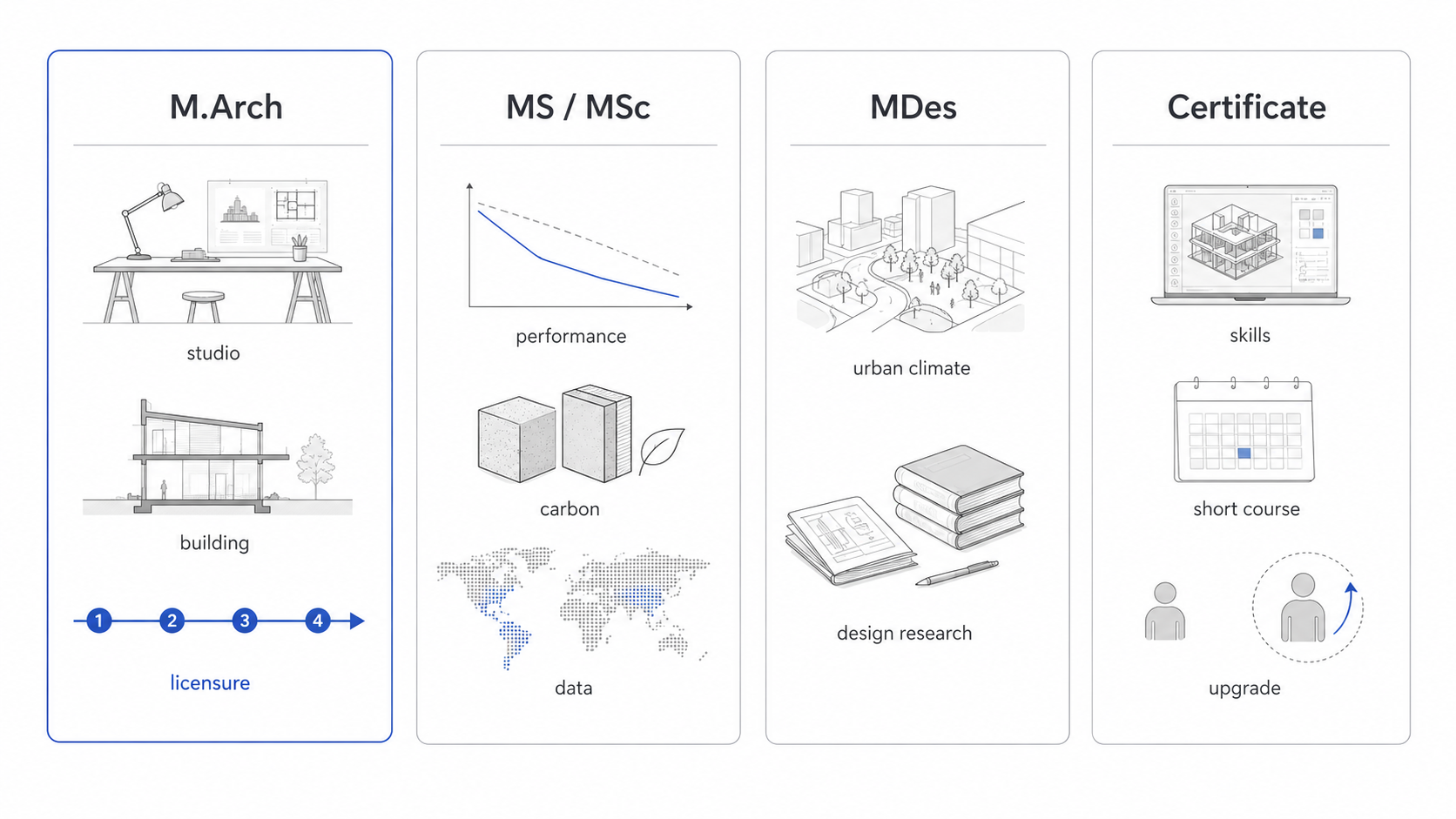
The Portfolio Has to Prove Something
Sustainable design portfolios often fail in a specific way.
They look good, but they prove nothing.
A beautiful rendering with trees on the roof is not evidence. A good sustainable architecture portfolio shows a target, a method, and a result.
| Weak portfolio move | Stronger version |
|---|---|
| “This design uses natural light” | Show daylight analysis and explain what changed in the plan or facade |
| “This project uses sustainable materials” | Compare material options by carbon, durability, cost, and availability |
| “The building is climate responsive” | Show sun, wind, shade, overheating, or comfort logic |
| “This is a resilient community plan” | Show phasing, access, infrastructure, maintenance, and post-disaster use |
Admissions teams and employers do not need a speech about caring for the planet. They need proof that you can test a design decision.
For portfolio structure, read real architecture portfolios.
What Students Discover After They Enroll
This is the part most degree pages skip.
Sustainable architecture is not always the softer, greener version of architecture school. In many programs, it is more technical.
Students who expected design studios full of natural materials may find themselves learning energy modeling, daylight metrics, coding logic, climate files, carbon spreadsheets, HVAC basics, facade performance, and reporting standards.
Some love that. Some hate it.
The second surprise is cost. Software, laptop power, printing, travel, model materials, workshops, and fieldwork can sit outside the tuition number. A low-tuition program can still become expensive if housing is high, visas are difficult, or local job connections are weak.
The third surprise is that some sustainability jobs are not design jobs. They may involve reports, compliance, simulation, spreadsheets, coordination meetings, and technical writing. That can be a strong career. It is just not the same as being the lead designer.
The protective move is simple: look at graduate portfolios and job titles before applying. Not marketing copy. Actual student work and actual outcomes.
Online Sustainable Architecture Programs
Online study can work for some sustainable design paths.
It fits technical subjects better than traditional studio subjects: building performance, carbon accounting, software workflows, sustainability frameworks, historic preservation, research, and professional development.
But online study needs extra checking.
Some online programs are serious specialist degrees. Some are short certificates. Some are useful skill upgrades. Some are vague credentials with weak outcomes.
Boston Architectural College lists an Online Master of Design Studies in Sustainable Design as a four-semester degree program. Its curriculum page also says the program is not currently accepting applications while it undergoes strategic repositioning. Applicants should verify the current program status, admissions availability, format, cost, and whether the program is professional, post-professional, or specialist before relying on it.
The wider online-degree problem is covered in online architecture degree, especially for students comparing remote study, hybrid studio, and professional accreditation.
How to Choose a Program Without Getting Sold
Do not start with rankings.
Start with the work.
| If you want to... | Look for programs with... | Avoid programs that... |
|---|---|---|
| Model building performance | Energy, daylight, comfort, facade, simulation, real project testing | Only show green renderings |
| Work on urban climate | Urban design, GIS, heat, public space, microclimate, planning studios | Never leave the building scale |
| Do carbon and material work | LCA, EPDs, material systems, policy, reporting, construction logic | Use “sustainable materials” without measurement |
| Work in resilience | Fieldwork, housing, infrastructure, emergency design, climate risk | Turn disaster work into portfolio drama |
| Become licensed | Recognized professional architecture degree route | Blur specialist study with licensure |
Read studio briefs. Look at student work. Ask where graduates work. Check whether the program is professional, post-professional, or specialist. Those words matter.
Graduate applicants who already know they want a sustainability-focused master’s path should also compare this page with master sustainable design before treating every green-sounding degree as the same credential.
Admissions: What a Strong Application Shows
A strong sustainable architecture application does not need to sound heroic.
It needs to be specific.
The best statements usually name a problem and explain how the applicant tested it: a daylight study, a shading detail, a retrofit analysis, a material comparison, a street heat study, a flood-risk housing proposal, or a carbon calculation.
The portfolio should show:
- one project with a measurable target
- one project showing method, not only final image
- one technical or analytical page
- one design project with clear drawings
- one example of writing or explanation
Do not send ten green-looking projects with no evidence. Send fewer projects that show how you think.
Costs That Do Not Show Up First
Tuition is only the first number.
Sustainable architecture students may also need:
- a laptop strong enough for modeling and simulation
- software access or subscriptions
- printing and presentation costs
- travel for fieldwork, workshops, or hybrid sessions
- housing in expensive university cities
- visa and documentation costs for international study
- unpaid or low-paid internship time
The most expensive path is not always the program with the highest tuition. Sometimes the expensive path is the cheap program that does not connect to the work you want.
Price the whole route: degree, location, software, portfolio, work access, and the next credential if one is required.
Skills That Actually Get Hired
Employers do not hire the word “sustainability.” They hire useful skills.
| Skill | Why it matters |
|---|---|
| Energy and daylight modeling | Turns design claims into testable performance work |
| Lifecycle analysis | Helps teams compare carbon and material consequences |
| Building systems literacy | Stops sustainability from becoming surface-level design language |
| Clear diagrams | Lets clients and teams understand climate and performance logic |
| Technical writing | Turns analysis into reports, approvals, and client decisions |
| BIM coordination | Connects sustainability work to real project delivery |
A student who can explain one tested wall assembly clearly may be more employable than a student with five attractive but unsupported sustainability boards.
Programs Worth Knowing How to Read
Do not treat this as a ranking list. Treat it as a way to understand program types.
AA School Sustainable Environmental Design is a specialist postgraduate route focused on evidence-based sustainable environmental design, with MSc and MArch options. It is useful to study if you want to understand the building-performance and climate-design lane.
Boston Architectural College design studies options are worth checking for students who need distance-format study, but always verify whether the exact program is open, what format it uses, and whether it is professional, post-professional, or specialist.
Canadian M.Arch programs should be checked through CACB if the goal is licensure in Canada. The important point is not whether the school talks about sustainability. The important point is whether the professional degree is recognized.
Urban climate and resilience programs should be judged by studio work, fieldwork, public-space analysis, and graduate outcomes, not only by sustainability language on the program page.
Common Mistakes
| Mistake | Why it hurts | Better move |
|---|---|---|
| Choosing the biggest school name | The program may not match the work you want | Start with daily work, then choose the school |
| Ignoring licensure | A specialist degree may not be a professional architecture degree | Check NAAB, CACB, or the relevant local route |
| Submitting green-looking projects with no proof | The portfolio feels decorative | Show target, method, and result |
| Underestimating software and hardware costs | The real cost rises after enrollment | Budget tools, laptop, printing, and travel |
| Using vague application language | “Saving the planet” sounds generic | Name a specific problem you tested |
Before You Choose
Sustainable architecture is not one clean career path.
It can mean simulation, carbon accounting, urban climate, resilience, policy, research, or professional architecture with a sustainability focus.
Choose the program that trains you for the work you can actually see yourself doing.
Then check the hard parts: accreditation, portfolio evidence, tools, costs, and graduate outcomes.
The greenest-sounding degree is not always the strongest one. The useful degree is the one that gives you a real role after the slogan is gone.
FAQ
What is a sustainable architecture degree?
It is an architecture or design degree focused on environmental performance, climate response, materials, carbon, resilience, or sustainable building systems. The exact meaning depends on the program.
Is a sustainable architecture master’s worth it?
It can be worth it if the program matches a clear job lane: performance modeling, urban climate, lifecycle analysis, resilience, or specialist practice. It is risky when the student only wants a broad “green design” credential.
Can a sustainable architecture degree lead to licensure?
Only if it is part of a recognized professional architecture degree route. Many sustainable design degrees are specialist or post-professional programs, not standalone licensure degrees.
What should be in a sustainable architecture portfolio?
Show design work with evidence: daylight analysis, energy modeling, carbon comparison, material reasoning, climate diagrams, or resilience strategy. Pretty renderings alone are weak.
What jobs do graduates get?
Common lanes include building performance consultant, sustainability coordinator, environmental designer, carbon analyst, urban climate designer, resilience planner, research assistant, or specialist roles inside architecture and engineering firms.
Is online sustainable architecture study useful?
It can be useful for software, research, carbon, preservation, professional development, and some design studies. For licensure or studio-heavy work, check format and recognition carefully.
What is the biggest mistake students make?
They choose by topic label instead of work outcome. “Sustainable architecture” is too broad. The better question is whether you want to model performance, design climate-responsive spaces, measure carbon, or work on resilience.
References and Resources
- NAAB Accredited Programs
- NCARB NAAB-Accredited Programs
- NCARB Architecture License Options for Non-NAAB Education
- CACB Accredited Programs in Canada
- AA School Sustainable Environmental Design
- Boston Architectural College Online Master of Design Studies in Sustainable Design
- Boston Architectural College Sustainable Design Curriculum Status
Read This Next
Start with types of architecture degrees if you still need to compare B.Arch, BA, BS, M.Arch, and technical routes.
If graduate study is the main question, read master’s degree in architecture before choosing a specialist sustainability program.
For remote and hybrid options, read online architecture degree.