

An online architecture degree can be useful, but the degree name can hide the real outcome.
Some online programs prepare students for drafting, BIM, construction documents, or technical office support. Some are pre-professional degrees that may help with a later Master of Architecture. A smaller group of hybrid professional programs can connect to licensure, but only when the accreditation and state-board path are right.
That is the part students need to check before they spend money. “Architecture” in the title does not automatically mean “architect license.” It may mean design studies, architectural technology, drafting, preservation, planning, history, or a pre-professional route that needs another degree later.
Start With the Job, Not the Degree Name
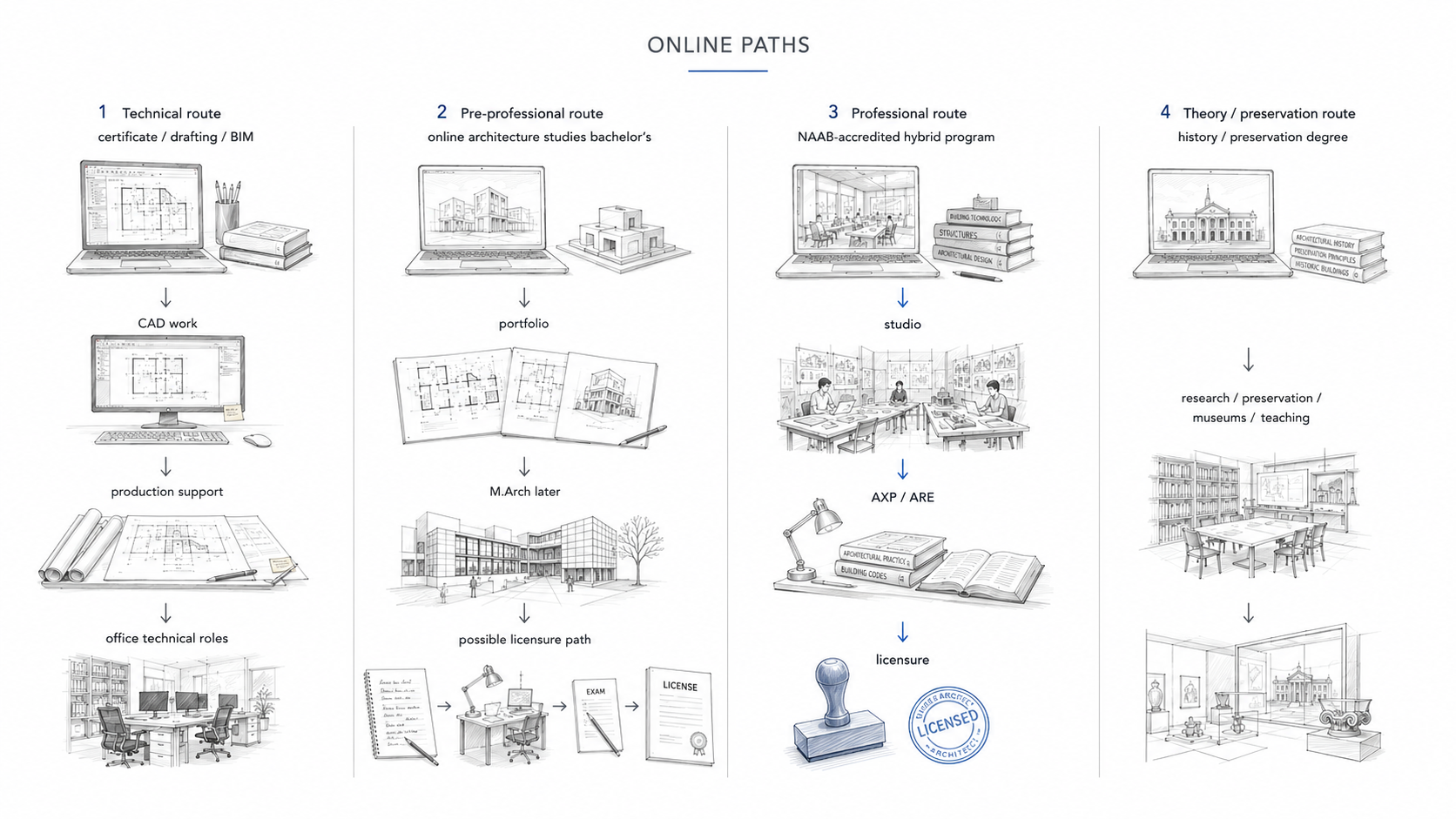
The safest way to judge an online architecture degree is to ask what job it is built for.
A drafting certificate is not trying to do the same job as a professional M.Arch. A Bachelor of Arts in Architecture is not the same thing as a B.Arch. An online preservation degree is not a shortcut into licensed architectural practice. Each path can be valid, but only if the student understands the outcome.
| Online path | What it usually trains | Best fit | Licensure warning |
|---|---|---|---|
| Drafting, CAD, or BIM certificate | Technical drawings, software, documentation support | Students who want production or technician roles | Not an architecture license path by itself |
| Online architecture studies bachelor’s | Design foundation, history, representation, portfolio work | Students who may apply to an M.Arch later | Usually pre-professional, not a direct license degree |
| Hybrid professional M.Arch | Studio, building systems, professional practice, portfolio development | Students seeking the professional architecture route | Check NAAB accreditation and state-board rules |
| History, theory, or preservation degree | Research, conservation, writing, museums, preservation work | Students who want academic, cultural, or preservation roles | Not a substitute for a professional architecture degree |
Can You Earn an Architecture Degree Online?

Yes, but the answer depends on the kind of architecture degree.
Technical programs are the easiest to move online because the work can be taught through software, drawing standards, assignments, and construction document exercises. Students can learn CAD, BIM, Revit basics, detailing, sheet layout, and drawing coordination without living in a campus studio every day.
Design programs are harder. Architecture is not only a set of lectures. It also depends on critique, iteration, scale, models, pin-ups, peer feedback, and physical judgment. A student can draw on a screen from home, but the best programs still need a serious feedback structure.
Professional architecture degrees are the hardest to judge online. If the goal is licensure in the United States, the student needs to check whether the program is a professional architecture degree recognized for that route. A convenient online format does not matter if the degree does not satisfy the education requirement later.
The Online Studio Problem Nobody Mentions
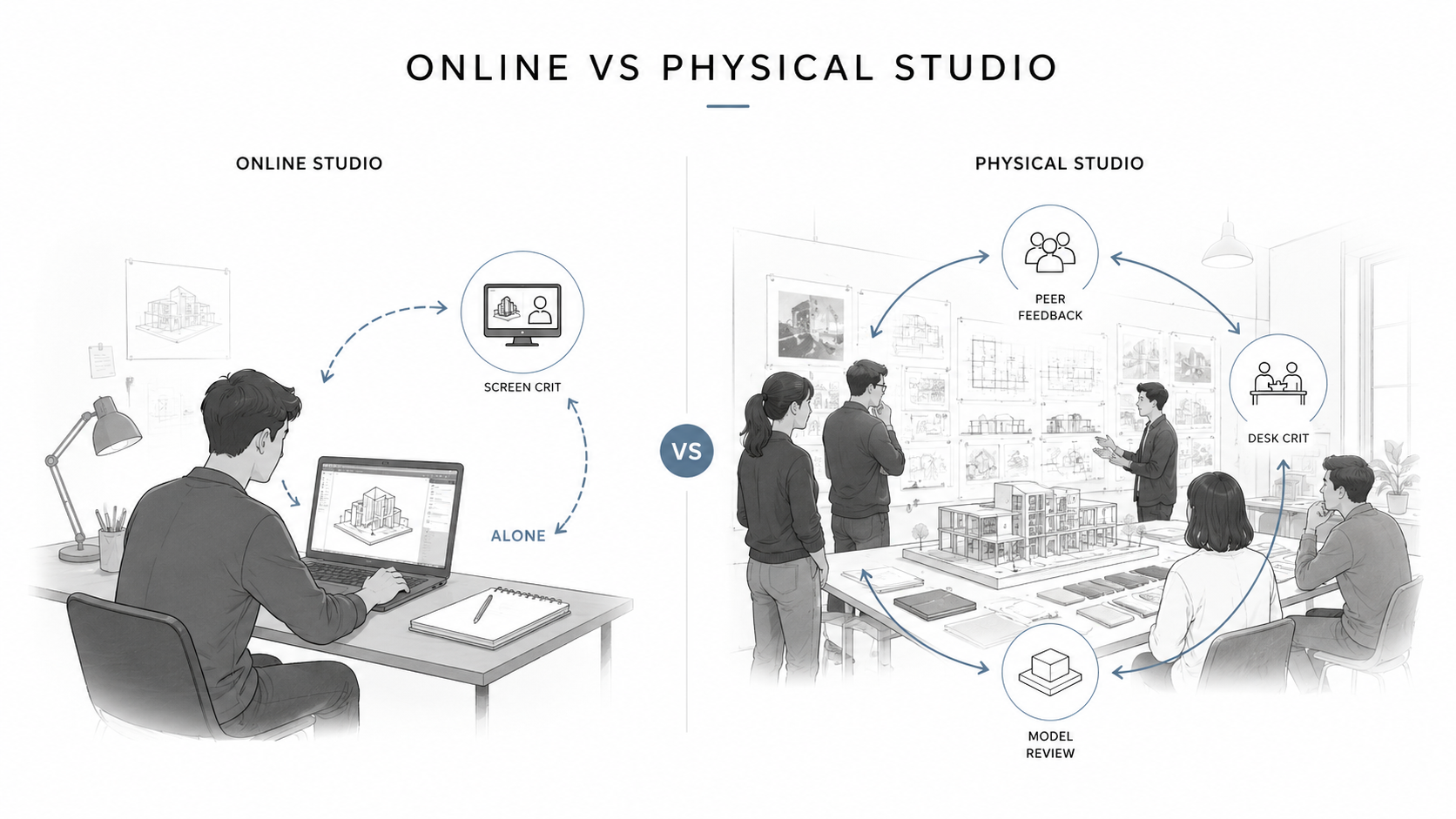
The weak point in online architecture study is not always the software. It is the studio loop.
In a strong studio, students do not only submit finished drawings. They test rough ideas, get challenged, rebuild the model, redraw the plan, explain the section, and compare their work against other students. That pressure is uncomfortable, but it teaches judgment.
Online programs can replace some of that with video critiques, shared boards, digital markups, recorded reviews, and scheduled desk crits. But the student has to check whether that structure really exists. A folder of lectures and weekly uploads is not the same thing as an architecture studio.
What Students Usually Learn Online
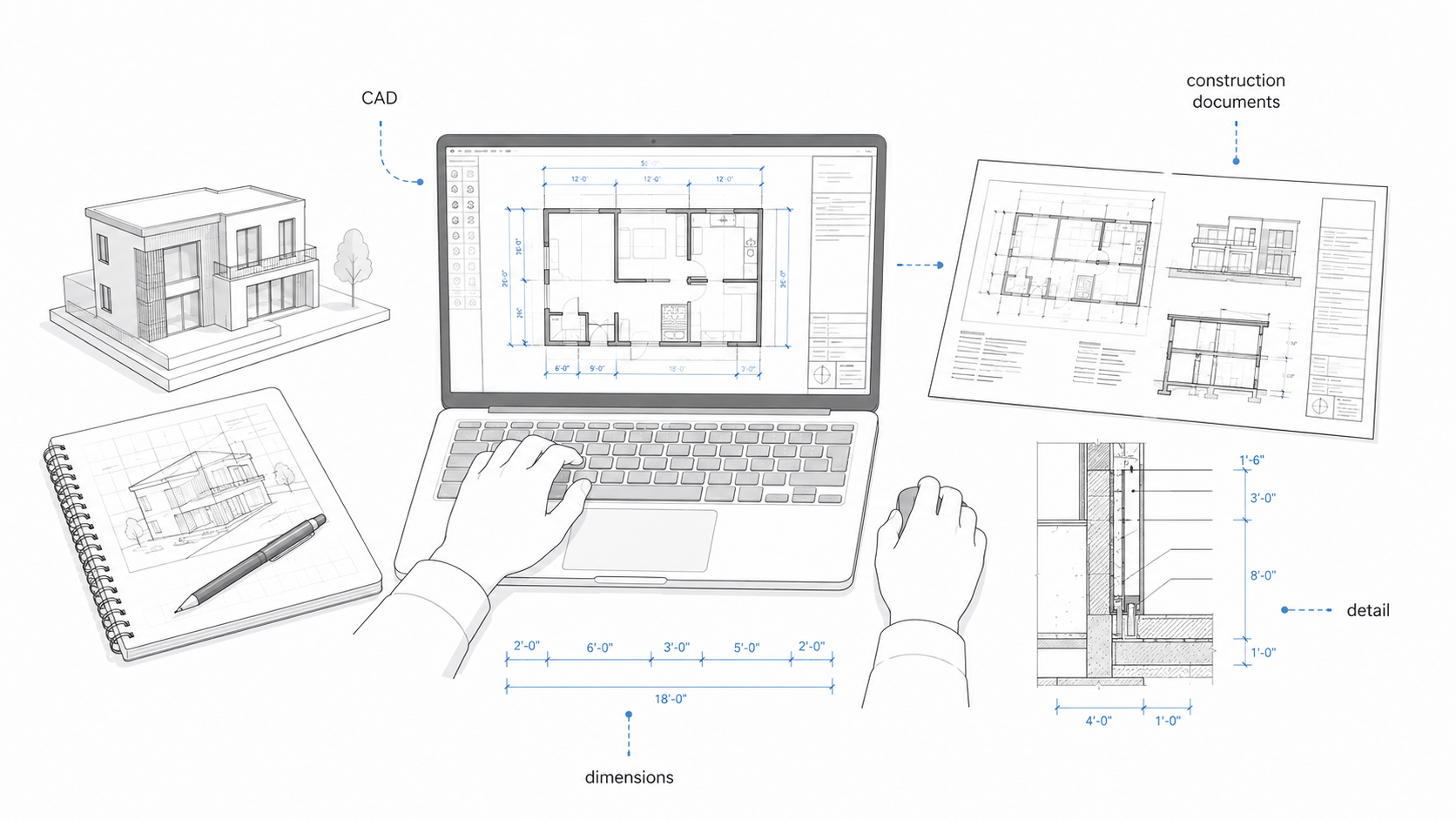
The most useful online architecture coursework is practical and visible in a portfolio or work sample.
Students should expect some mix of drafting, digital modeling, architectural history, design process, environmental systems, structures basics, visual communication, and construction documentation. The mix depends heavily on whether the program is technical, pre-professional, professional, or research-based.
| Course area | What to look for | Why it matters |
|---|---|---|
| Design studio | Real critique, revision, portfolio projects | Shows whether the program teaches design judgment, not only software |
| CAD and BIM | Plans, sections, details, sheets, model coordination | Useful for technical office work and internships |
| History and theory | Architecture, cities, culture, precedent analysis | Builds context and writing ability |
| Structures and systems | Basic load paths, envelopes, materials, environmental systems | Prevents design work from becoming surface-only |
| Portfolio development | Curated projects, process work, clear layouts | Needed for transfer, graduate school, and job applications |
Online Bachelor’s Degrees Need Extra Checking
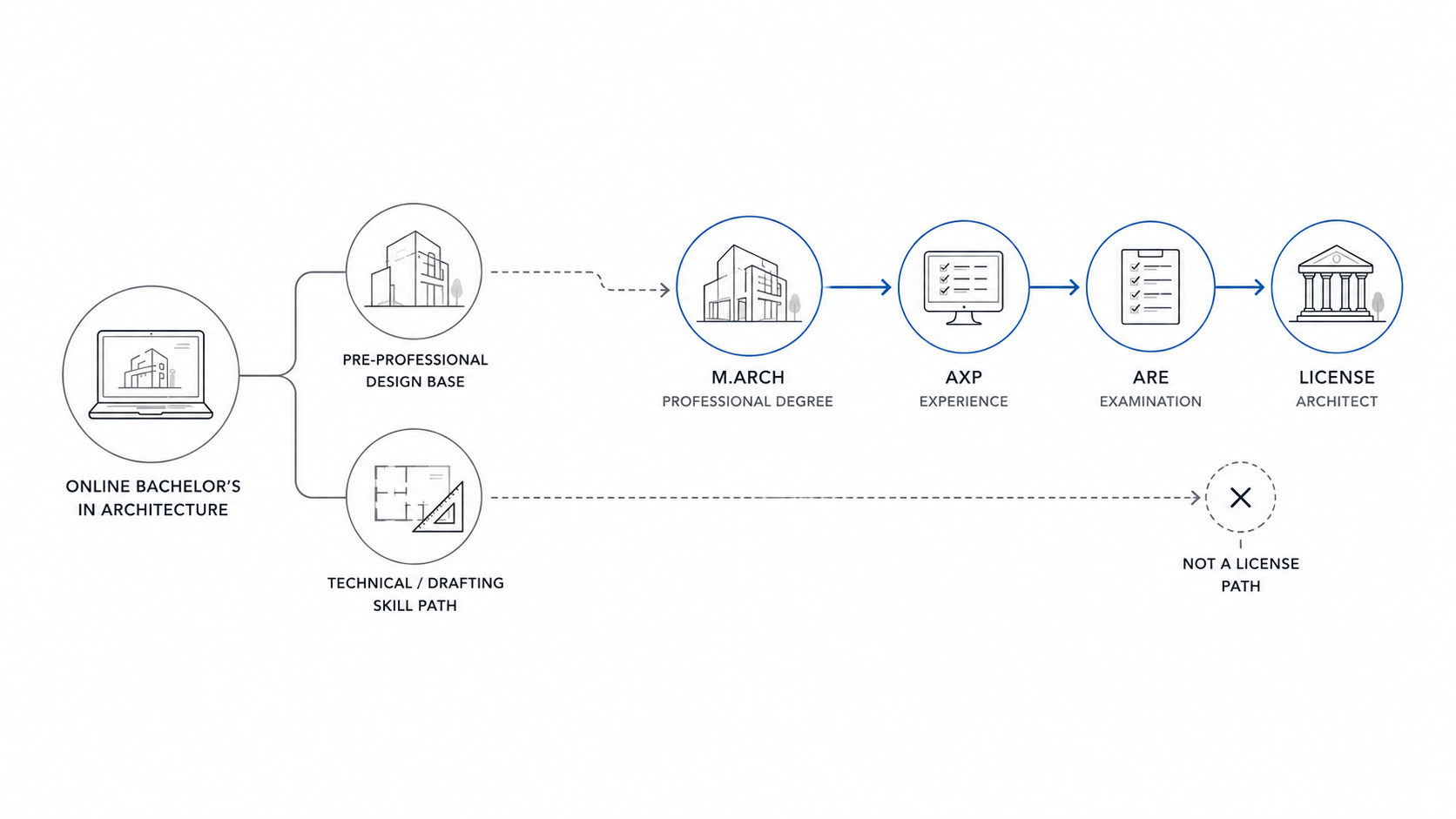
A bachelor’s degree with “architecture” in the name can mean several different things.
A Bachelor of Arts in Architecture or Bachelor of Science in Architecture is often a pre-professional degree. That can be a good foundation, especially for students who want design, history, digital tools, or a later graduate degree. But it may not qualify as the professional architecture degree needed for licensure.
A B.Arch is different. In the United States, the B.Arch is commonly used as a professional undergraduate architecture route when it is properly accredited. That is why students should not compare BA, BS, and B.Arch programs by length or price alone.
The question is not “Is it online?” The question is “What does this degree let me do next?”
Can You Become a Licensed Architect Online?
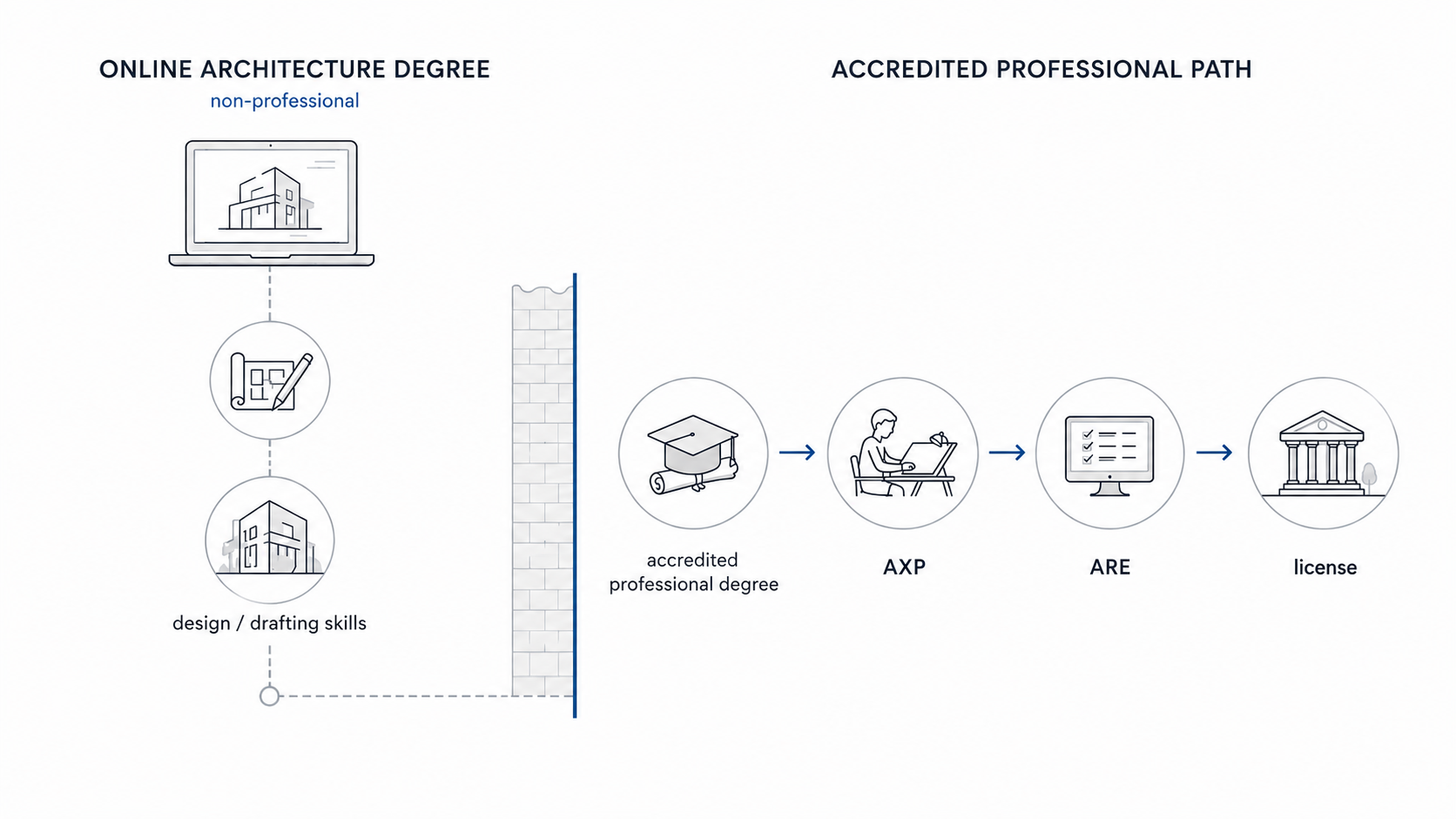
Sometimes, but not through any random online architecture program.
In the United States, the usual licensure route depends on education, experience, exams, and state-board requirements. For many students, the education piece means a NAAB-accredited professional architecture degree. After that, the student still needs professional experience and exams before licensure.
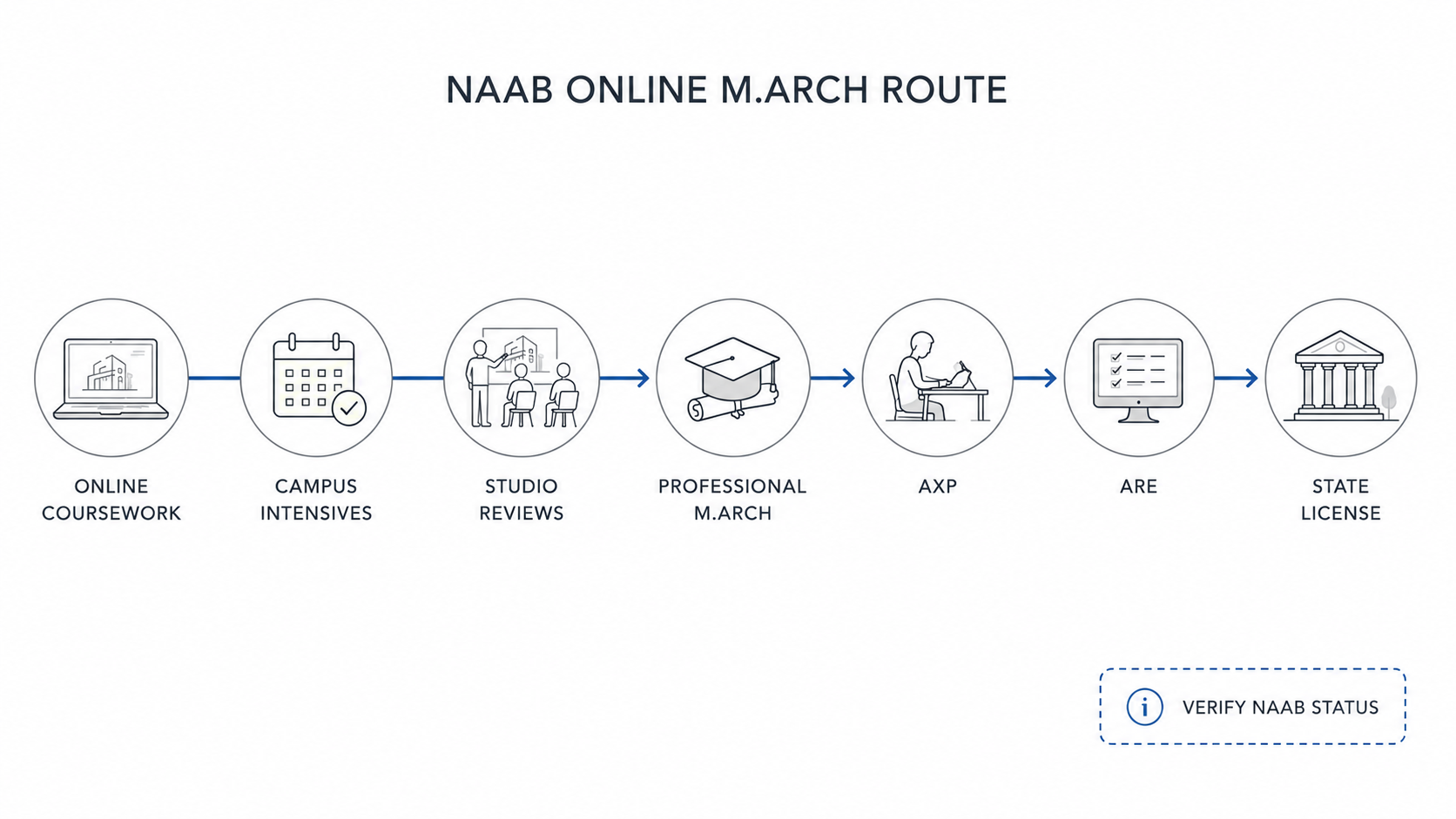
Some professional M.Arch programs use hybrid formats. That can include online coursework, limited campus visits, studio reviews, and professional-degree requirements. These are not the same as casual online design courses. They are structured professional programs that still need accreditation and serious studio work.
What Online Architecture Is Good For
Online study can work well when the goal is clear.
It can help a student build drafting skills, prepare for technical office work, explore architecture before committing to a professional degree, strengthen a portfolio, or study history and preservation while working. It can also help career changers complete prerequisites or prepare for graduate school.
The danger comes when a student assumes every architecture degree leads to the same professional outcome. That is where wasted money happens.
- Good use: learning CAD, BIM, drawing standards, and documentation basics.
- Good use: building a portfolio before applying to an M.Arch.
- Good use: studying architecture history, preservation, or theory for non-licensure roles.
- Risky use: assuming a non-professional online degree replaces a professional architecture degree.
- Risky use: choosing the cheapest program without checking accreditation and transfer value.
What To Check Before Enrolling
Before choosing an online architecture program, check the outcome in writing.
| Question | Why it matters |
|---|---|
| Is the program professional, pre-professional, technical, or academic? | The category controls what the degree can realistically lead to. |
| Is it NAAB-accredited if licensure is the goal? | A degree name alone is not enough for the professional architecture route. |
| Does it include real design studio critique? | Architecture education depends on revision and feedback, not only lectures. |
| Will the work build a usable portfolio? | Graduate school and design jobs usually need visible work samples. |
| Are there campus visits, intensives, or residency requirements? | Hybrid programs may not be fully remote. |
| Do credits transfer into a professional M.Arch? | Some students discover too late that their online credits do not reduce the next degree. |
| What jobs do graduates actually get? | Marketing language is less useful than real graduate outcomes. |
The Cost Problem
Online programs can look cheaper because the student avoids moving, commuting, or paying for a full campus lifestyle. That can be true. But architecture still has hidden costs.
Students may still need software, a strong computer, printing, drawing tools, model materials, scanning, portfolio hosting, and occasional travel for reviews or intensives. If the program is weak, the bigger cost is not supplies. It is losing a year or two on a degree that does not lead where the student thought it would.
A cheaper program is not cheaper if it forces the student to repeat coursework later.
Who Should Consider an Online Architecture Degree?
An online architecture degree can make sense for students who need flexibility and know the limits.
It can work for working adults, students testing the field, people building technical skills, students in areas without nearby architecture schools, and applicants preparing for a later professional degree. It can also work for students focused on preservation, history, planning-adjacent roles, or digital production.
It is a weaker fit for students who need a full studio culture, constant in-person feedback, model shop access, strong peer competition, and a direct professional architecture school environment.
Online Architecture Degree vs Online Drafting Degree
These two paths get confused.
An online drafting degree or certificate is usually more direct and job-specific. It may focus on CAD, BIM, construction documents, drawing standards, and production support. That can lead to useful work in architecture offices, engineering firms, contractors, cabinet shops, or drafting departments.
An online architecture degree is broader. It may include design, history, theory, visual communication, and sometimes studio. It can support a later M.Arch or related design work, but it may not be as direct for immediate technical employment unless the program teaches strong software and documentation skills.
Online Architecture Degree vs Hybrid M.Arch
A hybrid M.Arch is a different level of commitment.
A serious professional M.Arch usually has studio expectations, reviews, faculty critique, portfolio pressure, and accreditation requirements. Even when part of the program is online, it may still require campus time or intensive reviews.
Students should read the program structure closely. “Online” may mean fully remote, mostly remote, low-residency, hybrid, asynchronous, synchronous, or campus-intensive. Those differences change time, cost, travel, and family planning.
Red Flags
Walk away or slow down if the program avoids direct answers.
- The site says “architecture license path” but does not clearly explain accreditation.
- The school uses “architect” language loosely for a non-professional design program.
- The curriculum has no serious studio sequence.
- The portfolio examples are weak or missing.
- The admissions team cannot explain transfer into an M.Arch.
- The program promises career outcomes but does not show real graduate work.
- The program looks cheap but requires expensive software, travel, or repeat coursework later.
Better Questions To Ask the School
Do not ask only whether the degree is online.
Ask whether the degree is professional or pre-professional. Ask whether it is accredited for the licensure path you want. Ask how studio critique works. Ask how often students meet faculty. Ask whether students build physical models. Ask whether the school has examples of accepted graduate portfolios. Ask what graduates do after the program.
If the answer is vague, assume the risk is yours.
FAQ
Can I become an architect with an online architecture degree?
Only if the degree fits the professional licensure route required by your jurisdiction. Many online architecture degrees are technical, pre-professional, or academic. Those can be useful, but they may not satisfy the education requirement for licensure by themselves.
Is an online architecture degree respected?
It depends on the program and the outcome. A strong technical program with good CAD and BIM training can be respected for production roles. A strong hybrid professional program can be taken seriously if it has the right accreditation and studio structure. A weak online program with little critique or poor portfolio work will not carry much weight.
What is the best online architecture degree for beginners?
For beginners, the best option depends on the goal. If the goal is technical work, a drafting or BIM program may be more practical. If the goal is professional architecture, the student should check whether a pre-professional bachelor’s can lead into a professional M.Arch later.
Can I study architecture online without drawing skills?
Yes, but drawing will still matter. Architecture students need to communicate space, proportion, structure, and design decisions. Digital tools help, but they do not remove the need for visual thinking.
Are online M.Arch programs fully online?
Some programs use online coursework, but professional M.Arch programs may still include campus intensives, studio reviews, residency periods, or other in-person requirements. Read the schedule before assuming it is fully remote.
Is online architecture cheaper than campus study?
It can be, especially if the student avoids relocation. But software, equipment, printing, model materials, portfolio costs, and possible travel can still add up. The biggest financial risk is choosing a program that does not lead to the next step the student needs.
Read Next
If your goal is licensure, compare this with the professional architecture route before choosing a program. Read Master of Architecture Degree before assuming an online bachelor’s is enough.
If you are still comparing degree names, read Types of Architecture Degrees so you can separate B.Arch, BA, BS, M.Arch, drafting, and related design paths before spending money.