

Architecture degree options get confusing fast.
The names sound close. The outcomes are not close.
A B.Arch, a BS in Architecture, a BA in Architecture, an M.Arch, a research master’s, and a certificate can all sit inside the same school catalog. They do not lead to the same licensure route, the same cost, or the same kind of work after graduation.
The mistake is choosing by title instead of outcome.
Start With the Route, Not the Degree Name
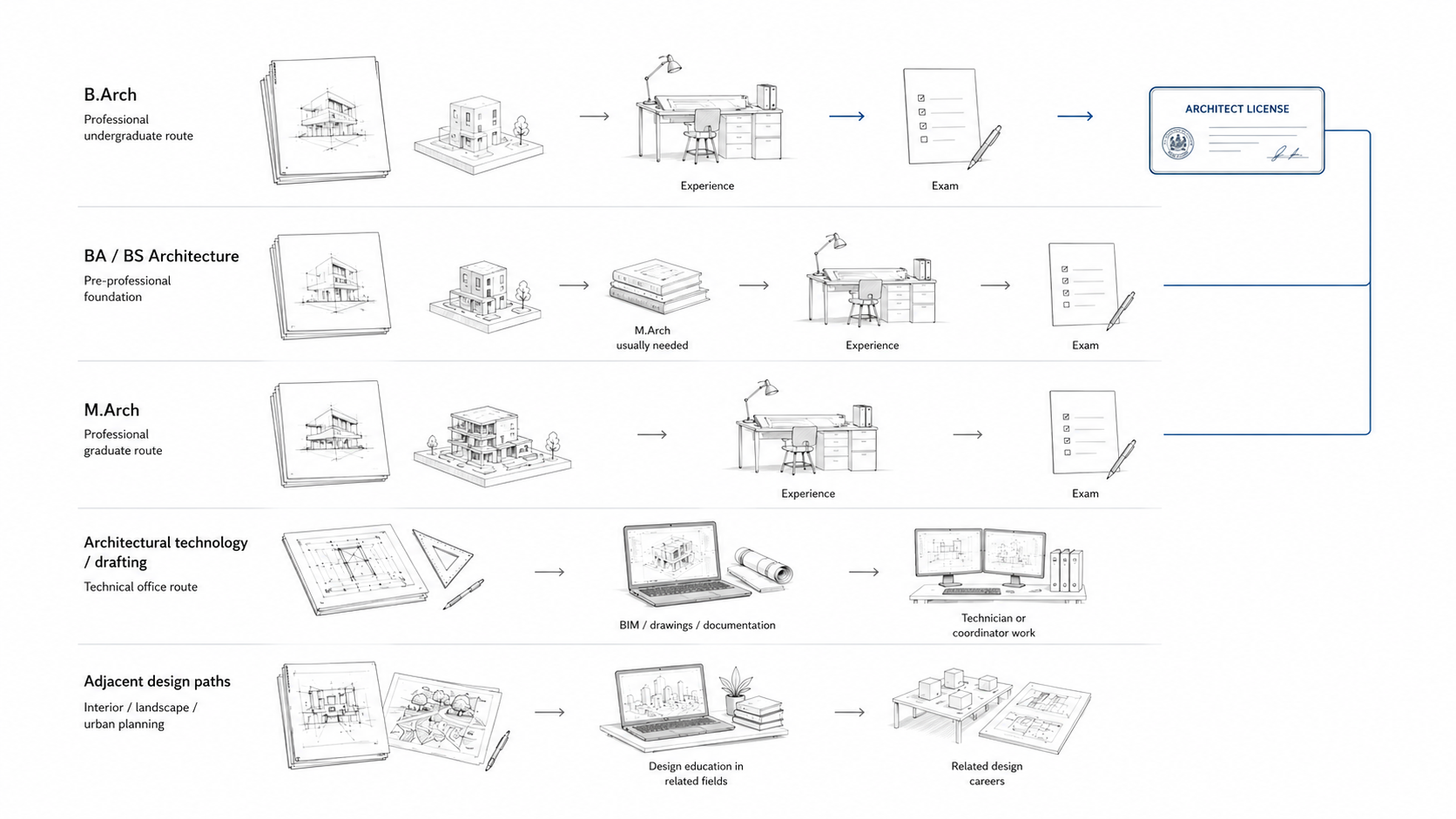
The first question is not “Which architecture degree sounds best?”
The first question is simpler: do you want the professional architect route, or do you want architecture as a broader design, technical, research, or planning foundation?
That one answer changes everything.
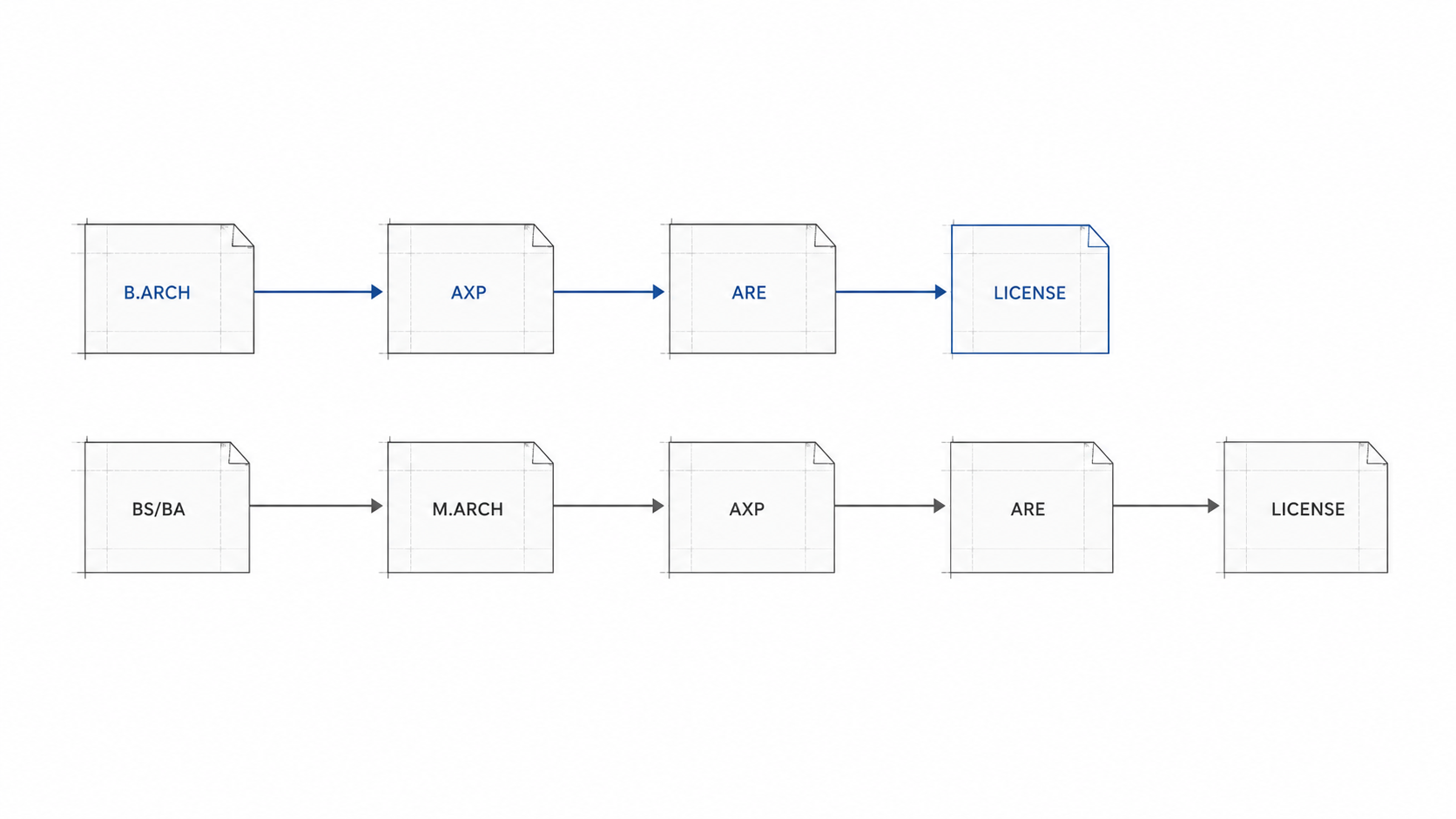
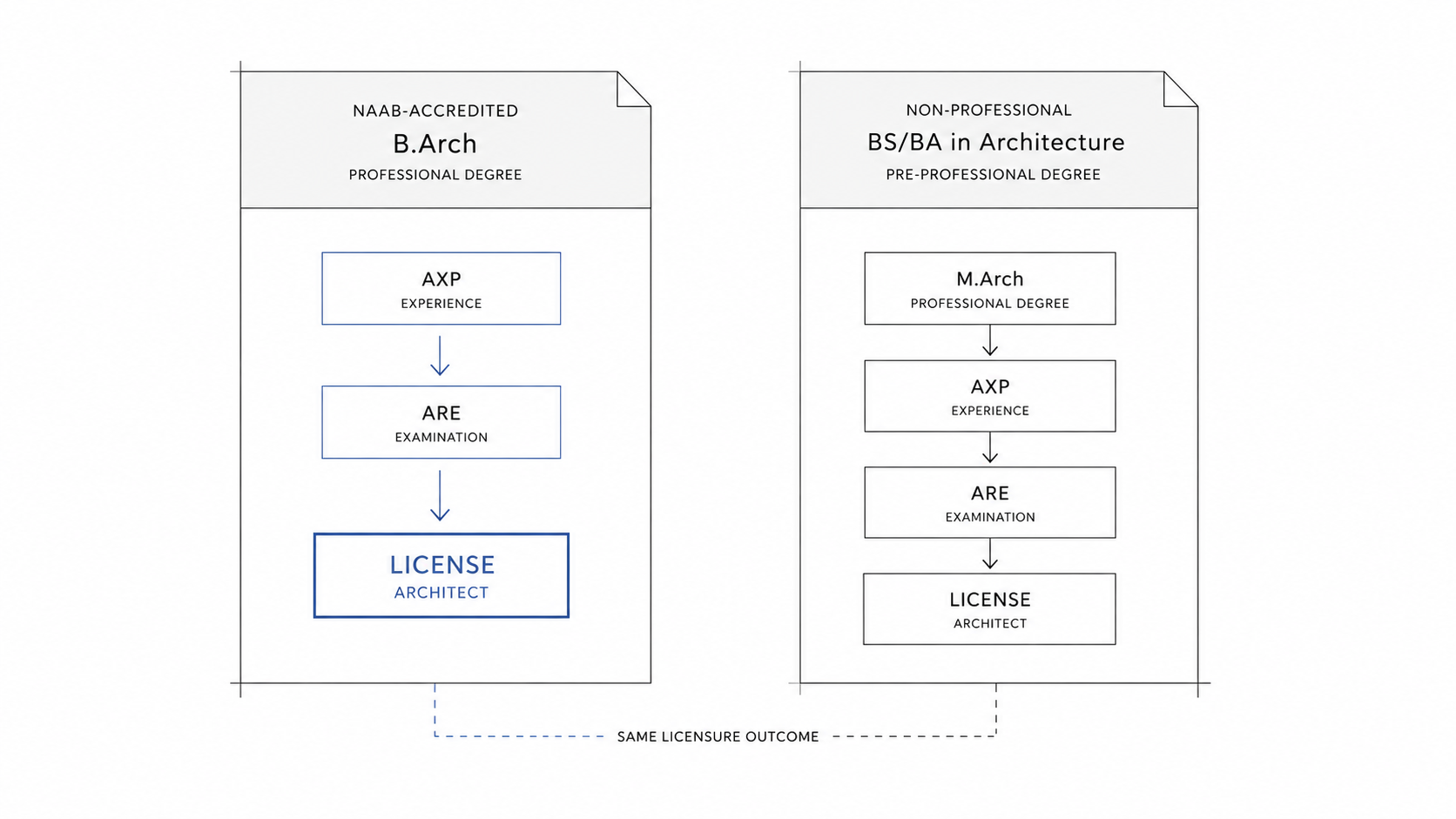
If licensure is the goal, the degree has to fit the licensure path. In the United States, that usually means a professional degree from a NAAB-accredited program, followed by supervised experience and the Architect Registration Examination. State boards still control the final license.
If licensure is not the goal, you have more room. A technical degree, design degree, planning degree, or certificate may make more sense than forcing yourself into a five-year studio program.
Types of Architecture Degrees

Most students start with the undergraduate choice. This is where the biggest misunderstanding happens.
| Degree | Typical Length | Best For | Licensure Effect |
|---|---|---|---|
| B.Arch | 5 years | Students who want the most direct professional architecture route | Can satisfy the professional degree step when accredited |
| BS in Architecture | 4 years | Students who want a technical architecture base before graduate school or related work | Usually needs an M.Arch later for licensure |
| BA in Architecture | 4 years | Students who want architecture with more room for theory, history, writing, or design culture | Usually needs an M.Arch later for licensure |
| Architectural Technology | 2 to 4 years | Students who want drafting, BIM, construction documents, and technical production | Usually not a full architect licensure route by itself |
| Certificate | Months to 2 years | Students adding CAD, BIM, drafting, rendering, or technical skills | Useful add-on, not a professional architecture degree |
The column that matters most is not length.
It is licensure effect.
A four-year degree may look cheaper than a five-year B.Arch. If it requires a two- or three-year M.Arch afterward, the “cheaper” route may not stay cheaper.
B.Arch: The Direct Professional Path
The Bachelor of Architecture is the professional undergraduate architecture degree.
It is built for students who already know they want the architect route and are ready for a studio-heavy program from the start.
A B.Arch usually includes design studio, structures, environmental systems, building technology, materials, history, theory, and professional practice. The workload is not light. The fifth year matters too. It adds cost, time, and another year before full-time earnings begin.
The trade-off is directness. If the program is accredited and accepted by your jurisdiction, the B.Arch can satisfy the professional education step without requiring a separate M.Arch later.
This is the right route when the goal is clear. It is a poor route when the student only likes architecture drawings and has not yet thought about code, structure, revisions, clients, and construction responsibility.
BS in Architecture: More Technical, Still Usually Pre-Professional
Bachelor of Science in Architecture
A BS in Architecture often leans more technical than a BA. It may include more building systems, environmental design, structures, digital tools, materials, or construction logic.
That does not automatically make it a professional degree.
This is where students get burned. “Science” sounds serious. It sounds technical. It may be technical. But technical strength and licensure recognition are different things.
A BS can be a good choice if you want architecture, but not necessarily a five-year professional commitment on day one. It can also be a good base before an M.Arch.
The question to ask is simple: if I finish this degree, what exact professional degree step remains before licensure?
BA in Architecture: Flexible, Broader, Usually Not the Final Step
Bachelor of Arts in Architecture
A BA in Architecture is usually broader. It may include design, history, theory, visual culture, writing, urban topics, and some technical coursework.
This path fits students who want architecture as a base but still want room to move. It can lead toward an M.Arch, graduate study, design research, preservation, planning, writing, interiors, or adjacent fields.
It is not usually the fastest route to becoming a licensed architect.
That does not make it weak. It makes it different.
If a student wants the full architect path, the BA should be treated as the first stage, not the finish line.
The M.Arch Is Often the Second Bill
Master of Architecture
The M.Arch is the professional graduate degree many students need after a pre-professional or unrelated undergraduate degree.
For some students, it is the right move. It gives time to mature, build a stronger portfolio, explore other subjects first, or enter architecture after another field.
But it is not a small add-on.
| Route | Typical Time | Rough U.S. Cost Reality |
|---|---|---|
| 5-year B.Arch | 5 years | Often lower total cost if it avoids graduate school later |
| 4-year BA/BS + 2-year M.Arch | 6 years | Often significantly higher after graduate tuition and living costs |
| 4-year unrelated degree + 3-year M.Arch | 7 years | Can become extremely expensive without scholarships or assistantships |
It can mean two or three more years of tuition, rent, studio costs, lost full-time income, and another round of portfolio pressure.
If the undergraduate degree was chosen because it looked cheaper than a B.Arch, this is where the math has to be redone.
Post-Professional Degrees Are Not Licensure Shortcuts
Not every master’s degree in architecture is a professional licensure degree.

A Master of Science in Architecture, Master of Arts in Architecture, post-professional design degree, or specialized research degree may be excellent. It may also have nothing to do with satisfying the professional degree requirement for licensure.
| Graduate Degree | Usually For | Licensure Warning |
|---|---|---|
| M.Arch | Professional architecture path, often after BA/BS or another undergraduate degree | Check NAAB accreditation and program status |
| MS in Architecture | Research, sustainability, computation, technology, building performance | Often not a professional licensure degree |
| MA in Architecture | History, theory, criticism, culture, writing, scholarship | Usually not the professional route |
| Urban Design or Planning Master’s | City-scale design, policy, planning, public space, land use | Different profession and credential path |
This distinction matters because students sometimes see “Master of Architecture” language and assume all graduate architecture degrees do the same job.
They do not.
The Program Culture Matters More Than Rankings

Students often choose architecture schools by prestige, campus look, or ranking lists.
Then the studio culture hits.
Some programs are collaborative. Some are quietly competitive. Some still romanticize burnout and all-nighters like they are proof of commitment instead of signs of bad time management and weak project structure.
The culture matters because it shapes the work.
A school where technical rigor gets mocked usually produces weak detailing and shallow building logic. A school where every review turns theatrical can produce students who present well but struggle once real coordination begins.
Students should ask harder questions during school visits:
- Do professors still practice?
- Do students talk about exhaustion constantly?
- Are the portfolios technically believable?
- Does the school respect structures and building systems, or only visuals?
- Do students seem collaborative or isolated?
These things matter more than the brochure.
Architecture Majors Inside the Degree
Inside architecture programs, students may choose majors, concentrations, tracks, or electives. The names vary by school.
The mistake is treating a specialization like a career guarantee.
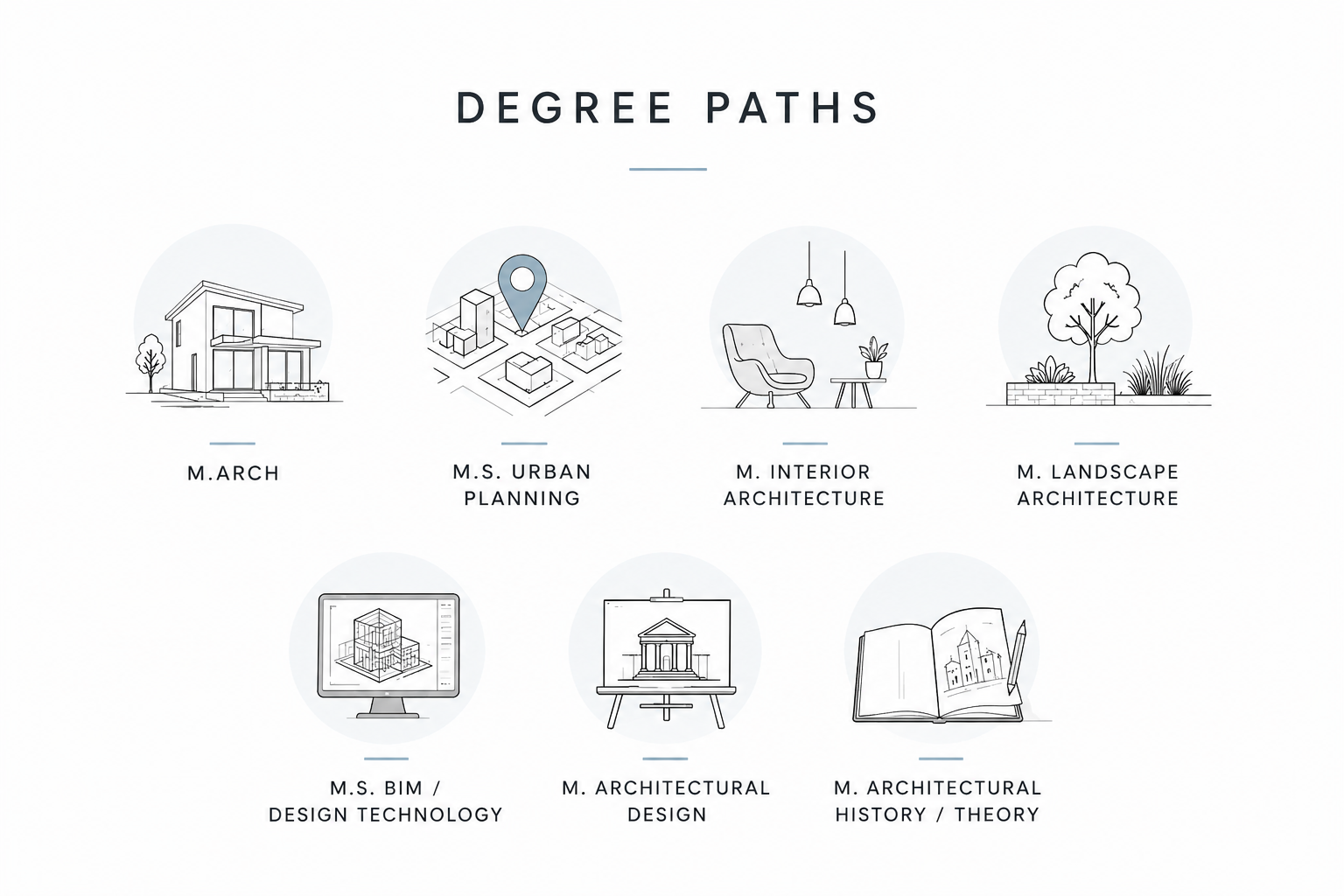
Architectural Design
This is the studio-heavy path. It fits students who want to design buildings, test form, work through spatial problems, and build a strong portfolio.
The risk is becoming too image-driven. A beautiful presentation with weak plans, weak sections, and no building logic starts to fall apart under review.
Sustainable Architecture
This path focuses on climate response, energy use, materials, building performance, daylight, ventilation, and environmental systems.
Schools that still treat environmental systems as a side course instead of core technical training are producing graduates who struggle once projects become real buildings instead of studio exercises.
When comparing programs, ask whether environmental systems is treated like serious technical coursework or decorative sustainability language.
Also Useful: Sustainable Architecture Degrees
Urban Planning and Design
This route moves outward from the building to the city.
It fits students who care about streets, districts, zoning, transit, housing, land use, and public space. The work is less about one beautiful object and more about systems that affect many people at once.
Related Reading: Urban and Landscape Design Courses
Architectural Technology
This is where construction documents, BIM, assemblies, coordination, detailing, and technical problem-solving become central.
It is not the softer path. In many offices, the technical person is the one who keeps the project from becoming an expensive drawing problem.
Historic Preservation
Historic preservation fits students interested in old buildings, adaptive reuse, restoration, heritage policy, and documentation.
The work is slower than design-school fantasy. Existing buildings come with damage, code limits, moisture problems, structural surprises, and owners who do not always understand what can be saved.
Interior Architecture
Interior architecture focuses on interior space, circulation, light, materials, human use, and how rooms actually work.
It overlaps with interior design, but it stays closer to spatial systems, construction logic, and building constraints.
One More Thing: Bachelor of Science in Interior Design
The Transfer Problem Students Find Out Too Late
Architecture credits do not always move cleanly between schools.
General education credits may transfer. Studio placement is harder. A school may accept your credits on paper but still place you lower in the design sequence because your studio work does not match its curriculum.
That can add a semester. Sometimes a year.
Before transferring, ask one exact question:
“If I enter your program with my current studio credits, what year of the studio sequence would I actually join?”
Anything vague should make you slow down.
When Architecture May Not Be the Right Degree
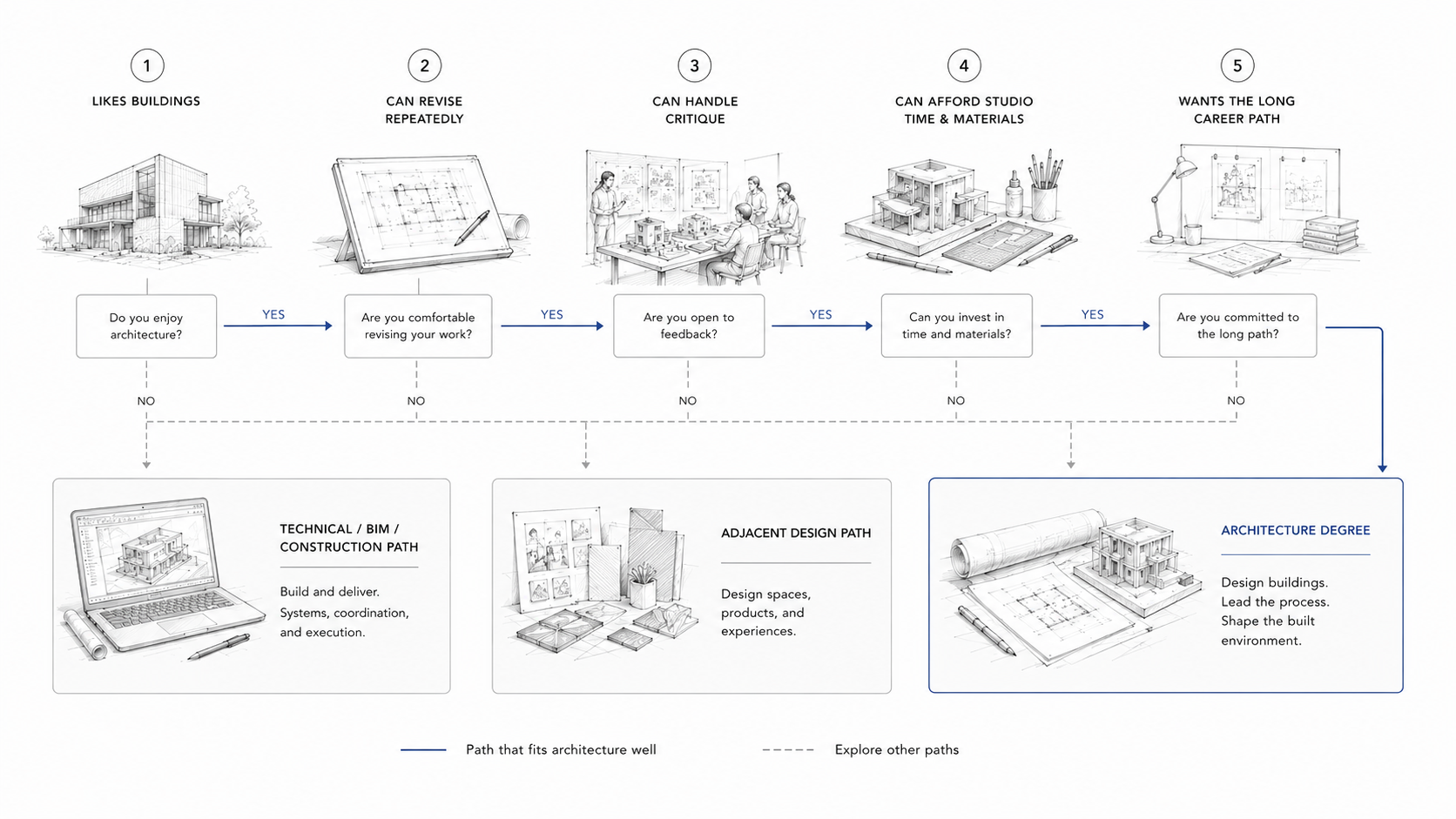
Liking buildings is a start. It is not enough by itself.
Architecture school asks for repeated revision, public criticism, long studio hours, model work, technical patience, and a slow professional path after graduation. Some students discover they love buildings but dislike the way architecture is studied and practiced.
That does not mean they chose the wrong interest. It may mean they chose the wrong degree.
If you like building systems, construction logic, schedules, coordination, or site work, construction management or architectural technology may fit better. If you like interior space and human use more than full buildings, interior architecture may fit better. If you care more about streets, housing, land use, and transit, planning or urban design may fit better.
The goal is not to force every building-minded student into the architect route. The goal is to match the degree to the work the student can still tolerate after the romance wears off.
Related Degrees That May Fit Better
| Related Degree | Best Fit | Typical Direction |
|---|---|---|
| Architectural Engineering | Students who want heavier engineering and building systems | Structures, systems, technical design, coordination |
| Building Science | Students interested in envelope behavior, energy, materials, and performance | Consulting, analysis, sustainability, research |
| Construction Management | Students drawn to schedule, cost, sequencing, and site delivery | Project management, estimating, construction administration |
| Interior Architecture | Students most interested in interior space and user experience | Interior architecture, workplace, hospitality, residential design |
| Landscape Architecture | Students who prefer outdoor space, grading, ecology, and site systems | Site design, public realm, parks, environmental planning |
| City and Regional Planning | Students who want policy, zoning, housing, and city-scale work | Planning, development, transportation, community design |
Not everyone who likes architecture should study the same degree.
Some students want the building. Some want the city. Some want the detail. Some want the construction sequence. The degree should match the work you can tolerate after the romance wears off.
Final Word
The safest architecture degree choice is the one that matches the outcome.
If you want licensure, verify accreditation before getting attached to the school. If you want flexibility, be honest about the graduate step you may be adding later. If you want technical work, do not pretend every design degree teaches enough construction logic.
The wrong degree does not usually feel wrong in year one.
It starts feeling wrong when the next required step shows up and nobody budgeted for it.
FAQ
What is the best architecture degree?
For licensure, a NAAB-accredited B.Arch or M.Arch is usually the clearest U.S. route. For flexibility, a BA or BS in Architecture may make sense first, but it often adds a graduate step later.
Is a B.Arch better than a BS in Architecture?
It depends on the goal. A B.Arch is usually better for the direct professional route. A BS may be better for students who want a technical base before deciding on graduate school.
Can I become an architect with a BA in Architecture?
Often, yes, but usually not with the BA alone. Many students use the BA as the undergraduate step before an accredited M.Arch.
Is an M.Arch always a professional degree?
No. Some M.Arch programs are professional degrees; other graduate architecture degrees are post-professional or research-focused.
How long does architecture school take?
A B.Arch often takes five years. A BA or BS plus M.Arch can take six to seven years depending on graduate placement.
What matters more: the school or the portfolio?
The portfolio usually decides the interview. School reputation helps, but weak work does not get carried very far by prestige alone.
Read This Next
For the professional-degree route, read Bachelor of Architecture (B.Arch) before comparing shorter undergraduate options.
If you are still sorting out all degree names, read Types of Architecture Degrees as the broader map.
For the licensing sequence after school, read How to Become a Licensed Architect.
If you are comparing schools, read Choosing the Right Architecture School before choosing by ranking or campus alone.
If you are still in high school, start with Introduction to Architecture for High School Students.