

A master’s degree in architecture can move you closer to the architect license, or it can become an expensive extra degree with no clear job path behind it.
The difference is not the word “architecture.”
The difference is the type of master’s degree, its accreditation, the student’s previous degree, the portfolio it helps build, and whether the program connects to the work the student actually wants after graduation.
That is where many applicants get trapped. They compare school names before they understand the route.
Start With the Type of Master’s
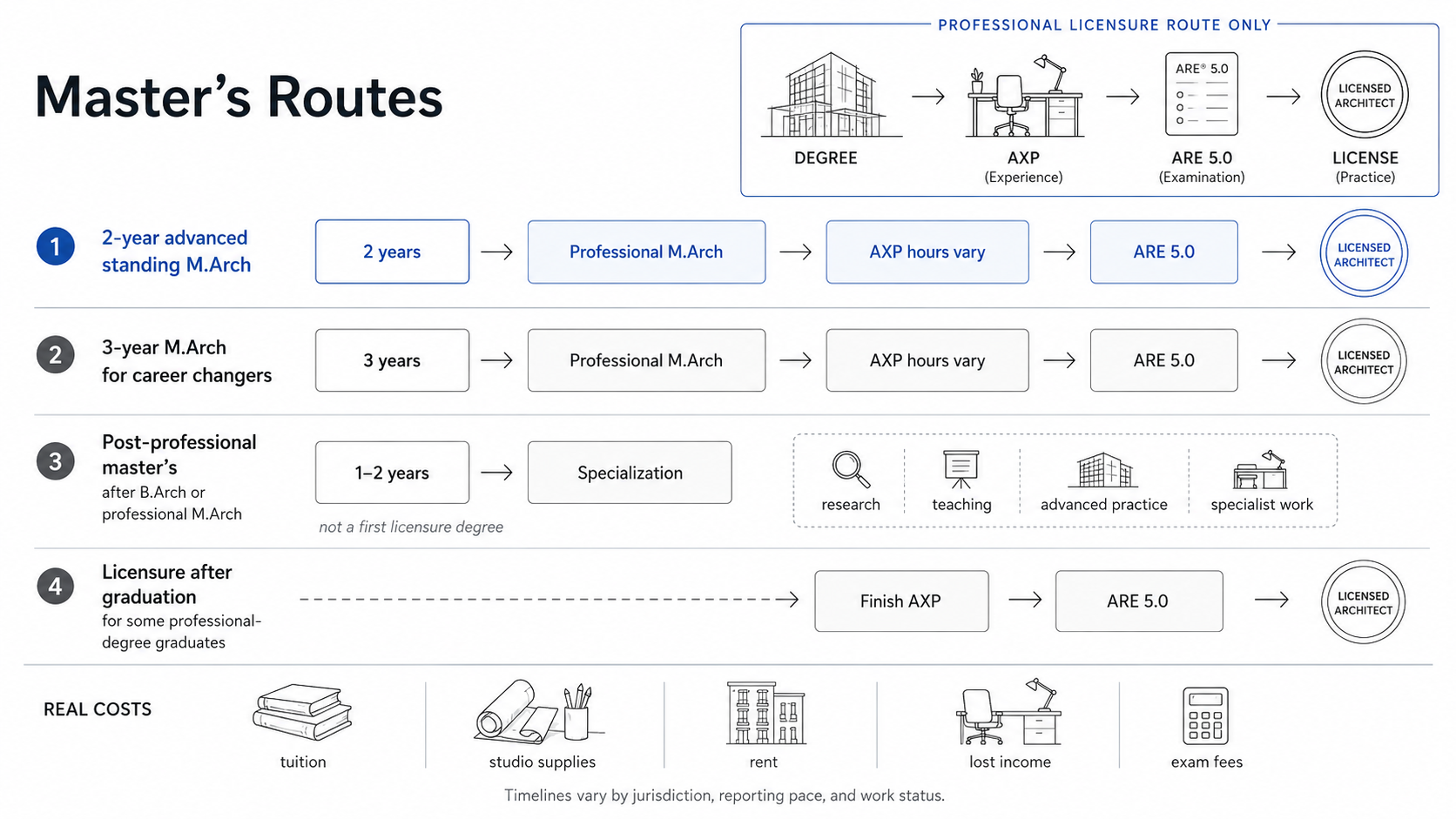
Not every graduate architecture degree does the same job.
A professional Master of Architecture, usually written as M.Arch, is the degree many students use to meet the professional education requirement for licensure. A post-professional master’s is different. It is usually for students who already have a professional architecture degree and want deeper study in design, research, sustainability, technology, urban design, or another specialty.
Related graduate degrees can be useful too, but they are not automatic substitutes for a professional M.Arch.
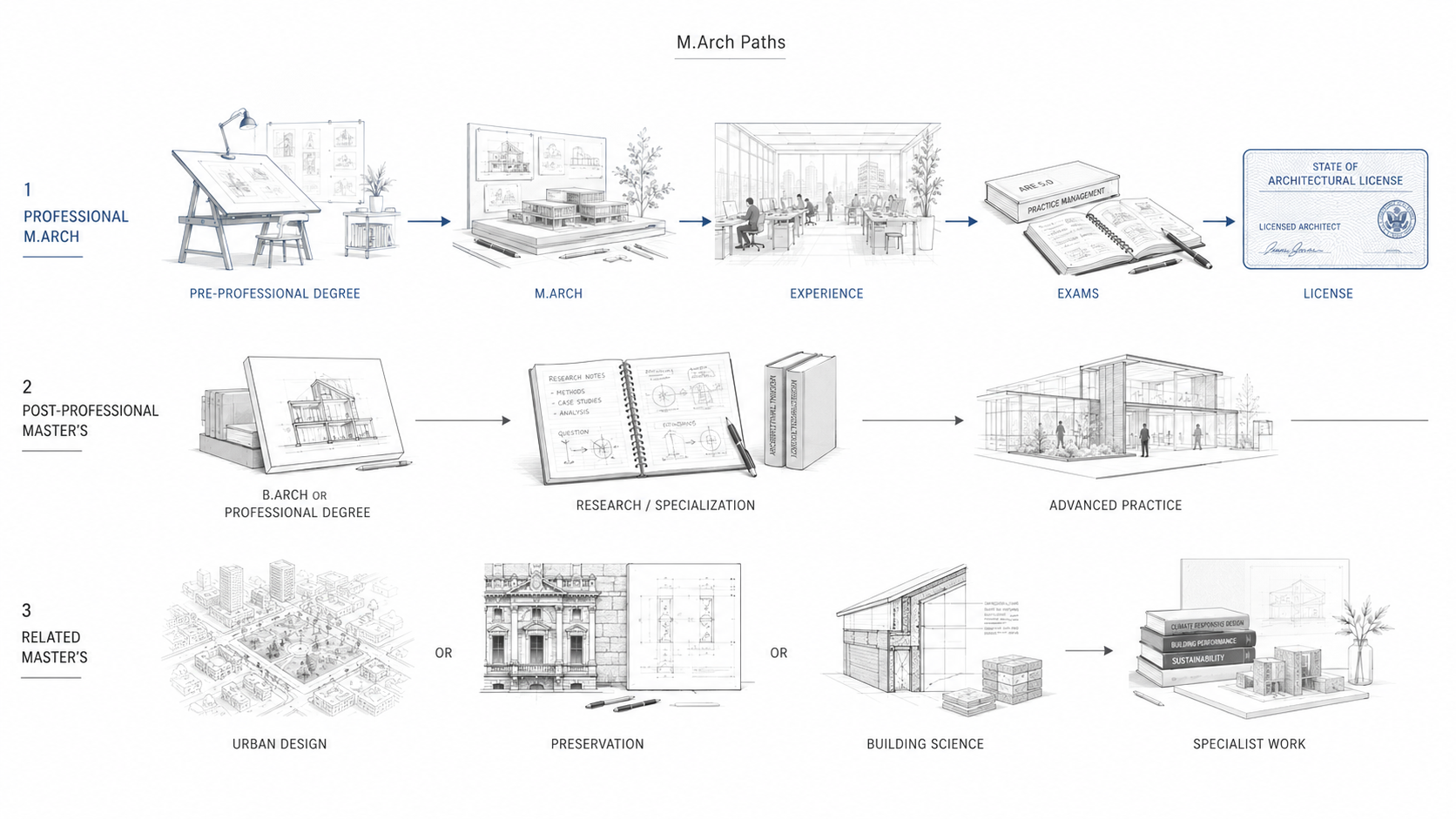
| Graduate path | Who it fits | Licensure warning |
|---|---|---|
| Professional M.Arch | Students who need a professional architecture degree after a pre-professional or unrelated bachelor’s degree | Check accreditation before applying |
| Post-professional master’s | Students who already hold a professional architecture degree | Usually not a first professional licensure degree |
| MS or MA in Architecture | Research, history, theory, computation, building science, or design specialization | May not satisfy the professional degree requirement |
| Urban design, preservation, planning, or building science master’s | Specialist work outside the standard architect path | Useful, but not the same credential as a professional M.Arch |
If the goal is licensure, do not assume. Verify the program’s professional status first.
For the broader degree map, read Types of Architecture Degrees.
Who Needs an M.Arch
An M.Arch usually matters most for three groups.
The first group is students with a pre-professional architecture degree, such as a BA or BS in Architecture, who still need a professional degree before moving fully into the licensure path.
The second group is career changers. They may come from engineering, art, environmental studies, construction, planning, or another field. Their M.Arch path is usually longer because the program has to teach studio fundamentals first.
The third group is international or transfer students whose previous degree may not be recognized the same way in the country where they want to practice.
A student with an accredited B.Arch may not need a professional M.Arch at all. That student may be better served by working, logging experience, passing exams, or choosing a post-professional degree only if it supports a real specialty.
For the direct undergraduate professional route, read Bachelor of Architecture.
M.Arch I, M.Arch II, and Advanced Standing
Schools use different names, but the basic split is simple.
An M.Arch I is usually for students who do not already have a professional architecture degree. It can take about three years for career changers or students without enough design studio background.
An M.Arch II or advanced-standing M.Arch is usually shorter. It is often for students who already completed a strong pre-professional architecture degree or a professional degree outside that school’s system.
This matters because the shorter program is not just a discount. It depends on placement. A school may accept your bachelor’s degree but still place you into a longer studio sequence if your portfolio does not prove enough design preparation.
Ask the school this directly:
“With my exact transcript and portfolio, what studio year would I enter?”
That answer matters more than the brochure’s fastest timeline.
Admissions Are Really a Portfolio Test
Graduate admissions pages usually list transcripts, letters, statements, English testing for international students, and sometimes GRE language.
Those things matter.
But the portfolio is the real test.
A strong M.Arch portfolio does not need to be huge. It needs to prove that the applicant can think through a design problem and communicate it clearly. Plans, sections, process work, model photos, and one or two details often say more than a stack of polished renderings.
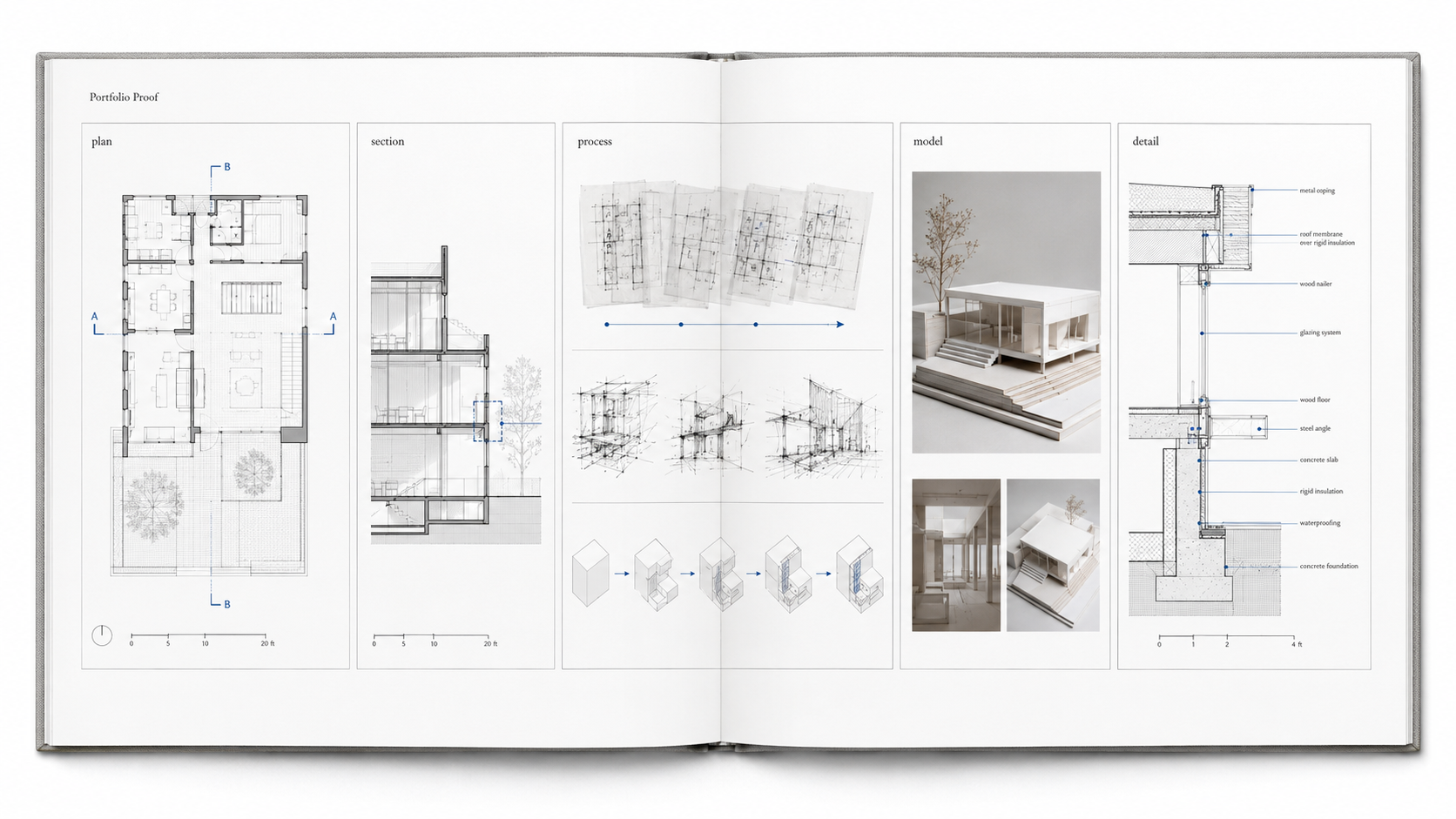
What the Portfolio Has to Prove
The portfolio should show judgment, not just effort.
| Portfolio evidence | What it proves | Weak version |
|---|---|---|
| Plans | You understand rooms, circulation, access, and organization | Pretty plan graphics with no real use logic |
| Sections | You understand height, structure, light, and spatial relationships | Flat building images with no section thinking |
| Process | You can revise and explain decisions | Only final images, no development |
| Models | You can test form, material, scale, and assembly | Decorative models with no design purpose |
| Details | You are starting to think like a builder, not only a presenter | Renderings that avoid how the building works |
One complete project with clear plans, sections, process, and model work is stronger than six shallow projects.
For portfolio-specific help, read Real Architecture Portfolios.
Cost Is More Than Tuition
The published tuition number is only the first cost.
The real cost of a master’s degree in architecture includes rent, transportation, studio supplies, printing, model materials, software, a strong computer, health insurance, lost income, and later licensure expenses.
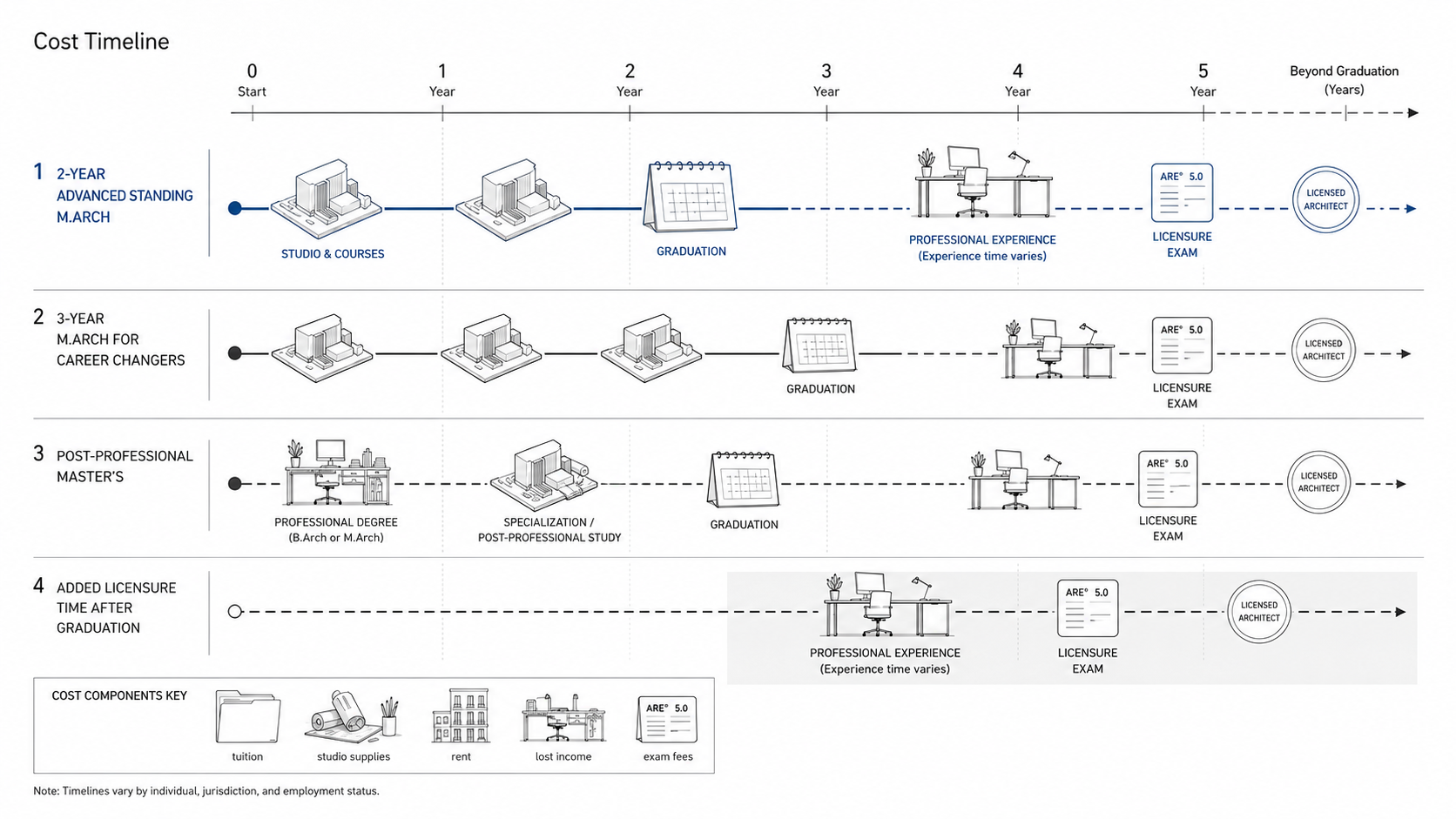
| Path | Typical time | Cost pressure |
|---|---|---|
| Advanced-standing M.Arch | About 2 years | Shortest graduate route if placement is real |
| Career-change M.Arch | About 3 years | Higher tuition, more rent, more time out of full-time work |
| Post-professional master’s | 1 to 2 years | Only worth it when the specialization has a clear return |
| M.Arch plus licensure period | Degree time plus several years of experience and exams | Exam fees, study materials, retakes, and lower early-career pay |
Rough U.S. totals vary widely by school and city. A cheaper public program with strong placement can be smarter than a famous private program in a high-rent city. Prestige does not pay the rent during studio, and it does not automatically make the portfolio stronger.
The Cost Spike After Admission
The acceptance letter makes the degree feel settled. It is not settled.
The second bill starts after classes begin.
Model materials. Plotting. Software. Storage. Better laptop hardware. Site travel. Late printing before reviews. Replacement tools after the first ones break. Presentation supplies. Then, after graduation, AXP reporting, ARE exam fees, study materials, and possible retakes enter the picture.
This is the part many school pages do not explain plainly enough.
A three-year M.Arch in an expensive city can quietly cost far more than the tuition estimate suggests, especially when studio workload limits outside work. Some students would be better off choosing a cheaper accredited program with stronger internship access than a famous school that leaves them financially cornered.
The protective move is simple: price the degree like a project, not like a semester bill.
Accreditation and Licensure
In the United States, students who want the standard architect licensure path usually need a professional degree from a NAAB-accredited program, then experience through AXP, then the ARE exams, then state board approval.
The state board matters because licensure is controlled by jurisdictions, not by the school brochure.
That means the M.Arch must be checked against the place where the student wants to practice. This is even more important for online, hybrid, international, or unusual degree formats.
For the full licensing route, read How to Become a Licensed Architect.
Online and Hybrid M.Arch Programs
Some architecture graduate programs use online or low-residency formats. That does not automatically make them weak. It also does not automatically make them acceptable for licensure.
The issue is accreditation and studio delivery.
Architecture is not just lectures. It needs critique, feedback, drawing review, model review, technical correction, and evidence that the student can develop work over time. A serious online or hybrid program has to replace the missing studio culture with structured reviews, residencies, synchronous critique, and strong faculty feedback.
Fully online convenience is not enough.
Before applying, ask whether the program is professionally accredited, how studio reviews work, whether residencies are required, and how graduates move into AXP, ARE, and licensure.
For the broader online degree question, read Can You Earn an Architecture Degree Online?.
Studio Work Changes at the Graduate Level
Graduate studio is not supposed to be a bigger version of undergraduate studio.
The work should become more accountable. A clinic needs egress, privacy, equipment clearances, air handling, and code logic. A housing project needs unit planning, structure, daylight, cost, and circulation that works beyond the presentation board. A preservation project needs measured drawings, repair logic, and code upgrades that do not destroy the building.
Good programs make students connect design decisions to consequences.
Weak programs let students hide behind images.
That difference shows up in interviews. Firms can usually tell when a portfolio is beautiful but thin. They can also tell when a project has real plans, sections, details, and coordination behind it.
Specializations That Make Sense
A specialization should not be chosen because it sounds current. It should point toward work someone actually wants to do.
Sustainable design and building performance
This path fits students who care about envelopes, daylight, energy modeling, carbon, comfort, and building systems. It can lead toward sustainability consulting, performance roles inside firms, public work, higher education projects, or government projects.
Read more: Sustainable Architecture Degrees.
Urban design
Urban design moves beyond the single building. It deals with streets, blocks, transit, open space, zoning, housing patterns, public realm, and development pressure.
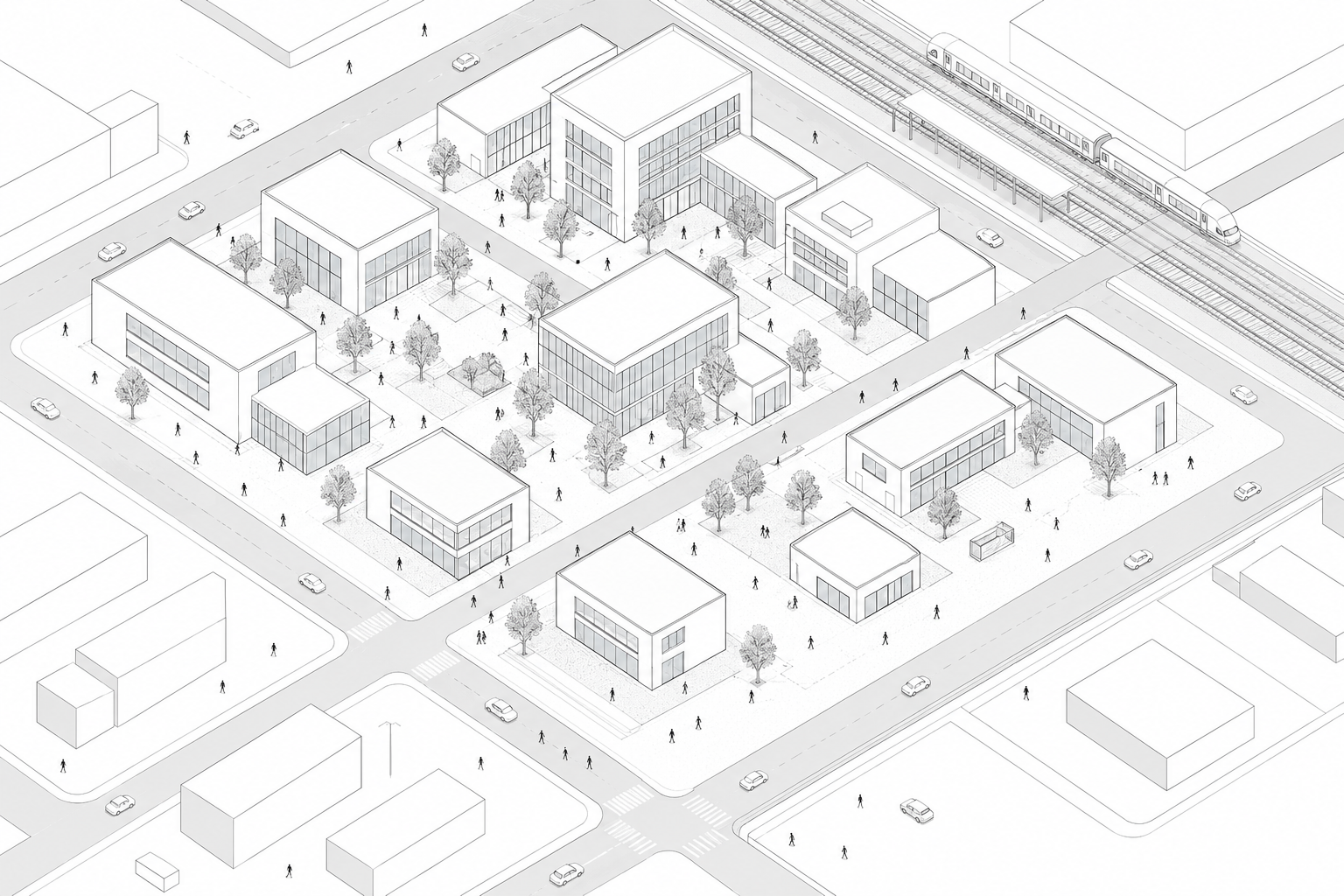
Read more: Master of Urban Design.
Digital design and fabrication
This path fits students who want to work with BIM, computational design, simulation, fabrication, façade systems, prototypes, and office workflows that save time or improve coordination.
The warning is simple: digital skill has to connect to a deliverable. A script that produces a beautiful pattern is less useful than a workflow that improves coordination, reduces rework, or helps a team price and build something.
Historic preservation and adaptive reuse
Preservation is not nostalgia. It is documentation, material judgment, repair logic, code negotiation, and patience.
This path fits students who can work with existing buildings without forcing every project to become a clean new-build fantasy.
Healthcare, labs, and technical building types
Some of the strongest career lanes are not the glamorous ones. Healthcare, labs, airports, transit, campuses, and public facilities need architects who can coordinate systems, understand regulations, and keep a project moving.
These fields reward technical depth because mistakes are expensive.
Careers After an M.Arch
A professional M.Arch can support the licensure path, but the degree itself does not guarantee a title, salary, or senior role.
The portfolio, location, internship access, software fluency, construction understanding, and licensure progress all matter.
| Career lane | What the work involves | Portfolio proof |
|---|---|---|
| Architectural designer | Design studies, drawings, models, documentation support | Plans, sections, models, and coherent design development |
| Licensure-track architect | AXP, ARE, project work, code, consultant coordination | Technical drawings, details, and construction logic |
| Urban designer | Districts, streets, housing, transit, public realm | Site plans, block studies, diagrams, policy awareness |
| Sustainability specialist | Energy, carbon, daylight, comfort, envelope strategy | Performance studies tied to design decisions |
| BIM or digital design specialist | Model coordination, automation, documentation workflows | Real tools, scripts, templates, or coordination examples |
| Preservation or adaptive reuse designer | Existing buildings, documentation, repair, code upgrades | Measured drawings, material research, repair details |
Early salaries vary heavily by city, firm type, and responsibility. Licensure often changes the ceiling more than the degree alone. So does the ability to manage scope, coordinate consultants, understand code, and deliver drawings that can survive construction.
Funding, Assistantships, and What to Ask
Graduate funding can make or break the decision.
Do not ask only whether aid exists. Ask how many students receive it, whether it renews, whether assistantships reduce tuition, and whether the stipend is enough to matter in that city.
Useful questions:
- How many M.Arch students receive assistantships?
- Are awards guaranteed for one year or the full program?
- Can students work while in studio?
- Are fabrication fees, printing, and software included?
- Does the school publish graduate employment outcomes?
- Do local firms recruit from the program?
Some schools offer better financial reality even if their headline ranking is lower. That matters.
When the M.Arch Is Worth It
An M.Arch is worth considering when it clearly unlocks something.
That may be professional licensure. It may be a career change into architecture. It may be a strong technical specialization. It may be access to a city, firm network, lab, or studio culture that improves the student’s work in a visible way.
It is weaker when the student cannot explain why that specific program is necessary.
“I want a master’s” is not enough.
A stronger reason sounds like this: “I need a professional degree for licensure, and this accredited program gives me the studio placement, cost structure, internship access, and portfolio support that fit my path.”
When Another Path May Be Better
Some students do not need an M.Arch.
If the goal is drafting, BIM production, visualization, construction coordination, interiors, planning, real estate development, or sustainability consulting, another degree or certificate may be faster and cheaper.
If the student already has a professional B.Arch, the next move may be work experience and licensure instead of another degree.
If the student wants architecture culture more than architecture practice, a research or theory degree may fit better than a professional M.Arch.
The honest question is not “Is a master’s impressive?”
The honest question is “What does this degree let me do that I cannot do without it?”
FAQ
Do I need a master’s degree to become a licensed architect?
Not always. In the United States, many students use either a NAAB-accredited B.Arch or a NAAB-accredited M.Arch as the professional degree step. If your undergraduate degree is pre-professional or unrelated, the professional M.Arch is often the cleaner route.
What is the difference between M.Arch I and M.Arch II?
M.Arch I usually serves students who do not already have a professional architecture degree. M.Arch II or advanced-standing formats are usually shorter and serve students with stronger prior architecture preparation.
How long does a Master of Architecture take?
Many advanced-standing programs take about two years. Career-change or first-professional tracks can take about three years, depending on placement and prior coursework.
Can I study architecture online and still become licensed?
Possibly, but only if the route meets professional accreditation and jurisdiction requirements. Some low-residency or hybrid programs may work. Do not assume a fully online architecture degree leads to licensure.
What should an M.Arch portfolio include?
Plans, sections, process work, models, and a few strong projects. The portfolio should prove design thinking and revision, not just visual polish.
Is the GRE required for M.Arch programs?
Many schools have dropped it or made it optional, but requirements vary. Check each program’s current admissions page before spending money or time on the exam.
Can I work while completing an M.Arch?
Some students do, but studio workload can be heavy. Part-time work is more realistic when the program structure, commute, and review schedule allow it.
Which M.Arch specializations have strong career value?
Building performance, healthcare, labs, BIM coordination, digital fabrication, façade work, adaptive reuse, and project delivery can all be valuable when the portfolio proves real skill.
Read This Next
For the broader map of degree types, read Types of Architecture Degrees.
For the direct undergraduate professional route, read Bachelor of Architecture.
For licensing after school, read How to Become a Licensed Architect.
For online and hybrid study questions, read Can You Earn an Architecture Degree Online?.
For choosing the school itself, read Choosing the Right Architecture School.
Before You Apply
A Master of Architecture degree has to prove its job before you pay for it.
If it is the professional route, verify accreditation and licensure fit. If it is a specialization, make sure the field has real demand and the school has proof of student outcomes. If it is a famous program in an expensive city, run the full cost before getting emotionally attached.
The right M.Arch can sharpen a student fast.
The wrong one becomes another beautiful portfolio, another large bill, and another delay before the real career starts.