
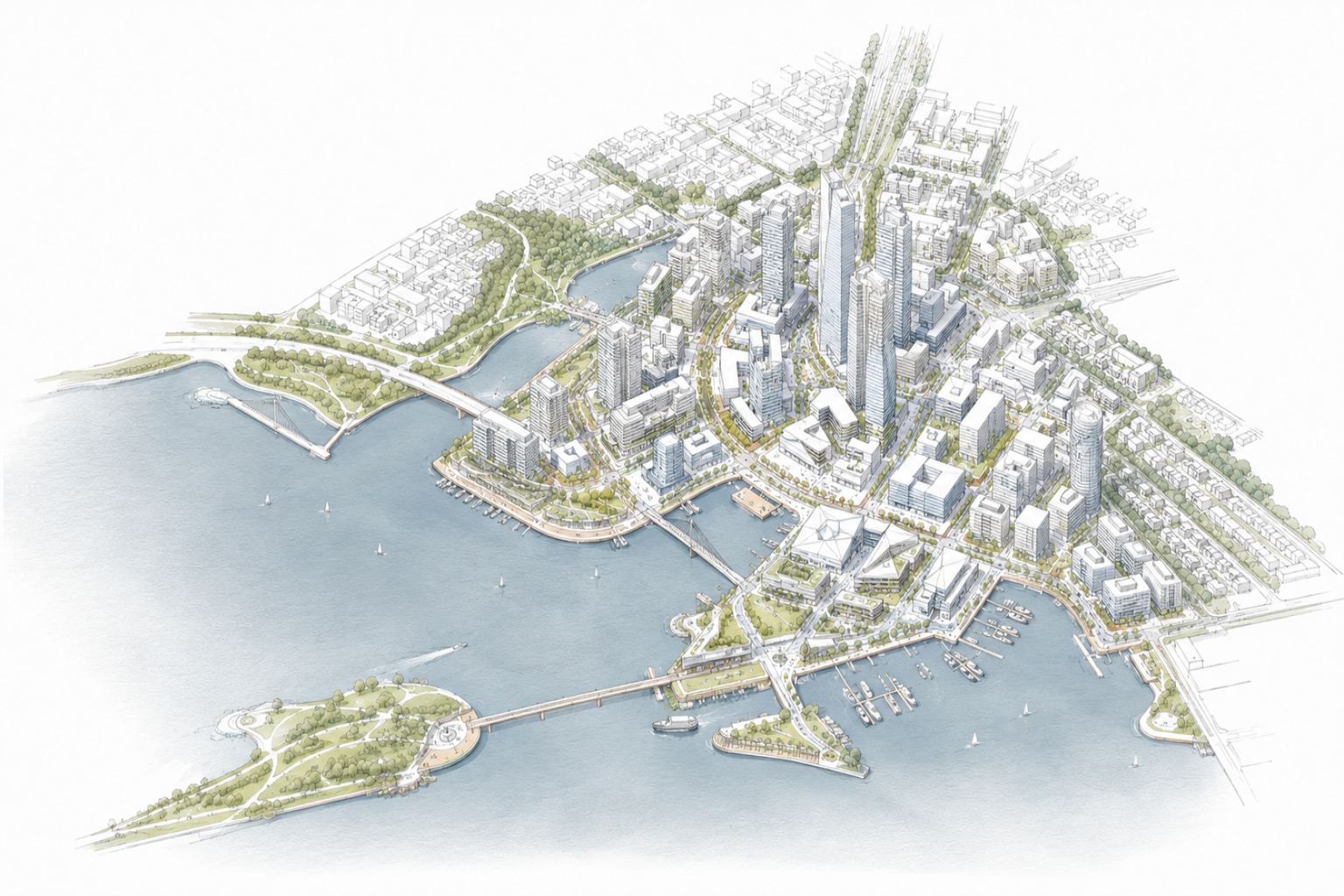
A Master of Urban Design sounds like architecture at a bigger scale.
That is only partly true.
Urban design is not one large building project. It is the work between buildings: streets, blocks, transit, open space, ground floors, shade, zoning, phasing, housing mix, public process, and the ugly question of who pays for the plan.
That is where weak student work falls apart.
A beautiful district rendering means little if the street section does not fit, the housing numbers do not work, the bus route disappears, the public space has no shade, or the plan needs a zoning change nobody has budgeted time to win.
A good Master of Urban Design program teaches you to design at that scale without pretending the city is a blank model board.
What Urban Design Really Does
Urban design sits between architecture, planning, landscape architecture, transportation, housing, policy, and real estate.
Architecture usually starts with a building. Planning often starts with policy, land use, regulation, or long-term public goals. Urban design has to translate both into physical form people can understand: street sections, block structure, frontage rules, open-space networks, massing, public-realm guidelines, and implementation diagrams.
The job is not just to make a place look better.
The job is to make the parts work together.
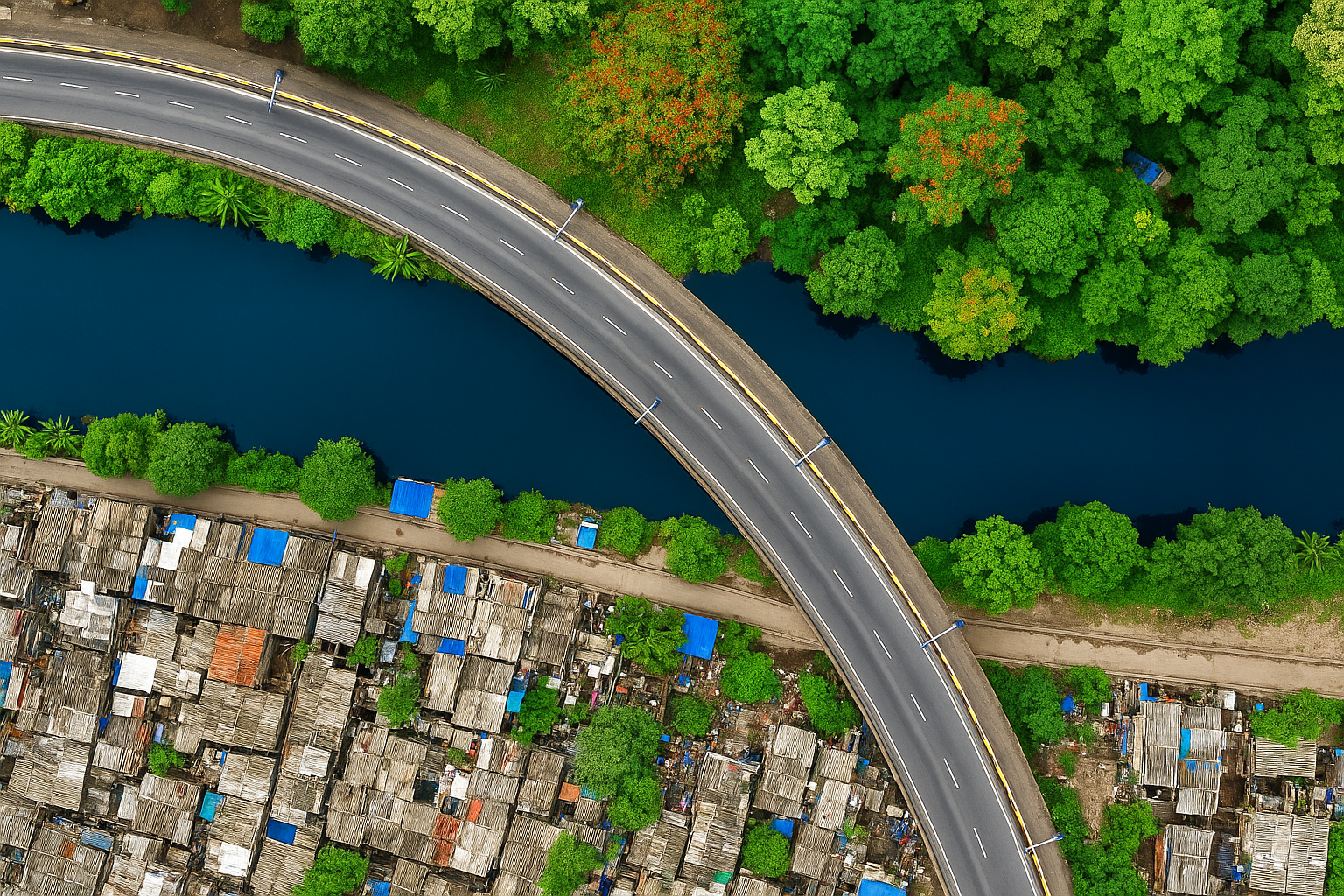
That means an urban designer may spend one hour testing building massing, the next hour redrawing a street section, and the next hour explaining why ground-floor uses matter more than the tower image everyone keeps arguing about.
The best urban design work is not the prettiest drawing in the room. It is the drawing that a planner, resident, developer, engineer, and elected official can all use without pretending they agree on everything.
What It Is Not
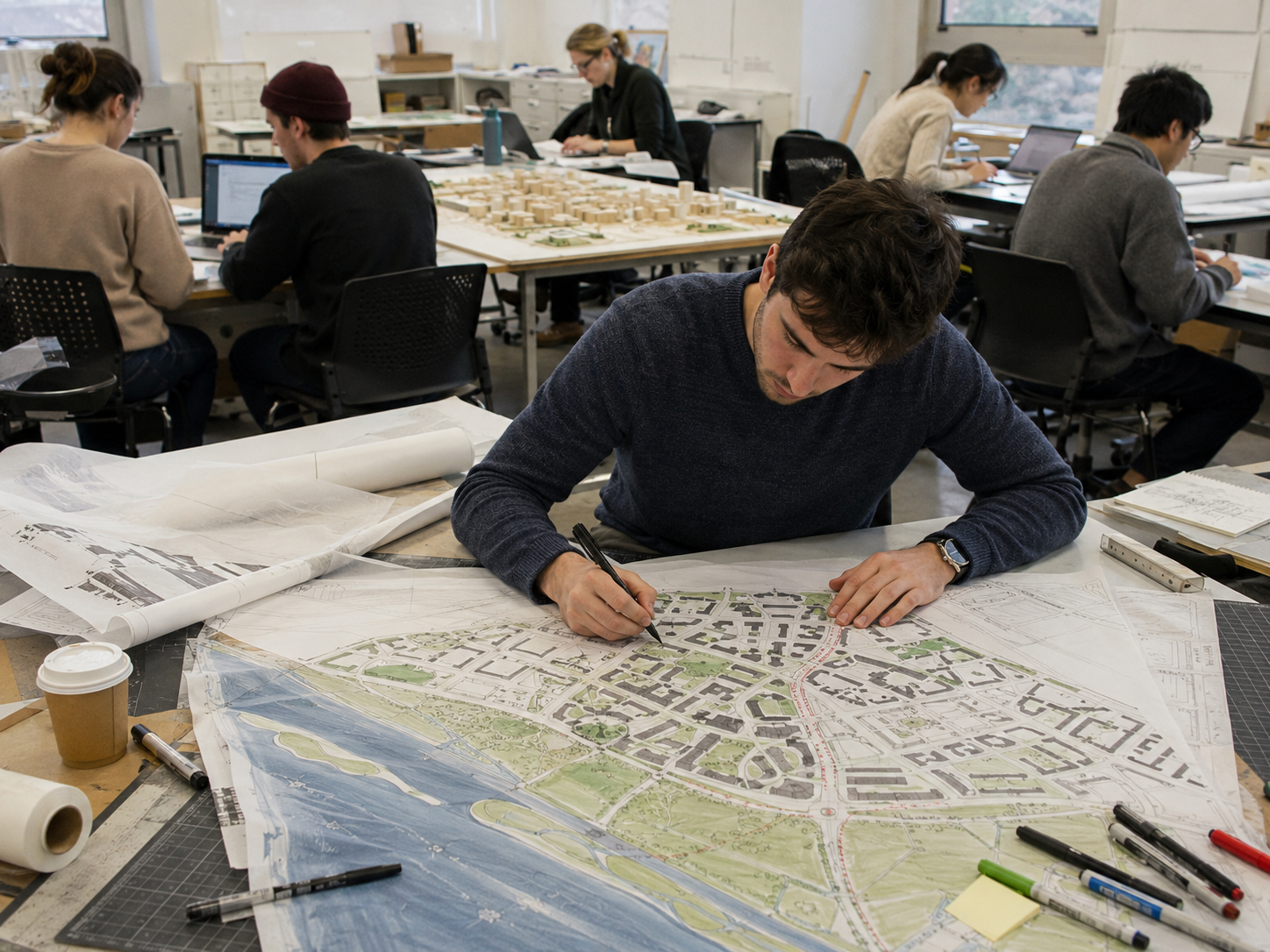
A Master of Urban Design is not a replacement for a professional architecture degree.
If your goal is to become a licensed architect in the United States, the standard education route usually runs through a NAAB-accredited professional architecture degree such as a B.Arch or M.Arch, followed by experience, exams, and state board requirements.
An MUD can strengthen your design range. It can help you move into urban design, planning-adjacent work, development advisory work, public-realm design, or city-scale studio roles. But it is not the same thing as a professional M.Arch.
That distinction matters before you spend money.
| Degree | Main focus | Best fit | Licensure warning |
|---|---|---|---|
| Master of Urban Design | Streets, blocks, districts, public realm, frameworks, implementation | Students who want city-scale design work | Not an architecture license degree by itself |
| Master of Architecture | Buildings, studio, structures, systems, professional practice | Students who need the professional architecture route | Check NAAB accreditation if licensure is the goal |
| Master of Urban Planning | Policy, housing, transportation, land use, regulation, data | Students who want planning and public-sector roles | Usually less design-studio heavy |
| Landscape Architecture / Urbanism | Landscape systems, ecology, public space, site design, climate | Students focused on outdoor systems and public realm | Different professional path |
If you still need the architecture license path, read Master’s Degree in Architecture before choosing an urban design degree.
What You Actually Study
The core of a good MUD program is studio. Not lecture first. Studio.
But the studio should not behave like a big architecture project with extra roads around it. It should force you to work across scales.
| Studio work | What it teaches | Weak version |
|---|---|---|
| Regional and district analysis | How movement, land use, water, growth, and infrastructure shape a place | Decorative maps with no design consequence |
| Block and parcel studies | How development actually lands on property | Masses floating on a site with no ownership or access logic |
| Street sections | How sidewalks, bikes, cars, transit, trees, utilities, and frontage compete for space | Pretty streets that do not physically fit |
| Public-realm frameworks | How parks, plazas, shade, edges, and paths create usable civic space | Green shapes added after the buildings are already decided |
| Design guidelines | How to turn a vision into rules other people can use | Vague principles nobody can enforce |
| Implementation phasing | How plans survive money, politics, construction, and time | One perfect final image with no first step |
The real skill is translation.
You translate policy into form. You translate community concerns into spatial priorities. You translate transport limits into street design. You translate development pressure into rules that still leave room for public life.
That is why urban design is harder than it looks.
Choose MUD, M.Arch, or Planning?
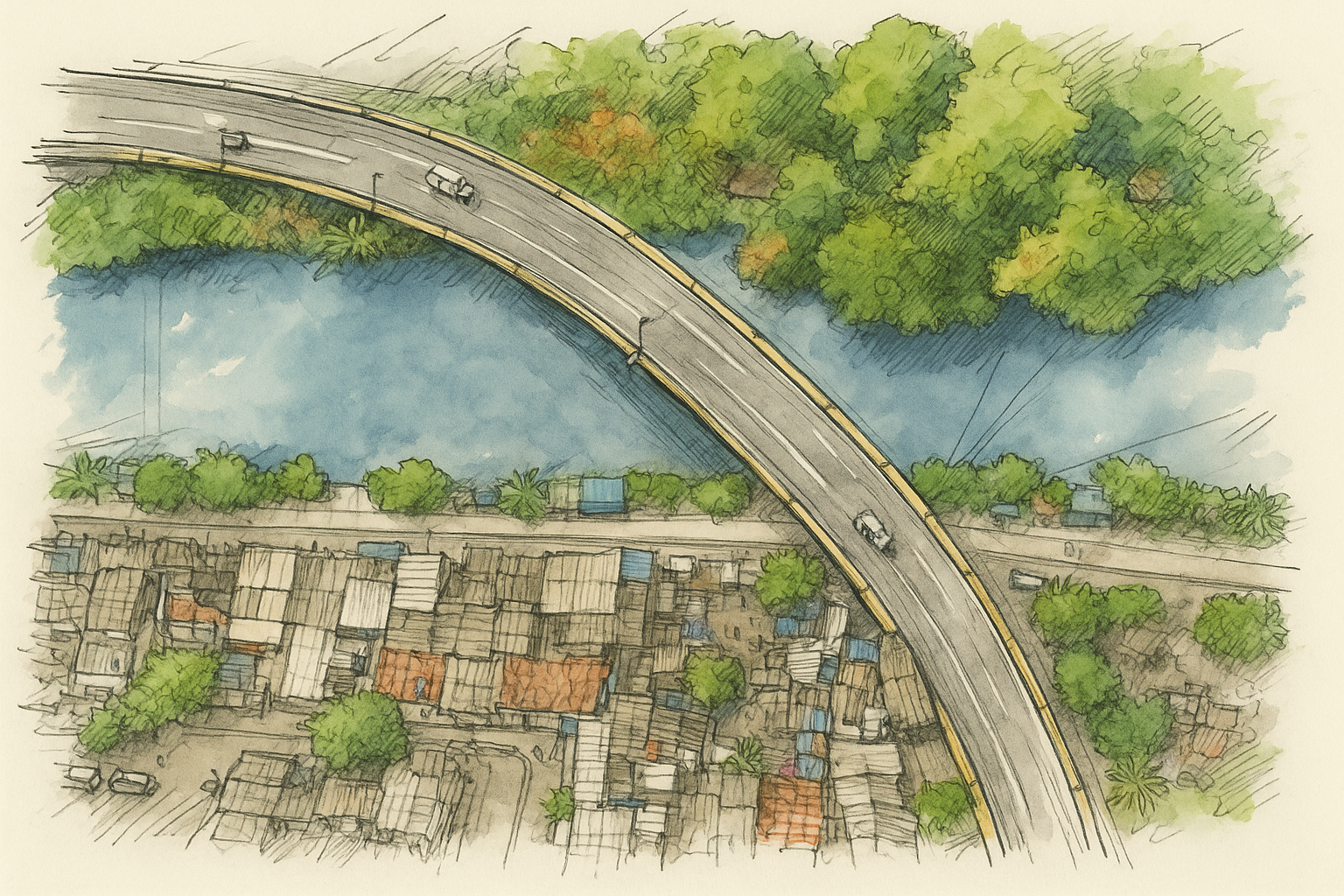
Choose a Master of Urban Design if you want to work on neighborhoods, districts, streets, waterfronts, campuses, transit corridors, growth plans, public-space frameworks, or design guidelines.
Choose a Master of Architecture if the architect license is the main goal.
Choose a Master of Urban Planning if you are more interested in policy, housing programs, transportation planning, zoning, public administration, and data-heavy planning work than drawing-led design.
Choose landscape architecture if the outdoor system, ecology, grading, planting, water, and public realm matter more to you than building massing.
The mistake is choosing the degree by prestige instead of by daily work.
A student who hates public meetings, zoning constraints, and messy politics may not enjoy urban design, even if they love city images. A student who only wants to design buildings may find MUD too indirect. A student who wants policy power may find MUD too drawing-heavy.
For a broader comparison, see Urban and Landscape Design Courses.
The Part Schools Do Not Emphasize Enough
Urban design is full of beautiful plans that never become anything.
That is the quiet trap.
Students often learn how to make convincing diagrams, elegant massing studies, and polished public-realm images. Then they enter practice and discover the plan is stuck because the land is split across owners, the infrastructure budget is missing, the street section violates a transportation standard, the zoning change is politically dead, or the housing mix does not pencil for anyone who could build it.
This is where the degree either becomes valuable or ornamental.
A serious MUD program should make implementation part of the design work, not a final paragraph.
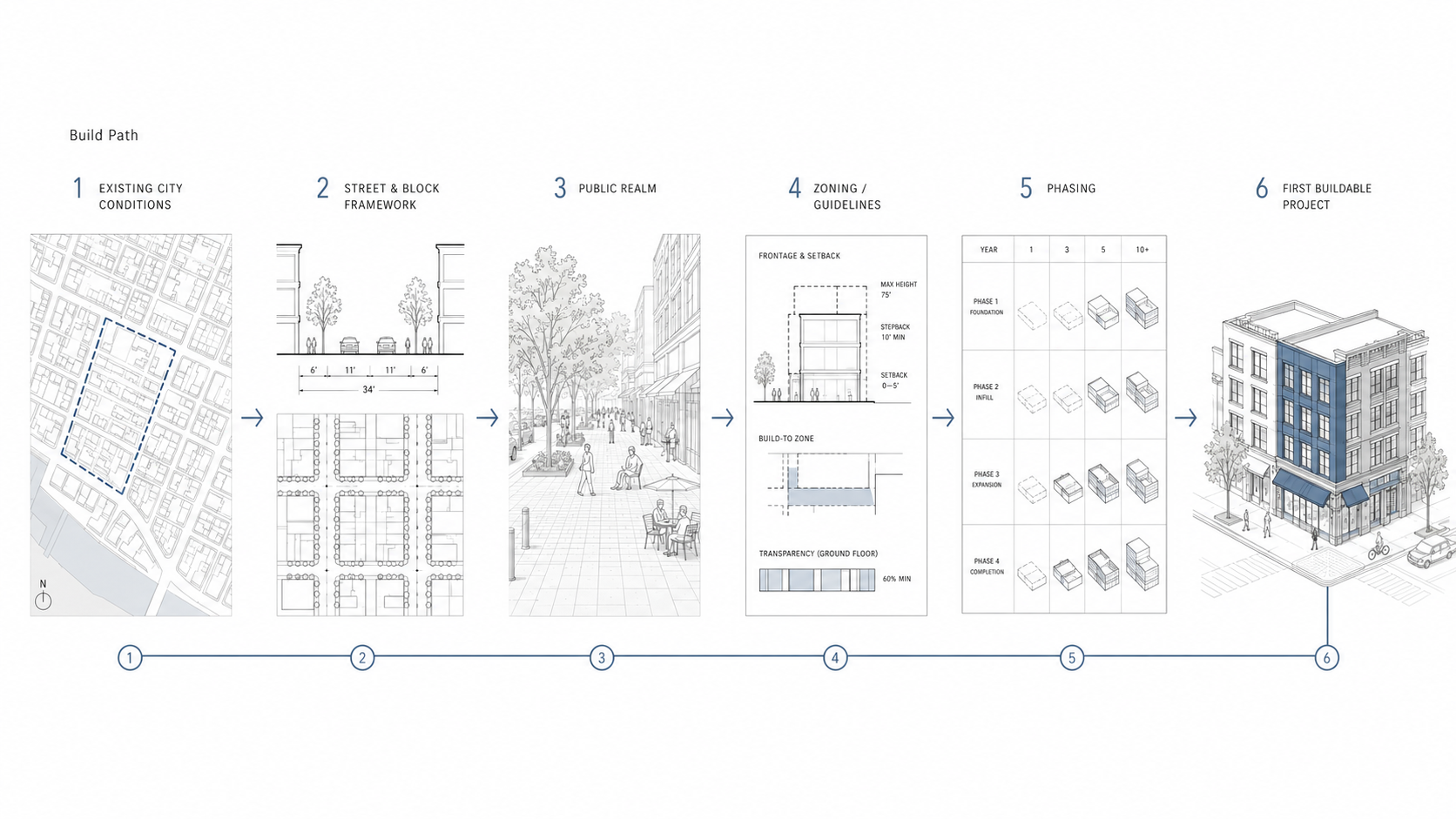
It should ask who owns the land, what changes first, what can be built without waiting ten years, which public agency controls the road, what the development economics allow, and which parts of the plan are rules rather than wishes.
That is the difference between a studio board and an urban design career.
What a Strong Portfolio Must Show
An urban design portfolio should not look like an architecture portfolio stretched over a bigger site.
It has to prove scale control.
That means maps, frameworks, street sections, public-space logic, building massing, phasing, and human-scale details. It should show that you can move from a regional problem to a block rule to a corner condition without losing the plot.
| Portfolio piece | What it proves | Why it matters |
|---|---|---|
| Existing conditions map | You can read a place before redesigning it | Weak urban design starts with fake assumptions |
| Street section | You understand real width, movement, trees, frontage, and access | Many beautiful plans fail here |
| Block framework | You can organize parcels, entries, massing, and public space | Urban design lives at the block scale |
| Public-realm detail | You understand how people use edges, shade, seating, crossings, and thresholds | Good plans fail when the ground floor is dead |
| Phasing diagram | You know the first buildable move | City plans need sequence, not just vision |
| Short policy or guideline page | You can turn design into usable rules | Other people must be able to apply the plan later |
Ten strong pages can beat thirty attractive pages if the logic is clear.
If you come from architecture, show that you can stop obsessing over one object. If you come from planning, show that you can turn analysis into form. If you come from landscape, show that public space, ecology, and urban structure are working together.
The Real Cost Is the City
Most Master of Urban Design and urbanism programs run one to two years full time.
The shorter programs can be intense. The longer programs may allow deeper research, more studio development, or a stronger thesis. The better choice depends on your background and the kind of work you need to produce.
Do not compare tuition alone.
Compare total cost: tuition, living costs, software, travel, studio printing, visa costs if relevant, lost income, and whether the city gives you internship access while you study.
The city can cost more than the program difference. A cheaper tuition number in London, New York, Los Angeles, or Toronto can still become expensive once rent, transit, food, printing, and unpaid studio time are included. For urban design, the city is part of the education, but it is also part of the bill.
| Cost factor | Why it matters | Question to ask |
|---|---|---|
| Program length | A one-year program may reduce rent and lost income | Is the year too compressed to build a strong portfolio? |
| City cost | Urban design programs are often in expensive cities | Can I afford the city without working too much during studio? |
| Internship access | Local networks can matter more than the brochure | Do firms, agencies, or studios recruit from this program? |
| Fieldwork | Some studios require travel, site visits, or project expenses | Are field costs included or extra? |
| Funding | Small awards may not offset high rent | What is the typical actual award, not the maximum advertised award? |
A cheaper program in a city with real public agencies, design firms, housing work, transport work, or redevelopment projects may be more useful than a famous program that leaves you broke and disconnected.
Where to Study Without Chasing Names
Do not start with a ranking list.
Start with the city and the studio model.
An urban design program in Los Angeles will expose you to different pressures than one in London, Delft, Zurich, Singapore, Toronto, or New York. Housing politics, transit systems, climate, public-space culture, development economics, and planning laws all change the education.
That is not a side issue. It is the subject.
When comparing programs, look at student work before you look at slogans. The work should show real places, real constraints, clear sections, useful diagrams, and some evidence of implementation thinking.
What to Check Before Applying
- Do studios work with actual cities, agencies, communities, or development problems?
- Do projects include phasing, guidelines, or implementation logic?
- Are street sections technically believable?
- Do portfolios show housing, transit, climate, equity, or public-realm problems clearly?
- Are graduates working in firms, agencies, development teams, or research roles you would actually want?
- Does the city give you field access, or is the program mostly abstract?
Good urban design education is not portable in the same way a generic design lecture is portable. The city becomes part of the curriculum.
Common Mistakes Applicants Make
The first mistake is applying with a portfolio that only shows buildings.
Buildings matter, but urban design programs need to see that you can think beyond the object. Show streets, districts, movement, open space, and the relationship between private development and public life.
The second mistake is ignoring feasibility. If your proposal needs new transit, a zoning rewrite, land assembly, flood protection, and five public agencies to agree, show the sequence. Do not pretend complexity disappears because the diagram is clean.
The third mistake is having no sections. Urban design without sections is weak. A street section proves whether the idea physically works.
The fourth mistake is treating “community” as decoration. A few people in a rendering do not prove public value. Show how the proposal handles access, displacement pressure, heat, safety, maintenance, affordability, and daily use.
What Graduates Actually Do
Urban design jobs do not always carry the same title.
Some graduates become urban designers in architecture or planning firms. Some work in city agencies. Some join development consultancies. Some move into housing, transport, campus planning, public-realm design, resilience planning, research, or teaching.
| Career lane | Work involved | Portfolio proof |
|---|---|---|
| Urban designer | Frameworks, districts, public realm, guidelines, massing | Street sections, block plans, public-space logic |
| Planning / design policy | Design review, zoning, public plans, growth strategy | Clear analysis, policy-to-form diagrams, readable reports |
| Development advisory | Feasibility, site capacity, phasing, mixed-use strategy | Yield studies, parcel logic, implementation diagrams |
| Public realm / streetscape | Streets, plazas, sidewalks, transit edges, open space | Sections, details, shade, access, maintenance logic |
| Research or teaching | Urban theory, mapping, policy, housing, climate, methods | Writing, diagrams, research questions, published work |
The graduates who stand out are not only good at drawing. They can explain trade-offs without sounding vague. They can talk to planners, architects, residents, engineers, and developers without losing the design idea.
That is the job.
The Skill Stack That Matters
Software helps, but software is not the skill.
The skill is seeing how one decision affects many systems.
- Mapping: GIS, figure-ground, land use, mobility, flood, heat, ownership, and access.
- Drawing: clean plans, sections, axons, massing, and public-realm diagrams.
- Street logic: lane widths, sidewalks, trees, parking, transit, bikes, servicing, and crossings.
- Housing literacy: unit mix, density, affordability, frontage, parking, and ground-floor use.
- Policy literacy: zoning, design guidelines, entitlements, overlays, and public review.
- Delivery: phasing, funding, agencies, land ownership, and first buildable moves.
- Facilitation: public workshops, stakeholder interviews, design review, and plain explanation.
If you only want to make beautiful drawings, urban design will frustrate you.
If you like the tension between design, politics, money, and public life, it may be exactly the right field.
Books Worth Reading Before You Apply
Read fewer books, but read the useful ones properly.
Great Streets by Allan Jacobs is useful because it teaches street sections and proportion with real examples.
Soft City by David Sim is useful when student projects get too sterile. It explains density through ordinary comfort, edges, uses, and human-scale decisions.
Also read your target city’s comprehensive plan, zoning code, transport plan, and climate plan. That is the real studio brief.
Before You Choose the Degree
A Master of Urban Design is worth it when it teaches you how cities actually change.
Not just how they should look.
The useful programs make you draw, test, argue, price, phase, and explain. They make you work across streets, blocks, housing, landscape, transport, policy, and public life. They do not let a beautiful rendering hide a weak plan.
Choose the program that makes your work harder to fake.
FAQ
What is the difference between a Master of Urban Design and a Master of Architecture?
A Master of Urban Design focuses on city-scale design: streets, blocks, districts, public realm, housing patterns, and implementation frameworks. A Master of Architecture focuses more directly on buildings and may be part of the professional architecture licensure route if accredited.
Can a Master of Urban Design make me a licensed architect?
No, not by itself. If licensure is your goal, check professional architecture degree routes such as a NAAB-accredited B.Arch or M.Arch.
How long does a Master of Urban Design take?
Many programs take one to two years full time. The right length depends on your background, studio intensity, thesis structure, and whether the program is practice-oriented or research-heavy.
Do I need an architecture degree first?
Not always, but many programs expect a design, planning, architecture, landscape, engineering, or related background. If you come from a non-design field, the portfolio has to prove visual and spatial ability.
What should an urban design portfolio show?
It should show multiple scales: city or district analysis, street sections, block plans, public-realm thinking, massing, phasing, and human-scale details. It should not look like only building design.
Is an MUD better than a planning degree?
Only if you want design-led work. If you want policy, data, transportation, housing programs, or public administration with less drawing, a planning degree may fit better.
What jobs do graduates get?
Graduates often work as urban designers, planning/design consultants, public-realm designers, development advisors, agency staff, researchers, or design-focused planners. Titles vary by country and firm.
What is the biggest mistake in urban design student work?
Pretty diagrams with no implementation. A good plan needs sections, phasing, ownership logic, policy awareness, and some clue about how the first piece gets built.
Read This Next
For the professional architecture route, read Master’s Degree in Architecture.
For the broader education map, read Types of Architecture Degrees.
For related design paths, read Urban and Landscape Design Courses.
For city-reading basics, read Kevin Lynch’s 5 Elements of a City.
For a planning foundation, read Urban Planning Essentials.