

A master’s in sustainable architecture is not one clear path.
One program may be a professional M.Arch for licensure. Another may be an MS or MSc for energy modeling, carbon, building performance, climate design, or research. Another may be for people already working in architecture, planning, construction, interiors, policy, or sustainability.
Do not choose by the green label.
Choose by the job you want after it: licensed architect, performance consultant, carbon specialist, environmental designer, researcher, or working professional with stronger sustainability skills. Then compare programs.
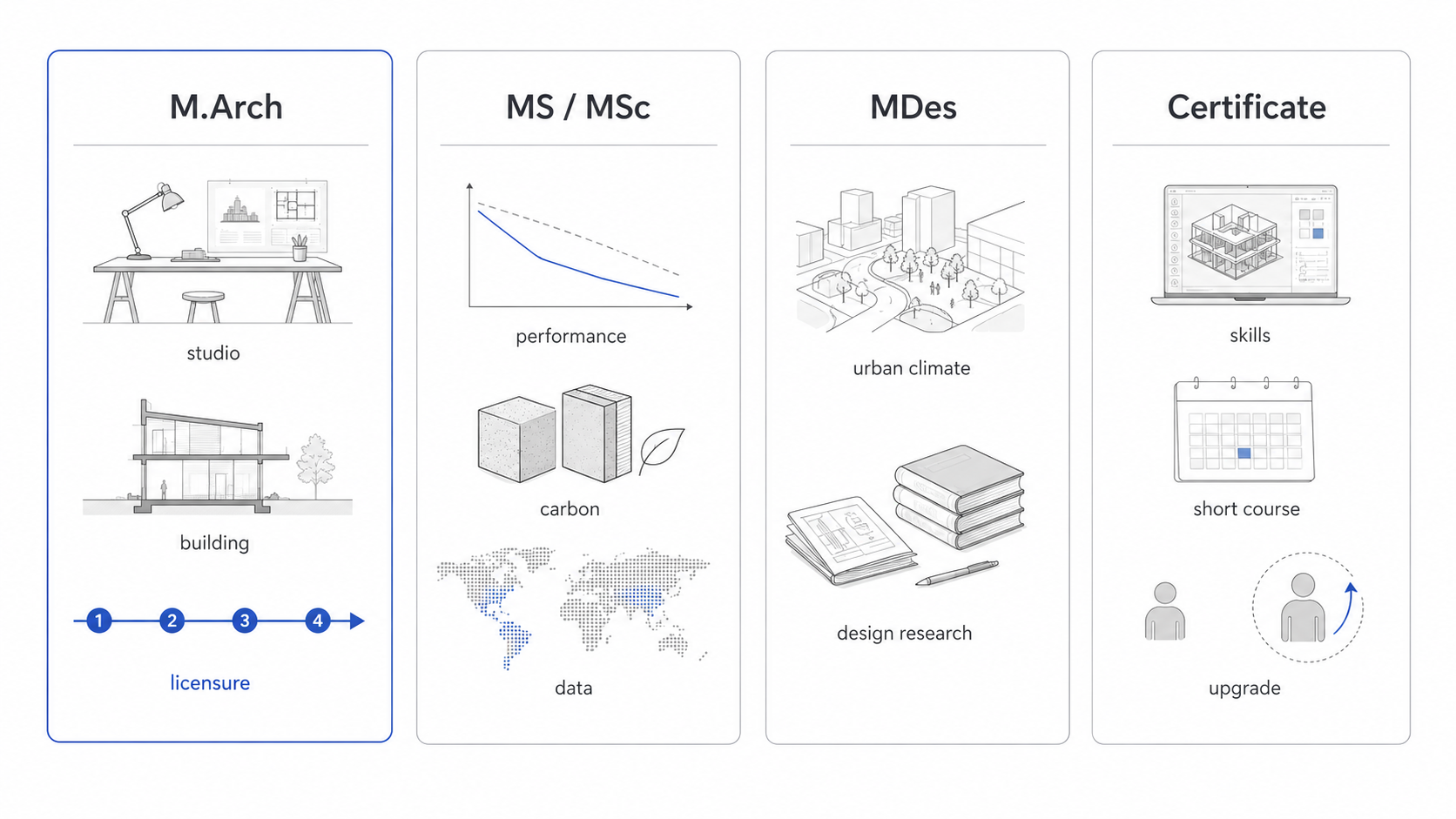
Start With the Degree Type
The search phrase “master’s in sustainable architecture” does not point to one standard degree. Schools use different titles, and the title matters less than the degree’s role.
| Graduate path | What it usually means | Best fit | Check carefully |
|---|---|---|---|
| Professional M.Arch | Architecture studio degree that may support licensure when properly accredited | Students who want the architect path | NAAB, CACB, or local professional recognition |
| MS or MSc in sustainable design | Technical or research-focused study in performance, carbon, climate, or materials | Students who want specialist sustainability work | Whether it is professional, post-professional, or non-licensure |
| MDes or design studies | Design research, environmental design, urban climate, systems thinking, or applied design inquiry | Designers and professionals who want a sustainability focus | Portfolio expectations and career outcomes |
| Certificate | Shorter skill upgrade in sustainable design, building performance, carbon, or green building practice | Working professionals who do not need another full degree | Whether the credential has enough weight for your goal |
| PhD | Research route for teaching, scholarship, advanced technical research, or policy-facing work | Students aiming for research rather than practice | Funding, advisor fit, and research topic strength |
A professional M.Arch and an MSc in sustainable environmental design may both sound close to “sustainable architecture master’s.” They can lead to different work.
So the first question is not which school sounds greener. The first question is what the degree is designed to do.
If You Want Licensure, Accreditation Comes First
Students who want to become licensed architects need to separate professional architecture education from sustainability specialization.
In the United States, NAAB accredits professional architecture degree programs. NAAB lists three professional architecture degree types: B.Arch, M.Arch, and D.Arch. NCARB explains that most U.S. licensing boards require a professional degree from a NAAB-accredited program, although some jurisdictions offer alternative routes with additional requirements.
Canada has its own structure. CACB says accredited architecture programs offered in Canada are Master of Architecture degrees.
A master’s in sustainable architecture is only a licensure-route degree when it is part of the recognized professional architecture path for the place where you want to practice.
A specialist MS, MSc, MDes, or design studies degree can still be valuable. It may help you work in building performance, sustainable design consulting, carbon, research, resilience, policy, or environmental design. It just may not replace a professional architecture degree.
For the broader professional route, read Master of Architecture Degree. For the full degree map, read Types of Architecture Degrees.
The M.Arch Path With a Sustainability Focus
A professional M.Arch with strong sustainability work can be the right route when you want both architecture licensure and environmental design depth.
This path usually still includes studio, building systems, structures, history, professional practice, drawing, representation, critique, and code-related thinking. The sustainability work may appear through electives, studios, faculty research, performance tools, thesis work, or a concentration.
The benefit is clear: you do not separate the architect path from sustainable design. You learn sustainability inside architecture.
The trade-off is time and cost. A professional M.Arch is usually not a short skill upgrade. It may mean two years after a pre-professional architecture degree or three years after a non-architecture undergraduate degree. Some programs have other structures, but the larger point stays the same: this is a major degree commitment.
Choose this route when the license matters. Do not choose it only because the word “sustainable” sounds better than a regular M.Arch.
The MS or MSc Sustainable Design Path
An MS or MSc in sustainable design, sustainable environmental design, sustainable building design, or environmental architecture is usually more specialist.
This path often fits students who want the technical side of sustainable architecture: energy modeling, daylight, overheating, passive design, carbon, materials, building envelope performance, urban microclimate, or research.
The work can be analytical. You may spend more time with climate files, simulation tools, field measurements, reports, performance diagrams, and research methods than with traditional architectural studio.
That is not a weakness. It can be the whole value of the degree.
This path fits students who want to prove that a building performs better instead of only describing it as green. It is weaker for students who mainly want the legal path to the architect title.
The MDes and Design Studies Path
A Master of Design Studies or similar design research degree may sit between architecture, environmental design, urban climate, policy, public space, materials, and building systems.
This route can work well for people who already have some design, planning, construction, real estate, policy, interiors, or architecture background and want to move into sustainability work without starting a full professional architecture degree.
The risk is vagueness.
Some design studies programs are strong because they build a clear research or professional skill set. Others can become broad, expensive, and hard to explain to employers. Before applying, look at graduate projects, course titles, faculty expertise, and job outcomes.
The program should help you say something specific: “I can model overheating risk,” “I can compare embodied carbon,” “I can work on resilient housing,” “I can develop urban climate strategies,” or “I can coordinate sustainable design decisions in practice.”
Online Master’s in Sustainable Architecture
Online study can work for some sustainable architecture master’s paths.
It works best when the subject is technical, research-based, professional-development focused, or software-heavy. Building performance, carbon accounting, sustainable design frameworks, environmental policy, materials research, and some design studies formats can translate better online than traditional studio education.
Professional architecture studio is harder to move fully online. Critique, model work, peer review, pin-ups, campus intensives, and accreditation requirements can make many professional M.Arch routes hybrid rather than fully remote.
Do not judge an online program by the word “online.” Ask what has to happen in person.
- Are there campus residencies or intensive weeks?
- Is the degree professional, post-professional, or specialist?
- Does it support licensure where you plan to practice?
- What software, laptop, and studio equipment do students need?
- How does critique happen?
- What do graduates do after finishing?
Boston Architectural College lists an Online Master of Design Studies in Sustainable Design as a four-semester degree program. That kind of program can be useful for working professionals and specialist study, but applicants should still check current admissions status, format, cost, residency expectations, and whether the degree is professional, post-professional, or specialist.
For the broader online question, read Can You Earn an Architecture Degree Online?.
What the Curriculum Should Prove
A strong sustainable architecture master’s program should make the student useful after graduation.
Look for coursework and studios that connect environmental goals to measured decisions. A program does not need every subject below, but it should not rely only on green language.
| Curriculum area | Why it matters | Weak sign |
|---|---|---|
| Building performance | Connects energy, daylight, comfort, and envelope choices to measurable outcomes | Renderings with no performance testing |
| Carbon and materials | Helps students compare assemblies, EPDs, reuse, embodied carbon, and durability | “Natural materials” claims with no comparison |
| Climate and site | Teaches sun, wind, shade, heat, water, microclimate, and outdoor comfort | Generic sustainability studios that ignore place |
| Building systems | Keeps sustainability tied to ventilation, heating, cooling, envelope, and operation | Treating green design as surface appearance |
| Research methods | Helps students test claims, explain assumptions, and produce credible evidence | Broad theory with no method |
| Professional communication | Turns analysis into reports, diagrams, client decisions, and team coordination | Good data that nobody can understand |
The best programs train students to connect a design move to a result: better shading, lower overheating risk, lower embodied carbon, more durable materials, better daylight, less operational energy, or more repairable housing.
Sustainability has to become a method, not a mood.
What Students Discover After Enrolling
The surprise is that a sustainable architecture master’s may be more technical than expected.
Students who imagined a design degree full of plants, timber, passive houses, and inspiring environmental language may find themselves working through spreadsheets, simulation errors, assumptions, climate files, material data, daylight metrics, HVAC basics, building envelope details, and carbon reports.
Some students love that. Some realize they wanted a softer design identity, not the daily work.
The second surprise is that the most valuable work may not look like the most attractive portfolio image. A clear wall assembly comparison, a well-explained overheating study, or a disciplined material analysis can be more useful than a dramatic rendering with trees on it.
The third surprise is that some sustainability jobs are coordination jobs. You may spend your day checking evidence, writing reports, reviewing consultant input, comparing materials, preparing diagrams, or helping a project team make a defensible decision.
That is a good career for the right person. It is a bad surprise for someone who thought the degree would only mean designing greener-looking buildings.
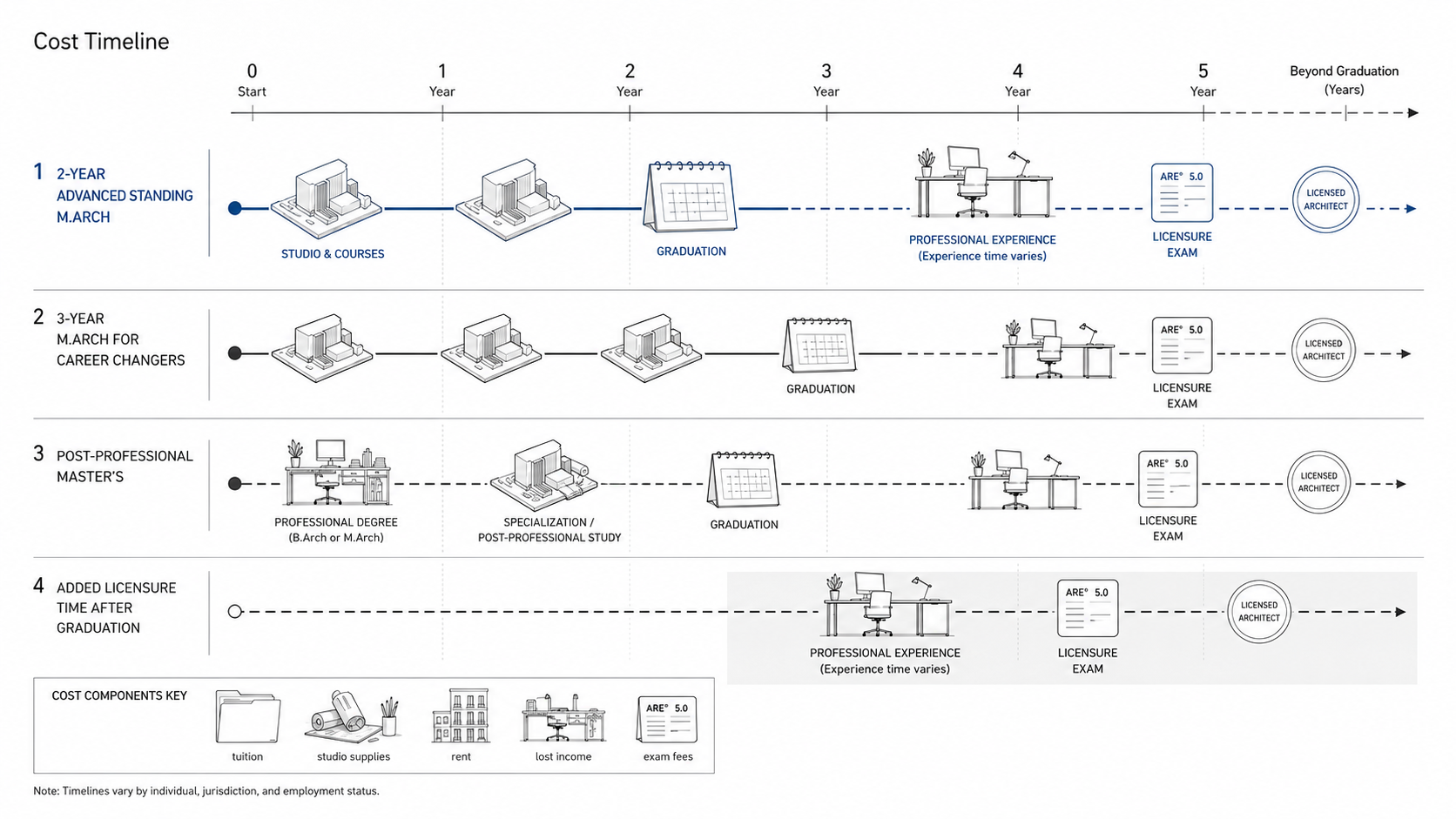
Costs That Change the Decision
Tuition is only the visible cost.
Graduate sustainable architecture study can also involve software, laptop upgrades, printing, model materials, fieldwork, travel, residencies, rent in expensive cities, lost income, professional exams, and unpaid or low-paid experience time.
The cost problem changes by path.
| Path | Main cost risk | What to ask before applying |
|---|---|---|
| Professional M.Arch | Longer degree route, studio costs, lost income, licensure timeline | How long is the path from my current degree to graduation and licensure? |
| MS or MSc | Specialist training that may not replace a professional degree | What jobs do graduates get, and do employers understand this credential? |
| MDes or design studies | Broad degree with unclear job translation | What concrete skills and portfolio evidence will I leave with? |
| Online or hybrid program | Travel, residencies, remote critique limits, equipment, self-discipline | What must happen in person, and how often? |
| Certificate | Too light to change career direction by itself | Is this enough for my next job, or only a supplement? |
The expensive mistake is not always the high-tuition program. Sometimes it is the cheaper degree that does not lead to the work you wanted.
Careers After a Master’s in Sustainable Architecture
Graduates do not all move into the same job lane.
Some work inside architecture firms. Some move into sustainability consulting. Some work with engineers, public agencies, universities, nonprofits, developers, material companies, or building-performance teams.
| Career lane | What the work may involve | Degree path that often fits |
|---|---|---|
| Architect with sustainability focus | Design, detailing, coordination, code, client work, and environmental decisions inside practice | Accredited professional M.Arch |
| Building performance consultant | Energy modeling, daylight, overheating, comfort, envelope strategy | MS, MSc, M.Arch with performance focus |
| Carbon and materials specialist | Embodied carbon, LCA, EPDs, material comparisons, reporting | MS, MSc, certificate plus professional experience |
| Environmental designer | Climate-responsive design, outdoor comfort, shading, airflow, site strategy | M.Arch, MSc, MDes, environmental design master’s |
| Resilience or climate adaptation planner | Flood, heat, emergency housing, public space, infrastructure, rebuilding strategy | MDes, MS, MSc, urban design or planning-adjacent route |
| Research or teaching | Advanced study, academic research, lab work, publications, doctoral path | Research master’s, MSc, PhD route |
The job title matters less than the daily work. Before applying, look for graduate outcomes and alumni portfolios. Check what people actually do after the degree.
Program Examples Are Not Rankings
Do not use program examples as a ranking list. Use them to understand degree types.
A professional M.Arch with sustainability studios can be the right path when licensure matters and you want environmental design inside architecture practice. The key is accreditation and the strength of the sustainability work, not the greenest marketing language.
AA School Sustainable Environmental Design is a specialist postgraduate example. Its Sustainable Environmental Design program leads to either an MSc or MArch and is structured around evidence-based, practice-oriented environmental design research.
Boston Architectural College’s sustainable design studies page is useful as an online specialist example. Its Online Master of Design Studies in Sustainable Design is listed as a four-semester degree program, which is why students should compare degree purpose, format, cost, and career outcomes before assuming an online program solves the whole problem.
Canadian M.Arch programs should be checked through CACB when the goal is professional recognition in Canada. Do not assume a sustainability label replaces the Canadian professional degree path.
How to Read a Program Page Without Getting Sold
School pages often sound stronger than they are. Read past the opening claim and look for proof.
- Does the curriculum name tools, methods, and measurable outcomes?
- Are graduate projects available?
- Do studios show analysis, or only final images?
- Is the degree professional, post-professional, specialist, or research-based?
- Does the program show where graduates work?
- Are residencies, travel, software, and equipment costs clear?
- Does the faculty work match the subject you want?
The strongest program page makes the work visible. The weakest one hides behind broad words: innovation, sustainability, future, impact, transformation.
Portfolio and Application Strategy
A sustainable architecture master’s application should show more than interest.
It should show how you think.
A strong portfolio may include a building project, a climate study, a material comparison, a daylight or energy diagram, a retrofit idea, a research page, a city-scale environmental study, or a clear technical drawing.
The work does not need to be perfect. It needs to show evidence.
| Weak application move | Stronger move |
|---|---|
| Saying you care about sustainability | Showing one problem you tested |
| Submitting green-looking renderings | Showing sun, wind, carbon, energy, comfort, or material logic |
| Writing a broad personal statement | Naming the exact work you want to learn |
| Choosing projects only by appearance | Choosing projects that prove method, revision, and judgment |
For portfolio structure, read Real Architecture Portfolios.
Common Mistakes
| Mistake | Why it hurts | Better move |
|---|---|---|
| Treating every sustainable architecture master’s as the same | You may choose a specialist degree when you need a professional one | Identify the degree type first |
| Ignoring accreditation | The degree may not support licensure | Check NAAB, CACB, or the relevant jurisdiction |
| Choosing by school prestige alone | The program may not train for the work you want | Compare curriculum, faculty, graduate work, and outcomes |
| Assuming online means easy | Hybrid residencies, critique, software, and self-directed work can be demanding | Ask how the online format works week by week |
| Underestimating the technical side | Sustainability work may involve data, reports, modeling, and systems | Review syllabi and graduate projects before applying |
FAQ
What is a master’s in sustainable architecture?
It is a graduate degree focused on sustainable architecture, sustainable design, environmental design, building performance, carbon, materials, resilience, or related research. The exact meaning depends on whether the program is a professional M.Arch, MS, MSc, MDes, certificate, or research degree.
Is a master’s in sustainable architecture the same as an M.Arch?
Not always. Some M.Arch programs include sustainability work and may support licensure when accredited. Many sustainable design master’s programs are specialist degrees that do not replace a professional architecture degree.
Can a master’s in sustainable architecture lead to licensure?
It can when the degree is part of the recognized professional architecture route in the jurisdiction where you want to practice. In the United States, that usually means a NAAB-accredited professional degree. In Canada, CACB-accredited professional programs are M.Arch degrees.
Is an online master’s in sustainable architecture worth it?
It can be worth it for building performance, carbon, research, professional development, and some sustainable design studies. Check whether the program is accepting applications, whether it has residencies, and whether it supports the career path you want.
What is the difference between an MS, MSc, and MDes in sustainable design?
An MS or MSc is often more technical or research-focused. An MDes may be more design-research or systems-oriented. Titles vary by school, so compare curriculum, faculty, projects, and outcomes instead of relying on the letters alone.
What jobs can you get with a sustainable architecture master’s?
Possible lanes include architect with a sustainability focus, building performance consultant, sustainability coordinator, carbon analyst, environmental designer, resilience planner, materials researcher, or academic researcher. The exact path depends on the degree type and prior background.
What should I look for before applying?
Check accreditation, degree type, curriculum, studio or research structure, software expectations, portfolio requirements, graduate outcomes, online or residency requirements, and the total cost beyond tuition.
Read This Next
Start with Sustainable Architecture Degrees if you are still comparing the whole field.
Read Master of Architecture Degree if the main question is professional M.Arch study and licensure.
Use Types of Architecture Degrees to compare B.Arch, BA, BS, M.Arch, and technical routes.
For remote study, read Can You Earn an Architecture Degree Online?.
For Canadian professional recognition, read Architecture Career Canada.
References and Resources
- NAAB Prospective Students: Professional Architecture Degrees and Licensure Requirements
- NCARB: NAAB-Accredited Programs
- NCARB: Architecture License Options for Non-NAAB Education
- CACB Accredited Programs in Canada
- AA School Sustainable Environmental Design
- Boston Architectural College Online Master of Design Studies in Sustainable Design
Before You Choose a Program
A master’s in sustainable architecture is only useful when the degree matches the work.
Choose a professional M.Arch when the architect license is part of the plan. Choose an MS, MSc, MDes, or certificate when the goal is specialist work in performance, carbon, environmental design, resilience, research, or professional development.
Then check the parts schools do not always make obvious: accreditation, studio format, online requirements, software, cost, portfolio evidence, graduate work, and actual job outcomes.
The greenest program name is not the safest choice. The better program is the one that gives you a clear role after graduation.