

Graduation does not make someone an architect in Canada.
It starts the professional path.
A strong portfolio helps. A respected school helps. Good studio work helps. None of that replaces certification, internship, exams, provincial or territorial registration, and the first years of office work where drawings stop being school projects and start carrying liability.
That is the part career pages usually soften. They talk about creativity, salaries, demand, and beautiful work. Then the graduate discovers the slower part: documentation, supervision, experience records, exam preparation, regulator rules, and jobs that may or may not move them toward the title.
The question is not only whether architecture is a good career in Canada.
The sharper question is: which path are you actually entering?
Certification Comes First

Architecture is regulated in Canada. The title architect is controlled by provincial and territorial regulators. A graduate cannot use the title just because they finished school or work in an architecture office.
The usual path starts with academic certification through the Canadian Architectural Certification Board. After that, the candidate can enter the Internship in Architecture Program through the province or territory where they plan to become licensed. Then come supervised experience, examination, and registration.
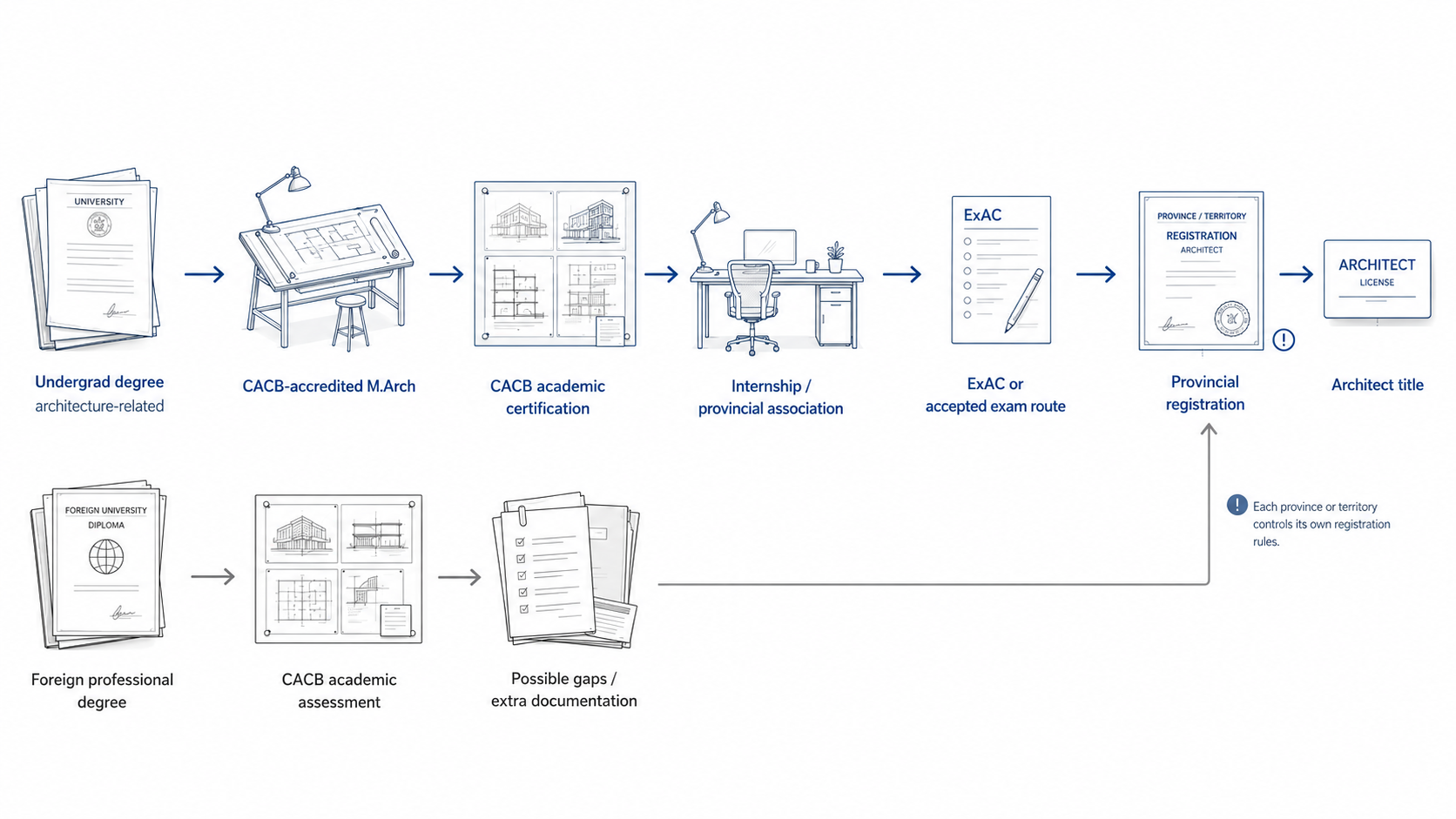
Useful starting points: CACB academic certification, ROAC Internship in Architecture Program, and ExAC.
Working in architecture and becoming a licensed architect are related. They are not the same step.
Working Before the Title
A graduate can work in architecture before licensure.
The job title may be architectural designer, intern architect, technologist, BIM coordinator, drafting staff, visualization specialist, project assistant, or junior designer. Some of these roles can be useful steps toward licensure. Some build strong adjacent careers. Some pay the bills but do very little for the registration path.
The protected title is the line.
You can help produce drawings, models, renderings, diagrams, code research, meeting notes, site records, and coordination work without being licensed. Taking professional responsibility and using the title architect is a different legal matter.
A career plan should separate those two things early.
Internship Is Where School Habits Get Tested
The internship years are not dead time.
They are where school habits get broken, corrected, or hardened into bad office habits.
In school, a project can survive on a strong idea, a good model, a clean section, or a persuasive review. In an office, the work has to survive deadlines, consultant comments, client changes, code questions, budgets, tender packages, permit comments, and construction problems. A drawing is no longer a presentation object. Someone else may price it, review it, build from it, reject it, or ask why it does not match another sheet.
That shift can feel brutal at first.
A good internship gives the intern broad exposure: early design, technical drawings, code review, coordination, contract documents, construction administration, and the quiet office work that never appears in student portfolios. A weak internship keeps a graduate in one narrow lane for too long.
The danger is not hard work. The danger is repetitive work that teaches very little.
The First Job Can Stall the Path
This is where graduates get caught.
The first available job may feel like progress because it is inside an architecture office. It may not be enough.
A role focused only on rendering, drafting cleanup, furniture layouts, presentation packages, marketing images, or narrow BIM production can build useful skill. It may also leave the intern short on broader experience. Months pass. The graduate gets faster at one task. The registration path barely moves.
The problem usually appears late, after the person has already settled into the job. They realize they have not touched enough project phases. They have little exposure to code, consultant coordination, contract documents, construction administration, or client meetings. Their experience record may look thinner than their hours suggest.
Before accepting a job, ask direct questions.
Who supervises interns? What project phases do junior staff touch? Do interns get experience reviewed? Have past interns completed the path from this office? Will the role expose you to more than production support?
A vague answer is not a small problem.
ExAC Is Not a School Exam
The Examination for Architects in Canada is part of the licensing path for many candidates.
It is easy to treat it like another academic hurdle. That is the wrong frame. ExAC is tied to practice readiness. The exam sits after education and internship because the candidate is supposed to be learning how architecture works outside school.
Design skill alone is not enough here.
A future architect has to understand programming, site constraints, codes, coordination, contracts, bidding, construction-phase services, cost awareness, and professional responsibility. The exam does not create those skills by itself. It exposes whether the candidate has been moving toward them.
Foreign Degrees Need a Paper Trail
Foreign-trained architects and international graduates should be careful with timing.
A foreign degree may be serious. The graduate may already have strong work experience. That does not make the Canadian review path automatic.
CACB assessment or certification may require transcripts, course descriptions, academic records, proof of professional experience, translations, registration documents, and employer letters. Those records are much easier to gather before a move, before a school changes its system, before an old employer disappears, and before a candidate needs them urgently.
The painful version is predictable. Someone arrives in Canada assuming the degree or old title will transfer cleanly. The review takes longer than expected. Documents are missing. A former school is slow. An old office cannot provide the right letter. The candidate works below their ability while the paper trail catches up.
The degree may be real. The experience may be real. If the candidate cannot prove it in the format requested, the process still slows down.
The Province Comes Before the Plan
Canada has a national professional framework, but registration is handled through provincial and territorial regulators.
That final detail changes the plan.
Ontario is not British Columbia. Quebec is not Alberta. A candidate moving provinces, entering from outside Canada, or trying to count prior experience should check the regulator where they expect to register first.
A general search for “architect license Canada” is too loose. The regulator matters. Local rules, forms, deadlines, accepted exam routes, documentation expectations, and professional-practice requirements can shape the path.
Pick the first registration province or territory early. Then check the rules there.
Architecture Jobs Are Not One Job
The word architecture covers several careers.
A graduate might enter a small residential office, a large commercial firm, a public-sector design team, an interiors practice, a heritage office, a developer’s design department, a BIM-heavy technical team, a visualization studio, an urban design group, or a construction-related role.
Those jobs do not train the same person.
| Career direction | What the work may involve | Where it can go wrong |
|---|---|---|
| Intern architect | Drawings, coordination, code research, models, meetings, and project support. | The role may stay too narrow unless the office deliberately supports eligible experience. |
| Architectural technologist | Technical drawings, BIM, details, construction documents, and coordination. | It can become a strong career, but it should not be confused with the licensed architect route. |
| BIM coordinator | Model setup, standards, clash coordination, consultant files, and digital workflows. | The work can become highly technical and move away from design authorship. |
| Urban design or planning-adjacent work | Site studies, public space, housing, transit, policy, and city-scale diagrams. | Some roles may expect planning credentials or a different graduate route. |
| Visualization or design media | Renderings, diagrams, animations, presentation sets, and competition imagery. | Useful skill, but presentation work alone may not build broad practice experience. |
| Construction or development role | Budgets, schedules, feasibility, coordination, site issues, and project delivery. | Good practical exposure, but the path can drift away from licensure without a plan. |
Office Work Thins Out the Romance
School teaches design thinking, drawing, theory, precedent, criticism, and portfolio work. Offices teach constraints.
A graduate learns that a good idea still has to pass through zoning, code, budget, consultants, client changes, field conditions, product substitutions, liability, and construction sequencing.
That can feel disappointing.
It is also where the work becomes serious. A detail changes because another trade needs space. A room layout changes because the client’s budget breaks. A permit comment forces a revision. A consultant note makes the clean drawing messier but more buildable.
The strongest early jobs explain why those changes happen. Weak offices only push the markups back onto the junior desk.
Pay Is Tied to Time
Architecture careers can feel slow at the beginning.
The early years may include modest responsibility, software-heavy production work, exam preparation, long learning curves, and the pressure of recording experience while paying rent. In Toronto, Vancouver, and other expensive markets, that pressure is not abstract. Rent changes career choices.
This does not make architecture a bad career.
It does mean the first years need a plan. A lower-cost city, better supervision, a practical office, or a clearer technical role can be more useful than chasing the most famous firm right away.
Prestige does not pay rent if the job teaches little and leaves the intern stuck.
Six Months In, Ask Harder Questions
A first job does not have to be perfect. It rarely is.
But after six months, the graduate should know what the job is doing for them. Are they seeing real projects? Are they learning why drawings change? Are they getting useful feedback? Is the work helping the registration path, or only filling a timesheet?
One graduate wants licensure but stays in a role that barely supports the internship path. Another wants design growth but spends every week cleaning files. Another wants BIM expertise but works in a firm that treats digital coordination as an afterthought. Another wants housing or public-interest work but never builds the portfolio those offices respect.
The work may be honest. It may still be the wrong lane.
By month six, three questions should be hard to avoid:
- What am I learning here that school could not teach?
- Is this job moving me toward licensure or toward another clear career path?
- What kind of office should I aim for next?
If every answer is vague, the job may be giving you office time without direction.
Adjacent Careers Are Not Failure
Not everyone who studies architecture needs to become a licensed architect.
Some people build strong careers in architectural technology, BIM, visualization, interiors, construction coordination, development, planning, heritage, sustainability, fabrication, or public-sector project work.
That is not failure.
The problem starts when a person thinks they are on the licensure path but is actually building a different career.
A student who loves technical drawings may be happier in BIM or architectural technology than in a design-heavy licensure track. A student who loves cities may belong closer to planning, housing policy, or urban design. A student who loves making images may fit visualization or design media. A student who likes job sites may move toward construction or project management.
The architecture degree can open adjacent doors. Pick the door on purpose.
Be Careful If You Only Like Buildings
Architecture work is not mainly looking at finished buildings.
It is drawing, revising, checking, coordinating, waiting, explaining, documenting, pricing, responding, and fixing problems created by constraints.
Be careful if you hate feedback. The profession runs on review comments, consultant comments, client comments, permit comments, and site comments.
Be careful if you need a fast financial payoff. Architecture can become a good career, but the early route can feel slow beside fields that pay more quickly after graduation.
Be careful if you want pure design control. Most real projects are shaped by clients, budgets, codes, consultants, office hierarchy, and field conditions.
Enter with your eyes open, or the career will feel like a bait-and-switch.
A Better Career Plan
Do not build the plan around the title alone.
First, know the registration path if the goal is licensure: CACB, internship, examination, and the regulator in the province or territory where you plan to practise.
Second, know the kind of work you want to learn. Housing, public buildings, interiors, BIM, sustainability, heritage, construction, development, and urban design lead to different offices.
Third, choose jobs that teach. The first office does not need to be famous. It needs supervision, feedback, project exposure, and a clearer next step.
An architecture career in Canada can work. It works better when the path is treated as a system, not a dream title.
FAQ
How do you become an architect in Canada?
The usual path includes academic certification through CACB, registration in the Internship in Architecture Program, supervised experience, examination, and registration with the provincial or territorial regulator. The exact details depend on the jurisdiction.
Can I work in architecture in Canada without being licensed?
Yes. You can work in architecture offices, BIM teams, drafting roles, visualization, interiors, construction coordination, and design support without being a licensed architect. The protected title architect is different from working in the architecture industry.
Do foreign architects need CACB review in Canada?
Many foreign-trained candidates need CACB academic certification, assessment, or another recognized pathway before moving toward provincial registration. Check CACB and the relevant provincial or territorial regulator before assuming the degree or title will transfer cleanly.
What is the Internship in Architecture Program?
The Internship in Architecture Program is the structured experience stage used by Canadian regulators. It helps candidates gain and document supervised professional experience before licensure.
What is ExAC?
ExAC is the Examination for Architects in Canada. Candidates register through the licensing authority in their province or territory, and the exam is part of the path toward licensure for many intern architects.
Is architecture a good career in Canada?
It can be. It is strongest for people who can handle long training, criticism, coordination, technical learning, and slow growth in responsibility. It is weaker for people who want quick money or pure creative control.
What is the biggest mistake architecture graduates make in Canada?
They assume any architecture job automatically moves them toward licensure. The better move is to check supervision, experience recording, regulator rules, and whether the job gives broad enough project exposure.
Read Next
If you are still choosing where to study, read Architecture Schools in Canada: CACB, M.Arch, Cost, and Career Fit.
If you are comparing country routes, read Architecture Schools by Country: What to Check Before You Apply.
If you are sorting degree types, read Types of Architecture Degrees: Which Path Is Right for You?.
If you want the broader path into the profession, read How to Become an Architect.