

A school list can send you in the wrong direction fast.
The famous name looks safe. The studio photos look serious. The program page says “architecture.” Then you discover the degree does not fit the country where you want to work, the license path is longer than expected, or the school is strong in theory but weak for the kind of practice you want.
That is the problem with architecture school lists. They make every option look comparable. They are not comparable.
Architecture education depends on country, degree type, accreditation, studio culture, portfolio rules, cost, internship access, and the kind of work you want after graduation. A school that makes sense for someone planning to work in New York may be a poor choice for someone planning to work in Toronto, London, Dubai, Lagos, Melbourne, or back in their home country.
The better question is not “What are the best architecture schools?” The better question is: where do you want this degree to work?
Start With the Country
Architecture degrees are tied to professional rules. That makes country choice more important than it looks at first.
A business degree or computer science degree may travel more easily. Architecture is different. The title “architect” is protected in many places. To use it, you usually need the right education, work experience, exams, and local registration.
Before comparing studios, rankings, campus photos, or famous alumni, ask one blunt question:
Where do I want to be licensed, employed, or taken seriously after graduation?
That answer changes the school list right away.
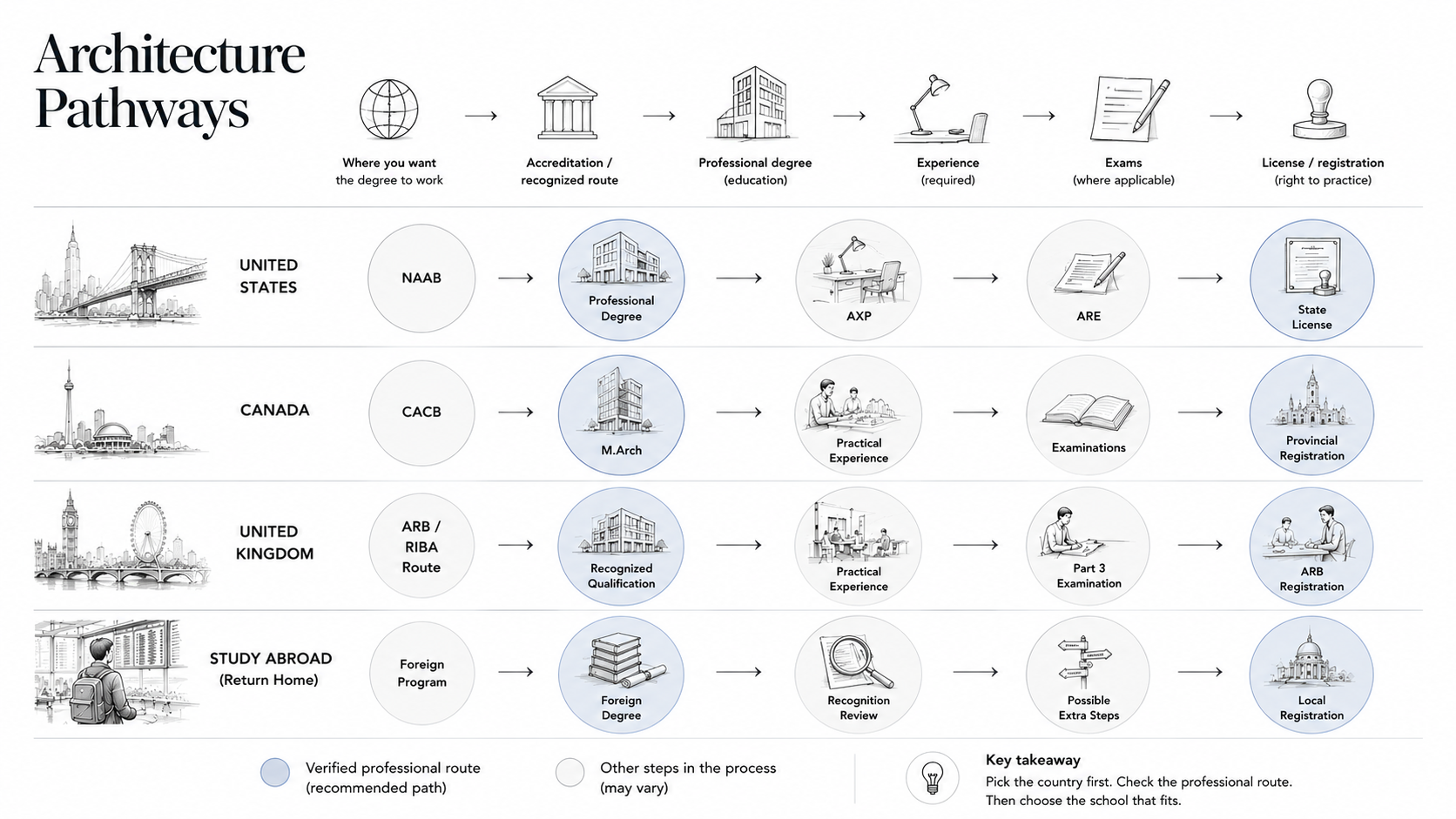
| Goal | What to check first | Why it matters |
|---|---|---|
| Become a licensed architect in the United States | NAAB-accredited professional degree and state licensure rules | A non-accredited route can add time, paperwork, or limits depending on the state. |
| Become a licensed architect in Canada | CACB-accredited professional architecture program | Canada’s professional path is tied to recognized graduate-level education and provincial registration steps. |
| Practice in the United Kingdom | ARB recognition, RIBA route, practical experience, and current transition rules | The UK route is structured and changing, so old advice can mislead students. |
| Study abroad, then return home | Recognition of the foreign degree in your home country | A respected foreign school can still require extra review, exams, local experience, or more coursework later. |
| Work in BIM, visualization, drafting, or construction coordination | Technical training, software depth, building systems, and internship access | A full professional architecture degree may not be the fastest or cheapest route into these jobs. |
The Name Is Not Enough
A famous school can open doors. It can also distract you from the parts that shape your daily life and long-term options.
Architecture school is lived through studio deadlines, critique, software, models, drawings, group work, internships, and the slow work of building a portfolio that someone outside school will trust.
The name matters less if the program does not match your route.
A student who wants a direct U.S. licensure path should care deeply about NAAB accreditation. A student planning to practice in Canada needs to understand the CACB route. A student looking at the UK needs to understand ARB registration, RIBA qualifications, practical experience, and the current changes to the old Part 1, Part 2, Part 3 path. A student studying internationally needs to know whether the degree will travel cleanly or create extra review later.
The wrong school is not always a bad school. Sometimes it is a good school in the wrong system.
United States: Check the Degree Before the School
In the United States, the cleanest architecture school route usually runs through a professional degree accredited by the National Architectural Accrediting Board. That can mean a Bachelor of Architecture, Master of Architecture, or Doctor of Architecture, depending on the program.
Do not assume every architecture major is a professional degree.
A Bachelor of Science in Architecture, Bachelor of Arts in Architecture, architectural studies degree, environmental design degree, or design studies degree may be useful. It may also be pre-professional. That means it does not do the same job as a professional B.Arch or M.Arch.
That mistake can be expensive.
A pre-professional architecture degree may still be the right choice if you plan to continue into an accredited M.Arch. It can also be useful if you want urban design, development, visualization, construction, preservation, planning, or design research. But if your goal is licensure, you need to know exactly what the degree does and does not do before you enroll.
Before applying to a U.S. program, check the official NAAB listing, not only the school’s marketing page. Look for the exact degree name, accreditation status, and whether the program is fully accredited or still in candidacy.
Useful starting point: NAAB accredited programs.
Check official pages again before applying because accreditation, recognition, and registration rules can change.
Canada: The M.Arch Question Matters
Canada is easy to misunderstand because several schools offer strong architecture-related education, but the professional path is more specific than the word architecture on a program page.
Canadian students should pay close attention to CACB-accredited professional programs. In Canada, accredited professional architecture programs are Master of Architecture degrees.
That means an undergraduate architecture-related degree may be preparation, not the final professional credential.
This is where students get trapped. They see a design-heavy undergraduate program, assume it leads directly to becoming an architect, and later realize they still need a professional graduate degree, internship hours, exams, and provincial registration steps.
That does not make the undergraduate program useless. It may be the right foundation. But it should be chosen with the next step in mind.
A Canadian student comparing architecture schools should ask a different question from the one ranking sites push:
Does this path lead to the accredited professional degree I need, or does it only prepare me to apply for one?
Useful starting point: CACB accredited programs in Canada.
Check official pages again before applying because accreditation, recognition, and registration rules can change.
United Kingdom: The Route Is Part of the Cost
The UK system has its own structure. Students often hear about Part 1, Part 2, and Part 3, along with practical experience and registration with the Architects Registration Board.
That route can work well for students who want a structured professional path. It can also feel long and expensive if the student did not understand the full sequence before starting.
The important distinction is this: RIBA validation, ARB recognition, practical experience, and registration are not the same as a school simply having a good reputation.
A UK architecture school may be excellent for design culture, research, or experimentation. That still does not remove the need to understand the professional route.
The UK route is also changing, so students should check current ARB and RIBA information before using older advice. A school page, forum answer, or old blog post can be behind the rules.
Useful starting points: RIBA becoming an architect and ARB registration routes.
Check official pages again before applying because accreditation, recognition, and registration rules can change.
International Study: The Degree May Not Travel Cleanly
International architecture study can be valuable. It can also create the hardest paperwork later.
A student might study in Europe, Asia, Latin America, Africa, or the Middle East and receive a serious architectural education. The problem is not always quality. The problem is recognition.
Will that degree be accepted where you want to work? Will you need an equivalency review? Will you need extra courses? Will your home licensing board recognize the school? Will employers understand the degree? Will visa rules allow you to stay long enough to gain experience?
Those questions matter more than whether the school appears on a global ranking page.
International study is strongest when the student has a clear plan:
- where they want to work after graduation;
- which licensing body will review the degree;
- whether the program has recognized accreditation or validation;
- what language the studio and professional documents use;
- whether internships are realistic during or after study;
- whether the degree supports return-home recognition.
The risky version of international study is romantic. The safer version is strategic.
The Recognition Problem Three Years Later
The painful part often arrives after graduation, not during admission.
A student finishes a degree, builds a portfolio, moves countries, and starts applying. Then the questions begin. Is the degree professionally recognized? Does the local board accept it? Does the employer understand the credential? Does the graduate need another degree, an equivalency exam, a supervised work period, or extra documents from the original school?
This is the part school marketing rarely makes clear.
The building in the portfolio may look impressive. The thesis may be strong. The student may have worked harder than classmates in a more recognized system. None of that automatically solves registration paperwork.
Before choosing an international architecture school, contact the registration body in the place where you eventually want to work. Do not rely on a school recruiter for that answer. The recruiter’s job is admission. The licensing body controls recognition.
This is where a cheaper or more exciting school can become expensive later. Extra review, extra documents, extra time, and another degree can cost more than the student expected.
Professional Degree or Architecture-Related Degree?
The word architecture can appear on very different programs.
Some degrees are built for licensure. Some are built for design studies. Some are technical. Some are research-based. Some are post-professional, which means they are intended for people who already have a professional architecture degree. Some are useful for the architecture industry but do not lead to the architect title by themselves.
That difference matters more than the school’s photography.
| Degree type | What it may be good for | What to verify |
|---|---|---|
| Professional architecture degree | Licensure path, architectural practice, graduate-level professional training | Official accreditation or recognition in the country where you plan to practice. |
| Pre-professional architecture degree | Preparation for a professional M.Arch, design foundation, portfolio development | Whether it leads into an accredited professional program and how much time remains. |
| Architectural studies or design studies | Design thinking, history, theory, urbanism, media, research, related fields | Whether graduates commonly continue to professional architecture or move into adjacent careers. |
| Architectural technology or drafting program | BIM, drafting, construction documents, technical coordination, faster industry entry | Whether the credential leads to technician roles, transfer credit, or a separate professional route. |
| Post-professional architecture degree | Advanced research, specialization, teaching, theory, computation, urban design | Whether it is meant for already-qualified architecture graduates rather than first professional qualification. |
The Transfer Trap
Architecture is not always easy to transfer.
A student can complete one or two years at one school and assume another school will accept the work cleanly. That is not guaranteed. Studio sequences are often specific. Accreditation rules can be specific. Portfolio review can be strict. A school may accept general credits but still place the student behind in studio.
That means transferring can cost more than expected.
You may lose time. You may repeat studio. You may need summer courses. You may discover that your previous work does not match the new school’s expectations. In a normal major, a transfer may be inconvenient. In architecture, it can reset the path.
Ask this before enrolling anywhere you are not sure about:
If I need to transfer later, what happens to my studio credits?
If the answer is vague, treat that as a warning.
Studio Culture Decides More Than Rankings
Architecture school is built around studio. That is where the school’s real personality shows.

Some studios are intense but supportive. Some are intense and careless. Some reward clear thinking. Some reward performance. Some teach students how to revise. Others mainly teach students how to survive public criticism.
This matters because architecture students do not only learn content. They learn habits.
A good studio teaches you how to test options, explain decisions, absorb critique, draw better, build judgment, and keep going without losing your mind. A bad studio can turn design education into sleep loss, confusion, and fear of feedback.
Do not judge studio culture from school websites. Look at student work from recent years. Talk to current students. Ask how many all-nighters are normal. Ask whether instructors give useful feedback or just opinions. Ask whether students share knowledge or hide it.
The best school for you is not always the school with the most dramatic student projects. Sometimes it is the school where the work is strong and the students still look like people.
The Internship Pipeline Is Part of the Program
A school does not only teach classes. It also puts students closer to some offices and farther from others.
This is easy to miss when you compare programs online. Two schools can have similar studio work, similar tuition, and similar degree names. One may sit near firms, alumni, visiting critics, public agencies, construction offices, and regular portfolio reviews. The other may be isolated, with weaker local practice ties and fewer chances to meet people who hire students.
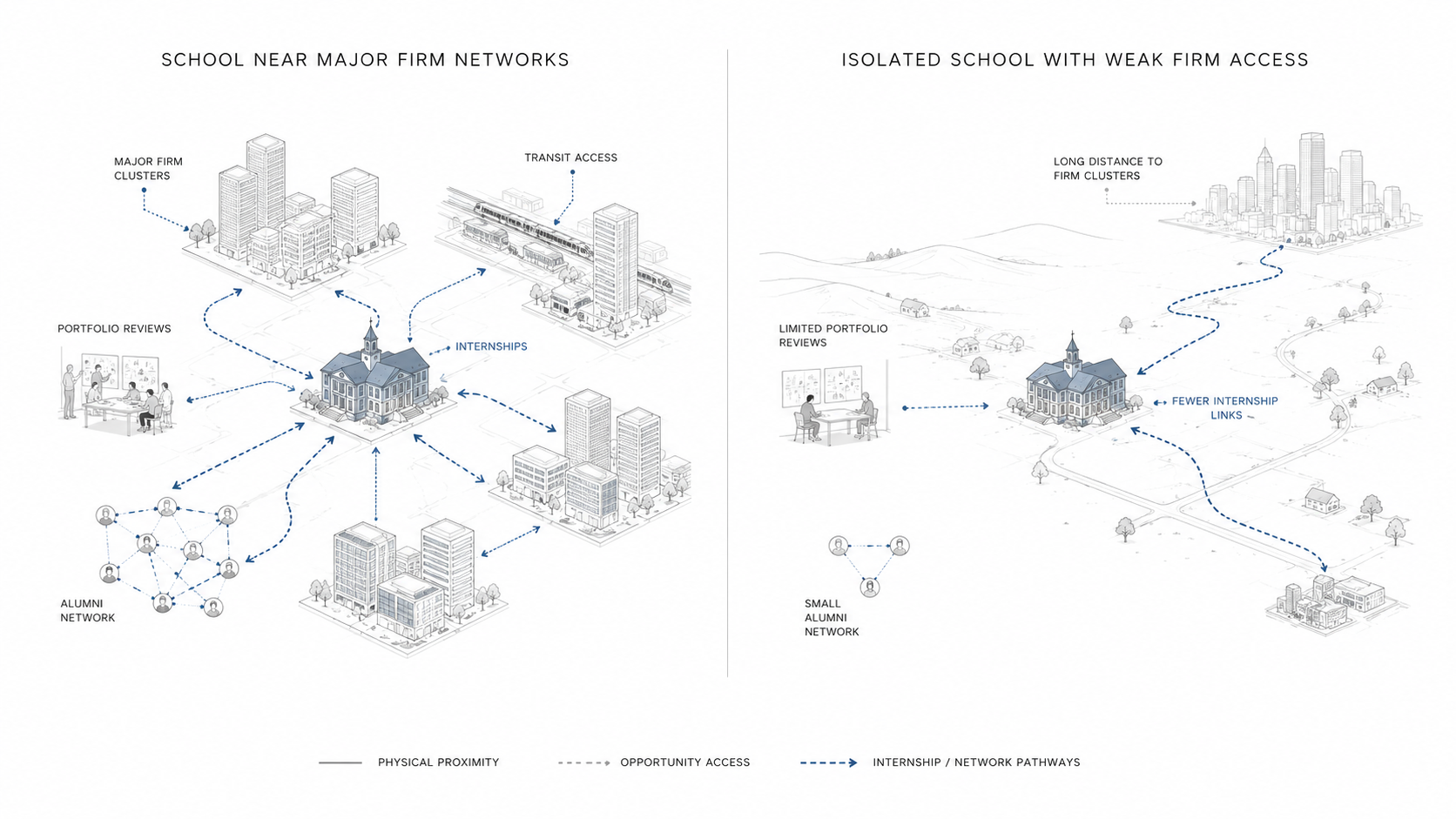
That access can change the whole degree. A student who gets a summer internship early may understand drawing sets, office language, deadlines, consultants, and client limits before graduation. A student with no practice exposure may leave school with strong academic projects but little sense of how buildings move through an office.
This does not mean every good school must be in a major city. Some smaller programs have strong regional connections. Some big-city schools are expensive and still weak at helping students. The point is simpler: ask how students actually get into offices before you assume the school’s name will do the work.
A useful question is:
Where did last year’s students intern, and how did they get those positions?
If the answer is vague, the school may be selling culture without proving access.
Compare Schools by Fit, Not Rank
Use schools as comparison anchors, not trophies.
MIT, Harvard GSD, Cornell, Berkeley, Rice, University of Toronto, Waterloo, McGill, UBC, UCL, Cambridge, ETH Zurich, TU Delft, Politecnico di Milano, National University of Singapore, and University of Melbourne are all names students may compare. Putting them into one global list does not help much because they do different jobs in different systems.
A better comparison asks what each school is likely to train you to become.
| School emphasis | Good fit for | Possible problem |
|---|---|---|
| Conceptual design and theory | Students who like argument, research, speculation, and experimental portfolios | May feel weak if you want practical detailing and production skills early. |
| Technical building knowledge | Students who want construction logic, building systems, BIM, and practice readiness | May feel less exciting if you want highly experimental design culture. |
| Urban design and planning connection | Students interested in cities, public space, policy, development, or infrastructure | May not be ideal if you want a small-building or residential design focus. |
| Research university environment | Students considering graduate study, teaching, computation, sustainability, or advanced design research | Can feel abstract if you want direct job-ready training. |
| Applied technical institute or diploma route | Students who want drafting, building technology, coordination, or faster industry entry | May not lead directly to the licensed architect route without further education. |
What Students Discover After Choosing
The expensive surprises usually come after acceptance.

The first surprise is time. Studio does not behave like a normal course. It expands. A project can take over evenings, weekends, and the space where a part-time job was supposed to fit.
The second surprise is material cost. Models, prints, software, hardware, transport, site visits, and presentation supplies add up. A cheaper tuition number can become less cheap if the program expects constant physical production.
The third surprise is feedback style. Some students arrive excited about buildings and leave shaken by critique culture. The issue is not criticism itself. Architecture needs criticism. The issue is whether the criticism teaches.
The fourth surprise is the gap between school work and office work. A student can produce beautiful academic projects and still struggle with construction documents, coordination, codes, details, budgets, consultant comments, and client limits. That gap is normal, but some schools prepare students for it better than others.
The fifth surprise is debt pressure. Heavy debt narrows choices after graduation. It can push graduates toward jobs they do not want, delay licensure, or make low-paid internships harder to accept.
That is why the school decision has to be more practical than the brochure makes it look.
When a Famous School Is the Wrong Choice
A famous school can be wrong for a serious student.
It may cost too much. It may push a design culture that does not match the student’s strengths. It may be weak in the country where the student wants to practice. It may reward conceptual performance when the student wants technical competence. It may offer prestige but not the support, structure, or professional clarity the student needs.
Prestige helps when it connects to your path. It becomes noise when it replaces the path.
A less famous school with the right accreditation, strong studio teaching, reasonable cost, good local internships, and a clear professional route can be the better decision.
That is especially true for students who already know where they want to work. If your future is tied to a specific city, province, state, or country, a school with strong local practice connections may beat a distant name with weaker practical value.
When the Path Is Unclear
The risky school is not always the lowest-ranked school.
It is the school that makes the path unclear.
It uses the word architecture everywhere but does not clearly explain whether the degree is professional, pre-professional, technical, post-professional, or general design. It shows dramatic student projects but says little about graduate outcomes. It celebrates studio culture but avoids the workload question. It lists global opportunities but does not explain recognition. It talks about creativity but stays quiet about debt, transfer credits, internships, software, model costs, and professional registration.
That school may still be legitimate. It may even be excellent for the right student. But if you have to dig too hard to understand what the credential does, slow down.
A strong architecture school should be able to explain the route plainly. The program page should tell you what degree you earn, whether it is accredited or recognized, what graduates usually do next, what the next licensure step is, and what kind of portfolio or preparation you need to enter.
Confusion before admission usually becomes cost after admission.
Questions to Ask Before You Apply
Ask these before you fall in love with the campus.
- Is this a professional architecture degree or a pre-professional degree?
- Which organization accredits, validates, or recognizes the program?
- Does the degree support licensure in the country where I want to work?
- If I study here, what is the next required step after graduation?
- How long does the full path take, including experience and exams?
- What happens if I transfer?
- How much do students spend on models, printing, software, hardware, and travel?
- Do students get internships during the program?
- Where did last year’s students intern, and how did they get those positions?
- What kind of work do recent graduates actually do?
- Does the studio culture fit how I handle feedback and pressure?
The school that answers clearly is usually safer than the school that hides behind reputation.
Use Lists Only at the Start
A school list is useful at the beginning, not at the end.
Use a list to discover options. Then stop treating the list as the decision.
Once you have names, sort them by country, accreditation, degree type, cost, portfolio expectations, internship access, and professional route. A long list becomes useful only after you cut it down to schools that fit your actual future.
If a school cannot explain how its degree connects to licensure, employment, or further study, do not let the brochure do the explaining for it.
Build Three Shortlists
One school list is too blunt. Build three.
First, make a safe list. These are schools that clearly match your licensure or career goal. The degree type is clear. The accreditation or recognition is clear. The next step after graduation is clear.
Second, make a stretch list. These are stronger, more competitive, more expensive, or more selective schools that could be worth it if the offer, funding, location, or studio fit is right.
Third, make a practical list. These are programs with lower cost, better commute, stronger local employment links, clearer transfer options, or a better technical path.
Then compare the lists against debt, location, recognition, studio culture, internship access, and the kind of work you want to do.
That method is less exciting than ranking schools by reputation. It is also less likely to waste years.
FAQ
What is the best country to study architecture?
The best country is usually the country where you want the degree to work. If you want U.S. licensure, start with U.S. accreditation rules. If you want Canadian registration, check the Canadian professional route. If you want the UK, understand ARB and RIBA requirements. Studying abroad can be valuable, but recognition should be checked before you apply.
Do I need an accredited architecture degree?
If your goal is licensure, accreditation or official recognition matters a lot. Some places allow alternative routes, but those routes can add time, experience requirements, reviews, exams, or limits. If you do not want licensure and prefer BIM, visualization, drafting, development, planning, or construction coordination, a different degree or technical route may still make sense.
Is a famous architecture school worth the cost?
Sometimes. A famous school can help with network, graduate school options, and competitive design careers. It is not automatically worth heavy debt. The value depends on accreditation, studio fit, location, internships, portfolio outcomes, and what you want after graduation.
Should I study architecture abroad?
Study abroad can be a strong choice if you understand recognition before leaving. Check whether the degree will be accepted where you want to work. Also check language, visa rules, internship access, cost of living, and whether the school has graduates working in the places you care about.
What is the difference between a professional and pre-professional architecture degree?
A professional degree is designed to satisfy the education part of a licensure path in that country or system. A pre-professional degree may prepare you for graduate architecture school or related work, but may not be enough by itself for licensure.
Can I work in architecture without becoming licensed?
Yes. Many people work in architecture firms, construction offices, BIM teams, visualization studios, development companies, and design-related roles without becoming licensed architects. The limits depend on country and role. The protected title “architect” is different from working in the architecture industry.
Can I transfer from one architecture school to another?
Sometimes, but architecture transfers are harder than they look. Studio credits may not transfer cleanly, and the new school may place you earlier in its studio sequence. Ask the receiving school how it treats studio transfer credits before assuming you can move without losing time.
How important are internships when choosing an architecture school?
Internships matter because they help students understand office work before graduation. A school near firms, alumni, public agencies, and regular portfolio reviews may give students more openings than a program with weak practice connections. Ask where recent students interned, not only where graduates hope to work.
Read Next
If you are still choosing between degree types, start with Architecture Degrees: Every Path in Design, Construction, and More.
If you want a broader look at school fit, studio culture, rankings, and what architecture schools miss, read Architecture Schools: What Rankings Miss.