
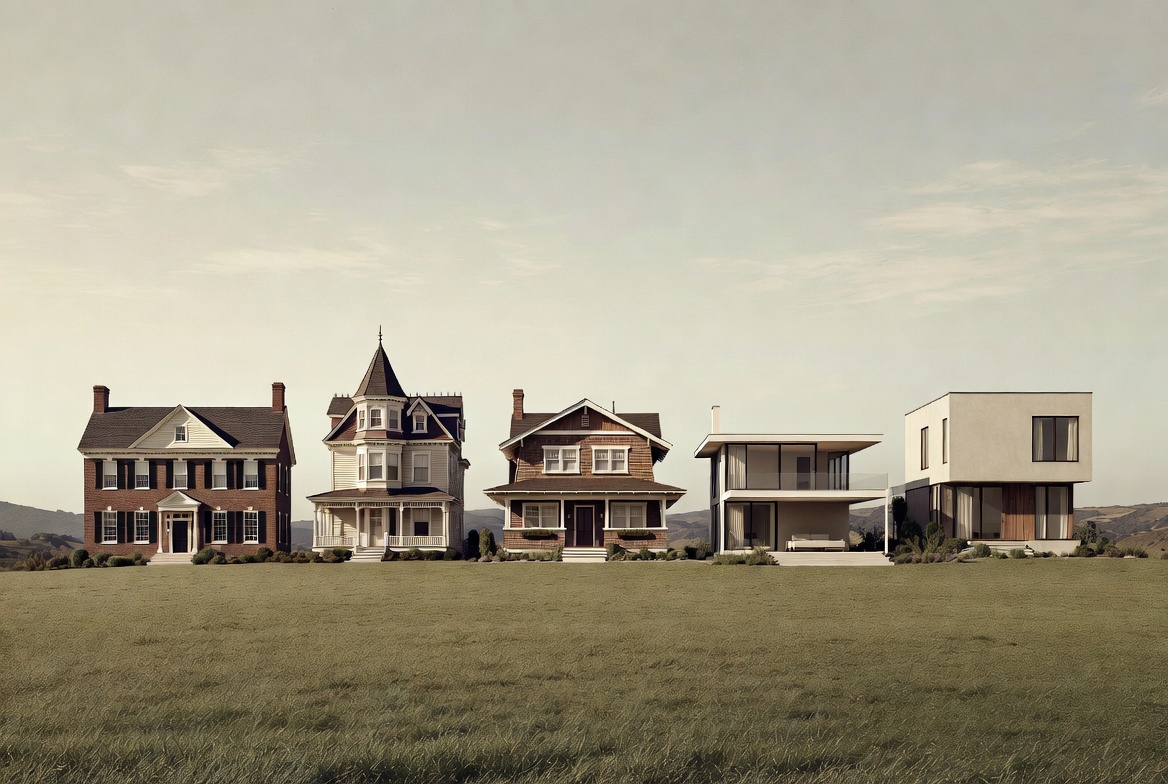
House styles do not change just because taste changes. They change when materials shift, construction gets cheaper or harder, cities get denser, families use rooms differently, and old layouts stop matching ordinary life.
That is what makes a five-century look at house styles useful. The point is not just to admire old buildings in sequence. It is to see what each period was trying to solve, what each one got right, and which ideas still hold up when you are renovating, building, or trying to understand the house in front of you.
Some ideas lasted because they worked. Some died because life moved on. Some keep returning in new forms because the original logic was better than the trend that replaced it.
What this guide covers
- how house design changed from the 17th century to today,
- what each major period emphasized,
- which design ideas still hold up,
- and where to go next if you want a deeper read on specific eras or styles.
Why Looking Across Five Centuries Helps
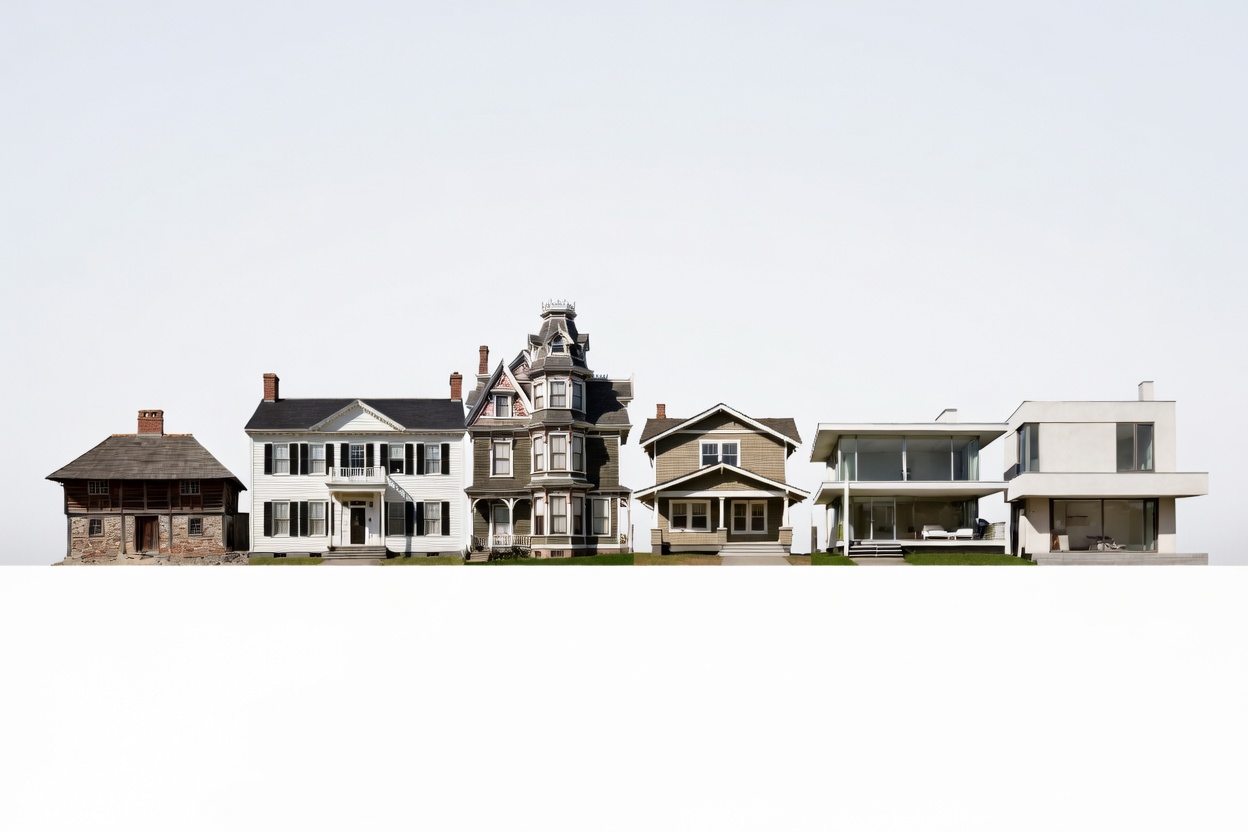
Illustration by ArchitectureCourses.org. A simplified visual timeline showing how house styles changed from older enclosed forms to modern residential design.
A lot of style guides flatten history into surface details. Columns. shutters. trim. arches. roof shapes. Those things matter, but they are not enough on their own.
The more useful question is always bigger: why did people build this way at that moment? A thick-walled masonry house and a glassy modern one are not just stylistic opposites. They come from different climates, different tools, different economies, and different expectations about privacy, labor, heating, and status.
That is also why old houses still teach good lessons. A lot of them were better at room hierarchy, daylight, porch logic, durable trim, and climate response than houses built much later. Not every old solution deserves romantic treatment, but many deserve more respect than they get.
Worth Knowing: if you want the broader style-family guide rather than the long historical arc, start with House Styles: Five Centuries of Architecture and Traditional Home Styles.
The Fast Version: What Changed by Century
| Period | Main Pressure | What Houses Prioritized | What Still Holds Up |
|---|---|---|---|
| 17th century | local materials, hierarchy, craft labor | durability, enclosure, symmetry emerging in elite work | material honesty, climate response, strong massing |
| 18th century | classical order, urban growth, refinement | proportion, balance, formal fronts, clear social rooms | symmetry, entry logic, measured façades |
| 19th century | industry, urbanization, new wealth, mass production | ornament, variety, expressive forms, revival styles | rich detail when used with discipline, better room identity |
| 20th century | technology, modern life, suburban expansion | efficiency, openness, new materials, less ornament | clear plans, connection to outdoors, simplified forms |
| 21st century | energy, flexibility, technology, land pressure | performance, adaptability, sustainability, hybrid living | smart systems used quietly, efficient envelopes, flexible rooms |
17th Century: Weight, Craft, and Early Order
The 17th century was still shaped heavily by local materials, regional craft traditions, and social hierarchy. Houses were not trying to be endlessly flexible. They were trying to stand up, express status where needed, and work within the limits of labor and materials.
In practical terms, that meant thick walls, smaller windows, stronger enclosure, and plans that reflected who belonged where. In grander European work, you also start seeing the early push toward stronger symmetry and formal composition that would carry into later Georgian and classical traditions.
The useful lesson here is not “bring back 17th-century house planning.” It is simpler than that: the best buildings of this period had a strong sense of mass, material truth, and relationship to climate. They looked the way they were built, and they were built the way their place required.
This is also where a lot of later architecture picks up one of its strongest habits: the idea that a house should feel coherent from the outside before anyone starts decorating it.
18th Century: Symmetry, Proportion, and the Civilized Front
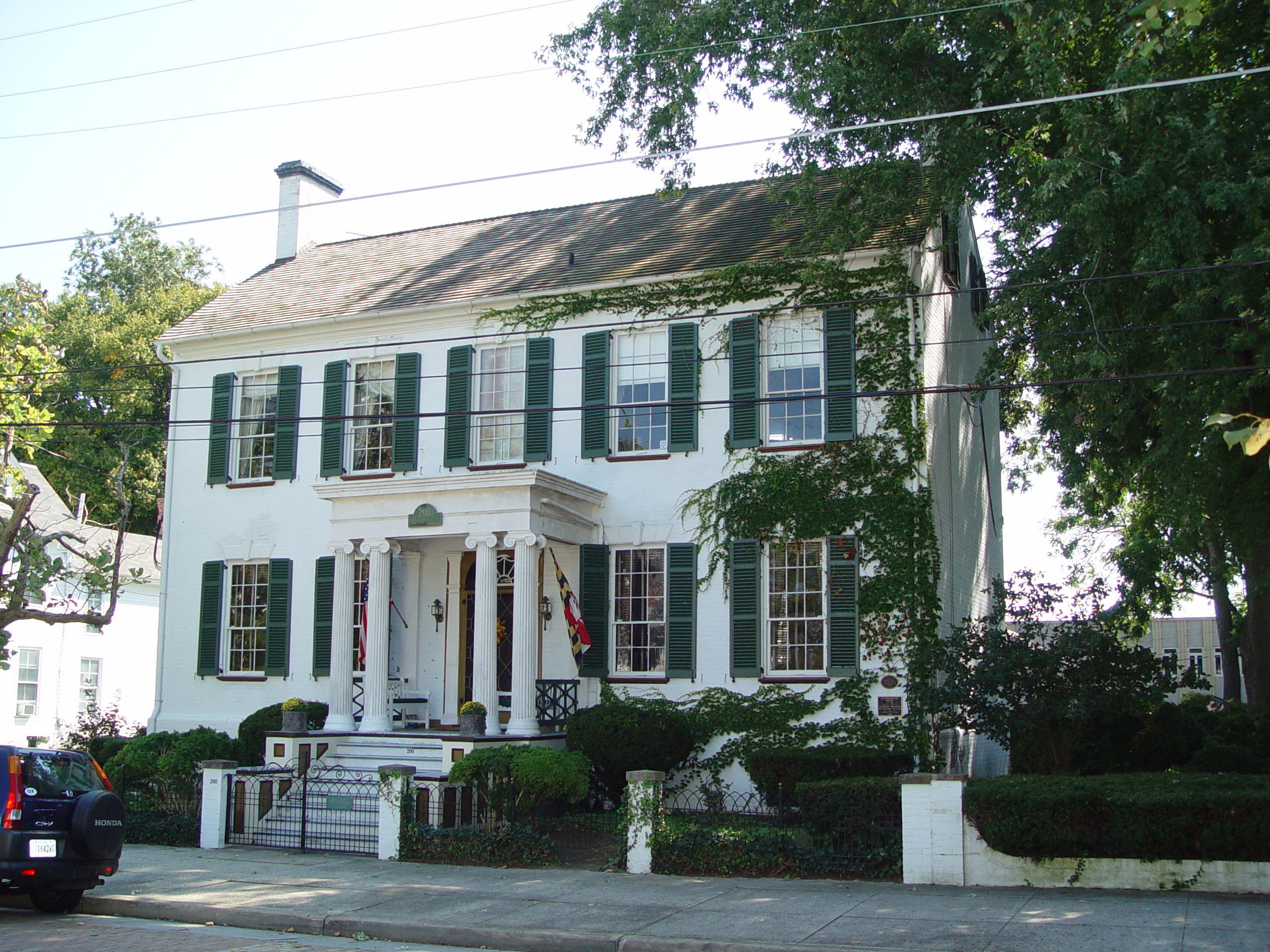
By the 18th century, house design in Britain, Europe, and the American colonies leans much harder into classical order. Georgian, Colonial, Federal, and later Neoclassical work all pull in different ways, but they share a basic belief that good architecture should feel balanced, legible, and controlled.
That gave us houses with centered entries, measured window spacing, formal room sequences, and façades that read as complete compositions rather than accumulations of parts. In cities, it also helped shape row-house traditions that made dense urban living look dignified instead of accidental.
What this period solved well was clarity. A lot of these houses know exactly where the front is, where you enter, which rooms are public, and how the elevation should read from the street. Even when the details are fairly restrained, the architecture still feels confident.
Also Useful: if you want the cleaner parent pages from this family, see Colonial Architecture, Georgian Colonial Style, and Greek Revival Architecture.
19th Century: Industry, Ornament, and the Explosion of Styles
The 19th century is where house-style guides usually get loud. Victorian, Gothic Revival, Italianate, Second Empire, Queen Anne, Shingle Style, Arts and Crafts. It is a crowded century because industrialization changed what could be built, how fast it could be built, and how much ornament could be produced and distributed.
That does not mean every 19th-century house is overdone. But it does mean variety expands fast. Pattern books spread ideas. Rail transport moves materials farther. Cast iron, mass-produced trim, and larger glass all widen the design vocabulary. Houses become more expressive, and in many cases more eager to show personality, status, or aspiration.
The weak version of the century is clutter. The strong version is richness with structure.
That is why some Victorian houses still feel brilliant and others feel exhausting. The best ones have hierarchy under the ornament. The parts still cooperate. The bad imitations, or bad later remodels, keep the fuss and lose the discipline.
The later Arts and Crafts reaction matters here too. It pushes back against overproduction and excess, and that shift helps set up the early 20th century. Craft, natural materials, visible structure, and more humane domestic scale come back into focus.
Related Reading: Victorian Architecture History, Queen Anne Architectural Style, and Gothic Revival Architecture.
20th Century: From Revival Styles to Modern Life
The 20th century does not move in one direction. It swings.
Early on, you still get revival styles and strong domestic traditions: Colonial Revival, Tudor Revival, Craftsman, bungalow culture, Prairie influence, Mediterranean and Spanish revival forms. A lot of 1920s and 1930s houses are still very invested in room identity, trim, masonry, porches, fireplaces, and recognizable fronts.
Then modernism changes the conversation. Ornament becomes suspect. Function, structure, openness, and new materials start driving the look. International Style, later mid-century modern work, and postwar suburban forms all move the house toward lighter planning, different glazing strategies, and new relationships between indoors and outdoors.
This period gives us some of the best and worst lessons in residential design.
What it got right:
- more efficient planning,
- better integration with site in some traditions,
- cleaner structure,
- less dead ceremonial space,
- and, in the best work, a stronger relationship between daily life and layout.
What it often got wrong:
- too much flattening of room identity,
- cheap suburban repetition,
- weak materials pretending to be modern sophistication,
- and houses that felt “open” but not actually well organized.
The century is too broad to reduce to one lesson, but one pattern keeps repeating: the strongest houses are the ones where new technology improved the plan instead of replacing architectural judgment.
Worth Knowing: this is where the era pages matter most. Start with 1920s House Styles, 1940s House Styles, and 1950s House Styles. For the more stylized side of the period, see Art Deco House Style.
21st Century: Performance, Flexibility, and the House as System

The 21st century is less unified stylistically than earlier periods, but it is very clear about its pressures. Energy use. carbon. cost. smaller households in some places, denser cities in others, remote work, aging in place, resilience, and technology woven into everyday life.
That shifts attention away from “what style is this?” and more toward “how does this house perform?”
You see it in better envelopes, larger but more strategic glazing, passive-house thinking, prefab and modular systems, adaptive reuse, more flexible rooms, and houses trying to work harder with less wasted space. You also see it in the spread of softer labels that are not really house styles in the older sense at all: Japandi, Grandmillennial, Cottagecore, and other terms that often describe interior mood more than architecture.
The best 21st-century work tends to do three things well:
- performance: better energy logic, durability, and comfort,
- adaptability: spaces that can change as work and family life change,
- restraint: technology and sustainability used in ways that support life instead of turning the house into a gadget demo.
The weak version is easier to spot too: trend-driven surfaces, generic open plans, smart-home clutter, and fashionable minimalism that feels more empty than calm.
What Actually Lasted Across the Centuries
If you strip out the surface differences, a few ideas keep surviving because they keep working.
Good houses know where the entry is
Whether formal or casual, the house should explain how you arrive.
Rooms still need hierarchy
Total openness is not automatically better. People keep rediscovering that some rooms need edges, centers, and transitions.
Window placement matters more than window size alone
Rhythm, proportion, and relationship to the room matter as much as the glazing itself.
Material honesty ages better than decorative fakery
Real masonry, believable trim, well-used wood, proper plaster, restrained concrete, and clean metal usually outlast surface imitation.
Climate always wins
The smartest houses still respond to sun, rain, wind, and temperature before they start performing for the camera.
| Idea | Why It Kept Lasting | What People Still Get Wrong |
|---|---|---|
| Room hierarchy | It makes daily life easier and calmer | Confusing openness with good planning |
| Entry sequence | It gives the house orientation and dignity | Burying the front or overdecorating it |
| Material truth | Real materials weather better and look more convincing | Substituting fake surfaces for depth |
| Climate response | It reduces strain on the building and the people in it | Treating style as independent from region |
| Clear massing | Strong forms age better than busy compositions | Adding features without improving the overall house |
What People Misread When Looking at Old Houses
The usual mistake is focusing on the easiest visible detail and ignoring the larger logic.
- They obsess over trim and ignore proportion.
- They call a house “Colonial” or “Victorian” too loosely.
- They romanticize age before checking structure, water, and systems.
- They assume modernizing means flattening.
- They treat décor labels like architecture.
A house can survive losing a light fixture. It usually cannot survive bad massing, bad windows, bad additions, or a plan stripped of all hierarchy.
FAQ
What is the most useful way to read house styles across history?
Start with the period, then the style family, then the house type. That order usually clears up confusion faster than jumping straight to decorative details.
Did older houses always have better design?
No. Plenty had real problems. But many handled room hierarchy, material depth, entry sequence, and climate response better than later houses built more cheaply or more carelessly.
Why do so many historic houses still feel good today?
Because the better ones solved ordinary domestic problems clearly. They had room identity, useful circulation, daylight logic, and believable materials. Those things do not stop mattering.
Did modernism improve houses or make them worse?
Both. The best modern work clarified plans, improved light, simplified structure, and connected houses better to site. The weaker versions flattened space, cheapened materials, and confused emptiness with quality.
Is the 21st century producing real house styles or mostly hybrid labels?
Both, but many current terms function more as lifestyle or interiors labels than as deep architectural categories. That is why performance, layout, and envelope often tell you more than the label.
What should I read next if I am trying to identify my own house?
Start with the era pages and the stronger parent-style pages. They sort the confusion faster than giant random lists.
What To Read Next
If this page helped you place the broad timeline, the next step is to get more specific about the part of history your house actually belongs to.
- Traditional Home Styles if the older families are still blending together.
- 1920s House Styles if you are working in the early 20th century and need to separate Craftsman, Tudor Revival, Colonial Revival, and related forms.
- 1950s House Styles if the real question is postwar identity, ranch logic, or mid-century overlap.
- Art Deco House Style if the decorative side of the early 20th century is the part you keep circling back to.