
A Brief History of Victorian Architecture (With Real Examples)
Victorian Architecture: What It Is, Where It Came From, and Why It Lasts
Victorian Architecture: A Simple Guide to Its History and Style
What Is Victorian Architecture?
Victorian architecture refers to the building styles that were popular during the reign of Queen Victoria (1837–1901). It was a time of big changes in Britain — cities were growing fast, new materials were being invented, and people were excited to show off their progress.
As a result, Victorian buildings are often large, decorative, and full of detail.
But Victorian architecture isn’t just one style — it’s a mix of styles that evolved over time. Some homes were Gothic and pointed; others were colorful and full of patterns.
What they all shared was ambition. Victorian buildings didn’t try to be subtle. They wanted to be seen.
Victorian Homes Explained: A Beginner’s Guide to the History and Design
Victorian Architecture History: From Gothic Revival to Queen Anne
Victorian Architecture Timeline: What Changed, What Mattered
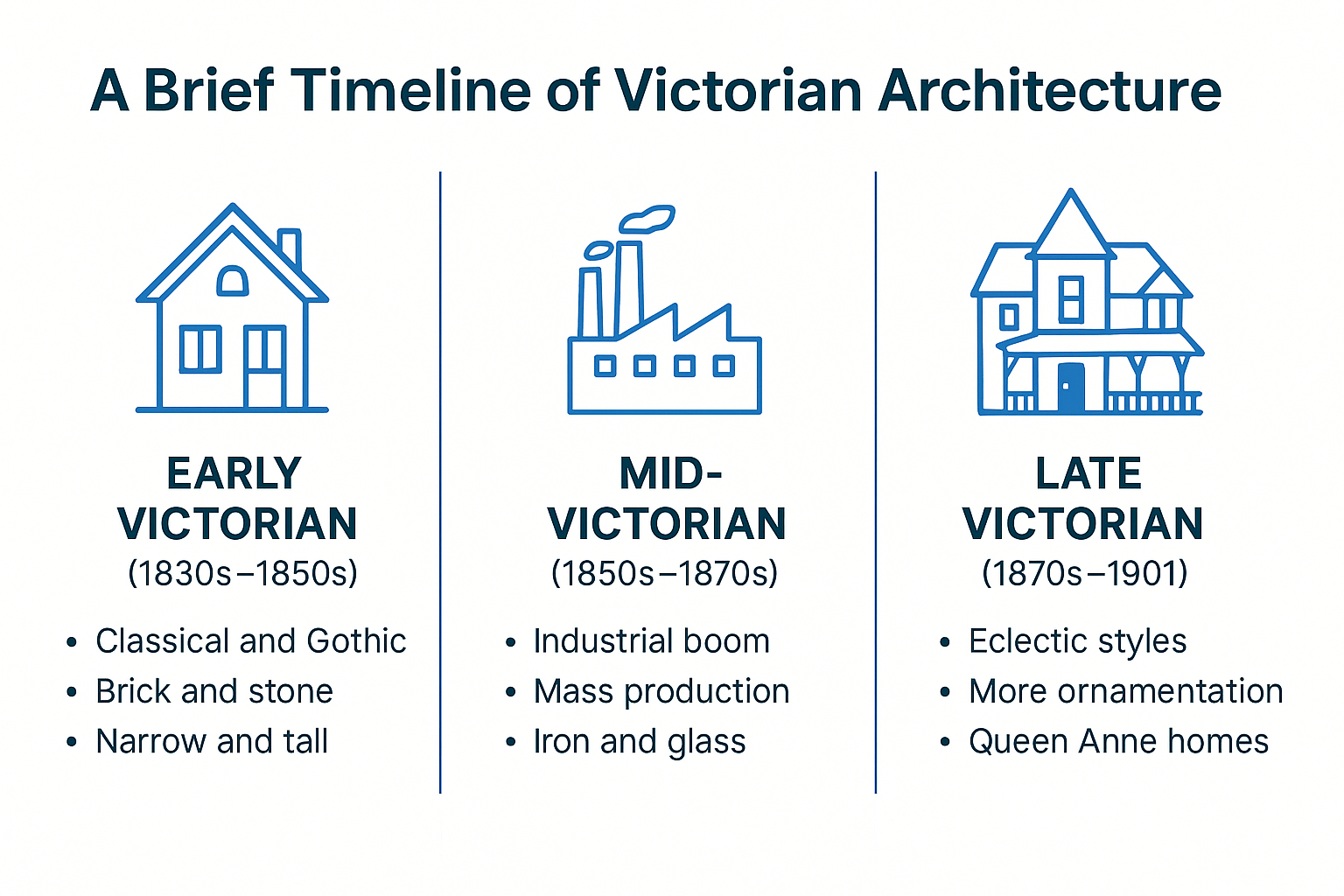
Early Victorian (1830s–1850s)
Roots of Revival | Modesty, Morals, and Mechanisms Begin
This period still had one foot in the Georgian world—orderly, restrained, and influenced by classical shapes—but something new was forming.
Cities were swelling, new classes were emerging, and architecture began to reflect more than just money. It reflected values.
Key Features:
-
Influenced by Greek Revival and Gothic Revival
-
Materials: Brick, stone, slate
-
Steep-pitched roofs, pointed arches, tall narrow windows
-
Functional but moralizing: beauty meant respectability
Famous Buildings:
-
Keble College, Oxford (1868 by William Butterfield – early Gothic revival energy)
What Changed:
-
The idea that homes and public buildings could teach morality through form
Key Architect:
-
Augustus Pugin – Didn’t just revive Gothic; he believed it was spiritually superior
Famous for his work on the Palace of Westminster (with Charles Barry)
What to Learn:
-
Design reflects belief systems—architecture wasn’t neutral
-
The Victorian push for style had real conviction behind it, not just taste
-
Early period teaches how form and function started to separate from strict classicism
Mid-Victorian (1850s–1870s)
Industrial Power | Machines, Railways, and the Rise of Iron and Glass
Britain was the factory of the world. Cities expanded fast. New money demanded bigger homes, rail stations, museums—and technology answered. Cast iron, mass production, and glass gave architects new tools. Decoration became accessible. The middle class exploded, and they wanted beauty too.
Key Features:
-
Eclectic mix: Italianate, Gothic Revival, Neo-Renaissance
-
Mass-produced ornament (cast iron balconies, terracotta tiles)
-
Expansion of public buildings: rail stations, libraries, markets
-
First real use of glass and steel in large civilian projects
Famous Buildings:
-
Crystal Palace (1851 by Joseph Paxton – made almost entirely of iron and glass)
-
Royal Albert Hall (1871 – round, decorative, bold use of structure and scale)
What to Read: The Victorian House: Domestic Life from Childbirth to Deathbed – Judith Flanders
Key Architects:
-
Joseph Paxton – pioneered prefabrication and modular design
-
George Gilbert Scott – prolific, Gothic Revival master (St. Pancras Station)
What Changed:
-
Engineering and architecture merged—function began driving form
-
Building became faster, larger, more affordable
-
Decoration no longer needed wealth; machines made beauty democratic
What to Learn:
-
Innovation comes from constraint—Paxton was a gardener, not an architect
-
This era shows how material breakthroughs (steel, iron, glass) changed not just how we build, but what’s possible
Late Victorian (1870s–1901)
Ornament and Identity | Creativity, Global Influences, and Style Clashes
By this time, Victorian Britain was wealthy, confident, and global. Architects started pulling ideas from everywhere—India, Japan, Venice, the Middle Ages. Homes got towers, wraparound porches, curved windows. Everything was layered: brick on stone, wood on tile, colors on colors. It wasn’t subtle—but it was alive.
Key Features:
-
Queen Anne, Arts and Crafts, Shingle Style emerge
-
Asymmetrical facades, bay windows, turrets, verandas
-
Heavy use of decorative woodwork, colored brick, and patterned tiles
-
Interior layouts started favoring light, flow, and health
Famous Buildings:
-
Bedford Park, London – first real garden suburb (Richard Norman Shaw)
-
Carson Mansion, Eureka, CA – most ornate Victorian house in the U.S.
-
Red House (1859, Philip Webb & William Morris) – Arts & Crafts manifesto
Key Architects:
-
Richard Norman Shaw – led the Queen Anne revival
-
William Morris – father of Arts & Crafts, fought against mass production
-
Charles Voysey – simpler forms, modern feel before Modernism
What Changed:
-
Return to handcraft, local materials, and “honest” construction
-
Architecture became self-aware—talked back to industrial excess
-
The suburban home emerged: private, artistic, personal
What to Learn:
-
Decoration can carry cultural meaning—color and shape communicate ideas
-
The end of the Victorian period set the stage for modern design
-
Architecture became narrative—buildings told stories about place and identity
Recommended Reading: The Victorian House: Domestic Life from Childbirth to Deathbed – Judith Flanders
Takeaway: Each phase of Victorian architecture tells us what people believed at the time:
-
Early Victorian: Morality, order, and tradition
-
Mid-Victorian: Power, progress, and invention
-
Late Victorian: Expression, identity, and rebellion against excess
Victorian architecture isn’t one look—it’s a record of change.
Study the details, and you don’t just learn design. You learn what mattered to people, and why.
Why Victorian Architecture Still Inspires Designers Today
What made Victorian architecture so unique? Discover its origins, major styles, and real-world examples in this clear and engaging overview.
Key Features of Victorian Buildings
-
Decorative Trim: Often called “gingerbread,” these were the carved wooden details under roofs or around porches.
-
Tall, Narrow Windows: Usually grouped in twos or threes. Sometimes with stained glass.
-
Steep Roofs: Often with gables, dormers, or towers.
-
Mixed Materials: Brick, stone, wood, and metal — sometimes all on the same house.
-
Bay Windows: These popped out from the wall to bring in light and add space.
-
Front Porches: Many homes had covered porches with columns or railings.
From steep roofs to gingerbread trim, Victorian architecture shaped cities worldwide. Get the facts, features, and famous buildings in one guide.
Where You’ll See Victorian Architecture
-
England: Victorian townhouses and terraces are everywhere, especially in cities like London and Bath.
-
United States: Victorian homes boomed in places like San Francisco (think "Painted Ladies") and along the East Coast.
-
Australia, Canada, India: As part of the British Empire, these regions also adopted the style, often adapting it to local climates and materials.
What Made It Possible?
The Industrial Revolution changed everything. For the first time, decorative parts like columns, railings, and moldings could be mass-produced.
Cast iron and sheet glass became widely available.
Trains could ship building materials across the country. People had more money, and homes became a way to show off success.
Why So Many Styles?
Victorian architecture borrowed ideas from everywhere — medieval castles, Italian villas, Greek temples, and even Eastern architecture.
It was an age of historic revival.
People weren’t trying to invent new looks — they were celebrating and remixing old ones.
Some popular substyles include:
-
Italianate (tall towers, flat roofs, decorative brackets)
-
Queen Anne (asymmetrical shapes, bay windows, ornate trim)
-
Second Empire (Mansard roofs, bold and formal)
Victorian Architecture and the Birth of the Modern Home
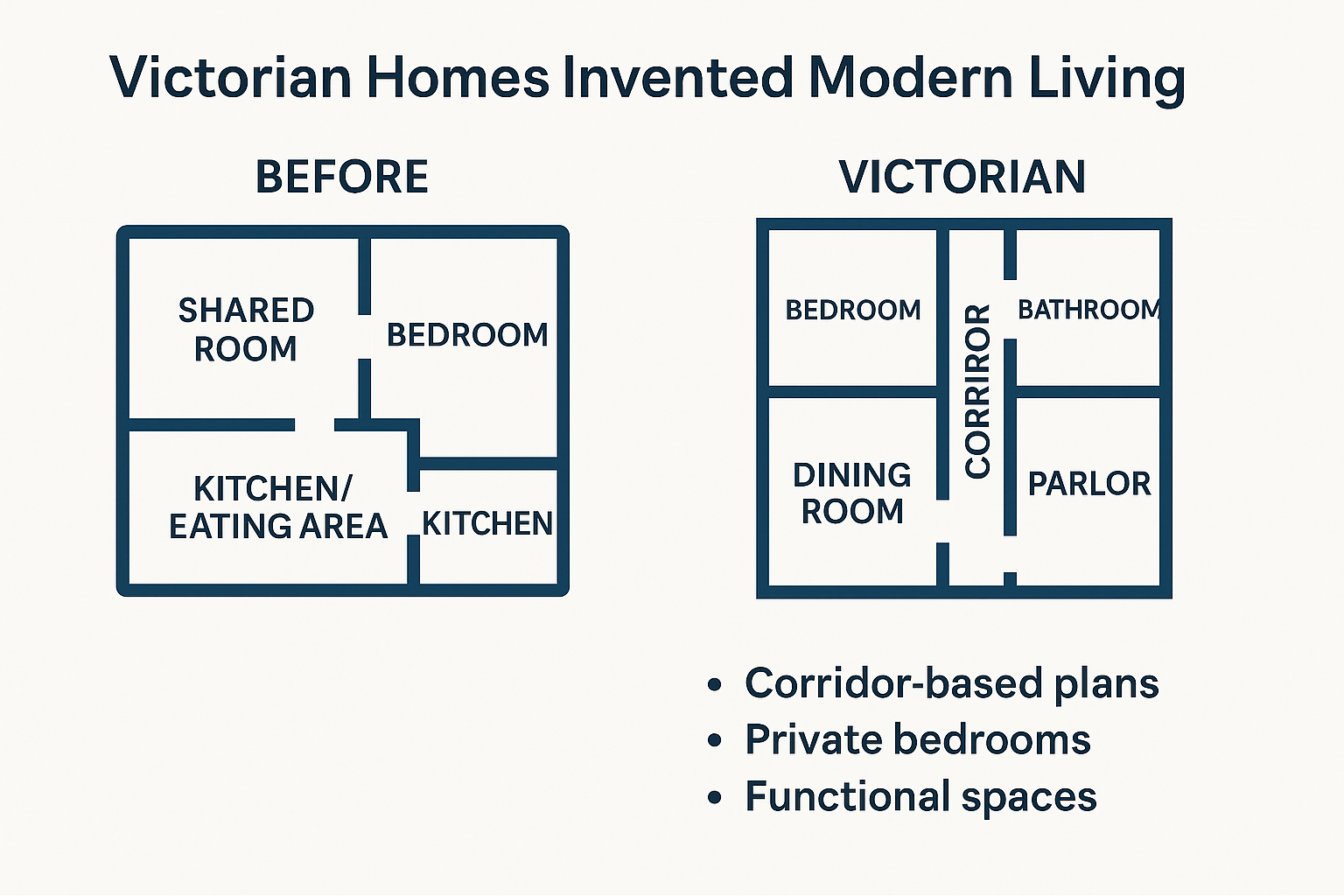
Diagram comparing pre-Victorian open layouts to Victorian corridor-based home plans with defined, private living spaces.
How This Era Quietly Shaped the Way We Live Today
Most articles talk about styles, shapes, and ornament. But what they miss is this: Victorian architecture didn’t just change how homes looked—it changed how they were used. It introduced things we now take for granted in residential living.
What Actually Emerged During the Victorian Era?
-
Corridor-based plans: Before this, rooms often opened into each other. Now, private hallways connected bedrooms and parlors.
-
Bedrooms for children: The idea of kids having separate rooms became standard in middle-class homes.
-
Bathrooms indoors: Plumbing advances made it possible to have dedicated bathrooms inside the home.
-
Functional zoning: Parlors, dining rooms, servant quarters, and family rooms each had specific roles—this division shaped how homes were laid out for over a century.
Why It Matters
This isn’t just about gingerbread trim. It’s about how social change, class identity, and industrial technology created the blueprint for the modern middle-class house.
Victorian homes invented:
-
Privacy as a design concept
-
Status spaces like formal dining rooms
-
The idea that a house could express not just function—but personality
Queen Anne Style: The Boldest Face of Victorian Architecture
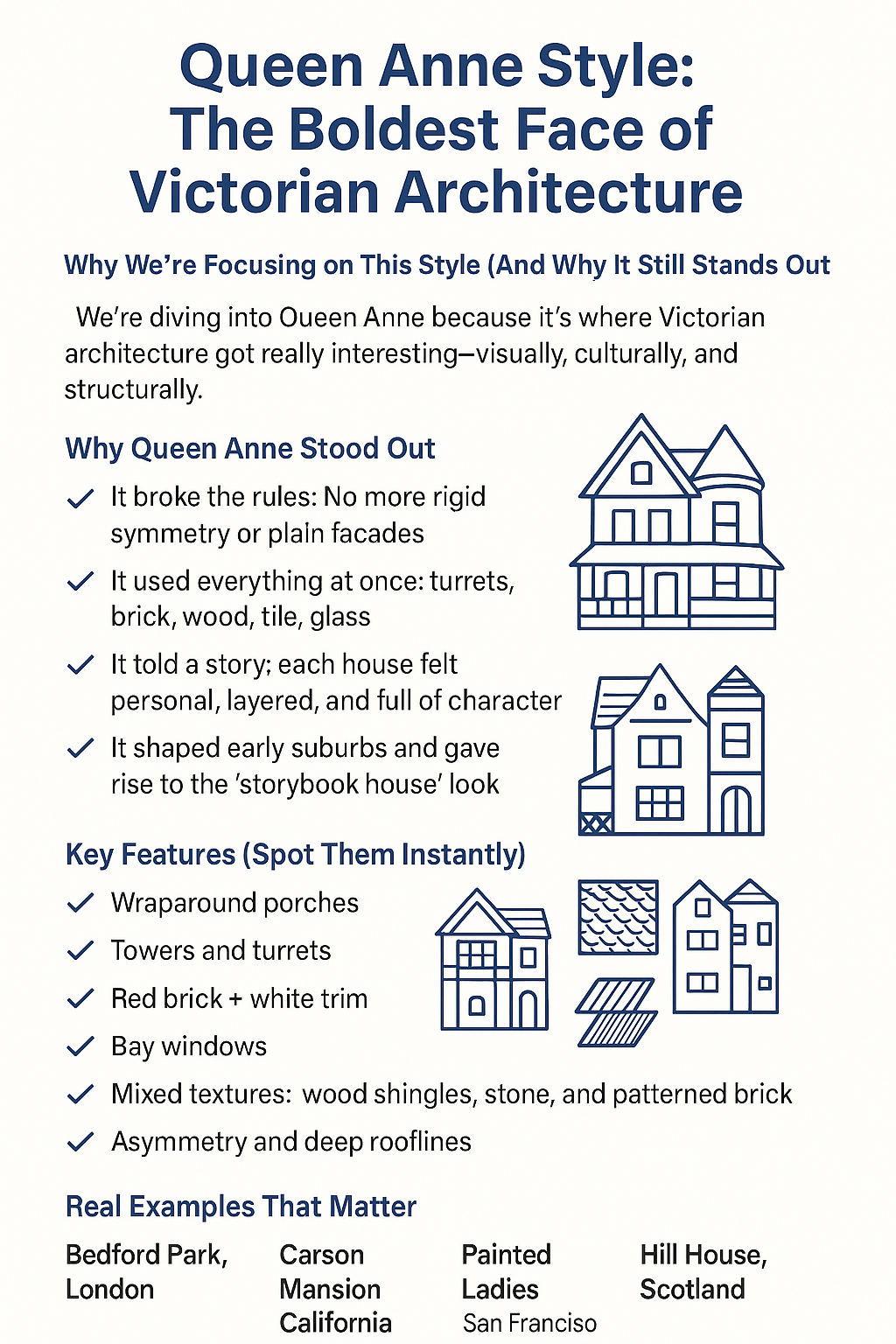
Among all the styles that came out of the Victorian era, Queen Anne is one of the most recognizable—and most misunderstood.
Despite the name, it has almost nothing to do with Queen Anne herself. Instead, it exploded in the late 1800s as architects pushed for creativity, personality, and freedom in design.
Why We’re Focusing on This Style (And Why It Still Stands Out)
We’re studying Queen Anne because it marks a turning point in Victorian architecture, becoming more visually, culturally, and structurally intriguing.
Why Queen Anne Stood Out
-
It broke the rules: No more rigid symmetry or plain facades
-
It used everything at once: turrets, brick, wood, tile, glass
-
It told a story: each house felt personal, layered, and full of character
-
It shaped early suburbs and gave rise to the “storybook house” look
Key Features (Spot Them Instantly)
-
Wraparound porches
-
Towers and turrets
-
Red brick + white trim
-
Bay windows
-
Mixed textures: wood shingles, stone, and patterned brick
-
Asymmetry and deep rooflines
Real Examples That Matter
-
Bedford Park, London – The first garden suburb, led by Richard Norman Shaw, who made Queen Anne a household style
-
Carson Mansion, California – Often called the most famous Victorian house in the U.S.
-
Painted Ladies, San Francisco – Bright, expressive, iconic Queen Anne rowhouses

Image: The Painted Ladies of San Francisco, a row of iconic Victorian homes known for their detailed architecture and scenic placement against the city’s skyline.
-
Hill House, Scotland – A refined, early modern take by Charles Rennie Mackintosh, blending Queen Anne with new ideas
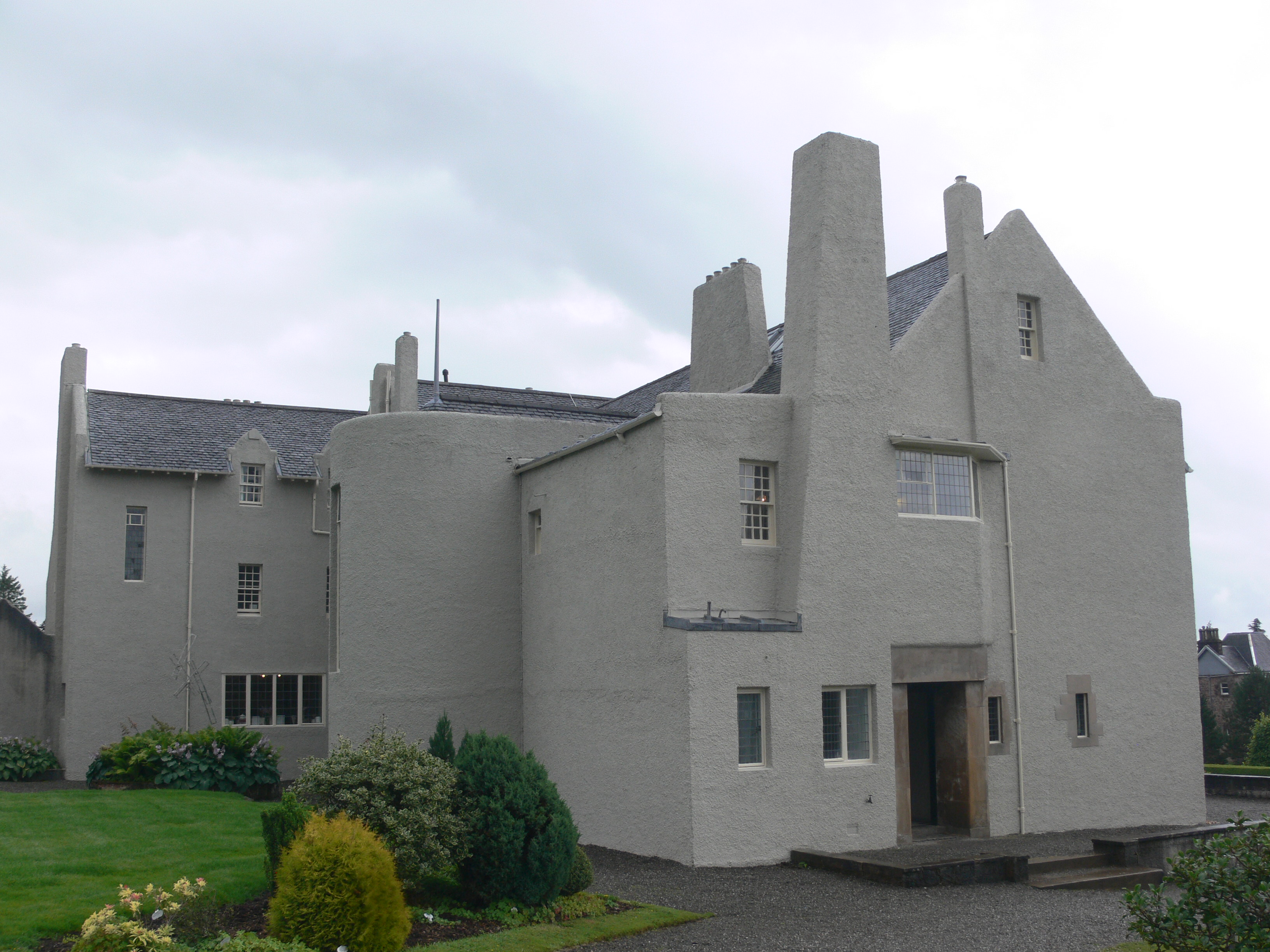
Image: Hill House in Helensburgh, a notable example of late Victorian architecture blending traditional Queen Anne features with early modernist design by Charles Rennie Mackintosh.
Key Architects
-
Richard Norman Shaw – Made Queen Anne respectable and desirable for the middle class
-
Charles Voysey – Simplified the style, paving the way for Arts and Crafts
-
George Devey – Known for picturesque country homes with Queen Anne roots
Why It Still Matters
Queen Anne isn’t just a historic style—it’s a bridge. It connects Victorian richness with modern creativity.
You see echoes of it in early 20th-century homes, craftsman bungalows, and even contemporary suburban builds.
It showed architects that homes could be personal, beautiful, and full of life—not just boxes for shelter.
What to Learn From It
-
Asymmetry isn’t chaos—it’s character
-
Detail isn’t excess when it’s done with purpose
-
Materials can mix, as long as the form holds
-
Homes can reflect personality—not just rules
In Focus: What Made Victorian Architecture So Iconic?
Victorian buildings weren’t subtle. They embraced color, texture, and decoration in a way that no earlier era had. What made them stand out wasn’t just how they looked—it was why they were built that way.
-
Expression of Status: The more decorated your house, the more successful you looked.
-
Industrial Boost: New machines meant mass-produced parts. Style became affordable.
-
Borrowed History: Every style revival told a story—Gothic for spirituality, Italianate for elegance, Queen Anne for creativity.
What to learn: Look at what’s behind the design—how social change, tech, and economy shaped the architecture.
Recommended Books on Victorian Architecture
-
The Victorian House: Domestic Life from Childbirth to Deathbed – Judith Flanders
A deep look into real-life inside Victorian homes—not just architecture but daily living. -
Victorian Architecture – Roger Dixon & Stefan Muthesius
Comprehensive and visual. Covers the full range of styles, materials, and movements. -
Old House Handbook – SPAB (Society for the Protection of Ancient Buildings)
Practical guide to maintaining and understanding old Victorian homes.
Related Victorian Styles & Architects (With Real Examples)
| Style | What to Look For | Architects & Real Examples | What to Learn From It |
|---|---|---|---|
| Gothic Revival | Pointed arches, towers, stained glass | St. Pancras Station (London), by George Gilbert Scott | Craftsmanship, moral symbolism, religious influence |
| Italianate | Tall towers, brackets, arched windows | Osborne House (Isle of Wight), by Prince Albert and Thomas Cubitt | Use of rhythm, balance, romantic symmetry |
| Queen Anne | Bay windows, red brick, asymmetry | Bedford Park (London), by Richard Norman Shaw | Artistic freedom, modern planning roots |
| Second Empire | Mansard roofs, rich ornament | City Hall (Philadelphia), by John McArthur Jr. | Urban boldness, vertical elegance |
| Stick/Eastlake | Visible wood structure, decorative trusses | Carson Mansion (Eureka, CA) | Expressive woodwork, truth-to-materials philosophy |
| Shingle Style | Wood cladding, flowing forms | Isaac Bell House (Newport, RI), by McKim, Mead & White | Organic massing, American adaptation of Victorian forms |
Why It Still Matters
Victorian buildings don’t try to impress—they just are. Even when worn down, you can see the thought in how they were made. They weren’t about trends. They were about doing things properly.
FAQ
Q: Is Victorian a style or a time period?
A: It's both. It refers to buildings built during Queen Victoria’s reign (1837–1901), but also to several styles that were popular at that time.
Q: Why are Victorian houses so detailed?
A: Because for the first time, decorative parts like brackets and spindles could be factory-made cheaply.
Q: Are all Victorian homes big?
A: Not at all. While many are large, there are also modest Victorian cottages that share the same details on a smaller scale.
Q: Can you still build Victorian homes today?
A: Yes, but it's rare due to cost. Some “new builds” borrow elements like bay windows or gables while using modern materials.
References
-
Historic England: historicengland.org.uk
Search their archives for listed Victorian buildings and architectural analysis. -
Society for the Protection of Ancient Buildings (SPAB): spab.org.uk
Great for practical and historical knowledge on maintaining old homes. -
Royal Institute of British Architects (RIBA): architecture.com
For scholarly articles and building records. -
Library of Congress (USA): loc.gov
Digitized plans and photos of Victorian homes, especially in North America. -
Open Access Books by Yale or Harvard Design Schools (e.g. “Image of the City” for context)