

Norman Foster’s buildings are easy to recognize from the skyline. The better lesson is in the section, the structure, the public route, and the office machinery that makes such large work possible.
Norman Foster: Architect Behind the Gherkin, Apple Park, and High-Tech Architecture
Norman Foster turned technical architecture into public image. The Gherkin in London, the Reichstag dome in Berlin, Hearst Tower in New York, Apple Park in California, HSBC Headquarters in Hong Kong, and the Millau Viaduct in France all carry the same pressure: a building has to look clear, work hard, and explain itself without becoming dead machinery.
Foster is usually filed under high-tech architecture.
The label fits, but it can make the work sound colder than it is. His best buildings are technical because the problem demands it. A dome becomes a public route. A tower becomes lighter through its frame. An airport roof helps people move. A bridge crosses a valley with restraint instead of brute force.
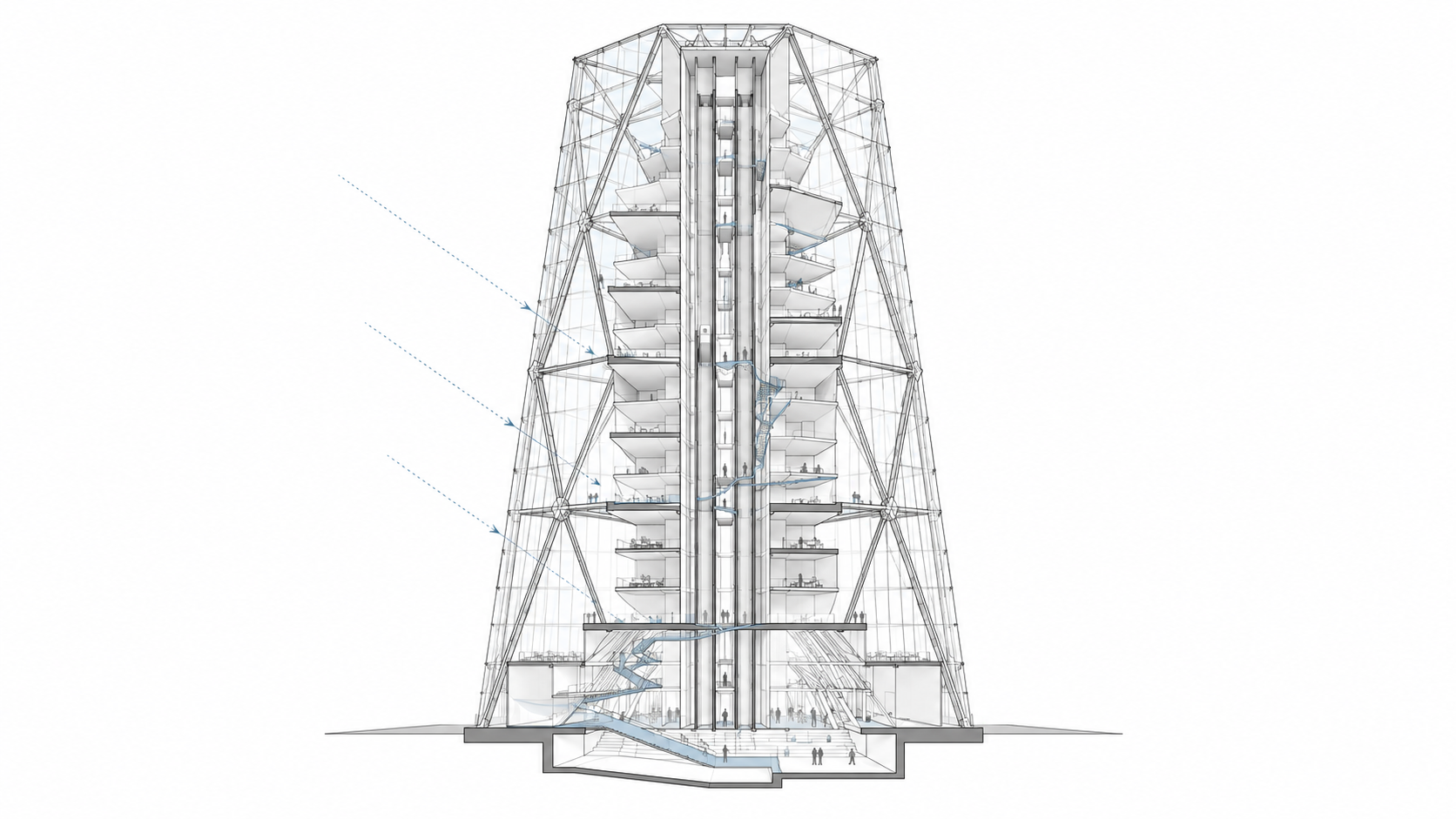
Illustration by ArchitectureCourses.org. This high-tech tower section shows the kind of design logic associated with Norman Foster’s work: an exposed structural skin, clear central core, open floor plates, daylight movement, and public circulation treated as part of the architecture.
Born in Manchester in 1935, Foster moved from a working-class childhood into one of the largest and most influential architecture practices in the world. He studied at the University of Manchester, won a Henry Fellowship to Yale, worked with Richard Rogers and others in Team 4, then founded Foster Associates in 1967. The practice later became Foster + Partners, a global studio working across architecture, urban design, engineering, interiors, research, and product design.
His legacy is bigger than one famous architect. Foster helped normalize the modern global design office: research-heavy, engineer-friendly, digitally fluent, environmentally branded, corporate, ambitious, and sometimes too polished for its own good. That tension is the reason he still deserves serious study.
Early Life in Manchester
Foster’s background matters because it helps explain his interest in machines, structure, aircraft, railways, cars, and industrial systems. He did not come from an old architectural family. He grew up around Manchester’s industrial landscape and found his way into architecture through work, study, discipline, and a fascination with how things are made.
Before architecture fully took hold, he worked ordinary jobs and served in the Royal Air Force. The design consequence is clearer than the biographical romance. Foster came to architecture with a strong interest in systems. Buildings were things to be assembled, tested, refined, and made legible.
At the University of Manchester, he studied architecture and city planning. Yale opened the next door. There he encountered American modernism, larger design ambitions, and a more experimental architectural culture. He also met Richard Rogers, a key early collaborator.
The move from Manchester to Yale changed the scale of the work Foster could imagine. He returned to Britain with a sharper sense that architecture could be technical, urban, industrial, and publicly visible at the same time.
Related reading: Rem Koolhaas gives a useful contrast. Koolhaas explains the city through congestion, program, media, and instability. Foster tends to explain it through structure, systems, performance, and controlled large-scale delivery.
Team 4 Started the Pattern
Before Foster + Partners, there was Team 4. The group included Norman Foster, Wendy Cheesman, Richard Rogers, and Su Brumwell. It did not last long, but it mattered. The work pointed toward a lighter, more industrial, more open kind of modern architecture in Britain.
The early lesson was collaboration. Foster is often packaged as a single heroic designer, but his career makes more sense as a long record of building strong teams around engineering, production, environmental thinking, and detailed coordination.
After Team 4 ended, Foster founded Foster Associates in 1967 with Wendy Foster. The practice became known for buildings that exposed their logic instead of hiding it behind decorative surfaces. Structure, services, circulation, and enclosure were not treated as background work. They became part of the architecture.
That sounds normal now because so much contemporary architecture absorbed the language. At the time, it was a serious shift. The building was no longer only a composition. It was a working system with a visible body.
For broader context, modern architecture places Foster after the early modern masters, while contemporary architecture explains the later world of digital tools, global practices, and sustainability claims that Foster + Partners helped shape.
Willis Faber Changed the Office Building
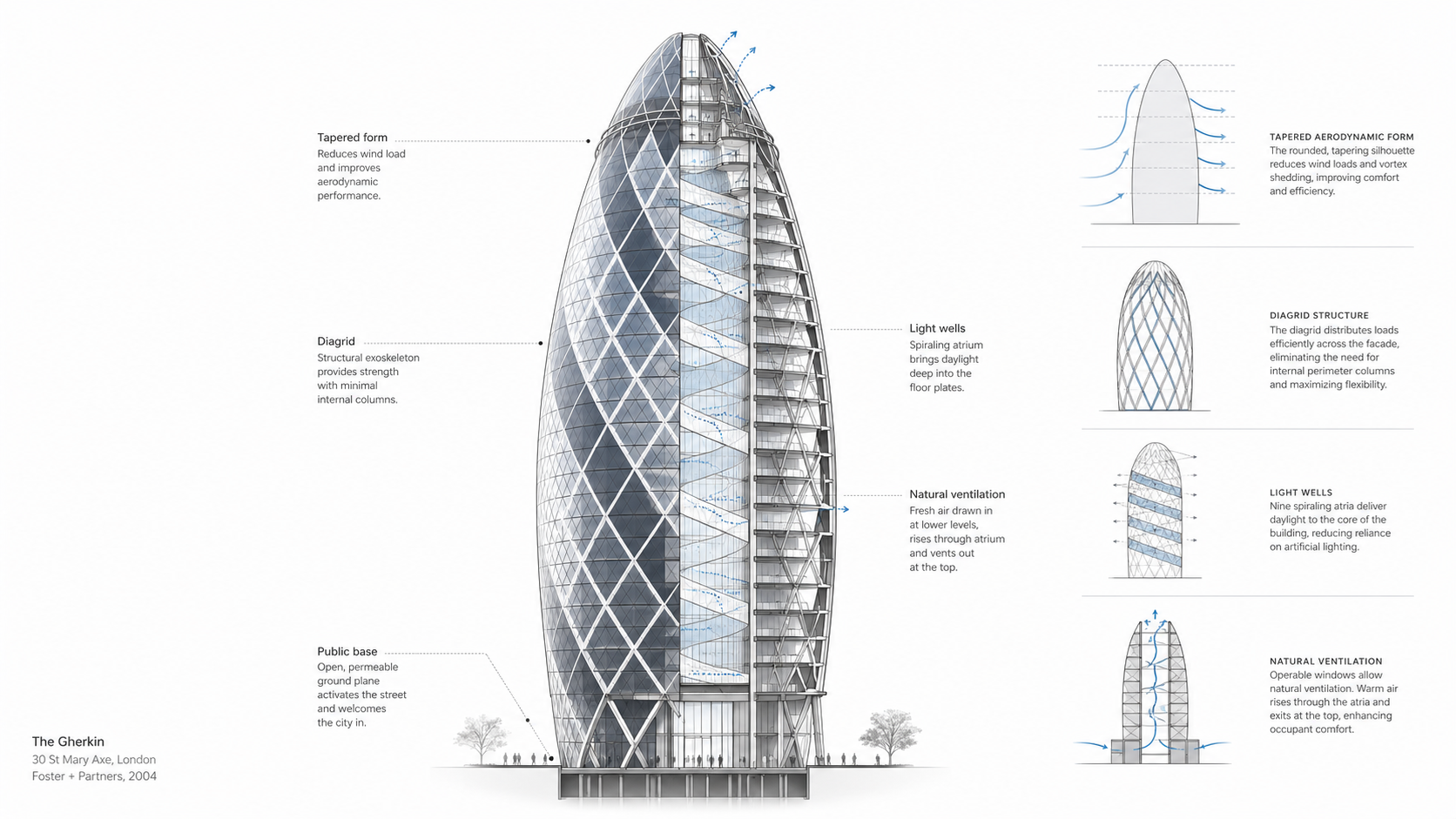
Foster’s buildings often look smooth from a distance, but the better projects are built around structure, daylight, circulation, and environmental control.
The Willis Faber & Dumas headquarters in Ipswich, completed in 1975, was one of Foster’s early breakthroughs. It was not a giant skyline object. It was a corporate office building, but it treated the office as something more flexible, open, and socially active than the typical sealed workplace.
The curved glass edge gave the building a softer relationship with the street. The deep plan, roof garden, flexible work areas, and environmental thinking made it more than a stylish envelope. It showed that a commercial building could be efficient without becoming hostile.
This matters because Foster’s later work is often judged through the big icons. The Gherkin, Apple Park, and the Reichstag dome are easier to remember. Willis Faber shows the early discipline underneath them: technical clarity, workplace planning, energy awareness, and a refusal to treat the facade as decoration.
A lot of Foster’s strongest work starts there. The building asks how people work, how light reaches them, how the structure organizes the plan, and how a corporate client can get a memorable building without wasting the whole budget on image.
The Foster Building Test
A Foster building often feels as if the form has been pulled out of a system. Sometimes that reading is fair. Sometimes the image is more controlled than the engineering story suggests. Either way, the better projects reward a slower look.
The repeated traits are easy to name: glass, steel, exposed structure, curved forms, visible circulation, large roofs, precise details, and environmental claims. The deeper pattern is more useful. Foster’s buildings often try to make performance legible. They want the visitor to sense how the building stands, moves air, admits light, handles people, or marks public space.
That is why the work can feel convincing even when it is corporate. The building may be expensive, polished, and backed by a powerful client, but the architectural idea usually sits inside a practical problem. A parliament needs public transparency. A tower needs less structural weight. An airport needs legible movement. A bridge needs to cross a valley without looking brutal.
This is also where the criticism begins. When the system feels earned, Foster’s architecture can be excellent. When the system becomes a style, the work can feel too smooth, too expensive, or too detached from ordinary urban life.
The Buildings That Explain Him Best
Foster has produced too many projects to reduce the career to a clean top-five list. Still, a few buildings carry the main arguments.
30 St Mary Axe, London
Better known as the Gherkin, this tower became a London symbol because its form was instantly recognizable. The more useful lesson is the way the diagrid structure, tapered shape, and environmental strategy work together. It is a tall office building, but it avoids the dead slab feeling of many corporate towers.
Reichstag Dome, Berlin
The Reichstag dome is one of Foster’s clearest civic projects. Visitors move through the dome above the parliamentary chamber, turning public oversight into a physical route. The glass, ramps, and mirrored cone connect democracy, visibility, daylight, ventilation, and public access.
Hongkong and Shanghai Bank Headquarters, Hong Kong
Completed in 1985, HSBC proved Foster could operate at huge international scale. The building used exposed structure, prefabricated components, flexible floor plates, and careful daylight strategies. It looked like a machine, but the point was not machine worship. The point was speed, adaptability, and clarity under enormous commercial pressure.
Hearst Tower, New York
Hearst Tower matters because it joins an older masonry base with a new diagrid tower. That move gives the building a sharper urban story than a stand-alone glass object. It also became a strong example of sustainability branding in American corporate architecture.
Apple Park, Cupertino
Apple Park is one of Foster’s most debated late projects. It is technically refined, landscape-heavy, and obsessively controlled. It also raises hard questions about workplace culture, campus isolation, land use, and whether an enormous ring can ever feel urban. That makes it worth studying carefully, not casually praising.
Millau Viaduct, France
The Millau Viaduct shows Foster at his most elegant. The bridge is vast, but it reads with unusual lightness. Its power comes from restraint. The engineering does the dramatic work, and the architecture avoids adding noise.
For a wider architect comparison, read Frank Lloyd Wright vs Le Corbusier. Wright and Le Corbusier changed the private house and the modern city in different ways. Foster belongs to a later generation, where the problem shifts toward infrastructure, corporate power, sustainability, and the global design office.
Style Changed With Scale
Foster’s early work is sharper, more industrial, and more openly high-tech. The later work is larger, more global, and often softer in form. The difference matters because students sometimes copy the look without understanding the period.
| Period | What the Work Emphasized | Useful Examples | Where Bad Copies Fail |
|---|---|---|---|
| Early Foster | Lightweight structure, industrial clarity, flexible interiors, exposed systems | Willis Faber, Sainsbury Centre, Renault Distribution Centre | The building becomes a technical pose without the discipline behind it |
| Breakthrough Foster | Large-scale coordination, prefabrication, structure as public image | HSBC Headquarters, Stansted Airport | The roof or frame gets copied as a shape instead of a working system |
| Civic Foster | Public movement, symbolism, transparency, historic intervention | Reichstag Dome, Great Court at the British Museum | Glass is treated as “openness” even when the politics or program do not support it |
| Late Global Foster | Corporate campuses, airports, towers, sustainability claims, global office production | Apple Park, Bloomberg HQ, Lusail Stadium | Scale and polish overpower the city around the project |
The visible language is easy to copy: steel, glass, curves, exposed frames, clean details. The harder part is the coordination. Foster’s best buildings are strong when the technical system earns the form.
High-Tech Without the Costume
High-tech architecture can become a costume quickly. Add exposed trusses, shiny ducts, glass elevators, and a few visible bolts, and the building starts performing intelligence whether it has any or not.
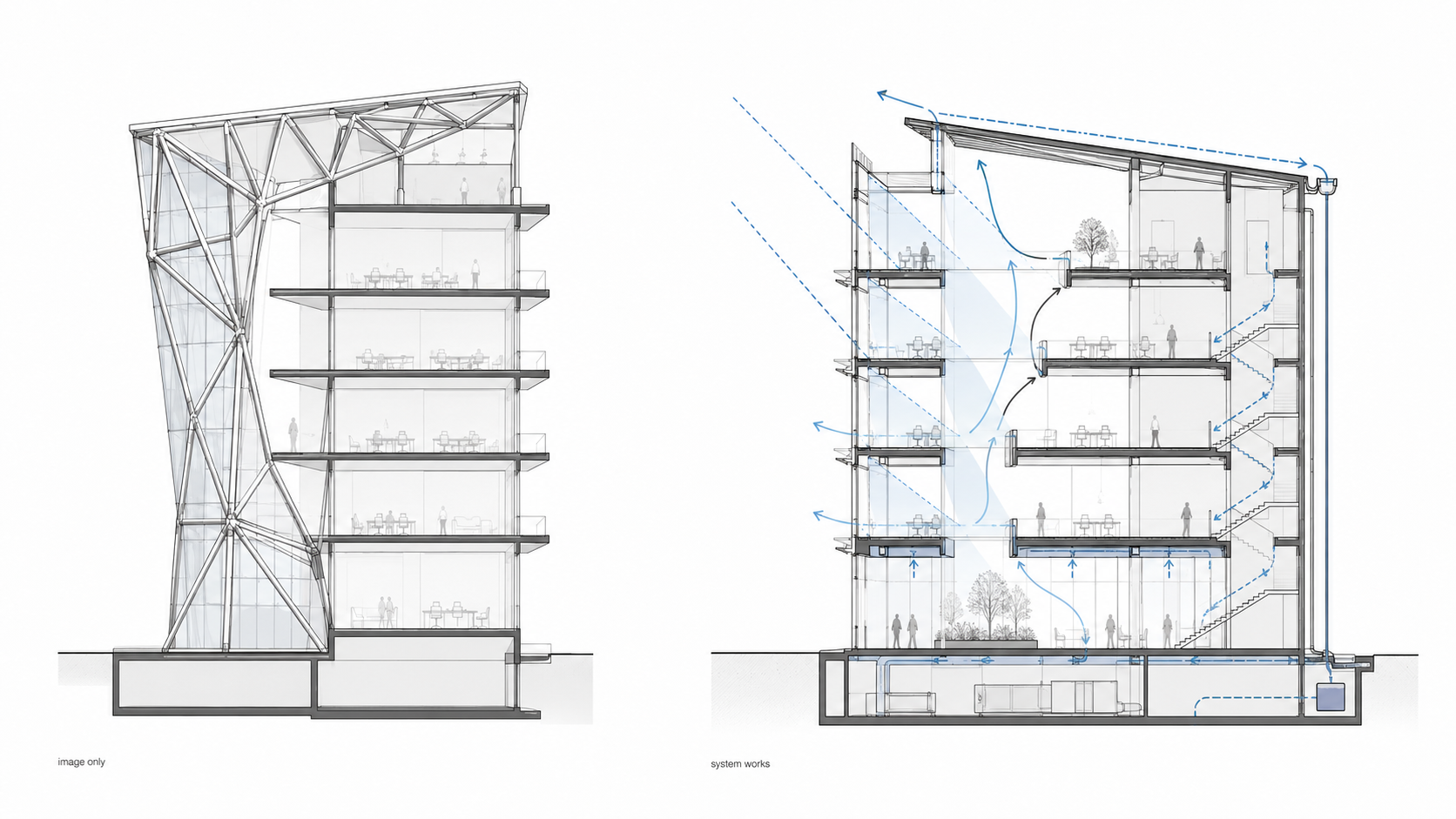
Illustration by ArchitectureCourses.org. High-tech architecture only works when the visible structure, glass skin, daylight, air movement, drainage, and circulation support the building together. Exposed trusses and glass by themselves can look technical without solving much.
Foster’s better work avoids that trap by making technology carry an architectural burden. At Stansted Airport, the roof and structural system help organize movement, light, and legibility. At HSBC, the modular system and exposed frame support a flexible commercial building under severe site and schedule pressure. At the Reichstag, the dome connects public movement, daylight, ventilation, and political symbolism.
That is the standard to use when judging Foster. Do not ask only whether the building looks sleek. Ask what the visible system is doing.
Does the structure reduce weight or only create drama? Does the glass improve daylight or only sell transparency? Does the environmental strategy change the experience of the building or sit in the press release? Does the big formal move help people understand the place?
When the answer is yes, the work holds up. When the answer is no, Foster’s language can become the same corporate gloss it once tried to improve.
This is also the difference between Foster and many weaker copies of his work. A copied Foster-looking building often has the gloss but not the section. It has the glass but not the climate logic. It has the exposed frame but no structural reason for exposing it.
The Copy Fails in Section
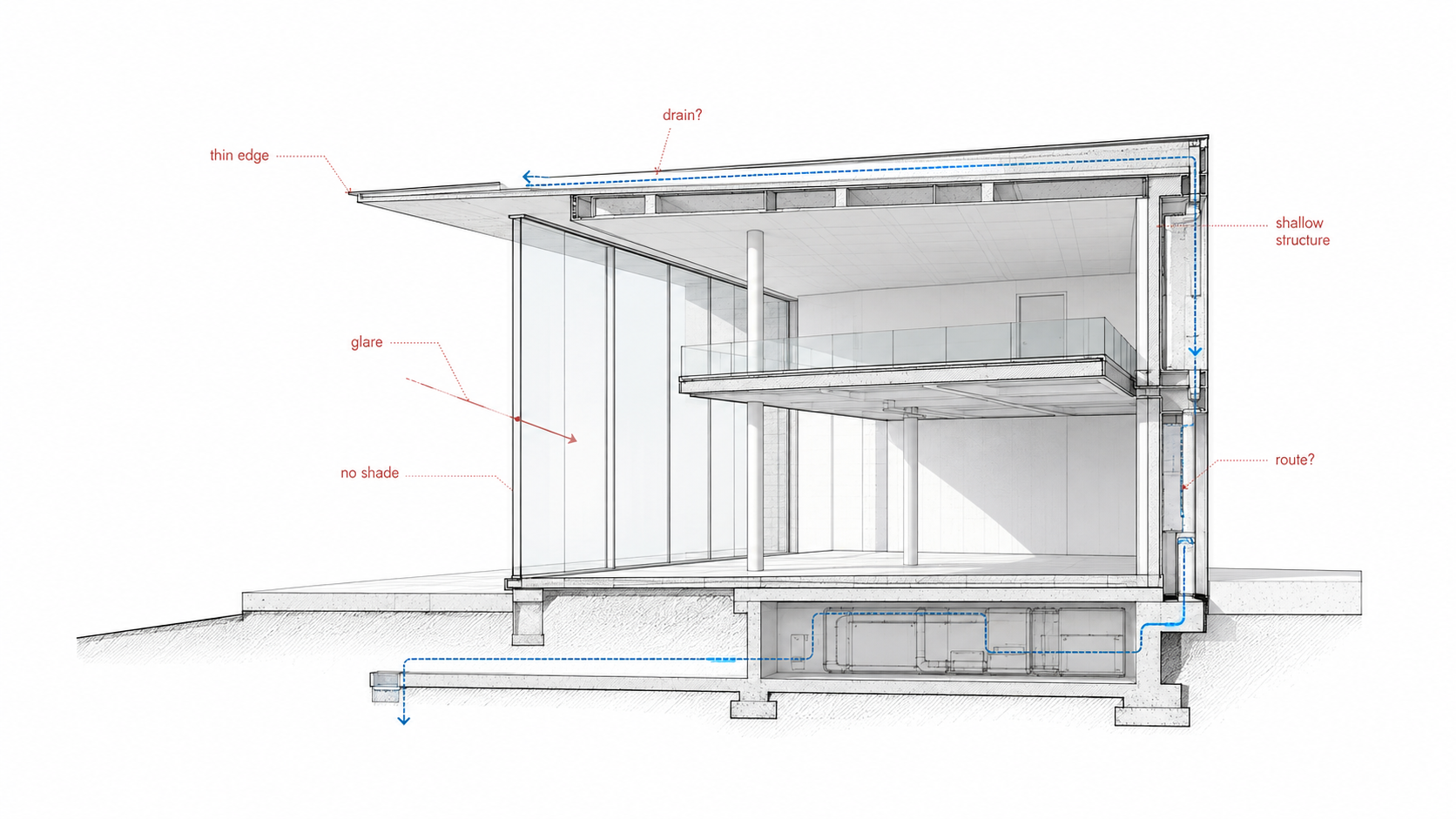
Illustration by ArchitectureCourses.org. A Foster-inspired design can look refined in elevation but fail in section when the roof edge is too thin, drainage is unresolved, glass lacks shading, structure is too shallow, and service routes have nowhere clear to go.
The hard lesson shows up after a student or young designer tries to copy Foster. The first rendering may look convincing. The tower has a smooth skin. The atrium looks bright. The roof floats. The diagram has arrows for sun and air. The presentation feels clean.
Then the section starts asking questions the image avoided.
Where does the load go? Where does the roof drain? How deep is the structure? How does the facade handle glare, heat, cleaning, replacement panels, fire separation, and movement? How does the building stay comfortable without turning the environmental claim into a caption? How do people enter, move, wait, gather, and leave?
This is where Foster becomes useful instead of decorative. The work punishes shallow copying. If you borrow the smooth glass and exposed structure without the coordination, the project starts to fail in the boring places: stair cores, service zones, roof edges, mechanical routes, shading, maintenance, and cost.
The protective move is simple. Before copying the look, redraw the building as a problem. Redraw the section. Trace the public route. Mark the structure. Find the air path. Find the daylight strategy. Find the client pressure. Find the expensive move and ask what it buys. If the answer is only “it looks like Foster,” the design has already gone thin.
The Office Makes the Architecture
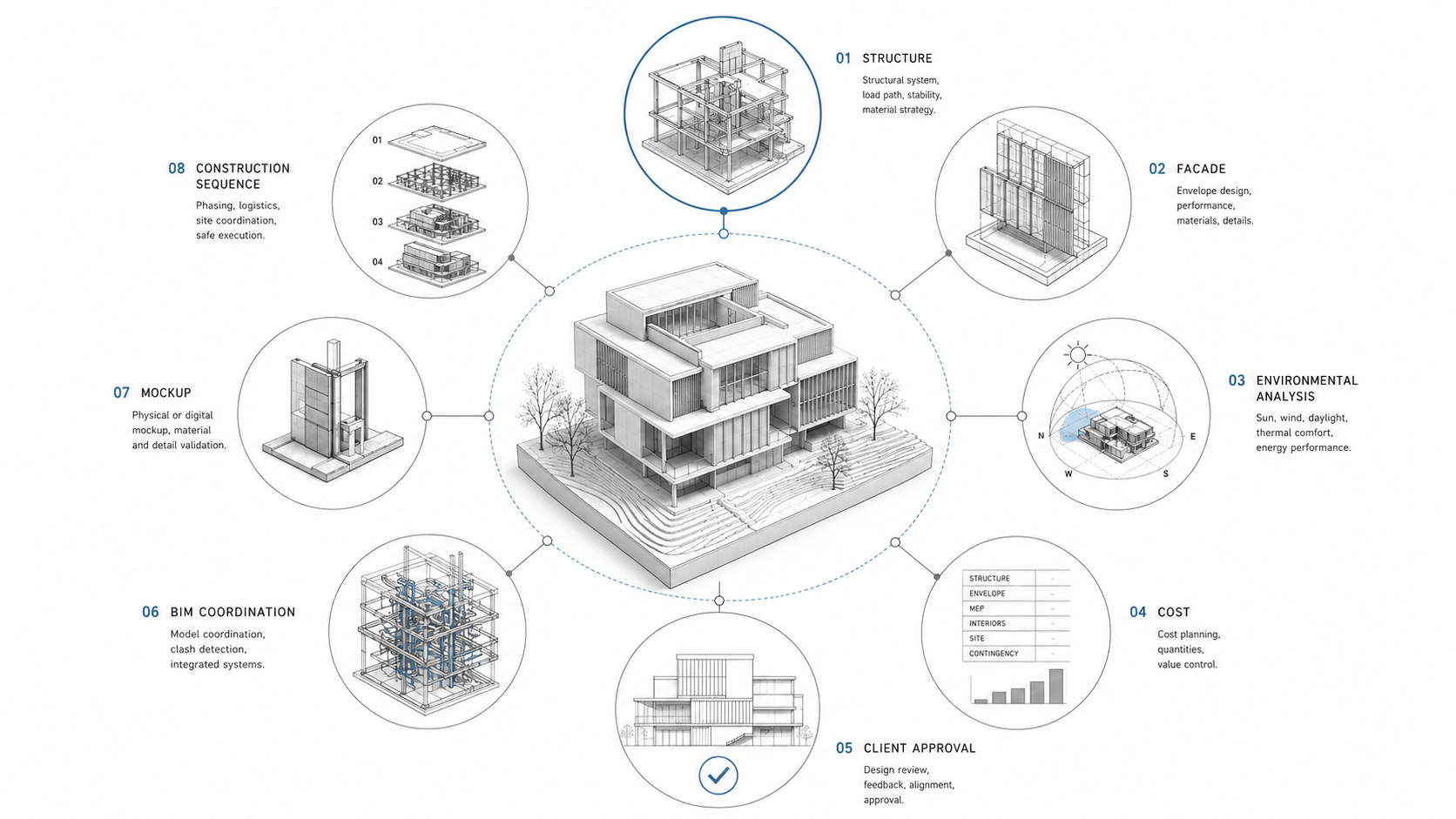
Illustration by ArchitectureCourses.org. Architectural design is not one finished image. A project has to pass through structure, facade design, environmental checks, cost planning, client approval, BIM coordination, mockups, and construction sequencing before it becomes buildable.
The public talks about Norman Foster as if one person draws every line. That is not how buildings of this scale happen. Foster + Partners is a large international practice with architects, engineers, model makers, researchers, sustainability consultants, visualization specialists, workplace planners, urban designers, and project teams working across offices and time zones.
This matters for students because the celebrity-architect myth can damage how they understand practice. A project like Apple Park, Bloomberg HQ, or an airport terminal is not produced by a lone genius. It is produced by teams, consultants, client groups, software systems, approvals, cost checks, mockups, and years of coordination.
Foster’s achievement includes the buildings, but it also includes the office structure capable of delivering them. That is less romantic and more useful.
The firm gives clients a recognizable design culture: clean technical ambition, strong presentation, major-project confidence, and the ability to coordinate architecture with engineering and environmental claims. That is why Foster + Partners keeps winning work at scales most small practices cannot touch.
The cost is that the work can feel distant from smaller urban messes. A global practice often works for governments, institutions, developers, and corporations with very large budgets. That does not make the architecture false, but it changes the questions. Public access, land use, embodied carbon, labor, procurement, local culture, and maintenance become harder to ignore.
This is a useful contrast with Frank Lloyd Wright, whose public image is tied to houses, landscapes, and individual authorship. Foster belongs more to the age of the coordinated global practice. For another related profile, Alvar Aalto gives a different model of modern architecture: warmer, more tactile, and more closely tied to material, furniture, and human scale.
Tools Are Not the Point
Foster + Partners is known for advanced digital workflows, but the important point is not the software name. Large contemporary practices use Rhino, Grasshopper, Revit, BIM coordination, environmental analysis, visualization tools, physical models, mockups, and custom scripts. The real difference is how those tools connect.
A tower form can be tested for structure and wind. A facade can be studied for solar gain, glare, maintenance, and fabrication. A roof can be checked against daylight, drainage, mechanical routing, and construction sequencing. A campus can be modeled as landscape, workplace, security system, energy system, and brand image at the same time.
That connected workflow is where Foster’s office culture becomes important. The drawing is not only a picture. It is a coordination device. The model is not only a presentation object. It is a way to test consequences before they become expensive site problems.
Young designers often focus on the most glamorous tool. That is backwards. The useful question is what the tool is checking. A beautiful parametric facade that ignores cleaning access, thermal movement, replacement panels, embodied carbon, or cost is still a weak facade.
For related method context, architectural technology explains the practical side of building systems, while parametric architecture connects digital form-making to rules, constraints, and performance.
Sustainability Claims Need Pressure
Foster’s work helped move sustainability into mainstream architectural discussion before it became a standard marketing layer. Daylight, natural ventilation, reduced material use, structural efficiency, and energy performance appear again and again in the practice’s public story.
That influence is important. It also needs pressure.
Large buildings carry large consequences. Airports, towers, global campuses, museums, bridges, and high-spec headquarters are resource-heavy projects even when they use advanced environmental strategies. A building can reduce energy use and still raise questions about embodied carbon, land use, travel patterns, client behavior, and long-term maintenance.
Foster’s best sustainable work makes a physical argument. You can see how the building admits light, reduces structural waste, supports ventilation, or improves movement. The weaker argument is the polished one: sustainability as a press-release layer placed over an expensive object.
Readers should study that contradiction instead of cleaning it up. It is one of the central problems of contemporary architecture. For a wider entry point, read sustainable architecture.
Where the Criticism Lands
Foster’s architecture attracts praise because it is precise, technically ambitious, and often easy to recognize. It attracts criticism for some of the same reasons.
The strongest criticism is that the work can become too corporate. Many major Foster projects are made for banks, technology companies, airports, governments, luxury clients, and global institutions. That world has money, but it also has its own language: smooth surfaces, controlled access, brand confidence, and high-performance claims. The architecture can start to feel like an excellent machine serving powerful clients more than messy public life.
Another criticism is environmental. Foster’s practice helped bring sustainability into mainstream architectural discussion, especially through energy-conscious office buildings, daylight strategies, and performance-driven design. At the same time, very large buildings, aviation infrastructure, global campuses, and high-spec construction raise uncomfortable questions about carbon, land use, travel, and resource intensity.
Foster’s best projects make a real performance argument. His weaker projects can sound sustainable because the language is polished. The reader’s job is to tell the difference.
Awards and Recognition
Foster received the Pritzker Architecture Prize in 1999. He has also received the Royal Gold Medal for Architecture, was knighted in 1990, and became Lord Foster of Thames Bank. Those honors reflect his role in shifting British and global architecture toward a more technical, international, systems-driven model of practice.
Awards can flatten an architect into a monument. Foster is more useful when treated as a working case study. His career shows how architecture changed after late modernism: bigger offices, more engineering, more corporate clients, more environmental language, more digital coordination, and more pressure for buildings to perform as public symbols.
That is why he belongs in any serious study of famous modern architects. You do not have to love every project. You do have to understand the machinery he helped normalize.
For cluster context, see Most Famous Modern Architects and Top 10 Famous Architects You Need to Know. Those pages should send readers here when they want the deeper Foster-specific explanation.
How to Read a Foster Building
Start with the section, not the skyline image. Foster’s buildings often reveal themselves through vertical movement, roof depth, structural rhythm, air paths, and daylight.
Then look at the client. A Foster building for a bank, a parliament, an airport, a museum, and a technology company will not carry the same pressures. The client affects security, budget, image, maintenance, access, and public meaning.
Next, check the environmental claim. Is the building using form, orientation, shading, ventilation, structure, or material reduction in a way you can understand? Or is sustainability being used as a soft label after the design is already fixed?
Finally, look at the city around it. Some Foster projects improve public space and movement. Others sit more like controlled objects. That difference matters. A technically impressive building can still be weak urbanism.
This is where Foster is valuable for architecture students and general readers. His buildings are clear enough to study, famous enough to find, and complicated enough to argue with.
Foster’s Influence
Foster taught architecture a few lasting habits.
He made engineering visible without treating it as background service. He helped make sustainability part of mainstream architectural ambition before it became standard marketing language. He showed that airports, bridges, offices, museums, and government buildings could share a design culture built around clarity, lightness, and performance.
He also helped create the modern image of the global architecture studio. That influence is everywhere now, for better and worse. Major practices are expected to think across architecture, interiors, engineering, branding, landscape, and environmental performance. Foster did not invent every part of that model, but his office made it highly visible.
A useful comparison is Santiago Calatrava. Calatrava often turns structure into expressive movement and sculptural drama. Foster usually works toward disciplined clarity, even when the project is enormous. Both use engineering as architectural language, but the emotional temperature is different.
FAQ
What is Norman Foster most famous for?
Norman Foster is most famous for buildings such as 30 St Mary Axe, known as the Gherkin, the Reichstag dome, HSBC Headquarters in Hong Kong, Hearst Tower, Apple Park, and the Millau Viaduct.
What style of architecture is Norman Foster known for?
Foster is strongly associated with high-tech architecture. His work often uses exposed structure, glass, steel, environmental systems, and precise engineering logic.
What is Norman Foster’s most important building?
There is no single answer. HSBC Headquarters was a major professional breakthrough. The Reichstag dome is one of his strongest civic works. The Gherkin is probably his most recognizable tower.
Is Foster + Partners still active?
Yes. Foster + Partners remains a major international architecture and design practice working on buildings, infrastructure, urban design, interiors, and research-led projects.
How old is Norman Foster?
Norman Foster was born on June 1, 1935. As of May 2026, he is 90 years old.
Did Norman Foster design Apple Park alone?
No. Apple Park is associated with Foster and Foster + Partners, but a project of that scale was produced by large design teams, consultants, engineers, client groups, and many years of coordination.
Why do architecture students study Foster?
Foster is useful because his buildings connect form to structure, systems, daylight, environmental claims, and large-office practice. The work shows what happens when design ambition meets engineering and institutional scale.
Read This Next
- Most Famous Modern Architects places Foster beside other major modern architects without turning the subject into a loose name list.
- Frank Lloyd Wright is the better next read if you want a contrast between organic architecture, houses, landscape, and individual authorship.
- Rem Koolhaas gives a sharper contrast with Foster’s controlled systems thinking.
- Alvar Aalto shows another side of modern architecture: material warmth, human scale, and softer modernism.
- Santiago Calatrava is useful if you want to compare expressive structure with Foster’s more disciplined high-tech language.