
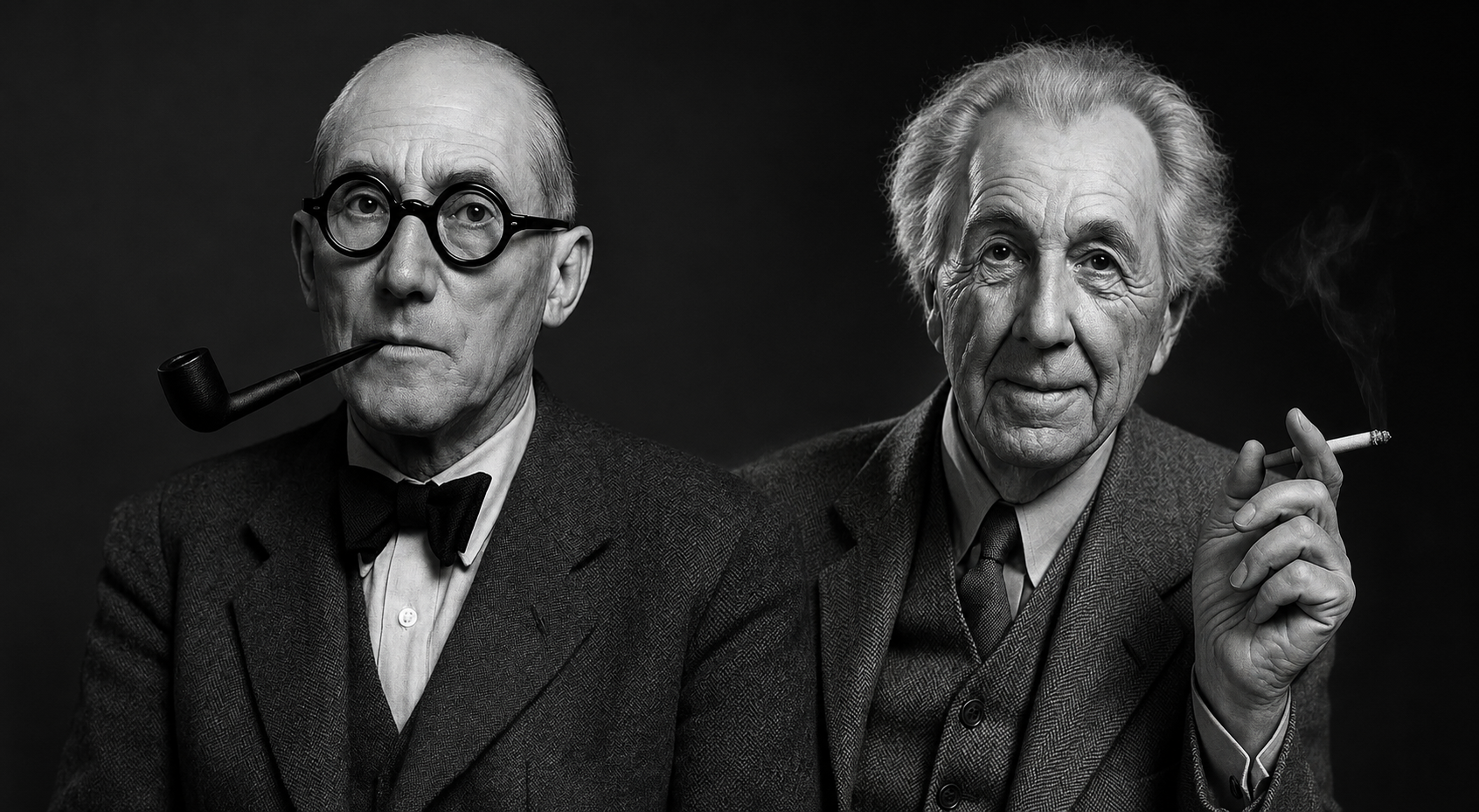
Illustration by ArchitectureCourses.org. Frank Lloyd Wright and Le Corbusier did not disagree over small style choices. They disagreed over what modern life should feel like: land, house, and human scale on one side; machine logic, city planning, and repeatable systems on the other.
Frank Lloyd Wright wanted architecture to grow from the land. Le Corbusier wanted architecture to reorganize the modern city.
That difference sounds clean until you look closer. Wright could be controlling while talking about nature and freedom. Le Corbusier could be brutal in his urban plans, but his best buildings also gave modern architecture some of its sharpest spatial ideas. Neither one fits neatly into hero worship.
Their argument still matters because it never really ended. A low house with long horizontal lines, built-in furniture, and indoor-outdoor flow still carries Wright’s shadow. A white concrete building lifted on columns, a modular apartment block, a roof terrace, or a city plan built around towers and circulation still carries Le Corbusier’s.
The useful comparison is not “who was better.” The better question is what each one solved, what each one broke, and what architects still copy without understanding.
Wright Began at the Ground
Frank Lloyd Wright saw the building as part of a larger living order: land, plan, hearth, structure, furniture, windows, roof, and movement tied together. He called this organic architecture. The phrase gets overused now, but in Wright’s best work it had teeth.
A Wright house was rarely placed on a lot as an object. It was composed as a relationship with the land. Low roofs stretched outward. Chimneys and fireplaces anchored the plan. Materials often carried the color and weight of the site. Walls opened and closed to control view, privacy, light, and movement.
The best Wright buildings do not feel like boxes arranged for convenience. They feel like a sequence. You compress, turn, enter, open, sit low, look out, and understand the house through movement.
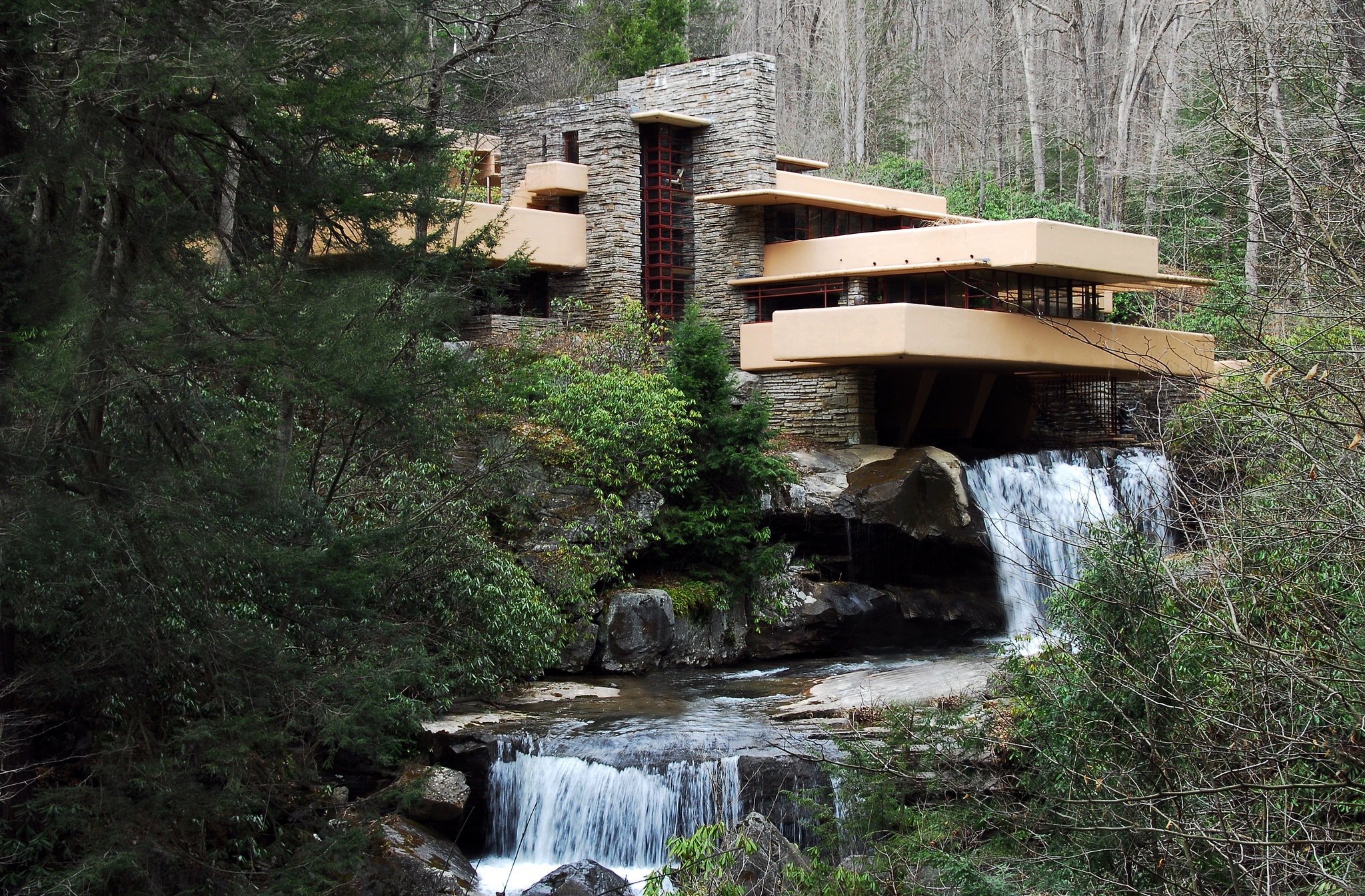
Fallingwater is the cleanest Wright example for many readers because the house does not only face nature. It builds the drama of the site into the structure, terraces, sound, and movement through the house.
Fallingwater is famous, but it can also mislead. It was a wealthy, highly specific commission, not a normal house. The better lesson is not “build over a waterfall.” The better lesson is that Wright treated site as an active force. Rock, water, sound, view, and horizontal concrete all become part of one architectural argument.
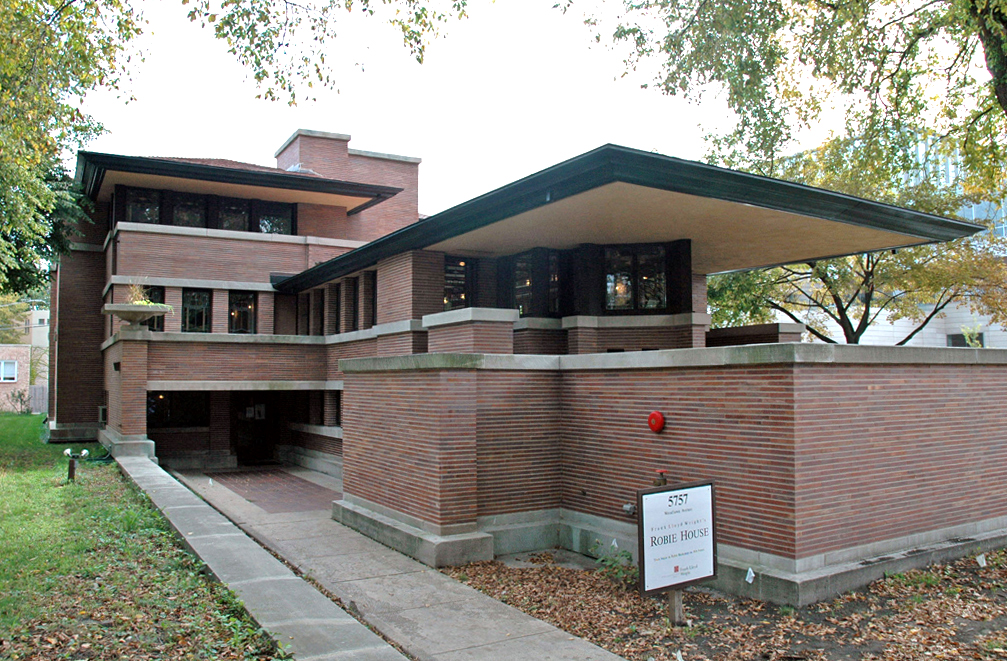
Robie House shows Wright’s Prairie logic more clearly: long rooflines, horizontal emphasis, protected edges, and rooms tied to movement across the site.
Robie House is more useful for understanding Wright’s Prairie period. The house is long, low, layered, and controlled. The roofline does serious work. It protects, stretches, compresses, and gives the house its horizontal force. Weak “Prairie-inspired” houses often fail here. They copy the long roof but lose the plan discipline underneath it.
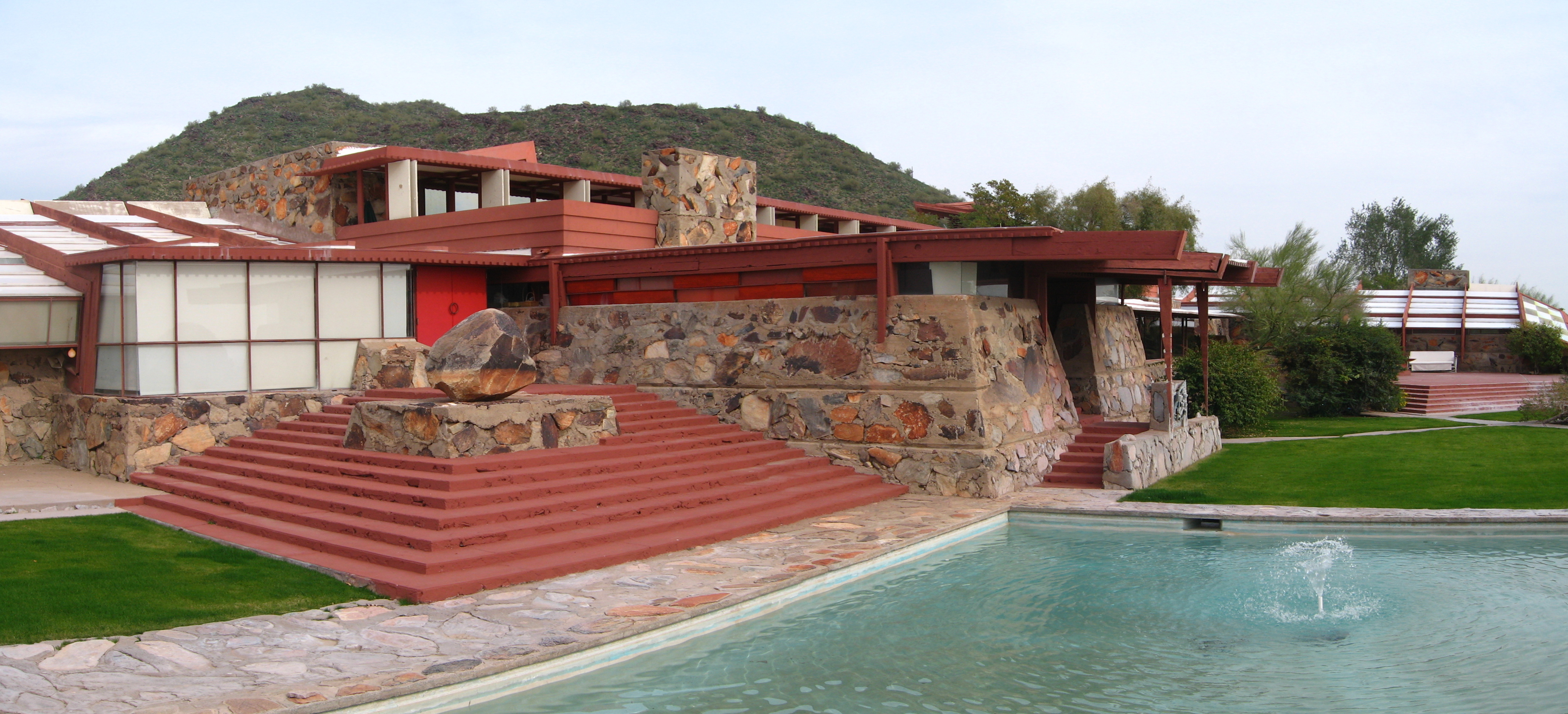
Taliesin matters because Wright’s architecture was not only a set of famous houses. It was also a working environment, school, studio, and long experiment in building a life around architecture.
Wright also designed furniture, lighting, windows, fabrics, and built-ins because he did not want the architecture to stop at the shell. That control produced some extraordinary interiors. It also came with a cost. The user entered a strong world, but it was Wright’s world.
Related reading: Frank Lloyd Wright gives the deeper profile if you want Wright’s career, houses, ideas, and contradictions in one place.
Le Corbusier Began With the System
Le Corbusier looked at the modern world and saw disorder: overcrowded cities, old streets, poor housing, inefficient plans, and architecture still tied to historical styles. His answer was not gentle. He wanted new rules.
His “machine for living” phrase is often repeated lazily, but it explains a real shift. Le Corbusier wanted architecture to learn from cars, ships, factories, airplanes, and industrial production. He cared about standardization, structure, circulation, sunlight, air, and the possibility of mass housing.
That ambition produced powerful buildings and dangerous planning ideas. The building as a machine can be liberating when it gives people light, space, sanitation, and a flexible plan. It becomes brutal when people are treated as units inside a diagram.
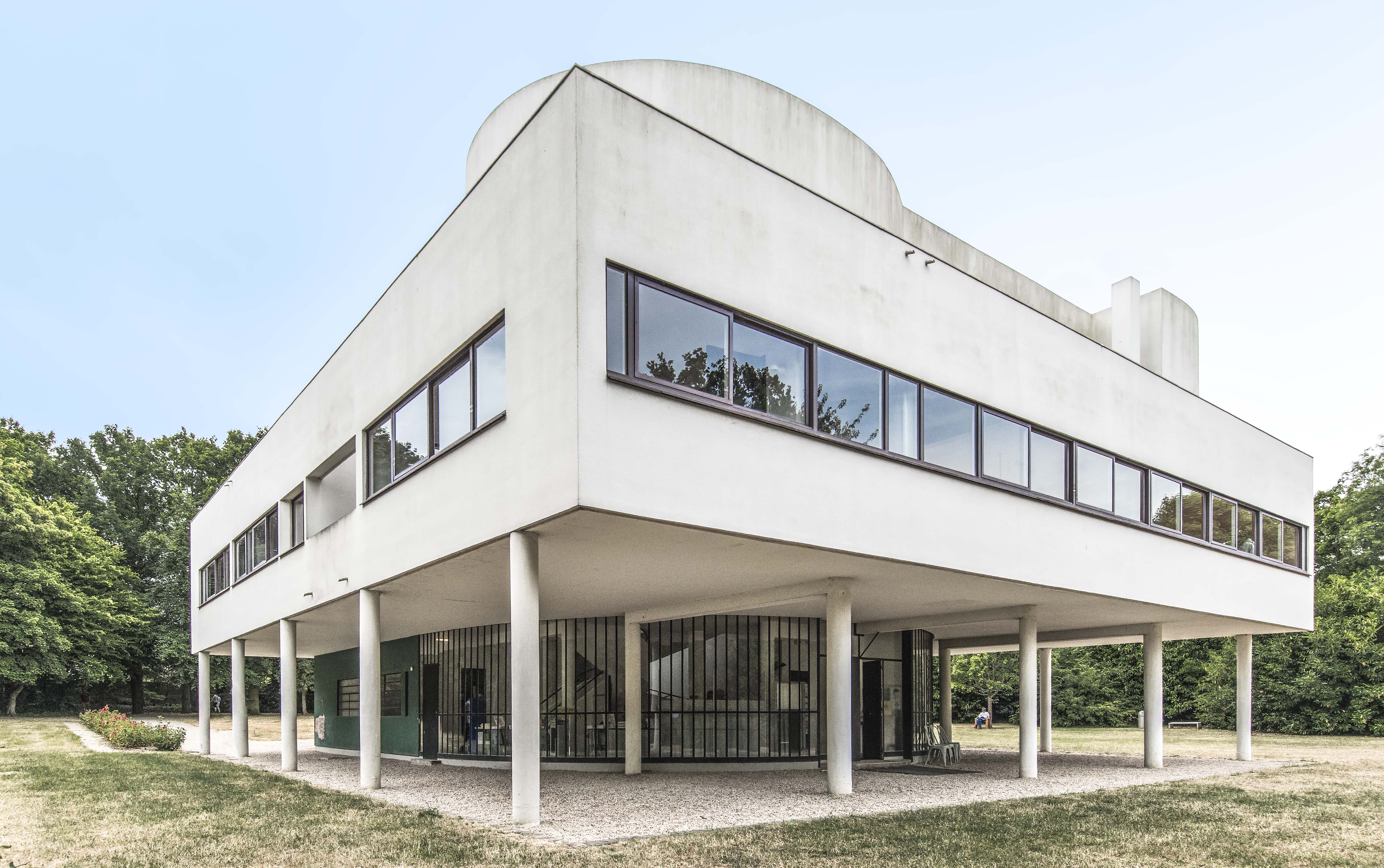
Villa Savoye is Le Corbusier’s Five Points in built form: pilotis, roof terrace, free plan, ribbon windows, and a facade released from traditional load-bearing walls.
Villa Savoye is the cleanest small building for understanding Le Corbusier’s early modern language. It is lifted on pilotis. The plan is freed from thick load-bearing walls. The roof becomes usable. The facade is treated as a skin. The window becomes a long horizontal strip.
The house is also a warning. A perfect diagram can still leak, age badly, or resist ordinary use. That does not erase the design’s importance. It makes the lesson sharper. Modern architecture cannot survive as a diagram alone.
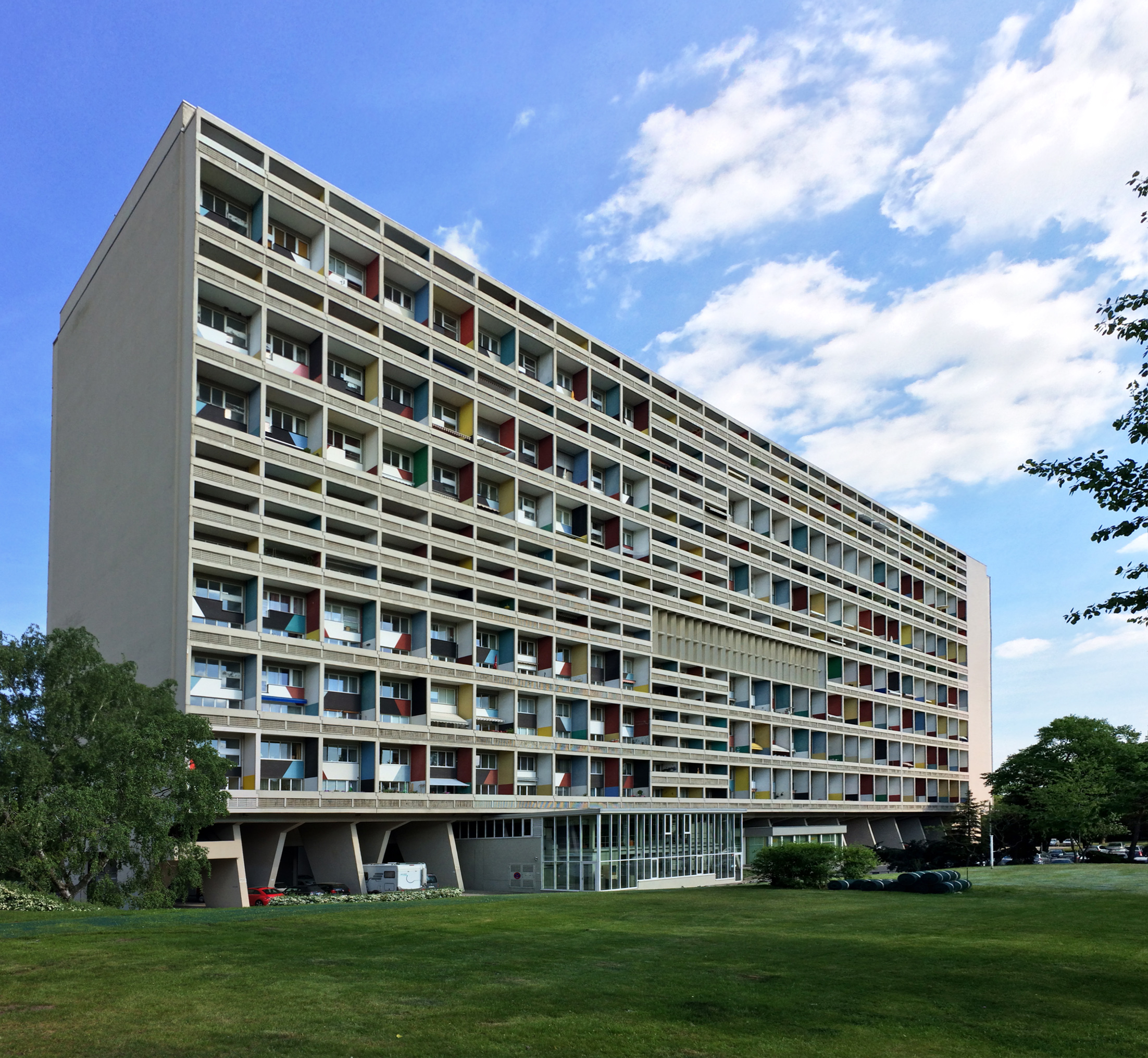
Unité d’Habitation shows Le Corbusier thinking at the scale of housing systems: repeated units, shared services, thick concrete, and the idea of the building as a vertical neighborhood.
Unité d’Habitation is where the argument gets bigger. Le Corbusier was not only designing objects. He was trying to design social order through housing, services, circulation, sunlight, and density. The idea was bold. The lived results of modernist mass housing were much more uneven.
Ronchamp matters because it breaks the lazy version of Le Corbusier. He was not only the architect of white boxes and pilotis. The chapel is heavy, curved, strange, and atmospheric. It proves that Le Corbusier’s career cannot be reduced to one slogan.
The Split Was Bigger Than Style
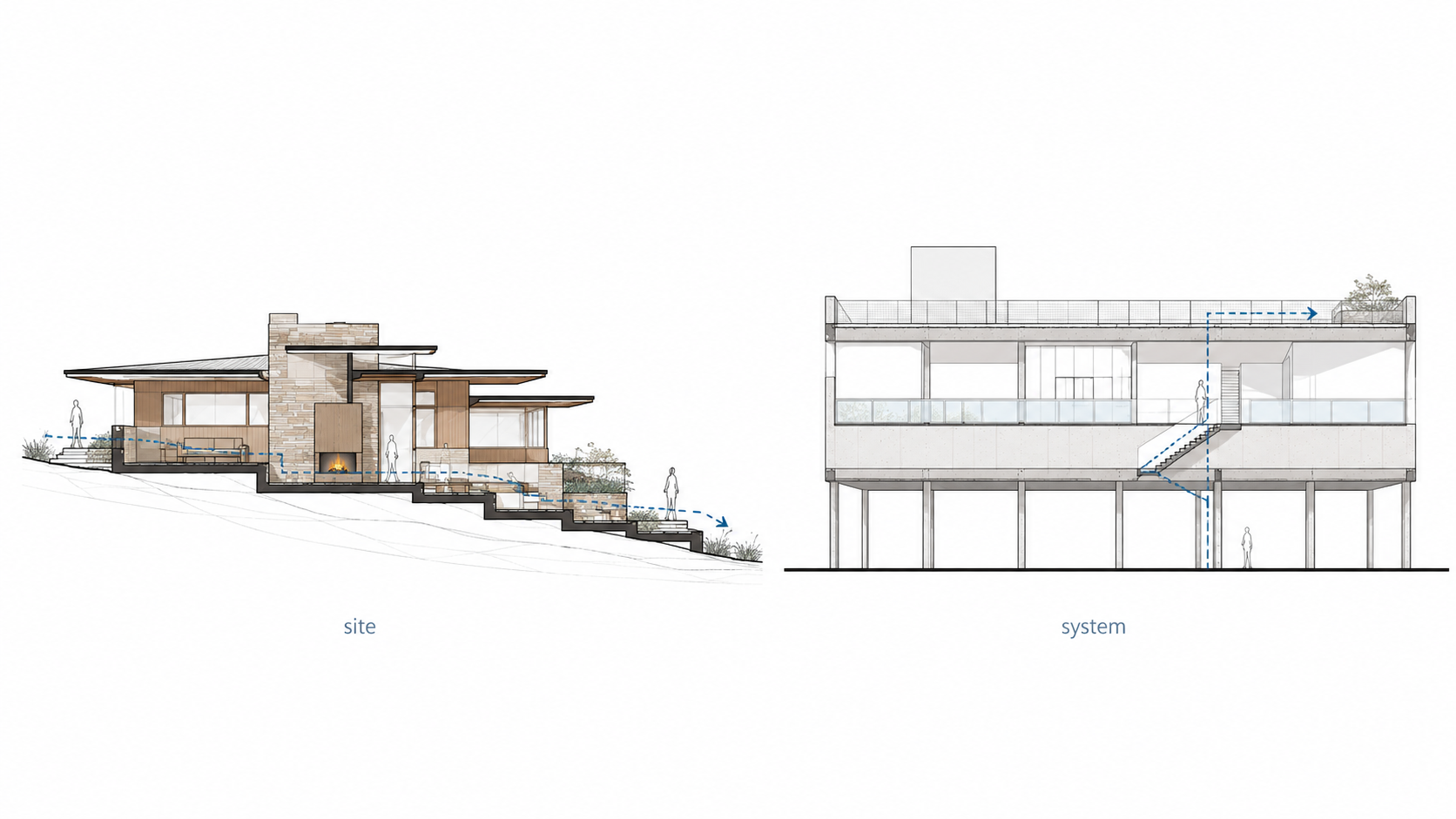
Illustration by ArchitectureCourses.org. The split between Wright and Le Corbusier was not just visual style. One approach ties movement, form, and shelter to the site, while the other organizes life through structure, grid, and system.
Wright and Le Corbusier both wanted to remake modern life. They just started from opposite assumptions.
| Question | Frank Lloyd Wright | Le Corbusier |
|---|---|---|
| Where does architecture begin? | With the site, landscape, hearth, movement, and the individual life inside the building | With structure, standards, circulation, sunlight, density, and the modern city |
| What should a house feel like? | Rooted, low, continuous, protected, personal | Open, rational, lifted, flexible, efficient |
| What is the danger? | The architect controls every detail and the house can become too personal, expensive, or hard to adapt | The system overpowers the person and the city becomes a diagram imposed from above |
| What did weaker followers copy? | Long roofs, stone, wood, built-ins, and “organic” language without site discipline | White boxes, pilotis, concrete frames, roof terraces, and urban megaplans without social care |
The table is blunt because the difference needs to be blunt. Wright’s best work starts with lived space. Le Corbusier’s best work starts with an architectural system. Both can produce great architecture. Both can also give lazy designers a dangerous shortcut.
Fallingwater vs Villa Savoye
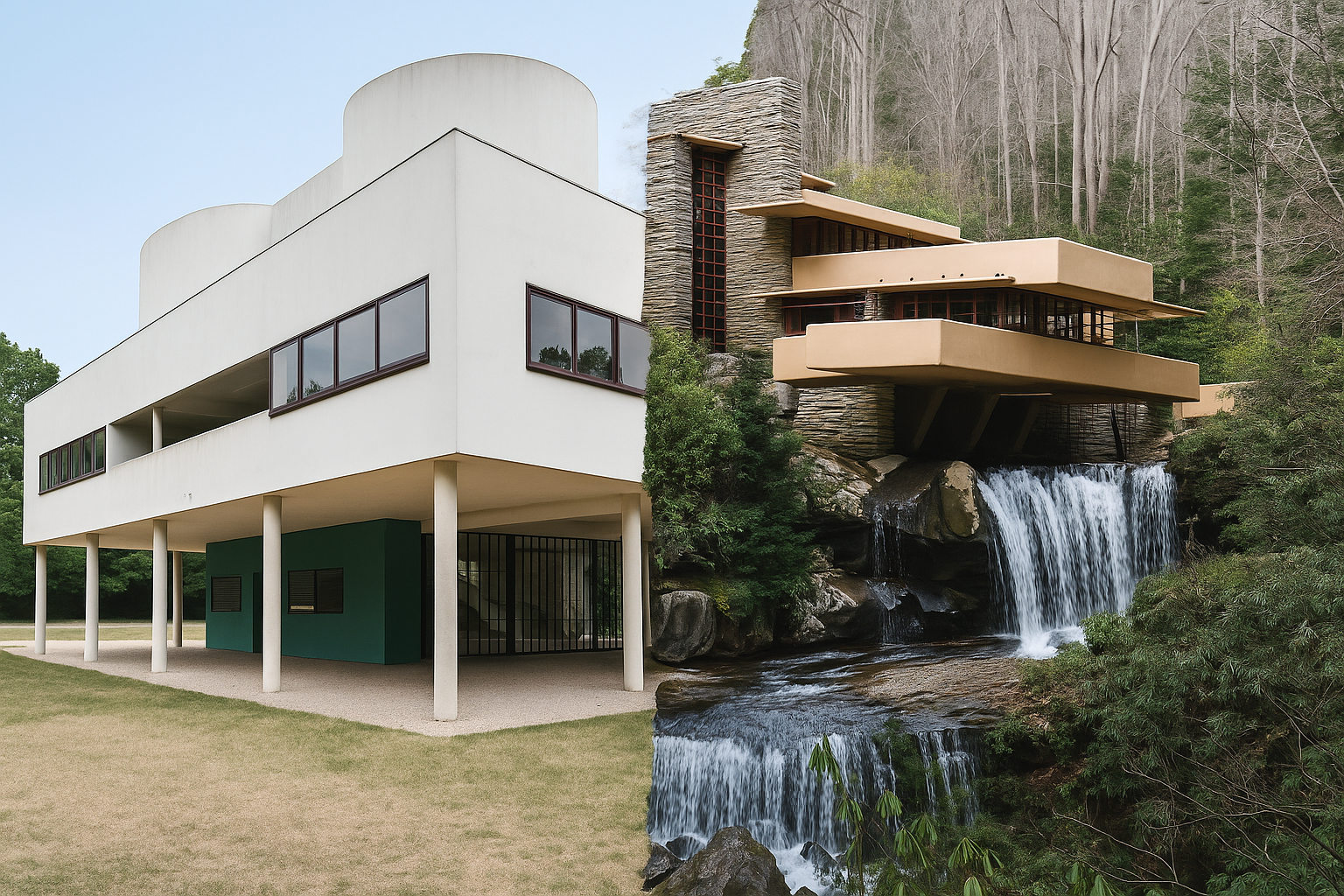
Fallingwater and Villa Savoye are useful together because they show two opposite instincts: one house presses into site and sound; the other lifts itself into an abstract modern system.
Fallingwater and Villa Savoye are the comparison everyone reaches for because it works. One seems to grow from rock, water, and forest. The other sits as a white machine above a lawn.
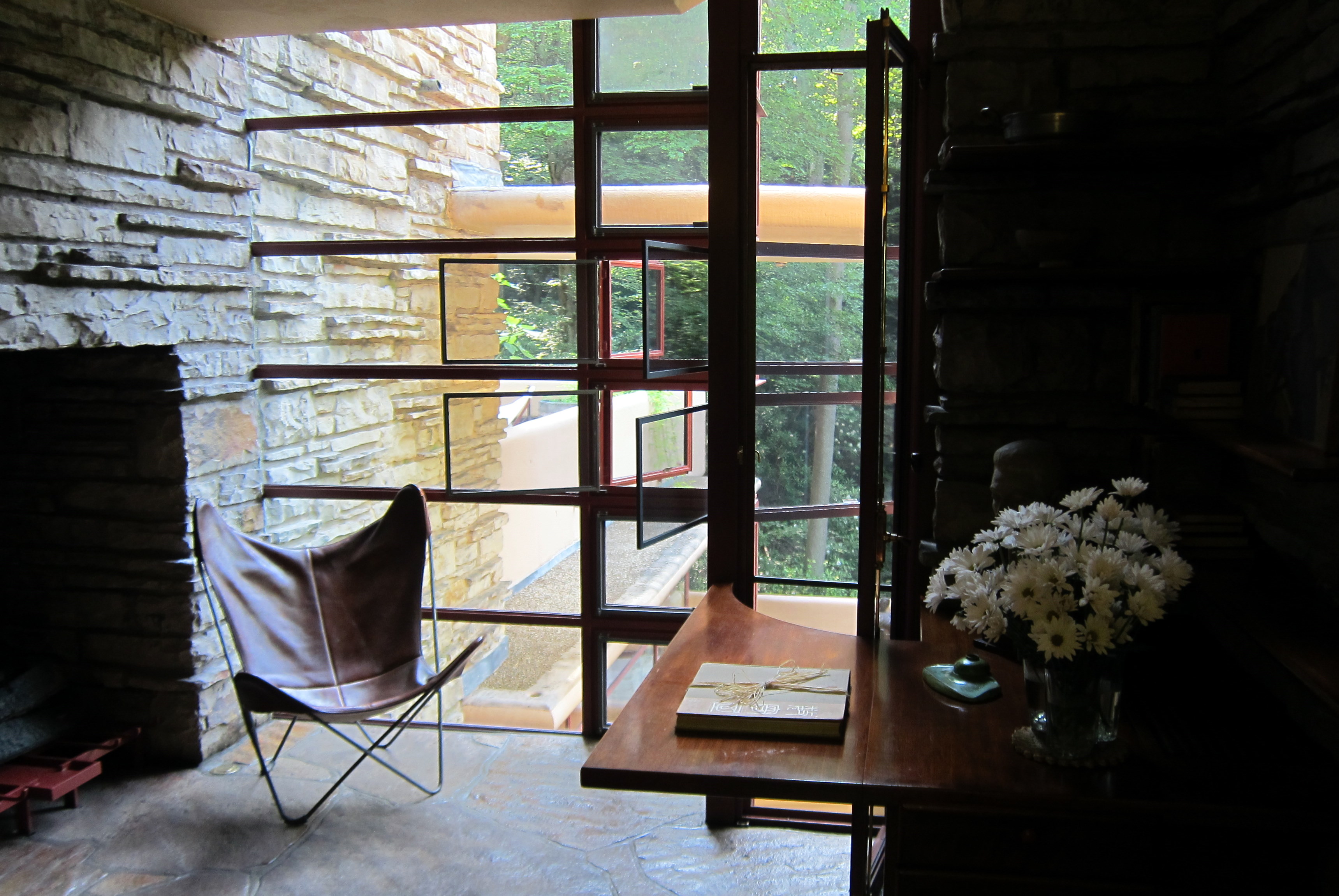
Fallingwater is not only a house with a dramatic site. Its terraces, structure, fireplace, stairs, and movement through the rooms all depend on the pressure of that site.
Wright made Fallingwater almost impossible to separate from its place. The sound of water matters. The stone matters. The cantilevers matter. The low ceilings and projecting terraces make the house feel tied to rock and stream, even when the engineering has been debated for decades.
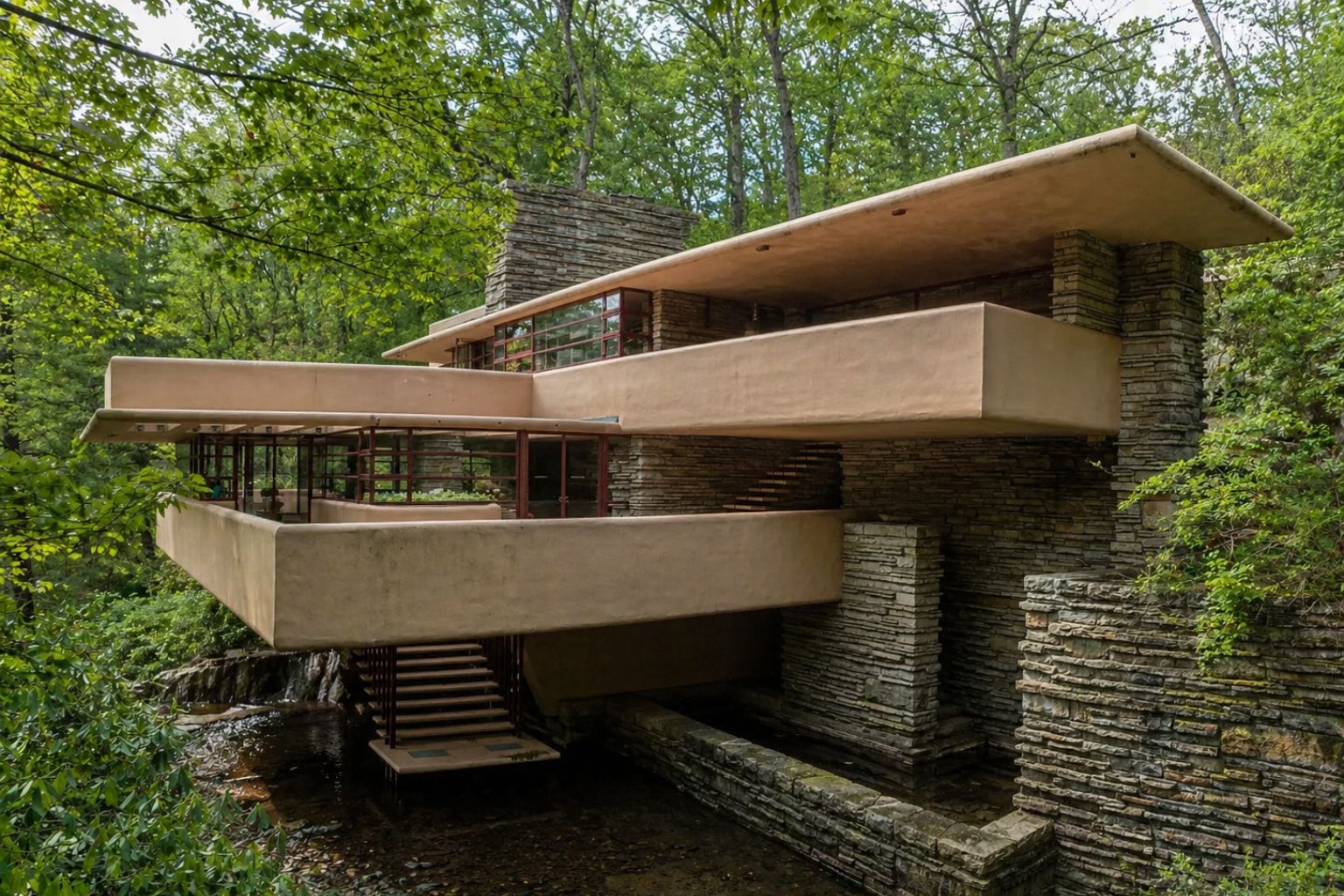
Villa Savoye is more useful as a built manifesto than as a comfortable house. Its value is in how clearly it shows Le Corbusier’s modern rules.
Villa Savoye does the opposite. It lifts, abstracts, orders, and separates. The land becomes something the building hovers above rather than something it grows from. The house is valuable because the idea is so clear. It is also vulnerable for the same reason. Once the idea meets weather, use, and maintenance, the clean diagram has to answer harder questions.
The real lesson is not which house is prettier. It is what each one asks the site to do. Fallingwater makes the site part of the architecture. Villa Savoye makes the site a field for the architectural system.
Usonian House vs Maison Citrohan
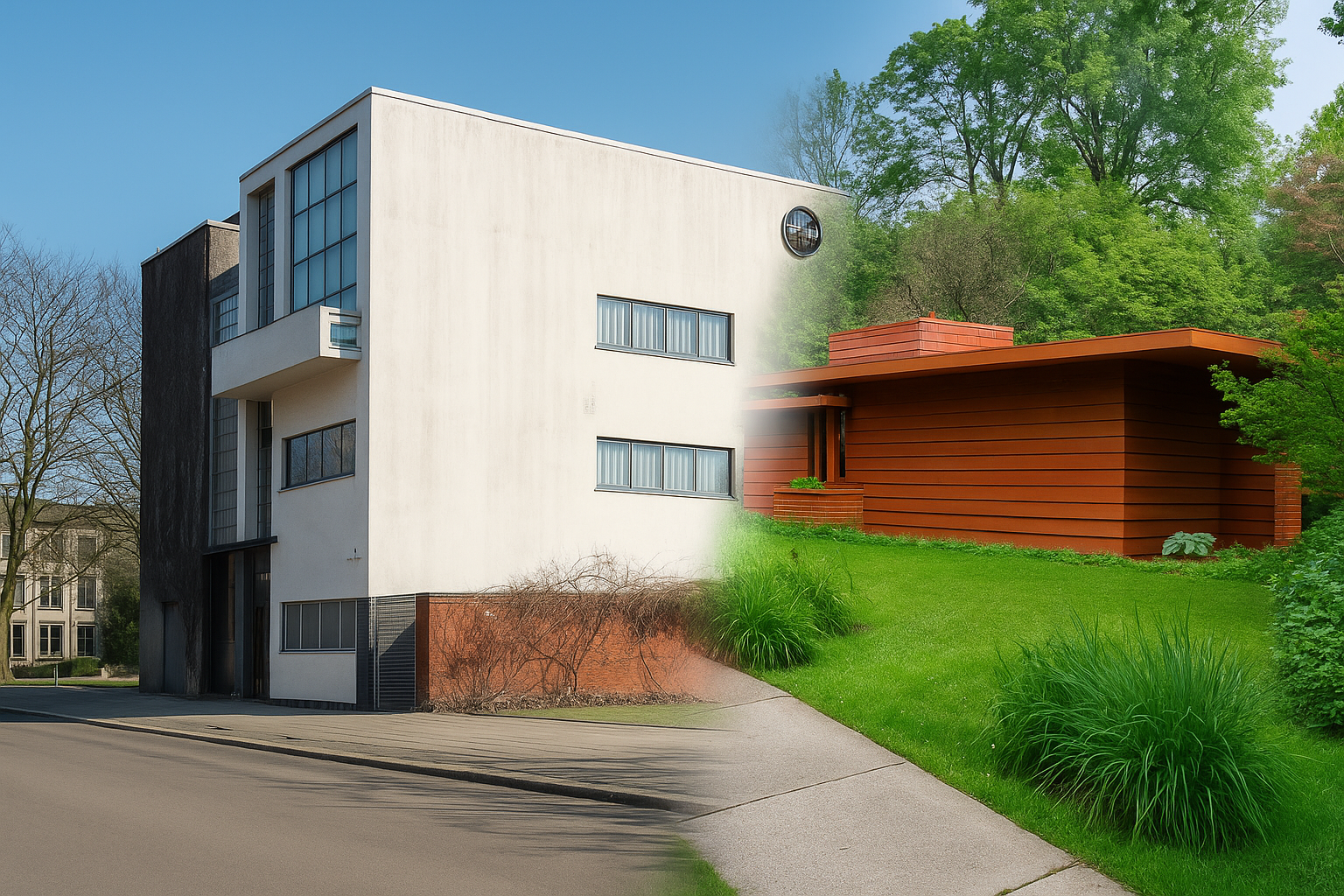
Wright’s Usonian houses and Le Corbusier’s Maison Citrohan both aimed at modern housing, but one was rooted in domestic life while the other treated the house as a repeatable industrial type.
Wright’s Usonian houses were his attempt to make a more affordable American house: smaller, simpler, lower, with built-ins, slab floors, radiant heat, carports, open living areas, and a strong relationship to the site.
Le Corbusier’s Maison Citrohan was a different kind of answer. It was a prototype, a house imagined with industrial repetition in mind. It used a compact volume, roof terrace, open interior, and the logic of mass production.
Both were trying to escape old domestic habits. Wright wanted a house that felt personal and grounded without being decorative. Le Corbusier wanted a housing type that could be repeated, improved, and scaled.
Where this usually goes wrong in student work is the word “affordable.” Wright’s Usonian houses were not cheap in a careless way. They reduced and controlled. Le Corbusier’s prototypes were not simple boxes because the architect lacked imagination. They were attempts to make housing think like an industrial product.
Usonian Houses vs the Dom-Ino System
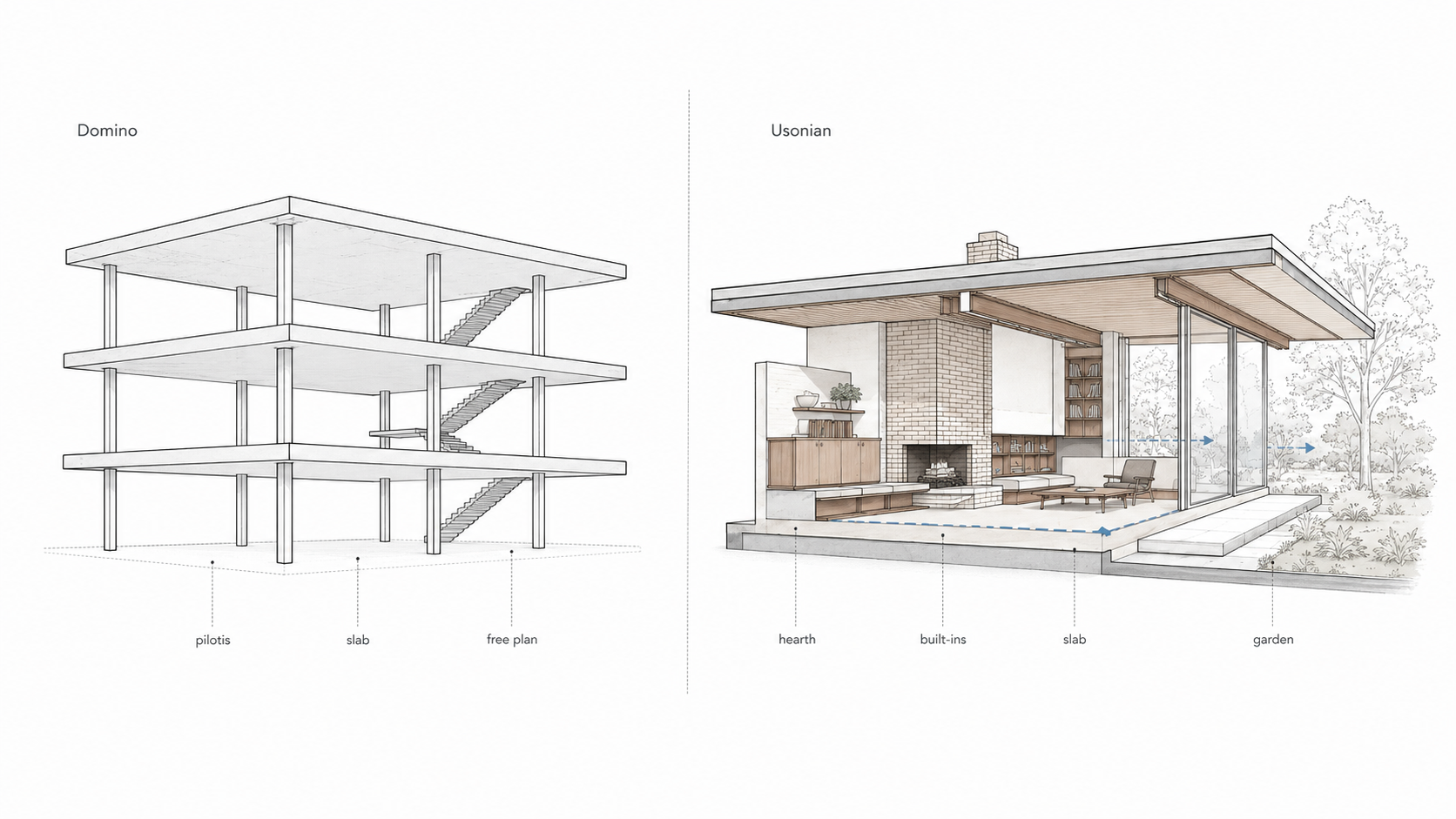
Illustration by ArchitectureCourses.org. The Dom-Ino frame treats the building as an open structural system of slabs and columns. The Usonian house works in the opposite direction, tying structure, hearth, built-ins, slab, roof, and garden into one low domestic space.
Wright’s Usonian idea stayed close to the ground. It looked at the middle-class house, the family, the daily plan, the built-in storage, the slab, the car, and the relation to garden and street.
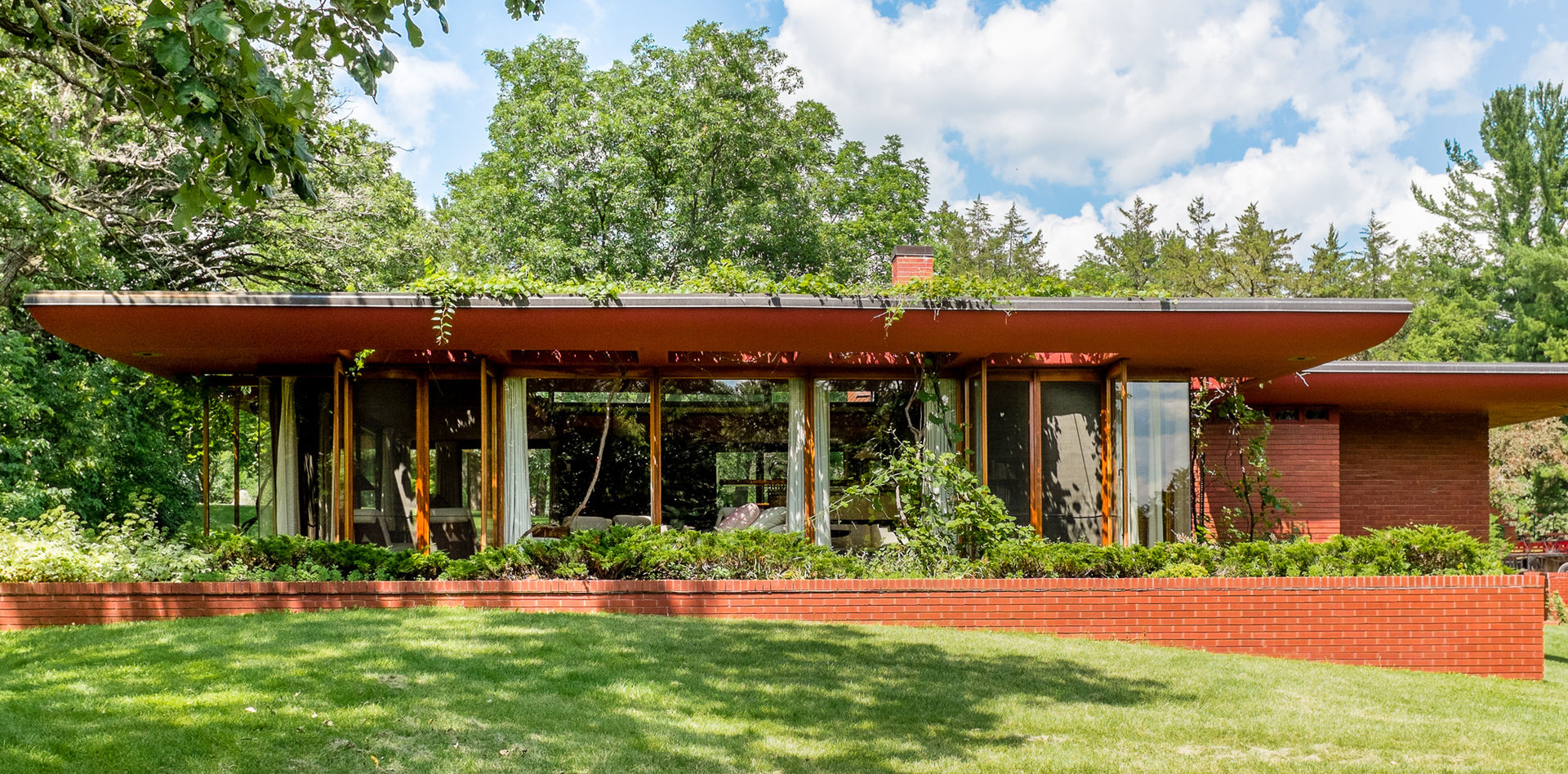
Usonian houses often worked through horizontality, compact planning, built-ins, and an attempt to make modest domestic space feel intentional rather than leftover.
Le Corbusier’s Dom-Ino system stripped architecture back to frame, slab, stair, and columns. It was not a house style. It was an idea about structural freedom. Once walls no longer carried the whole load, the plan and facade could change.
That idea reshaped modern architecture far beyond anything Wright would have accepted. The concrete frame made new kinds of apartments, offices, schools, and housing blocks possible. It also made lazy architecture possible: open slabs with dead plans, blank facades, bad proportions, and no real care for life inside.
Broadacre City vs Radiant City
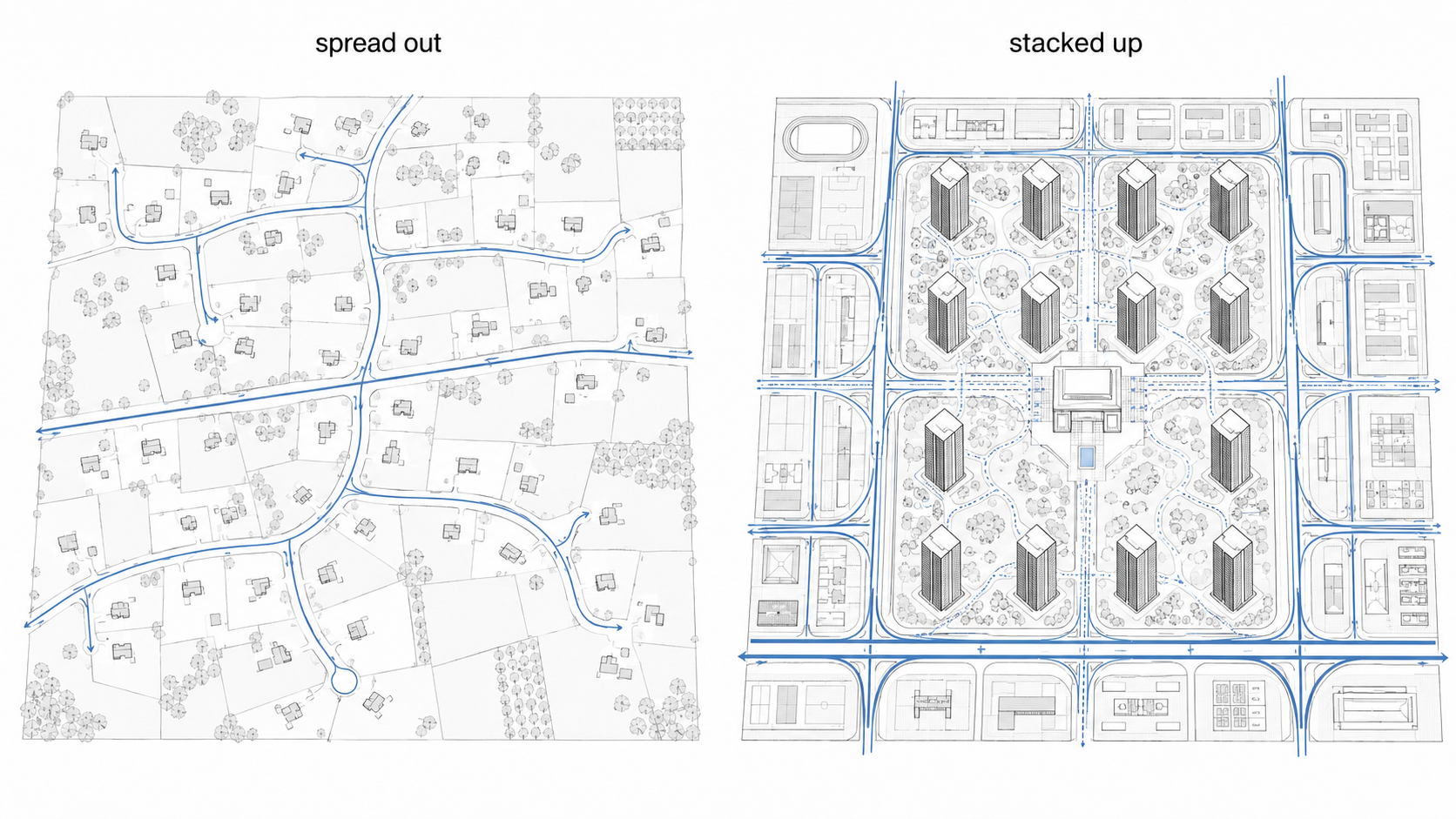
Illustration by ArchitectureCourses.org. Broadacre spreads houses and roads across large plots, while Radiant City concentrates towers into centralized superblocks. The comparison shows why one tends toward sprawl and the other toward top-down urban control.
Their urban visions are where both architects become harder to defend cleanly.
Wright’s Broadacre City imagined a decentralized landscape where families had land, cars gave mobility, and the city dissolved into a more spread-out democratic order. It sounds attractive if you hate dense urban crowding. It also points straight toward sprawl, car dependence, infrastructure waste, and land consumption.
Le Corbusier’s Radiant City moved in the opposite direction: towers, open space, separation of uses, height, sunlight, order, and top-down planning. It promised cleanliness and efficiency. It also gave later planners a dangerous excuse to erase old neighborhoods and replace them with abstract superblocks.
This is the section people skip when they turn Wright and Le Corbusier into poster figures. Their city ideas were not harmless drawings. They helped shape real arguments about highways, density, zoning, towers, suburbs, public space, and who gets displaced when a planner’s diagram becomes policy.
The protective question is simple: who pays for the vision after the drawing leaves the studio?
Guggenheim vs Carpenter Center
Wright’s Guggenheim Museum and Le Corbusier’s Carpenter Center are useful because both architects used movement as architecture.
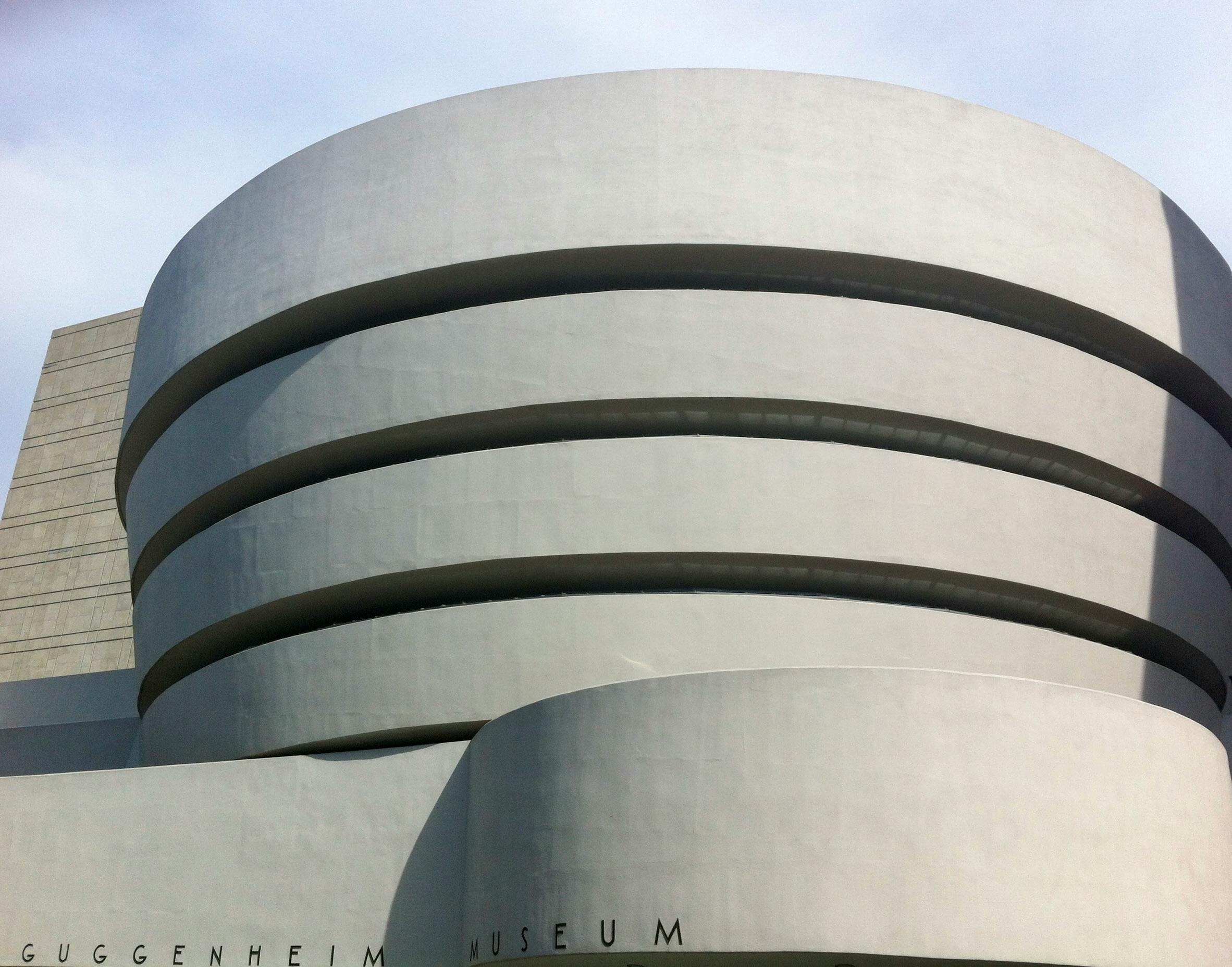
The Guggenheim turns museum movement into one continuous spatial idea. The strength is memorable circulation; the problem is that art does not always want to obey the ramp.
The Guggenheim makes the visitor move through one strong idea: a spiral ramp around a central void. It is brilliant as space. It has also been criticized because the architecture is so powerful that it can compete with the art. That is Wright’s gift and his risk in one building.
Carpenter Center, Le Corbusier’s only building in North America, also uses ramps, pilotis, and movement as part of the form. It is less famous than the Guggenheim but useful in a different way. It shows Le Corbusier bringing his circulation ideas into an institutional setting where movement, studio work, and visual arts overlap.
Both buildings prove that circulation is not only a code requirement or a hallway problem. It can become the building’s main idea. The danger is when the route becomes stronger than the use.
What Their Followers Got Wrong
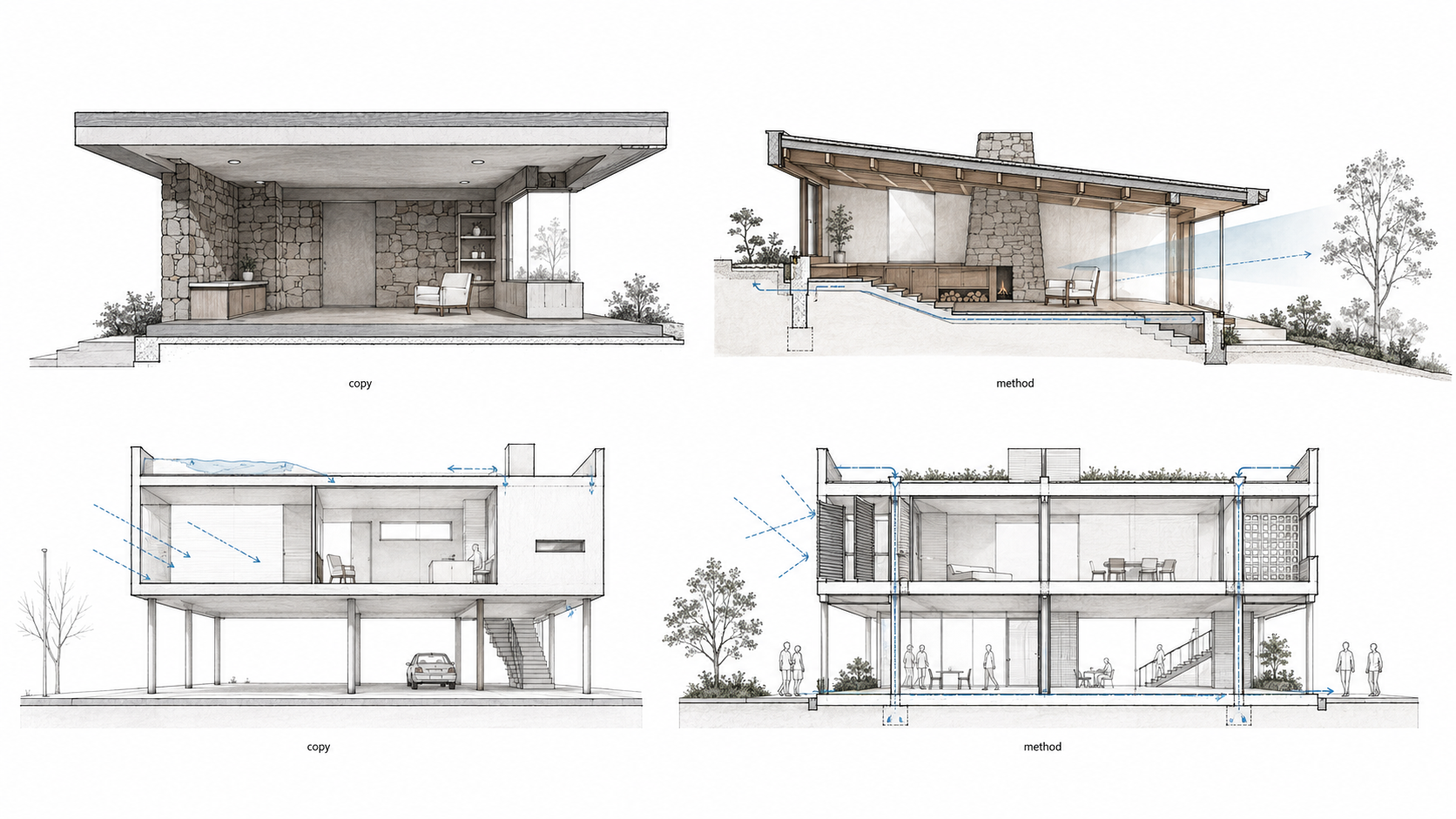
Illustration by ArchitectureCourses.org. Followers often copied Wright’s low roofs and stone or Le Corbusier’s white boxes and pilotis without understanding the real method. The better lesson is in site response, daylight control, drainage, structure, privacy, movement, and useful ground-level space.
Wright and Le Corbusier are both dangerous teachers because their work is easy to copy badly.
Wright’s weaker followers copy stone, wood, low roofs, horizontal windows, and the language of “organic” design. Then the plan still behaves like a normal builder house. The roof is heavy but not disciplined. The site is landscaped after the fact. The built-ins are decorative. The house says “nature” but does not know where the sun, slope, water, privacy, or movement are.
Le Corbusier’s weaker followers copy white walls, pilotis, roof terraces, ribbon windows, and concrete frames. Then the building leaks, overheats, feels blank at the street, or treats the user like an abstract figure in a diagram. The roof terrace is useless without drainage and access. The pilotis create dead space if the ground level has no public life. The free plan does not help if nobody understands how people live inside it.
The hidden lesson is the same for both men: the visible style is the easy part. The discipline underneath is where the architecture lives.
What Still Shapes Homes and Cities
Wright is still present in open plans, indoor-outdoor living, long rooflines, built-ins, warm materials, site-specific houses, and the idea that a home should feel personal rather than generic.
Le Corbusier is still present in modular housing, concrete frames, roof terraces, pilotis, towers in open space, urban master plans, and the belief that architecture can operate as a repeatable system.
Neither legacy is clean. Wright’s domestic intimacy can become expensive, controlling, and hard to adapt. Le Corbusier’s system thinking can become cold, bureaucratic, and destructive when it ignores existing neighborhoods. Both architects gave modern design tools that still work. Both also gave later designers excuses for bad buildings.
That is why this comparison still matters. It shows up whenever a designer chooses between site and system, household and city, hand and machine, lived detail and repeatable rule.
Books Worth Having
Keep the reading list tight. A page like this can turn into a bookstore if every famous title gets added. The better move is to recommend a few books that help the reader understand the comparison.
For Wright: Frank Lloyd Wright: The Houses is useful because Wright’s domestic work is where many readers first understand his architecture. The houses show site, plan, roof, furniture, and material working together.
For Le Corbusier: Towards a New Architecture is still the direct source for his early machine-age argument. Read it as a manifesto, not as neutral history.
For reading beyond both: Complexity and Contradiction in Architecture by Robert Venturi is useful because it pushes back against the clean heroic simplicity that both Wright and Le Corbusier can encourage in different ways.
FAQ
Who was more influential, Frank Lloyd Wright or Le Corbusier?
It depends on the field. Wright had enormous influence on houses, organic architecture, Prairie Style, Usonian homes, and American domestic space. Le Corbusier had deeper influence on modernist theory, urban planning, mass housing, concrete frames, and the International Style.
Did Frank Lloyd Wright and Le Corbusier meet?
Their careers overlapped, and they were aware of each other, but the useful comparison is not personal friendship. It is the clash between Wright’s site-based organic architecture and Le Corbusier’s system-based modernism.
What is the biggest difference between Wright and Le Corbusier?
Wright usually began with land, house, movement, material, and the individual experience of space. Le Corbusier usually began with structure, standardization, circulation, light, and the larger problem of the modern city.
Which architect is more relevant today?
Both. Wright matters whenever architects talk about site, landscape, indoor-outdoor living, and human-scale housing. Le Corbusier matters whenever architects discuss density, modular systems, urban planning, concrete frames, and mass housing.
Was Le Corbusier only a modernist box architect?
No. Villa Savoye supports that stereotype, but Ronchamp breaks it. His career includes white villas, urban plans, housing blocks, religious architecture, furniture, theory, and sculptural late work.
Was Wright only an organic architect?
No. Organic architecture is central to Wright, but he was also a planner, furniture designer, writer, teacher, and relentless controller of the total environment.
As an Amazon Associate, ArchitectureCourses.org earns from qualifying purchases at no extra cost to you.
Read This Next
- Frank Lloyd Wright is the deeper profile to read if Wright’s houses, organic architecture, and contradictions are the main interest.
- Alvar Aalto is a useful next comparison because he softened modernism through light, wood, furniture, acoustics, and human comfort.
- Norman Foster shows a later version of system-driven architecture, with technology, structure, and global practice replacing Le Corbusier’s early machine-age model.
- Most Famous Modern Architects should act as the broader cluster page for Wright, Le Corbusier, Aalto, Foster, Calatrava, and other major figures.
- Top 10 Famous Architects You Need to Know is the broader entry point for readers comparing major architect names.