
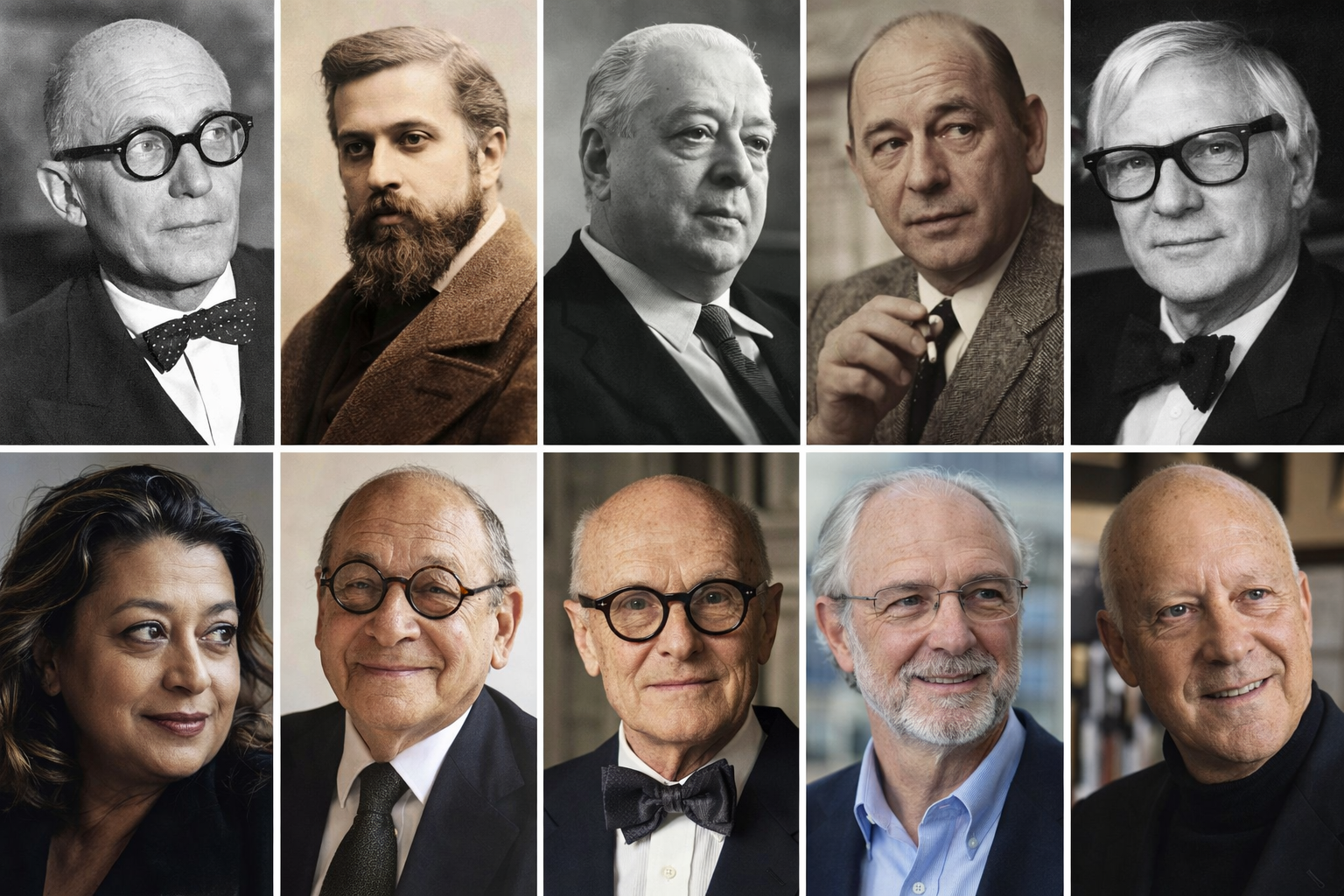
Most “top architect” lists turn into brochure copy. This one does not.
These ten are worth studying because each one solved a problem in a way you can still use in studio or practice. Not hero worship. Just pattern recognition. What they kept returning to, what they cared about most, and what still works after value engineering and actual use.
For each architect, start with one key project, the main move in plain language, and the misread that keeps students stuck.
Quick Map
10 Architects Worth Studying
A fast way to pick who to study based on the skill you’re trying to build.
| Architect | Best Known For | Start With | What To Steal |
|---|---|---|---|
| Frank Lloyd Wright | Organic space and flow | Fallingwater | How plans follow landscape |
| Le Corbusier | Modernist systems | Villa Savoye | Clear rules for plan and facade |
| Zaha Hadid | Form as movement | Heydar Aliyev Center | Continuous surfaces and circulation |
| Renzo Piano | Lightweight clarity | Centre Pompidou | How structure becomes legible |
| Jean Nouvel | Context and atmosphere | Louvre Abu Dhabi | Light control as architecture |
| Tadao Ando | Minimalism with impact | Row House (Sumiyoshi) | Light, shadow, and restraint |
| Norman Foster | High-tech performance | 30 St Mary Axe | Systems thinking and efficiency |
| Mies van der Rohe | Precision minimalism | Barcelona Pavilion | Detail discipline |
| Rem Koolhaas | Program and urban logic | Seattle Public Library | How to design the “mess” |
| Santiago Calatrava | Structure as sculpture | Milwaukee Art Museum | Expressive structural rhythm |
The 10 Architects
Each entry is intentionally short. Study the work, then reverse-engineer the decisions.
Frank Lloyd Wright
Why He Matters: Wright made “space” the main event. Not rooms as boxes, but sequences, compression, release, view control, and material continuity.
Start With: Fallingwater (1935). The lesson isn’t just “built over a waterfall.” It’s how terraces, structure, and approach choreography turn the site into the plan.
If you want a deeper profile with more context and projects, see Frank Lloyd Wright’s key works and ideas.
Le Corbusier
Why He Matters: He turned architecture into a system of decisions you can name and test. That’s useful when design gets chaotic.
Start With: Villa Savoye (1929–31). Read it as a set of rules: lifted volume, free plan, ribbon windows, roof terrace, and a facade that behaves like a skin.
Common Misread: Treating modernism as a “look.” The better lesson is how constraints become a clear framework. If you like head-to-head comparisons, Wright vs. Le Corbusier is a useful contrast study.
Zaha Hadid
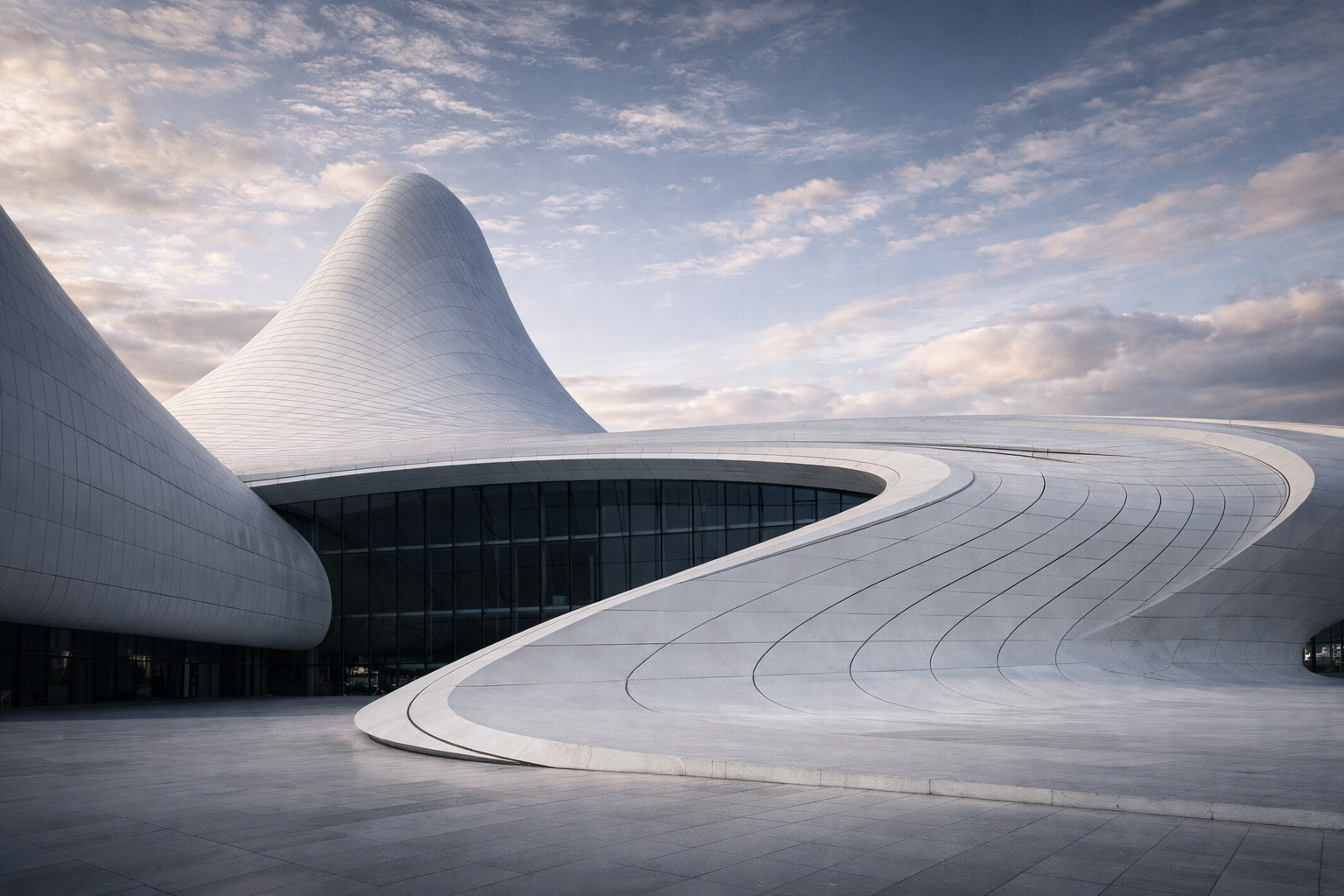
Why She Matters: Hadid pushed form and circulation into one continuous idea. The building isn’t an object you walk into; it’s a landscape you move through.
Start With: Heydar Aliyev Center (2012). Study the transitions: floor-to-wall-to-roof continuity and how the interior routes are shaped by the geometry.
Common Misread: Chasing curves as a style choice. The better takeaway is: geometry serving movement, program, and hierarchy.
Renzo Piano
Why He Matters: Piano makes complex buildings feel calm because structure, skin, and services become readable. He’s a master of “nothing looks accidental.”
Start With: Centre Pompidou (1977, with Richard Rogers). It’s not just “inside-out.” It’s a diagram of how buildings work, turned into architecture.
Common Misread: Thinking the lesson is exposure for shock value. It’s actually clarity: systems are organized, not dumped.
Jean Nouvel
Why He Matters: Nouvel treats light as a building material. Atmosphere isn’t decoration; it’s performance.
Start With: Louvre Abu Dhabi (2017). The dome isn’t a gesture. It’s environmental control: shade, filtered daylight, and a microclimate idea expressed as form.
Common Misread: Calling it “mood” and stopping there. The real move is measured: how light is shaped, timed, and controlled.
Tadao Ando
Why He Matters: Ando proves restraint can still hit hard. Minimal elements, maximal spatial effect.
Start With: Row House in Sumiyoshi (1976). Study the courtyard cut and the way the plan forces you to experience weather, light shifts, and threshold.
Common Misread: Copying “smooth concrete” as a look. The lesson is sequencing, proportion, and how light defines the room.
Norman Foster
Why He Matters: Foster brings engineering and architecture into the same sentence. Not as aesthetics. As performance: structure, ventilation, daylight, and buildability.
Start With: 30 St Mary Axe (2003). Focus on the logic of the form: what it does for structure and environmental strategy, not just the skyline silhouette.
If you want the longer arc of his approach and why it changed the industry, how Norman Foster reshaped modern architecture is the right follow-up.
Mies van der Rohe
Why He Matters: Mies teaches discipline. When you remove noise, the remaining details have to be precise.
Start With: Barcelona Pavilion (1929). It’s a lesson in planes, columns, and the choreography of movement. Simple on paper. Hard to do well.
Common Misread: “Less is more” as minimal taste. It’s actually alignment, junctions, tolerances, and material honesty.
Rem Koolhaas
Why He Matters: Koolhaas deals with the real mess: program overload, urban pressure, and cultural contradiction. He designs the collision, not a clean fantasy.
Start With: Seattle Public Library (2004). It’s a program diagram made spatial. Study how uses stack, separate, and connect without turning into chaos.
For a tighter read on his “bigness” logic and why it’s not just provocation, see Koolhaas on chaos and control.
Santiago Calatrava
Why He Matters: Calatrava shows what happens when structure becomes the main aesthetic driver. His work is a lesson in rhythm, repetition, and expressive framing.
Start With: Milwaukee Art Museum (2001). Study the structural language and the way movement (real or implied) shapes experience.
If you want a focused breakdown of his approach, Calatrava’s “moving building” mindset is a solid companion.
What To Learn From This List
Pick one architect based on the skill you’re weak at, then copy the method, not the image.
- If your plans feel dead: study Wright and Mies for sequence and proportion.
- If your buildings feel “styled” but not coherent: study Piano for system clarity.
- If your forms don’t help circulation: study Hadid for movement-driven geometry.
- If your projects collapse under complex program: study Koolhaas for organization.
- If your work lacks atmosphere: study Nouvel for light control.
FAQ
Do students need to copy famous architects?
Copy the thinking, not the look. Reverse-engineer why a plan works, how a section behaves, and what the building is optimizing under constraints.
Which architect should I study first?
Start with the one whose weakness matches yours. If you don’t know your weakness, start with Mies. Minimalism exposes every mistake.
Are these the best architects ever?
It’s a useful ten, not a final verdict. The point is range: site logic, systems, light, program, structure, and detail discipline.
What’s the fastest way to learn from a building?
Trace the plan, then trace the section, then mark the circulation path. After that, write one paragraph on what the building is prioritizing.