
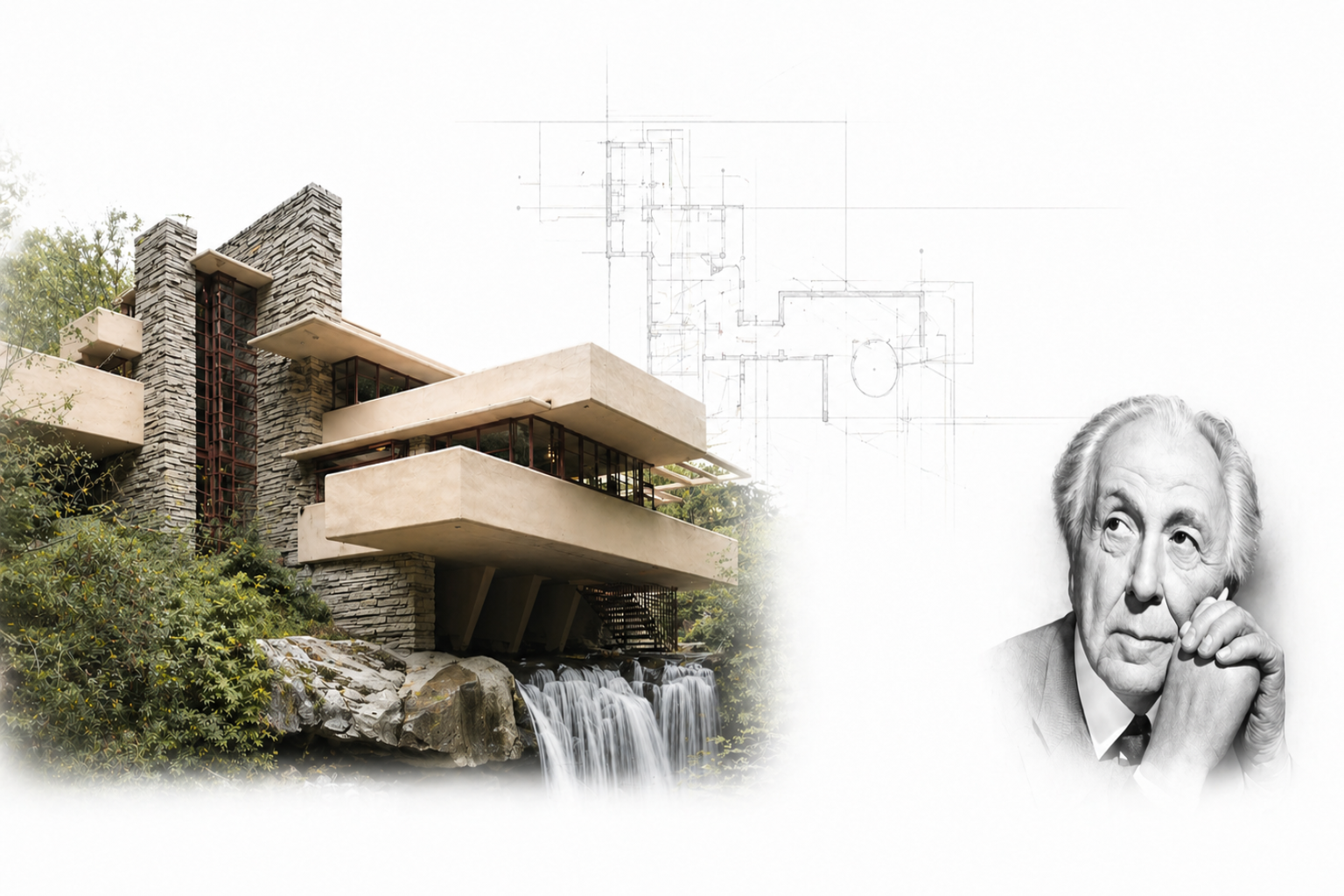
Frank Lloyd Wright was born in 1867 in Richland Center, Wisconsin, and died in 1959 in Scottsdale, Arizona, six months before the Guggenheim Museum opened. In between, he designed over a thousand projects, survived scandal and personal tragedy twice over, burned through money and relationships at a rate that should have ended his career multiple times, and produced a body of work that still pulls architects and students to study it more than sixty years after his death.
He never finished high school. He attended the University of Wisconsin briefly, studying civil engineering, then left without a degree. By 22, he had his own practice. By 30, he had invented a new architectural language.
Timeline
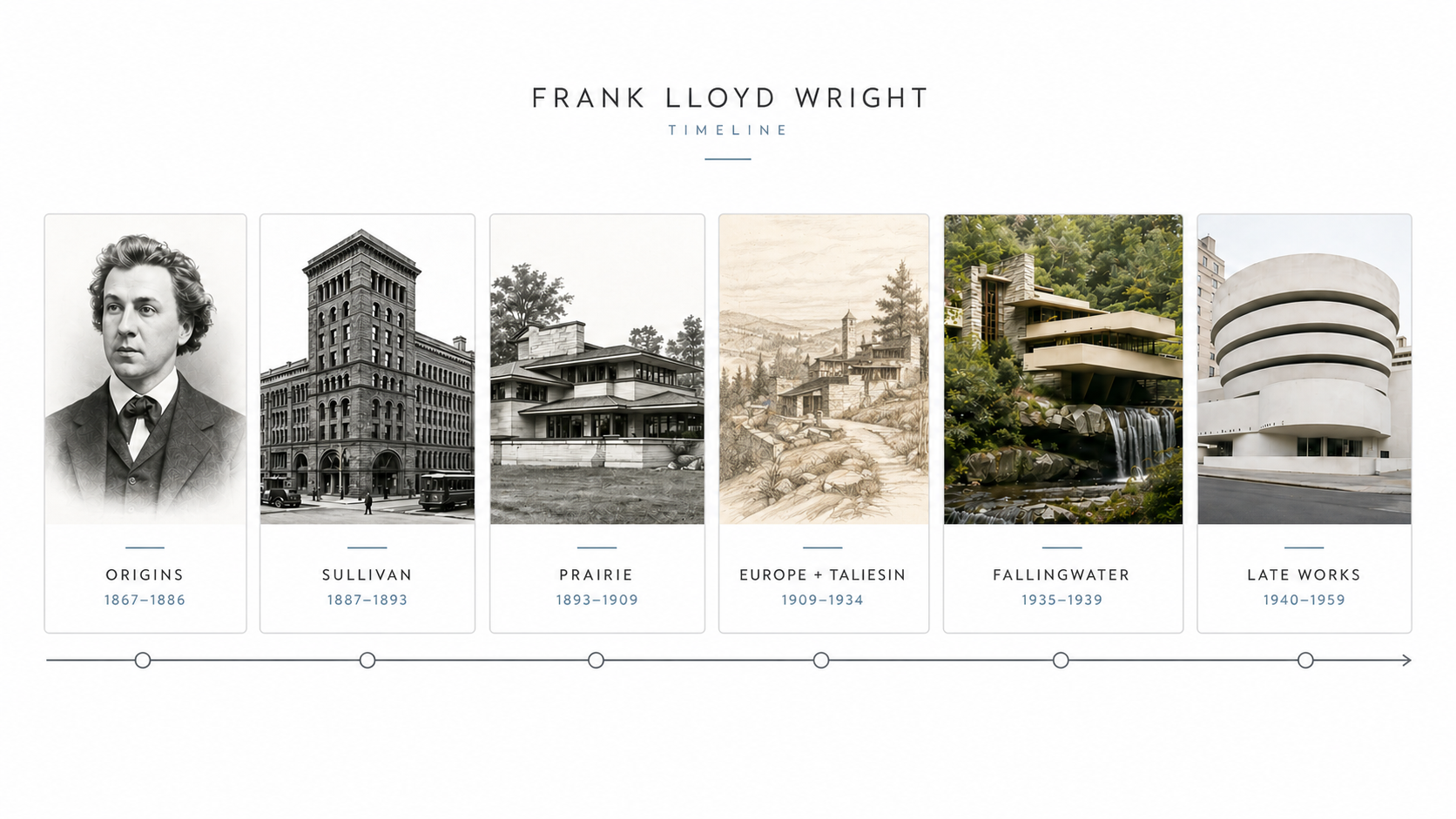
Illustration by ArchitectureCourses.org. This timeline shows Frank Lloyd Wright’s major career phases, from his early years and Sullivan period through the Prairie era, Taliesin, Fallingwater, and his late works.
1867–1886: Wisconsin
Born June 8, 1867. His mother filled the house with Froebel Blocks — geometric educational toys — and prints of great buildings. In 1876, at age nine, he attended the Centennial Exhibition in Philadelphia and encountered modern structural models that he later described as formative. His attachment to the rolling landscape of rural Wisconsin became the foundation of what he would call organic architecture: buildings that felt grown from the land rather than placed on it.
1887–1892: Chicago and Louis Sullivan
Wright moved to Chicago at 20 and found work with Adler and Sullivan. Louis Sullivan — whom Wright called "Lieber Meister" — taught him that form follows function. Working on the Auditorium Building, Wright learned the relationship between structure, ornament, and human scale. In 1889, he married Catherine Tobin and built his first house in Oak Park, which would become his experimental laboratory for the next two decades.
1893–1909: Prairie Style
Wright opened his own firm in 1893. Over the next sixteen years, he developed what became the Prairie Style: horizontal lines, overhanging eaves, open floor plans, built-in furniture, and earth-toned materials that echoed the flat Midwestern landscape. Unity Temple (1905), with its exposed concrete and geometric simplicity, became one of the landmarks of modern religious architecture. The Robie House (1909) and Martin House are the clearest statements of Prairie Style's mature form — linear, grounded, domestic without being domestic in any previous sense.
1909–1915: Scandal, Europe, and Taliesin I
In 1909, Wright left his family and his reputation behind, traveling to Europe with Mamah Borthwick Cheney, a client's wife. In 1910, he published the Wasmuth Portfolio in Berlin — 28 plates of his work that made him famous in Europe before America had fully processed what he had done. In 1911, he began building Taliesin in Spring Green, Wisconsin, as a home, studio, and retreat. In 1914, a servant set fire to Taliesin, killing Mamah and six others. Wright rebuilt.
The buildings he designed after this period show the effect. Entries narrow. Walls rise. Spaces fold inward.
1915–1928: Japan, Textile Blocks, Collapse
Wright designed the Imperial Hotel in Tokyo between 1915 and 1922. When the Great Kanto Earthquake struck in 1923, the hotel survived while most of Tokyo did not — Wright's floating foundation system absorbed the seismic forces. Back in California, he developed the textile block system: interlocking patterned concrete blocks used in the Hollyhock House and Ennis House. By 1925, financial ruin and personal collapses had nearly ended his career.
1929–1939: Fallingwater and Taliesin West
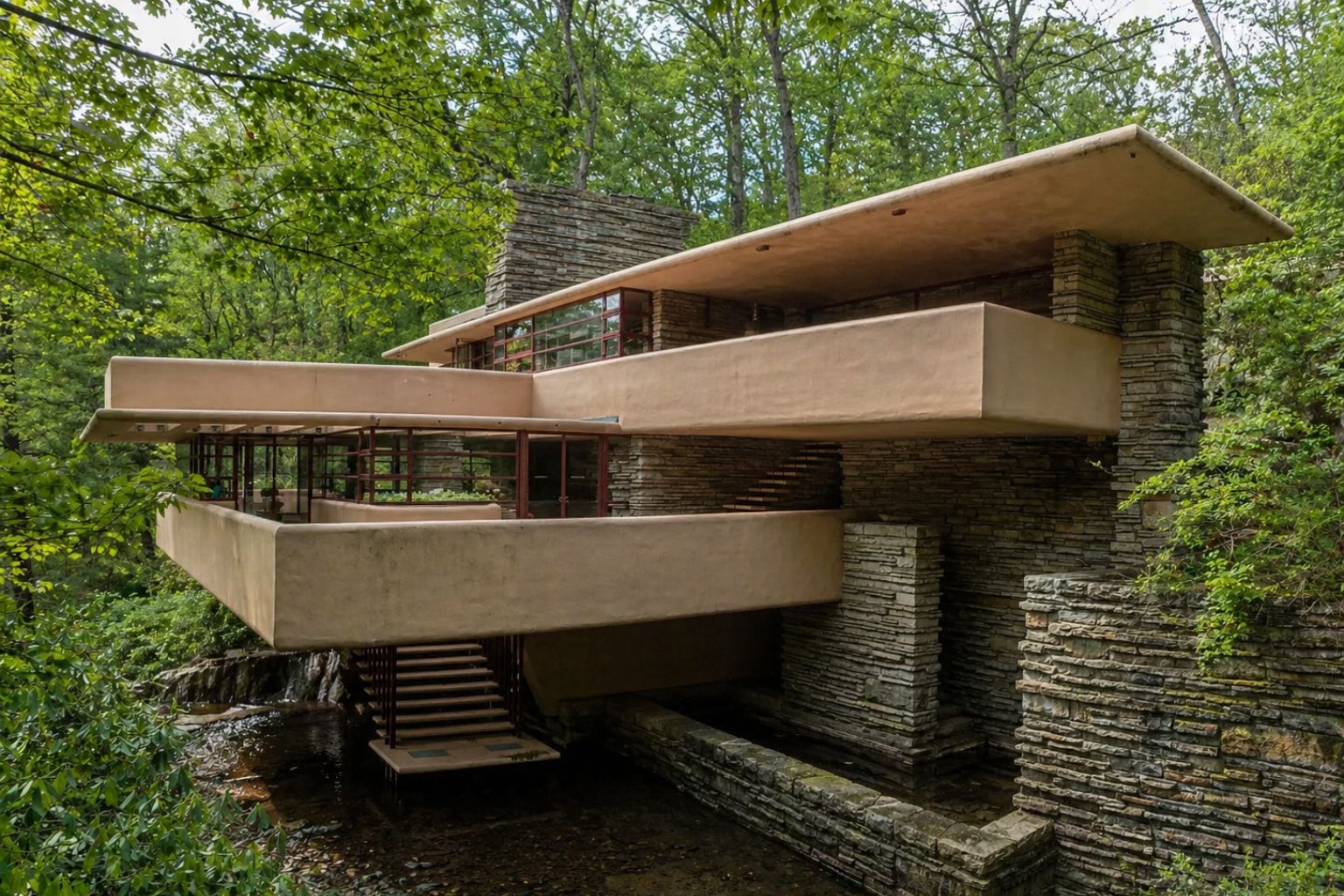
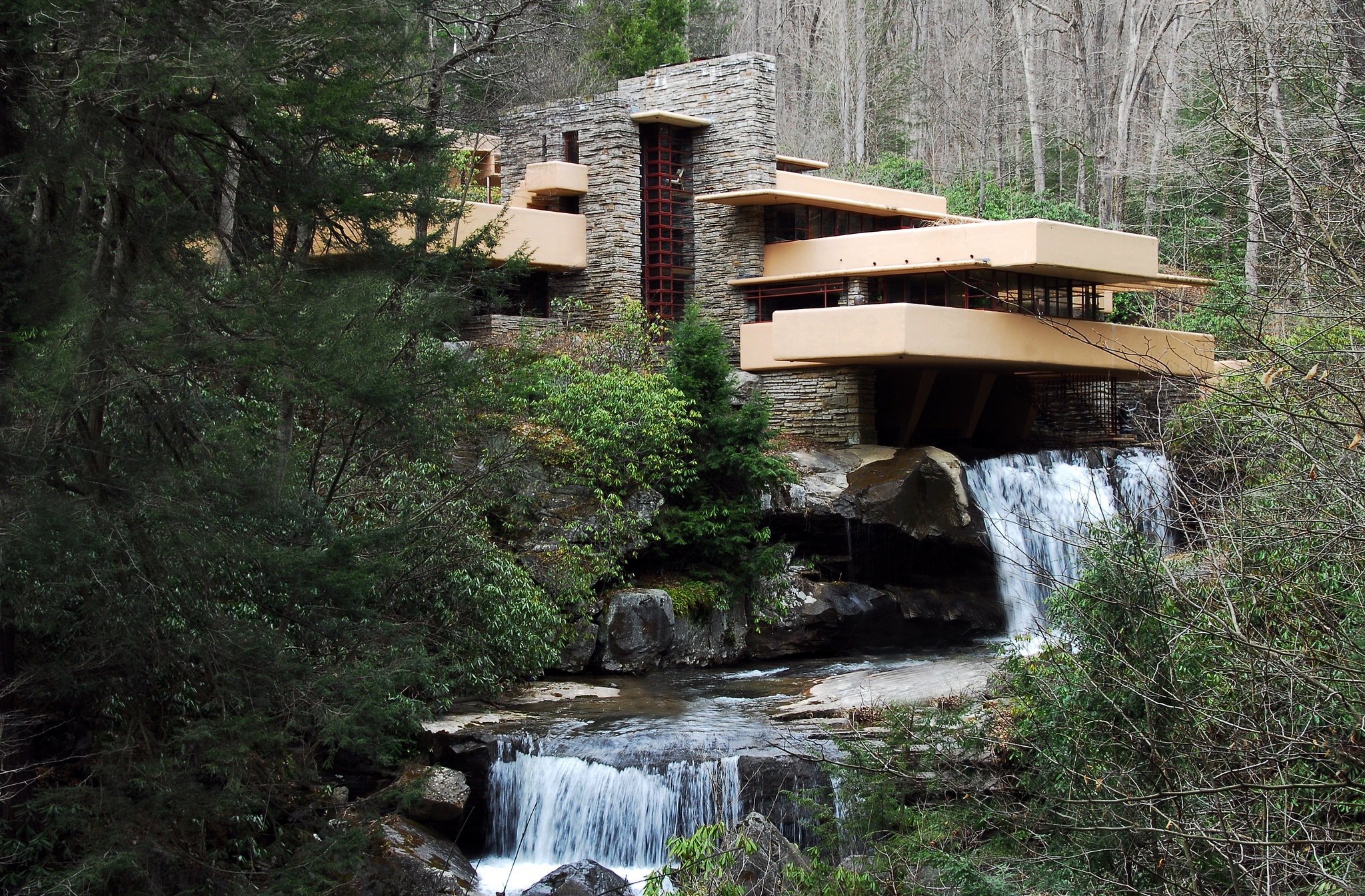
Fallingwater from the entrance path, showing Wright's organic design nestled within Pennsylvania woodland.
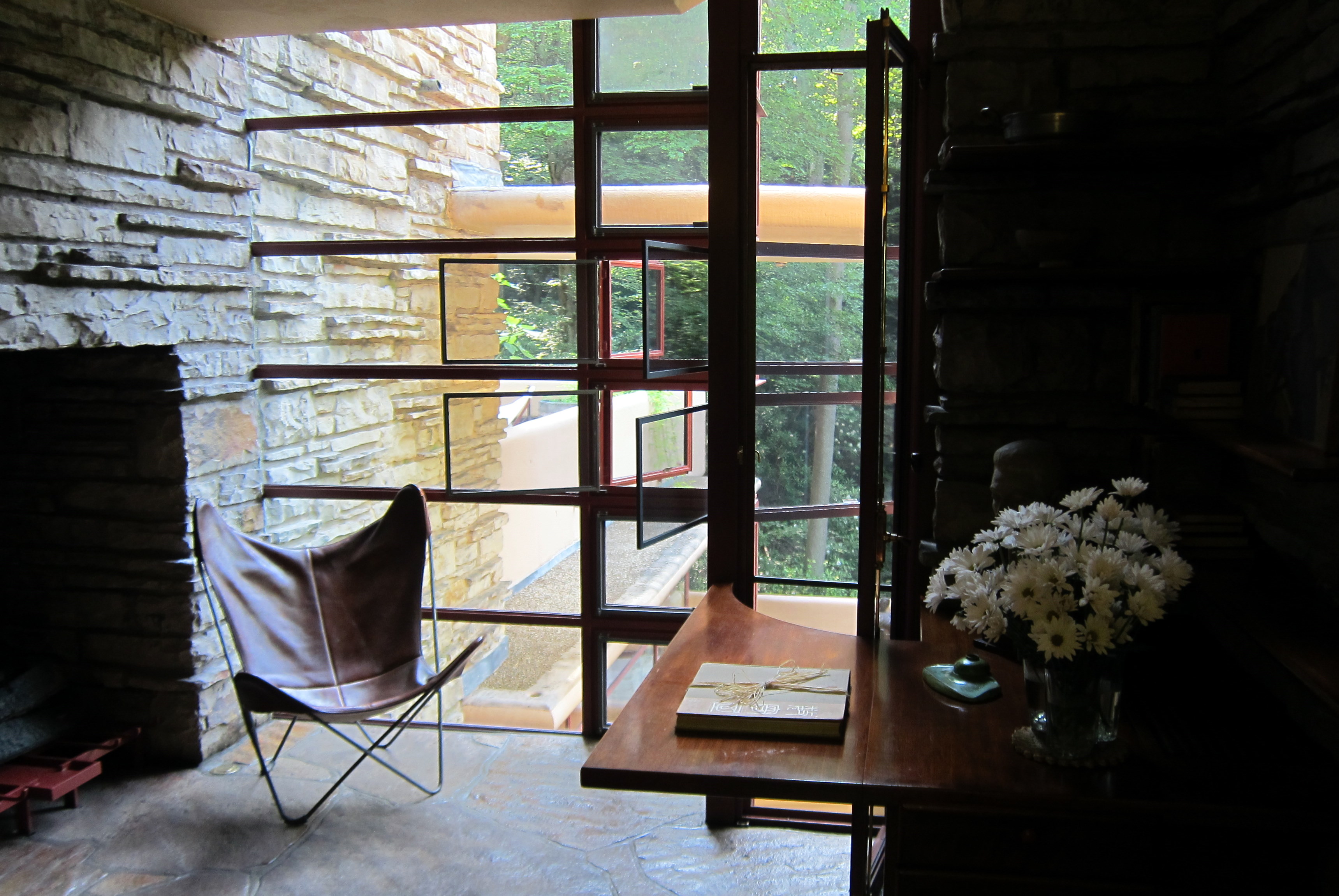
In 1935, Edgar Kaufmann commissioned a weekend house at Bear Run, Pennsylvania. Wright had visited the site once. He is said to have produced the design — Fallingwater — in two hours, directly in response to a phone call saying Kaufmann was coming to see the drawings. The cantilevers were more aggressive than any structural engineer had signed off on. They deflected more than expected and required additional reinforcement decades later. None of that changed what the building was: a house that did not sit near a waterfall but hovered above it, with the sound of water audible from every room.
In 1937, Wright established Taliesin West in the Arizona desert near Scottsdale. Built partly by hand by his apprentices from local desert stone, it became his winter studio and the base for the Taliesin Fellowship — his apprenticeship program for young architects. The desert changed his palette: rawer materials, angled forms, deeper shade.
1940–1959: Final Decades
In 1943, Wright began work on the Guggenheim Museum. It took sixteen years and 700 letters between Wright and city planners before it was built.
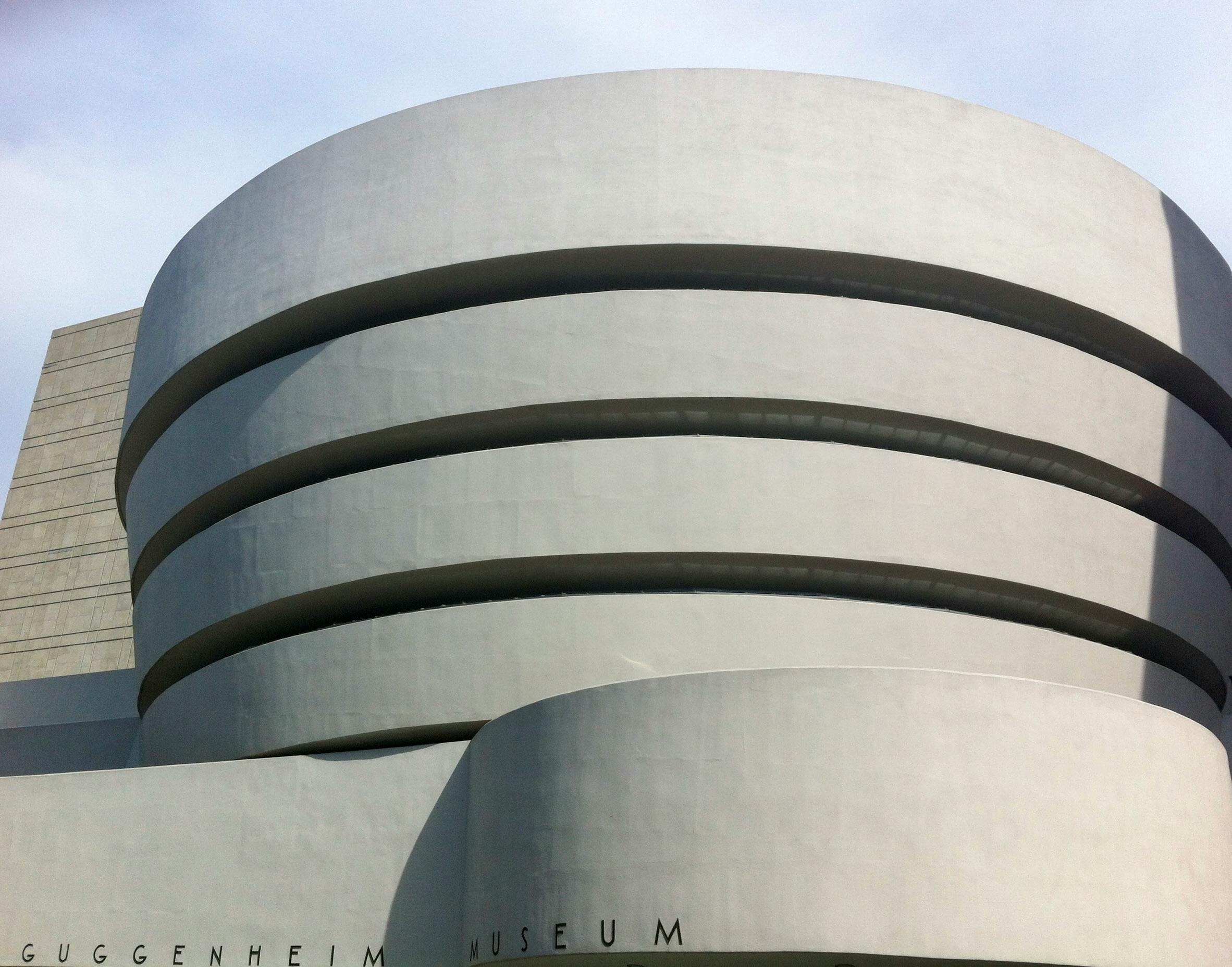
He designed Usonian homes throughout the 1940s and 1950s — affordable, small-footprint houses with passive solar heating, radiant floors, no basements, and carports instead of garages — and published his autobiography. He continued designing into his nineties. He died on April 9, 1959. The Guggenheim opened six months later.
Early Life and Education
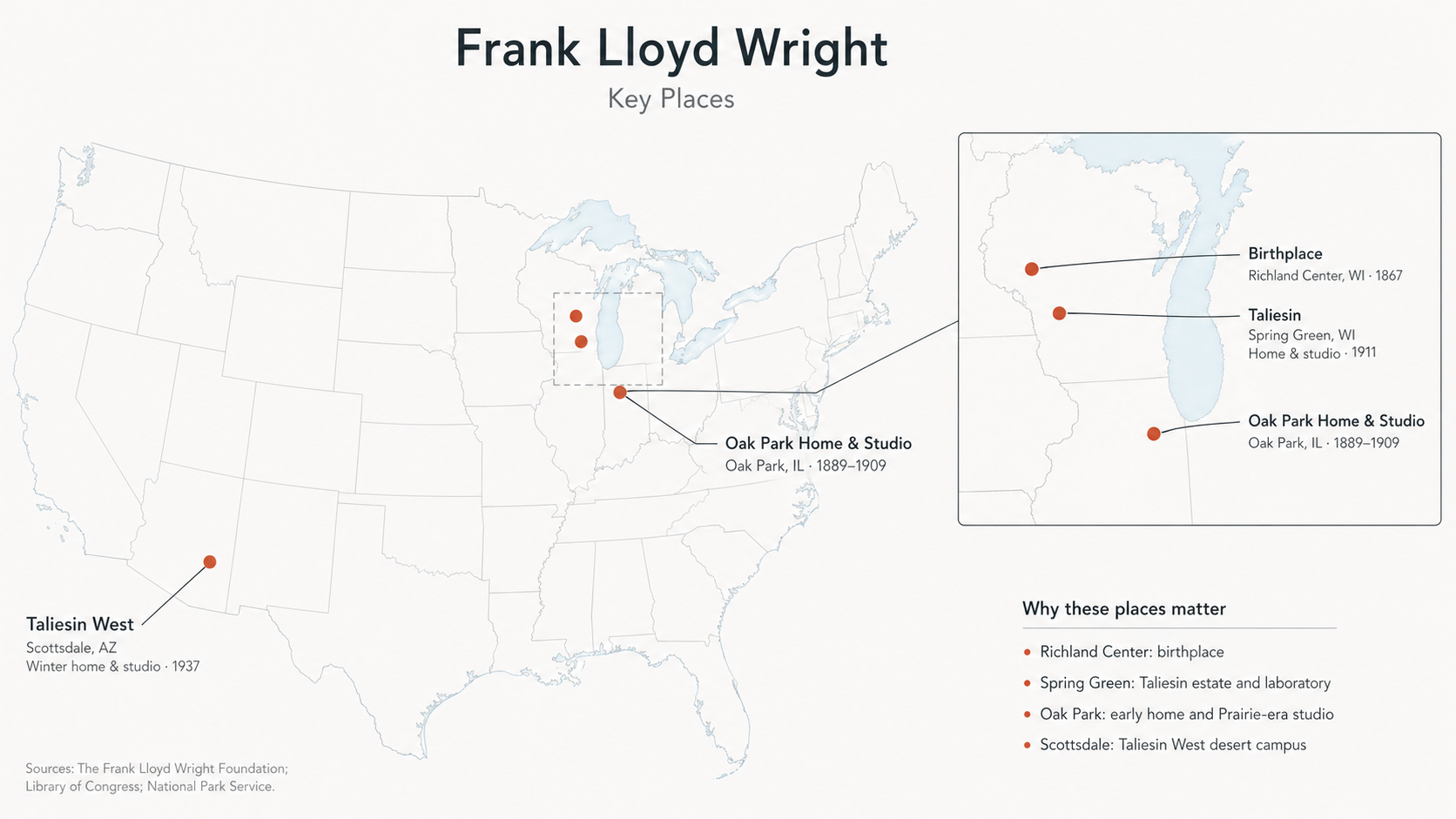
Illustration by ArchitectureCourses.org. Key Frank Lloyd Wright places show where his early life, home studios, and desert campus shaped different phases of his work.
Wright's education was incomplete by any formal measure and highly effective by any practical one. He absorbed technical skills during a brief stint studying civil engineering at Wisconsin. He learned to draft working under Joseph Lyman Silsbee in Chicago. He learned to think architecturally working under Louis Sullivan.
His break with Sullivan was his own fault. He had been secretly taking on private residential clients while employed at Adler and Sullivan — a violation of his contract. Sullivan fired him. Without that fracture, he would not have opened his own practice when he did. The Prairie Style would have come later, if at all.
In 1955, the University of Wisconsin awarded Wright an honorary Doctorate of Fine Arts — sixty-eight years after he had dropped out. He was 88.
Philosophy
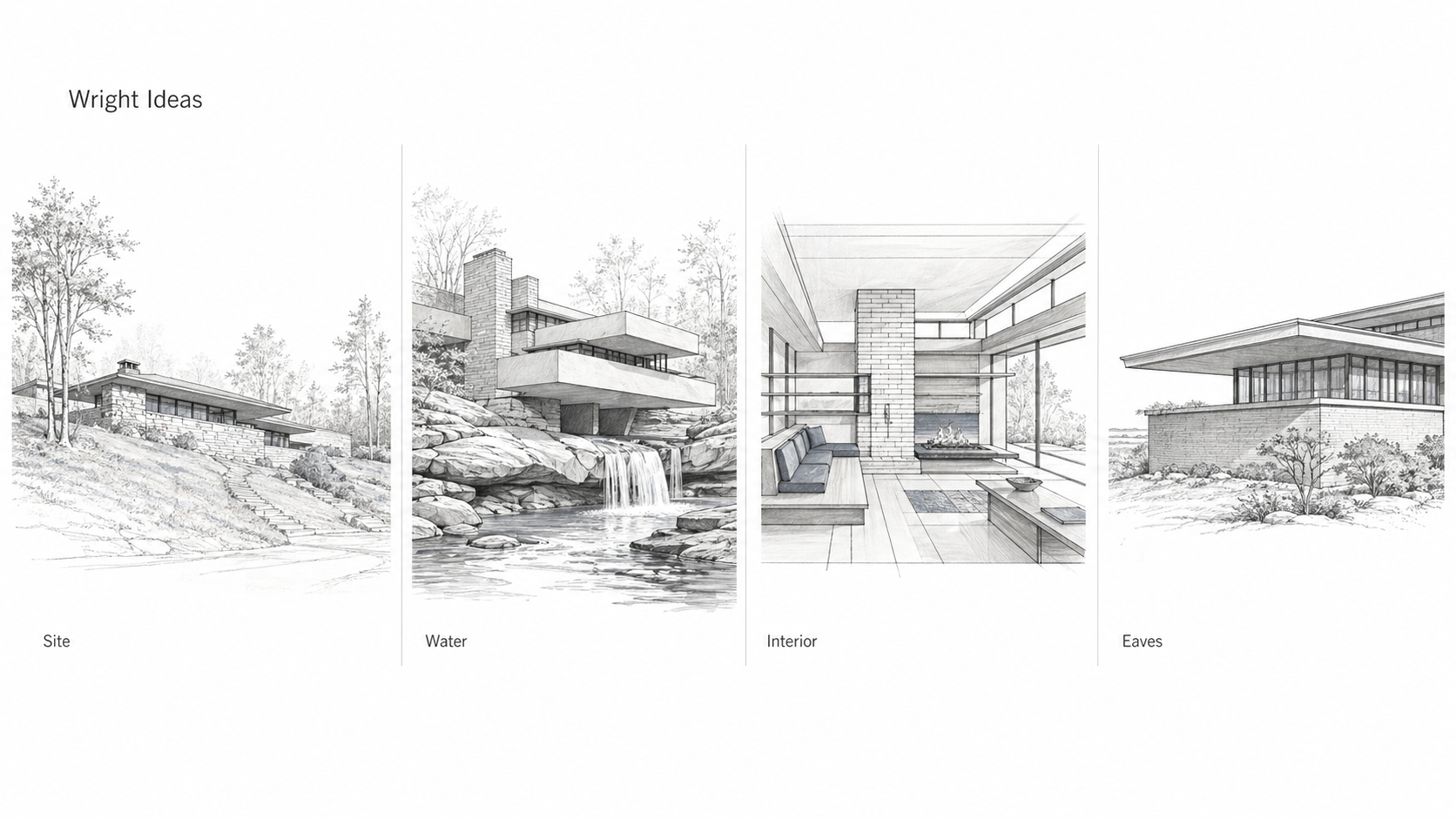
Illustration by ArchitectureCourses.org. A Wright-inspired study plate showing four recurring ideas in his work: site integration, water and landscape, interior order, and deep horizontal eaves.
Wright's central idea was that a building should belong to its site — not imposed on the land but grown from it. He called this organic architecture. The term is sometimes treated as vague, but in practice it meant specific things: choose materials from the site or materials that relate to the site; orient the building to light, prevailing winds, and topography; design the interior as a continuous space rather than a series of boxes; let the structure be visible rather than hidden behind applied ornament.
Fallingwater is the clearest example. The building does not have a view of the waterfall. It sits in the waterfall. The rock of the streambed appears through the living room floor as a hearth. The sound of the water is part of the interior experience. The cantilevers extend the living space over the stream as if the building is reaching into the landscape rather than sitting beside it.
The Usonian homes applied the same logic at a different scale. No basements, no wasted storage volumes, no attics. Built-in furniture meant the building and its furnishings were one object rather than a container and its contents. Passive solar orientation meant south-facing glass and roof overhangs calculated to admit winter sun and block summer sun. Radiant floor heating, which was not standard practice, eliminated the need for radiators and freed the walls. These were not stylistic choices — they were consequences of thinking systematically about how a house works and who it is for.
Japanese architecture influenced Wright's sense of horizontal proportion, his use of layered spaces, and his feeling for natural materials. He visited Japan multiple times and collected Japanese prints throughout his life. The influence is visible in the Prairie homes: the low eaves, the integration of exterior and interior, the discipline of the material palette.
More on Wright's concept of organic architecture.
The Personal Record
Wright was not easy to be around. He left his first wife and six children for a client's wife. He ran through money continuously — borrowed from clients, from his mother, from anyone who would lend it. He claimed credit aggressively and disputed the contributions of others. He made his apprentices at Taliesin work on construction projects, cook meals, and perform at his musical evenings, and he called this their education.
Some of this is the normal record of a difficult person in the early twentieth century. Some of it is worse than that. A 2017 New York Post piece titled Frank Lloyd Wright Was a House Builder and Homewrecker covers the specifics. The question — whether personal conduct should change how we evaluate the work — is one architecture has not resolved for Wright or for anyone else. What is accurate is that his personal life and his professional life were not separate. Mistresses became muses. Personal disasters shaped the character of buildings. The introspective, sheltering quality of his post-1914 work is directly related to the fire at Taliesin.
Source: New York Post, 2017. Related reading: Plagued by Fire: The Dreams and Furies of Frank Lloyd Wright.
What to Borrow and What to Avoid
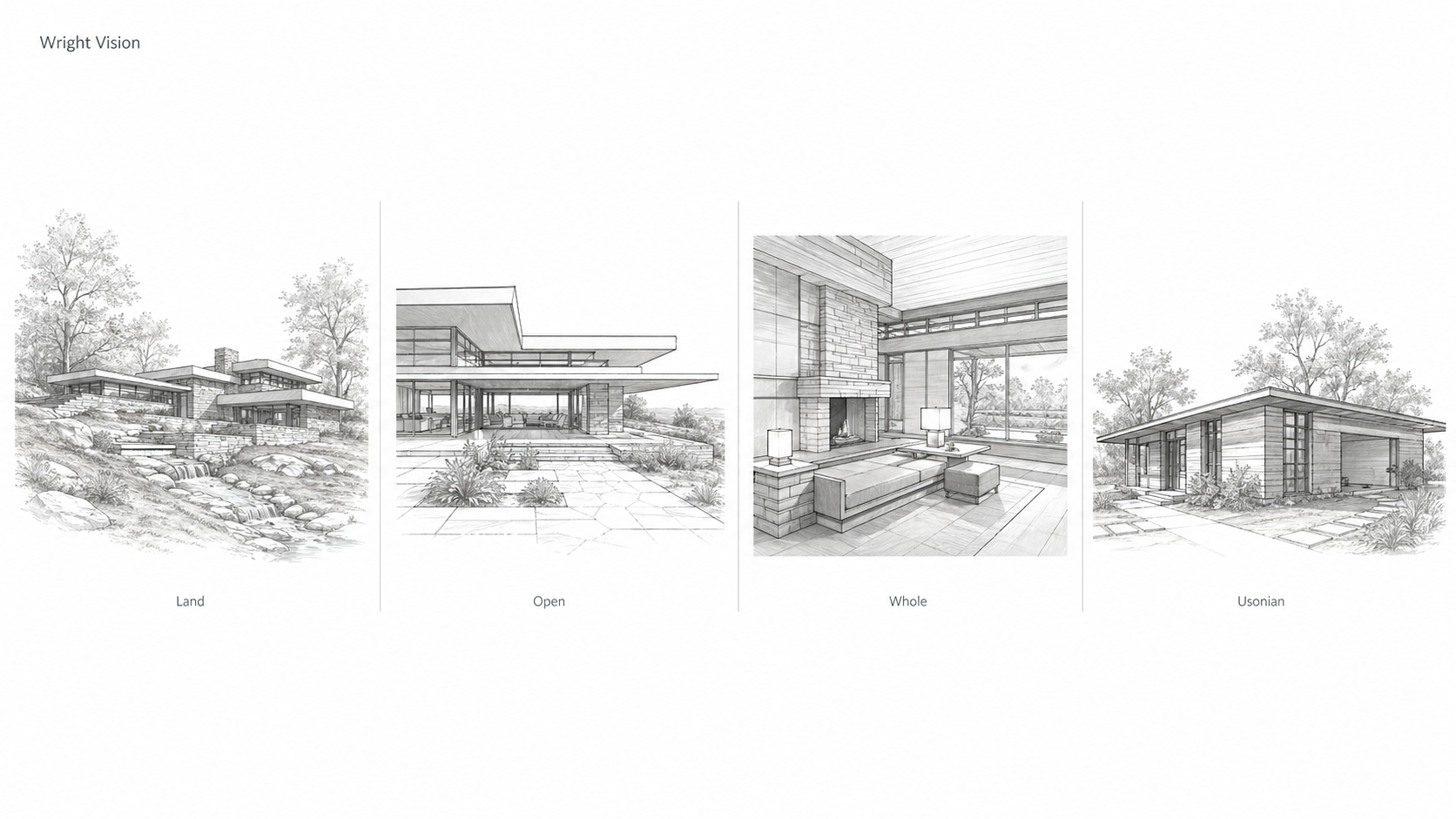
Illustration by ArchitectureCourses.org. This Wright-inspired study plate shows four ideas associated with his work: building with the land, opening the house, designing the whole interior, and making disciplined Usonian homes.
Wright's work contains genuine lessons for architects working today and genuine warnings. They are not the same list.
Let the site lead. Wright studied a site before drawing a line. Light direction, topography, views, prevailing wind — these shaped the building, not the other way around. This is not a stylistic position. It is the most durable principle in his work and directly applicable to contemporary practice on climate-responsive design.
Design the whole experience. Wright designed furniture, light fixtures, carpets, and occasionally dinnerware for his buildings. The point was not control for its own sake but coherence — the idea that a building is one thing, not a container and separate contents. The practical version of this is simply designing with the building's finishes and furnishings in mind from the start rather than treating them as independent decisions.
Use materials honestly. Exposed concrete at Unity Temple was a choice, not a budget concession. The wood at Taliesin West is structural and visible. Wright did not hide materials behind applied surfaces. This remains useful both aesthetically and in terms of long-term durability — materials that are visible are materials that get maintained.
The roofs leak. Many of Wright's roofs — particularly the flat and low-slope variations — performed poorly over time. Drainage details were often sacrificed for visual effect. Buried gutters looked clean and failed. Clients at Fallingwater dealt with water infiltration for decades. This is a direct consequence of prioritizing form without adequate attention to weathering performance. The lesson is that good building envelope design is not a separate consideration from architectural intent — it is part of it.
Materials need to perform in real climates. Some of Wright's material choices did not hold up — untreated wood in wet climates, thin concrete shells in freeze-thaw conditions. Innovation in materials is worth pursuing. Testing those innovations against actual climate conditions before committing a client's building to them is equally worth pursuing.
Design for how people actually live. Wright's interiors sometimes reflected his ideals more than his clients' habits. Small kitchens. Bedroom arrangements that did not match how families used them. The tension between an architect's vision and a client's life is real in every practice. Wright resolved it consistently in his own favor, which is one reason some of his houses are more admired than they are comfortable to live in.
Key Buildings
| Building | Year | Location | What It Did |
|---|---|---|---|
| Robie House | 1909 | Chicago, IL | Defined Prairie Style — horizontal, open, grounded in its landscape |
| Unity Temple | 1908 | Oak Park, IL | First major building in exposed reinforced concrete; geometric precision in religious architecture |
| Taliesin | 1911 | Spring Green, WI | Personal studio, built twice after fire; the building as autobiography |
| Imperial Hotel | 1923 | Tokyo, Japan | Survived the Great Kanto Earthquake; early seismic engineering through flexible foundation |
| Fallingwater | 1935 | Mill Run, PA | Cantilevers over a waterfall; building as immersion in landscape rather than view of it |
| Johnson Wax HQ | 1936 | Racine, WI | Column-supported open workspace; human-centered commercial interior design |
| Taliesin West | 1937 | Scottsdale, AZ | Climate-responsive desert architecture; local stone, shade, and natural ventilation |
| Guggenheim Museum | 1959 | New York, NY | Spiral form that guides movement through the building; architecture as experience |
Influence: Wright and Arthur Erickson
Wright's reach extended into Canadian architecture through Arthur Erickson — one of the clearest examples of how his ideas translated into a different landscape and a different generation.
Erickson absorbed Wright's principle that buildings should grow from the land rather than sit on it, and applied it to British Columbia's coastal terrain and Alberta's landscape. Robson Square in Vancouver does not sit above the city as an object — it moves across several blocks, steps with the street grade, and integrates landscape through the building. Simon Fraser University uses massive concrete forms and precision-framed light in ways that trace directly to Wright's horizontal discipline and his use of light as a spatial element.
The specific ideas that carried: organic integration of building and site; horizontal planes that connect interior space to landscape; the principle that public architecture should shape experience rather than simply provide enclosure. These became foundational for how Canadian civic and institutional buildings were designed through the latter half of the twentieth century.
Ten Things Worth Knowing
1. Wright drew on his bedroom walls as a child. His mother framed the drawings.
2. He opened his own practice at 22, having left Sullivan's firm after being caught taking outside clients.
3. The Prairie Style was not imported from European modernism. It preceded it. European architects encountered Wright's work through the Wasmuth Portfolio (1910) and were influenced by it, not the other way around.
4. He designed over a thousand projects in his career. Approximately 532 were built.
5. Taliesin burned twice. The 1914 fire, set by a servant, killed seven people including Mamah Cheney. Wright rebuilt both times.
6. Fallingwater's cantilevers deflected more than calculated. Additional reinforcement was added in 2002 after engineering surveys. The building is structurally sound.
7. Wright trained apprentices at Taliesin through hands-on work — construction, farming, cooking, music — not lectures. The Taliesin Fellowship produced a generation of architects who carried his ideas forward.
8. Usonian homes were designed for families earning $5,000–$10,000 a year in the 1930s and 1940s. They anticipated passive solar design, open-plan living, and the elimination of wasted storage volumes by several decades.
9. Wright was still designing at 91. The Guggenheim opened six months after his death.
10. In 1991, Wright was posthumously awarded the Presidential Medal of Freedom — not for any single building but for changing how architecture was thought about in America.
FAQ
What made Frank Lloyd Wright famous?
Open floor plans, the Prairie homes, and buildings like Fallingwater and the Guggenheim that did things no previous architecture had done. More specifically: he changed the spatial experience of the American house by removing interior walls, integrating furniture into the architecture, and designing for how people actually move through a space rather than for how a room looks on a plan.
What was organic architecture?
Buildings designed as part of their environment rather than placed in it. Materials from or related to the site. Orientation to sun, wind, and topography. Interior space that flows rather than compartmentalizes. The term is Wright's own and he used it to describe a design philosophy rather than a style — which is why buildings as different as the Prairie homes, Fallingwater, and the Guggenheim all belong to it.
What did Wright get wrong?
Roofs that leaked. Materials that did not perform in harsh climates. Interiors that served his ideals more than his clients' lives. A tendency to prioritize the visual logic of a detail over its weathering performance. None of this diminished his influence, but all of it is worth knowing before treating his work as a model.
Who influenced Wright?
The landscape of rural Wisconsin. Louis Sullivan's principle that form follows function. Japanese architecture — its horizontal proportions, layered spatial sequences, and honest use of natural materials. Sullivan is the most direct professional influence; Japan is the most pervasive visual one.
Who did Wright influence?
Arthur Erickson in Canada. Eero Saarinen. Contemporary sustainable designers working with passive solar, site integration, and natural materials. His influence is broad enough that it is easier to describe what contemporary architecture still owes him — site-responsive design, open-plan living, material honesty — than to list individuals.
What is Fallingwater?
A house built over a waterfall in rural Pennsylvania in 1935. The cantilevers extend the living spaces directly over the stream. The rock of the streambed appears through the floor as a hearth. The sound of water is audible from every room. It is the clearest physical statement of Wright's argument that architecture and landscape should be inseparable.
What was wrong with his buildings practically?
Flat roofs with poor drainage. Cantilevers that deflected. Materials chosen for appearance that did not hold up to weather. High customization that made maintenance expensive. He was aware of some of these issues and addressed others inadequately. They are real limitations in buildings that are simultaneously genuine achievements.
What is the difference between Wright and Le Corbusier?
Wright built with the land; Le Corbusier designed against it. Wright used wood, brick, and stone; Le Corbusier used concrete and glass. Wright designed from the inside out, starting with how people would inhabit a space; Le Corbusier designed from formal and ideological principles outward. Both were influential and both produced buildings that are uncomfortable to live in for some of the same reasons — the architect's vision dominated the client's life.
Books
- The Architecture of Frank Lloyd Wright by William A. Storrer — The definitive catalog. Floor plans, photographs, and building histories for every major project. The reference book.
- Understanding Frank Lloyd Wright's Architecture — Covers Wright's process: siting, interiors, landscaping, concept development. More analytical than visual.
- Plagued by Fire: The Dreams and Furies of Frank Lloyd Wright — A biography that takes the personal record seriously without either dismissing it or reducing the work to it. Honest and well-researched.
- Frank Lloyd Wright: Natural Design, Organic Architecture — Focused on Wright's climate-responsive and site-integrated work. Relevant for sustainable design.
- 50 Lessons to Learn from Frank Lloyd Wright — Practical design takeaways organized by theme. More useful for students than scholars.
- Frank Lloyd Wright: The Rooms, Interiors and Decorative Arts — Covers the full-spectrum vision: interiors, furniture, and fixtures within the architecture.
- Frank Lloyd Wright: Natural Design, Organic Architecture — Lessons for building green from his work. Accessible for non-specialists.