
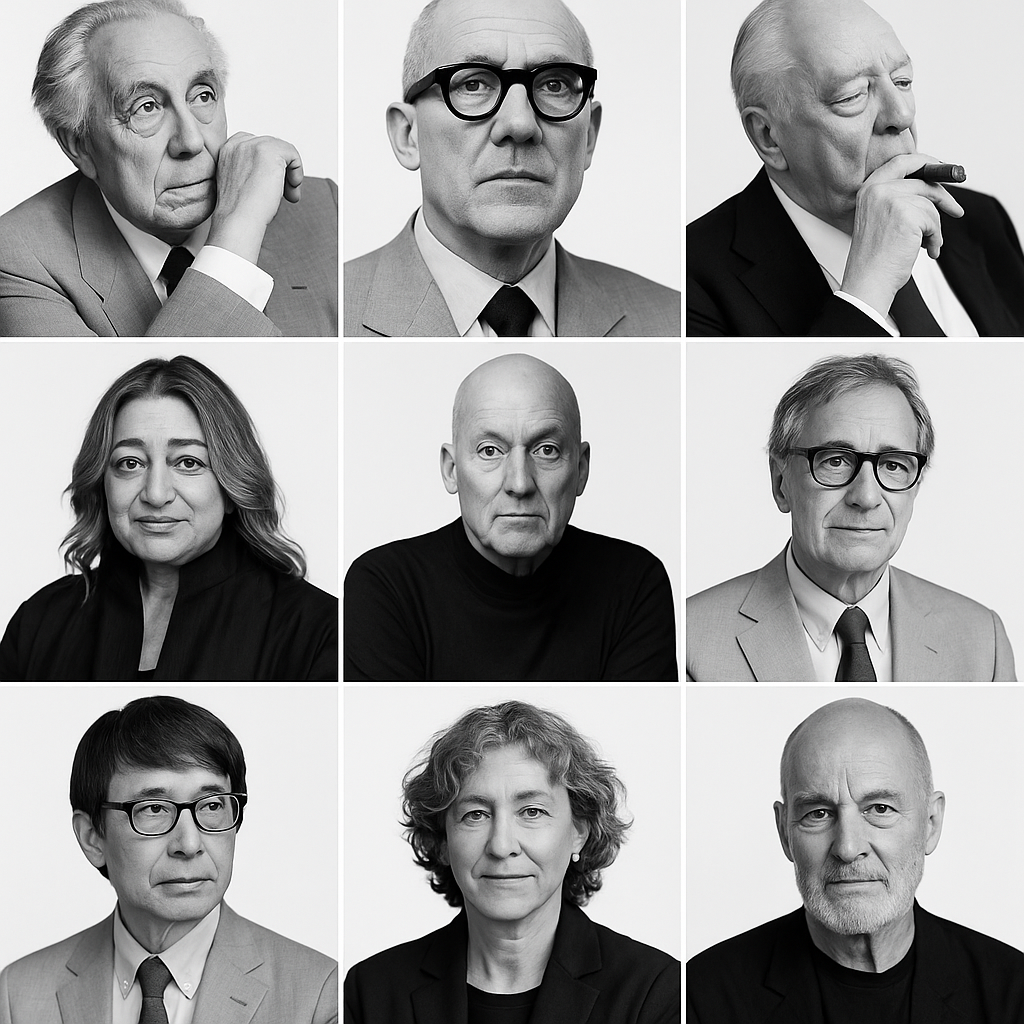
Architects Who Changed How We Build: Learn the One Thing
We know we don’t need another “10 best” or “10 most famous” architects list. We’ve got plenty. Everyone has their own. Some people even do a blind pick because there are so many, and each has a good reason to make a top 10.
What we did is different. We picked based on the single most important thing each architect contributed to the field. That’s it.
After we worked hard to choose twelve, we had another idea. Find the one thing they all share. We assumed every architect had the same common thread. We were wrong. So we repicked and reorganized more than thirty times until we had a list where every name shared one core habit and still brought something unique that actually changed architecture.
Here it is. Study the single move each master does better than anyone. Steal the principle. Use it on your next project.
12..!
Best 12 Modern Architects: The One Shift They Made
Frank Lloyd Wright
Core idea: Building and site work as one system
Result: Structure bends to the terrain. Rooms and decks match rock, water, and slope
Example to study: Fallingwater — stone slabs feel like part of the hill
Dive deeper in this breakdown of Wright’s organic architecture
Le Corbusier
Signature method: A universal kit for living and city-making
Impact: Piloti, ribbon windows, free plans — systems you could scale from house to capital
Best proof: Villa Savoye versus Chandigarh. One template, many outcomes
See how he stacks up against Wright in this head-to-head comparison
Ludwig Mies van der Rohe
Design habit: Remove everything except structure and proportion
Effect: With no trim to hide behind, every millimeter matters
Study spots: Barcelona Pavilion and Farnsworth House
Find him in our full architects master list
Zaha Hadid
Working logic: Draw motion first, shape the building around it
Shift: Forms capture how people move, not just how they stand still
Best lesson: MAXXI in Rome — paths and galleries feel choreographed
Browse Zaha’s global impact inside our Muslim architects long read
Norman Foster
Approach: Engineering drives form. Make it light, smart, and efficient
Change made: High performance didn’t have to look heavy or awkward
Try this one: The Gherkin — airflow, structure, and skyline at once
Full breakdown in Foster’s impact on modern architecture
Renzo Piano
Mindset: Treat daylight like a building material
Why it sticks: Roofs and facades are devices for light, not decoration
Tracking it: The Menil Collection — art lit by calibrated louvers
Tadao Ando
Philosophy: Shape silence and light with concrete and void
Effect: Bare walls and one sharp cut can do more than furniture ever would
Watch it happen: Church of the Light — a room made by subtraction
Find Ando’s logic inside everyday genius in architecture
Rem Koolhaas
Rule: Let program and diagram shape the building
Shift: Form came from use, not styling. Cities got new zoning logic
Case file: Seattle Central Library — a stack of functions turned inside out
Full look at OMA’s playbook in Rem Koolhaas on bigness and control
Jeanne Gang
Technique: Use form to solve environment and social use at once
Why it works: Curved balconies manage wind, shade, and neighbors together
Field example: Aqua Tower — texture with purpose
Diébédo Francis Kéré
Core practice: Design from climate and local skill
Real-world effect: Dirt walls and ventilation do more than imported HVAC
Best lesson: Gando Primary School — build it so people can own it
Learn about Kéré inside our bioclimatic architects piece
Liz Diller
Instinct: Reuse dead infrastructure for public space
Shift: Old rail lines became civic rooms instead of scrap
Proof: The High Line — a mile of leftover steel turned into an icon
Explore adaptive reuse in our Baroque to modern shift guide
Peter Zumthor
Essence: Build feelings from mass, heat, and echo
Why it hits: You can’t draw atmosphere. You walk it
Built example: Therme Vals — architecture built into your bones
The One Thing They All Share
They don’t start with style. They start with one hard idea and everything else lives or dies by it
- They mock it up full-size, not in software
- They treat sun, wind, and noise as sketch tools, not problems
- They draw assemblies, not decoration
- They cut until only the working parts stay
Run this on your next project. Name your one hard idea. Prove it full-scale. Cut until it stands on its own
The One Thing Every Master Does That New Architects Ignore
None of them began with “what should this look like?” They began with the problem no one else was solving.
-
Wright didn’t perch on the hill — he made slabs part of the hill.
-
Hadid didn’t draw rooms — she froze motion and skinned it.
-
Kéré didn’t ship in A/C — he used dirt walls and passive airflow.
-
Diller didn’t build parks — she turned leftovers into public rooms.
Lesson: Don’t start with looks. Start with the one constraint everyone else ignored. Solve that. Form will crawl out on its own.
What Ties All 12 Architects Together
We thought the thread was “innovation.” Wrong.
It’s subtraction.
-
Mies cut walls.
-
Corb cut ornament.
-
Ando cut noise.
-
Zumthor cut perfection.
-
Zaha cut corners.
-
Kéré cut the catalog.
The move that matters is what you delete.
You want work that lasts? Figure out what the building can live without — then make what’s left count more than ever.
What We Learned Digging Through the Work
We didn’t start with names. We started with the buildings. And it got messy fast.
We tried picking “the best architects” like everyone else. Didn’t work. Too many names, not enough clarity. Every list online starts with “icons” but never tells you what they actually do that matters.
So we did the slow work.
We took one project at a time and forced ourselves to answer one question:
What is the single move here that makes this building what it is?
It took a while before anything made sense. But once we found the first one — Wright merging slabs into the rock at Fallingwater — everything else snapped into place. It wasn’t about style. It wasn’t about fame. It was about one intentional move that held the whole project together.
We kept going:
-
Zaha didn’t “do curves.” She froze motion and made it architecture.
-
Ando didn’t “do concrete.” He used shadow as structure.
-
Kéré didn’t “do local.” He designed with what people could build with their own hands.
Once we locked onto the move instead of the portfolio, it changed everything.
That’s the hidden pattern no one tells you:
You don’t learn from “architecture.”
You learn from the one decision that makes the whole thing work.
Do this yourself once and you’ll stop screenshotting random pretty buildings. Pull out their one load-bearing idea. Draw it. Mock it. Prove it.
If you can’t find that core move in your own work? You’re still decorating — not designing.
FAQ
Why only 12 architects?
Because more names would water down the point. This list is about moves that changed how buildings get made, not who got published most.
Why isn't [insert famous architect] here?
Because they didn’t bring one single idea strong enough to stand on its own the way these did. Famous doesn’t always mean foundational.
What if I disagree with the list?
Good. Make your own. The point is to track why a move worked—not to worship signatures.
Isn't architecture about more than one idea?
Yes. But the strongest projects start with one clear intention. Everything else holds it up or gets cut.
How do I apply this to my student work?
Pick one constraint no one else in your studio is talking about. Solve that. Let the form be the side effect.
Why is 'subtraction' such a big deal here?
Because buildings age. Noise, decoration, extra parts—they die first. What stays walkable, useful, and repairable is what matters.
Where can I learn how to use site forces (light, wind, noise) the way these architects do?
Start here: Intro to Architecture: How Buildings Work. Then walk into a building and feel where the sun goes.
Do I need software to design like this?
No. You need cardboard, tape, and sunlight first. Software can wait.
Is this list meant for beginners or pros?
Both. Good work is typically simple on paper, brutal to get right in reality.
Why “steal” their ideas?
Because you won’t copy their work by copying their methods. You’ll make better decisions in your own projects.