
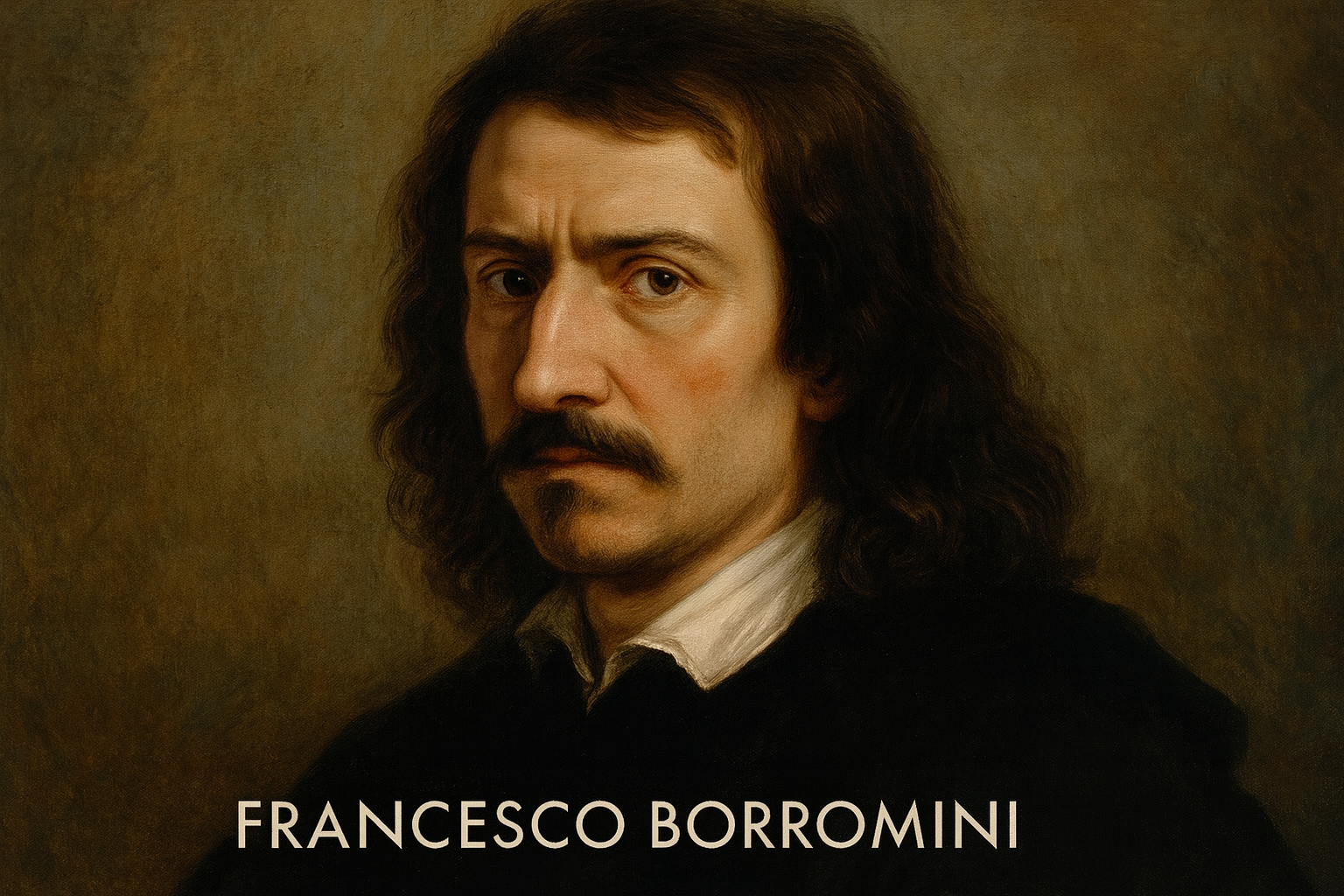
Francesco Borromini Architecture That Changed Rome Forever
Francesco Borromini: field notes on a difficult genius
Borromini is hard to copy and harder to forget. His buildings breathe. Corners don’t end; they turn, slip, swell, and release. The plans look like knots a monk might draw in the margin of a manuscript. And yet, on site, it all resolves: the light lands where it should, the curves manage the air, and the structure holds with an almost dry calm.
If you’ve only seen photos, you’ve missed the work. If you’ve stood under his lanterns, you know why the rest of us keep returning. (If you want a quick primer on why Baroque space feels so alive, our Baroque architecture explainer is a good warm-up.)
Francesco Borromini Architecture and the Geometry Behind It
A look at Francesco Borromini’s architecture: his shapes, materials, and how he reshaped Baroque design across Rome.
Where he learned to break rules
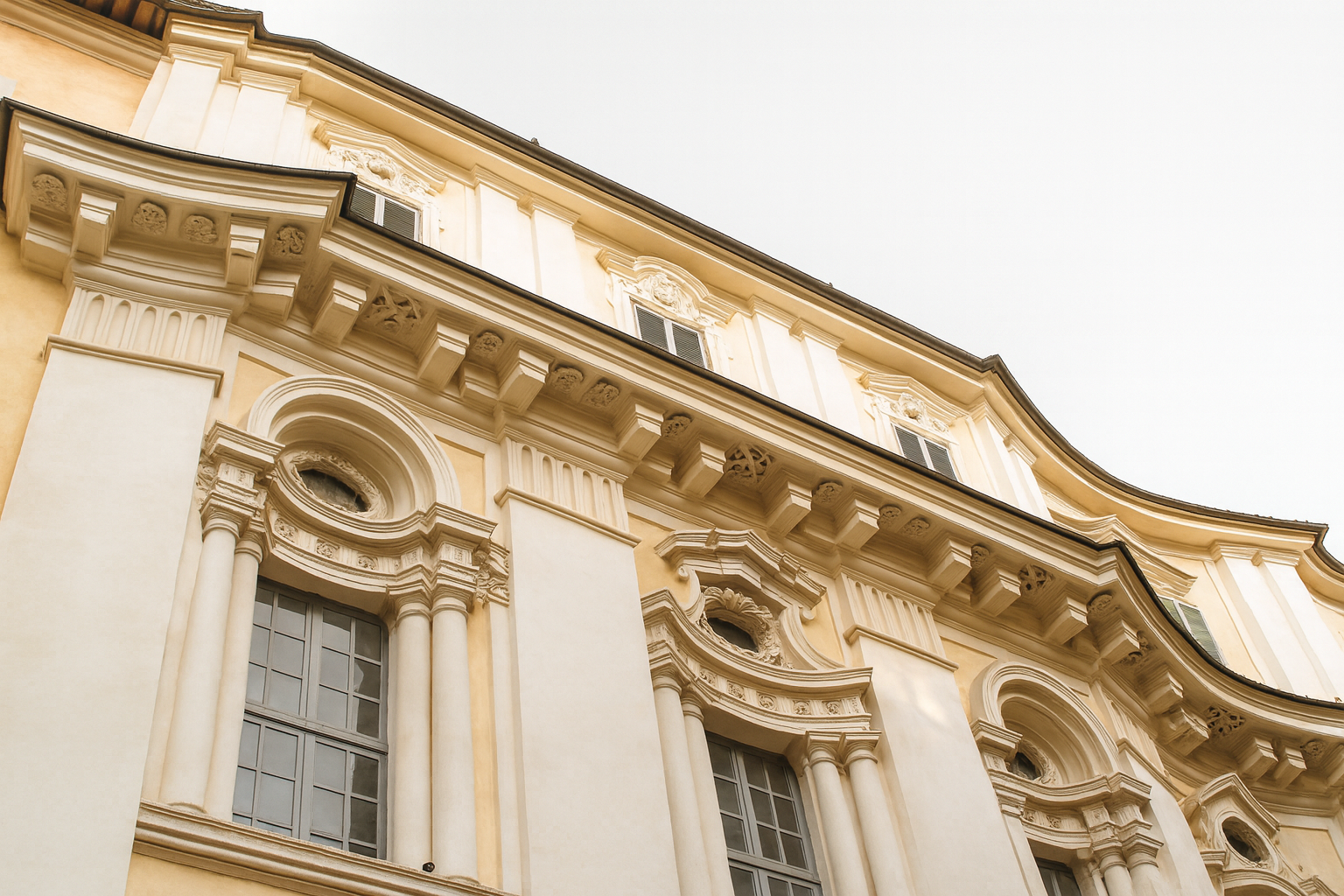
Borromini trained as a stone carver and worked under Carlo Maderno, which means he learned Rome by joints and scaffolds before theory. That matters: his flares and inversions were always built off sound geometry and a mason’s skepticism.
The timeline is simple enough: born 1599, major Roman commissions through the 1630s–1660s. But what matters more is method: tight geometric order first, then a controlled distortion of that order when the site demanded it. A reliable overview of his life and major works sits here if you want the dates and the list.
San Carlo alle Quattro Fontane: the oval that really breathes
“San Carlino” is small—almost pocket sized by Roman standards—but it carries the Baroque in full. The nave is an oval stretched along one axis, then pinched by four shallow chapels that are not quite chapels; they’re pressure valves. The dome pattern looks like a honeycomb that has been gently pulled—coffers shrinking as they rise—so the apex feels higher than it is. That optical lift is deliberate, and tied to the oval field below. For a clear, reliable walk-through of the plan and the dome logic, Smarthistory’s essay remains one of the better short guides.
The facade is almost an afterthought until you stand in traffic and notice how the concave and convex bays settle the corner where four fountains and four streets collide. In plan, those waves are not decoration; they are site control. That is the first Borromini lesson worth stealing.
MUST READ
Baroque without fog: Robert Neuman’s Baroque and Rococo Art and Architecture gives enough context to place San Carlino without drowning in names. → See the book
Oratory of the Filippini: brick, shadow, and a quiet kind of bravado
Walk south of Piazza Navona, step off the Corso, and the Oratory reads like a deep breath—brick front, muscular pilasters, a central swelling that is more diaphragm than chest. The surprise is inside: a plan that snaps cleanly to the program of the Oratorians—gather, listen, sing—without the spiritual theatrics of its neighbors. It’s still Baroque, but the emphasis is civic: learning, devotion, acoustics. John Beldon Scott’s study of the Oratory remains the best account of how Borromini negotiated this institution, its music, and the city.
You’ll notice the brick isn’t merely facing; the articulation throws shade like a set of louvers. It reads warm at noon, crisp at dusk, and never flat. That’s not mood; it’s section. (If the texture question interests you, our short note on metal and other materials in architecture pairs well with this facade.)
Sant’Ivo alla Sapienza: a star, a hexagon, a spiral that keeps going
In drawings, Sant’Ivo looks like a game of sacred geometry—two interlocking triangles (Star of David) embedded in a hexagon, rounded at the points, then lifted into a dome. That description sounds mystical. In use, it’s simply an engine for light and focus. The alternating concave–convex bays manage the push-pull of the courtyard; the plan does the rest. The corkscrew lantern is the part everyone photographs. Its job is less symbolic than climatic and directional: it vents, it crowns, it points. For a dependable description of the fabric and history, the Discover Baroque Art dossier is solid.
Notice how the dome’s ribs do not chase ornament; they chase structure and sight lines from the courtyard. The result is a room that feels both taut and generous. Students read there on weekday mornings. The geometry holds them without shouting.
FIELD PICK
If you sketch plans, Francis Ching’s Form, Space, and Order remains the fastest way to see how Sant’Ivo’s hexagon pushes into volume. → Quick reference
Barberini’s oval stair: structure disguised as ease
At Palazzo Barberini, Bernini got the square stair; Borromini drew the oval. Walk it once and you’ll feel why the client kept both. Borromini’s helix hangs off paired Doric columns with the Barberini bee tucked into capitals—a family mark, not a flourish. Laser-scan work on the stair has confirmed what your legs learn: the oval plan softens the climb and squeezes more stair into less room while holding regular rise and run.
The inner handrail is the better line for a slow ascent; the outer gives you the longer radius and a quicker rhythm. You won’t find that in treatises; you’ll find it in use. That’s the second Borromini lesson worth stealing.
Palazzo Spada: a 26-foot corridor that looks like 120
Forced perspective is an old painter’s trick. Borromini built it. In the Spada courtyard, a short colonnade climbs at a shallow grade, columns shrink, and a rising floor conspires with a tight barrel vault to fake enormous depth.
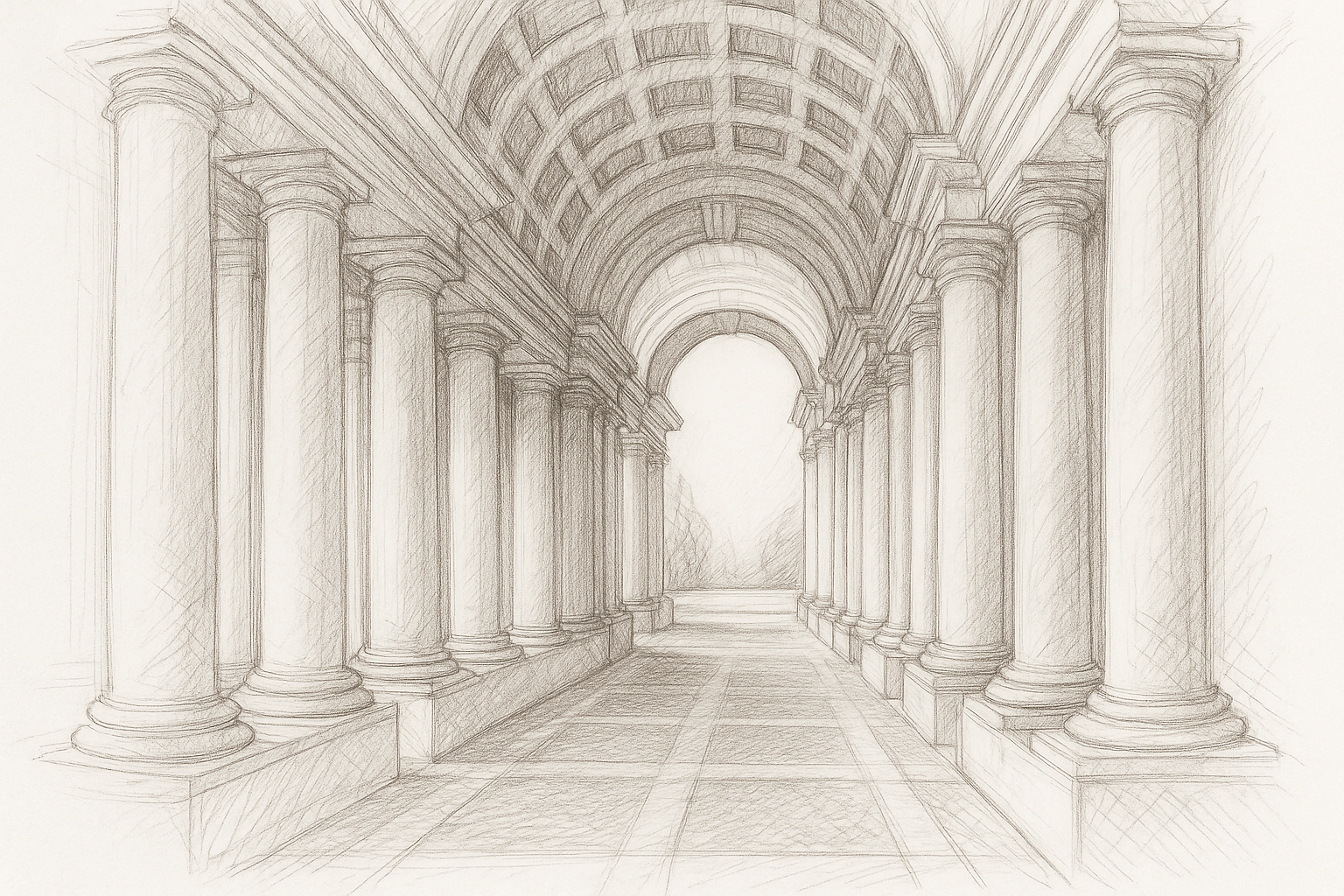
The game would be cheap if the stonework weren’t so exact. The point was didactic, legal, and theatrical—Cardinal Spada understood power optics—and today it remains Rome’s clearest seminar on how architecture can argue with your eye. For a clean primer on the device in context, Smarthistory’s overview of Borromini’s work situates Spada alongside San Carlino and Sant’Ivo.
Lateran and the discipline behind the curves
Borromini’s renovation work at San Giovanni in Laterano is often described as severe. Look closer: the discipline lies in proportion and a refusal to smother earlier fabric. The bays are tightened, the orders crisped, the nave’s momentum corrected rather than rewritten. It’s a reminder that his Baroque was not all bravura; it was also stewardship. The standard biographies summarize his pivots between innovation and repair across the 1640s–1660s.
RECOMMENDED TOOL
For builders and students who want method over adjectives, Jean-Pierre Adam’s Roman Building: Materials and Techniques shows the craft logics Borromini inherited and bent. → Check the reference
How he holds a corner
If you’re a young designer, study Borromini’s corners. He seldom lets a 90-degree angle end flat to the street. He shaves it, rounds it, or pulls it inward so movement can wash around a building rather than slam into it. Italian scholarship has traced how these scantonature—the beveled or scooped solutions—temper urban flow and widen the field of view at tight junctions. You’ll find that reading supported across multiple typologies.
Try it in your own work: take a narrow intersection and relieve the corner by one module—brick, stone, or glass—and let the light do the softening. It costs little and buys space you can feel.
Light, shadow, and the tone of the room
The signature Baroque trick—chiaroscuro—is less drama and more calibration in Borromini’s hands. San Carlino’s coffers aren’t just pattern; they grade the glare so the oval reads as one body. The Oratory’s pilasters aren’t bulk; they throw shadows that refresh the brick and cool the facade. Sant’Ivo’s ribs find the balance between emphasis and quiet so voices don’t get lost in glare. If you need a quick refresher on how color temperature and intensity shape space, our note on color in architecture ties directly to what you’ll feel under these domes.
What to copy carefully (and what to leave alone)
Borrow the discipline, not the shapes. The oval plan, the spiraling lantern, the staged perspective—these are outcomes of very specific sites and programs. What scales and travels is the method: start with a hard geometric order and let the site, light, and circulation bend it by necessity. That’s why Borromini still reads modern when the copies go kitsch.
For students planning a Rome day around him
Start at San Carlo alle Quattro Fontane when the light is soft; you’ll catch the dome without glare. Cut down to the Oratory of the Filippini and sit for ten minutes across the street. Cross to the Spada courtyard at midday when the perspective trick is bright and slightly brutal. Save Sant’Ivo for the late morning, when the courtyard’s frame is active with students and the lantern reads against the sky. If you want broader context on the era as a whole, this walk pairs well with our Baroque vs. Rococo overview so you can place his restraint against later glitter.
Why he still matters
In every Borromini project you can draw a straight line from idea to detail without getting lost in rhetoric. The geometry serves use. The structure earns its curve. The light does the talking. That ethic is what makes him useful today, beyond the romance of the corkscrew and the oval.
Technical appendix for the curious
San Carlino’s oval and the rising coffers
The nave ellipse is set with major and minor axes aligned to the site. Four shallow chapels occupy the diagonals of the ellipse, thickening the perimeter wall just enough to house structure and confessionals. The dome’s coffering pattern is a geometric progression: panel modules diminish toward the oculus, a calibrated reduction that lifts the visual apex and disperses glare. The literature on San Carlino’s geometry is consistent on this point and remains a clear example of structure and optics working together.
Sant’Ivo’s plan as interlaced triangles
The base hexagon hosts alternating concave and convex apses. Superimposed triangles complete a star that governs rib spacing and window placement. The lantern’s spiral stacks diminishing rings with slight rotational offset; the rotation is not arbitrary but tuned to read from the courtyard centerline. Museum-level summaries remain the most accessible public documentation of that schema.
Barberini’s oval stair: numbers behind the grace
Recent laser-scan analysis of the Barberini oval stair confirms regular riser heights and a consistent tread despite the changing radius. The paired Doric colonnettes carry the inner stringer as a continuous load path; the outer wall stabilizes the helix. Column spacings tighten subtly at landings to keep rhythm. If you teach, that paper is a good studio handout for how measured surveys dispel myths and show the craft under the image.
FAQ
Was Borromini only about curves and tricks?
No. The curves were tools serving site, circulation, and light. His renovation work, especially at the Lateran, shows a strict classicist when needed. Standard biographies outline that range clearly.
Who should study him first: students, architects, or builders?
All three, but for different reasons. Students learn how plan geometry drives section. Architects learn to let site and program bend an initial order. Builders see how stone logic underwrites the flourishes. If you need a foundation pass through the era, start with our timeline of architectural history for bearings.
Where can I read a clear, short piece before visiting San Carlino?
Smarthistory’s overview of Borromini covers San Carlino and Sant’Ivo in plain language and travels well on a phone.
Is there a single non-religious site that captures his mind?
The Spada perspective is the neatest secular proof of concept: a legal scholar’s courtyard turned into an optical lesson. It’s small, precise, and honest about how architecture can steer perception.
Sources worth your time
You don’t need a stack of monographs to meet Borromini; a few reliable anchors are enough. Encyclopaedia entries for dates and list of works; museum-grade essays for the walk-throughs; a technical paper for the stair. Here are the ones this piece leans on:
- Encyclopaedia overview for biography and works: Francesco Borromini, Britannica.
- Site-level reading with plans and context: Smarthistory, “Francesco Borromini.”
- Oratory context and program: John Beldon Scott’s account of the Filippini.
- Sant’Ivo dossier with historical notes: Museum With No Frontiers / Discover Baroque Art.
- Geometry and survey of the Barberini oval stair: laser-scan study (University of L’Aquila).
- Urban corner technique and beveling practices: Treccani note on scantonatura.
Related reading on our site
If you want to set Borromini against his era and neighbors, these short guides help you place the moves: Baroque architecture, in plain terms, 1920s decor (a later echo of theatrical space), and for structural background, groin vaults explained.