
Inside Roman Courtyards: Architecture, Daily Life, and Design
Roman houses faced the street with blank walls and narrow doors. Inside, the first open space was the atrium, a rectangle cut to the sky. Rain fell through the roof opening and collected in the impluvium, the shallow stone basin still visible in Pompeii. Pipes dropped overflow into cisterns. Some are neat, others hacked in later, proof these were working systems more than monuments.
Light falls hard at noon. Walls stay dark, thresholds step up to block water. On one marble edge you can see a groove worn by dripping. Even the plaster holds a faint tide line where flooding left its mark.
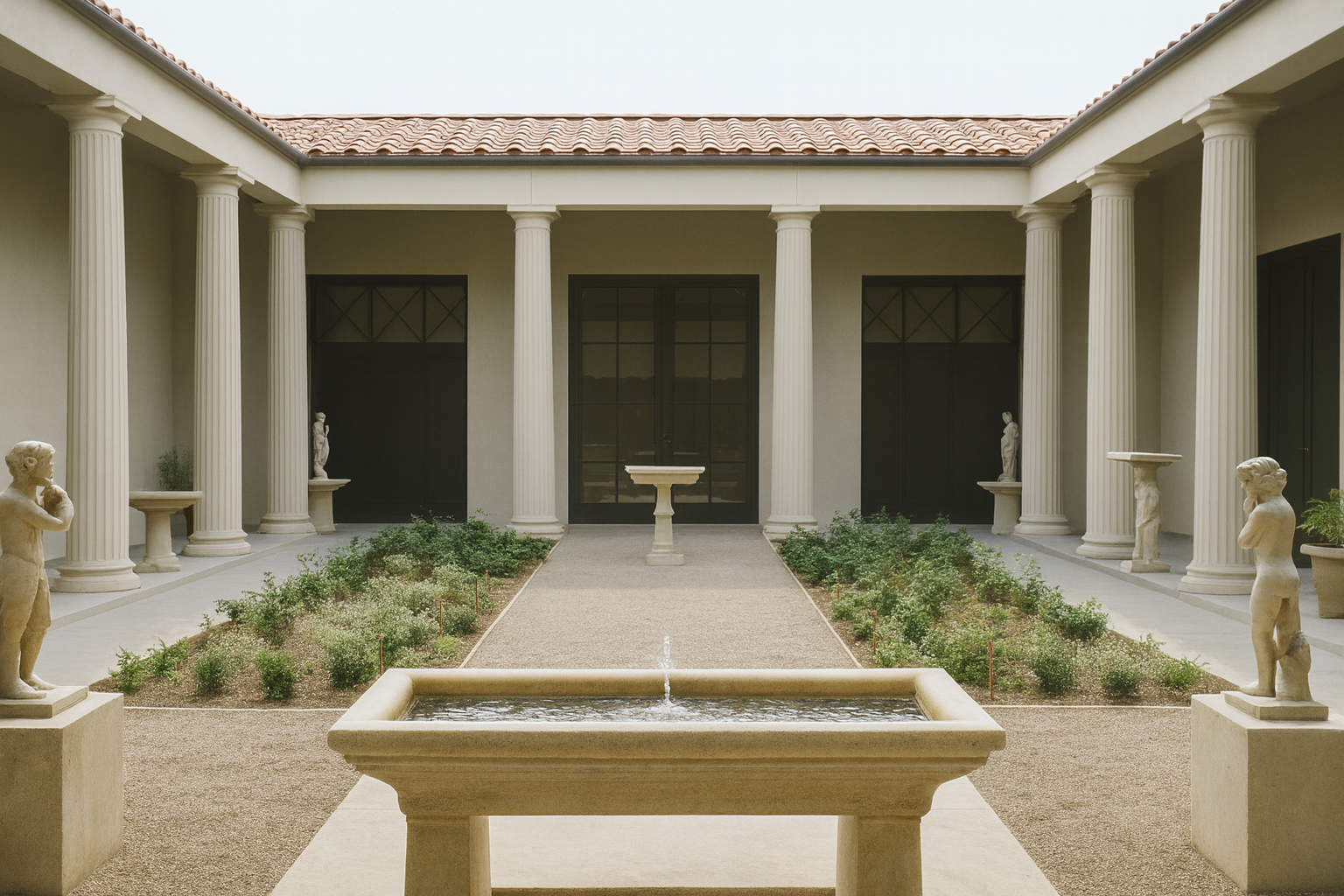
Beyond this came the peristyle, a quieter courtyard. Columns framed soil beds and fountains. Flooring shifted from basalt to mosaic. Families lived here, apart from the business at the front.
Courtyards kept houses habitable in heat, and they still read that way today, machines of air and water carved into stone.
For more on how these systems tied into wider Roman building logic, see Ancient Roman Architecture: Techniques, Structures, and Impact.
The Atrium Courtyard
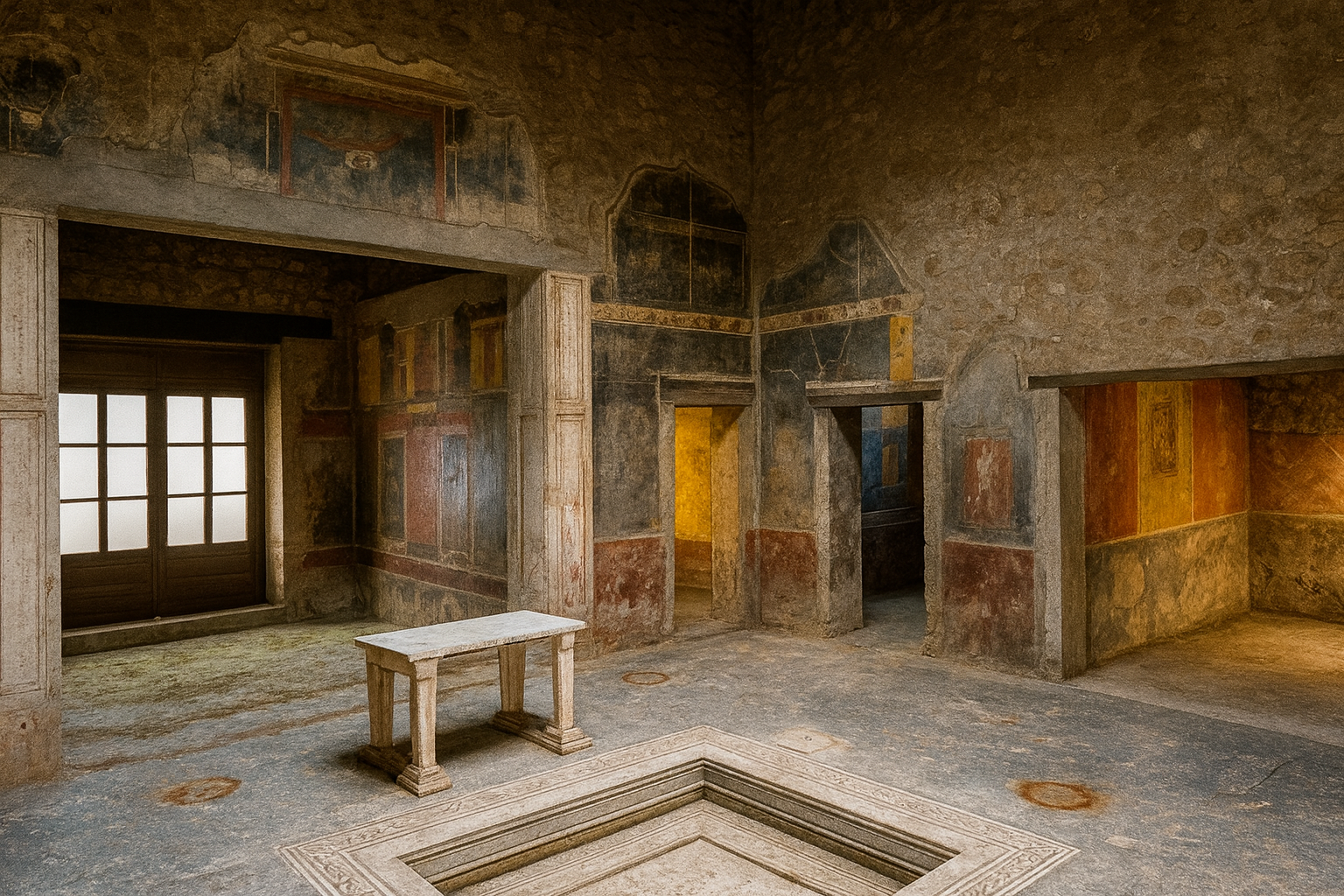
Atrium of the House of the Tragic Poet in Pompeii: central impluvium pool, and painted walls.
Shape and Scale
The atrium is the first courtyard inside a Roman house. A square or rectangle open to the sky, rooms leaning inward on all sides. Plans make them look wide, but on site most are smaller than expected. Six or seven meters across at best. Just enough to gather light, small enough so the rain hits the basin below.
The Impluvium System
At the center is the impluvium, a shallow pool cut in stone or marble. Rain falls through the opening above, the compluvium, then drains into cisterns below the floor. In Pompeii you can still follow the path of water. Some houses have neat terracotta pipes. Others show rough cuts where later masons hacked through older pavements. If you visit, trace those scars. They prove the courtyard was a machine, repaired and adjusted with use.
Details You Might Miss
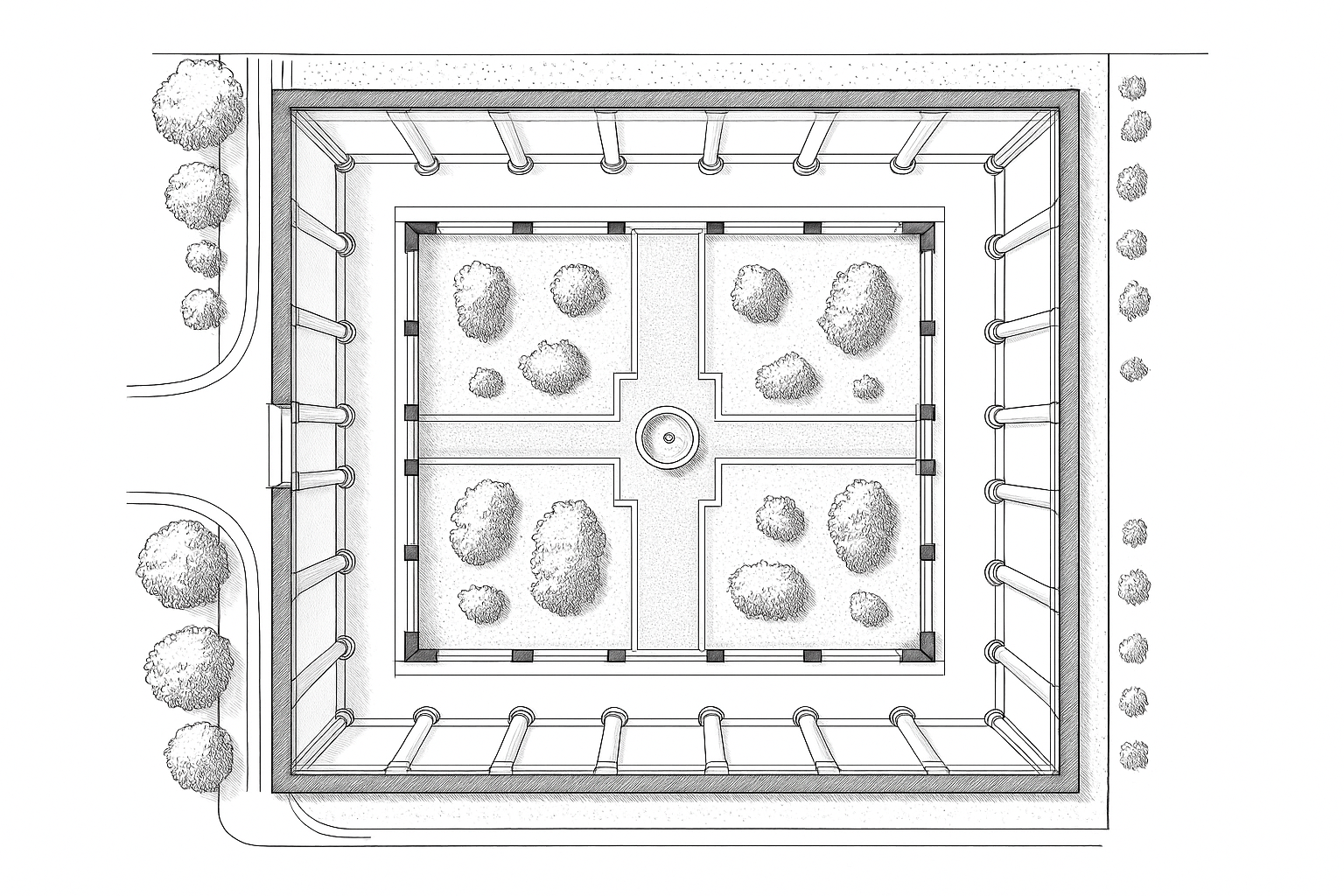
Architectural site plan of a Roman courtyard house: a central garden with fountain, colonnades, and symmetrical walkways.
Thresholds step higher than the floor. A small move against water spilling into the rooms. On some marble edges you find grooves carved to catch drips. Bend low and you see the faint stains running along the plaster base. A tide line left by flooding. These are not decorative touches. They are the marks of failure and repair. Plans clean them away. The ruins keep them visible.
Light and Air
At noon the impluvium shines while the walls stay dim. The space pulls hot air upward. At sunrise and sunset the light just skims the basin edge. If you stand there, notice how far that light reaches. It explains why frescoes survive in certain corners and not others. Decoration lived in the zones where daylight could touch it.
Social Life in the Atrium
The atrium was not only water and air. Clients waited here each morning. Ancestor busts lined the walls. Conversations happened while the basin still held rain. That mix of business and utility is what makes the atrium such a direct picture of Roman life.
For more on how Romans built spaces that worked as both structure and social stage, see Roman Architecture and Engineering: How the Romans Built Strong.
📘 MUST READ
Keep Ten Books on Architecture – Vitruvius nearby. It is uneven, sometimes dry, but it is the only surviving voice of a Roman architect explaining how courtyards, roofs, and water systems should be made.
The Roman Domus Courtyard: Atrium, Peristyle, and Space Logic
Roman Courtyards and Gardens: Private Life in Stone and Green
The Peristyle Courtyard
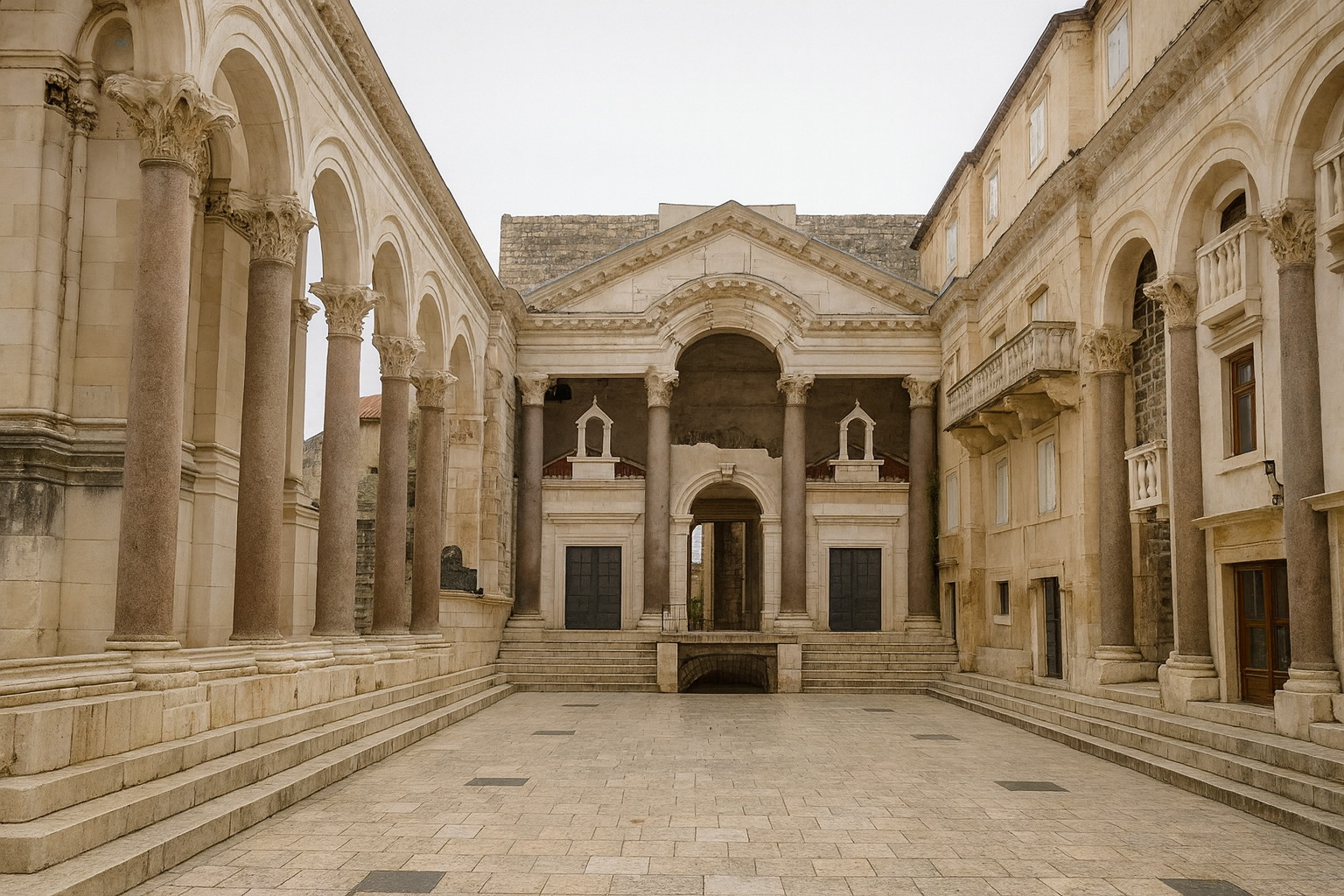
The peristyle court of Diocletian’s Palace in Split, Croatia: Roman colonnades, arches, and central gathering space preserved from the 4th century.
Plan and Edges
The peristyle sits behind the atrium. A garden court wrapped by a portico. Columns make a rectangle of shade and the rooms open to it. On plans it reads simple. In stone it is a set of edge conditions. Column base to paving. Paving to soil. Soil to wall. Each joint tells you how the space was used and watered.
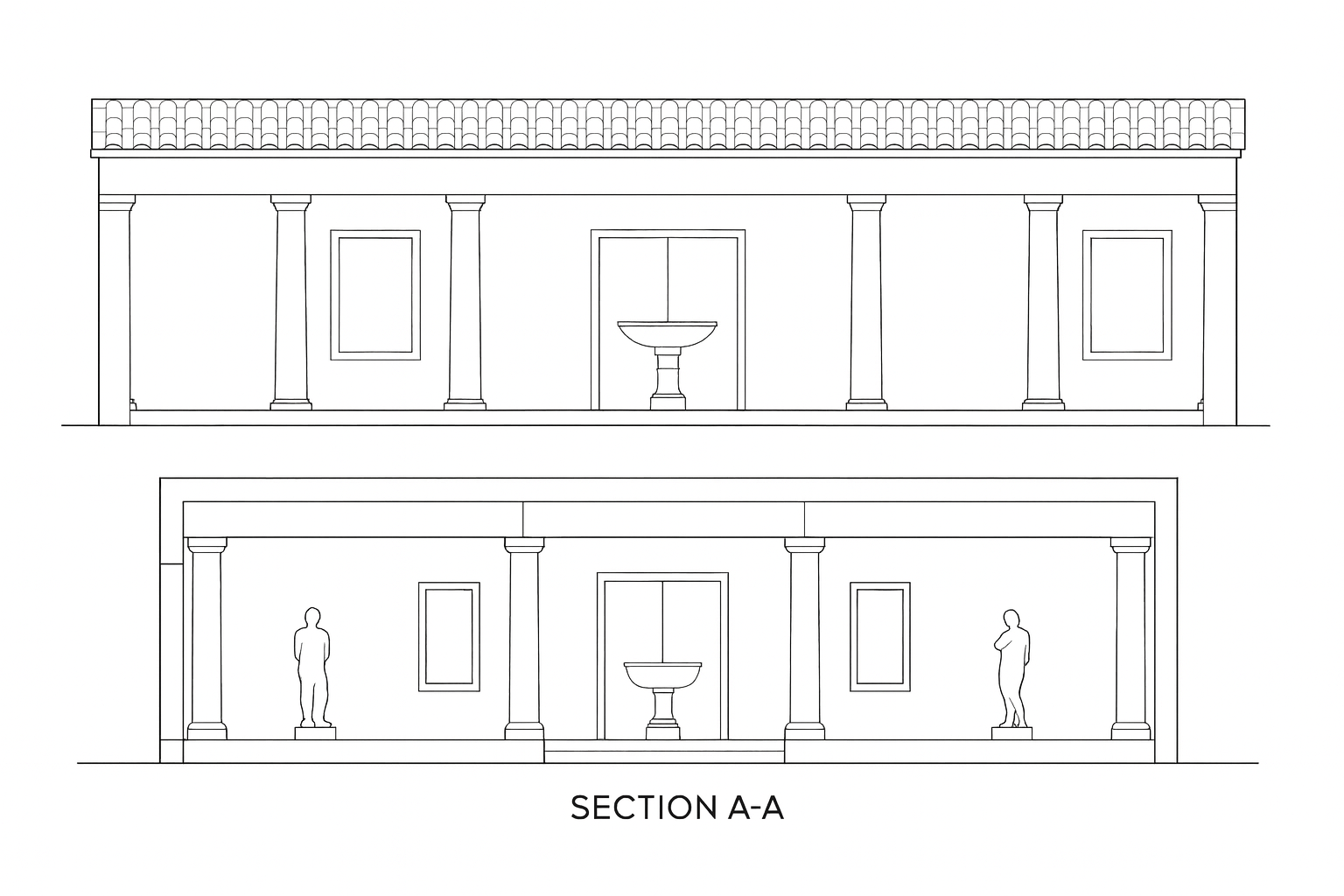
Columns and Footing Marks
Look at the column bases. Some sit on broad plinths with clean arrises. Others show thin repair bands where the base settled and was shimmed. A few carry drill holes at the back face for clamps you never see in books. If you visit, crouch and check the dust line around the base. You can read wind direction there. One side stays cleaner under the dominant breeze.
Flooring Shift
Portico walks are often hard stone or opus signinum. The garden field is soil or gravel. Where the two meet you sometimes find a narrow marble strip acting as a mower edge. In smaller houses that strip is missing. Soil bleeds onto the paving. That small mess is useful. It shows the garden was tended by hand, not staged for visitors.
Water and Planting
Basins and small channels cross the garden. Some are fed by reused pipes from the atrium system. Overflow points are easy to miss. They hide at the corner of planting beds, a thumb sized hole with lime scale around it. If you walk a site after rain, watch which bed drains last. That is where the subsoil compaction is worst, often from repeated foot traffic along a shortcut.
Light and Shade
Morning light enters under the colonnade and stops at a sharp line on the paving. By noon the garden field glows while the portico cools down. Frescoes survive best where that line stalls. If you visit, stand against a back wall at noon and count how many column bays you can see without turning. That number tells you how the family staged tables and benches to keep faces out of glare.
Privacy and Use
The peristyle was family ground. Eating, weaving, small lessons, storage moves. You see it in the wear. Thresholds from service rooms have deeper grooves than those to formal rooms. A few houses show a low shelf built into the back wall at elbow height. Likely a simple work ledge. Not a shrine. Everyday furniture without legs.
What To Notice On Site
- Check the underside of a column abacus. Soot marks mean lamps hung there more than you think.
- Look for a single odd stone in the paving near the garden corner. Often a lifted access slab to a small drain or cistern neck.
- Find the quietest corner at midday. That pocket usually holds the best preserved paint because wind and sun never found it.
For background on wider Roman house systems and urban context, see Ancient Roman Architecture: Techniques, Structures, and Impact and Urban Planning in Ancient Rome: Roads, Forums, and Aqueducts.
Atrium to Peristyle: Roman Courtyards Explained for Architects
Roman courtyards blended architecture, function, and gardens. See how they worked in daily life and why they remain central to design history.
Other Roman Courtyards
Service Courts
Beyond the atrium and peristyle, many Roman houses held small work courts. These were open pockets near kitchens, storerooms, or stables. They lacked decoration but carried the same climate logic. Smoke vented upward, animals tethered in shade, cistern mouths left accessible. At Pompeii some service courts are only three or four meters across, paved in rough basalt. You know them by the wear: deep grooves where jars were dragged and patched drains set against walls.
Light Wells
Narrow townhouses could not spare space for a full peristyle. Instead they used simple light wells. These were vertical slots open to the sky, often no wider than a corridor. Their purpose was daylight and air for cramped back rooms. Look for plaster stained by rainwater, or small basins tucked against the base to collect runoff. These wells show that not all courtyards were grand. Some were just functional voids cut into tight plans.
Commercial Courtyards
Inns and shops used courtyards as circulation hubs. A taberna might open to a central space where goods were stacked, animals loaded, and customers gathered. These courts were hard surfaces first — beaten earth, lava slabs, or reused stone. In Ostia, you can still see U-shaped blocks around courts where shop doors open inward, sharing the same void. No fountains, no mosaics, just a work yard scaled for traffic.
Villa Courts
Country villas stretched the type further. Large estates might have multiple service courts, each tied to agriculture. One for pressing olives, one for storing amphorae, another for livestock. These are rarely drawn in books, but when you walk a villa site the scatter of open rectangles makes sense. Each court tuned to a task. Some paved, some left bare soil, some edged with drains cut to the fields beyond.
What to Notice
- Check for rougher paving or even compacted earth — a sign of work courts rather than display courts.
- Look for off-axis drains and reused blocks, often faster repairs in service areas.
- Find light wells by plaster streaks and simple runoff basins — modest versions of the impluvium logic.
For wider context on functional spaces in Roman building design, see Roman Architecture Style | Materials, Tools, and Style.
Water, Light and Microclimate
Rain and Storage
Courtyards were rain catchers first. The compluvium in the roof let water fall straight into the impluvium. From there it drained into underground cisterns. In Pompeii some channels are still visible, neat terracotta tubes in wealthier houses, rough cuts through mosaic in modest ones. If you stand by an impluvium after rain, you can see how the floor pitches just enough to guide overflow toward a hidden drain. Think about the daily work behind that system — cleaning algae, scraping lime, patching leaks.
Air Movement
With no glass, air control was basic but effective. The atrium acted like a chimney, pulling hot air upward through the roof opening. Peristyles worked differently. The colonnade trapped cool air in shaded walks, while the open garden breathed heat away. Cross-breezes were possible only if corridors aligned. In many houses they did not. Narrow passageways cut air flow short. That detail rarely shows on plans but you feel it on site, standing in still corners that never move.
Light as Structure
Light dropped hard at midday, vertical shafts on stone and water. At morning and evening it skimmed edges. Romans used that logic in decoration. Frescoes survive best where daylight brushed the wall for only a few hours. In the peristyle, columns staged deep shadow lines that shifted hour by hour. If you visit, stand against a back wall and watch how the shadow creeps along the floor. It shows exactly where furniture or benches once sat, always just inside the shade line.
Failures in the System
These courtyards were not perfect machines. Clogged drains left standing water. Stagnant pools drew insects. Overflow cut stains into plaster. Some cisterns were too small for the roof area, leaving houses dry by late summer. Look for lime scale rings inside basins or moss growth along corner joints. They are signs of repeated failure, not design. That is part of the real story — repair and adaptation written into stone.
For background on how Roman builders managed climate through form, see Roman Architecture Style | Materials, Tools, and Style.
📘 FIELD PICK
For a builder’s-eye view of construction methods, drainage, and climate logic, check Roman Building: Materials and Techniques – Jean-Pierre Adam. Less history, more how-to. Diagrams of scaffolds, gutters, brick patterns, and vaulting. It reads closer to a site manual than a book.
Materials, Ornament and Illusion
Stone and Brick
The frame of a Roman courtyard was not uniform. Wealthier houses show ashlar blocks, travertine thresholds, or marble revetments. Modest houses relied on tufa, rough brick, or concrete cores faced with small stones in opus incertum or reticulatum. Stand close to a surviving wall and you see the switch: a fine surface at eye level, rougher work tucked into corners or service rooms. The economy of finish is a lesson in where effort was meant to be seen.
Stucco and Paint
Walls were coated with plaster, often painted to mimic marble. Frescoes still hold color in shaded corners of Pompeii and Herculaneum. In one peristyle you can trace brushstrokes of a painted garden where space was too narrow for planting. The illusion of depth replaced soil. If you visit, look at the lower plinth zones. The red banding is not only style — it hides dirt marks and water stains where plaster met the floor.
Mosaic and Floor Surfaces
Floors shift by zone. Atriums carry harder basalt or opus signinum, able to take water and foot traffic. Peristyles often hold mosaics or opus sectile in the porticos, while garden areas stay gravel or earth. The transitions matter. A thin marble strip between paving and soil works like a mower edge. Where it is missing, soil bleeds across the walkway. That spill tells you how gardens were tended and how fast maintenance slipped.
Objects and Statuary
Courtyards were also stages for objects. Small fountains, herms, or busts marked corners. Many are missing now, but the sockets and water feeds survive. You can read the size of the statue by the cut in the paving. Some bases are only 20 cm square, lighter than most guides suggest. These were not always grand statements. Sometimes just markers in shadow, set to balance the rhythm of columns.
Illusion as a Tool
Romans filled gaps with paint and craft. When light could not reach, walls were painted to look like openings. Porticos framed views with borrowed landscapes. Columns themselves were painted to mimic richer stone. If you walk a site, look for brush lines where red was dragged over cheaper plaster. The illusion is obvious up close, invisible from a distance. These tricks kept courtyards lively even when resources were thin.
For further context on Roman decorative systems, see Characteristics of Roman Architecture: Arches, Columns, and Innovation.
📘 VISUAL GUIDE
For clear drawings and cross-sections of Roman decorative schemes, see Architecture: A Visual History – Jonathan Glancey. Quick to use when you want to place color and material against structure.
FORM TYPES
Different Courtyard Types Across the Empire
Elite vs Modest Houses
Not every domus carried a grand peristyle. The House of the Faun in Pompeii has multiple courts aligned on axis, each framed by colonnades. Smaller houses cut down to a single atrium, sometimes with only a narrow light well behind it. Plans in books often flatten this range, but on site you feel the difference in scale immediately. In the larger houses, you can see through two or three courtyards at once. In the smaller, you are pulled into one compressed space with no escape to a garden.
Pseudo-Peristyles
Some houses show half-courtyards, columns on only one or two sides. The House of the Small Fountain is a good example. A narrow court with a decorative fountain, part open, part enclosed. It reads as a hybrid — not quite atrium, not quite peristyle. These spaces remind us that Roman builders experimented. They did not follow a single pattern.
Provincial Adaptations
Outside Italy, courtyard logic adjusted. In Gaul, U-shaped houses at Vieux-la-Romaine wrapped the court on three sides, a form tuned to climate and site. In North Africa, broader peristyles opened directly to the sky with less portico depth, trading shade for more air. These variations are underplayed in most accounts. They show that the courtyard was a flexible type, not a fixed model.
Reading Changes
Many houses reveal phases of remodeling. A courtyard widened, a wall cut across, drains shifted. Stratigraphy tells the story, not the clean plan you see in textbooks. Look for offset paving joints or mismatched column bases. They signal rebuilds. If you walk Pompeii, notice where basalt slabs change size mid-run. That break often means a later extension of the court.
Why It Matters
These shifts show how Roman houses were lived in. They were not fixed diagrams. Courtyards grew, shrank, and bent to family needs and local climates. Thinking of them as a single “Roman type” hides that human layer.
For a broad overview of form and change across regions, see Roman Building Style: Why It Still Matters Today.
📘 RESEARCH TOOL
For full coverage of villas, townhouses, and regional differences, use Roman Architecture – Frank Sear. Dense but clear. Explains not only what survived, but why plans differ across the empire.
FORM TRANSFORMATIONS
How Courtyards Changed Over Time
Alterations, Repairs, and Reuse
Courtyards in Motion
Roman houses were not frozen in time. Walls shifted, drains were cut, openings were sealed. The clean diagrams we see in books erase that history. On site you see it in uneven joints, in patches of paving that no longer line up, in a column base that sits off axis by a hand’s width. Those small misfits record centuries of change.
Inserted Walls and Blocking
Some atriums were later cut by walls to create smaller rooms. Look at plaster scars where paint lines stop short. A red border suddenly ends in the middle of a wall. That is a clue that a later partition erased the original surface. In a few peristyles you find blocked doorways with recycled stone filling the gap. If you visit, run your hand across the joint. You feel the rough back of a block where once it faced outward.
Drainage Shifts
Clogged or undersized drains forced builders to improvise. New cuts were made through existing floors. Some are brutal: a channel hacked straight through a mosaic. Others are subtle, just a terracotta pipe added against a wall. The mismatch between old and new work is obvious if you look at mortar color. Fresh lime always reads lighter. Even two thousand years on, the patch is visible.
Material Reuse
Spolia is everywhere. A basalt threshold reused as a step in a back passage. A column drum flipped and set as a bench. A marble revetment panel built into a cistern wall. These reuses were practical, not symbolic. Walk a site slowly and count how many surfaces show tool marks on the wrong face. That is where a block lived one life before being turned to another use.
Reading Phases
Archaeologists layer the story in stratigraphy. As a visitor you can read it in scars. Offset joints. Cut floors. Paint lines that end too early. These are not mistakes. They are the record of families altering their houses to fit new needs, new tastes, new failures. The courtyard was not timeless. It was reworked like any lived space.
For a sense of how Roman urban life kept reshaping private houses, see Roman Forum Architecture: The Center of Roman Public Life.
📘 PRACTICE NOTE
If you want to understand how builders handled those changes in real detail, read Roman Building: Materials and Techniques – Jean-Pierre Adam. It shows the scaffolds, brick bonds, and patch methods that explain why courtyards look pieced together today.
Use This Now
Courtyards as Climate Tools
The Roman courtyard worked because it solved heat and light in a simple way. Open to the sky for sun and rain. Enclosed enough to funnel air. No glass. No machines. That logic is still useful. In hot cities today, a small internal court can lower temperature without fans. Architects call it passive cooling. The Romans built it by instinct.
Privacy in Dense Cities
Houses in Pompeii faced narrow streets. Courtyards turned life inward, giving families privacy behind blank walls. Modern urban housing fights the same problem. A courtyard lets windows open without facing traffic or neighbors. The form protects and connects at the same time.
Courtyards in Modern Practice
You see echoes of Roman design in Spanish patios, Islamic riads, and Renaissance palazzi. Today, contemporary houses in dense neighborhoods often borrow the same move: a central void, rooms clustered around it. Walk through new housing in Mexico City or Barcelona and you find courtyards handling air, light, and noise just as they did two thousand years ago.
What to Take Forward
- Size matters. Keep courts compact so light and water reach the floor.
- Drainage is not an afterthought. One blocked pipe can ruin walls in months.
- Shadows are design tools. Use colonnades or overhangs to tune heat and glare.
- Courtyards are lived spaces. Design them for work, meals, and rest, not only as voids.
Human Scale
Standing in a Roman peristyle, you feel proportions tuned to walking pace and eye height. Columns at two meters spacing. Beds of soil small enough to touch from the path. These lessons in scale carry forward. A courtyard that feels human is one that invites use, not just admiration.
For a wider frame on Roman design carried into urban form, see Urban Planning in Ancient Rome: Roads, Forums, and Aqueducts.
📘 MUST READ
For a broader sweep of global courtyard traditions and their place in architecture, keep A Global History of Architecture – Francis D.K. Ching, Mark Jarzombek, Vikramaditya Prakash. Useful to compare Roman moves with parallel solutions in Asia, Africa, and the Americas.
Misreads on Site
Thinking All Houses Had Peristyles
Many guides imply every Roman home had a peristyle garden. Most did not. Smaller houses stopped at the atrium or used a light well. When you visit Pompeii, look for houses with only one open court. It is a reminder that the textbook model is built from elite examples, not the average street.
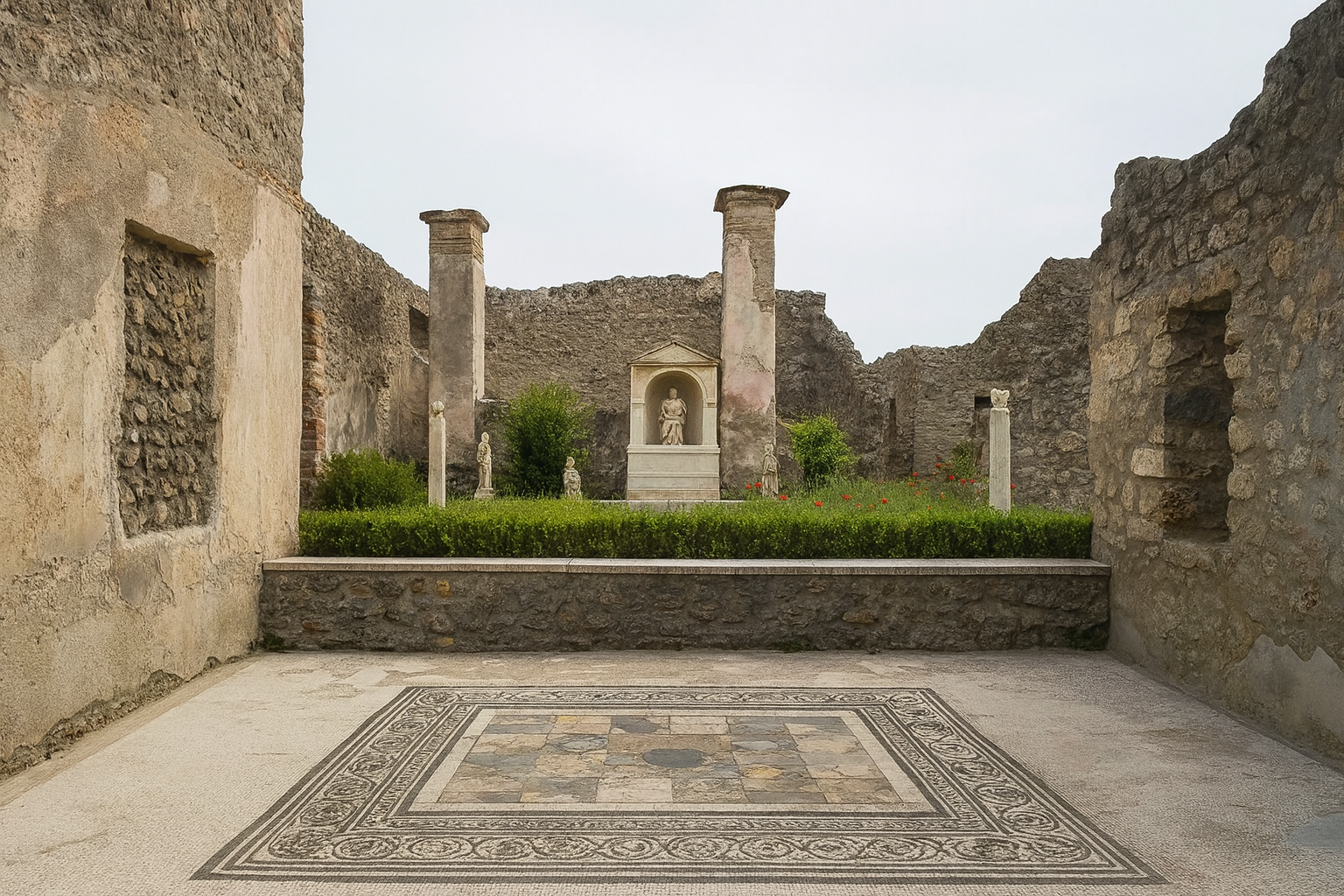
The peristyle courtyard of the House of Marcus Lucretius in Pompeii.
Reading Plans as Final
Plans in books show crisp rectangles. On site, no courtyard is perfect. Walls bend, floors sag, drains cut across mosaics. Students often treat the diagram as the truth. Better to trust the ruin. Look at where paving stones change size mid-run. That is the real plan, shaped by repair.
Overvaluing Decoration
Frescoes and mosaics draw attention, but they distract from function. The impluvium, the drains, the thresholds — these made the house work. Do not miss the groove in a marble lip because you were staring at the wall painting. Utility is part of beauty here.
Assuming Silence and Cleanliness
Reconstructions often show empty courtyards. In reality they were noisy and messy. Water dripped, kids played, dogs crossed the floor. Surfaces wore out fast. If you walk a site, notice the worn patches near thresholds. Those are footprints repeated for decades, not polished voids.
Ignoring Regional Variation
Roman houses outside Italy did not copy Pompeii exactly. In Gaul, Africa, or the East, courtyards adjust to climate. Some are wider, some with less portico depth. If you study only Campania, you miss half the story. Always check how form shifts across provinces.
For more on structural and functional choices Romans made, see Ancient Roman Architecture: Techniques, Structures, and Impact.
📘 ON SITE
A good companion for spotting real construction logic is The Seventy Wonders of the Ancient World – Chris Scarre. Less theory, more about how stones were moved, drains cut, and spans managed.
On-site Vignettes
House of the Small Fountain, Pompeii
The court is narrow. The fountain niche pulls the eye but the real story sits at your feet. A thin channel cuts across the paving toward a corner drain. The cut is later than the mosaic and the mortar color gives it away. Someone solved an overflow problem fast. Stand by the niche and look down the wall. You can trace a faint water stain that lines up with the pipe exit. The garden is painted more lush than the soil could ever hold. Paint as irrigation for the eye.
What to notice: the joint between the fountain basin and the wall. A hairline crack runs the whole height. That is movement from the portico roof, not bad craft. It tells you the structure flexed with weather and time. If you sketch, mark that crack before the color.
For background on how water and structure share the same space in Roman houses, see Roman Architecture and Engineering: How the Romans Built Strong.
House of the Faun, Pompeii
Scale changes everything. Two peristyles, long axes, deep shade. Walk the main axis and stop where the light breaks from bright court to dim portico. The threshold stones are polished in a narrow band that matches that line. Feet found the shade and stayed there. The famous mosaics read like rugs laid where the light would not burn them. Columns sit on clean plinths, but check the back faces. You will find small repair patches no guide points out.
What to notice: stand at the far peristyle and look back through both courts. Count how many door heads align. Not many. The perfect axis exists in drawings, not in stone. The misalignments are the house telling you it grew in pieces, season by season, budget by budget.
For a wider frame on elite house planning and urban setting, see Ancient Roman Architecture: Techniques, Structures, and Impact.
U-shaped Courtyard House, Vieux-la-Romaine
Provincial air changes the type. Three wings wrap a court that opens on one side. Wind runs through more freely. Portico depth is thin, shade is short. The paving mix is rougher, with reused stone edging a planting strip. Stand by a corner post and check the base. Dust builds on the windward side only. That detail explains why paint survives better inside the U than at the open mouth.
What to notice: the step heights. They vary by a finger or two across the wing. That is not error. It is building with what was on hand. You feel it in your knees. The courtyard still works as a climate tool, just tuned to a different sky and a different budget.
Acoustics and Night Life of Courtyards
Sound as Architecture
Roman atrium acoustics
Drop a coin in the impluvium. The splash carries across the hall. Stone and plaster turn it louder than you expect. The atrium worked like a sound box. Clients waiting could hear footsteps before the patron appeared. Water dripping from the compluvium kept a steady rhythm. A colleague once clapped in a Pompeian peristyle at dawn. The echo returned after a short pause, long enough to measure in strides. That echo mapped the space as clearly as any drawing.
In Islamic sahns, fountains did more than cool. Their sound masked the city beyond the walls. A thin jet into a basin breaks noise like a screen. Walk the Alhambra’s Court of the Lions and you notice how the water hushes voices, turning the space intimate even when crowded. Architecture by ear, not just by eye.
Courtyards After Sunset
We read them as daylight spaces, but at night they came alive in other ways. Romans hung oil lamps on column abaci — soot stains still mark the stone. The flicker turned the portico into a moving colonnade of shadows. In Islamic courts, moonlight reflected in pools. At midnight you could navigate by the glow of water alone. The cool draft at night pooled in shaded corners, a relief after day heat. I remember standing in a restored riad in Fez — the air felt ten degrees cooler, the fountain barely audible but present like a pulse.
The Hidden Labor of Courtyards
Work Behind the Image
Courtyards look timeless in drawings. In reality they demanded constant work. Roman impluvia gathered algae unless scrubbed with lime. Cisterns needed draining and clearing. I have walked floors where later pipes hacked through mosaics — fast repairs by enslaved workers who kept the water moving. Those scars are labor made visible.
Islamic courtyards were no easier. Tile fountains had to be polished, channels cleared of silt, plants watered and trimmed. A colleague who studied maintenance crews at the Alhambra told me they worked as a small army: one team for water flow, one for plaster, one for gardens. Paradise was built on shifts and schedules.
Why This Matters
Architecture is not just form and proportion. It is the system of upkeep. Courtyards were machines that broke, leaked, clogged, and needed care. When you stand in them, look for lime scale rings, patched mortar, or mismatched tiles. Those marks are the real history — the people who kept the air cool and the water running long after the architects were gone.
For structural detail on Roman repair craft, see Roman Architecture and Engineering: How the Romans Built Strong. For wider context on daily upkeep in Islamic domestic design, read Domestic Architecture and Urban Expansion – Arts, MDPI.
Roman vs Islamic Courtyards
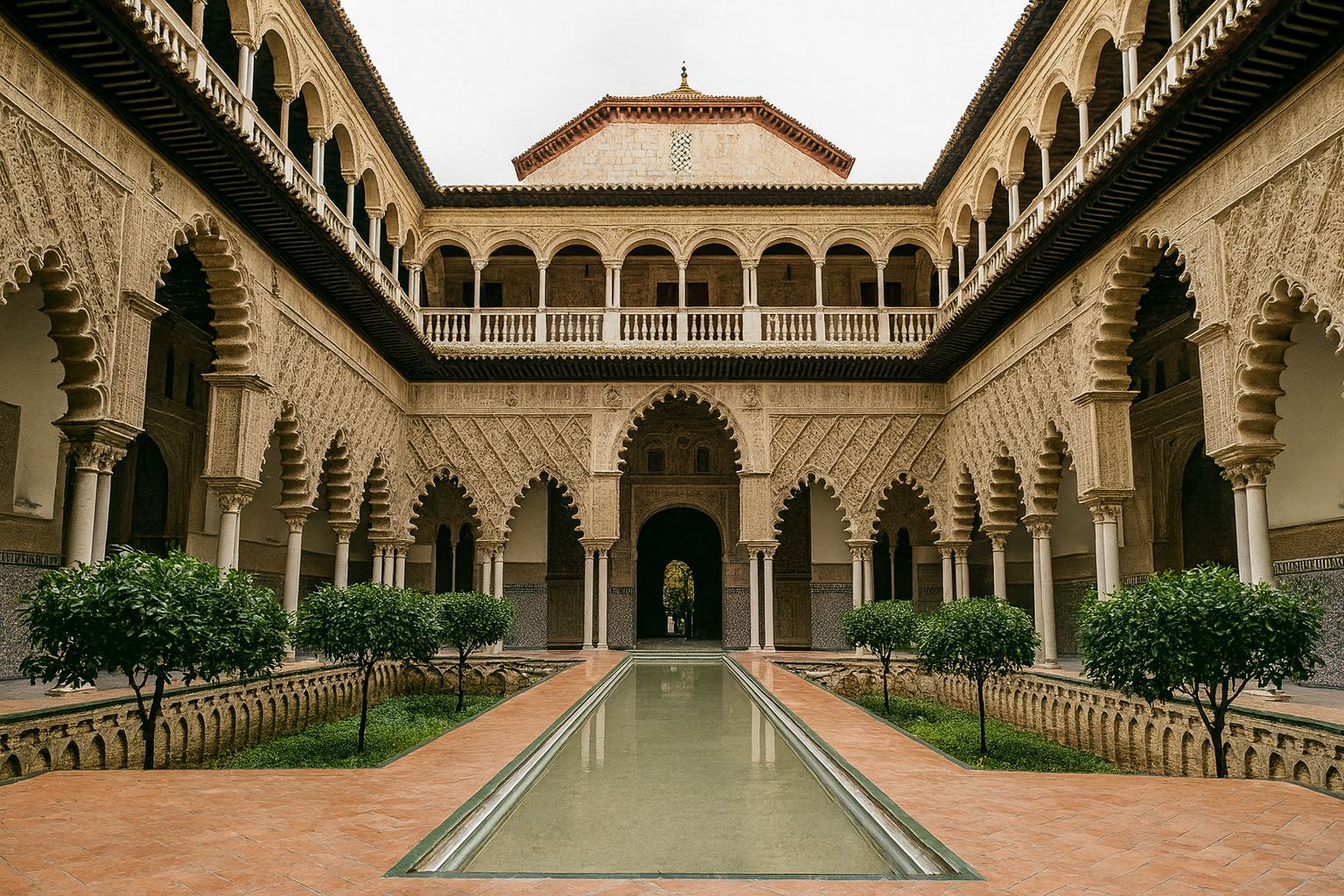
Shared Ground, Different Aims
Both Romans and Islamic builders worked with the same constraint: hot summers, bright light, crowded cities. The solution was the courtyard. Yet the core logic split. Roman courts caught rain and light, acting as both roof drain and family stage. Islamic courts slowed heat and glare, with shade and water used as active coolers. On paper they look alike. In lived use they pull in different directions.
Which Came First?
Courtyards did not start with Rome. Mesopotamian houses had them centuries earlier. Simple voids in mudbrick compounds, open to sky. Rome perfected them with drains and symmetry. When Islam spread, it inherited lands already full of Roman and Byzantine houses. Builders and craftsmen carried the DNA forward. But the Islamic courtyard was not a copy. It folded in Persian garden logic, local desert house traditions, and religious needs for privacy. Borrowed bones, new body.
Roman Atrium vs Islamic Sahn
In a Roman atrium the impluvium mattered most, water as resource. In an Islamic sahn the fountain mattered most, water as symbol and cooler. Romans left the sky hole open, using air stack effect to vent. Islamic builders deepened arcades and iwans, breaking glare and carving shadow. If you walk both, you feel the difference in your skin: Rome is bright with a wet floor at center; an Islamic sahn is dimmer, cooler, with water running just to touch the air.
Privacy and Social Logic
Roman courts were semi-public. Clients waited in atriums, guests strolled peristyles. Islamic courts were inward and private. Houses turned blank walls to the street and lived around shaded courts inside. This shift matters. It changes scale. Roman courts can be broad, axial, demonstrative. Islamic courts hug smaller footprints but build depth through repetition, arcades, tile, carved stucco, pulling richness into the private realm.
Before Islam, Among Arabs
Pre-Islamic Arab houses were simpler, often courtyard compounds in mudbrick or stone, built for herding and trade towns. Shade, storage, pen space. They had the idea long before empire. Islam did not invent the courtyard but gave it symbolic weight. Paradise gardens in miniature. The type matured in Medina and Damascus when early Muslim rulers adapted older Roman/Byzantine structures with their own needs layered in.
Who Excelled?
Rome engineered the courtyard as a working machine: drains, light, structure. Islam refined it into climate comfort and symbolic depth: shade, water, privacy, paradise made domestic. Both are master classes, but in different registers. If you stand in Pompeii you see infrastructure laid bare. If you stand in the Alhambra you feel air cooled by geometry and sound. Excellence sits on both sides, depending on whether you prize function or atmosphere.
What to Notice on Site
- Roman impluvium edges: check for drip grooves and patched drains.
- Islamic fountains: note how water sound carries, masking street noise.
- Roman light shafts: stand at noon, see how far glare runs into rooms.
- Islamic arcades: walk the shade line, feel how temperature drops step by step.
For structural background, see Roman Architecture Style | Materials, Tools, and Style. For global context, compare with A Global History of Architecture – Ching, Jarzombek, Prakash.
Roman vs Modern Courtyards
Scale and Proportion
Roman courtyards were small by modern standards. An atrium in Pompeii might measure six to seven meters across. Enough for light and air, not enough to stage a garden. Modern houses that attempt a courtyard often scale them larger, chasing openness instead of containment. The result can be too much void, leaving rooms starved of shade. The Roman lesson is restraint: design the court to pull air and daylight, not to brag in plan.
Climate Logic
Roman impluvia and peristyles managed Mediterranean heat without machines. Open roofs, shaded edges, and water basins worked together as passive cooling. Modern versions sometimes miss this logic. Developers cut a “patio void” but forget shade depth or drainage, leaving hot slabs that radiate heat. The workable modern courtyards — in places like Mexico City, Marrakesh, or Singapore — still respect proportion, shadow, and airflow. They echo Roman function more than Roman form.
Materials and Surfaces
Romans leaned on volcanic stone, brick, and plaster. Their courts aged visibly: stains at thresholds, patched drains, grooves worn into paving. Modern courtyards rely on concrete slabs, steel shading frames, glass, and lightweight tile. These clean surfaces age differently. They show cracks, rust streaks, or discoloration rather than carved wear. The contrast matters. Roman courts teach us to expect and design for weathering. Modern ones often pretend weather does not exist until it does.
Social Use
Roman courts balanced business and domestic life. Clients waited beside basins while family life moved around them. Today’s versions are more private. Courtyards in houses, apartments, or offices become retreats — places for quiet air and controlled greenery. You rarely find them as negotiation halls or business stages. The overlap of public and private that made Roman atria hum has mostly disappeared, except in hotels or hybrid live–work houses.
Where to See the Continuity
The closest modern parallels are in climates that demand shade and airflow. Latin American casas with central patios, North African riads with planted sahns, even some urban infill projects in southern Europe — all keep the core idea alive. These places work like Roman courts not because they copy them, but because they answer the same problems: heat, light, and space hierarchy. The continuity is practical, not stylistic.
For more on how Romans solved these problems at scale, see Urban Planning in Ancient Rome: Roads, Forums, and Aqueducts. And for architects testing similar ideas today, The Timeless Way of Building – Christopher Alexander is still one of the sharpest tools.
FAQ
Did every Roman house have a peristyle?
No. Many stopped at the atrium or used a small light well. Peristyles show up more in larger or wealthier houses. If you walk Pompeii, count how many plans have just one court. It is most of them.
How big was an impluvium?
Often 2 to 4 meters on a side, shallow, with a clean stone lip. Small enough that rain still hits it. Look for the drain hole in a corner or a pipe set into a side wall. The size pairs with the roof opening above it.
Where did the water go?
Down into a buried cistern. You can trace the run by lime scale, a terracotta tube, or a patched channel in mosaic. If you see two outlets, one was likely a later fix after floods.
How did they keep courtyards clean?
Brooms, lime scrubs, and constant patching. Algae still stains some basins. The red plinth band on walls hides splash marks and dirt. That band is practical before it is decorative.
Were these spaces quiet?
Not really. Water dripped. People crossed all day. In bigger houses you hear footsteps echo under porticos. In small ones sound dies fast. Worn stone by thresholds is the sound map turned into polish.
How did light move through the day?
Hard and vertical at noon. Low and grazing in the morning and evening. Frescoes survive best where light touched for a short window. Stand at midday and follow the shade line along the paving. Furniture sat just inside that line.
What fails first in a courtyard?
Drains. Then plaster at the base. Look for hairline cracks at basin corners, lime halos on joints, and small mortar patches that read lighter than the surrounding floor. Those are the repair map.
How can you tell a later modification?
Paint lines that end in mid wall. Paving that changes size mid run. A column base off axis by a hand’s width. Mortar tone that does not match. Reused blocks with tool marks on the wrong face.
Why do some courtyards feel cooler than others?
Portico depth, water surface, and wind path. A deeper colonnade drops the radiant load. A working basin cools a little. Cross breeze matters only if doors line up. Many do not, which is why some corners feel still.
What should I look for first on site?
Start at the ground. Drain holes, overflow paths, step wear, dust lines around column bases. Then lift your eyes to the shade edge on the paving. That line explains more about use than any label.
For a quick primer on the structural logic behind these answers, see Characteristics of Roman Architecture: Arches, Columns, and Innovation and Ancient Roman Architecture: Techniques, Structures, and Impact.
Related
Ancient Rome
References
- Berry, Joanne. Boundaries and Control in the Roman House. Academia.edu. https://www.academia.edu/89541268/Boundaries_and_control_in_the_Roman_house
- Sear, Frank. Roman Architecture. Routledge, 1982. Overview of Roman building types, including atrium and peristyle houses.
- Adam, Jean-Pierre. Roman Building: Materials and Techniques. Routledge, 1994. Still the most detailed breakdown of Roman construction craft and repair methods.
- Aparicio Sánchez, L. Domestic Architecture and Urban Expansion. Arts, MDPI, 2023. https://www.mdpi.com/2076-0752/12/2/79
- Ali, M., & Magdi, S. “The Influence of Spolia on Islamic Architecture.” International Journal of Heritage Architecture, WIT Press. https://www.witpress.com/Secure/ejournals/papers/HA010307f.pdf
- Kashef, Mohamad. “Critical Analysis of Design Paradigms in Islamic Architecture: A Study of Interiority, Versatility and Cellularity.” Architecture Research, 2019. Available via ResearchGate. ResearchGate link
- Oxford Islamic Studies Online. “Gardens and Landscaping.” Bridging Cultures Muslim Journeys Project. https://bridgingcultures-muslimjourneys.org/items/show/264
- Scarre, Chris (ed.). The Seventy Wonders of the Ancient World. Thames & Hudson, 1999. Construction-focused overview of ancient structures, including Roman houses.
- Curtis, William J.R. Modern Architecture Since 1900. Phaidon, 1996. Useful for legacy comparisons into modern courtyard forms.
- Ching, Francis D.K., Jarzombek, Mark, & Prakash, Vikramaditya. A Global History of Architecture. Wiley, 2017. Amazon link for wider cross-cultural courtyard traditions.
- Khamui, A., et al. “Urban Courtyards and Canopies in Residential Areas of Historic Arab Cities.” Repozytorium Biblos. https://repozytorium.biblos.pk.edu.pl/redo/resources/46972/file/resourceFiles/KhamuiA_BetweenTradition.pdf
- Social Science Journal. “Origin and Development of Mosque Architecture.” https://www.socialsciencejournal.in/assets/archives/2019/vol5issue3/5-3-37-109.pdf
- Edinburgh University Press. “The Medieval Islamic Garden: Typology and Hydraulics.” https://doi.org/10.3366/edinburgh/9781474482189.003.0016
- ArchitectureCourses.org. “Courtyards ‘Sahn’ in Islamic Architecture.” /design/courtyards-sahn-islamic-architecture