
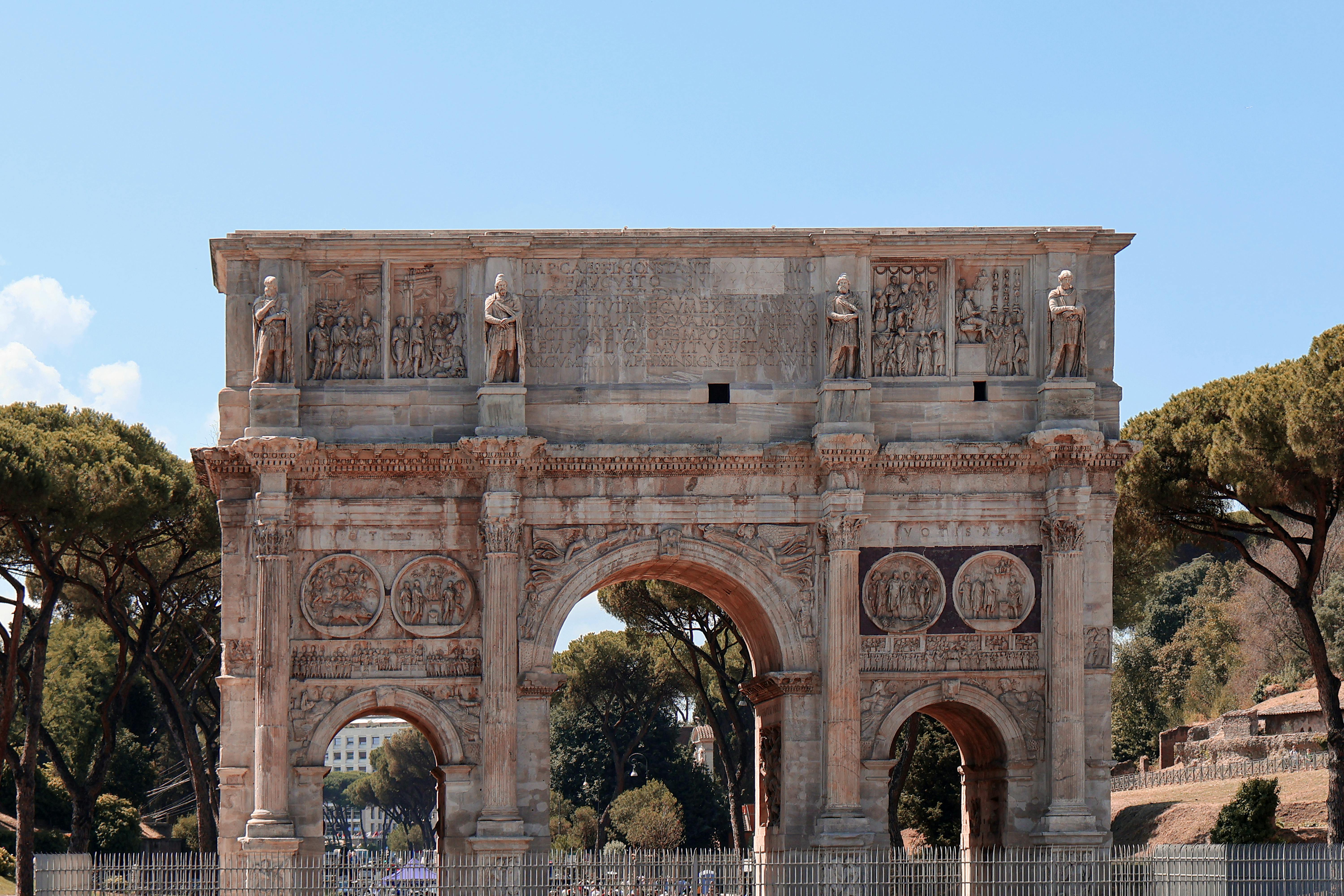
Roman Forum Architecture: The Civic Core of Ancient Rome
The Roman Forum was never just a set of ruins. It was a blueprint for public life—one that still echoes in modern cities.
Forget the marble. Focus on the flow, the function, and the focus. That’s where the genius lies.
Architecture at its best isn’t just about form. It’s about people, systems, and stories—all built into stone.
Roman Forum Architecture: Where Politics, Commerce, and Society Intersected
The Evolution of Rome's Central Hub
Why the Roman Forum Still Matters
Core Civic Structures That Shaped a Civilization: What did the Roman Forum look like?
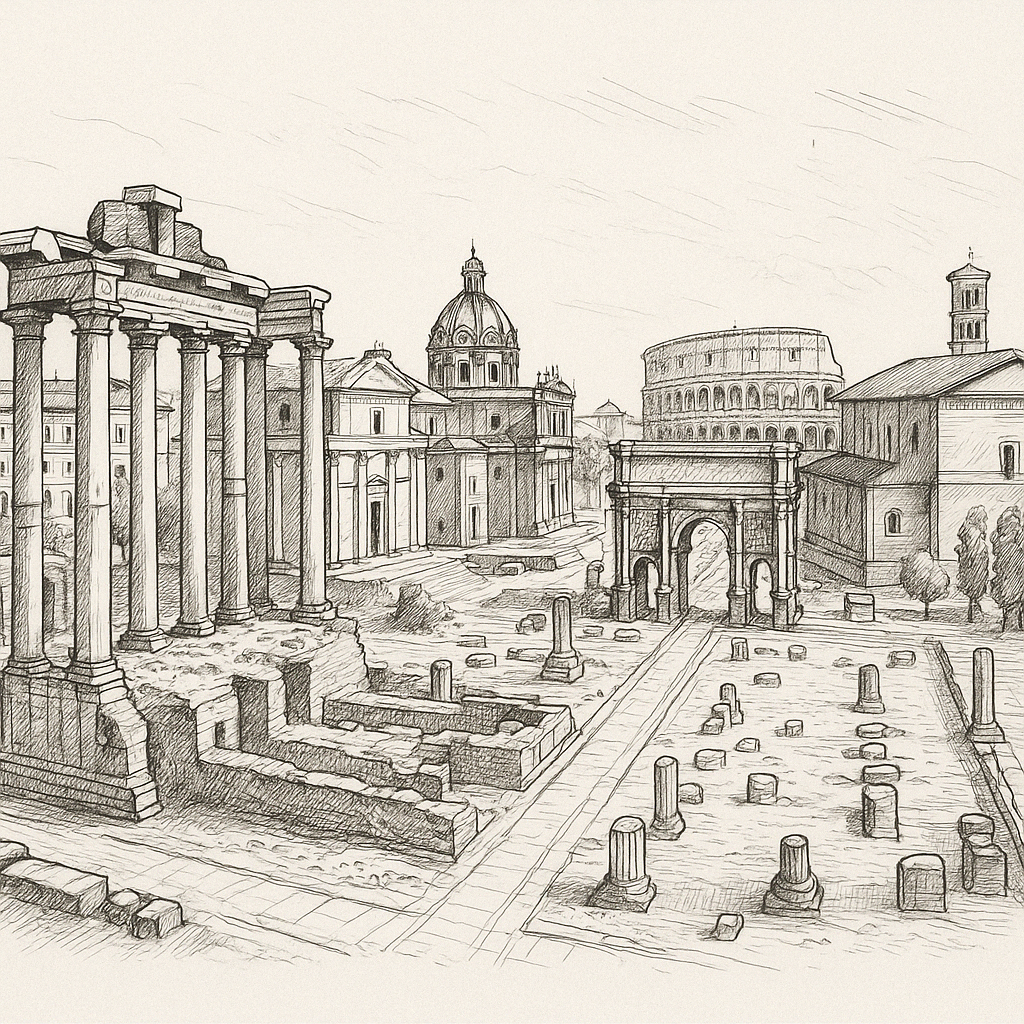
The Roman Forum wasn’t just a marketplace or a relic of empire. It was a masterclass in civic architecture—spaces designed not only to function but to influence how people thought, behaved, and governed.
Temples often take the spotlight, but the real backbone of Rome’s political and public life? That came down to three core buildings:
-
The Basilica (Rome’s version of a multi-use civic hall)
-
The Curia (Senate meeting chamber)
-
The Triumphal Arch (symbolic architecture with psychological and political weight)
These weren’t built for beauty alone. They were built to work—and to impress.
Roman Forum Architecture: Understanding the Forum's Role in Roman Society
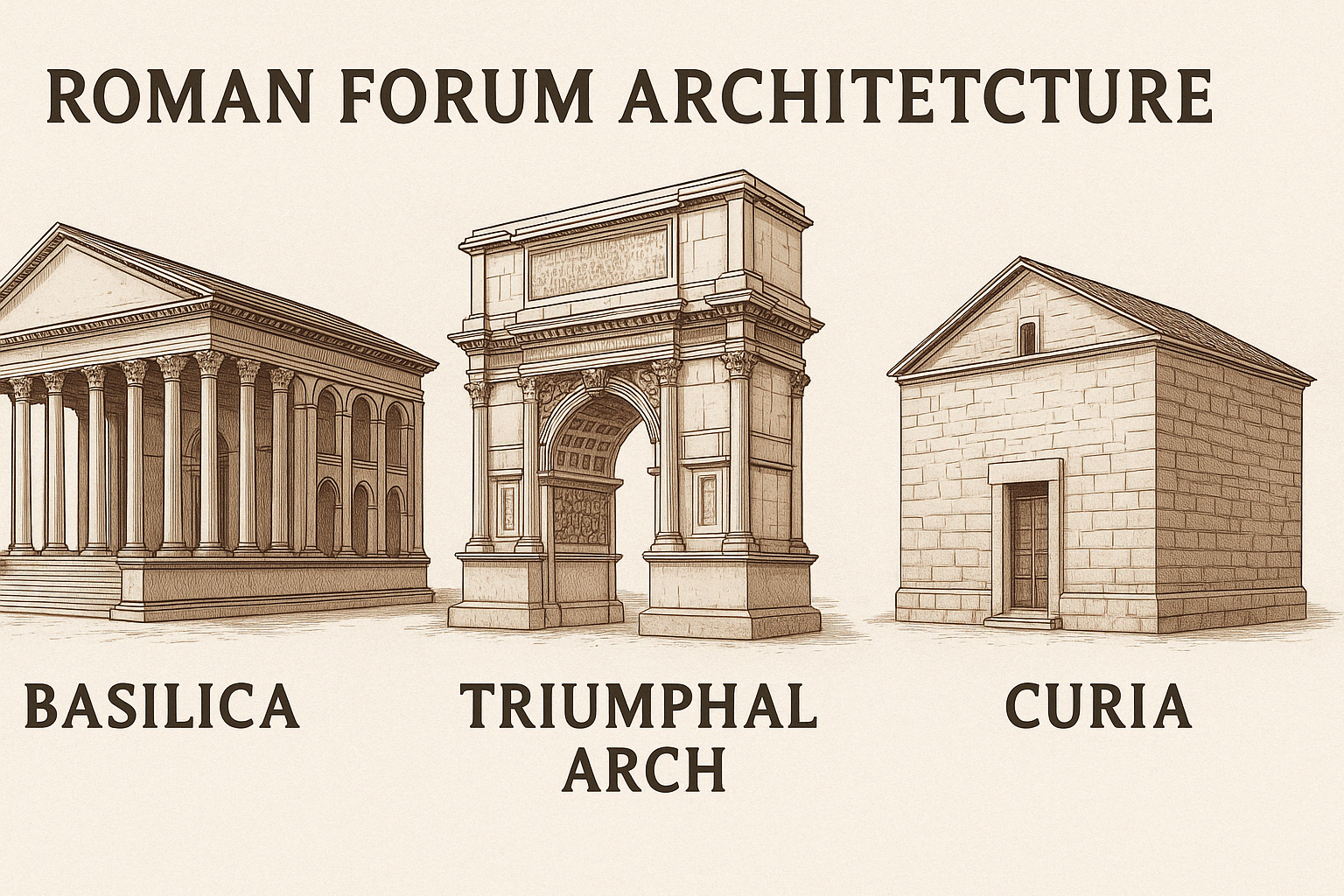
Image: Educational illustration of the Roman Forum highlighting the basilica, triumphal arch, and curia, showcasing core civic structures with accurate scale and layout.
The Architectural Significance of Rome's Forum: Insights into Ancient Roman Engineering
1. The Roman Basilica: Public Utility, Roman Style
Forget what the word “basilica” means today. In ancient Rome, it was a civic building—often rectangular, with rows of columns and an open central space.
Purpose:
-
Legal proceedings
-
Commercial transactions
-
Large public gatherings
Architectural Features:
● Long central nave with aisles on either side
● High clerestory windows for natural lighting
● Often included an apse—a semicircular recess at the far end for judges or officials
Why it Worked:
The layout allowed for sound to travel clearly, light to fill the room, and crowds to circulate easily. You could argue it was the Roman answer to the town hall, courtroom, and convention center—all rolled into one.
Psychological Impact: The sheer size made people feel small—but that was the point. It reminded citizens that they were part of something larger than themselves: the Roman state.
2. The Curia: Where the Senate Ruled
The Curia Julia, built by Julius Caesar and finished by Augustus, was the official seat of the Roman Senate. It wasn’t massive or ornate, but it was deliberate—heavy walls, strong geometry, restrained elegance.
Purpose:
-
Political decision-making
-
Deliberation on laws, military action, and imperial policies
Architectural Features: ● Rectangular footprint with a single grand hall
● Elevated podiums for senators
● Large wooden doors and high windows to give light without distraction
Why it Mattered:
This was the room where the future of the empire was decided. The structure was designed for acoustics, visibility, and power dynamics.
Design Psychology: The high ceilings and plain interior weren’t decorative—they helped control focus. Eyes on the speaker. No visual clutter. Just strategy, debate, and power plays.
3. Triumphal Arches: Architecture for Propaganda
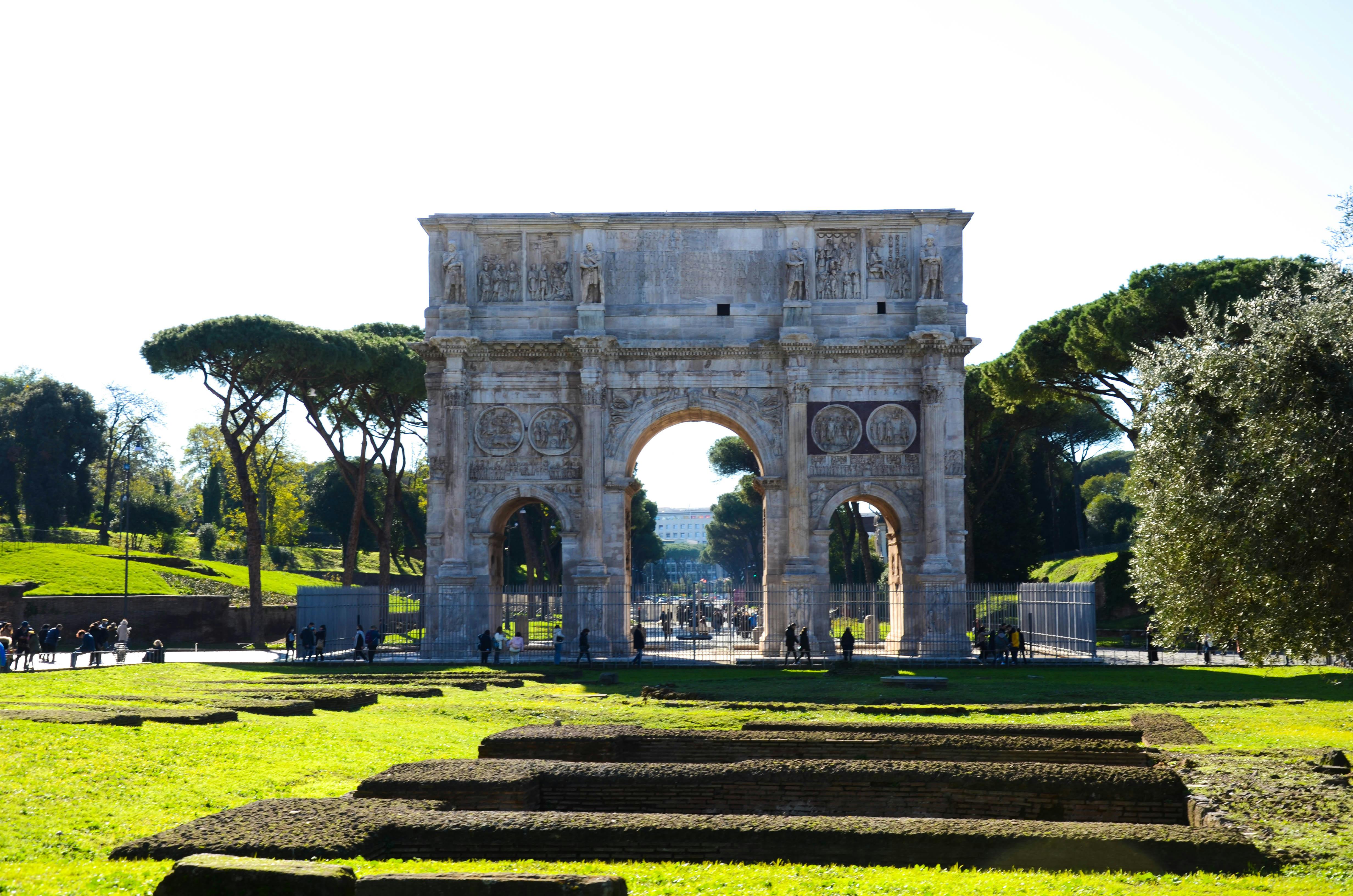
Image: The Arch of Constantine in Rome, Italy, a preserved Roman triumphal arch known for its elaborate carvings and commemoration of Constantine’s victory.
You’ve seen them in modern cities—because Romans did it first. Triumphal arches were celebratory but not subtle. They commemorated victories, honored emperors, and told stories in stone.
Purpose:
-
Public celebration of military success
-
Permanent reminder of Roman supremacy
Key Features: ● One or more vaulted passageways
● Detailed relief carvings showing battle scenes, captured enemies, or religious ceremonies
● Inscriptions that immortalized the person or event being honored
Psychological Function: Triumphal arches were carefully positioned so every citizen would see them. Soldiers would march through, crowds would cheer, and the message was clear: “Rome wins.”
Architecture That Communicated Power
What ties these three buildings together isn’t just stone and engineering—it’s purpose.
These weren’t passive structures. They had jobs:
-
Keep order
-
Project power
-
Control how people moved, met, and remembered
This is what made Roman civic architecture so enduring. It was never just about form—it was about function tied to emotion, behavior, and memory.
Functional Urban Design: How These Structures Worked Together
Now, here’s where things get interesting.
These buildings weren’t just randomly scattered—they were part of a master plan. The Forum was designed to guide movement, behavior, and memory.
● You’d enter under an arch—your mind primed for power.
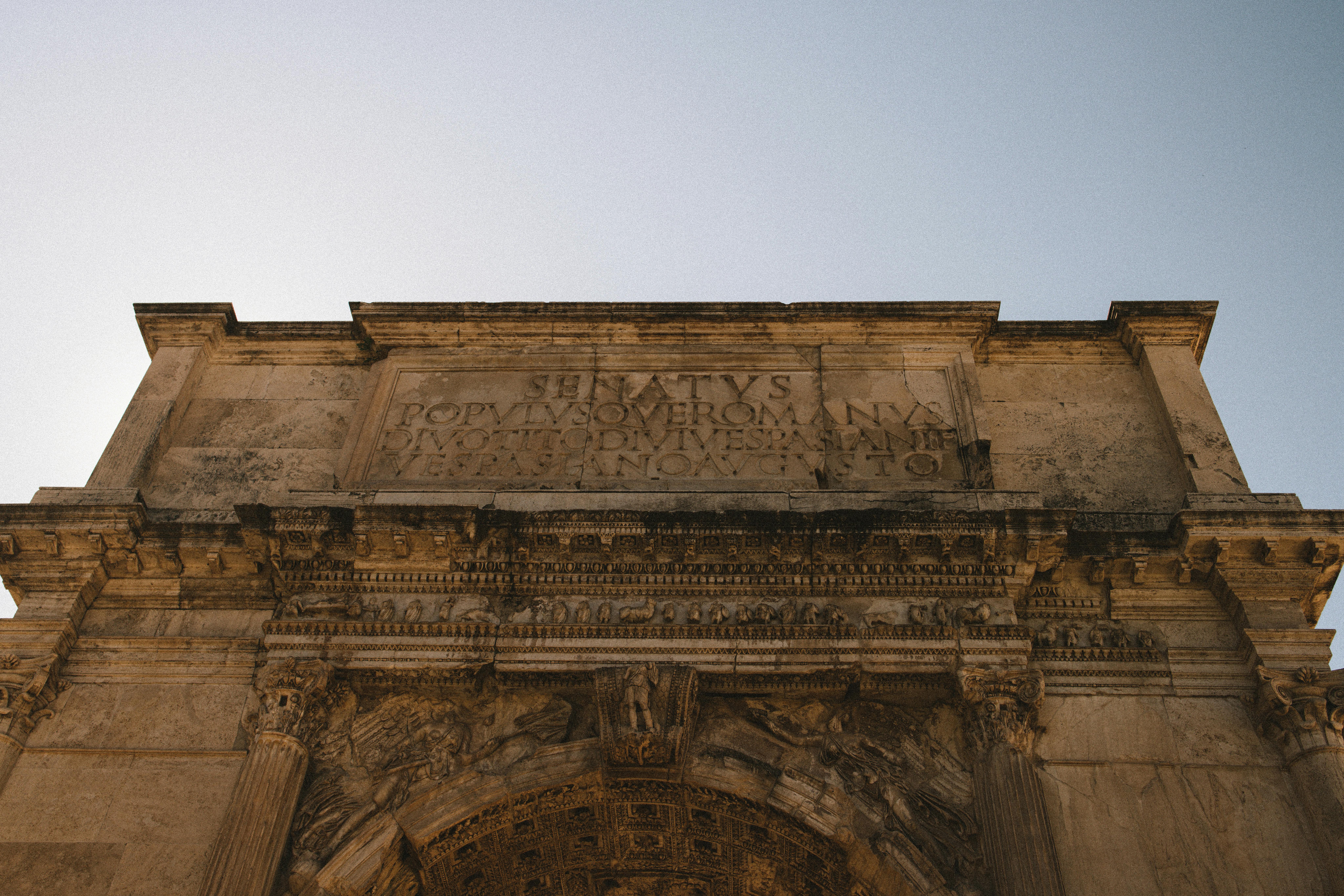
Image: The Arch of Titus in Rome, a historic Roman triumphal arch featuring detailed carvings commemorating military victories.
● Walk toward the basilica—where public affairs happened.
● Pass the Curia—reminded of political structure.
● All of this was deliberate.
Even street widths, paving materials, and sightlines were chosen to emphasize order, hierarchy, and drama.
Human-Scale Design in the Forum
Despite their grandeur, these buildings were surprisingly human-scaled. That’s what made them work.
● Proportions matched how people moved and gathered
● Colonnades created rhythm and shade
● Interiors focused on acoustics and visibility
The Forum wasn’t just built to impress—it was built to function.
Roman Forum Architecture: Designing for Movement, Emotion, and Society
The Genius of Roman Forum Planning
The Roman Forum wasn’t just a backdrop for history. It was designed for action—deliberate, civic, and psychological.
The real engine of public life were the long walkways, the civic buildings, the curated flow from one structure to another.
Let’s look at how this layout worked not just for structure, but for human movement, emotion, and public behavior—and why some of its ideas are still used today.
Urban Planning Logic: Not Just Where, But Why There
The Romans planned like psychologists and politicians. Every street, structure, and empty space had a purpose:
● The Curia faced inward, anchoring the Forum with power and authority
● Basilicas flanked the forum's long sides—easily visible, easily accessed
● Triumphal arches sat at transitional points—between streets and squares, movement and pause
This layout encouraged circulation, but also guided emotion. People moved from wide to narrow spaces, light to shadow, openness to structure.
That contrast? It wasn’t random. It kept people moving but also pausing to watch, to reflect, or to gather.
Movement Psychology: Directing the Crowd Without Saying a Word
Walk through the Forum and you’re not wandering—you’re being directed.
The Roman Forum had:
● Axial paths aligned with power—either the emperor, the Senate, or the divine
● Arched gateways to mark transitions (think: from marketplace to official zone)
● Open plazas for stopping, assembling, watching rituals or debates
● Column spacing that funneled movement without blocking views
In modern terms, the Forum used visual hierarchy and spatial rhythm—concepts we still use today in airports, city plazas, and even shopping malls.
The Emotional Impact: What You Felt, Where You Felt It
Roman architects wanted to control space and they wanted to control experience as well.
People would enter the Forum from crowded, noisy streets—and suddenly find space.
● A pause. A reveal. A shift in tone.
● Noise died down. Stone echoed underfoot.
● Statues rose ahead. The Senate loomed.
It was all intentional. Even the height of the buildings, the openness of the plaza, and the echo of your voice were planned.
Just like in a cathedral or theater, Roman spaces changed how you felt the moment you entered.
Sound Design: Yes, They Thought About That Too
Sound carries differently in stone plazas.
Romans used this to their advantage:
● Narrow arches created entry tunnels where sound sharpened—your footsteps or voices echoed
● Open plazas softened that—creating room for calm or ceremonial speech
● The curved or porticoed edges of basilicas helped reduce echo, perfect for business or legal proceedings
● Elevated speakers or orators stood where acoustics worked best
Sound was architecture, not accident.
Influence on Modern Civic Architecture
Still think this is ancient history?
Look at any major civic square today—Washington D.C., Paris, London—and you’ll see the Forum’s fingerprints.
● City halls with basilica layouts
● Parliamentary chambers modeled after the Curia
● Victory arches or war memorials copying Roman triumphal forms
These aren’t coincidences. They’re architectural descendants.
Modern City Design Still Follows This Logic
Walk around Paris, Washington D.C., or Berlin, and you’ll feel it.
● Long processional avenues that terminate at monuments
● Plazas surrounded by government or cultural buildings
● Triumphal arch motifs used in civic or memorial architecture
● Wide stairs, columned facades, deliberate framing of sightlines
Even shopping malls and museums use Roman Forum psychology:
● Open central space → entry paths → focused focal points
● Gradual reveal from dark to light, tight to wide
● “Sacred” corners: a curated end destination or viewpoint
It's Not About Nostalgia—It's About Function
We use Roman Forum logic because it works:
✓ People move better in predictable patterns
✓ Crowds feel more in control when space opens then narrows
✓ We pause at arches. We gravitate to framed views.
✓ Authority buildings feel more legitimate when they're centered and elevated
This isn’t style—it’s strategy.
Lessons for Architects and Urban Planners
The Forum’s architecture still offers practical lessons:
● Clarity of purpose: Every structure had a job—and its form followed that job
● Legibility: You could navigate by eye and foot—no Google Maps needed
● Symbolism: Architecture as messaging isn’t new—it started here
● Social glue: Public buildings meant for real public use—not gated off
Real Lessons for Modern Designers
Architects today still take cues from these ancient structures. The concept of designing for scale, public access, light, sound, and psychological clarity hasn’t changed—it’s just evolved.
● Need a building where people gather, argue, and vote? Start with the layout of the Curia.
● Need a public space that handles both order and chaos? Study the basilica.
● Want to create a memorable public monument? Triumphal arches still influence commemorative structures worldwide.
You can learn a lot from marble and mortar—if you know what to look for.
The Roman Forum is a map of how to build cities that shape behavior. And that’s something even the most modern architects can’t ignore.
10 Facts About the Roman Forum (That Aren’t Boring)
1. It started as a swamp.
Before it became the beating heart of Rome, the Forum was literally just a muddy valley between hills. The Romans drained it using one of their first sewer systems—Cloaca Maxima.
2. It was the center of everything.
Politics, religion, business, gossip—it all went down in the Forum. Think of it like the original downtown core where senators debated and merchants shouted over each other.
3. It grew over time—messily.
The Forum wasn’t planned all at once. It evolved over centuries, with new emperors, temples, and monuments layered on top of older ones. It's a timeline in stone.
4. Julius Caesar rebuilt part of it.
Caesar wasn’t just into conquering—he was also into urban design. He reshaped parts of the Forum to make room for his own public space: the Forum of Caesar.
5. There was a speaker's platform called the Rostra.
Want to rant about politics in ancient Rome? You stood on the Rostra. Its name came from ship prows (rostra) that were stuck to the front—because Rome never passed up a chance to flex.
6. Temples weren’t even the most important buildings.
Despite how we talk about them today, temples were just one part. Basilicas, arches, law courts, and markets were far more active and critical for daily Roman life.
7. The Arch of Septimius Severus still stands.
It’s massive and incredibly well preserved—built to celebrate military victories. You can still walk under it today, and its shadow alone tells you how much power Rome once had.
8. It wasn’t quiet.
Forget slow tourist strolls. The Forum was loud, packed, chaotic. Animal sellers, court trials, debates, and daily commotion made it feel more like a giant open-air arena than a sacred zone.
9. It’s where the phrase “Curia” comes from.
The Curia Julia was the Roman Senate building, built under Julius Caesar. Its name still lives on in legal and religious terminology today.
10. You can still walk through it—on the original stones.
Yes, seriously. The same stones Roman citizens used underfoot 2,000 years ago are still there. You’re not just visiting a ruin—you’re walking through real, layered history.
Best Books to Buy on Roman Forum Architecture & Urban Planning
1. The Roman Forum by David Watkin
Why Buy:
● It’s one of the clearest, best-illustrated overviews of the Forum’s physical layout and evolution.
● Watkin explains the architectural logic with real-world comparisons—no fluff, just usable info.
● It balances history, architecture, and visuals—great for designers, historians, and curious minds.
How It Helps:
If you're trying to understand how the Forum actually looked and worked (not just the myth), this is your go-to.
2. Rome: An Urban History from Antiquity to the Present by Rabun Taylor
Why Buy:
● Covers the entire urban planning logic behind ancient Rome, with the Forum at the center.
● Includes modern parallels—how Roman city planning shaped later cities.
● Academic but readable, with fantastic diagrams and street logic.
How It Helps:
Perfect if you want to see how Rome’s spatial thinking still shapes cities today.
3. The Architecture of the Roman Empire: Volume I by William L. MacDonald
Why Buy:
● A classic—deep dive into why Roman public spaces worked so well, including acoustics, movement, and emotion.
● Great architectural language—but still readable if you’re a student or designer.
● Focuses on civic space design (Forum, baths, basilicas), not temples.
How It Helps:
If you want to learn from how Romans shaped space to influence crowds, this is it.
4. Roman Architecture and Urbanism by Fikret K. Yegül and Diane Favro
Why Buy:
● Recent, detailed, modern scholarship—beautiful maps, 3D reconstructions, real photography.
● Great on urban strategy and architecture across different Roman cities.
● Explores Forum logic in context—how it worked in Rome vs. other parts of the Empire.
How It Helps:
Advanced but visual—perfect for anyone doing deeper research or teaching architecture.
5. Daily Life in Ancient Rome by Jérôme Carcopino
Why Buy:
● Not strictly about architecture—but shows how people actually used the Forum in daily life.
● Firsthand feel for how space shaped Roman experience.
● Easy to read, packed with stories and context.
How It Helps:
Great if you’re into human behavior, crowd psychology, or spatial storytelling.
6. On Architecture by Vitruvius (Penguin Classics Edition)
Why Buy:
● This is the original Roman architectural handbook, written in the 1st century BC.
● Talks directly about forum layouts, space logic, proportion, and public design.
● Every architect should own it—it’s part design manual, part philosophy.
How It Helps:
Shows what Romans themselves thought about design—straight from the source.
Pro Tip:
Get the books in physical format if possible—especially the ones with diagrams. Forum plans, layouts, and city maps are way easier to absorb when printed big and clear.
Closing Thoughts
The Roman Forum was smart. Every curve, every column, every axis told people where to go, how to feel, and what to do next.
Today, we call this civic design or user experience—but the Romans already nailed it.
So next time you walk through a public square or a grand government complex and it feels right… know that you’re probably walking in the steps of Roman design logic.
And no, they didn’t need signage.
FAQ: Roman Forum Architecture & Urban Planning
What was the purpose of the Roman Forum?
The Forum was the civic heart of Roman life—like a downtown, courthouse, plaza, and main street all rolled into one. It hosted speeches, legal trials, markets, processions, and everyday public life.
Why was the Roman Forum so important to the empire?
Because it worked. It created order in chaos—letting huge crowds move efficiently, gather socially, and engage politically. It was designed to control movement, mood, and meaning in public space.
What architectural elements made the Forum feel organized?
● Grid layout connected streets
● Basilicas framed the central zone
● Triumphal arches marked entry points
● The Curia (Senate House) anchored power
● Open space in the middle? Gave balance and flow
Did the Romans plan the Forum for emotional effect?
Yes—completely. They understood that space changes how people feel. Entering the Forum felt like leaving chaos behind. The openness, symmetry, and hierarchy made you feel grounded… or humbled.
How did the design guide people?
Without signs. The Forum used:
● Wide to narrow transitions
● Axis paths to monuments
● High focal points (arches, statues)
● Column spacing to funnel movement
● Shadow and light for mood shifts
What buildings were in the Forum?
The most important were:
● Curia – Senate and political power
● Basilicas – law, finance, business
● Triumphal Arches – celebration and status
● (Temples existed too, but weren’t the main focus here)
How did sound affect Forum design?
It was part of the plan. Porticos and open areas softened or echoed voices depending on use—like a natural microphone system. Orators knew where to stand, and ceremonies were heard without tech.
What modern cities use similar planning?
You’ll see Forum-inspired layouts in:
● Washington D.C. – with long avenues and civic buildings
● Paris – monuments at the ends of sightlines
● Berlin & London – public squares with framed movement
● Even malls and airports mimic this flow logic
What made the Forum different from a modern city center?
The Forum wasn’t just functional—it was psychological. Every part was symbolic. You didn’t just move—you felt things: awe, order, importance, power, connection.
Is any of this used in modern architecture?
Absolutely. Good public space still follows these ideas:
● Let people gather without chaos
● Frame views to guide focus
● Create contrast (wide → tight → wide again)
● Use sound, texture, and material to shape how we feel
Related: Urban Planning in Ancient Rome: Roads, Forums, and Aqueducts