

Female construction manager is a phrase people usually search for when they are trying to answer a practical question: is this role really open to women, and what is it like once you get there?
The job itself is not a different version of construction management. It is the same core work: planning, coordination, budgeting, subcontractor management, safety, quality, and schedule control. What changes is the professional context around it. On some jobs that means being the only woman in the trailer. On others it means dealing with authority, site culture, PPE fit, travel, or credibility in ways male managers often do not have to think about as early or as often.
This guide explains what a female construction manager actually does, how women get into the role, what the career path looks like, where the friction still is, what people get wrong about the job, and what helps someone stay effective and move up.
What This Guide Covers
- What a construction manager actually does
- How the role feels different for women in practice
- How women get into construction management
- What the career path usually looks like
- What helps on site and what usually makes the job harder
- Pay, outlook, and advancement
What a Female Construction Manager Actually Is
A female construction manager is a construction manager who happens to be a woman. That sounds obvious, but it matters because the job should be defined by the work first, not by the label.
Construction managers plan, coordinate, budget, and supervise construction projects from start to finish. The role usually stretches across more of the project than outsiders expect. Depending on the company and delivery method, that can include preconstruction input, schedule control, submittal flow, procurement tracking, contractor and subcontractor coordination, quality management, safety expectations, payment review, change management, punch work, and closeout.
That is why the role is not just “site supervision.” It sits at the intersection of office control and field reality.
Before you move on: if you want the wider project sequence around this role, construction project development and construction project management workflow are the two best companion pages.
The Job Is the Same. The Context Often Is Not.
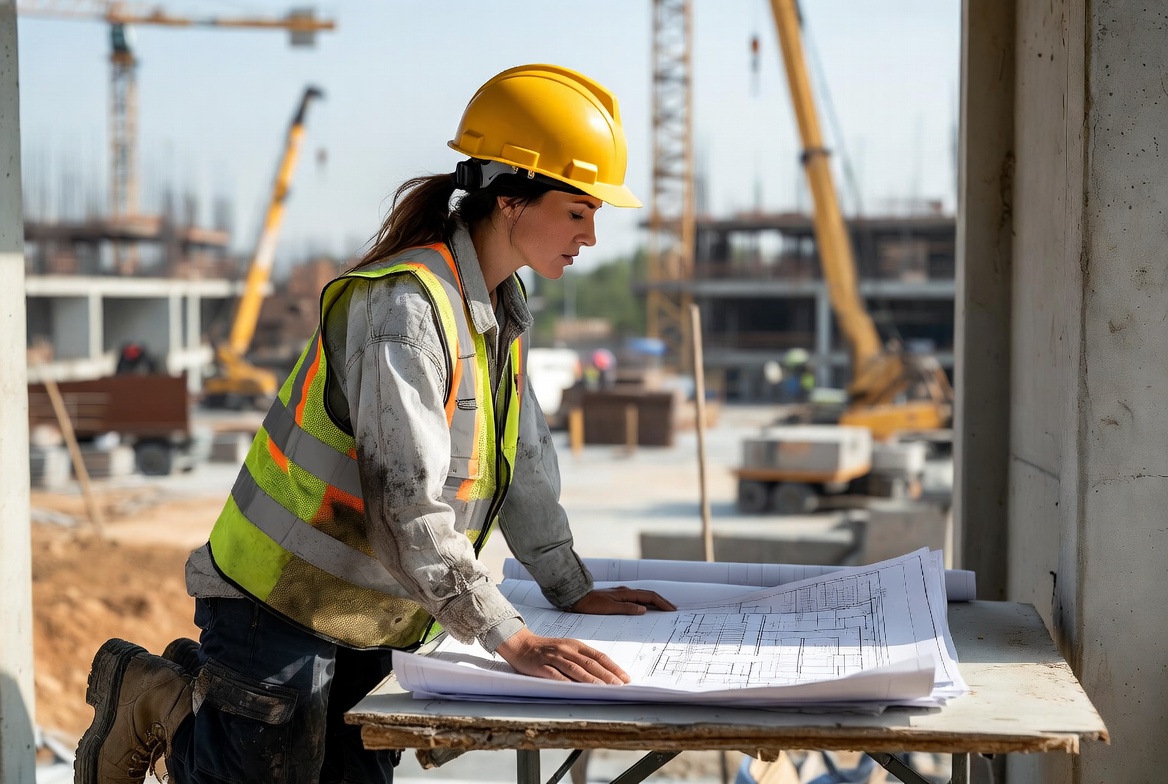
This is the cleanest way to say it.
The technical responsibilities of the role do not change because the manager is a woman. The schedule still has to work. The subcontractors still have to be coordinated. RFIs still need answers. Budget pressure still lands where it lands. Quality still has to be protected. Inspectors do not soften because the PM is female. Concrete does not care either.
What often changes is the environment around the work.
That can show up in ordinary ways:
- being mistaken for admin staff instead of site leadership
- having authority tested more quickly or more casually
- dealing with PPE or field gear not designed with women in mind
- being watched more closely in early interactions
- having to decide how much energy to spend correcting assumptions vs moving the job forward
None of that changes what the job is. It changes how much extra judgment is sometimes needed to do it without wasting energy.
What the Role Actually Involves Day to Day
A lot of people imagine construction management as either nonstop hardhat supervision or nonstop email from a trailer. It is usually both, plus a lot of coordination that does not look glamorous from the outside.
Depending on the project, daily work can include:
- running coordination meetings
- reviewing schedules and short-horizon work plans
- tracking submittals and procurement
- checking area readiness for the next trade
- walking the site for quality, safety, and sequencing issues
- resolving field conflicts before they turn into delays
- reviewing pay applications and change pricing
- following up on inspections, deficiencies, and closeout items
The stronger construction managers are rarely the loudest people on site. They are usually the ones who can keep several moving parts aligned without letting the project drift into confusion.
Also useful: construction planning and scheduling, construction quality management, and construction inspection process all sit right under this role in practice.
Where Women Are in the Industry Right Now
The role is still male-dominated, but it is not a novelty role anymore.
NAWIC says women made up just over 14% of the construction workforce at the end of 2024, and it also notes that nearly half of women in construction work in professional and management roles. BLS shows the construction manager occupation itself remains a strong one overall, with median annual pay of $106,980 in May 2024 and projected employment growth of 9% from 2024 to 2034. Those numbers do not prove the path is easy. They do show the role is established, growing, and worth taking seriously.
| Current Reality | What It Means | Why It Matters |
|---|---|---|
| Women are still a minority in construction overall | You may still be one of very few women on a project team or site | The job is real and growing, but the culture can still feel uneven |
| Women are more concentrated in professional and management roles than in field-trade roles | Construction management is one of the clearer entry points into leadership | The career path is there, even if visibility still lags in some companies |
| Construction management has strong pay and solid growth | The role is not a side niche; it is a core management occupation | This is a serious career path, not a symbolic one |
How Women Usually Get Into Construction Management
There is no single route into the role. That is good news, because people arrive from different kinds of strength.
Common paths include:
- construction management degree
- civil engineering, architecture, or architectural technology background
- field engineer or project engineer route
- trade background moving into supervision or project coordination
- assistant project manager path through a general contractor, CM firm, or developer
The cleanest route on paper is usually a construction management or engineering path into project engineer, assistant PM, or field engineer work. The stronger route in practice is the one that gives you actual exposure to drawings, procurement, scheduling, site logistics, and subcontractor coordination early enough that the job stops feeling theoretical.
A lot of women also come in through trades and then move upward. That route can build very strong site credibility because it gives the manager firsthand understanding of production, sequencing, and field pressure. It is not the only valid path. It is one of the stronger ones when it is available.
| Entry Route | Best For | Main Advantage | Main Risk |
|---|---|---|---|
| Construction management degree | People who want a direct path into PM/CM roles | Strong industry fit and clean hiring signal | Can still feel too theoretical without field exposure |
| Civil engineering / architecture | People with technical design or systems interest | Good drawing and coordination depth | May need more direct site-management experience |
| Trade-to-management path | People coming from field production | Strong site credibility and practical sequencing sense | May need to build document and financial management skills faster |
| Project engineer / assistant PM route | People who want to grow inside a contractor organization | Good exposure to workflow, submittals, and coordination | Can get boxed into admin work if the company does not mentor well |
The Early Career Stage Is Usually the Hardest
This is true for a lot of people in construction, but it can hit women differently because the early-career stage is where credibility gets tested fastest.
You are learning the work, the site culture, the paperwork, and the production pressure at the same time. You are also being watched. Sometimes fairly. Sometimes not.
That is why the early years matter so much. The goal is not to win every room immediately. The goal is to get technically useful fast enough that the room has to deal with you as a professional.
That usually means getting good at things like:
- reading drawings accurately
- understanding sequence and dependencies
- writing cleaner RFIs and meeting notes
- tracking submittals without letting them drift
- spotting gaps before the field is already stuck
- asking questions early instead of trying to bluff through them
That last point matters. Trying to sound more certain than you are is usually a weak early-career move. Construction is full of people who talk too confidently and miss important things. Better to be clear, quick, and technically useful than loud.
Do This Instead of This
| Do This | Instead of This | Why It Works Better |
|---|---|---|
| Build technical fluency fast | Rely on personality to carry authority | Construction respects usefulness more than presentation |
| Ask direct project questions early | Stay quiet too long to avoid looking inexperienced | Silence usually costs more than a smart question |
| Use written follow-up when scope or sequence is fuzzy | Assume a verbal conversation settled it | Written follow-up protects the job and your position |
| Correct disrespect once, cleanly, and move back to the work | Spend the whole day negotiating tone | You protect your authority without letting the site hijack your time |
| Learn cost, schedule, and quality together | Get good at only one side of the job | Promotion usually follows broader control, not narrow competence |
What Usually Builds Real Authority
Not style. Not volume. And not trying to act tougher than everyone else.
Authority on construction projects usually comes from three things:
- you understand the work
- you follow through
- people learn that your questions are worth answering
That is why some of the strongest construction managers do not “perform authority” very much at all. They know the drawings. They know what is late. They know what is missing. They know who is blocked. They know which answer matters now and which one can wait until tomorrow. They stay steady, and they are hard to ignore.
For women in particular, that kind of authority tends to age better than imitation hardhat theater. You do not need to become a caricature of a construction manager to be effective. You need to become one.
Residential, Commercial, and Civil Work Feel Different
The role title may stay the same. The rhythm of the job can change a lot.
| Project Type | What the Role Usually Feels Like | Good Fit If You Like | What Usually Gets Hard |
|---|---|---|---|
| Residential | Faster owner interaction, finish decisions, custom scope pressure | Direct client impact and tighter team contact | Late owner changes and finish creep |
| Commercial building | Heavier coordination, systems, documentation, and schedule pressure | Complex logistics and broader team structure | Trade coordination, procurement, and turnover pressure |
| Civil / infrastructure | More field logistics, sequencing, public interface, and production pressure | Large-scale operations and site intensity | Weather, traffic, utilities, and production risk |
Use this when / avoid this when: if you want faster exposure to owners and custom decision-making, residential can be a good early fit. If you want deeper systems coordination and stronger formal workflow, commercial often teaches more. If you want bigger site-production pressure and more outdoor logistics, civil can be the better track.
What People Get Wrong About Women in Construction Management
A few lazy ideas keep repeating.
- “Women in construction management mostly handle the office side.” Not true. Plenty of women run field-heavy roles, live schedules, buyout, site coordination, and closeout.
- “You need a certain personality type to survive the job.” You need competence, steadiness, and follow-through. The personality theater is optional.
- “The hard part is getting hired.” Sometimes. Staying and advancing can be the bigger test.
- “If a company hires women into PM roles, the culture problem is solved.” Not automatically. Hiring is one step. Retention, support, authority, and growth are the bigger tests.
The role is not about proving women can do construction management. That part is already settled. The better question is whether the company, site culture, and project structure are set up well enough that good people can keep doing the job and move up without wasting half their energy on nonsense.
PPE, Site Conditions, and the Boring Problems That Are Not Boring
This section matters because people keep pretending these issues are secondary. They are not.
NAWIC is right to keep pushing the PPE issue. Hard hats, vests, boots, gloves, harnesses, and general site gear have not always been sized or designed with women in mind. That is not a fashion complaint. It is a safety and usability issue. Bad fit changes how equipment performs and how a worker moves through the site.
The same goes for site basics more generally. Clean restrooms. Reasonable changing access. Workwear that fits. A site culture where harassment is actually addressed instead of joked around. None of that is decorative. Those are operating conditions.
A company does not become serious about women in management because it puts one woman on the org chart. It becomes serious when the site conditions stop quietly assuming every body and every career path on the job looks the same.
Pay, Outlook, and Advancement
Construction management is a real management career, not a side route.
BLS reports median annual pay for construction managers at $106,980 in May 2024, with stronger wages in heavy civil and nonresidential segments than in residential building. BLS also projects 9% employment growth for construction managers from 2024 to 2034, with about 46,800 openings per year on average.
That does not mean every company pays well, promotes fairly, or supports growth properly. It does mean the occupation itself is strong enough to take seriously as a long-term career.
Advancement usually follows a pattern like this:
- project engineer / field engineer / assistant PM
- project manager or assistant superintendent depending on track
- senior PM / senior superintendent / construction manager
- project executive, operations leader, or owner-side management roles
The people who move fastest are not always the most charismatic. They are usually the ones who can hold schedule, cost, quality, procurement, and communication together without letting the job get loose.
Also useful: cost control and construction planning and scheduling both matter here because the managers who move up usually understand more than one side of project control.
What Helps a Female Construction Manager Stay in the Industry
Getting hired is one milestone. Staying and building a career that is worth keeping is the bigger one.
The things that help most are usually less dramatic than people think:
- a company that puts women on real projects, not only support tracks
- mentors who answer technical questions without making every question feel expensive
- clear project responsibilities
- exposure to field and office sides, not just one or the other
- access to training, certifications, and harder assignments
- a site culture where disrespect gets handled early
That is why retention matters more than branding. A company can say all the right things about diversity and still lose good people if the day-to-day experience keeps draining them.
What To Do Next
Construction project management workflow is the right next read if you want to understand how information, approvals, procurement, and field release move through the job once you are in the role.
Construction planning and scheduling matters if you want the part of the job that controls sequence, readiness, and why projects drift.
Construction quality management is the better next step if you want to get stronger in the part of the role that protects the work once the site gets busy.
FAQ
What does a female construction manager do?
The same core job any construction manager does: plan, coordinate, budget, supervise, solve field problems, manage subcontractor workflow, and keep the project moving from preconstruction through closeout.
Is construction management a good career for women?
Yes, if the person actually wants the work. It is a serious management career with solid pay, real growth, and multiple entry paths. The harder part is often company fit and site culture, not whether women can do the role.
Do female construction managers work on site or only in the office?
Both. Most construction management roles involve office and field work. On many projects, the manager spends significant time in a field office or on site walks because that is where sequencing, quality, and coordination issues show up first.
How do women get into construction management?
Common paths include construction management degrees, civil engineering or architecture-related backgrounds, project engineer roles, assistant PM roles, or moving into management from the trades.
What is the biggest challenge for women in construction management?
It varies by company and project, but common issues include authority being tested more often, weak site culture, limited mentorship, poor PPE fit, and the extra energy it can take to move past assumptions that should not still be there.
Do women in construction management get paid less?
Pay differences can exist, but they depend heavily on company, sector, geography, experience, and title. The stronger move is to understand the role’s market value clearly, build the technical range that makes you harder to underplace, and work for companies that tie advancement to responsibility instead of assumptions.
Is residential or commercial construction better for women managers?
Neither is automatically better. Residential often gives faster owner contact and custom-scope pressure. Commercial often gives stronger systems coordination and more formal workflow. The better fit depends on the kind of work and team environment you want.
What makes someone effective in this role?
Technical fluency, follow-through, calm communication, and the ability to keep scope, schedule, cost, and field reality connected. The role rewards usefulness more than performance.
Official sources
- U.S. Bureau of Labor Statistics – Construction Managers
https://www.bls.gov/ooh/management/construction-managers.htm - BLS – Employed People by Detailed Occupation and Sex
https://www.bls.gov/cps/cpsaat11.htm - NAWIC – Building a Career Path in the Construction Trades Part Two
https://nawic.org/building-a-career-path-in-the-construction-trades-part-two-construction-trade-skills-for-women-are-just-the-beginning/ - NAWIC – 7 Facts Men Should Know About Women in Construction
https://nawic.org/facts/ - CMAA – Outline of CM Functions
https://www.cmaanet.org/outline-cm-functions - CMAA – Owners Guide to Construction and Program Management
https://www.cmaanet.org/sites/default/files/inline-files/Owners%20Guide.pdf