
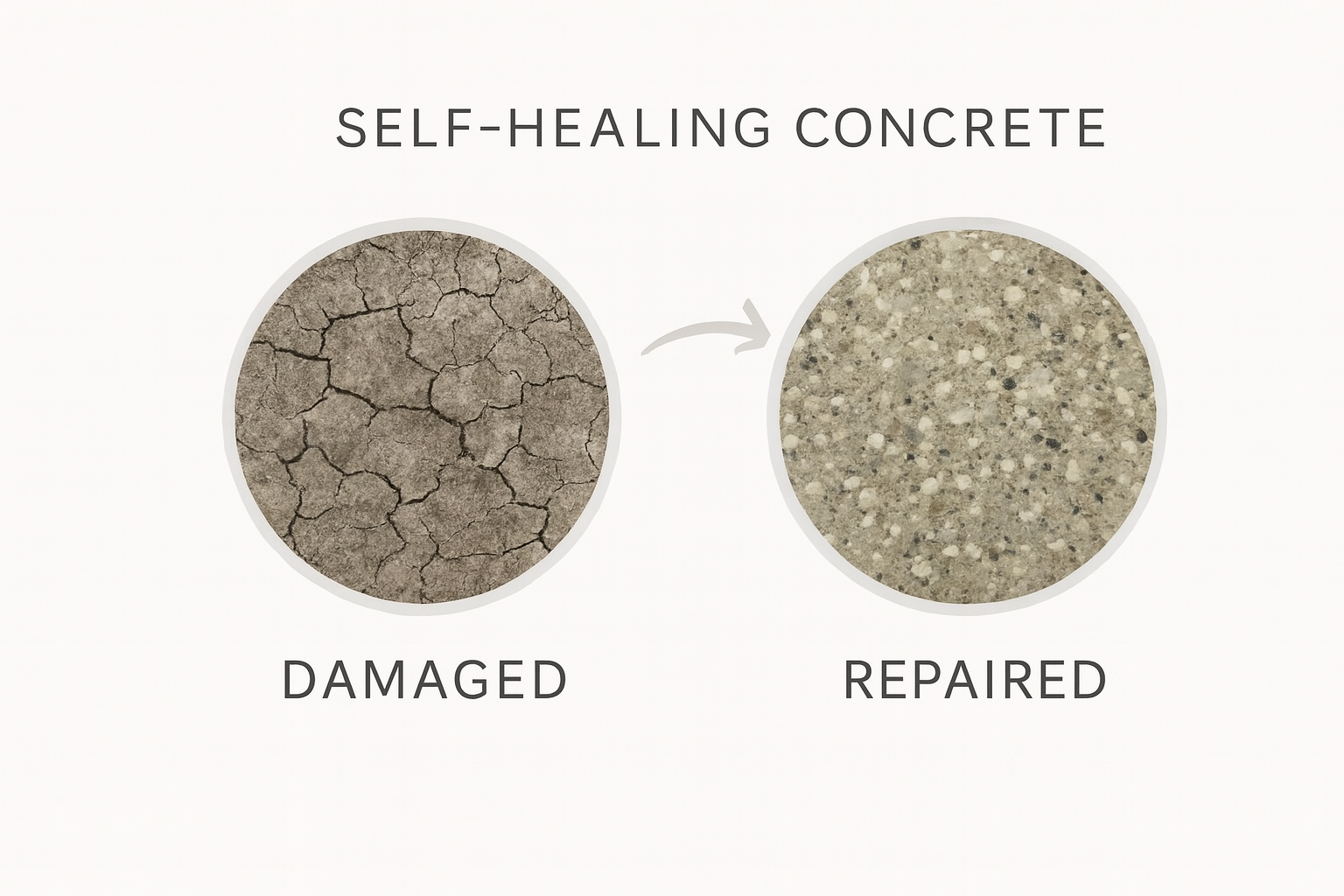
A Smarter Kind of Concrete
For years, cracks in concrete meant one thing: repair bills. That logic is shifting. Engineers now use bacteria and other agents inside the mix to trigger repairs the moment a crack forms. This is called self-healing cement, and it is starting to change how durability is measured in construction.
Self-Healing Cement: A Practical Breakthrough
Concrete will always crack under stress. The difference with this new cement is that it reacts from within. When exposed to air or water, embedded capsules or microbes activate and seal the fracture. The result is a material that repairs itself instead of waiting for maintenance crews.
Trials are no longer limited to labs. Bridges, tunnels, highways, and even residential projects have already used self-healing mixes in the field. Inspectors are watching closely, but the early results point to fewer long-term repairs and extended service life.
How It Stacks Up Against Other Sustainable Materials
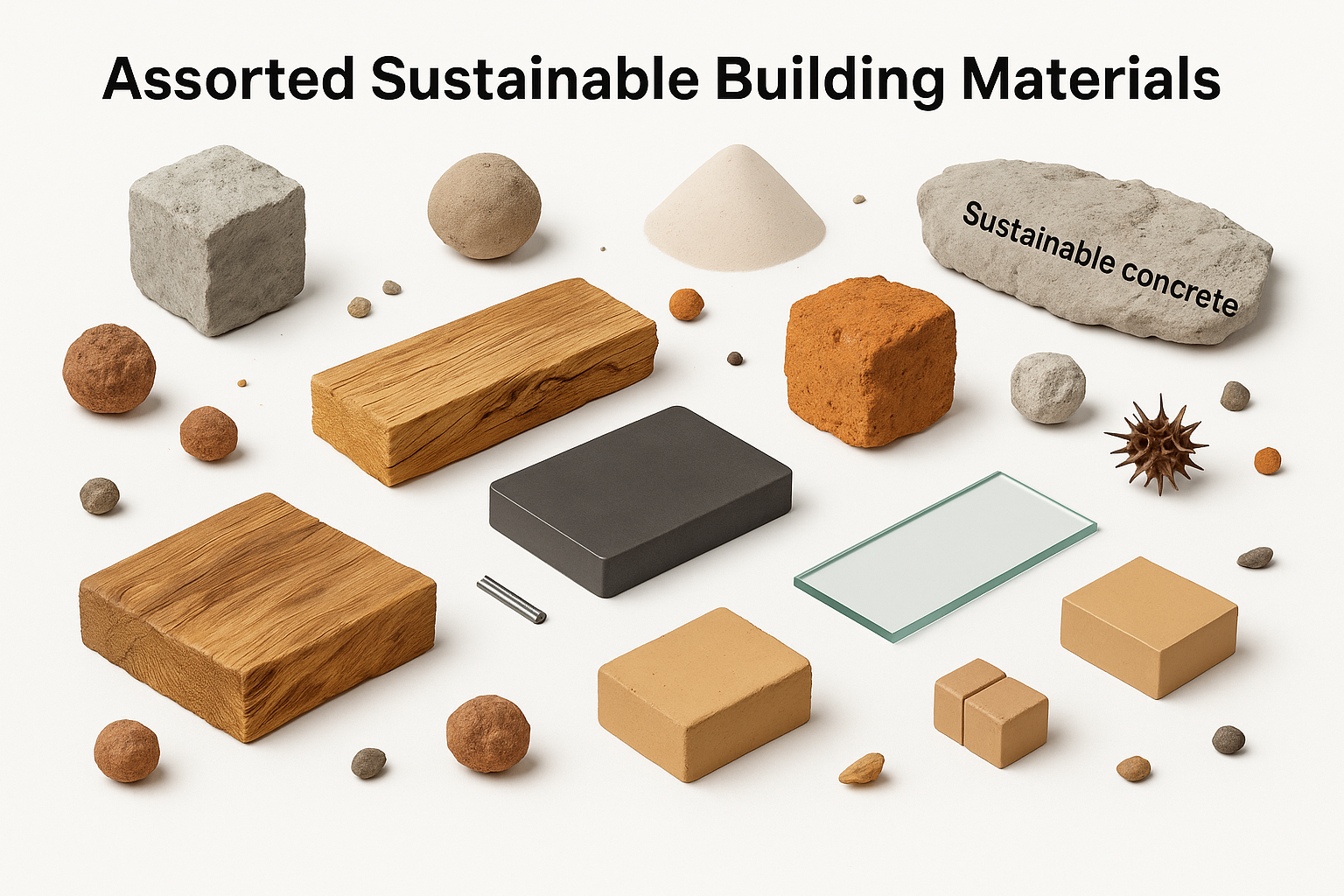
This guide explains how self-healing cement works, where it is being used, and how it compares to other sustainable concretes such as:
● Hempcrete
● Biodegradable Cement
● Geopolymer Concrete
● Geopolymer Cement
● Ferrock Cement
The comparisons are straightforward. You will see where self-healing cement makes sense, what it costs, and how it performs against these other options.
MUST READ: Structural Condition Assessment by Robert T. Ratay. Why I recommend it: clear field methods for checking the health of concrete structures, old and new.
The Science Behind Healing Cement
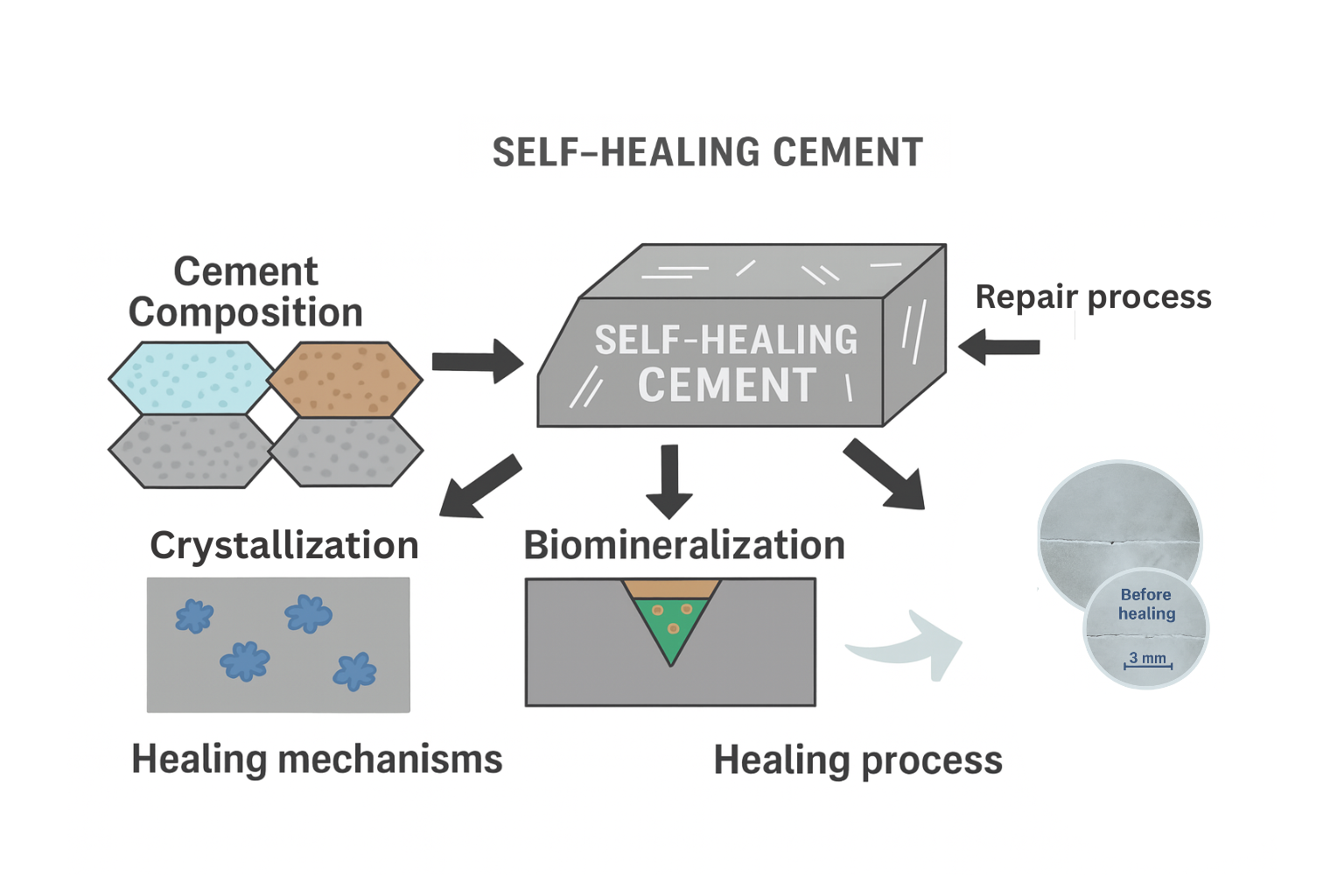
At its core, self-healing cement is about one thing: cracks that close on their own. Instead of waiting for a crew to patch and seal, the material reacts to stress, water, or heat and repairs itself.
Bacteria doing the work. Engineers embed dormant spores, usually Bacillus. When water seeps into a crack, the spores wake up, consume nutrients in the mix, and leave behind calcium carbonate—essentially limestone—that seals the gap. The process is slow but steady, perfect for damp environments where regular concrete would just keep eroding.
Capsules that break on cue. Another approach is mixing in tiny capsules filled with polymers or epoxy. When a crack slices through the material, the capsules rupture and release their contents. The liquid hardens, welding the gap from within. Bridges and tunnels see the most of this version, because traffic and vibration create repeat stress.
Materials with memory. Some blends use fibers or additives that shrink, swell, or “snap back” under heat or pressure. The movement physically pulls the crack shut. It’s less about chemistry and more about mechanics, but it can add years of service life to structural members.
Nano-scale reinforcements. Adding nano-silica or similar particles doesn’t close cracks outright, but it makes the mix denser and slows down crack formation. Micro-cracks that would normally spread are blocked before they matter. It’s prevention instead of cure.
Among these approaches, the bacterial method is getting the most attention: low-maintenance, naturally triggered, and especially effective anywhere moisture is the enemy. For a step-by-step, field-friendly walkthrough of mix design and site practice, see How to Create Self-Healing Concrete, and Self-Healing Cement: The Future of Resilient Construction.
| Type | How It Works | Best Used For |
|---|---|---|
| Microbial (Bacteria-Based) | Bacteria produce limestone to seal cracks when water activates them | Moist, high-risk environments |
| Polymer Capsule-Based | Cracks burst capsules that release sealing polymers | Bridges, tunnels, heavy-traffic structures |
| Fiber-Reinforced | Fibers control crack width and reinforce the matrix | Structural strength + durability |
| Nano-Enhanced | Nano-additives block micro-cracks early | Long-term durability and resistance |
For a deeper technical dive, the go-to reference is Self-Healing Materials: Fundamentals, Design Strategies, and Applications by Swapan Kumar Ghosh. It’s not light reading, but it maps the design logic in a way practicing engineers can use.
Where Self-Healing Cement Is Showing Up
Self-healing cement is no longer a lab story. It’s being poured into jobs that need durability without constant patchwork. Think bridges, tunnels, basements, and even historic repairs.
Infrastructure first. Bridges, tunnels, and highways are where the material proves its worth. Heavy loads and temperature swings always crack concrete. With self-healing mixes, those cracks close before they spread. That means fewer shutdowns, longer service life, and less money burned on emergency repairs.
Homes and everyday buildings. Foundations and floor slabs are where hairline cracks quietly show up. In seismic areas, they spread faster. Self-healing cement makes those weak spots close on their own. For homeowners, that translates into lower maintenance bills and more peace of mind when the ground shakes.
Marine projects. Saltwater chews up concrete faster than most people realize. Docks, piers, and submerged tunnels take the worst of it. Self-healing cement resists the attack, filling its own cracks underwater and keeping structural cores intact. It’s one of the few ways to fight both water and time at once.
Heritage and restorations. Old stone and concrete buildings often can’t survive another round of patching. With healing cement, repairs blend into the existing material. You keep the original look while strengthening the structure from within. That’s a big win for architects working on historic preservation.
If you want to see where else healing mixes are being tested, check the full run-down here: Applications of Self-Healing Cement.
How Self-Healing Cement Compares to Other Green Materials
Self-healing cement is leading the next wave of sustainable construction—but it’s not alone. Here's how it stacks up against other cutting-edge materials used today.
Material Comparison Snapshot
| Feature/Property | Self-Healing Cement | Hempcrete | Geopolymer Concrete | Ferrock Cement | Biodegradable Cement |
|---|---|---|---|---|---|
| Self-Repairs Cracks | ✓ Yes | ✕ No | ✕ No | ✕ No | ✕ No |
| Carbon Footprint | Low (via longer life) | Carbon-negative | Low | Carbon-negative | Low |
| Durability | High | Moderate | High | Very High | Moderate |
| Insulation Value | Moderate | High | Moderate | Moderate | Moderate |
| Moisture Resistance | High | High | Moderate | High | Moderate |
→ Takeaway: If you're looking for long-term structural strength and lower emissions, self-healing cement and Ferrock lead the pack.
What's Next: New Innovations in Healing Cement
Smart Cement That Thinks for Itself
Some researchers are now embedding tiny sensors into cement. These monitor structural health and automatically trigger repairs when a crack appears. Think of it as concrete with a nervous system—ideal for bridges, high-rise towers, and earthquake zones.
Bio-Based Healing Agents
Instead of synthetic polymers, labs are testing plant-based or recycled materials as the healing agent itself. Early results show promise in improving sustainability and reducing environmental impact.
● Examples include bio-polymers, waste-derived gels, and naturally occurring minerals.
→ These changes won’t just improve performance—they’ll make concrete smarter, safer, and greener.
Practical Tips for Using Self-Healing Cement
Smart Tips for Using Self-Healing Cement
● Pick the Right Formula
Not all self-healing cement is the same.
→ For marine or wet environments? Use microbial or waterproof blends.
→ For buildings in dry climates? Polymer or nano-based mixes work better.
● Work with People Who’ve Done It Before
This isn’t basic concrete. Get suppliers or engineers with real experience using healing agents—especially for structural or large-scale jobs.
● Look at the Long Game, Not Just Upfront Cost
Yes, it’s more expensive to start. But you’ll save thousands in maintenance—especially for bridges, foundations, or any spot where repairs are expensive or hard to reach.
● Build in Smart Monitoring (If You Can)
Newer versions include embedded sensors. If your budget allows, add these to track cracks and healing in real time. You’ll know exactly when and how it’s working.
● Don’t Skip Site Testing
Test a small section before full pour. Climate, curing time, and mix ratios all affect performance—so dial it in first.
Case Studies: How Self-Healing Cement Is Actually Being Used
These real-world examples show what works—and what’s still being tested—in the field of self-healing concrete.
1. Dutch Waterways: Cracked Canal Locks Get a Long-Term Fix
In the Netherlands, where water management infrastructure is crucial, a test program introduced bacteria-infused self-healing concrete in canal lock walls. The locks developed micro-cracks over time due to constant water pressure.
🔹 What they did:
Engineers applied a microbial healing concrete coating that activates when water seeps in—ideal for wet conditions.
🔹 Result:
Over 18 months, the cracks sealed naturally. Maintenance cycles were reduced, and inspections showed improved structural integrity.
2. Highway Shoulders in Belgium: Tackling Freeze-Thaw Cracking
A pilot project on the E34 highway tested self-healing concrete in road shoulders—an area prone to frequent cracking from freeze-thaw cycles and heavy vehicles.
🔹 What they tested:
A cement mix embedded with polymer microcapsules that release a sealing agent when ruptured by stress.
🔹 Outcome:
The shoulders remained intact through two winters, showing fewer signs of degradation than adjacent sections with standard concrete.
3. Parking Garage Deck – Chicago, USA
A multi-storey parking garage in downtown Chicago used fiber-reinforced self-healing concrete for its rooftop deck, where salt, snow, and vehicles cause rapid wear.
🔹 Why it mattered:
Traditional concrete decks need resurfacing every 5–7 years. This project aimed for a 15–20 year maintenance gap.
🔹 Real result:
Early monitoring shows reduced cracking after one full winter season. The embedded steel fibers bridge small cracks, while added nano-silica helps densify the mix.
4. UK Housing Pilot – University of Bath
Researchers in the UK constructed test walls and panels using self-healing concrete blends to simulate performance in residential buildings.
🔹 Use case:
Urban housing projects, especially in older neighborhoods, where building movement often causes hairline foundation cracks.
🔹 Insight:
Panels treated with healing agents sealed cracks up to 0.6 mm within 28 days of exposure to water. Researchers see potential in retrofitting.
5. Tunnel Repair Trials – South Korea
In a tunnel repair project near Seoul, engineers tested spray-applied healing cement slurry on existing concrete linings.
🔹 What they tried:
A bio-cement formula containing Bacillus spores and nano-silica.
🔹 What they found:
Hairline cracks sealed within 3 weeks of water ingress. The treated areas resisted further cracking during 8 months of seismic testing.
What These Projects Teach Us:
● Moist environments are ideal for microbial healing
● Freeze-thaw zones benefit from polymer-based healing agents
● Parking structures and tunnels are top candidates for early adoption
● Retrofitting is possible—even on older concrete, using spray or coating applications
● Healing performance depends on crack size, water presence, and curing time
Future Directions: What Lies Ahead for Self-Healing Cement?
What’s Next for Self-Healing Cement?
Self-healing cement isn’t just a lab experiment anymore. It’s moving fast—and here’s where it’s heading:
● 3D Printing That Repairs Itself
Imagine printing a house that can fix its own cracks. That’s where we’re going. 3D construction using self-healing cement could be a game-changer, especially in disaster zones.
● Smarter, Greener Buildings
Future buildings might not just heal—they’ll power themselves too. Pairing self-healing concrete with solar tech could create structures that are both self-sustaining and ultra-durable.
● Global Use, Especially Where It’s Needed Most
As prices drop, this tech could spread fast—especially in developing regions where long-lasting, low-maintenance materials make a real difference.
Final Take: Why Self-Healing Cement Is Just Getting Started
Self-healing cement is a game changer. It tackles real problems: cracking, maintenance, wasted resources.
As testing turns into real-world use, expect to see it everywhere—from tunnels to homes to historic restorations.
What makes it powerful isn’t just the tech—it’s what it replaces: costly repairs, structural failure, environmental waste.
✓ It’s smarter.
✓ It lasts longer.
✓ And it’s built for the future.
This isn’t just new cement—it’s better construction. Period.
FAQ
Self-Healing Concrete — What You Need to Know
How does self-healing concrete work?
It contains agents that automatically react when cracks form—like bacteria, microcapsules, or shape-memory materials. These agents fill gaps, restoring strength without human intervention.
How long does self-healing concrete last?
Much longer than traditional concrete. With proper conditions, it can last 80–100+ years, reducing the need for major repairs.
Is self-healing concrete expensive?
Yes—initial costs are higher due to specialized agents and production. But long-term savings in maintenance and durability often justify the price.
What are the pros and cons?
Advantages:
✓ Repairs itself automatically
✓ Reduces long-term repair costs
✓ Extends structural lifespan
✓ Improves safety and moisture resistance
Disadvantages:
✕ More expensive upfront
✕ Not widely available yet
✕ Requires precise mix and conditions
Is it waterproof?
Yes—especially microbial and encapsulated types. Sealed cracks prevent water intrusion, making it ideal for marine and humid environments.
What type of bacteria is used?
Bacillus strains, like Bacillus sphaericus and Bacillus megaterium, are most common. They produce calcium carbonate when activated by moisture, sealing cracks naturally.
What affects self-healing performance?
Key factors:
● Type of healing agent (bacteria, chemical, nano)
● Environmental moisture and temperature
● Concrete mix ratio and additives
● Size and timing of the crack
What is self-cure cement?
It's another term for self-healing cement—able to autonomously fix cracks using embedded healing systems, such as bacteria or smart materials.
Where is self-healing concrete used?
● Bridges, tunnels, highways
● Foundations and walls in seismic zones
● Marine structures like docks and sea walls
● Historic preservation with minimal material replacement
● Future smart buildings and 3D-printed construction
What's next for self-healing cement?
Expect:
→ Smart sensor integration
→ Eco-based healing agents (like bio-polymers)
→ Wider commercial use as costs drop
→ Enhanced performance for extreme climates
Best‑Selling Books on Self‑Healing Cement & Smart Materials
1. Self-Healing Materials: Fundamentals, Design Strategies, and Applications – Swapan Kumar Ghosh
A comprehensive guide covering mechanisms (bacterial, capsule-based, intrinsic), material choices, and real-world applications
2. Structural Condition Assessment – Robert T. Ratay
While not focused solely on self-healing, this resource offers a solid foundation on deterioration processes and prevention—useful for understanding why self-healing plays a vital role
Related
Sustainable Building Materials:
- Eco-Friendly Cement: Sustainable Materials
- Hempcrete: Green Construction Revolution
- Rammed Earth: An Ancient Technique for Modern Sustainable Construction
- Biodegradable Cement: Alternatives to Traditional Concrete
- Geopolymer Concrete: Sustainable Modern Construction
- Ferrock Cement: Sustainable Building Pioneering
- Limestone Calcined Clay Cement (LC3): Benefits, Applications, and Innovations
Modern Innovations in Cement:
- How to Create Self-Healing Concrete?: Revolutionizing Construction
- Application of Self-Healing Concrete: A Detailed Overview
- Geopolymer Cement: Future of Construction
Concrete Alternatives and Applications:
- Sustainable Concrete: Benefits and Applications of Sustainable Concrete
- Concrete Alternatives: Key Materials in Sustainable Concrete Alternatives
Sources
- European Cooperation SARCOS (Self‑healing as Preventative Repair of Concrete Structures): Academic network led by Dr. Abir Al‑Tabbaa
Governmental Sources
- U.S. Environmental Protection Agency (EPA)
- Website: https://www.epa.gov/
- Focus: The EPA provides information on the environmental impacts of cement production, sustainability practices, and regulations related to the construction industry.
- U.S. Department of Transportation (DOT)
- Website: https://www.transportation.gov/
- Focus: The DOT offers resources on infrastructure projects, including the use of cement and concrete in road construction, bridge building, and maintenance.
- National Institute of Standards and Technology (NIST)
- Website: https://www.nist.gov/
- Focus: NIST provides research and standards related to construction materials, including cement and concrete, with a focus on improving safety, durability, and sustainability.
- European Committee for Standardization (CEN)
- Website: https://www.cen.eu/
- Focus: CEN develops European standards (EN) for various industries, including construction materials like cement. Their standards are widely adopted across Europe.
- International Organization for Standardization (ISO)
- Website: https://www.iso.org/
- Focus: ISO develops international standards for cement and concrete, covering areas such as quality, safety, and environmental impact.
- U.S. Geological Survey (USGS)
- Website: https://www.usgs.gov/
- Focus: USGS provides data on the production, consumption, and environmental impact of cement and other construction materials.
Professional Sources
- Portland Cement Association (PCA)
- Website: https://www.cement.org/
- Focus: PCA is the leading association representing the U.S. cement industry. They provide technical resources, research reports, and information on sustainable cement production.
- American Concrete Institute (ACI)
- Website: https://www.concrete.org/
- Focus: ACI is a professional organization that develops standards, technical resources, and certifications related to concrete design, construction, and materials, including self-healing concrete.
- The Concrete Society
- Website: https://www.concrete.org.uk/
- Focus: The Concrete Society offers technical information, best practices, and research on concrete and related materials. They also provide certifications and training for industry professionals.
- RILEM (International Union of Laboratories and Experts in Construction Materials, Systems, and Structures)
- Website: https://www.rilem.net/
- Focus: RILEM promotes research and knowledge dissemination in the field of construction materials, including cement and concrete. Their publications and conferences are key resources for professionals.
- The Institution of Civil Engineers (ICE)
- Website: https://www.ice.org.uk/
- Focus: ICE is a professional membership body for civil engineers, offering insights, publications, and guidelines on the use of cement and concrete in infrastructure projects.
- Cement Sustainability Initiative (CSI) by the World Business Council for Sustainable Development (WBCSD)
- Website: https://www.wbcsd.org/Sector-Projects/Cement-Sustainability-Initiative
- Focus: CSI works on improving sustainability practices within the cement industry. Their reports and guidelines focus on reducing the environmental impact of cement production.